
Report Feature
Hardware Store Software Market Trends and Forecast
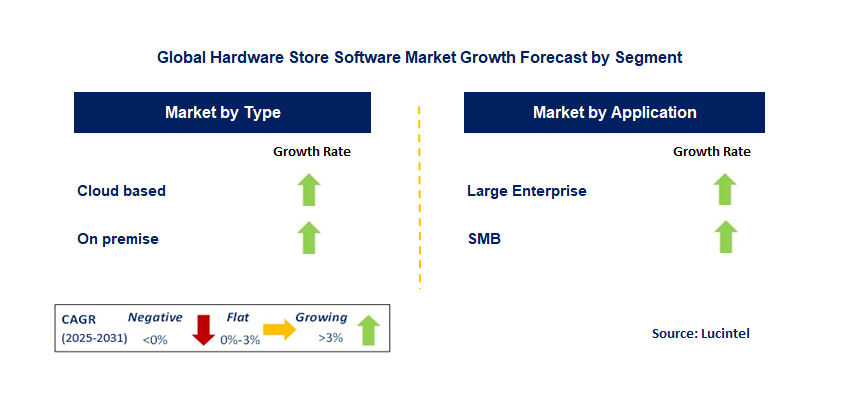
The future of the global hardware store software market looks promising with opportunities in the large enterprise and SMB markets. The global hardware store software market is expected to grow with a CAGR of 5.8% from 2025 to 2031. The major drivers for this market are increasing demand for automation in retail operations, growth in e-commerce and online sales platforms, and rising need for inventory management and supply chain optimization. Lucintel forecasts that, within the type category, cloud based is expected to witness higher growth over the forecast period due to their scalability, lower upfront costs, easier maintenance, and remote accessibility. Within the application category, large enterprise is expected to witness the higher growth due to they require more robust, scalable solutions for managing complex operations. In terms of region, North America is expected to witness the highest growth over the forecast period due to the region’s advanced retail infrastructure, high adoption of technology, and a large number of established hardware stores. Gain valuable insights for your business decisions with our comprehensive 150+ page report. Sample figures with some insights are shown below.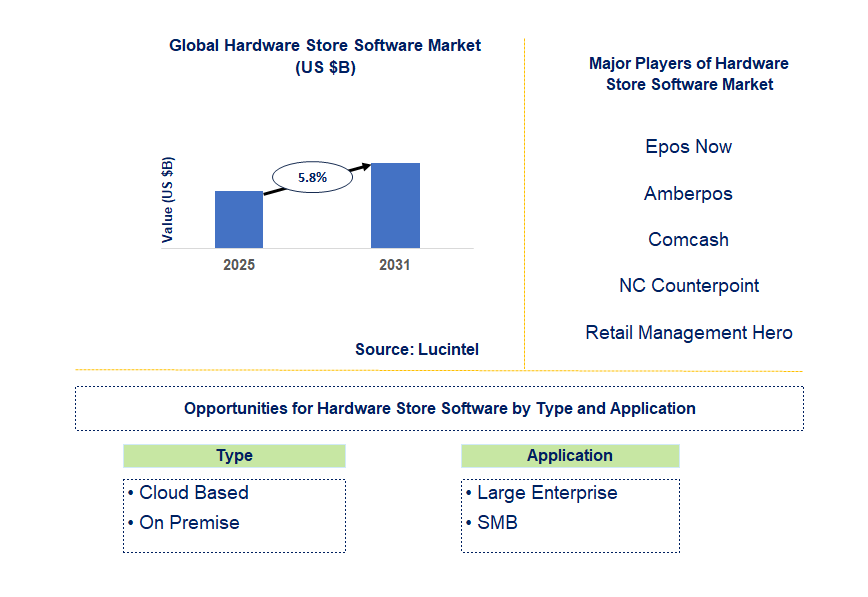
Emerging Trends in the Hardware Store Software Market
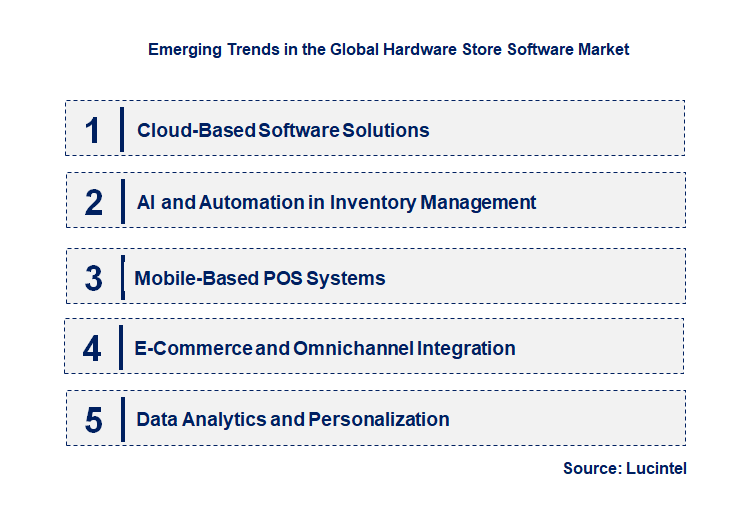
The hardware store software market is rapidly changing with the incorporation of advanced technologies, changes in consumer expectations, and increased emphasis on automation. Emerging trends show how software is becoming more adaptive, data-driven, and customer-focused. These trends are changing the way hardware stores work, helping them to improve efficiency, enhance customer experience, and drive innovation. Below are the key trends that are influencing the market, each with its own impact on the industry.• Cloud-Based Software Solutions: Cloud technology is transforming the hardware store software market by providing scalable, cost-effective solutions for inventory management, POS systems, and customer relationship management. Cloud-based platforms enable stores to access real-time data from any location, improving decision-making and operational efficiency. They also provide a secure environment for storing and accessing sensitive business information, reducing the risk of data loss. Additionally, these platforms enable integration with e-commerce systems, making it easier for hardware stores to manage both physical and online operations.
• AI and Automation in Inventory Management: Artificial intelligence (AI) and automation are increasingly being utilized to optimize inventory management in hardware stores. AI algorithms can predict demand, identify trends, and help stores maintain optimal stock levels, reducing stockouts and excess inventory. Automation tools help in restocking and tracking inventory in real time, so that hardware stores can provide the right products to customers at the right time. These technologies also reduce human error and enhance operational efficiency, which saves costs and increases customer satisfaction.
• Mobile-Based POS Systems: Mobile-based point-of-sale (POS) systems are becoming popular in the hardware store software market because of their convenience and flexibility. The motive is to increase the productivity of in-store staffs and help in reducing the waiting lines at the point of sales. Mobile POS also integrates other tools used in managing the inventory and customer relationship, allowing the store owner to visually check the sales and preference of customers in real-time. This trend highly favors small and medium-sized businesses since mobile POS systems are cost-effective and simple to implement.
• E-Commerce and Omnichannel Integration: With the growth of e-commerce and omnichannel retailing, hardware stores have become more dependent on software solutions that can integrate online and offline operations. Integrated systems help hardware stores manage in-store sales and online orders from a single platform, which provides a seamless customer experience. With e-commerce integration, stores can track sales data across channels, making it easier to manage inventory and forecast demand. With customers increasingly looking for a seamless shopping experience, omnichannel integration is the trend that is fast becoming pivotal in the hardware store software market.
• Data Analytics and Personalization: Data analytics and customer personalization are new trends that power the evolution of hardware store software. Hardware stores can understand customer preference and purchasing patterns better with tools for data analytics, which could be used for offering promotions as well as giving product recommendations in a more personalized form. Personalized marketing campaigns, too, become automated with these data-driven insights, thereby bringing more effectiveness into advertising efforts. This trend facilitates businesses to create customer loyalty while driving sales by improving overall satisfaction. These emerging trends are significantly reshaping the hardware store software market by pushing efficiency, further enhancing customer experiences, and better decision-making. Increasingly standard solutions in cloud technology, AI, mobile POS systems, omnichannel integration, and data analytics shape hardware stores to employ more advanced tools and meet mounting consumer expectations.
Recent Development in the Hardware Store Software Market
There have been recent trends in the hardware store software market, including technological advancements, change in consumer requirements, and increased competition. These trends are changing the way hardware stores compete to offer better customer services and to make their operations leaner and more efficient. With increasing integration of technology in success, software solutions now enhance efficiency and effectiveness in managing everything from inventory to customer relations. Listed below are five major changes that have reflected significant advancements in the hardware store software market.• AI-Powered Inventory Management: AI-powered inventory management software has revolutionized the hardware store software market by predicting the demand patterns that help retailers to hold appropriate stock levels. These systems evaluate data from diverse sources, like sales history, seasonal trends, and customer preferences, to increase the accuracy of demand forecasting. As a result, hardware stores can lower the risk of stockouts and maximize their supply chain with operational efficiencies in the process. Furthermore, AI integration provides the facilities for automated replenishment of stock as well as optimization of pricing strategies that maximizes profitability.
• Integration with E-Commerce Platforms: The integration of hardware store software with e-commerce platforms is a highly crucial development that enables businesses to manage both in-store and online sales from the same platform. This seamless integration allows stores to track inventory in real time across multiple channels, ensuring that stock levels are accurately reflected both online and offline. As customers increasingly shop online, having integrated systems ensures that hardware stores can meet the demand for quick deliveries and efficient order fulfillment. This development helps businesses expand their reach and improve customer satisfaction by providing a unified shopping experience.
• Cloud-Based POS Systems: With the growth of flexibility and scalability, cloud-based point-of-sale systems have recently become popular in the hardware store software market. Cloud-based POS systems enable stores to process transactions from anywhere, hence increasing efficiency while minimizing the need for investments in costly hardware. Cloud-based POS systems also allow real-time sales data, allowing the owner of the store to monitor its performance and make decisions based on the data collected. Moreover, it can be integrated with other business functions such as inventory management and customer relationship management (CRM), offering a comprehensive view of the business and enhanced decision-making in the operation level.
• Mobile Solutions for Store Management: Mobile-based software solutions for store management have developed into an important innovation in the hardware store software market. Store owners and employees can easily track inventory, access sales data, and evaluate performance from the cell phone. Again, more than any other business, small businesses and retail chains, with locations spread all over, are beneficiaries of mobile solutions since they provide a flexible and affordable method of running operations. These tools also improve customer service as employees can assist customers on the sales floor with real-time information, which means a more personalized and efficient shopping experience.
• Advanced Data Analytics Tools: Hardware stores are increasingly adopting advanced data analytics tools to gain insights into customer behavior, sales trends, and inventory performance. These tools can enable businesses to make informed data-driven decisions so that they will be able to optimize their operation, improve the effectiveness of marketing efforts, and enhance customer experience. Analyzing large sets of data helps a hardware store identify a pattern, predicts trends, and makes strategic decisions that improve profitability. The use of data analytics is becoming an important differentiator for hardware stores to stay in competition in this increasingly data-driven retail environment. Recent advances in the hardware store software market, like AI-powered inventory management, cloud-based POS systems, mobile solutions, and data analytics, help hardware stores streamline operations, deliver great customer experience, and remain competitive in the face of modern-day demands. They help the companies to overcome new challenges imposed by modern customers and the fluctuation in the markets; hence the overall growth rate is enhanced.
Strategic Growth Opportunites in the Hardware Store Software Market
Several strategic growth opportunities are being presented in the hardware store software market as technological progress and changing consumer expectations continue to foster innovation across many applications. The opportunities are driving the streamlining of operations, enhancing customer experiences, and optimizing business performance for hardware stores. Growth areas in the software market enable businesses to respond to emerging trends and changes in market requirements. Listed below are five significant growth opportunities for hardware store software applications that businesses should embrace to continue thriving in this fast-changing landscape.• Inventory Management and Optimization: The most fundamental yet most important area of growth remains efficient inventory management, with real-time inventory level tracking solutions, as well as AI-based tools for forecasting usage becoming popular. With these technologies, hardware stores can minimize excess inventory, optimize stock replenishment, and ensure that popular products are always available. Furthermore, inventory management software that integrates with other systems, such as POS and e-commerce platforms, allows for a seamless flow of information across the business, improving decision-making and operational efficiency.
• E-commerce integration and omnichannel solutions: With the increase in the number of people shopping online, the integration of hardware store software with e-commerce platforms is a major growth opportunity. Omnichannel solutions allow hardware stores to manage both in-store and online sales from one platform, creating a seamless experience for the customer. The integration also allows businesses to track inventory and fill orders efficiently so that stock levels are accurately reflected across all channels. With the growth of e-commerce, this opens the way for hardware stores to reach more customers.
• Customer Relationship Management (CRM) Solutions: CRM solutions represent a critical growth opportunity in the hardware store software market. The key driver for most businesses is the development of better relationships with their customers. Through the use of CRM software, hardware stores can monitor all interactions with their customers, segment the customer base, and tailor their marketing campaigns. CRM solutions also assist in keeping the customer as a loyal one by offering specific promotions and deals based on purchasing history. With the growth of data analytics, CRM solutions have become more effective, and it has enabled stores to understand the preferences of the customers and thereby optimizing the offerings.
• Mobile and On-the-Go Solutions: Mobile technology is the biggest growth opportunity for hardware store software. Mobile-based solutions enable store owners and employees to manage sales, inventory, and customer interactions while on-the-go. This flexibility helps improve efficiency and enhance customer service by allowing employees to access real-time information from anywhere. As mobile technology continues to evolve, hardware stores can leverage these solutions to streamline operations and offer a more personalized shopping experience for customers.
• Data Analytics and Predictive Insights: The increased adoption of data analytics and predictive insights opens up a growth opportunity for hardware store software developers. With advanced analytics tools, hardware stores can get critical insights into sales trends, customer behavior, and inventory performance. Predictive analytics will help businesses to predict demand, optimize pricing strategies, and enhance marketing campaigns. This data-driven approach allows the stores to make more informed decisions, increase profitability, and give customers a more personalized experience. Great opportunities in inventory management and e-commerce integration, CRM, mobile solution, and data analytics are driving the hardware store software market. Based on these opportunities, hardware store firms can enhance their operational efficiency and customer service, thereby providing a competitive edge to firms in the fast-changing retail environment. Thus, moving forward with technology evolution, it will push businesses in all arenas during the digital era.
Hardware Store Software Market Driver and Challenges
Key factors that drive this hardware store software market and help in its growth and evolution include technological advancements, changes in consumers‘ behavior and requirements, as well as updates of requirements in regulatory levels. Drivers tend to provide quite high growth levels in many perspectives, but then challenges like costly nature, potential security risks towards data, as well as high need for perpetual adaptation exist too. Knowing this helps businesses in finding their way to the hardware store software market successfully. Here are the main drivers and challenges for this market. The factors responsible for driving the hardware store software market include: 1. Technological Advancements: Ongoing technology advancements such as cloud computing, artificial intelligence, and machine learning are propelling growth in the hardware store software market. It helps stores streamline operations, minimize costs, and deliver more quality experiences to customers. The tools now used by businesses can predict demand and optimize inventory management through the use of AI as well as scalable cloud-based platforms accessible online. Evolving technology is leading hardware stores to seek innovative solutions to remain effective as well as improving their operating processes. 2. More Convenient Option from Consumers: Consumers are demanding convenience in purchase experience, leading hardware stores to deploy software solutions that streamline operations and enhance customer services. From mobile POS systems to e-commerce integration, technology is making this possible for hardware stores. Customer expectations are now such that they demand quick, seamless shopping experiences both in-store and online. Businesses that can deliver this convenience will have an edge over the rest. As the consumer‘s expectations keep changing, so must the hardware stores‘ software solutions. 3. Omnichannel Retailing: The growth of omnichannel retailing is driving demand for integrated software solutions that enable hardware stores to manage both in-store and online sales from a single platform. Omnichannel systems provide customers with a seamless shopping experience, allowing them to browse products online, purchase in-store, or vice versa. This trend has accelerated as consumers increasingly expect a unified retail experience across channels. As more hardware stores embrace omnichannel retailing, the demand for software solutions that can support this model is likely to rise. 4. Data-Driven Decision Making: With the increasing use of data analytics in the retailing business, the hardware store software market has gained momentum. Hardware stores can achieve better insights into customer behavior and sales trends as well as inventory performance through data analytics tools. The use of big data and analytics has helped the companies make data-driven decisions to optimize their operations and customer service. Increasing availability of big data and advanced analytics tools will allow hardware stores to better understand their customers, anticipate future trends, and, hence, gain competitive advantage. 5. Regulatory Compliance and Sustainability Focus: With increased awareness of environmental issues, hardware stores are shifting focus to sustainability and adopting software solutions that help track and reduce waste. Moreover, regulatory requirements regarding data privacy and security are compelling businesses to adopt more secure and compliant software solutions. These factors are driving demand for software that helps stores comply with regulations and promote sustainability while improving operational efficiency. Challenges in the hardware store software market are: 1. High Implementation Costs: One of the biggest problems currently facing the hardware store software market relates to high software implementation costs. It could be hard to implement for even the most cutting-edge solutions if the costs seem too steep; many small operations, especially those just emerging, often cannot afford up-front software system costs, even if maintenance is included, update costs can mount in the future. However, as cloud-based solutions and subscription models are increasing their prevalence, the cost of adoption of software for small and medium-sized businesses is being cut down. 2. Data Security and Privacy: While hardware stores acquire more customer data digitally, data security and privacy issues become one of the greatest concerns. Small and medium-sized businesses should focus on investment in secure software applications that help save sensitive information regarding customers from various cyber-attacks. Data breaches may lead to financial losses, reputational damage, and legal consequences. Data security is therefore one of the most important concerns for hardware stores. Compliance with privacy regulations, such as the GDPR, is another challenge that hardware stores have to deal with. 3. Technological integration and change: This fast-paced environment is difficult for hardware stores as their software needs to be up-to-date constantly. Introducing new software to an already installed system may take considerable resources, be quite cumbersome, and even take much time. Also, there‘s the constant need for adapting to trends and emerging technologies if the business wants to maintain competitiveness. The consequences of failing to adapt are, in many ways, inefficient operations and losing market share. The drivers of the hardware store software market are technological advancement, consumer demand for convenience, and the rising omnichannel retailing. On the other hand, high implementation costs, security of data, and continuous adaptation are major challenges in this market. Businesses can optimize their operations, enhance customer experiences, and remain competitive only by addressing these drivers and challenges.List of Hardware Store Software Companies
Companies in the market compete on the basis of product quality offered. Major players in this market focus on expanding their manufacturing facilities, R&D investments, infrastructural development, and leverage integration opportunities across the value chain. With these strategies hardware store software companies cater increasing demand, ensure competitive effectiveness, develop innovative products & technologies, reduce production costs, and expand their customer base. Some of the hardware store software companies profiled in this report include-• Epos Now
• Amberpos
• Comcash
• NC Counterpoint
• Retail Management Hero
• Bepoz
• Ivend Retail
• Agiliron
• Rocksolid Max
• Erply
Hardware Store Software Market by Segment
The study includes a forecast for the global hardware store software market by type, application, and region.Hardware Store Software Market by Type [Value from 2019 to 2031]:
• Cloud Based
• On Premise
Hardware Store Software Market by Application [Value from 2019 to 2031]:
• Large Enterprise
• SMB
Hardware Store Software Market by Region [Value from 2019 to 2031]:
• North America
• Europe
• Asia Pacific
• The Rest of the World
Country Wise Outlook for the Hardware Store Software Market
The use of hardware store software has highly increased due to the advancement of technology, customer behavior change and reliance on software tools for better management of digital tools for products, sales transactions, and relating with customers. Many countries are moving forward in growing their markets - the United States, China, Germany, India, and Japan, among the major ones for these markets both locally and according to global dynamics. All these are changing the nature of hardware store businesses and making their operations more efficient while improving the customers‘ experience. The subsequent overviews provide recent changes in the hardware store software markets of these countries as well as the emerging trends and strategic opportunities.• United States: In the United States, the hardware store software market has transformed significantly, and more businesses rely on cloud-based solutions. The main emphasis is on POS systems, inventory management, and CRM software that are powerful and robust. More companies are using AI-driven software to manage operations, minimize stock-outs, and enhance the overall customer experience. The demand for digital tools with real-time data and analytics that support business decisions drives this change. Integration with e-commerce platforms has also become a key feature, allowing hardware stores to manage both in-store and online operations seamlessly.
• China: China’s hardware store software market is expanding with a strong emphasis on digital transformation and smart retail. The government’s push for digitalization and smart cities is influencing this trend. Many stores are now adopting integrated software systems that include inventory management, logistics, and supply chain optimization. Mobile-based POS systems have been more widely used lately, and AI-powered solutions for customer personalization have been growing in popularity. With China being the country with a strong presence of e-commerce, hardware stores have been shifting to omnichannel software platforms that connect the gap between brick-and-mortar stores and online sales, which allows them to increase their market reach and improve their operational efficiency.
• Germany: Germany has been a forerunner in manufacturing and technology, and the same applies to its hardware store software market. The most important development is the general use of sophisticated ERP (Enterprise Resource Planning) systems that integrate various business functions, including inventory, sales, and procurement. This has led to more streamlined operations and better decision-making. There is a growing trend toward sustainability, and most software solutions are now including features that help hardware stores track and reduce waste. In addition, the increasing demand for automation has led to the adoption of AI tools that predict customer needs and optimize stock levels, thus improving efficiency and reducing costs.
• India: The hardware store software market in India is booming with small and medium-sized businesses opening their hearts to digital tools. More and more software solutions are being developed to be simple and affordable enough for the Indian market‘s divergence. The markets for POS software, inventory management tools, and billing systems are up, as businesses look to upgrade and shun manual and dated processes. The growing penetration of the internet and use of smartphones has also led to a shift towards mobile-based solutions that enable hardware store owners to manage their business on the move. These trends are empowering SMBs to compete with larger retailers and improve operational efficiency.
• Japan: The hardware store software market in Japan is evolving towards more technologically advanced solutions, particularly in the area of automation and robotics. There is a rising trend to use AI-driven software that supports the process of demand forecasting, inventory management, and optimizing the stock replenishment process. Additionally, emphasis is growing for the installation of IoT devices within stores that enables real-time data collection for effective inventory tracking. The highly developed retail market in Japan has created specific software solutions tailored to the needs of hardware stores, thus ensuring that such businesses remain competitive in an increasingly tech-driven market.

Features of the Global Hardware Store Software Market
Market Size Estimates: Hardware store software market size estimation in terms of value ($B). Trend and Forecast Analysis: Market trends (2019 to 2024) and forecast (2025 to 2031) by various segments and regions. Segmentation Analysis: Hardware store software market size by type, application, and region in terms of value ($B). Regional Analysis: Hardware store software market breakdown by North America, Europe, Asia Pacific, and Rest of the World. Growth Opportunities: Analysis of growth opportunities in different type, application, and regions for the hardware store software market. Strategic Analysis: This includes M&A, new product development, and competitive landscape of the hardware store software market. Analysis of competitive intensity of the industry based on Porter’s Five Forces model.
FAQ
Q1. What is the growth forecast for hardware store software market? Answer: The global hardware store software market is expected to grow with a CAGR of 5.8% from 2025 to 2031. Q2. What are the major drivers influencing the growth of the hardware store software market? Answer: The major drivers for this market are increasing demand for automation in retail operations, growth in e-commerce and online sales platforms, and rising need for inventory management and supply chain optimization. Q3. What are the major segments for hardware store software market? Answer: The future of the hardware store software market looks promising with opportunities in the large enterprise and SMB markets. Q4. Who are the key hardware store software market companies? Answer: Some of the key hardware store software companies are as follows:• Epos Now
• Amberpos
• Comcash
• NC Counterpoint
• Retail Management Hero
• Bepoz
• Ivend Retail
• Agiliron
• Rocksolid Max
• Erply Q5. Which hardware store software market segment will be the largest in future? Answer: Lucintel forecasts that cloud based is expected to witness higher growth over the forecast period due to their scalability, lower upfront costs, easier maintenance, and remote accessibility. Q6. In hardware store software market, which region is expected to be the largest in next 5 years? Answer: North America is expected to witness the highest growth over the forecast period due to the region’s advanced retail infrastructure, high adoption of technology, and a large number of established hardware stores. Q7. Do we receive customization in this report? Answer: Yes, Lucintel provides 10% customization without any additional cost.
Table of Contents
Methodology
- In-depth interviews of the major players in this market
- Detailed secondary research from competitors’ financial statements and published data
- Extensive searches of published works, market, and database information pertaining to industry news, company press releases, and customer intentions
- A compilation of the experiences, judgments, and insights of Lucintel’s professionals, who have analyzed and tracked this market over the years.


Buy Now
Choose a license that fits your team. Instant PDF delivery.
Prices exclude taxes. Instant delivery. Custom licensing available on request.
Key Questions
- • What are some of the most promising, high-growth opportunities for the hardware store software market by type (cloud based and on premise), application (large enterprise and SMB), and region (North America, Europe, Asia Pacific, and the Rest of the World)?
- • Which segments will grow at a faster pace and why?
- • Which region will grow at a faster pace and why?
- • What are the key factors affecting market dynamics? What are the key challenges and business risks in this market?
- • What are the business risks and competitive threats in this market?
- • What are the emerging trends in this market and the reasons behind them?
- • What are some of the changing demands of customers in the market?
- • What are the new developments in the market? Which companies are leading these developments?
- • Who are the major players in this market? What strategic initiatives are key players pursuing for business growth?
- • What are some of the competing products in this market and how big of a threat do they pose for loss of market share by material or product substitution?
- • What M&A activity has occurred in the last 5 years and what has its impact been on the industry? For any questions related to Hardware Store Software Market, Hardware Store Software Market Size, Hardware Store Software Market Growth, Hardware Store Software Market Analysis, Hardware Store Software Market Report, Hardware Store Software Market Share, Hardware Store Software Market Trends, Hardware Store Software Market Forecast, Hardware Store Software Companies, write Lucintel analyst at email: helpdesk@lucintel.com. We will be glad to get back to you soon.


