
Report Feature
Handheld 3D Scanner Market Trends and Forecast
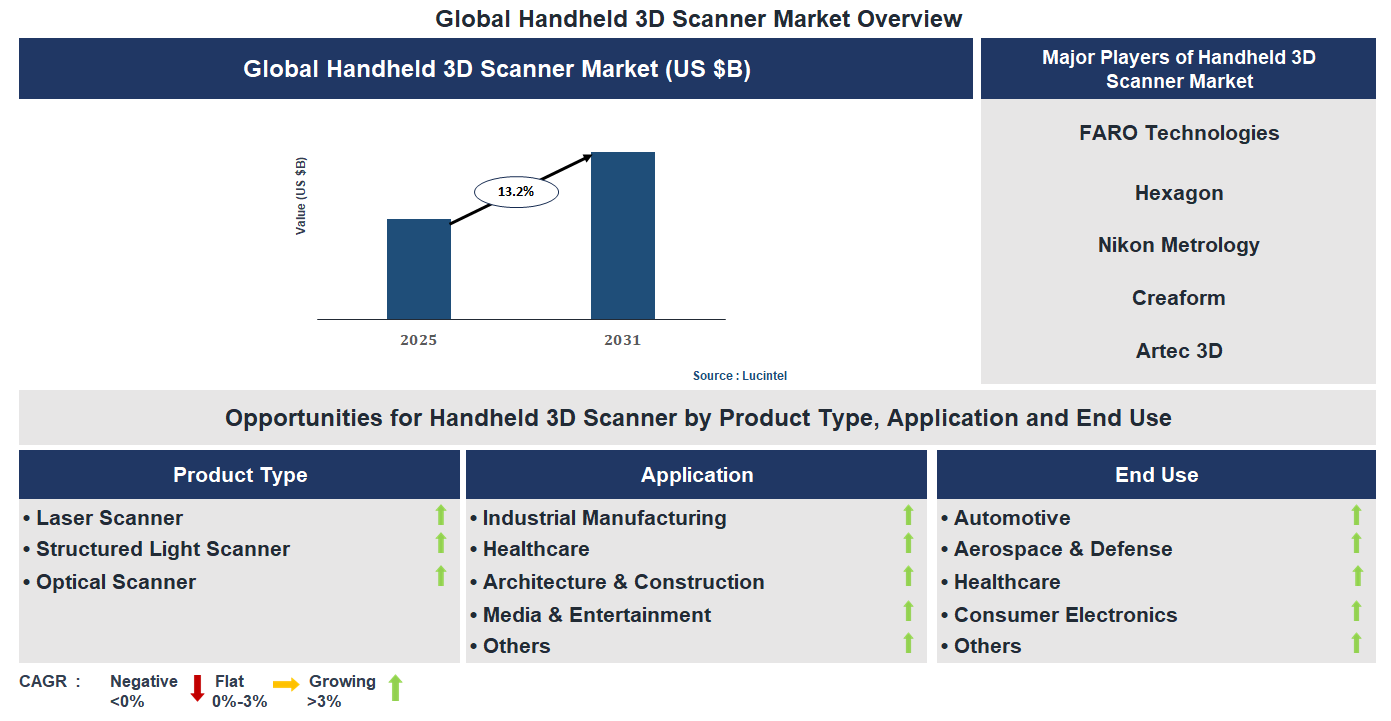
The future of the global handheld 3D scanner market looks promising with opportunities in the automotive, aerospace & defense, healthcare, and consumer electronics markets. The global handheld 3D scanner market is expected to grow with a CAGR of 13.2% from 2025 to 2031. The major drivers for this market are the increasing demand for portable scanning accuracy, the rising use of 3D inspection tools, and the growing adoption of handheld measurement devices.• Lucintel forecasts that, within the product type category, laser scanner is expected to witness the highest growth over the forecast period.
• Within the end use category, automotive is expected to witness the highest growth.
• In terms of region, North America is expected to witness the highest growth over the forecast period. Gain valuable insights for your business decisions with our comprehensive 150+ page report. Sample figures with some insights are shown below.
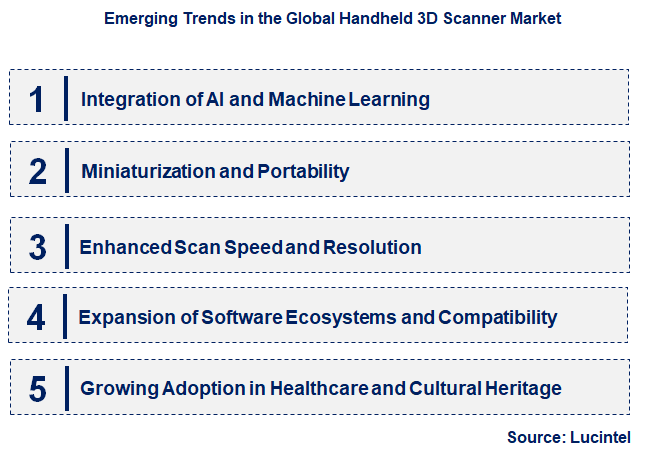
Emerging Trends in the Handheld 3D Scanner Market
The handheld 3D scanner market is experiencing rapid growth driven by technological advancements, increasing demand across various industries, and the need for more efficient and accurate 3D data capture solutions. As industries such as manufacturing, healthcare, entertainment, and architecture seek innovative tools for design, inspection, and analysis, the market is evolving to meet these needs. Emerging trends are shaping the future landscape, influencing product development, market strategies, and user adoption. These developments are not only expanding the capabilities of handheld 3D scanners but also making them more accessible and versatile, thereby transforming how industries approach 3D scanning tasks.• Integration of AI and Machine Learning: This trend involves embedding AI algorithms into handheld 3D scanners to enhance data processing, improve scan accuracy, and enable real-time analysis. AI-driven features facilitate automatic object recognition, defect detection, and predictive maintenance, making scans more reliable and reducing post-processing time. As a result, users can achieve higher precision with less effort, expanding the application scope in quality control, healthcare, and design. The integration of AI is expected to accelerate innovation and increase the adoption of handheld 3D scanners across diverse sectors.
• Miniaturization and Portability: Advances in miniaturization are making handheld 3D scanners more compact, lightweight, and easier to operate in confined or hard-to-reach environments. This trend enhances portability, allowing users to perform scans in remote locations, on-site inspections, or in tight spaces without sacrificing accuracy. The increased portability broadens the usability in fields like construction, archaeology, and field service, where mobility is crucial. As devices become more user-friendly and portable, they are likely to see higher adoption rates among professionals and hobbyists alike.
• Enhanced Scan Speed and Resolution: Technological improvements are significantly increasing the speed and resolution of handheld 3D scanners. Faster scanning reduces operation time, enabling real-time data capture for dynamic objects or large-scale environments. Higher resolution provides more detailed and precise 3D models, essential for applications requiring meticulous accuracy such as dental prosthetics, reverse engineering, and quality inspection. These enhancements improve workflow efficiency, reduce costs, and expand the potential applications of handheld 3D scanners, making them indispensable tools in high-precision industries.
• Expansion of Software Ecosystems and Compatibility: The development of comprehensive software platforms that support various file formats, editing, and analysis tools is a key trend. Compatibility with popular CAD, CAM, and AR/VR applications allows seamless integration into existing workflows. Cloud-based solutions enable remote collaboration and data sharing, increasing flexibility and productivity. This ecosystem expansion makes handheld 3D scanners more versatile and user-friendly, encouraging adoption across different industries. It also fosters innovation by providing users with powerful tools to maximize the utility of scanned data.
• Growing Adoption in Healthcare and Cultural Heritage: The healthcare sector is increasingly utilizing handheld 3D scanners for personalized prosthetics, surgical planning, and dental applications due to their portability and accuracy. Similarly, cultural heritage preservation benefits from non-invasive scanning of artifacts and historical sites, aiding restoration and digital archiving. This trend is driven by the need for precise, quick, and non-contact measurement solutions in sensitive environments. As these applications grow, they are opening new markets for handheld 3D scanners, emphasizing their importance in fields requiring detailed, accurate, and rapid 3D data acquisition. In summary, these emerging trends are fundamentally reshaping the handheld 3D scanner market by enhancing device capabilities, expanding application areas, and improving user experience. The integration of AI, miniaturization, faster and higher-resolution scanning, software ecosystem development, and new industry applications are collectively driving market growth and innovation. These developments are making handheld 3D scanners more accessible, efficient, and versatile, thereby transforming how industries capture and utilize 3D data for various critical tasks.
Recent Development in the Handheld 3D Scanner Market
The handheld 3D scanner market has experienced significant growth driven by technological advancements, increasing demand across various industries, and the need for precise, portable scanning solutions. As industries such as manufacturing, healthcare, entertainment, and automotive adopt these devices, the market continues to evolve rapidly. Innovations in sensor technology, software integration, and affordability are shaping the competitive landscape. Additionally, the rising adoption of automation and digital twin technologies further fuels market expansion. This dynamic environment presents numerous opportunities and challenges, influencing market strategies and investment flows. Understanding recent developments is crucial for stakeholders aiming to capitalize on emerging trends and maintain a competitive edge.• Technological Advancements: Integration of AI and machine learning in handheld 3D scanners has improved accuracy and speed, enabling real-time data processing. This development enhances user experience and broadens application scope, especially in quality control and reverse engineering. The impact is a more efficient workflow, reduced errors, and increased adoption in complex industries.
• Miniaturization and Portability: Manufacturers are focusing on making scanners more compact and lightweight without compromising performance. This trend increases usability in fieldwork, medical applications, and on-site inspections. The impact is greater flexibility for users, expanding market reach into new sectors and environments.
• Software and Data Management Improvements: Enhanced software solutions now offer better data processing, editing, and integration capabilities. Cloud-based platforms facilitate remote collaboration and data sharing. The impact is streamlined workflows, improved data accuracy, and increased efficiency in project management.
• Cost Reduction and Market Accessibility: Competitive pricing strategies and technological innovations have lowered the cost of handheld 3D scanners. This makes advanced scanning technology accessible to small and medium-sized enterprises. The impact is market expansion, increased adoption across diverse industries, and democratization of 3D scanning technology.
• Industry-Specific Customization: Development of tailored solutions for sectors like healthcare, automotive, and entertainment has increased. Custom features address specific needs such as biocompatibility or high-detail capture. The impact is higher customer satisfaction, increased sales, and stronger industry-specific market positioning. In summary, these developments are significantly transforming the handheld 3D scanner market by enhancing device capabilities, expanding accessibility, and enabling industry-specific applications. The market is becoming more versatile, efficient, and inclusive, fostering innovation and growth across multiple sectors.
Strategic Growth Opportunities in the Handheld 3D Scanner Market
The handheld 3D scanner market is experiencing rapid growth driven by technological advancements and increasing demand across various industries. As applications expand, key growth opportunities are emerging that can significantly influence market dynamics. These opportunities are driven by the need for precise, efficient, and versatile scanning solutions in diverse sectors such as manufacturing, healthcare, entertainment, automotive, and education. Companies that capitalize on these opportunities can gain competitive advantages and meet evolving customer needs. Understanding these growth areas is essential for stakeholders aiming to innovate and expand their market presence in this dynamic landscape.• Manufacturing: Enhanced quality control and rapid prototyping : Handheld 3D scanners enable real-time inspection and quick iteration of product designs, reducing time-to-market and minimizing errors in manufacturing processes. This improves overall efficiency and product quality, making it a vital tool for Industry 4.0 initiatives.
• Healthcare: Customized prosthetics and surgical planning : The ability to create accurate 3D models of patient anatomy allows for personalized medical solutions. This improves surgical outcomes and patient satisfaction while reducing costs associated with traditional imaging techniques.
• Entertainment and Media: Immersive content creation and virtual reality : Handheld 3D scanners facilitate detailed 3D modeling of objects and environments, enhancing the realism of virtual experiences. This opens new avenues for gaming, film production, and virtual tours, driving innovation in entertainment.
• Automotive: Design validation and reverse engineering : The technology supports detailed scanning of vehicle parts for design verification and reverse engineering. This accelerates product development cycles and ensures high precision in component manufacturing, boosting competitiveness.
• Education and Training: Interactive learning tools and simulation : 3D scanning provides realistic models for educational purposes, enhancing engagement and understanding. It supports hands-on training in fields like engineering, medicine, and archaeology, fostering skill development. In summary, these growth opportunities are transforming the handheld 3D scanner market by expanding its application scope and improving operational efficiencies across industries. They are driving innovation, reducing costs, and enabling more personalized and immersive experiences, thereby fueling market expansion and competitive advantage.
Handheld 3D Scanner Market Driver and Challenges
The handheld 3D scanner market is influenced by a variety of technological, economic, and regulatory factors that shape its growth trajectory. Advances in scanning technology, increasing demand for precise measurement solutions across industries, and supportive government policies are key drivers. However, the market also faces challenges such as high costs, data security concerns, and regulatory hurdles that could impede expansion. Understanding these drivers and challenges is essential for stakeholders to navigate the evolving landscape effectively and capitalize on emerging opportunities. The factors responsible for driving the handheld 3D scanner market include:-• Technological Advancements: The continuous development of more accurate, faster, and user-friendly handheld 3D scanners has significantly expanded their application scope. Innovations such as real-time data processing, improved resolution, and integration with augmented reality have made these devices more versatile and accessible. These technological improvements reduce operational costs and increase efficiency, encouraging adoption across sectors like manufacturing, healthcare, and entertainment. As technology evolves, the market is expected to see increased demand for sophisticated, portable scanning solutions that meet diverse industry needs.
• Growing Industrial Applications: The rising adoption of handheld 3D scanners in manufacturing, automotive, aerospace, and healthcare sectors is a major growth driver. These scanners enable rapid prototyping, quality control, reverse engineering, and complex part inspection, leading to improved productivity and reduced time-to-market. The increasing need for precise measurements and detailed 3D models in product development and maintenance processes fuels demand. Additionally, the ability to perform on-site scanning without extensive setup makes these devices highly attractive for industrial applications, further propelling market growth.
• Increasing Use in Healthcare: The healthcare industry is increasingly leveraging handheld 3D scanners for applications such as custom prosthetics, dental restorations, and surgical planning. These scanners provide non-invasive, accurate, and quick data acquisition, improving patient outcomes and reducing procedural times. The rising prevalence of personalized medicine and the need for precise anatomical modeling are driving demand. Moreover, technological improvements in scanner accuracy and ease of use are making healthcare providers more inclined to adopt these solutions, thus expanding the market.
• Rising Demand for Quality Inspection and Reverse Engineering: Industries are increasingly relying on handheld 3D scanners for quality assurance, defect detection, and reverse engineering. These devices facilitate detailed surface analysis and dimensional measurements, ensuring product quality and compliance with standards. The ability to quickly generate accurate 3D models helps streamline manufacturing workflows and reduce errors. As quality standards become more stringent globally, the demand for reliable, portable scanning solutions is expected to grow, further boosting market expansion. The challenges in the handheld 3D scanner market are:
• High Cost of Equipment and Maintenance: Despite technological advancements, the initial investment for high-quality handheld 3D scanners remains substantial. The cost of acquiring advanced devices, along with ongoing maintenance and calibration expenses, can be prohibitive for small and medium-sized enterprises. This financial barrier limits widespread adoption, especially in cost-sensitive markets. Additionally, the need for skilled operators to handle complex equipment adds to operational costs, potentially hindering market growth in certain regions.
• Data Security and Privacy Concerns: As handheld 3D scanners collect detailed and sensitive data, concerns regarding data security and intellectual property protection are rising. Unauthorized access or data breaches could lead to significant financial and reputational damage for organizations. Regulatory frameworks around data privacy are evolving, and compliance can be complex and costly. These concerns may slow down adoption, particularly in industries where data confidentiality is critical, such as defense and healthcare.
• Regulatory and Standardization Challenges: The lack of uniform standards and regulatory guidelines for handheld 3D scanning devices poses a significant challenge. Variations in certification requirements across regions can complicate product development and market entry. Regulatory hurdles may delay product launches and increase compliance costs. Additionally, evolving standards require continuous updates and testing, which can be resource-intensive. These factors create uncertainty and may restrain market growth, especially for new entrants seeking to establish a foothold globally. In summary, the handheld 3D scanner market is driven by rapid technological innovations, expanding industrial and healthcare applications, and increasing quality assurance needs. However, high costs, data security issues, and regulatory complexities present notable challenges. These factors collectively influence market dynamics, requiring stakeholders to balance innovation with strategic risk management. Overall, the markets growth potential remains strong, provided that technological and regulatory hurdles are effectively addressed, enabling broader adoption and integration across diverse sectors.
List of Handheld 3D Scanner Companies
Companies in the market compete on the basis of product quality offered. Major players in this market focus on expanding their manufacturing facilities, R&D investments, infrastructural development, and leverage integration opportunities across the value chain. With these strategies handheld 3D scanner companies cater increasing demand, ensure competitive effectiveness, develop innovative products & technologies, reduce production costs, and expand their customer base. Some of the handheld 3D scanner companies profiled in this report include-• FARO Technologies
• Hexagon
• Nikon Metrology
• Creaform
• Artec 3D
• Shining 3D
• Trimble
• 3D Systems Corporation
• Zebra Imaging
• Topcon Corporation
Handheld 3D Scanner Market by Segment
The study includes a forecast for the global handheld 3D scanner market by product type, application, end use, and region.Handheld 3D Scanner Market by Product Type [Value from 2019 to 2031]:
• Laser Scanner
• Structured Light Scanner
• Optical Scanner
Handheld 3D Scanner Market by Application [Value from 2019 to 2031]:
• Industrial Manufacturing
• Healthcare
• Architecture & Construction
• Media & Entertainment
• Others
Handheld 3D Scanner Market by End Use [Value from 2019 to 2031]:
• Automotive
• Aerospace & Defense
• Healthcare
• Consumer Electronics
• Others
Handheld 3D Scanner Market by Region [Value from 2019 to 2031]:
• North America
• Europe
• Asia Pacific
• The Rest of the World
Country Wise Outlook for the Handheld 3D Scanner Market
The handheld 3D scanner market has experienced significant growth driven by technological advancements, increasing industrial applications, and expanding adoption across various sectors such as manufacturing, healthcare, and entertainment. As industries seek more precise, portable, and user-friendly solutions, key players are innovating to meet these demands. The market dynamics vary across regions, influenced by technological infrastructure, industrial needs, and government initiatives. Recent developments reflect a shift towards more affordable, high-accuracy devices, integration with AI, and enhanced data processing capabilities, shaping the future landscape of handheld 3D scanning technology globally.• United States: The US market has seen rapid adoption of handheld 3D scanners in manufacturing, healthcare, and entertainment sectors. Innovations include integration with AI for improved accuracy and real-time data processing. Major companies are investing in R&D to develop portable, user-friendly devices, and government initiatives support industry growth through funding and standards development. The rise of 3D printing and digital twin applications further boosts demand, with increased focus on industrial automation and quality control.
• China: China is experiencing robust growth in the handheld 3D scanner market, driven by manufacturing, automotive, and consumer electronics industries. Local companies are advancing affordable, high-precision devices to cater to domestic demand and export markets. The government’s emphasis on smart manufacturing and Industry 4.0 initiatives accelerates adoption. Additionally, collaborations between tech firms and research institutions are fostering innovation, leading to improved scanning speed, accuracy, and integration with other digital tools.
• Germany: Germany’s market is characterized by a focus on high-precision, industrial-grade handheld 3D scanners used in automotive, aerospace, and machinery sectors. The emphasis on quality and reliability aligns with the country’s strong manufacturing tradition. Recent developments include the integration of advanced sensors and software for enhanced data accuracy and usability. Industry 4.0 initiatives and government support for digital transformation are further propelling market growth, with a focus on sustainable and efficient production processes.
• India: The Indian market is witnessing increasing adoption of handheld 3D scanners across automotive, healthcare, and education sectors. Cost-effective solutions are gaining popularity due to the price sensitivity of the market. Local startups and global players are introducing affordable, portable devices to expand reach in tier 2 and tier 3 cities. Government initiatives promoting digital manufacturing and skill development are also contributing to market expansion, alongside rising demand for quality inspection, reverse engineering, and product development.
• Japan: Japan’s market is driven by advancements in robotics, manufacturing, and healthcare. The focus is on high-precision, compact scanners that integrate seamlessly with existing industrial systems. Recent developments include the incorporation of AI and machine learning for enhanced data analysis and automation. The country’s emphasis on innovation and quality standards supports the adoption of cutting-edge handheld 3D scanning solutions, especially in sectors like automotive and electronics, where precision and efficiency are paramount.

Features of the Global Handheld 3D Scanner Market
Market Size Estimates: Handheld 3D scanner market size estimation in terms of value ($B). Trend and Forecast Analysis: Market trends (2019 to 2024) and forecast (2025 to 2031) by various segments and regions. Segmentation Analysis: Handheld 3D scanner market size by product type, application, end use, and region in terms of value ($B). Regional Analysis: Handheld 3D scanner market breakdown by North America, Europe, Asia Pacific, and Rest of the World. Growth Opportunities: Analysis of growth opportunities in different product types, applications, end uses, and regions for the handheld 3D scanner market. Strategic Analysis: This includes M&A, new product development, and competitive landscape of the handheld 3D scanner market. Analysis of competitive intensity of the industry based on Porter’s Five Forces model.
FAQ
Q1. What is the growth forecast for handheld 3D scanner market? Answer: The global handheld 3D scanner market is expected to grow with a CAGR of 13.2% from 2025 to 2031. Q2. What are the major drivers influencing the growth of the handheld 3D scanner market? Answer: The major drivers for this market are the increasing demand for portable scanning accuracy, the rising use of 3D inspection tools, and the growing adoption of handheld measurement devices. Q3. What are the major segments for handheld 3D scanner market? Answer: The future of the handheld 3D scanner market looks promising with opportunities in the automotive, aerospace & defense, healthcare, and consumer electronics markets. Q4. Who are the key handheld 3D scanner market companies? Answer: Some of the key handheld 3D scanner companies are as follows:• FARO Technologies
• Hexagon
• Nikon Metrology
• Creaform
• Artec 3D
• Shining 3D
• Trimble
• 3D Systems Corporation
• Zebra Imaging
• Topcon Corporation Q5. Which handheld 3D scanner market segment will be the largest in future? Answer: Lucintel forecasts that, within the product type category, laser scanner is expected to witness the highest growth over the forecast period. Q6. In handheld 3D scanner market, which region is expected to be the largest in next 5 years? Answer: In terms of region, North America is expected to witness the highest growth over the forecast period. Q7. Do we receive customization in this report? Answer: Yes, Lucintel provides 10% customization without any additional cost.
Table of Contents
List of Figures
List of Tables
Methodology
- In-depth interviews of the major players in this market
- Detailed secondary research from competitors’ financial statements and published data
- Extensive searches of published works, market, and database information pertaining to industry news, company press releases, and customer intentions
- A compilation of the experiences, judgments, and insights of Lucintel’s professionals, who have analyzed and tracked this market over the years.


Buy Now
Choose a license that fits your team. Instant PDF delivery.
Prices exclude taxes. Instant delivery. Custom licensing available on request.
Key Questions
- • What are some of the most promising, high-growth opportunities for the handheld 3D scanner market by product type (laser scanner, structured light scanner, and optical scanner), application (industrial manufacturing, healthcare, architecture & construction, media & entertainment, and others), end use (automotive, aerospace & defense, healthcare, consumer electronics, and others), and region (North America, Europe, Asia Pacific, and the Rest of the World)?
- • Which segments will grow at a faster pace and why?
- • Which region will grow at a faster pace and why?
- • What are the key factors affecting market dynamics? What are the key challenges and business risks in this market?
- • What are the business risks and competitive threats in this market?
- • What are the emerging trends in this market and the reasons behind them?
- • What are some of the changing demands of customers in the market?
- • What are the new developments in the market? Which companies are leading these developments?
- • Who are the major players in this market? What strategic initiatives are key players pursuing for business growth?
- • What are some of the competing products in this market and how big of a threat do they pose for loss of market share by material or product substitution?
- • What M&A activity has occurred in the last 5 years and what has its impact been on the industry? For any questions related to Handheld 3D Scanner Market, Handheld 3D Scanner Market Size, Handheld 3D Scanner Market Growth, Handheld 3D Scanner Market Analysis, Handheld 3D Scanner Market Report, Handheld 3D Scanner Market Share, Handheld 3D Scanner Market Trends, Handheld 3D Scanner Market Forecast, Handheld 3D Scanner Companies, write Lucintel analyst at email: helpdesk@lucintel.com. We will be glad to get back to you soon.


