
Report Feature
Hand Care Market Trends and Forecast
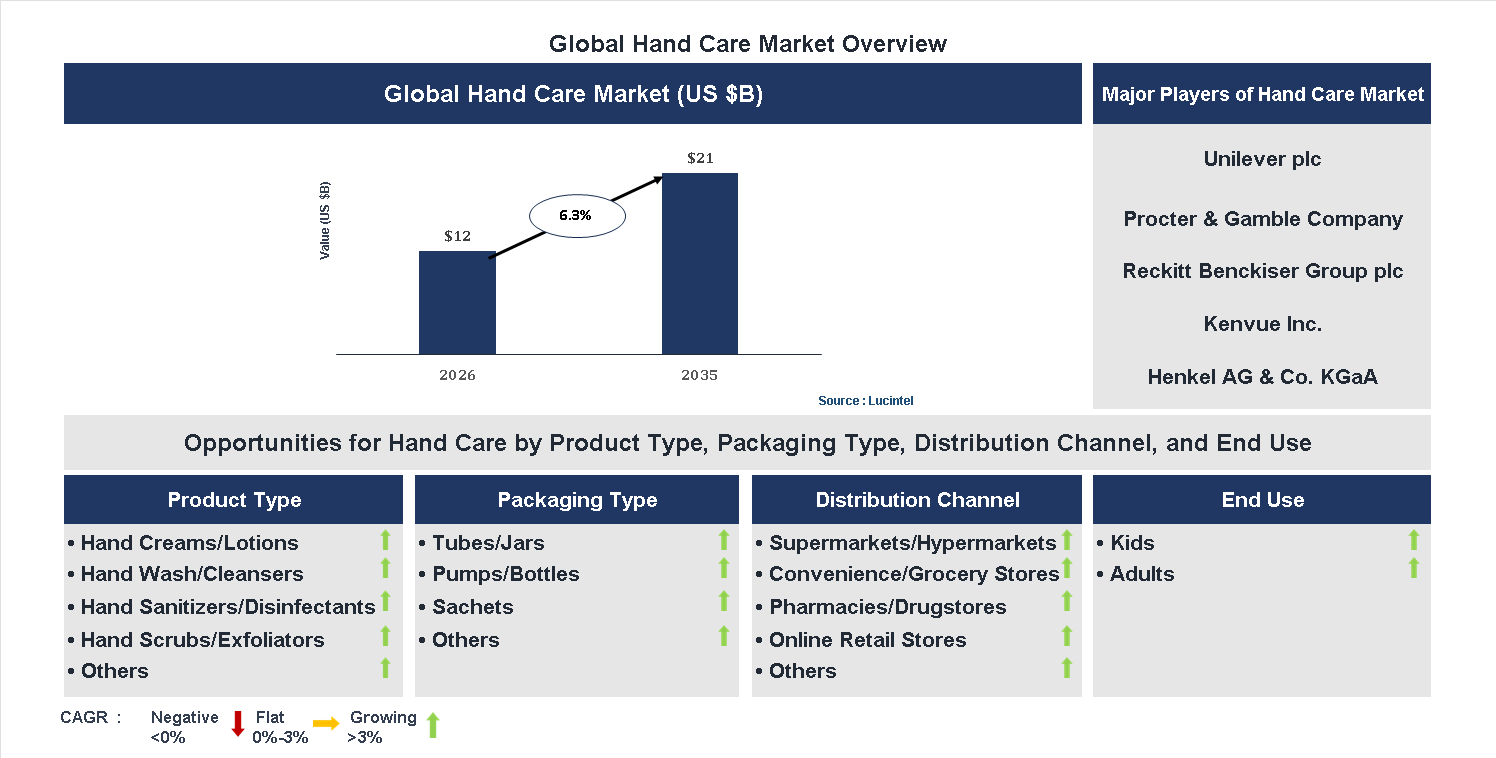
The future of the global hand care market looks promising with opportunities in the tube/jar, pump/bottle, and sachet markets. The global hand care market is expected to reach an estimated $21 billion by 2035 with a CAGR of 6.3% from 2026 to 2035. The major drivers for this market are the increasing demand for moisturizing creams & lotions, the rising demand for fragrance & scented hand products, and the growing demand for natural & organic hand care products.• Lucintel forecasts that, within the product type category, hand cream/lotion is expected to witness the highest growth over the forecast period.
• Within the packaging type category, pump/bottle is expected to witness the highest growth.
• In terms of region, APAC is expected to witness the highest growth over the forecast period. Gain valuable insights for your business decisions with our comprehensive 150+ page report. Sample figures with some insights are shown below.
Emerging Trends in the Hand Care Market
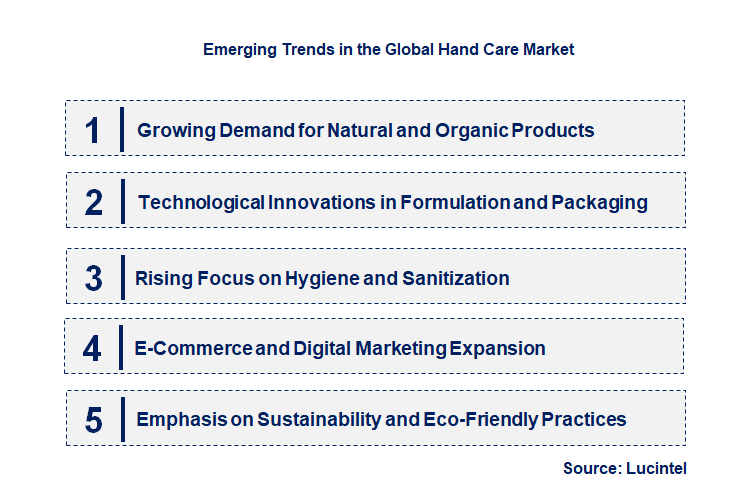
The hand care market is experiencing rapid evolution driven by changing consumer preferences, technological advancements, and increased awareness of health and hygiene. As consumers seek more effective, natural, and sustainable products, companies are innovating to meet these demands. The market is also influenced by rising personal care consciousness and the integration of digital platforms for marketing and sales. These developments are reshaping the competitive landscape, creating new opportunities for brands to differentiate themselves. Understanding these emerging trends is crucial for stakeholders aiming to capitalize on growth opportunities and stay ahead in this dynamic industry.• Growing Demand for Natural and Organic Products: Consumers are increasingly prioritizing natural ingredients and organic formulations in hand care products. This trend is driven by health consciousness, environmental concerns, and a desire for chemical-free options. Brands are responding by developing products with plant-based extracts, essential oils, and eco-friendly packaging. The shift towards natural products is expanding market size and encouraging innovation, leading to a more sustainable and health-conscious industry landscape.
• Technological Innovations in Formulation and Packaging: Advances in formulation technology are enabling the development of more effective, longer-lasting, and skin-friendly hand care products. Innovations include the use of nanotechnology, encapsulation, and bioactive ingredients that enhance absorption and efficacy. Packaging innovations such as airless pumps and biodegradable containers are also gaining popularity, improving product stability and reducing environmental impact. These technological advancements are elevating product performance and consumer experience, fostering brand loyalty and market growth.
• Rising Focus on Hygiene and Sanitization: The COVID-19 pandemic has heightened awareness around hand hygiene, boosting demand for sanitizers, disinfectant creams, and moisturizing hand sanitizers. Consumers now seek products that combine effective sanitization with skin nourishment. This trend has led to the development of multifunctional hand care products that address hygiene needs while maintaining skin health. The emphasis on hygiene is expected to sustain post-pandemic, making it a key driver for market expansion and innovation.
• E-commerce and Digital Marketing Expansion: The proliferation of online shopping platforms and digital marketing strategies is transforming how consumers access hand care products. E-commerce offers convenience, wider product selection, and personalized recommendations, fueling sales growth. Brands are leveraging social media, influencer collaborations, and targeted advertising to reach niche markets and younger demographics. This digital shift enhances consumer engagement, provides valuable data insights, and enables rapid product launches, making online channels a critical component of market growth and competitive strategy.
• Emphasis on Sustainability and Eco-Friendly Practices: Sustainability is becoming a core focus for brands in the hand care market. This includes using biodegradable ingredients, eco-friendly packaging, and ethical sourcing of raw materials. Consumers are increasingly supporting brands that demonstrate environmental responsibility, influencing purchasing decisions. Companies adopting sustainable practices are gaining a competitive edge, fostering brand loyalty, and contributing to environmental conservation. This trend is reshaping industry standards and encouraging innovation towards greener, more responsible products. These emerging trends are collectively transforming the hand care market by promoting healthier, more sustainable, and technologically advanced products. They are driving innovation, expanding market reach through digital channels, and aligning brands with consumer values centered on health and environmental responsibility. As these trends continue to evolve, they will shape the future landscape of the industry, creating new opportunities and challenges for market participants.
Recent Development in the Hand Care Market
The hand care market has experienced significant innovation and expansion driven by increasing consumer awareness of hygiene, skincare, and wellness. Advances in product formulations, sustainable packaging, and personalized solutions are shaping the industry landscape. The rise of e-commerce and social media marketing further accelerates growth, making hand care products more accessible and appealing. These developments reflect evolving consumer preferences and technological progress, creating new opportunities for brands to differentiate and capture market share in a competitive environment.• Innovation in Natural and Organic Formulations: The market is witnessing a surge in natural, organic, and eco-friendly hand care products. Consumers are increasingly seeking chemical-free options that are gentle yet effective, boosting demand for plant-based ingredients and sustainable packaging. This shift encourages brands to develop innovative formulations that meet health and environmental standards, expanding market reach and fostering brand loyalty among eco-conscious consumers.
• Integration of Advanced Skincare Technologies: Incorporating advanced skincare ingredients like hyaluronic acid, peptides, and antioxidants into hand care products enhances their efficacy. This technological integration addresses specific skin concerns such as dryness, aging, and sensitivity. It elevates product value, attracts a broader consumer base, and encourages premium pricing. The focus on scientifically backed formulations positions brands as innovative leaders, driving market growth and consumer trust.
• Growing Popularity of Personalization and Customization: Consumers now prefer personalized hand care solutions tailored to their skin type and needs. Brands are leveraging digital tools and diagnostic apps to offer customized products, fostering deeper engagement. This trend enhances customer satisfaction, encourages repeat purchases, and allows brands to differentiate themselves. The demand for personalized products is expected to continue rising, fueling innovation and expanding market segments.
• Expansion of E-commerce and Digital Marketing: The shift towards online shopping has transformed how consumers access hand care products. E-commerce platforms and social media marketing enable brands to reach wider audiences quickly and cost-effectively. Digital campaigns, influencer collaborations, and virtual consultations boost brand visibility and consumer engagement. This development accelerates market penetration, especially in emerging regions, and supports rapid product launches and consumer feedback integration.
• Emphasis on Sustainability and Eco-Friendly Packaging: Sustainability is a key driver in the hand care market, with brands adopting biodegradable, recyclable, and refillable packaging solutions. Consumers increasingly prefer brands committed to environmental responsibility, influencing purchasing decisions. This focus reduces environmental impact, enhances brand reputation, and aligns with global sustainability goals. The adoption of eco-friendly practices is expected to become a standard, shaping future product development and market competitiveness. These recent developments are significantly transforming the hand care market by fostering innovation, sustainability, and consumer-centric solutions. The integration of advanced technologies, personalized offerings, and eco-friendly practices enhances product appeal and market competitiveness. The growth of e-commerce and digital marketing broadens reach and accessibility. Collectively, these trends are driving market expansion, attracting new consumer segments, and setting the stage for sustained industry growth and innovation.
Strategic Growth Opportunities in the Hand Care Market
The hand care market is experiencing significant growth driven by increasing consumer awareness of hygiene, rising demand for premium and natural products, and expanding personal care routines. Innovations in formulations, packaging, and product types are creating new opportunities for brands to capture market share. Additionally, the rise of e-commerce and global expansion are further fueling growth. Companies that leverage these trends can enhance their market presence and meet evolving consumer preferences effectively.• Growing Demand for Natural and Organic Hand Care Products: Consumers are increasingly seeking natural, chemical-free, and eco-friendly hand care options. This shift is driven by health consciousness and environmental concerns, prompting brands to develop organic formulations, sustainable packaging, and transparent ingredient lists. The demand for natural products is particularly strong in premium segments, creating opportunities for differentiation and brand loyalty in the competitive market.
• Expansion of Premium and Luxury Hand Care Segments: The rising disposable income and consumer willingness to invest in self-care are fueling growth in premium hand care products. These include high-end creams, serums, and treatments with advanced formulations, unique ingredients, and luxurious packaging. Brands that focus on quality, exclusivity, and innovative benefits can attract affluent consumers seeking indulgence and effective solutions, thereby expanding their market share in the luxury segment.
• Increasing Adoption of Hand Sanitizers and Disinfectants: The COVID-19 pandemic significantly boosted the demand for hand sanitizers and disinfectant products. This trend continues as consumers prioritize hygiene and health safety. Opportunities exist for brands to innovate with formulations that combine moisturizing benefits with antimicrobial properties, as well as to develop portable, convenient packaging. The expansion into institutional and commercial sectors also presents substantial growth potential.
• Rising Popularity of Personalized and Targeted Hand Care Solutions: Consumers are seeking customized products tailored to specific skin types, conditions, or preferences. Brands are responding by offering personalized formulations, subscription services, and digital consultations. This trend enhances consumer engagement and loyalty, allowing companies to differentiate themselves in a crowded market. The integration of technology and data-driven personalization is expected to further accelerate growth in this segment.
• Market Expansion Through E-commerce and Emerging Markets: The proliferation of online shopping platforms has made hand care products more accessible globally. E-commerce enables brands to reach new demographics and offer a wider range of products. Additionally, emerging markets present untapped growth opportunities due to rising disposable incomes and increasing awareness of personal care. Strategic investments in digital marketing and distribution channels are essential for capturing these expanding customer bases. These growth opportunities are poised to significantly influence the hand care market by fostering innovation, expanding consumer choices, and enabling brands to adapt to evolving preferences. Embracing natural ingredients, premium offerings, hygiene products, personalization, and digital channels will be crucial for companies aiming to strengthen their market position and capitalize on emerging trends.
Hand Care Market Driver and Challenges
The hand care market is influenced by a variety of technological, economic, and regulatory factors that shape its growth and development. Innovations in formulation and packaging, along with increasing consumer awareness about skin health, drive demand. Economic factors such as rising disposable incomes and urbanization contribute to market expansion, while regulatory standards ensure product safety and quality. Additionally, trends like natural and organic products influence consumer preferences. However, the market also faces challenges including stringent regulations, high competition, and supply chain disruptions. Understanding these drivers and challenges is essential for stakeholders to navigate the evolving landscape effectively and capitalize on emerging opportunities. The factors responsible for driving the hand care market include:• Technological Innovations: The development of advanced formulations, such as long-lasting moisturizers and anti-aging creams, enhances product efficacy and consumer appeal. Innovations in packaging, like airless pumps and eco-friendly containers, improve user experience and sustainability. These technological advancements enable brands to differentiate themselves and meet evolving consumer expectations, fueling market growth. Moreover, the integration of digital platforms for marketing and e-commerce expands reach and accessibility, further boosting sales.
• Rising Consumer Awareness and Preference for Natural Products: Consumers are increasingly seeking natural, organic, and chemical-free hand care products due to health and environmental concerns. This shift is driven by greater awareness of the harmful effects of synthetic ingredients and a desire for sustainable options. As a result, brands are investing in R&D to develop plant-based formulations and eco-friendly packaging, which attracts a broader customer base and stimulates market expansion.
• Urbanization and Changing Lifestyles: Rapid urbanization leads to busier lifestyles, increasing demand for convenient, quick-absorbing, and multi-functional hand care products. Urban consumers are more exposed to pollution and harsh environmental conditions, which heighten the need for protective and nourishing hand creams. The growing middle class with higher disposable incomes also contributes to increased spending on personal care, further propelling market growth.
• Economic Growth and Increasing Disposable Income: Economic development in emerging markets results in higher disposable incomes, enabling consumers to spend more on premium and branded hand care products. This economic upliftment encourages brand switching and trial of new products, expanding the market. Additionally, increased employment and urban living standards support sustained demand for personal grooming and skincare products.
• Product Innovation and Diversification: Companies are continuously launching innovative products tailored to specific needs, such as anti-aging, anti-bacterial, and UV-protective hand creams. Diversification into niche segments like luxury, organic, and dermatologist-recommended products caters to diverse consumer preferences. This innovation-driven approach helps brands capture new market segments and maintain competitive advantage, fostering overall market growth. The challenges facing the hand care market include:
• Stringent Regulatory Frameworks: The hand care industry faces strict regulations concerning ingredient safety, labeling, and environmental impact. Compliance requires significant investment in testing and certification, which can delay product launches and increase costs. Variations in regulations across regions complicate international expansion and necessitate tailored formulations, posing a barrier for smaller players and limiting market agility.
• High Competition and Market Saturation: The market is highly competitive with numerous established brands and new entrants vying for consumer attention. Differentiating products becomes challenging amid similar offerings, leading to price wars and reduced profit margins. Market saturation in developed regions limits growth opportunities, compelling companies to innovate continuously and explore emerging markets.
• Supply Chain Disruptions: Global supply chain issues, including raw material shortages, transportation delays, and geopolitical tensions, impact product availability and cost structures. These disruptions can lead to stock shortages, increased prices, and reduced consumer satisfaction. Small and medium-sized enterprises are particularly vulnerable, which can hinder overall market growth and innovation. The hand care market is shaped by technological advancements, changing consumer preferences, and economic growth, which collectively drive expansion. However, regulatory complexities, intense competition, and supply chain challenges pose significant hurdles. Navigating these factors requires strategic innovation, compliance, and supply chain resilience. Overall, the markets future depends on how effectively stakeholders adapt to these drivers and challenges, balancing growth opportunities with risk management to sustain long-term success.
List of Hand Care Companies
Companies in the market compete on the basis of product quality offered. Major players in this market focus on expanding their manufacturing facilities, R&D investments, infrastructural development, and leverage integration opportunities across the value chain. With these strategies hand care companies cater increasing demand, ensure competitive effectiveness, develop innovative products & technologies, reduce production costs, and expand their customer base. Some of the hand care companies profiled in this report include-• Unilever plc
• Procter & Gamble Company
• Reckitt Benckiser Group plc
• Kenvue Inc.
• Henkel AG & Co. KGaA
• GOJO Industries Inc.
• Colgate-Palmolive Company
• 3M Company
• Kimberly-Clark Corporation
• Beiersdorf AG
Hand Care Market by Segment
The study includes a forecast for the global hand care market by product type, packaging type, distribution channel, end use, and region.Hand Care Market by Product Type [Value from 2019 to 2035]:
• Hand Creams/Lotions
• Hand Wash/Cleansers
• Hand Sanitizers/Disinfectants
• Hand Scrubs/Exfoliators
• Others
Hand Care Market by Packaging Type [Value from 2019 to 2035]:
• Tubes/Jars
• Pumps/Bottles
• Sachets
• Others
Hand Care Market by Distribution Channel [Value from 2019 to 2035]:
• Supermarkets/Hypermarkets
• Convenience/Grocery Stores
• Pharmacies/Drugstores
• Online Retail Stores
• Others
Hand Care Market by End Use [Value from 2019 to 2035]:
• Kids
• Adults
Hand Care Market by Region [Value from 2019 to 2035]:
• North America
• Europe
• Asia Pacific
• The Rest of the World
Country Wise Outlook for the Hand Care Market
The hand care market has experienced significant growth driven by increasing awareness of personal hygiene, rising consumer demand for premium products, and innovations in formulations. The COVID-19 pandemic heightened focus on hand hygiene, accelerating market expansion across various regions. Technological advancements, sustainable packaging, and natural ingredient incorporation are shaping product development. Market players are expanding their portfolios to meet diverse consumer preferences, including organic, cruelty-free, and dermatologist-recommended options. Regulatory changes and rising disposable incomes further influence market dynamics. This evolving landscape presents opportunities for innovation and competitive differentiation in the hand care industry worldwide.• United States: The U.S. hand care market has seen a surge in demand for organic and natural products, driven by health-conscious consumers. Major brands are launching innovative formulations with added skincare benefits like anti-aging and moisturizing properties. E-commerce sales continue to grow rapidly, expanding market reach. Sustainability initiatives, including eco-friendly packaging, are gaining importance. The market also benefits from increased awareness of hand hygiene due to the pandemic, leading to higher sales of hand sanitizers and moisturizers. Premium and luxury segments are expanding, catering to consumers seeking high-quality, dermatologist-recommended products.
• China: Chinas hand care market is experiencing rapid growth fueled by rising urbanization and increasing disposable incomes. Consumers are increasingly seeking premium and innovative products, including herbal and natural formulations. E-commerce platforms dominate sales channels, with social media marketing playing a crucial role. The demand for multifunctional products that combine hand care with skincare benefits is rising. Local brands are gaining market share by offering affordable, effective options. The pandemic has heightened awareness of hand hygiene, boosting sanitizer sales. Sustainability and eco-friendly packaging are gradually gaining attention among Chinese consumers.
• Germany: The German hand care market is characterized by a strong preference for organic and environmentally friendly products. Consumers prioritize skin health and sustainability, leading to increased demand for natural ingredients and cruelty-free options. The market is witnessing innovation in formulations, including products with added dermatological benefits. E-commerce sales are growing, complemented by a robust retail presence. The focus on eco-conscious packaging and transparency about ingredient sourcing is prominent. The pandemic has reinforced the importance of hand hygiene, but consumers continue to prioritize quality and sustainability in their product choices.
• India: The Indian hand care market is expanding rapidly, driven by increasing awareness of personal hygiene and rising disposable incomes. Consumers are seeking affordable, effective products, with a growing preference for herbal and natural formulations. The market is witnessing a shift towards premium and international brands, especially among urban consumers. E-commerce platforms are playing a vital role in distribution. The pandemic has significantly increased demand for hand sanitizers and moisturizers. Local brands are innovating with herbal ingredients and eco-friendly packaging to cater to the health-conscious and environmentally aware demographic. The market is poised for continued growth with a focus on affordability and efficacy.
• Japan: Japans hand care market emphasizes high-quality, innovative, and gentle formulations. Consumers favor products with natural ingredients, dermatological benefits, and eco-friendly packaging. The market is driven by a strong culture of skincare and hygiene awareness. Premium and luxury segments are expanding, with a focus on anti-aging and moisturizing properties. E-commerce and specialty stores are key distribution channels. The pandemic has increased demand for hand sanitizers and moisturizers, but consumers remain loyal to trusted brands emphasizing safety and efficacy. Sustainability and transparency about ingredients are increasingly influencing purchasing decisions in Japan.

Features of the Global Hand Care Market
Market Size Estimates: Hand care market size estimation in terms of value ($B). Trend and Forecast Analysis: Market trends (2019 to 2025) and forecast (2026 to 2035) by various segments and regions. Segmentation Analysis: Hand care market size by various segments, such as by product type, packaging type, distribution channel, end use, and region in terms of value ($B). Regional Analysis: Hand care market breakdown by North America, Europe, Asia Pacific, and Rest of the World. Growth Opportunities: Analysis of growth opportunities in different product types, packaging types, distribution channels, end uses, and regions for the hand care market. Strategic Analysis: This includes M&A, new product development, and competitive landscape of the hand care market. Analysis of competitive intensity of the industry based on Porter’s Five Forces model.
FAQ
Q1. What is the hand care market size? Answer: The global hand care market is expected to reach an estimated $21 billion by 2035. Q2. What is the growth forecast for hand care market? Answer: The global hand care market is expected to grow with a CAGR of 6.3% from 2026 to 2035. Q3. What are the major drivers influencing the growth of the hand care market? Answer: The major drivers for this market are the increasing demand for moisturizing creams & lotions, the rising demand for fragrance & scented hand products, and the growing demand for natural & organic hand care products. Q4. What are the major segments for hand care market? Answer: The future of the hand care market looks promising with opportunities in the tube/jar, pump/bottle, and sachet markets. Q5. Who are the key hand care market companies? Answer: Some of the key hand care companies are as follows:• Unilever plc
• Procter & Gamble Company
• Reckitt Benckiser Group plc
• Kenvue Inc.
• Henkel AG & Co. KGaA
• GOJO Industries Inc.
• Colgate-Palmolive Company
• 3M Company
• Kimberly-Clark Corporation
• Beiersdorf AG Q6. Which hand care market segment will be the largest in future? Answer: Lucintel forecasts that, within the product type category, hand cream/lotion is expected to witness the highest growth over the forecast period. Q7. In hand care market, which region is expected to be the largest in next 5 years? Answer: In terms of region, APAC is expected to witness the highest growth over the forecast period. Q8. Do we receive customization in this report? Answer: Yes, Lucintel provides 10% customization without any additional cost.
Table of Contents
List of Figures
List of Tables
Methodology
- In-depth interviews of the major players in this market
- Detailed secondary research from competitors’ financial statements and published data
- Extensive searches of published works, market, and database information pertaining to industry news, company press releases, and customer intentions
- A compilation of the experiences, judgments, and insights of Lucintel’s professionals, who have analyzed and tracked this market over the years.


Buy Now
Choose a license that fits your team. Instant PDF delivery.
Prices exclude taxes. Instant delivery. Custom licensing available on request.
Key Questions
- • What are some of the most promising, high-growth opportunities for the hand care market by product type (hand creams/lotions, hand wash/cleansers, hand sanitizers/disinfectants, hand scrubs/exfoliators, and others), packaging type (tubes/jars, pumps/bottles, sachets, and others), distribution channel (supermarkets/hypermarkets, convenience/grocery stores, pharmacies/drugstores, online retail stores, and others), end use (kids and adults), and region (North America, Europe, Asia Pacific, and the Rest of the World)?
- • Which segments will grow at a faster pace and why?
- • Which region will grow at a faster pace and why?
- • What are the key factors affecting market dynamics? What are the key challenges and business risks in this market?
- • What are the business risks and competitive threats in this market?
- • What are the emerging trends in this market and the reasons behind them?
- • What are some of the changing demands of customers in the market?
- • What are the new developments in the market? Which companies are leading these developments?
- • Who are the major players in this market? What strategic initiatives are key players pursuing for business growth?
- • What are some of the competing products in this market and how big of a threat do they pose for loss of market share by material or product substitution?
- • What M&A activity has occurred in the last 7 years and what has its impact been on the industry? For any questions related to Hand Care Market, Hand Care Market Size, Hand Care Market Growth, Hand Care Market Analysis, Hand Care Market Report, Hand Care Market Share, Hand Care Market Trends, Hand Care Market Forecast, Hand Care Companies, write Lucintel analyst at email: helpdesk@lucintel.com. We will be glad to get back to you soon.


