
Market Report · July 15, 2026

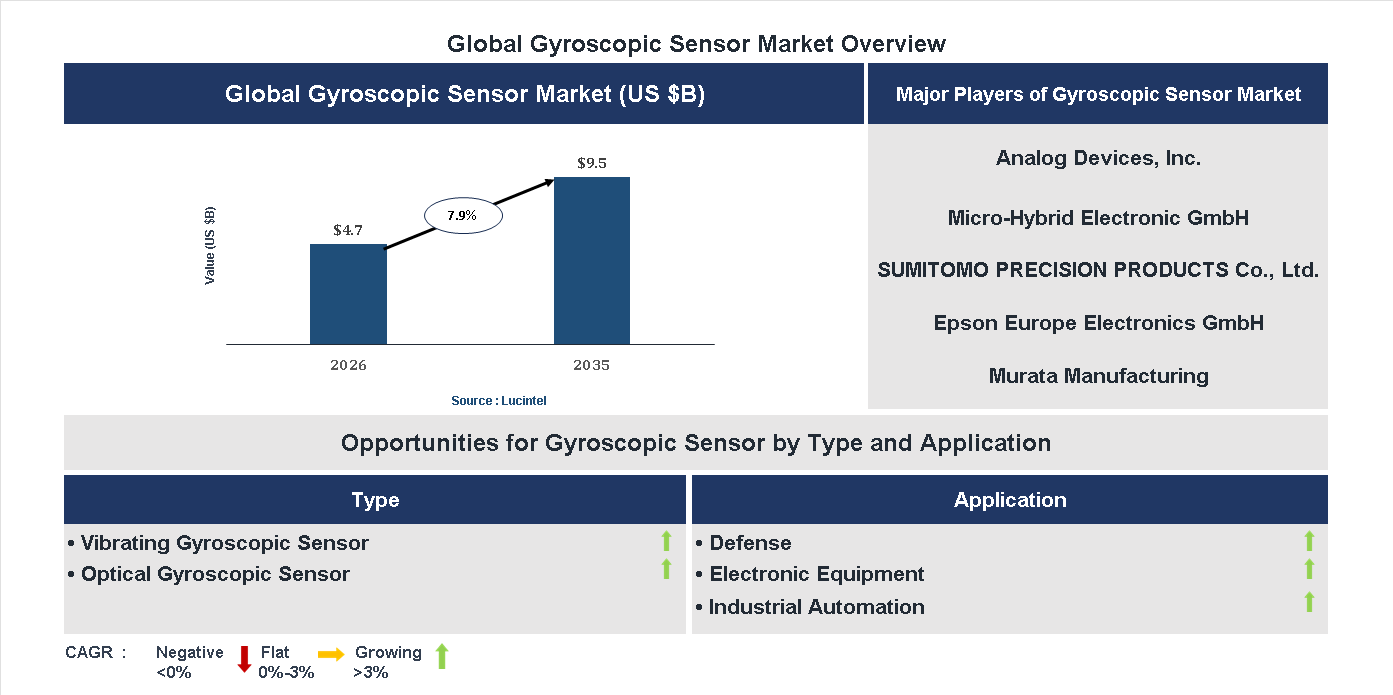
Key data points: The market size in 2035 = $9.5 billion, growth forecast = 7.9% annually for the next 8 years. Scroll below to get more insights. This market report covers trends, opportunities and forecasts in gyroscopic sensor market to 2035 by type (vibrating gyroscopic sensor and optical gyroscopic sensor), application (defense, electronic equipment, and industrial automation), and region (North America, Europe, Asia Pacific, and the Rest of the World)
We'll send your sample report shortly.
• Lucintel forecasts that, within the type category, vibrating gyroscopic sensor is expected to witness higher growth over the forecast period.
• Within the application category, defense is expected to witness the highest growth.
• In terms of region, APAC is expected to witness the highest growth over the forecast period. Gain valuable insights for your business decisions with our comprehensive 150+ page report. Sample figures with some insights are shown below.
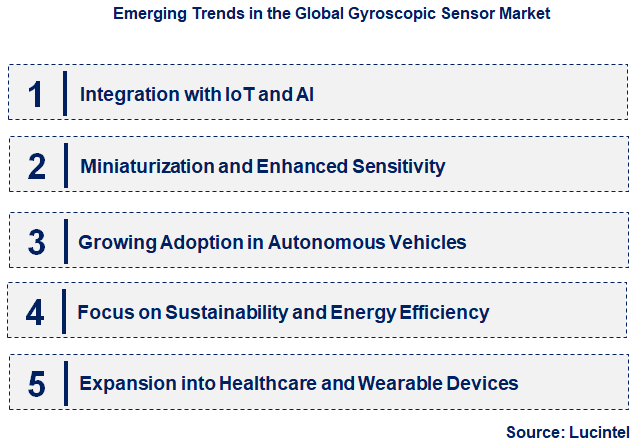
• Integration with IoT and AI: The incorporation of gyroscopic sensors with Internet of Things (IoT) devices and artificial intelligence (AI) is transforming data collection and analysis. This integration enables real-time monitoring, predictive maintenance, and enhanced automation across sectors such as healthcare, automotive, and industrial automation. As sensors become smarter and more connected, they facilitate more sophisticated applications, improving efficiency and user experience. This trend is driving the development of more compact, energy-efficient sensors that can seamlessly communicate within complex networks, ultimately expanding the market’s scope and capabilities.
• Miniaturization and Enhanced Sensitivity: Advances in microelectromechanical systems (MEMS) technology are enabling the production of smaller, more sensitive gyroscopic sensors. These miniaturized sensors are crucial for applications in wearable devices, drones, and compact consumer electronics, where space and weight are critical constraints. Enhanced sensitivity improves accuracy in motion detection, navigation, and stabilization systems. This trend is fostering innovation in product design, allowing manufacturers to develop more sophisticated, lightweight, and portable devices, thereby broadening the market reach and application spectrum.
• Growing Adoption in Autonomous Vehicles: The rise of autonomous and semi-autonomous vehicles is significantly boosting demand for gyroscopic sensors. These sensors are vital for precise navigation, stability control, and collision avoidance systems. As automotive manufacturers focus on safety and automation, the need for high-performance gyroscopic sensors increases. This trend is leading to the development of rugged, high-precision sensors capable of operating under harsh conditions, which in turn accelerates market growth and encourages technological innovation tailored to automotive needs.
• Focus on Sustainability and Energy Efficiency: Environmental concerns and the push for sustainable technology are influencing gyroscopic sensor development. Manufacturers are prioritizing energy-efficient designs and eco-friendly materials to reduce environmental impact. Low-power sensors are essential for battery-operated devices, extending device lifespan and reducing energy consumption. This trend promotes the adoption of gyroscopic sensors in green technologies, renewable energy systems, and sustainable transportation, aligning market growth with global sustainability goals and opening new avenues for eco-conscious innovations.
• Expansion into Healthcare and Wearable Devices: The healthcare sector is increasingly adopting gyroscopic sensors for applications such as patient monitoring, rehabilitation, and motion analysis. Wearable devices equipped with gyroscopic sensors enable continuous health tracking, fall detection, and activity recognition. This trend is driven by the demand for personalized healthcare solutions and the miniaturization of sensors to fit into compact devices. As healthcare providers and consumers seek more effective and non-invasive monitoring tools, the market for gyroscopic sensors in medical and wearable applications is poised for significant expansion. In summary, these emerging trends are fundamentally reshaping the gyroscopic sensor market by fostering innovation, expanding application areas, and emphasizing sustainability. The integration with IoT and AI, miniaturization, automotive adoption, sustainability focus, and healthcare applications are collectively driving market growth and technological advancement. These developments are making gyroscopic sensors more versatile, efficient, and integral to the future of connected, intelligent systems across multiple industries.
• Growing Adoption in Automotive Industry: The integration of gyroscopic sensors in autonomous vehicles and stability control systems is enhancing safety and navigation, leading to increased demand and market expansion.
• Advances in Sensor Technology: Improvements in sensitivity, size, and power efficiency are enabling new applications in wearable devices, drones, and robotics, broadening market scope and driving innovation.
• Rising Use in Consumer Electronics: Gyroscopic sensors are essential for smartphones, gaming consoles, and virtual reality devices, boosting user experience and fueling market growth.
• Expansion in Aerospace and Defense: Enhanced precision and reliability of gyroscopic sensors are critical for navigation, missile guidance, and aircraft stability, opening new revenue streams.
• Integration with IoT and Smart Systems: The incorporation of gyroscopic sensors into IoT devices and smart infrastructure is facilitating real-time monitoring and automation, creating new market opportunities. The overall impact of these developments is a dynamic, expanding market characterized by technological innovation and increased application diversity. This growth is fostering competitive advantages for industry players, encouraging investment, and accelerating adoption across sectors. As a result, the gyroscopic sensor market is poised for sustained expansion, contributing significantly to advancements in automation, safety, and user experience worldwide.
• Growing Adoption in Autonomous Vehicles: The integration of gyroscopic sensors in autonomous vehicles enhances navigation accuracy, stability, and safety. As the automotive industry shifts toward self-driving technology, demand for high-precision sensors increases. These sensors enable better motion detection, obstacle avoidance, and vehicle control, making them essential for advanced driver-assistance systems (ADAS). The expanding automotive market and regulatory push for safety features are expected to significantly boost gyroscopic sensor adoption in autonomous vehicle systems.
• Expansion of Consumer Electronics with Wearable Devices: The proliferation of wearable devices such as smartwatches, fitness trackers, and virtual reality headsets is driving demand for compact, accurate gyroscopic sensors. These sensors improve user experience by enabling precise motion tracking, gesture recognition, and immersive interactions. As consumer electronics become more sophisticated and integrated with health and fitness features, the need for miniaturized, energy-efficient gyroscopic sensors will grow, opening new avenues for market expansion.
• Increasing Use in Aerospace and Defense Applications: Gyroscopic sensors are vital for navigation, stabilization, and guidance in aerospace and defense sectors. They are used in aircraft inertial navigation systems, missile guidance, and satellite orientation. The demand for highly reliable, high-performance sensors is driven by advancements in aerospace technology and defense modernization programs. Growing investments in space exploration and military equipment are expected to further propel the adoption of gyroscopic sensors in these high-stakes applications.
• Rising Demand in Healthcare and Medical Devices: The healthcare industry is increasingly utilizing gyroscopic sensors for patient monitoring, rehabilitation, and medical imaging. Wearable health devices leverage these sensors for motion analysis, fall detection, and physical therapy. The trend toward personalized medicine and remote health monitoring is expanding the application scope. As medical technology advances, gyroscopic sensors will play a crucial role in improving diagnostic accuracy and patient outcomes, creating significant growth opportunities in this sector.
• Development of Smart Infrastructure and Robotics: Gyroscopic sensors are integral to robotics, automation, and smart infrastructure projects. They enable precise motion control, stability, and orientation in industrial robots, drones, and automated machinery. The rise of Industry 4.0 and smart city initiatives further accelerates demand for these sensors. Their ability to enhance operational efficiency, safety, and automation capabilities makes them indispensable for future infrastructure development, fostering innovation and market growth in robotics and smart systems. The overall market outlook indicates that these growth opportunities will significantly influence the gyroscopic sensor industry, fostering innovation, expanding application domains, and driving revenue growth across multiple sectors. As technology advances and applications diversify, the market is poised for sustained expansion and increased competitiveness.
• Technological Innovation: The continuous development of miniaturized, high-precision gyroscopic sensors enhances their application scope across various industries. Innovations such as MEMS (Micro-Electro-Mechanical Systems) technology have made sensors more affordable, compact, and energy-efficient, enabling integration into consumer electronics, automotive, and aerospace systems. These advancements improve performance, reliability, and ease of use, fueling market growth. As technology progresses, new applications emerge, further expanding the market. The demand for more sophisticated sensors that can operate in extreme conditions also drives research and development efforts, ensuring the market remains dynamic and competitive.
• Growing Adoption in Automotive Industry: The automotive sector is increasingly adopting gyroscopic sensors for stability control, navigation, and autonomous driving systems. These sensors improve vehicle safety by enabling features like rollover detection and electronic stability control. The rise of electric and autonomous vehicles accelerates this trend, as precise motion sensing becomes critical for vehicle operation. Automakers are investing heavily in integrating gyroscopic sensors to meet safety standards and enhance user experience. This growing adoption not only boosts sensor demand but also encourages innovation in sensor design tailored for automotive applications, contributing significantly to market expansion.
• Expansion in Aerospace and Defense: The aerospace and defense sectors are significant consumers of gyroscopic sensors due to their need for precise navigation, guidance, and control systems. These sensors are vital for missile guidance, aircraft stability, and space exploration missions. Increasing investments in space programs and military modernization initiatives worldwide are driving demand. The ability of gyroscopic sensors to operate reliably in harsh environments and provide accurate data makes them indispensable in these sectors. As aerospace technology advances and defense budgets grow, the market for high-performance gyroscopic sensors is expected to expand substantially, supporting innovations in navigation and control systems.
• Rising Demand for Consumer Electronics: The proliferation of smartphones, gaming devices, and wearable technology has significantly increased the demand for gyroscopic sensors. These sensors enable features like screen rotation, motion gaming, and augmented reality applications, enhancing user experience. The consumer electronics industry’s focus on integrating advanced sensors to differentiate products fuels market growth. Additionally, the trend toward smart and connected devices encourages manufacturers to incorporate gyroscopic sensors for improved functionality. As consumer demand for innovative and interactive devices continues to grow, the market for gyroscopic sensors is poised for substantial expansion, driven by technological advancements and increasing adoption.
• Increasing Investment in Autonomous Systems: The development of autonomous vehicles, drones, and robotics relies heavily on gyroscopic sensors for navigation, stabilization, and orientation. Governments and private companies are investing heavily in autonomous technology, which necessitates highly accurate and reliable sensors. These sensors enable autonomous systems to operate safely and efficiently in complex environments. The integration of gyroscopic sensors with other sensor types enhances system robustness and precision. As autonomous systems become more prevalent across industries, the demand for advanced gyroscopic sensors will surge, fostering innovation and expanding market opportunities. The challenges facing the gyroscopic sensor market include:
• High Manufacturing Costs: Producing high-precision gyroscopic sensors involves complex manufacturing processes and expensive materials, leading to elevated costs. These costs can limit the adoption of advanced sensors in cost-sensitive applications like consumer electronics. Additionally, economies of scale are still developing, which means unit costs remain high for smaller production runs. Manufacturers face pressure to reduce costs without compromising quality, which requires significant investment in R&D and manufacturing efficiencies. High costs can also hinder market penetration in emerging economies, restricting overall market growth and limiting the availability of affordable, high-performance sensors.
• Technological Complexity and Integration Challenges: Developing and integrating gyroscopic sensors into various systems pose significant technical challenges. Ensuring sensor accuracy, stability, and reliability in diverse operating conditions requires sophisticated design and calibration. Integration with other electronic components and systems can be complex, especially in compact devices like smartphones and wearables. Compatibility issues, signal interference, and power consumption are additional concerns that complicate deployment. Overcoming these challenges demands specialized expertise and advanced manufacturing capabilities, which can increase development time and costs, potentially slowing market growth and innovation.
• Regulatory and Standardization Barriers: The gyroscopic sensor industry faces regulatory hurdles related to safety, environmental impact, and data security. Lack of standardized testing and certification procedures can delay product approval and market entry. Regulatory compliance varies across regions, complicating global deployment. Additionally, evolving standards for autonomous vehicles and aerospace applications require continuous updates and adaptations. These barriers can increase time-to-market and development costs, discouraging investment and innovation. Navigating complex regulatory landscapes is essential for market players to ensure compliance and capitalize on emerging opportunities. In summary, the gyroscopic sensor market is driven by rapid technological advancements, expanding applications in automotive, aerospace, consumer electronics, and autonomous systems. However, high manufacturing costs, technological complexities, and regulatory challenges pose significant hurdles. The overall impact of these drivers and challenges creates a dynamic environment where innovation is essential for growth, but strategic navigation of costs and regulations is crucial. As the market evolves, stakeholders must balance technological progress with regulatory compliance and cost management to capitalize on emerging opportunities and sustain long-term growth.
• Analog Devices, Inc.
• Micro-Hybrid Electronic GmbH
• SUMITOMO PRECISION PRODUCTS Co., Ltd.
• Epson Europe Electronics GmbH
• Murata Manufacturing
• Innalabs
• Texense
• STMicroelectronics
• Shenzhen Rion Technology
• Dynalabs Mühendislik LTD
• Vibrating Gyroscopic Sensor
• Optical Gyroscopic Sensor
• Defense
• Electronic Equipment
• Industrial Automation
• North America
• Europe
• Asia Pacific
• The Rest of the World
• United States: The US market has seen substantial innovation in gyroscopic sensors, particularly in autonomous vehicles and aerospace applications. Leading companies are investing in miniaturization and enhanced precision, with increased adoption in consumer electronics like smartphones and gaming devices. Government initiatives supporting defense and space exploration further boost market growth, alongside rising R&D activities to improve sensor performance and integration capabilities.
• China: China is rapidly expanding its gyroscopic sensor industry, driven by strong demand in consumer electronics, automotive, and industrial sectors. Domestic manufacturers are focusing on cost-effective production and technological advancements, including MEMS-based sensors. The government’s emphasis on smart manufacturing and 5G infrastructure has accelerated adoption, with significant investments in research and development to enhance sensor accuracy and reliability.
• Germany: Germany’s market is characterized by its focus on high-precision gyroscopic sensors used in aerospace, defense, and industrial automation. The country’s strong engineering expertise and emphasis on quality have led to the development of advanced sensors with superior stability and durability. Collaborations between academia and industry are fostering innovation, while the automotive sector’s push toward autonomous driving is a key driver for market expansion.
• India: India’s gyroscopic sensor market is witnessing rapid growth due to increasing adoption in consumer electronics, automotive, and healthcare sectors. The government’s initiatives to promote digitalization and smart manufacturing are encouraging local production and innovation. Startups and established players are investing in developing affordable, high-performance sensors to cater to the expanding domestic market and export opportunities.
• Japan: Japan remains a leader in high-precision gyroscopic sensors, primarily serving the aerospace, defense, and robotics industries. The country’s focus on technological excellence and innovation has resulted in the development of highly reliable sensors with advanced features. Japan’s emphasis on integrating sensors into robotics and automation systems continues to drive market growth, supported by government and private sector R&D investments.


• Analog Devices, Inc.
• Micro-Hybrid Electronic GmbH
• SUMITOMO PRECISION PRODUCTS Co., Ltd.
• Epson Europe Electronics GmbH
• Murata Manufacturing
• Innalabs
• Texense
• STMicroelectronics
• Shenzhen Rion Technology
• Dynalabs Mühendislik LTD Q6. Which gyroscopic sensor market segment will be the largest in future? Answer: Lucintel forecasts that, within the type category, vibrating gyroscopic sensor is expected to witness higher growth over the forecast period. Q7. In gyroscopic sensor market, which region is expected to be the largest in next 5 years? Answer: In terms of region, APAC is expected to witness the highest growth over the forecast period. Q8. Do we receive customization in this report? Answer: Yes, Lucintel provides 10% customization without any additional cost.


Choose a license that fits your team. Instant PDF delivery.
Prices exclude taxes. Instant delivery. Custom licensing available on request.
Market Report · July 15, 2026
Market Report · July 13, 2026
Market Report · July 13, 2026
Trusted partner for strategic intelligence and business growth


Receive a complimentary market analysis tailored to your industry. Our analysts will identify key growth opportunities and competitive dynamics specific to your business.

Market size, growth rate, and key trend analysis for your specific sector.

Top competitor positioning and market share analysis.

Strategic recommendations backed by data-driven insights.
Get curated market intelligence and competitive moves straight to your inbox.
By subscribing, you agree to receive our monthly insights. Unsubscribe anytime.
Receive a complimentary market analysis tailored to your industry. Our analysts will identify key growth opportunities and competitive dynamics specific to your business.
Market size, growth rate, and key trend analysis for your specific sector.
Top competitor positioning and market share analysis.
Strategic recommendations backed by data-driven insights.
Get curated market intelligence, emerging trends, and competitive moves straight to your inbox each month.
By subscribing, you agree to receive our monthly insights. Unsubscribe anytime.
We'll send your sample report shortly.