
Market Report · July 31, 2026

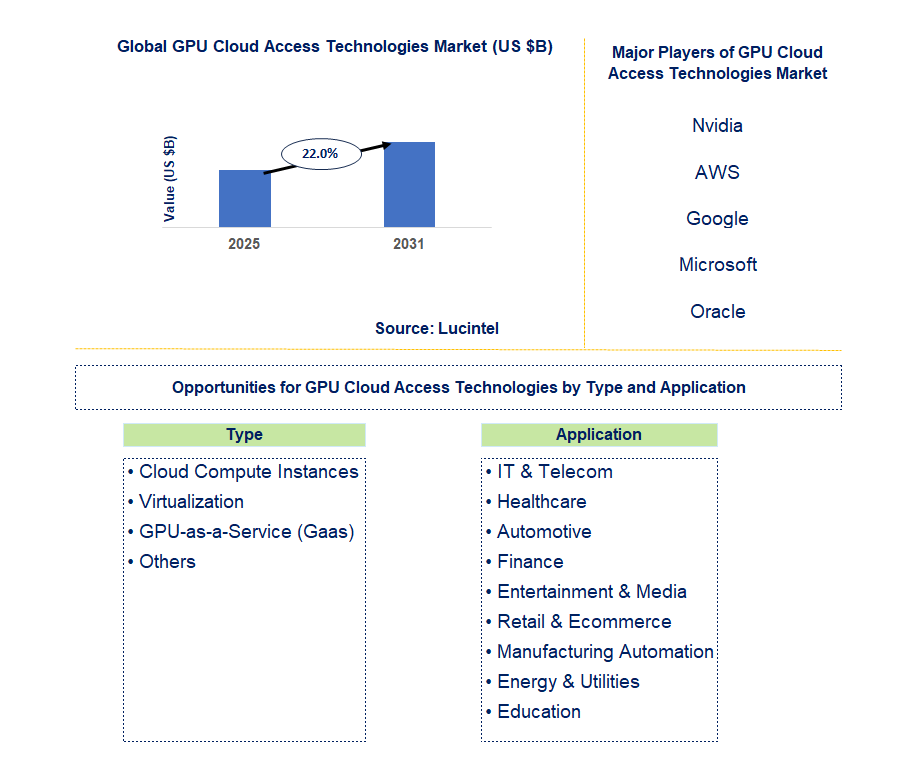
Key data points: The growth forecast = 22% annually for the next 7 years. Scroll below to get more insights. This market report covers Trends, opportunities and forecasts in GPU cloud access technologies market to 2031 by type (cloud compute instances, virtualization, GPU-as-a-service (GaaS), and others), application (IT & telecom, healthcare, automotive, finance, entertainment & media, retail & ecommerce, manufacturing automation, energy & utilities, and education), and region (North America, Europe, Asia Pacific, and the Rest of the World)
We'll send your sample report shortly.
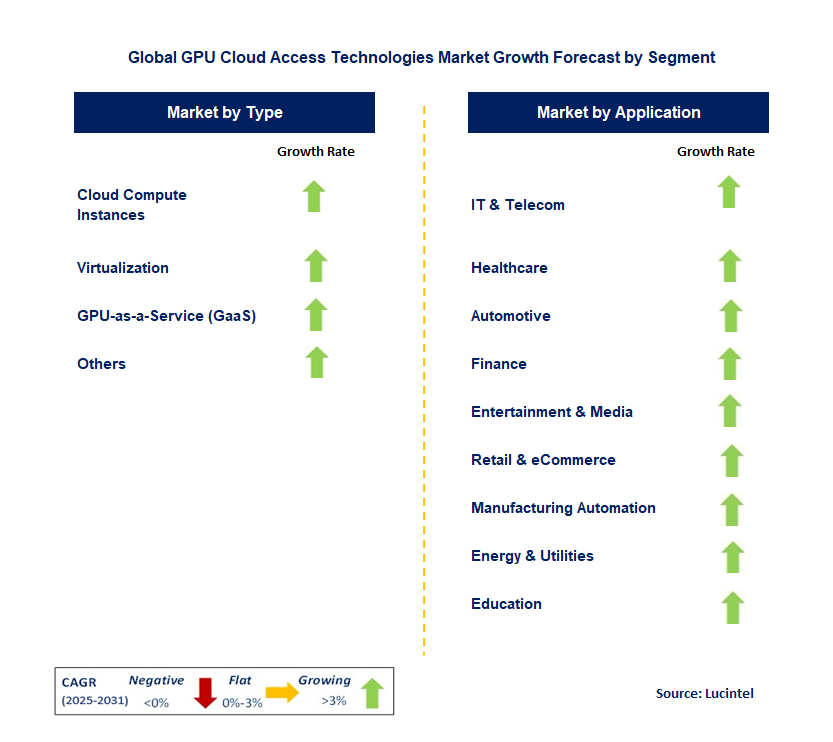
• Lucintel forecasts that, within the type category, GPU-as-a-service (GaaS) is expected to witness the highest growth over the forecast period due to its flexibility, scalability, cost efficiency, and increasing demand for GPU-powered applications like AI.
• Within the application category, IT & telecom is expected to witness the highest growth due to its massive demand for cloud computing, ai capabilities, and data-intensive applications.
• In terms of region, North America is expected to witness the highest growth over the forecast period due to its technological innovation, and significant demand from IT & telecom sector.
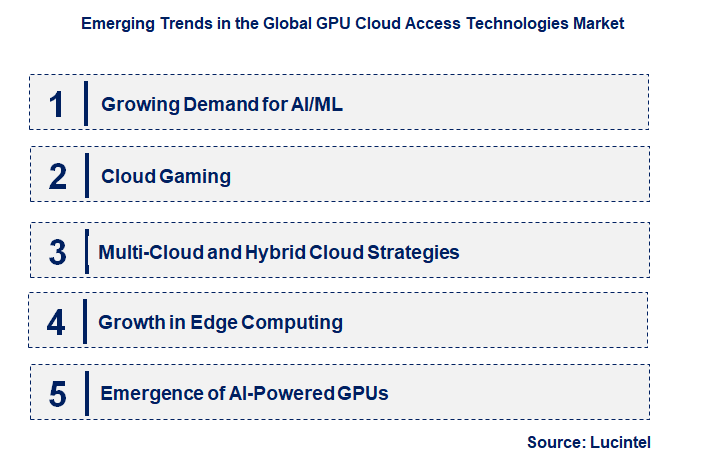
• Growing Demand for AI/ML: Activities involving AI and ML require high computing powers. The demand for real-time processing of data, training of models, and predictive analysis has instigated organizations to resort to GPU-based cloud solutions for further strengthening the AI capabilities in the system. These developing AI technologies, in turn, will require an increasing amount of GPU cloud service to accelerate more research and development, which has the potential for furthering change in industries related to healthcare, automotive, finance, and other sectors.
• Cloud Gaming: Cloud gaming is one of the major emerging trends in the GPU Cloud Access market. In recent years, Google Stadia, Microsoft Xbox Cloud Gaming, and Nvidia GeForce Now have introduced platforms that further support this industry. These platforms take advantage of GPU-powered cloud computing to provide the best gaming experience without requiring specific hardware. The demand for GPU cloud services will increase dramatically because of the growth in mobile and remote gaming, allowing consumers to access AAA games on-demand at any time and from anywhere, without requiring high-end devices.
• Multi-Cloud and Hybrid Cloud Strategies: Organizations are increasingly adopting multi-cloud and hybrid cloud strategies, combining private and public cloud resources to optimize their GPU cloud access. These strategies allow businesses to distribute workloads across various cloud providers, enhancing flexibility, security, and cost-efficiency. As organizations look to avoid vendor lock-in and ensure high availability, the demand for GPU-powered multi-cloud solutions is on the rise. This trend is particularly prevalent in industries that require flexibility, such as finance and healthcare, where data privacy and regulatory compliance are key concerns.
• Growth in Edge Computing: Edge computing is gaining momentum as a trend that complements GPU cloud services. By processing data closer to the source, edge computing reduces latency and bandwidth usage, enabling real-time processing for applications like autonomous vehicles, IoT, and industrial automation. With GPUs becoming an integral part of edge computing, cloud providers are adding GPU-powered edge devices to their offerings. This development is fueling the requirement for decentralized GPU cloud infrastructure and is making it possible to deploy high-performance computing resources in remote locations.
• Emergence of AI-Powered GPUs: AI-powered GPUs, designed specifically to optimize deep learning and AI workloads, are emerging as a key development in the GPU cloud space. These purpose-built GPUs are being integrated into cloud platforms to deliver enhanced performance for AI model training, inference, and deployment. As AI applications become more complex and resource-intensive, the demand for these purpose-built GPUs will grow, offering businesses the ability to scale their AI operations efficiently. This trend is revolutionizing industries such as healthcare, finance, and manufacturing, where AI adoption is critical. The trends emerging in GPU cloud access technologies are reshaping the market to require powerful, scalable, and specialized computing resources. AI and machine learning, cloud gaming, multi-cloud strategies, edge computing, and AI-powered GPUs are all driving innovation, making it necessary for businesses to adopt GPU cloud solutions to stay competitive in the changing technological landscape.
• Introduction of AI-Specific GPUs: There has been massive integration of the AI-specific graphics processing unit that has greatly formed the developments and innovations that led to major successes in cloud service. These specialized GPUs, designed to accelerate deep learning and machine learning workloads, are now widely available in public and private cloud environments. This means that organizations can optimize their AI operations without the need for expensive on-premise hardware, leading to adoption across industries such as healthcare, automotive, and finance. The availability of AI-powered GPUs in the cloud is accelerating the development of AI solutions and enhancing the speed and efficiency of AI model training.
• Emergence of GPU-Optimized Cloud Platforms: GPU-optimized cloud platforms have become a major development, offering tailored services that cater specifically to GPU-intensive workloads. These are platforms like Nvidia‘s DGX Cloud and Amazon‘s Elastic GPU Cloud. They help user-specified resources committed entirely to your use as an accelerator for high-performance computing, and what that has done is made the access to GPU cloud more efficient and cost-effective, allowing businesses in the execution of complex simulations of data analysis and in AI model training without latency. With time, the role of GPU cloud platforms in digital transformation across industries will become ever more important.
• Growth in GPU-Powered Edge Computing: Growth in GPU-powered edge computing is another key trend in the GPU cloud market. The ability to process data closer to its source, thus reducing latency and making real-time decisions possible, has been enhanced through the use of GPUs and edge computing. This is particularly useful in industries like autonomous driving, healthcare, and smart manufacturing. The integration of GPUs in edge devices allows for faster data processing and greater operational efficiency, driving the need for decentralized GPU cloud infrastructure that can support remote locations and edge applications.
• Accessibility of GPU Cloud Services Globally: Global expansion of GPU cloud services has brought forth new opportunities for businesses worldwide to have access to high-performance computing resources. The major cloud providers, like AWS and Google Cloud, and Microsoft Azure, have expanded their offerings of GPUs to data centers across different regions to make it easy to access power from anywhere in the world. Such broad availability is imperative for businesses operating in a multicounty location, and this, in turn, is the most significant reason that drives companies towards GPU cloud solutions, especially industries that need instant data analysis or global collaboration.
• Towards Lower-Cost Options of GPU Cloud Solutions: Organizations are seeking ways to make their high-performance computing affordable, but not with any capital expenditure like on-premises hardware, through lower-cost options of GPU cloud solutions. Cloud providers are nowadays offering flexible price models, among which pay-as-you-go or subscription-based, to allow firms to scale according to demand when using GPUs. This shift to cost-effective cloud solutions for powerful computing is bringing the power to small and medium-sized businesses with the ability to use GPU services for data analytics, AI, and other high-computing tasks. The recent advancements in GPU cloud access technologies have suggested an increased need for cloud-based GPU services in terms of driving innovation and digital transformation across industries. Ranging from AI-specialized GPUs and GPU-optimized cloud platforms to the expansion of edge computing and cost-effective solutions, these developments are transforming business approaches to high-performance computing.
• Artificial Intelligence and Machine Learning: Artificial Intelligence and Machine Learning applications are driving the growth of GPU cloud services. The demand for high computational power to train and deploy complex AI models has made the GPU a critical component. In order to provide cutting-edge computing power to companies without forcing them to shell out for expensive infrastructure, cloud providers are focusing on offering specialized AI-optimized GPUs. Scalability and flexibility attached to GPU cloud access allow businesses to deal with large datasets, accelerate model training, and enhance the performance of AI-driven applications. This trend is re-engineering industries like healthcare, finance, and manufacturing.
• Cloud Gaming: Cloud gaming is going to be the biggest growth opportunity for GPU cloud access technologies. With the ever-increasing popularity of streaming services, Google Stadia and Xbox Cloud Gaming, and Nvidia GeForce Now are already leveraging GPUs to offer high-quality gaming without requiring expensive hardware on users‘ devices. This opens the scope of playing graphics-intensive games even on devices not very strong for that. And so, by continuing to better its cloud infrastructure, the game industry will increase exponentially and so GPU-based cloud services will serve as the cornerstone in that kind of change.
• Data Analytics and Big Data: Applications relating to data analytics and big data demand massive processing of data with significant computational abilities to process or analyze a gigantic amount of data. Cloud access to GPUs allows a business to conduct complex data analysis, predictive analytics, and real-time processing without building in-house infrastructure. This area is fast growing for GPU cloud services from the retail, finance, and telecommunication sectors. As demand increases for more data-driven insights, this is one of the substantial growth opportunities for GPU cloud providers.
• Scientific Research and Simulation: Scientific research and simulation work, including drug discovery, climate modeling, and engineering simulations, require a huge amount of computation. The most effective use of parallel processing can be done through GPUs. They are highly suited for running complex simulations. Researchers can have access to on-demand, scalable GPU resources from the cloud, reducing the need for costly on-premises systems. This growth opportunity is significant in sectors such as pharmaceuticals, aerospace, and energy, where high-performance computing plays a crucial role in advancing innovation. The ability to scale GPU resources in the cloud enables faster research cycles and more accurate results.
• Virtual and Augmented Reality: Virtual Reality (VR) and Augmented Reality (AR) applications require high-performance computing to render complex graphics and provide immersive experiences. It can be utilized in a large way by a business for VR/AR by scaling up/down according to need, as resources become accessible at GPU clouds. Among these businesses, entertainment and education, even the real estate business, relies highly on virtual and augmented realities to present attractive interactive and fun experiences through this method of visualization. Thus, demand for it continues to accelerate with growth as innovation becomes all the more potent due to access to cloud-driven GPUs. Strategic growth opportunities in the GPU cloud access technologies market are transforming companies in various industries, allowing them to access high-performance computing resources without having to deploy on-premises infrastructure. From AI and machine learning to gaming, data analytics, scientific research, and VR/AR, applications for GPU cloud services are very wide and diverse. With businesses increasingly adopting cloud-based solutions, the demand for GPU-powered cloud services is likely to continue to grow, thus providing significant opportunities for providers and driving innovation in these industries.
• Nvidia
• AWS
• Microsoft
• Oracle
• Tesla
• Anyscale
• Cloud Compute Instances
• Virtualization
• GPU-as-a-Service (GaaS)
• Others
• It & Telecom
• Healthcare
• Automotive
• Finance
• Entertainment & Media
• Retail & Ecommerce
• Manufacturing Automation
• Energy & Utilities
• Education
• North America
• Europe
• Asia Pacific
• The Rest of the World
• United States: The United States is seeing major investments in GPU cloud access technologies, coupled with the enhancement of its services by major players such as Nvidia, Amazon Web Services (AWS), and Microsoft Azure. The adoption of GPU cloud services has rapidly grown in gaming, AI, and data analytics. This is mainly because of the increasing demand for high computational power and scalability in cloud infrastructure. Moreover, 5G networks are expected to expand, and this will also boost GPU cloud services to offer greater accessibility and performance. In this regard, U.S. companies are the leaders in terms of innovation and cloud adoption.
• China: China has witnessed a rapid evolution in the space of GPU clouds, supported both by private as well as government-backed investments. Baidu, Alibaba, and Tencent are currently aggressively rolling out GPU cloud services to back the AI and ML applications. A spurt in digital transformation backed by the Chinese government to improve smart cities is also fast in the pursuit for high-performance GPU services. Furthermore, the drive for self-sufficiency in the production of semiconductors is slowly diminishing the country‘s reliance on foreign GPU suppliers, which is paving the way for indigenous GPU cloud solutions. This makes China a prime contender in the global GPU cloud market.
• Germany: The use of GPU cloud access technologies in Germany is closely related to its strong manufacturing and automotive sectors, where AI and simulation technologies demand powerful computing resources. Companies like SAP and Siemens are increasingly integrating GPU cloud services for product design, industrial simulation, and data analysis. In addition, Germany‘s sensitivity to data protection and security led to the emergence of specific, specialized GPU cloud platforms that met the strictest EU regulations. As German industries continue their path of digital transformation, the need for GPU cloud services is anticipated to increase significantly in areas like automotive and engineering.
• India: China is fast becoming a prominent market for GPU cloud access technologies due to emerging AI, data analytics, and cloud gaming sectors. Indian businesses are embracing this service with increased demand in low-cost GPU cloud, which is considered essential for expanding the technological capabilities of any business. Startups and IT companies in cities such as Bengaluru and Hyderabad use these services to develop AI-driven solutions. In addition, the growing data center infrastructure in India and government initiatives to promote cloud adoption are accelerating the shift toward GPU-powered cloud technologies. India‘s price-sensitive market presents unique opportunities for providers to offer scalable GPU cloud solutions.
• Japan: Japan has been a major adopter of advanced technologies, and its GPU Cloud Access market is experiencing growth in AI, robotics, and digital entertainment. Japanese companies like Sony and Fujitsu invest in GPU cloud solutions in hopes of advancing technology in fields like augmented reality and virtual reality. Smart manufacturing, and developing autonomous systems are strong drivers of the adoption of GPU clouds in Japan. Another point is that R&D on new and innovative topics like quantum computing and robotics would place Japan among the global leaders in the market for GPU clouds.


• Nvidia
• AWS
• Microsoft
• Oracle
• Tesla
• Anyscale Q5. Which GPU cloud access technologies market segment will be the largest in future? Answer: Lucintel forecasts that, within the type category, GPU-as-a-service (GaaS) is expected to witness the highest growth over the forecast period due to its flexibility, scalability, cost efficiency, and increasing demand for GPU-powered applications like AI. Q6. In GPU cloud access technologies market, which region is expected to be the largest in next 5 years? Answer: In terms of region, North America is expected to witness the highest growth over the forecast period due to its technological innovation, and significant demand from IT & telecom sector. Q7. Do we receive customization in this report? Answer: Yes, Lucintel provides 10% customization without any additional cost.


Choose a license that fits your team. Instant PDF delivery.
Prices exclude taxes. Instant delivery. Custom licensing available on request.
Market Report · July 31, 2026
Market Report · July 31, 2026
Market Report · July 31, 2026
Trusted partner for strategic intelligence and business growth


Receive a complimentary market analysis tailored to your industry. Our analysts will identify key growth opportunities and competitive dynamics specific to your business.

Market size, growth rate, and key trend analysis for your specific sector.

Top competitor positioning and market share analysis.

Strategic recommendations backed by data-driven insights.
Get curated market intelligence and competitive moves straight to your inbox.
By subscribing, you agree to receive our monthly insights. Unsubscribe anytime.
Receive a complimentary market analysis tailored to your industry. Our analysts will identify key growth opportunities and competitive dynamics specific to your business.
Market size, growth rate, and key trend analysis for your specific sector.
Top competitor positioning and market share analysis.
Strategic recommendations backed by data-driven insights.
Get curated market intelligence, emerging trends, and competitive moves straight to your inbox each month.
By subscribing, you agree to receive our monthly insights. Unsubscribe anytime.
We'll send your sample report shortly.