
Market Report · July 31, 2026

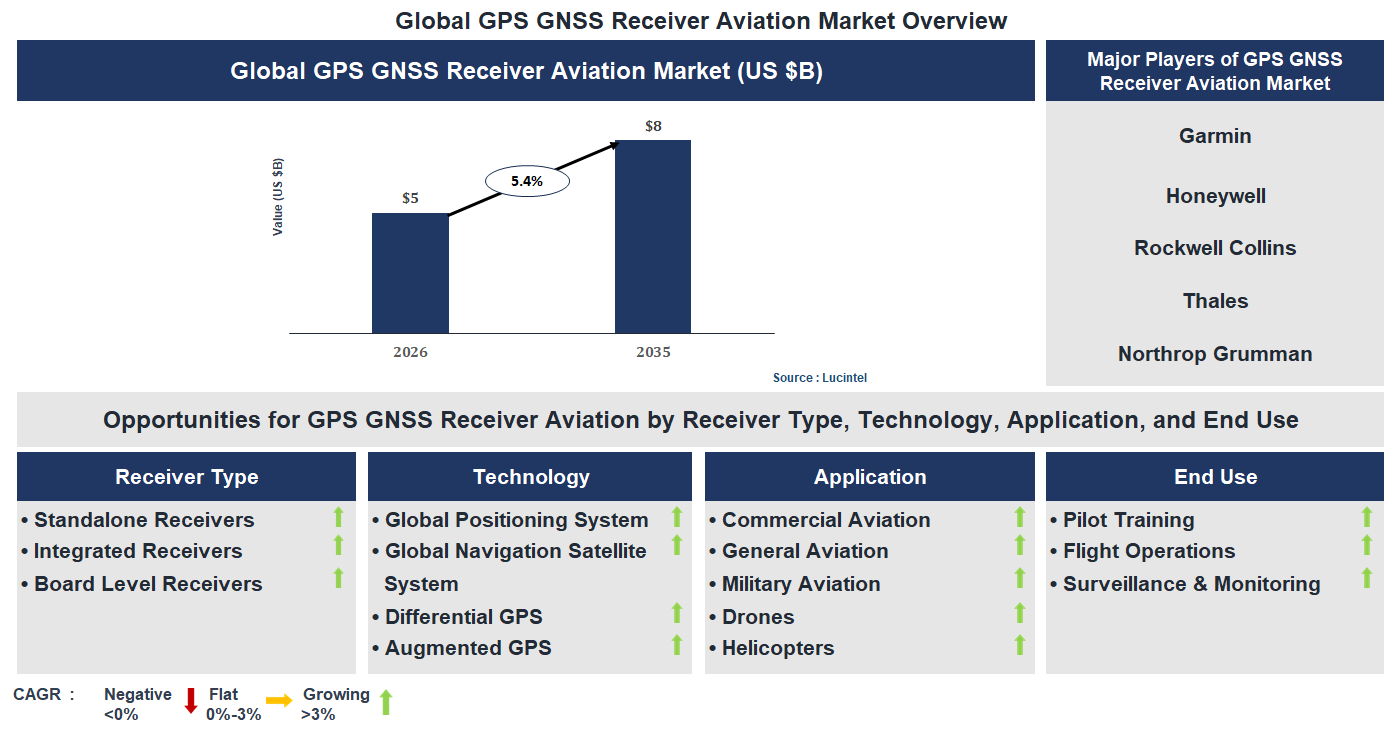
Key data points: The market size in 2035 = $8 billion, growth forecast = 5.4% annually for the next 8 years. Scroll below to get more insights. This market report covers trends, opportunities and forecasts in GPS GNSS receiver aviation market to 2035 by receiver type (standalone receivers, integrated receivers, and board level receivers), technology (global positioning system, global navigation satellite system, differential GPS, and augmented GPS), application (commercial aviation, general aviation, military aviation, drones, and helicopters), end use (pilot training, flight operations, and surveillance & monitoring), and region (North America, Europe, Asia Pacific, and the Rest of the World)
We'll send your sample report shortly.
• Lucintel forecasts that, within the receiver type category, standalone receiver is expected to witness the highest growth over the forecast period.
• Within the end use category, pilot training is expected to witness the highest growth.
• In terms of region, North America is expected to witness the highest growth over the forecast period. Gain valuable insights for your business decisions with our comprehensive 150+ page report. Sample figures with some insights are shown below.
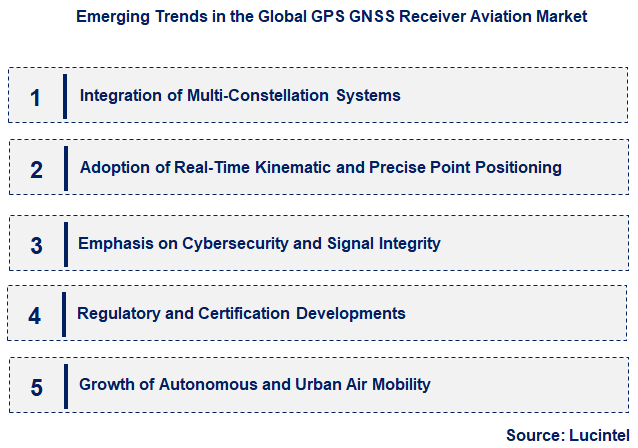
• Integration of Multi-Constellation Systems: This trend involves combining signals from multiple satellite navigation systems such as GPS, GLONASS, Galileo, and BeiDou. The integration enhances positional accuracy, reliability, and availability, especially in challenging environments like urban canyons or mountainous regions. It reduces dependency on a single system, thereby increasing resilience against signal disruptions or outages. This multi-constellation approach is becoming standard in modern aviation GNSS receivers, enabling safer and more precise navigation, which is critical for both commercial and military applications.
• Adoption of Real-Time Kinematic and Precise Point Positioning: RTK and PPP technologies are increasingly incorporated into aviation GNSS receivers to deliver centimeter-level accuracy. These techniques utilize correction data from ground stations or satellite-based augmentation systems (SBAS) to refine positioning information. The impact is significant, enabling more precise flight path management, improved landing approaches, and enhanced safety margins. As demand for high-precision navigation grows, especially in autonomous and urban air mobility, these technologies are becoming vital components of advanced aviation navigation systems.
• Emphasis on Cybersecurity and Signal Integrity: With the increasing reliance on GNSS for critical aviation operations, ensuring signal integrity and cybersecurity has become paramount. Emerging trends include the development of anti-spoofing and anti-jamming technologies, as well as robust encryption protocols. These measures protect against malicious interference and ensure continuous, reliable navigation signals. The focus on cybersecurity is driven by regulatory requirements and the need to prevent potential disruptions that could compromise safety. This trend underscores the importance of resilient GNSS systems capable of maintaining integrity under adverse conditions.
• Regulatory and Certification Developments: Governments and aviation authorities are updating standards and certification processes to accommodate advanced GNSS technologies. This includes establishing guidelines for multi-constellation use, integrity monitoring, and interference mitigation. These regulatory changes facilitate broader adoption of sophisticated GNSS receivers in commercial aircraft, unmanned aerial vehicles (UAVs), and other aerospace platforms. The evolving regulatory landscape ensures that new navigation solutions meet safety and performance standards, fostering innovation while maintaining high safety levels in aviation operations.
• Growth of Autonomous and Urban Air Mobility: The rise of autonomous aircraft and urban air mobility solutions is driving demand for highly accurate, reliable, and real-time navigation systems. Advanced GNSS receivers are integral to enabling autonomous flight, precise landing, and navigation in complex urban environments. This trend is expanding the market beyond traditional aviation, opening new opportunities in drone delivery, air taxis, and other UAM applications. The integration of GNSS with other sensors and systems is critical for ensuring safety, efficiency, and scalability of these emerging mobility solutions. These trends are collectively transforming the GPS GNSS receiver aviation market by enhancing accuracy, resilience, and safety. They are fostering innovation in autonomous flight, urban mobility, and safety standards, ultimately reshaping how navigation is integrated into future aviation systems. As these developments continue, the market is poised for significant growth and technological advancement, aligning with the evolving needs of the aerospace industry.
• Growing Adoption of Multi-Constellation GNSS Receivers: This development involves integrating multiple satellite systems like GPS, GLONASS, Galileo, and BeiDou into aviation GNSS receivers. It enhances positional accuracy, reliability, and availability, especially in challenging environments. The increased adoption improves safety and operational efficiency, reduces signal disruptions, and supports advanced navigation requirements. As a result, airlines and military agencies are increasingly deploying multi-constellation receivers, driving market growth and technological innovation.
• Advancements in Anti-Jamming and Anti-Spoofing Technologies: This innovation focuses on protecting GNSS signals from interference, jamming, and spoofing threats. Enhanced security measures ensure the integrity and reliability of navigation data, critical for aviation safety. These technologies are becoming standard in new receiver designs, especially for military and commercial aircraft operating in contested or high-risk environments. The development boosts confidence in GNSS-based navigation, encouraging broader adoption and fostering market expansion.
• Integration of AI and Machine Learning in Navigation Systems: Incorporating AI and machine learning algorithms into GNSS receivers improves signal processing, error correction, and predictive analytics. This integration enhances accuracy, reduces latency, and enables real-time decision-making. It supports autonomous flight operations and advanced air traffic management. The adoption of AI-driven solutions is expected to revolutionize aviation navigation, offering smarter, more resilient systems that adapt to dynamic conditions, thereby expanding market opportunities and technological leadership.
• Increasing Use of Augmentation Systems for Enhanced Accuracy: Satellite-based augmentation systems (SBAS) and ground-based augmentation systems (GBAS) provide correction signals to improve GNSS accuracy and integrity. These systems are vital for precision approaches, landing, and navigation in complex environments. Their deployment ensures compliance with stringent safety standards and supports the growth of autonomous and urban air mobility. The augmentation systems expansion is a key driver for market growth, enabling safer and more efficient aviation operations worldwide.
• Rising Demand for Lightweight and Compact Receivers: The trend toward miniaturization involves developing smaller, lighter GNSS receivers without compromising performance. This development benefits commercial and military aircraft by reducing weight and space requirements, leading to fuel savings and increased payload capacity. Advances in materials and integrated circuit design facilitate this trend. The demand for compact receivers is fueling innovation, broadening application scopes, and contributing to the overall growth and competitiveness of the aviation GNSS market. These recent developments are significantly transforming the GPS GNSS receiver aviation market by enhancing accuracy, security, and integration capabilities. The adoption of multi-constellation systems, advanced anti-jamming technologies, AI integration, augmentation systems, and miniaturization are collectively driving market expansion. These innovations improve safety, operational efficiency, and resilience, positioning the industry for sustained growth. As a result, stakeholders are better equipped to meet evolving aviation demands, ensuring a more reliable and advanced navigation infrastructure worldwide.
• Integration of Advanced Signal Processing Technologies: The adoption of sophisticated signal processing enhances the accuracy and reliability of GPS GNSS receivers in aviation, enabling better performance in challenging environments. This integration supports safety-critical applications, reduces errors, and improves resilience against interference and jamming, fostering trust among users and regulators. As technology advances, manufacturers are investing in innovative algorithms and hardware to meet evolving aviation standards and operational demands.
• Growing Demand for Enhanced Navigation in Commercial Aviation: Increasing air traffic and the need for precise navigation systems drive demand for high-performance GPS GNSS receivers in commercial aircraft. These systems improve route efficiency, reduce fuel consumption, and enhance safety by providing accurate positioning data. Airlines and manufacturers are prioritizing the integration of advanced GNSS solutions to optimize flight operations, meet regulatory requirements, and improve passenger experience through reliable navigation.
• Expansion of Military and Defense Applications: The military sector is increasingly adopting GPS GNSS receivers for secure, accurate navigation in complex operational environments. Enhanced anti-jamming capabilities, encrypted signals, and robust hardware are critical for defense applications. Growing geopolitical tensions and the need for reliable battlefield navigation are fueling investments in advanced GNSS technology, creating significant growth opportunities for defense contractors and technology providers.
• Rising Adoption of Multi-Constellation and Multi-Frequency Systems: The shift towards multi-constellation (GPS, GLONASS, Galileo, BeiDou) and multi-frequency receivers improves positional accuracy and reliability. These systems mitigate signal blockages and interference, essential for aviation safety and precision. Manufacturers are developing integrated solutions that support multiple satellite systems, enabling seamless global coverage and resilience, which are increasingly demanded by commercial and military aviation sectors.
• Increasing Focus on Safety and Regulatory Compliance: Stringent safety standards and regulatory frameworks are driving the adoption of reliable GNSS solutions in aviation. Manufacturers are developing compliant systems that meet certification requirements from authorities like FAA and EASA. This focus on safety and compliance ensures operational integrity, reduces liability, and fosters market trust, ultimately expanding the adoption of GPS GNSS receivers across various aviation applications. The overall market is poised for substantial growth as these opportunities foster innovation, improve safety, and enhance operational efficiency. Companies that leverage these trends will strengthen their market position, meet evolving customer needs, and contribute to the modernization of aviation navigation systems, ensuring sustained industry advancement.
• Technological Advancements: The continuous development of multi-constellation GNSS receivers, supporting GPS, GLONASS, Galileo, and BeiDou, enhances positioning accuracy and reliability. These innovations enable aircraft to operate safely in challenging environments, reduce navigation errors, and improve overall flight efficiency. The integration of anti-jamming and spoofing technologies further ensures signal integrity, which is critical for safety-critical aviation applications. As technology evolves, manufacturers are investing heavily in R&D to develop compact, lightweight, and energy-efficient receivers, fueling market growth and enabling new applications such as autonomous flight and urban air mobility.
• Increasing Air Traffic and Demand for Precision Navigation: The global rise in air travel, driven by economic growth and tourism, results in increased demand for reliable navigation systems. Precision GNSS receivers are essential for modern aircraft to optimize routes, reduce fuel consumption, and ensure safety during takeoff, landing, and en-route phases. The need for enhanced situational awareness and compliance with stringent safety standards propels airlines and manufacturers to adopt advanced GNSS solutions. This surge in demand is particularly prominent in emerging markets where infrastructure development is accelerating, further expanding the market scope.
• Regulatory and Certification Standards: Governments and aviation authorities worldwide impose strict regulations to ensure navigation safety and system interoperability. Certification processes by agencies such as the FAA and EASA require GNSS receivers to meet rigorous standards for accuracy, reliability, and resistance to interference. These regulatory frameworks influence product development, deployment timelines, and market entry strategies. Compliance with evolving standards, such as the adoption of ICAO’s Global Navigation Satellite System (GNSS) policies, is vital for market players to maintain competitiveness and ensure widespread adoption across commercial and military aviation sectors.
• Integration with Next-Generation Air Traffic Management (ATM): The shift towards NextGen and SESAR initiatives aims to modernize air traffic management through satellite-based navigation and surveillance. GNSS receivers are central to enabling performance-based navigation (PBN), allowing for more precise and efficient routing, reduced congestion, and enhanced safety. The integration of GNSS with other avionics systems facilitates seamless data sharing and real-time decision-making. This trend encourages airlines and manufacturers to upgrade existing systems, fostering market growth while also demanding compatibility with evolving ATM standards and infrastructure.
• Growing Adoption of Autonomous and Unmanned Aircraft: The rise of unmanned aerial vehicles (UAVs) and autonomous aircraft relies heavily on accurate, reliable GNSS signals for navigation and control. These platforms require advanced GNSS receivers capable of resisting interference and providing precise positioning in complex environments. The development of autonomous systems opens new markets and applications, including cargo delivery, surveillance, and urban air mobility. As regulatory frameworks adapt to accommodate unmanned operations, the demand for specialized GNSS solutions tailored for autonomous aviation is expected to surge, further propelling market expansion. The challenges facing the GPS GNSS receiver aviation market include:
• Signal Interference and Jamming: The aviation sector faces significant risks from signal interference, jamming, and spoofing, which can compromise navigation safety. As GNSS signals are weak and susceptible to malicious attacks or environmental disruptions, aircraft navigation systems must incorporate anti-jamming and anti-spoofing technologies. Developing and deploying such resilient systems is costly and technically complex, potentially delaying adoption. Additionally, increasing reliance on satellite signals makes the industry vulnerable to geopolitical conflicts and cyber threats, necessitating robust security measures to ensure continuous, reliable navigation.
• Regulatory and Certification Delays: The stringent certification processes required for aviation-grade GNSS receivers can be time-consuming and costly. Regulatory agencies often have lengthy approval cycles, which can delay product deployment and market entry. Rapid technological advancements sometimes outpace regulatory updates, creating compliance challenges for manufacturers. Moreover, differing standards across regions complicate global deployment, increasing costs and operational complexities. These delays can hinder the timely adoption of innovative GNSS solutions, impacting market growth and competitiveness.
• Dependence on Satellite Infrastructure and Geopolitical Risks: The aviation GNSS market heavily depends on satellite constellations operated by various countries, making it vulnerable to geopolitical tensions, satellite outages, or intentional disruptions. Political conflicts or sanctions can restrict access to certain satellite signals, affecting navigation reliability. Additionally, natural phenomena like solar storms can impair satellite signals, posing safety risks. This dependence necessitates backup systems and alternative navigation methods, increasing operational costs. Managing geopolitical risks and ensuring resilient infrastructure are critical challenges that could impact the stability and growth of the market. The GPS GNSS receiver aviation market is driven by technological innovations, increasing air traffic, regulatory standards, integration with modern ATM systems, and the rise of autonomous aircraft. However, it faces challenges such as signal interference, regulatory delays, and geopolitical risks. These factors collectively influence market dynamics, requiring stakeholders to innovate continuously, adapt to regulatory changes, and develop resilient systems. While growth prospects remain promising, addressing these challenges is essential for sustainable development and widespread adoption of advanced GNSS solutions in aviation.
• Garmin
• Honeywell
• Rockwell Collins
• Thales
• Northrop Grumman
• Raytheon Technologies
• Avidyne Corporation
• Sandel Avionics
• Navtech
• Trimble Inc.
• Standalone Receivers
• Integrated Receivers
• Board Level Receivers
• Global Positioning System
• Global Navigation Satellite System
• Differential GPS
• Augmented GPS
• Commercial Aviation
• General Aviation
• Military Aviation
• Drones
• Helicopters
• Pilot Training
• Flight Operations
• Surveillance & Monitoring
• North America
• Europe
• Asia Pacific
• The Rest of the World
• United States: The US market has seen rapid adoption of next-generation GNSS receivers, driven by military and commercial aviation sectors. Innovations in multi-constellation support and anti-jamming features have enhanced reliability. The FAAs modernization initiatives promote GPS-based navigation, boosting demand. Additionally, the growth of drone and autonomous aircraft operations has increased the need for precise GNSS solutions. Major players are investing in R&D to develop resilient, high-accuracy receivers, aligning with the countrys focus on aviation safety and technological leadership.
• China: China is rapidly expanding its GNSS infrastructure, with BeiDou becoming a key component in aviation navigation. The government emphasizes indigenous technology development to reduce reliance on foreign systems. Recent advancements include integration of BeiDou with GPS and Galileo for improved accuracy and reliability. The aviation sector is adopting these systems for commercial and military applications, supported by national policies promoting aerospace innovation. The growth of drone technology and smart airports further accelerates demand for advanced GNSS receivers, positioning China as a significant market player.
• Germany: Germanys aviation market emphasizes precision and safety, with significant investments in GNSS technology. The adoption of multi-constellation receivers supports European navigation standards and enhances operational efficiency. Recent developments include integration of Galileo with GPS and GLONASS systems, providing robust coverage. The countrys focus on sustainable aviation and digitalization drives the adoption of advanced navigation solutions. German aerospace firms are actively involved in developing high-precision GNSS receivers for commercial aircraft, military applications, and research projects, reinforcing Germanys role in the global aviation navigation market.
• India: India is witnessing rapid growth in GNSS receiver adoption, driven by government initiatives like the Digital Sky and UDAN schemes to modernize air traffic management. The integration of GPS, GLONASS, and Galileo enhances navigation accuracy for domestic and regional flights. The development of indigenous systems like Navi complements global satellite systems, reducing dependency on foreign technology. The expanding drone industry and increasing air connectivity are fueling demand for reliable GNSS solutions. Indian aerospace and defense sectors are investing in advanced receivers to support safety, surveillance, and navigation, positioning India as a key emerging market.
• Japan: Japans aviation sector is focusing on technological innovation and safety, with recent developments in multi-constellation GNSS receivers supporting GPS, GLONASS, and Galileo. The country emphasizes integration with satellite-based augmentation systems (SBAS) for enhanced accuracy. Japan is also investing in research for resilient GNSS technology to counter jamming and spoofing threats. The growth of regional airports and the expansion of drone applications are increasing demand for precise navigation solutions. Japanese aerospace companies are collaborating with international firms to develop high-performance GNSS receivers, reinforcing Japans position in the global aviation navigation market.


• Garmin
• Honeywell
• Rockwell Collins
• Thales
• Northrop Grumman
• Raytheon Technologies
• Avidyne Corporation
• Sandel Avionics
• Navtech
• Trimble Inc. Q6. Which GPS GNSS receiver aviation market segment will be the largest in future? Answer: Lucintel forecasts that, within the receiver type category, standalone receiver is expected to witness the highest growth over the forecast period. Q7. In GPS GNSS receiver aviation market, which region is expected to be the largest in next 8 years? Answer: In terms of region, North America is expected to witness the highest growth over the forecast period. Q8. Do we receive customization in this report? Answer: Yes, Lucintel provides 10% customization without any additional cost.


Choose a license that fits your team. Instant PDF delivery.
Prices exclude taxes. Instant delivery. Custom licensing available on request.
Market Report · July 31, 2026
Market Report · July 31, 2026
Market Report · July 31, 2026
Trusted partner for strategic intelligence and business growth


Receive a complimentary market analysis tailored to your industry. Our analysts will identify key growth opportunities and competitive dynamics specific to your business.

Market size, growth rate, and key trend analysis for your specific sector.

Top competitor positioning and market share analysis.

Strategic recommendations backed by data-driven insights.
Get curated market intelligence and competitive moves straight to your inbox.
By subscribing, you agree to receive our monthly insights. Unsubscribe anytime.
Receive a complimentary market analysis tailored to your industry. Our analysts will identify key growth opportunities and competitive dynamics specific to your business.
Market size, growth rate, and key trend analysis for your specific sector.
Top competitor positioning and market share analysis.
Strategic recommendations backed by data-driven insights.
Get curated market intelligence, emerging trends, and competitive moves straight to your inbox each month.
By subscribing, you agree to receive our monthly insights. Unsubscribe anytime.
We'll send your sample report shortly.