
Report Feature
GPS Disciplined Rubidium Clock Market Trends and Forecast
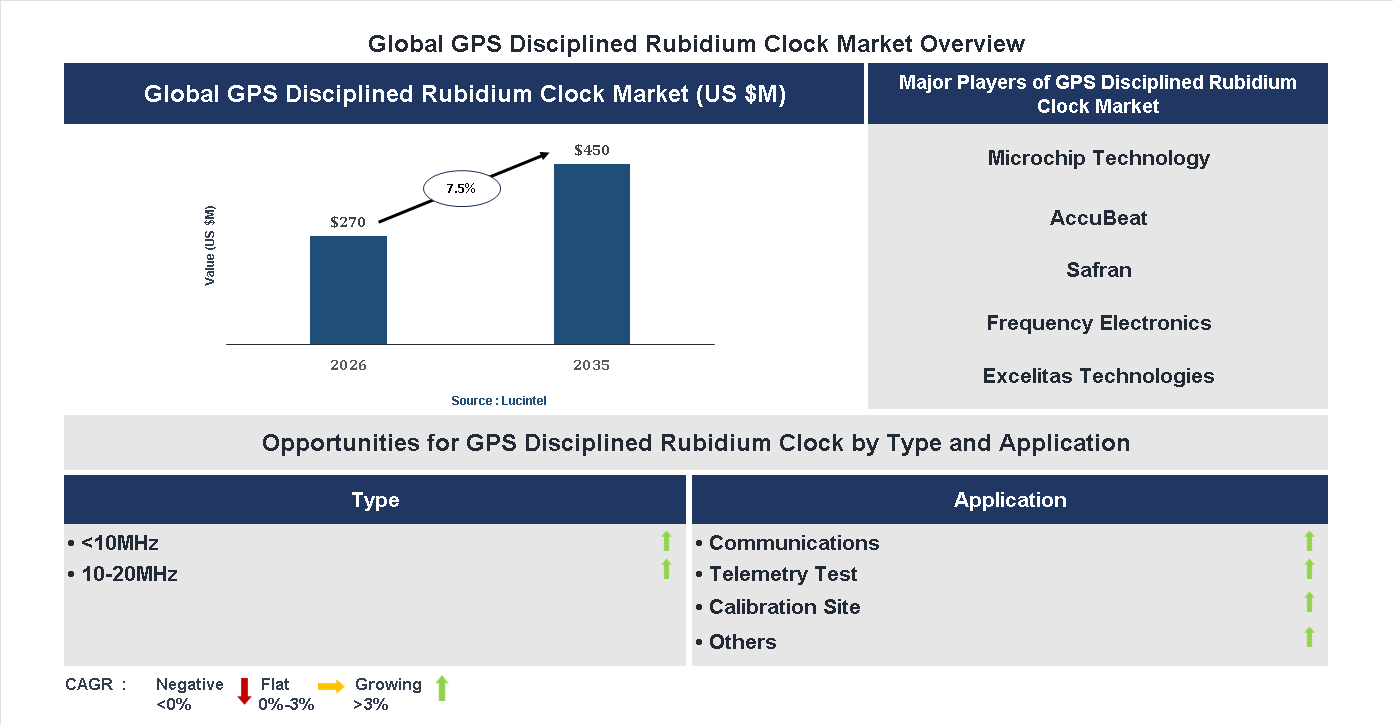
The future of the global GPS disciplined rubidium clock market looks promising with opportunities in the communication, telemetry test, and calibration site markets. The global GPS disciplined rubidium clock market is expected to reach an estimated $450 million by 2035 with a CAGR of 7.5% from 2026 to 2035. The major drivers for this market are the increasing demand for precise timing, the rising adoption of telecom synchronization, and the growing need for network reliability.• Lucintel forecasts that, within the type category, 10-20MHz is expected to witness higher growth over the forecast period.
• Within the application category, communication is expected to witness the highest growth.
• In terms of region, APAC is expected to witness the highest growth over the forecast period. Gain valuable insights for your business decisions with our comprehensive 150+ page report. Sample figures with some insights are shown below.
Emerging Trends in the GPS Disciplined Rubidium Clock Market
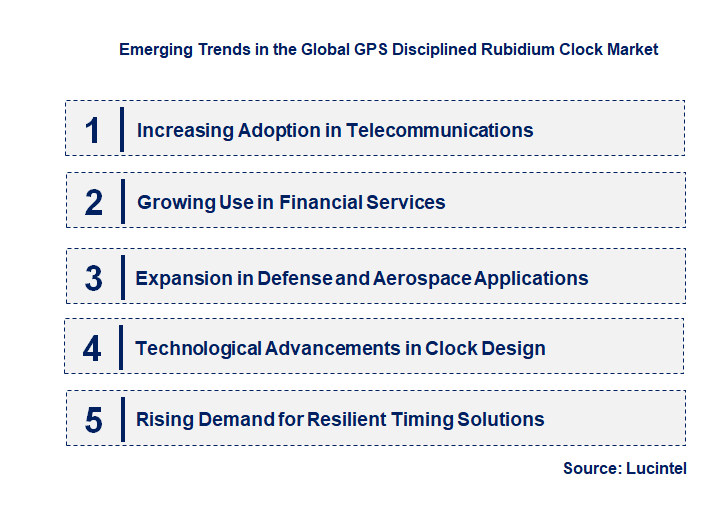
The GPS disciplined rubidium clock market is experiencing rapid evolution driven by technological advancements and increasing demand for precise timing solutions across various industries. As global reliance on satellite navigation, telecommunications, and data centers grows, so does the need for highly accurate and reliable timing devices. Emerging trends are shaping the market landscape, influencing product development, deployment strategies, and competitive dynamics. These developments are not only enhancing performance but also expanding the applications of GPS disciplined rubidium clocks, making them more integral to modern infrastructure and technology ecosystems. Understanding these trends is crucial for stakeholders aiming to capitalize on future opportunities.• Increasing Adoption in Telecommunications: The telecommunications industry is increasingly adopting GPS disciplined rubidium clocks for synchronization purposes. These clocks provide highly accurate timing essential for 4G and 5G networks, ensuring seamless data transfer and network reliability. As telecom infrastructure expands globally, the demand for precise timing solutions grows, driving market growth. The ability of rubidium clocks to deliver stable, long-term accuracy makes them ideal for supporting the high-speed, low-latency requirements of modern communication systems. This trend underscores the critical role of advanced timing devices in enabling next-generation connectivity.
• Growing Use in Financial Services: Financial institutions rely heavily on precise timing for transaction processing, high-frequency trading, and regulatory compliance. GPS disciplined rubidium clocks offer nanosecond-level accuracy, reducing discrepancies and enhancing operational efficiency. The increasing complexity and volume of financial transactions necessitate reliable timing sources to prevent errors and fraud. As the financial sector continues to digitize and automate, the integration of these clocks is becoming standard practice. This trend highlights the importance of accurate timing in maintaining market integrity and competitiveness in the financial industry.
• Expansion in Defense and Aerospace Applications: Defense and aerospace sectors are increasingly deploying GPS disciplined rubidium clocks for navigation, missile guidance, and secure communications. The robustness and high accuracy of these clocks are vital for mission-critical operations, especially in environments where GPS signals may be jammed or denied. The development of more resilient and miniaturized rubidium clocks is enabling their integration into a broader range of military and space applications. This trend reflects the strategic importance of precise timing in national security and space exploration, driving innovation and investment in advanced clock technologies.
• Technological Advancements in Clock Design: Innovations in miniaturization, power efficiency, and stability are transforming GPS disciplined rubidium clocks. New materials and engineering techniques are producing more compact, energy-efficient devices with enhanced performance. These advancements facilitate easier integration into various platforms, including portable and embedded systems. Improved stability and reduced maintenance requirements are making these clocks more attractive for diverse applications. This trend is fostering increased competition among manufacturers and expanding the potential use cases for rubidium clocks across industries, ultimately leading to more reliable and accessible timing solutions.
• Rising Demand for Resilient Timing Solutions: The increasing frequency of cyber threats, signal jamming, and environmental disruptions is driving the need for resilient timing solutions. GPS disciplined rubidium clocks are being integrated with backup systems and anti-jamming technologies to ensure uninterrupted operation. This resilience is critical for sectors like critical infrastructure, emergency services, and autonomous vehicles, where precise timing is essential for safety and efficiency. The market is witnessing a shift towards more secure and robust timing architectures, emphasizing the importance of reliability in mission-critical applications. This trend underscores the growing focus on security and dependability in timing technology. These emerging trends are significantly reshaping the GPS disciplined rubidium clock market by enhancing performance, expanding application scope, and emphasizing resilience. The integration of advanced technologies and increasing industry demands are driving innovation, making these clocks indispensable in modern digital and communication infrastructure. As these trends continue, the market is poised for sustained growth, with new opportunities emerging across sectors that rely on precise timing for operational excellence and security.
Recent Development in the GPS Disciplined Rubidium Clock Market
The GPS disciplined rubidium clock market is experiencing rapid advancements driven by the increasing demand for precise timing solutions across various industries. Technological innovations and expanding applications are fueling growth, making these clocks essential for telecommunications, defense, and financial sectors. As industries seek higher accuracy and reliability, market players are investing heavily in research and development. These developments are shaping the future landscape, offering new opportunities for growth and competitive advantage in the global market.• Growing Demand for Precise Timing in Telecommunications: The telecommunications industry requires highly accurate timing for network synchronization, especially with 5G deployment. GPS disciplined rubidium clocks provide the necessary precision, reducing latency and improving network reliability. This demand is driving manufacturers to innovate more robust and cost-effective solutions, expanding market reach. As 5G networks grow, the need for reliable timing solutions will further accelerate, making these clocks indispensable for future infrastructure.
• Expansion in Defense and Military Applications: Defense sectors rely heavily on GPS disciplined rubidium clocks for navigation, missile guidance, and secure communications. The increasing sophistication of military technology necessitates highly accurate and stable timing sources. Governments are investing in advanced clock systems to enhance operational efficiency and security. This trend is boosting market growth, with manufacturers developing ruggedized, military-grade clocks that withstand harsh environments, ensuring strategic advantages and operational reliability.
• Technological Innovations Enhancing Accuracy and Stability: Recent developments focus on improving the accuracy, stability, and miniaturization of rubidium clocks. Innovations such as temperature compensation and advanced calibration techniques have significantly enhanced performance. These improvements enable integration into smaller devices and systems, broadening application scopes. Enhanced stability reduces maintenance needs and operational costs, making these clocks more attractive for commercial and industrial uses, thus expanding market opportunities.
• Rising Adoption in Financial Sector for High-Frequency Trading: The financial industry demands ultra-precise timing for high-frequency trading (HFT) to ensure transaction accuracy and compliance. GPS disciplined rubidium clocks offer nanosecond-level synchronization, reducing discrepancies and preventing financial losses. As HFT continues to grow, the need for reliable timing solutions intensifies. Market players are developing specialized clocks tailored for financial institutions, which are expected to significantly boost market growth and competitiveness in this sector.
• Increasing Focus on Cost-Effective and Compact Solutions: Cost reduction and miniaturization are key trends driving market development. Manufacturers are designing smaller, more affordable rubidium clocks without compromising performance. These compact solutions facilitate integration into a wider range of devices, including IoT and portable systems. The focus on affordability and size reduction is expanding the market to new sectors, such as consumer electronics and small-scale industrial applications, fostering broader adoption and growth. The recent developments in the GPS disciplined rubidium clock market are significantly enhancing its precision, reliability, and application scope. Innovations and expanding use cases are driving market growth across telecommunications, defense, finance, and industrial sectors. These advancements are fostering increased adoption, reducing costs, and enabling integration into diverse systems. Overall, these opportunities are positioning the market for sustained growth, increased competitiveness, and technological leadership in the global timing solutions industry.
Strategic Growth Opportunities in the GPS Disciplined Rubidium Clock Market
The GPS disciplined rubidium clock market is experiencing significant growth driven by the increasing demand for precise timing solutions across telecommunications, defense, and financial sectors. Advancements in atomic clock technology and the need for high accuracy in global positioning systems are fueling market expansion. Additionally, the integration of these clocks into emerging applications such as autonomous vehicles and 5G networks presents substantial opportunities for industry players to innovate and capture new revenue streams.• Enhanced Precision for Critical Infrastructure: The demand for highly accurate timing sources in telecommunications, power grids, and financial networks is escalating. GPS disciplined rubidium clocks offer exceptional stability and accuracy, ensuring synchronization across complex systems. This precision reduces errors, enhances security, and improves operational efficiency, making them indispensable for critical infrastructure. As reliance on digital and connected systems grows, the need for reliable timing solutions will further propel market growth.
• Growing Adoption in Defense and Military Applications: Defense sectors require robust, secure, and precise timing devices for navigation, missile guidance, and secure communications. GPS disciplined rubidium clocks provide military-grade accuracy and resistance to jamming and spoofing. Their ability to operate independently of external signals enhances security and reliability. Increasing defense budgets and technological modernization initiatives worldwide are driving the adoption of these clocks in military applications, creating substantial growth opportunities.
• Expansion into Commercial and Consumer Markets: The proliferation of IoT devices, autonomous vehicles, and 5G networks necessitates highly accurate timing solutions. GPS disciplined rubidium clocks are increasingly integrated into commercial products to ensure seamless connectivity and synchronization. Their compact size, reliability, and precision make them suitable for consumer electronics and commercial applications. As these markets expand, the demand for advanced timing solutions will significantly increase, fostering market development.
• Technological Innovations Improving Performance and Cost-Effectiveness: Ongoing research and development efforts are leading to more compact, energy-efficient, and cost-effective rubidium clocks. Innovations such as miniaturization and improved thermal stability enhance their suitability for a broader range of applications. These advancements reduce overall system costs and improve performance, making high-precision timing accessible to a wider customer base. This technological progress is expected to accelerate market penetration and adoption across various sectors.
• Rising Demand for Resilient and Autonomous Timing Solutions: The increasing need for resilient timing systems that can operate independently of GPS signals is a key growth driver. GPS disciplined rubidium clocks can function in GPS-denied environments, ensuring continuous synchronization. This capability is critical for applications in remote locations, disaster recovery, and secure military operations. The development of autonomous timing solutions enhances system reliability and security, opening new avenues for market expansion in sectors requiring uninterrupted precise timing. The overall market outlook is strongly positive, with these growth opportunities driving innovation, expanding application areas, and increasing demand for high-precision timing solutions. As industries continue to evolve towards greater connectivity and security, GPS disciplined rubidium clocks will play a vital role in supporting these advancements, ensuring sustained market growth and technological progress.
GPS Disciplined Rubidium Clock Market Driver and Challenges
The GPS disciplined rubidium clock market is influenced by a variety of technological, economic, and regulatory factors. Rapid advancements in satellite navigation technology, increasing demand for precise timing solutions across industries, and stringent regulatory standards for communication and defense sectors are key drivers. Additionally, economic growth in emerging markets and the need for reliable synchronization in telecommunications further propel market expansion. However, the market also faces challenges such as high manufacturing costs, geopolitical restrictions, and technological obsolescence. These factors collectively shape the growth trajectory and competitive landscape of the GPS disciplined rubidium clock market, requiring stakeholders to adapt to evolving technological and regulatory environments. The factors responsible for driving the GPS disciplined rubidium clock market include:• Technological Advancements: The continuous development of more accurate and reliable timing solutions fuels market growth. Innovations in atomic clock technology improve precision, stability, and miniaturization, making these clocks suitable for a broader range of applications such as 5G networks, autonomous vehicles, and military systems. As industries demand higher synchronization accuracy, manufacturers invest heavily in R&D to stay competitive, which accelerates market expansion.
• Growing Demand for Precise Timing in Telecommunications: The expansion of 5G networks and the increasing reliance on high-speed data transmission require highly accurate timing solutions. GPS Disciplined Rubidium Clocks provide the synchronization needed for seamless communication, reducing latency and improving network reliability. This demand from telecom operators worldwide is a significant driver, especially as the deployment of 5G infrastructure accelerates globally.
• Defense and Aerospace Sector Expansion: Military and aerospace applications require highly secure, accurate, and reliable timing sources for navigation, communication, and surveillance systems. The increasing investments in defense modernization programs and space exploration initiatives boost demand for GPS Disciplined Rubidium Clocks. Their robustness and precision make them indispensable in these high-stakes environments, further propelling market growth.
• Regulatory and Standardization Frameworks: Governments and international bodies are establishing strict standards for timing accuracy and security in critical infrastructure. Compliance with these regulations encourages industries to adopt advanced timing solutions like GPS Disciplined Rubidium Clocks. This regulatory push ensures market players innovate and upgrade their offerings to meet evolving standards, fostering growth. The challenges facing the GPS disciplined rubidium clock market include:
• High Manufacturing and Maintenance Costs: The production of GPS Disciplined Rubidium Clocks involves sophisticated technology and high-precision components, leading to significant costs. Additionally, maintenance and calibration require specialized expertise, increasing operational expenses. These high costs can limit adoption among smaller organizations and in cost-sensitive markets, constraining overall market growth.
• Geopolitical Restrictions and Security Concerns: Certain countries impose restrictions on the export and use of advanced timing technology due to national security concerns. These restrictions hinder global trade and limit market access for some manufacturers. Moreover, concerns over signal spoofing and jamming threaten the reliability of GPS-based systems, prompting the need for additional security measures that can be costly and complex to implement.
• Technological Obsolescence and Competition: Rapid technological evolution can render existing GPS Disciplined Rubidium Clocks obsolete quickly. Competition from alternative timing solutions, such as chip-scale atomic clocks and network-based synchronization methods, challenges the markets growth. Companies must continually innovate to maintain relevance, which involves substantial R&D investments and risk. The GPS disciplined rubidium clock market is driven by technological innovation, increasing demand for precise timing in telecommunications, and expansion in defense sectors. However, high costs, geopolitical restrictions, and rapid technological changes pose significant challenges. These factors collectively influence market dynamics, requiring stakeholders to balance innovation with strategic risk management. The overall impact is a market poised for growth but necessitating careful navigation of regulatory and technological landscapes to sustain competitiveness.
List of GPS Disciplined Rubidium Clock Companies
Companies in the market compete on the basis of product quality offered. Major players in this market focus on expanding their manufacturing facilities, R&D investments, infrastructural development, and leverage integration opportunities across the value chain. With these strategies GPS disciplined rubidium clock companies cater increasing demand, ensure competitive effectiveness, develop innovative products & technologies, reduce production costs, and expand their customer base. Some of the GPS disciplined rubidium clock companies profiled in this report include-• Microchip Technology
• AccuBeat
• Safran
• Frequency Electronics
• Excelitas Technologies
• IQD Frequency Products
• SRS
GPS Disciplined Rubidium Clock Market by Segment
The study includes a forecast for the global GPS disciplined rubidium clock market by type, application, and region.GPS Disciplined Rubidium Clock Market by Type [Value from 2019 to 2035]:
• <10MHz
• 10-20MHz
GPS Disciplined Rubidium Clock Market by Application [Value from 2019 to 2035]:
• Communications
• Telemetry Test
• Calibration Site
• Others
GPS Disciplined Rubidium Clock Market by Region [Value from 2019 to 2035]:
• North America
• Europe
• Asia Pacific
• The Rest of the World
Country Wise Outlook for the GPS Disciplined Rubidium Clock Market
The GPS disciplined rubidium clock market has experienced significant technological advancements and increased adoption across various regions, driven by the growing demand for precise timing solutions in telecommunications, defense, and navigation systems. As industries seek higher accuracy and reliability, countries are investing in innovative clock technologies to enhance their infrastructure and security. The market dynamics are influenced by geopolitical factors, technological innovations, and the expansion of 5G networks, which require highly accurate timing sources. This report highlights recent developments in the United States, China, Germany, India, and Japan, reflecting their strategic priorities and technological progress in this sector.• United States: The US market has seen increased investments in defense and telecommunications sectors, with major players developing advanced GPS disciplined rubidium clocks to support 5G infrastructure and military applications. The government’s focus on national security has driven innovation and procurement of high-precision timing devices. Additionally, collaborations between tech firms and defense agencies have accelerated the deployment of these clocks in critical systems.
• China: China has made substantial progress in domestic clock manufacturing and technology development, aiming for self-sufficiency. The country’s focus on 5G expansion and satellite navigation systems has led to increased adoption of GPS disciplined rubidium clocks in both civilian and military applications. Chinese companies are also investing in research to improve clock stability and reduce costs, aligning with national strategic goals.
• Germany: Germany’s market is characterized by a strong emphasis on industrial automation and telecommunications. Leading firms are integrating GPS disciplined rubidium clocks into their infrastructure to ensure synchronization and reliability. The country’s focus on Industry 4.0 initiatives has further boosted demand for precise timing solutions, with a particular emphasis on quality and compliance with European standards.
• India: India is rapidly expanding its telecommunications and defense sectors, driving demand for accurate timing solutions. The government’s push for digital infrastructure and 5G deployment has increased the adoption of GPS disciplined rubidium clocks. Indian manufacturers are also collaborating with international firms to enhance local capabilities and reduce dependency on imports.
• Japan: Japan’s market is driven by advancements in electronics, transportation, and security systems. The country is investing in high-precision timing devices to support its smart city initiatives and transportation networks. Japanese companies are focusing on miniaturization and energy efficiency of rubidium clocks, ensuring their integration into various industrial and consumer applications.

Features of the Global GPS Disciplined Rubidium Clock Market
Market Size Estimates: GPS disciplined rubidium clock market size estimation in terms of value ($M). Trend and Forecast Analysis: Market trends (2019 to 2025) and forecast (2026 to 2035) by various segments and regions. Segmentation Analysis: GPS disciplined rubidium clock market size by type, application, and region in terms of value ($M). Regional Analysis: GPS disciplined rubidium clock market breakdown by North America, Europe, Asia Pacific, and Rest of the World. Growth Opportunities: Analysis of growth opportunities in different types, applications, and regions for the GPS disciplined rubidium clock market. Strategic Analysis: This includes M&A, new product development, and competitive landscape of the GPS disciplined rubidium clock market. Analysis of competitive intensity of the industry based on Porter’s Five Forces model.
FAQ
Q1. What is the GPS disciplined rubidium clock market size? Answer: The global GPS disciplined rubidium clock market is expected to reach an estimated $450 million by 2035. Q2. What is the growth forecast for GPS disciplined rubidium clock market? Answer: The global GPS disciplined rubidium clock market is expected to grow with a CAGR of 7.5% from 2026 to 2035. Q3. What are the major drivers influencing the growth of the GPS disciplined rubidium clock market? Answer: The major drivers for this market are the increasing demand for precise timing, the rising adoption of telecom synchronization, and the growing need for network reliability. Q4. What are the major segments for GPS disciplined rubidium clock market? Answer: The future of the GPS disciplined rubidium clock market looks promising with opportunities in the communication, telemetry test, and calibration site markets. Q5. Who are the key GPS disciplined rubidium clock market companies? Answer: Some of the key GPS disciplined rubidium clock companies are as follows:• Microchip Technology
• AccuBeat
• Safran
• Frequency Electronics
• Excelitas Technologies
• IQD Frequency Products
• SRS Q6. Which GPS disciplined rubidium clock market segment will be the largest in future? Answer: Lucintel forecasts that, within the type category, 10-20MHz is expected to witness higher growth over the forecast period. Q7. In GPS disciplined rubidium clock market, which region is expected to be the largest in next 5 years? Answer: In terms of region, APAC is expected to witness the highest growth over the forecast period. Q8. Do we receive customization in this report? Answer: Yes, Lucintel provides 10% customization without any additional cost.
Table of Contents
List of Figures
List of Tables
Methodology
- In-depth interviews of the major players in this market
- Detailed secondary research from competitors’ financial statements and published data
- Extensive searches of published works, market, and database information pertaining to industry news, company press releases, and customer intentions
- A compilation of the experiences, judgments, and insights of Lucintel’s professionals, who have analyzed and tracked this market over the years.


Buy Now
Choose a license that fits your team. Instant PDF delivery.
Prices exclude taxes. Instant delivery. Custom licensing available on request.
Key Questions
- • What are some of the most promising, high-growth opportunities for the GPS disciplined rubidium clock market by type (


