
Market Report · July 31, 2026

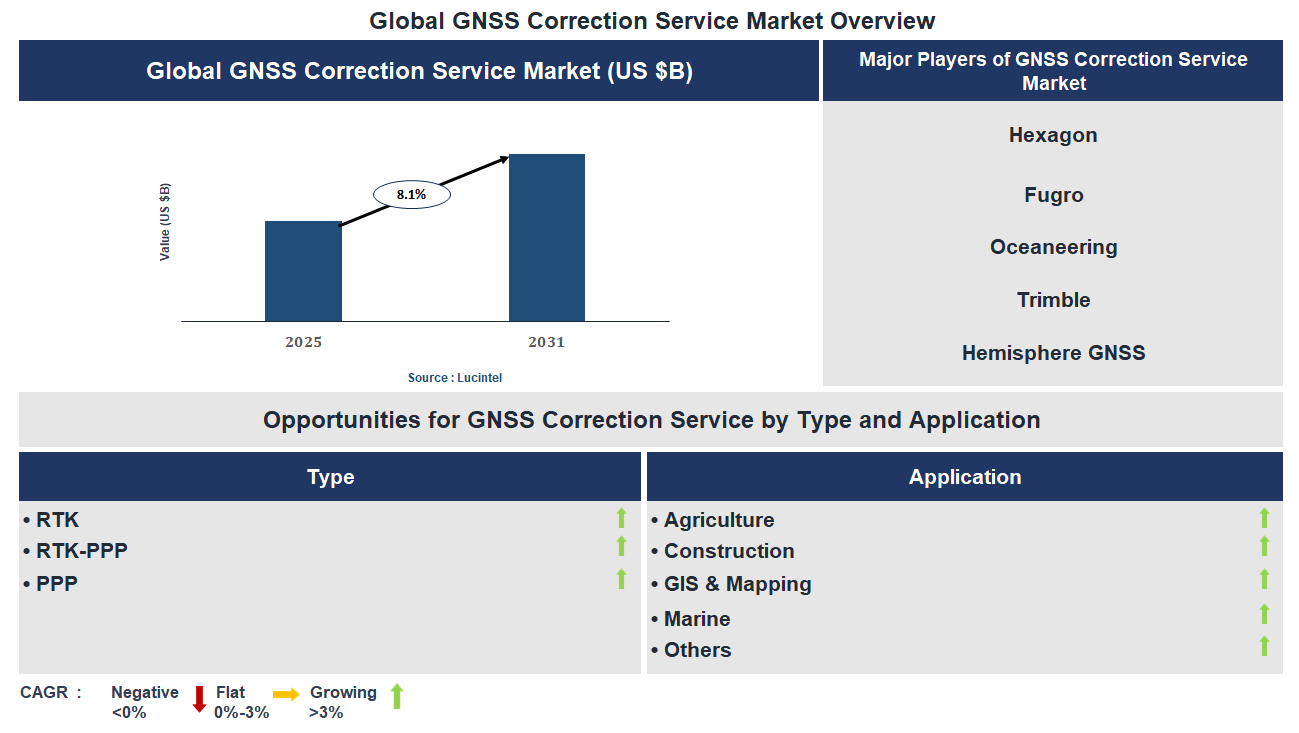
Key data points: The growth forecast = 8.1% annually for the next 7 years. Scroll below to get more insights. This market report covers trends, opportunities and forecasts in GNSS correction service market to 2031 by type (RTK, RTK-PPP, and PPP), application (agriculture, construction, GIS & mapping, marine, and others), and region (North America, Europe, Asia Pacific, and the Rest of the World)
We'll send your sample report shortly.
• Lucintel forecasts that, within the type category, RTK is expected to witness the highest growth over the forecast period.
• Within the application category, agriculture is expected to witness the highest growth.
• In terms of region, APAC is expected to witness the highest growth over the forecast period. Gain valuable insights for your business decisions with our comprehensive 150+ page report. Sample figures with some insights are shown below.
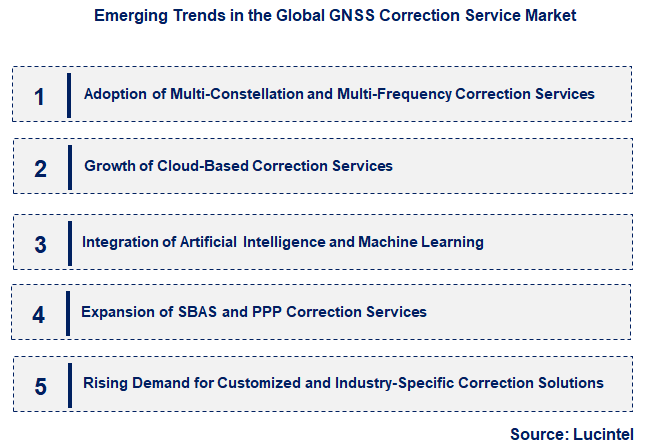
• Adoption of Multi-Constellation and Multi-Frequency Correction Services: This trend involves integrating signals from multiple satellite constellations like GPS, GLONASS, Galileo, and BeiDou, along with multi-frequency signals. It enhances positioning accuracy, reliability, and availability, especially in challenging environments such as urban canyons or dense forests. The increased use of multi-constellation correction services reduces signal blockages and improves service continuity, making GNSS solutions more robust for critical applications like autonomous vehicles and precision agriculture. This trend is driving market growth by expanding the usability and dependability of GNSS correction services.
• Growth of Cloud-Based Correction Services: Cloud technology is transforming how correction data is delivered and managed. Cloud-based correction services offer real-time, scalable, and cost-effective solutions accessible via internet platforms. They enable service providers to deliver high-precision corrections without extensive on-site infrastructure, reducing costs for end-users. This trend facilitates easier deployment in remote or underserved areas and supports the expansion of GNSS applications in emerging markets. The shift to cloud-based solutions is making high-accuracy GNSS correction services more flexible, accessible, and efficient, thereby broadening market reach and adoption.
• Integration of Artificial Intelligence and Machine Learning: AI and ML are increasingly being incorporated into GNSS correction systems to enhance data processing, anomaly detection, and predictive analytics. These technologies improve the accuracy and reliability of correction signals by identifying and mitigating errors in real-time. AI-driven systems can adapt to changing environmental conditions, optimize correction algorithms, and provide more precise positioning data. This integration is crucial for applications requiring ultra-high accuracy, such as autonomous navigation and surveying. The adoption of AI and ML is significantly elevating the performance and intelligence of GNSS correction services, fostering innovation and competitive advantage.
• Expansion of SBAS and PPP Correction Services: Satellite-Based Augmentation Systems (SBAS) and Precise Point Positioning (PPP) are gaining prominence due to their ability to deliver high-precision corrections over large areas. SBAS provides regional corrections, while PPP offers centimeter-level accuracy globally. These services are increasingly used in aviation, maritime, and surveying industries, where high accuracy is critical. The expansion of SBAS and PPP services is driven by technological improvements and increased satellite coverage, making precise GNSS positioning more accessible and reliable. This trend is broadening the market scope and enabling new applications that demand high-precision positioning.
• Rising Demand for Customized and Industry-Specific Correction Solutions: As industries have diverse requirements, there is a growing need for tailored correction services that address specific operational challenges. Customized solutions offer optimized accuracy, latency, and reliability for sectors like agriculture, mining, construction, and defense. Industry-specific correction services improve operational efficiency, safety, and compliance with regulatory standards. Providers are increasingly developing specialized correction packages, integrating additional data sources, and offering flexible delivery options. This trend enhances customer satisfaction and market segmentation, fostering innovation and competitive differentiation within the GNSS correction service market. In summary, these emerging trends are collectively transforming the GNSS correction service market by improving accuracy, expanding accessibility, and enabling new applications. The integration of advanced technologies, diversified correction methods, and industry-specific solutions is making GNSS correction services more reliable, scalable, and tailored to user needs. As a result, the market is poised for sustained growth, innovation, and increased adoption across multiple sectors, reshaping the landscape of precise positioning solutions worldwide.
• Technological Advancements in Correction Methods: Enhanced algorithms and hybrid correction techniques, such as real-time kinematic (RTK) and precise point positioning (PPP), have improved accuracy and reliability, enabling applications requiring centimeter-level precision and expanding market adoption.
• Expansion of Regional Coverage: Service providers are extending correction signal coverage to underserved regions, including emerging markets, which broadens access to high-precision GNSS services and stimulates market growth globally.
• Integration with IoT and 5G Networks: The incorporation of GNSS correction services with IoT devices and 5G networks facilitates real-time data transmission and improved positioning accuracy, supporting smart city initiatives, autonomous vehicles, and industrial automation.
• Growth in Agriculture and Construction Sectors: Increased adoption of GNSS correction services in precision agriculture and construction enhances operational efficiency, reduces costs, and promotes sustainable practices, significantly impacting market demand.
• Emergence of Cloud-Based Correction Services: Cloud platforms offer scalable, cost-effective correction solutions, enabling easier access for small and medium-sized enterprises and fostering a broader user base and new business models. These developments are collectively transforming the GNSS correction service market by enhancing accuracy, expanding accessibility, and integrating with emerging digital technologies. As a result, the market is experiencing accelerated growth, diversified application areas, and increased competitiveness, positioning it for sustained expansion in the coming years.
• Agriculture: Precision farming is a major growth opportunity, as GNSS correction services enable farmers to optimize crop yields through accurate field mapping, automated machinery guidance, and resource management. This reduces input costs and increases productivity, making agriculture more sustainable and profitable.
• Transportation: The integration of GNSS correction services in autonomous vehicles and fleet management systems enhances navigation accuracy and safety. This development supports the shift toward smart transportation networks, reducing accidents and improving logistical efficiency across urban and rural areas.
• Construction: Accurate positioning is vital for construction projects, especially in large-scale infrastructure development. GNSS correction services improve site surveying, machine control, and asset management, leading to reduced project timelines and cost savings, while increasing overall project precision.
• Defense: Military applications benefit from high-precision GNSS correction services for missile guidance, troop navigation, and surveillance. These services bolster national security by providing reliable, real-time positioning data in challenging environments, enhancing operational effectiveness.
• Surveying and Mapping: The demand for precise geospatial data drives growth in surveying and mapping applications. GNSS correction services improve the accuracy of geographic information systems (GIS), supporting urban planning, environmental monitoring, and disaster management efforts. In summary, these key growth opportunities are significantly impacting the GNSS correction service market by expanding its application scope, improving accuracy, and fostering technological innovation. As industries increasingly rely on precise positioning, the market is poised for sustained growth, driven by the need for smarter, safer, and more efficient solutions across diverse sectors.
• Technological Advancements: The continuous evolution of satellite and receiver technology enhances the accuracy and reliability of GNSS correction services. Innovations such as real-time kinematic (RTK) and precise point positioning (PPP) enable high-precision applications, expanding market opportunities. These advancements reduce latency and improve signal integrity, making services more accessible and efficient for users across various sectors. As technology progresses, the cost of equipment decreases, further democratizing access and fostering widespread adoption.
• Growing Adoption in Agriculture: Precision agriculture relies heavily on GNSS correction services to optimize crop yields and resource management. Farmers utilize these services for automated steering, field mapping, and soil analysis, which improve efficiency and reduce operational costs. The increasing global demand for food security and sustainable farming practices drives investments in GNSS solutions, making agriculture a significant growth segment within the market.
• Infrastructure Development and Smart Cities: Governments and private entities are investing heavily in infrastructure projects and smart city initiatives that require accurate positioning and navigation solutions. GNSS correction services support applications such as traffic management, urban planning, and public safety. These developments create a robust demand for high-precision GNSS services, fueling market growth and encouraging technological innovation to meet urbanization needs.
• Rising Investment and Market Expansion: The increasing influx of investments from private and public sectors into GNSS infrastructure and service providers accelerates market growth. Countries are deploying advanced satellite constellations and ground-based augmentation systems to enhance service coverage and accuracy. This financial backing fosters competitive innovation, expands service offerings, and opens new markets, especially in emerging economies seeking to leverage GNSS for economic development.
• Regulatory Support and Standardization: Governments and international bodies are establishing standards and regulations to ensure the quality, security, and interoperability of GNSS correction services. Regulatory support facilitates market confidence, encourages investment, and promotes the adoption of standardized solutions across industries. This environment fosters innovation while ensuring compliance, ultimately driving market stability and growth. The challenges in the GNSS correction service market are:
• Technological Complexities and Integration Issues: Implementing GNSS correction services involves sophisticated technology that requires seamless integration with existing systems. Compatibility issues between different satellite constellations, ground stations, and user equipment can hinder widespread adoption. Additionally, maintaining high accuracy in challenging environments such as urban canyons or dense forests remains a technical challenge, potentially limiting service reliability and user confidence.
• High Implementation and Maintenance Costs: Deploying and maintaining GNSS correction infrastructure, including ground stations and augmentation systems, involves significant capital expenditure. Small and medium-sized enterprises may find these costs prohibitive, restricting market penetration. Ongoing maintenance, software updates, and system upgrades further add to operational expenses, which could slow down adoption, especially in cost-sensitive regions.
• Regulatory Uncertainties and Geopolitical Risks: The GNSS market is subject to evolving regulations related to spectrum allocation, data security, and international cooperation. Geopolitical tensions can lead to restrictions or disruptions in satellite signals and service provision, impacting reliability. Unclear or inconsistent regulatory frameworks across countries create barriers to cross-border service deployment and hinder global market expansion, posing risks to investors and service providers. In summary, the GNSS correction service market is driven by technological innovations, expanding applications in agriculture and urban development, increased investments, and supportive regulatory frameworks. However, technological complexities, high costs, and regulatory uncertainties present significant challenges. These factors collectively influence the markets trajectory, requiring stakeholders to navigate a landscape marked by rapid technological change and evolving policy environments. Overall, the markets growth potential remains substantial, provided that these challenges are effectively managed through innovation, collaboration, and strategic investments.
• Hexagon
• Fugro
• Oceaneering
• Trimble
• Hemisphere GNSS
• Topcon
• Septentrio NV
• RTK
• RTK-PPP
• PPP
• Agriculture
• Construction
• GIS & Mapping
• Marine
• Others
• North America
• Europe
• Asia Pacific
• The Rest of the World
• United States: The US market has seen rapid adoption of advanced GNSS correction services, driven by innovations in satellite-based augmentation systems (SBAS) and the expansion of autonomous vehicle testing. Major players are investing in high-precision solutions for agriculture, construction, and defense sectors. Regulatory frameworks supporting the deployment of these services have also contributed to market growth, with increased collaborations between government agencies and private firms to improve coverage and accuracy.
• China: China has made substantial progress in developing its BeiDou Navigation Satellite System (BDS) and associated correction services, aiming for global coverage. The government has prioritized the integration of GNSS correction services into smart city projects, transportation, and agriculture. Domestic companies are actively expanding their service offerings, and China’s focus on technological self-reliance has accelerated the deployment of innovative correction solutions to support its digital infrastructure ambitions.
• Germany: Germany’s market is characterized by a strong emphasis on precision agriculture, industrial automation, and surveying applications. The country has adopted EGNOS (European Geostationary Navigation Overlay Service) and other regional augmentation systems to enhance GNSS accuracy. Collaborations between research institutions and industry players are fostering the development of next-generation correction services, with a focus on integrating these solutions into European Union initiatives for smart infrastructure and transportation.
• India: India has seen rapid growth in GNSS correction services, driven by government initiatives like Digital India and Smart Cities. The adoption of GPS and GAGAN (GPS Aided GEO Augmented Navigation) systems has increased, especially in agriculture, transportation, and urban planning. Local startups and telecom providers are investing in developing affordable correction solutions, aiming to improve navigation accuracy and support the country’s expanding infrastructure projects.
• Japan: Japan’s market is focused on high-precision applications in robotics, autonomous vehicles, and disaster management. The country has advanced regional augmentation systems, such as MSAS and QZSS, to provide reliable correction services. Japan continues to innovate in satellite technology and ground-based augmentation, emphasizing resilience and accuracy to support its technological and industrial leadership in precision navigation and safety-critical applications.


• Hexagon
• Fugro
• Oceaneering
• Trimble
• Hemisphere GNSS
• Topcon
• Septentrio NV Q5. Which GNSS correction service market segment will be the largest in future? Answer: Lucintel forecasts that, within the type category, RTK is expected to witness the highest growth over the forecast period. Q6. In GNSS correction service market, which region is expected to be the largest in next 5 years? Answer: In terms of region, APAC is expected to witness the highest growth over the forecast period. Q7. Do we receive customization in this report? Answer: Yes, Lucintel provides 10% customization without any additional cost.


Choose a license that fits your team. Instant PDF delivery.
Prices exclude taxes. Instant delivery. Custom licensing available on request.
Market Report · July 31, 2026
Market Report · July 31, 2026
Market Report · July 31, 2026
Trusted partner for strategic intelligence and business growth


Receive a complimentary market analysis tailored to your industry. Our analysts will identify key growth opportunities and competitive dynamics specific to your business.

Market size, growth rate, and key trend analysis for your specific sector.

Top competitor positioning and market share analysis.

Strategic recommendations backed by data-driven insights.
Get curated market intelligence and competitive moves straight to your inbox.
By subscribing, you agree to receive our monthly insights. Unsubscribe anytime.
Receive a complimentary market analysis tailored to your industry. Our analysts will identify key growth opportunities and competitive dynamics specific to your business.
Market size, growth rate, and key trend analysis for your specific sector.
Top competitor positioning and market share analysis.
Strategic recommendations backed by data-driven insights.
Get curated market intelligence, emerging trends, and competitive moves straight to your inbox each month.
By subscribing, you agree to receive our monthly insights. Unsubscribe anytime.
We'll send your sample report shortly.