
Report Feature
GNSS Amplifier Market Trends and Forecast
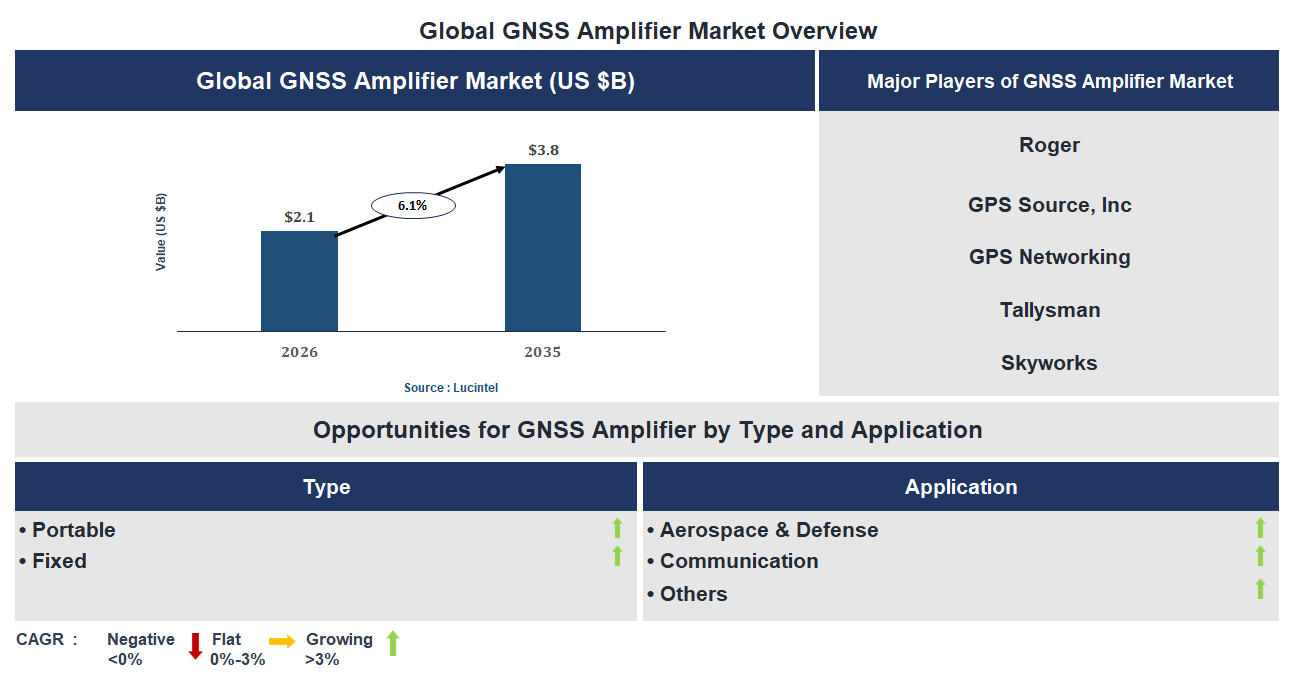
The future of the global GNSS amplifier market looks promising with opportunities in the aerospace & defense and communication markets. The global GNSS amplifier market is expected to reach an estimated $3.8 billion by 2035 with a CAGR of 6.1% from 2026 to 2035. The major drivers for this market are the increasing demand for precise navigation systems, the rising adoption of autonomous vehicle technologies, and the growing need for reliable satellite communication.• Lucintel forecasts that, within the type category, portable is expected to witness higher growth over the forecast period.
• Within the application category, communication is expected to witness higher growth.
• In terms of region, APAC is expected to witness the highest growth over the forecast period. Gain valuable insights for your business decisions with our comprehensive 150+ page report. Sample figures with some insights are shown below.
Emerging Trends in the GNSS Amplifier Market
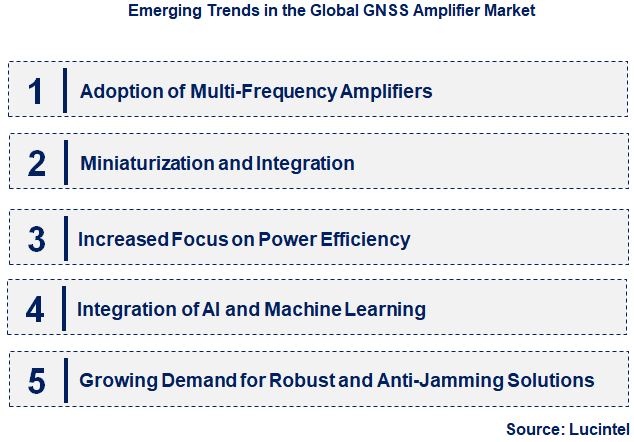
The GNSS amplifier market is experiencing rapid evolution driven by technological advancements, increasing demand for precise positioning, and the integration of innovative solutions across various industries. As the need for accurate navigation and location-based services grows, manufacturers are focusing on enhancing device performance, reducing costs, and expanding application areas. Emerging trends are shaping the competitive landscape, influencing product development, and creating new opportunities for market players. These developments are not only improving existing systems but also paving the way for novel applications, ultimately transforming how industries leverage GNSS technology for improved efficiency and reliability.• Adoption of Multi-Frequency Amplifiers: This trend involves integrating multiple frequency bands into GNSS amplifiers to improve signal accuracy and reliability. Multi-frequency amplifiers can mitigate signal interference and multipath effects, leading to enhanced positioning precision. As industries like autonomous vehicles, surveying, and agriculture demand higher accuracy, multi-frequency solutions are becoming essential. This development is driving innovation in amplifier design, encouraging manufacturers to develop more sophisticated, cost-effective products that support diverse GNSS signals, thereby expanding application possibilities and improving overall system robustness.
• Miniaturization and Integration: The market is witnessing a shift towards smaller, more integrated GNSS amplifiers that can be embedded into compact devices. Miniaturization allows for the deployment of GNSS technology in wearable devices, drones, and IoT applications, broadening its reach. Integration with other communication modules reduces device size and power consumption, making GNSS solutions more versatile and energy-efficient. This trend is crucial for expanding the use of GNSS in consumer electronics and portable devices, fostering innovation, and enabling new use cases that require high performance in limited spaces.
• Increased Focus on Power Efficiency: As GNSS amplifiers are incorporated into battery-powered devices, reducing power consumption has become a priority. Advances in low-power amplifier design help extend device battery life without compromising signal quality. This trend is particularly significant for applications like wearable technology, autonomous vehicles, and remote sensing, where energy efficiency directly impacts usability and operational costs. Manufacturers are investing in new materials and circuit designs to achieve optimal power-performance balance, which is expected to drive market growth by enabling longer-lasting, more reliable GNSS-enabled devices.
• Integration of AI and Machine Learning: The incorporation of AI and machine learning algorithms into GNSS amplifiers is enhancing signal processing capabilities. These technologies enable real-time correction of signal errors, adaptive filtering, and improved interference detection. The result is more accurate and reliable positioning, even in challenging environments. This trend is transforming the market by enabling smarter, self-optimizing GNSS systems that can adapt to changing conditions, thereby expanding their application scope in autonomous navigation, precision agriculture, and disaster management, and setting new standards for performance.
• Growing Demand for Robust and Anti-Jamming Solutions: With increasing reliance on GNSS for critical applications, the need for anti-jamming and anti-spoofing features is rising. Advanced GNSS amplifiers now incorporate sophisticated filtering and shielding techniques to protect signals from interference and malicious attacks. This trend is vital for military, aviation, and critical infrastructure sectors, where signal integrity is paramount. The development of robust solutions enhances system security and reliability, fostering trust and wider adoption of GNSS technology in sensitive and high-stakes environments. In summary, these emerging trends are significantly reshaping the GNSS amplifier market by improving accuracy, reducing size and power consumption, integrating advanced technologies, and enhancing security features. These developments are expanding the application landscape, fostering innovation, and ensuring that GNSS solutions meet the evolving demands of various industries, ultimately driving market growth and technological progress.
Recent Development in the GNSS Amplifier Market
The GNSS amplifier market is experiencing rapid growth driven by increasing demand for precise navigation and positioning solutions across various industries. Technological advancements and expanding applications are fueling market expansion, creating new opportunities for manufacturers and service providers. As industries such as automotive, aerospace, and telecommunications adopt GNSS technology, the market is poised for significant development. This report highlights five key recent developments shaping the future of the GNSS amplifier industry.• Innovation in Signal Amplification: Recent advancements have led to the development of high-efficiency GNSS amplifiers that provide stronger signal amplification with minimal noise. These innovations improve accuracy and reliability in challenging environments, such as urban canyons or remote areas. The new amplifiers support higher frequency bands, enabling better multi-constellation compatibility. This progress boosts user confidence and broadens application scope, especially in critical sectors like aviation, defense, and autonomous vehicles, thereby expanding market opportunities.
• Integration with 5G Networks: The integration of GNSS amplifiers with 5G infrastructure is creating new avenues for enhanced location-based services. These combined systems enable real-time, high-precision positioning essential for autonomous vehicles, smart cities, and IoT devices. The development of compact, energy-efficient amplifiers compatible with 5G networks accelerates deployment in urban environments. This synergy improves service quality, reduces latency, and supports emerging applications, significantly impacting the market by fostering innovation and expanding the customer base.
• Development of Compact and Power-Efficient Amplifiers: Recent developments focus on reducing the size and power consumption of GNSS amplifiers without compromising performance. These compact amplifiers are ideal for portable devices, drones, and wearable technology, broadening application possibilities. Power efficiency improvements extend device battery life, making them more practical for long-term use. The miniaturization trend enhances integration into existing systems, promotes cost-effective manufacturing, and opens new markets, especially in consumer electronics and mobile applications.
• Adoption of AI and Machine Learning: Incorporating AI and machine learning algorithms into GNSS amplifiers enhances signal processing capabilities. These intelligent systems can adapt to interference, multipath effects, and signal degradation in real-time, ensuring higher accuracy and reliability. They enable predictive maintenance and optimize performance under dynamic conditions. This technological leap supports the deployment of GNSS solutions in complex environments, boosting confidence among users and expanding market reach into sectors requiring high precision, such as agriculture, surveying, and defense.
• Focus on Security and Anti-Jamming Technologies: Recent developments emphasize strengthening security features within GNSS amplifiers to counteract jamming and spoofing threats. Advanced anti-jamming and encryption techniques safeguard signal integrity, crucial for military, aviation, and critical infrastructure applications. These innovations ensure continuous, reliable positioning services even in hostile environments. As security concerns grow, the market sees increased demand for robust, secure GNSS amplifiers, fostering trust and enabling wider adoption across sensitive sectors, thus significantly impacting overall market growth. The overall impact of these developments is a more reliable, versatile, and secure GNSS amplifier market. Enhanced performance, integration with emerging technologies, miniaturization, and security improvements are expanding application areas and boosting industry confidence. These advancements are driving market growth, attracting new customers, and fostering innovation across multiple sectors, ultimately shaping a more dynamic and competitive landscape.
Strategic Growth Opportunities in the GNSS Amplifier Market
The GNSS amplifier market is experiencing rapid expansion driven by increasing demand for precise positioning in various industries. Advancements in technology, rising adoption of autonomous systems, and the need for enhanced signal strength are fueling growth opportunities. Market players are focusing on innovation and strategic collaborations to capitalize on emerging applications. This dynamic environment offers significant potential for growth across multiple sectors, making it essential to identify key opportunities that can shape future market trajectories.• Expansion into Autonomous Vehicles: GNSS amplifiers are critical for autonomous vehicle navigation, providing high-precision positioning essential for safety and efficiency. As the automotive industry shifts toward autonomous solutions, demand for reliable GNSS signals increases. Amplifiers improve signal quality in urban canyons and tunnels, overcoming multipath interference. This growth opportunity involves developing compact, high-performance amplifiers tailored for automotive applications, enabling manufacturers to meet stringent accuracy and reliability standards, thus accelerating autonomous vehicle deployment.
• Integration with IoT and Smart Devices: The proliferation of IoT devices and smart infrastructure creates a significant opportunity for GNSS amplifiers to enhance location accuracy. These amplifiers enable precise tracking and monitoring in smart cities, agriculture, and logistics. By integrating with IoT modules, they improve signal strength in challenging environments, ensuring reliable data collection. This trend supports the development of intelligent systems that depend on accurate geolocation, fostering new revenue streams for market players through customized, scalable amplifier solutions.
• Adoption in Aerospace and Defense Sectors: The aerospace and defense industries require highly accurate and secure GNSS signals for navigation, surveillance, and military operations. Amplifiers play a vital role in strengthening weak signals received in remote or obstructed environments. Growing defense budgets and technological advancements drive demand for rugged, high-performance GNSS amplifiers. This opportunity involves designing specialized amplifiers that meet stringent military standards, supporting strategic operations, and enhancing national security capabilities.
• Enhancement of Consumer Electronics: Consumer electronics, including smartphones, wearables, and portable GPS devices, benefit from improved GNSS signal quality. Amplifiers enable better positioning accuracy, especially in urban or indoor settings. As consumer demand for location-based services rises, manufacturers seek compact, energy-efficient amplifiers to integrate into devices. This growth avenue focuses on miniaturization and cost reduction, making high-quality GNSS amplification accessible to a broader market segment, thereby expanding the overall market size.
• Development of Multi-Constellation and Multi-Frequency Solutions: The increasing use of multiple GNSS constellations (GPS, GLONASS, Galileo, BeiDou) necessitates advanced amplifiers capable of handling multi-frequency signals. These solutions improve positioning accuracy and reliability across diverse environments. The opportunity lies in designing versatile amplifiers that support multiple signals simultaneously, reducing interference and multipath effects. This technological advancement caters to sectors requiring high precision, such as surveying, agriculture, and defense, fostering innovation and market competitiveness. These growth opportunities collectively position the GNSS amplifier market for substantial expansion, driven by technological innovation and expanding application domains. As industries increasingly rely on precise geolocation, the demand for advanced amplification solutions will surge, fostering competitive differentiation and market leadership. Embracing these opportunities will enable stakeholders to capitalize on emerging trends, ensuring sustained growth and technological advancement in the evolving GNSS landscape.
GNSS Amplifier Market Driver and Challenges
The GNSS amplifier market is influenced by a variety of technological, economic, and regulatory factors that shape its growth trajectory. Advances in satellite navigation technology, increasing demand for precise positioning in various industries, and supportive government policies are key drivers. Conversely, challenges such as technological complexity, regulatory hurdles, and high development costs pose significant barriers. Understanding these drivers and challenges is essential for stakeholders to navigate the evolving landscape effectively and capitalize on emerging opportunities. The factors responsible for driving the GNSS amplifier market include:-• Technological Advancements: The continuous evolution of GNSS technology, including improved signal processing and miniaturization, enhances amplifier performance. These innovations enable higher accuracy, better signal reception, and increased reliability, which are critical for applications in automotive, aerospace, and defense sectors. As technology advances, manufacturers can develop more efficient and cost-effective amplifiers, fueling market growth and expanding application scope.
• Growing Demand for Precision in Navigation: Industries such as autonomous vehicles, surveying, and agriculture require highly accurate positioning solutions. GNSS amplifiers play a vital role in strengthening signal strength and reducing errors, thereby improving overall system precision. The rising adoption of these applications worldwide drives the need for advanced amplifiers capable of supporting high-precision requirements.
• Increasing Adoption in Emerging Markets: Rapid infrastructure development and urbanization in emerging economies are boosting the demand for reliable navigation and positioning systems. Governments and private enterprises are investing in smart city projects, transportation networks, and logistics, all of which rely heavily on GNSS technology. Amplifiers are essential components in these systems, and their adoption is expected to grow significantly.
• Regulatory Support and Standardization: Governments and industry bodies are establishing standards and regulations that promote the use of GNSS technology for safety and security reasons. These policies encourage the deployment of GNSS amplifiers in critical applications, ensuring compliance and fostering market expansion. Regulatory support also facilitates international trade and technology transfer, further propelling market growth. The challenges facing this GNSS amplifier market include:-
• Technological Complexity and Integration Issues: Developing high-performance GNSS amplifiers involves complex engineering to ensure compatibility with various satellite signals and environmental conditions. Integration with existing systems can be challenging, requiring extensive testing and customization. These complexities increase development time and costs, potentially delaying product launches and limiting market penetration.
• Regulatory and Spectrum Allocation Challenges: The GNSS industry faces strict regulatory frameworks governing spectrum allocation and signal interference. Navigating these regulations can be cumbersome, especially across different countries with varying standards. Interference from other wireless signals can degrade amplifier performance, posing a significant challenge to ensuring reliable operation.
• High Development and Manufacturing Costs: Advanced GNSS amplifiers require sophisticated components and precision manufacturing processes, leading to high costs. These expenses can hinder entry for smaller players and limit price competitiveness. Additionally, ongoing R&D investments are necessary to keep pace with technological advancements, further straining financial resources. In summary, the GNSS amplifier market is driven by technological innovations, increasing demand for precise navigation, emerging market opportunities, and supportive regulatory frameworks. However, technological complexity, regulatory hurdles, and high costs present notable challenges. These factors collectively influence the market’s growth potential, requiring stakeholders to innovate and adapt strategically. Overall, the market’s future will depend on balancing these drivers and overcoming challenges to capitalize on expanding applications and technological advancements.
List of GNSS Amplifier Companies
Companies in the market compete on the basis of product quality offered. Major players in this market focus on expanding their manufacturing facilities, R&D investments, infrastructural development, and leverage integration opportunities across the value chain. With these strategies GNSS amplifier companies cater increasing demand, ensure competitive effectiveness, develop innovative products & technologies, reduce production costs, and expand their customer base. Some of the GNSS amplifier companies profiled in this report include-• Roger
• GPS Source, Inc
• GPS Networking
• Tallysman
• Skyworks
• ETL Systems
• Mercury Systems
• Qorvo
• Forsberg Services
• Lotus
GNSS Amplifier Market by Segment
The study includes a forecast for the global GNSS amplifier market by type, application, and region.GNSS Amplifier Market by Type [Value from 2019 to 2035]:
• Portable
• Fixed
GNSS Amplifier Market by Application [Value from 2019 to 2035]:
• Aerospace & Defense
• Communication
• Others
GNSS Amplifier Market by Region [Value from 2019 to 2035]:
• North America
• Europe
• Asia Pacific
• The Rest of the World
Country Wise Outlook for the GNSS Amplifier Market
The GNSS amplifier market has experienced significant growth driven by increasing demand for precise navigation and positioning solutions across various sectors. Technological advancements, expanding applications in autonomous vehicles, and the integration of GNSS amplifiers in consumer electronics have contributed to this upward trend. Governments and private companies are investing heavily in research and development to enhance signal accuracy, reliability, and coverage. The markets evolution reflects a global push towards smarter, more connected infrastructure, with regional players adopting innovative strategies to capture market share. The following summarizes recent developments in key countries:• United States: The US market has seen substantial investments in autonomous vehicle technology, with major tech firms and automakers integrating advanced GNSS amplifiers to improve navigation accuracy. The government’s focus on 5G and smart city initiatives has also boosted demand for high-performance GNSS solutions. Additionally, research institutions are collaborating with industry leaders to develop next-generation amplifiers that enhance signal strength and reliability in urban environments.
• China: China has rapidly expanded its GNSS infrastructure, notably through the BeiDou system, which has increased domestic demand for GNSS amplifiers. The country’s emphasis on smart transportation, urban planning, and military applications has driven innovation in amplifier technology. Chinese companies are focusing on miniaturization and cost reduction to cater to the growing consumer electronics and automotive markets, positioning China as a key player in the global GNSS amplifier industry.
• Germany: Germany’s market is characterized by a strong focus on industrial automation, precision agriculture, and transportation sectors. Leading engineering firms are developing high-precision GNSS amplifiers to support autonomous machinery and logistics. The country’s emphasis on quality and reliability has led to the adoption of advanced, robust amplifiers that operate effectively in challenging environments, supported by government initiatives promoting digitalization and smart infrastructure.
• India: The Indian market is witnessing rapid growth driven by expanding telecom, transportation, and agriculture sectors. The government’s push for digital connectivity and smart city projects has increased demand for GNSS amplifiers. Local manufacturers are innovating to produce cost-effective solutions suitable for diverse terrains and conditions. Additionally, collaborations with international firms are facilitating technology transfer and boosting the development of high-performance amplifiers tailored to Indian needs.
• Japan: Japan’s focus on robotics, autonomous vehicles, and disaster management has spurred advancements in GNSS amplifier technology. The country’s emphasis on precision and reliability has led to the development of sophisticated amplifiers capable of functioning in complex urban and mountainous terrains. Japanese firms are also investing in miniaturization and energy-efficient designs to support the country’s aging infrastructure and innovative transportation systems, maintaining its position as a leader in high-tech GNSS solutions.

Features of the Global GNSS Amplifier Market
Market Size Estimates: GNSS amplifier market size estimation in terms of value ($B). Trend and Forecast Analysis: Market trends (2019 to 2025) and forecast (2026 to 2035) by various segments and regions. Segmentation Analysis: GNSS amplifier market size by type, application, and region in terms of value ($B). Regional Analysis: GNSS amplifier market breakdown by North America, Europe, Asia Pacific, and Rest of the World. Growth Opportunities: Analysis of growth opportunities in different type, application, and regions for the GNSS amplifier market. Strategic Analysis: This includes M&A, new product development, and competitive landscape of the GNSS amplifier market. Analysis of competitive intensity of the industry based on Porter’s Five Forces model.
FAQ
Q1. What is the market size and growth forecast for GNSS amplifier market? Answer: The global GNSS amplifier market is expected to reach an estimated $3.8 billion by 2035 and grow with a CAGR of 6.1% from 2026 to 2035. Q2. What are the major drivers influencing the growth of the GNSS amplifier market? Answer: The major drivers for this market are the increasing demand for precise navigation systems, the rising adoption of autonomous vehicle technologies, and the growing need for reliable satellite communication. Q3. What are the major segments for GNSS amplifier market? Answer: The future of the GNSS amplifier market looks promising with opportunities in the aerospace & defense and communication markets. Q4. Who are the key GNSS amplifier market companies? Answer: Some of the key GNSS amplifier companies are as follows:• Roger
• GPS Source, Inc
• GPS Networking
• Tallysman
• Skyworks
• ETL Systems
• Mercury Systems
• Qorvo
• Forsberg Services
• Lotus Q5. Which GNSS amplifier market segment will be the largest in future? Answer: Lucintel forecasts that, within the type category, portable is expected to witness higher growth over the forecast period. Q6. In GNSS amplifier market, which region is expected to be the largest in next 5 years? Answer: In terms of region, APAC is expected to witness the highest growth over the forecast period. Q7. Do we receive customization in this report? Answer: Yes, Lucintel provides 10% customization without any additional cost.
Table of Contents
List of Figures
List of Tables
Methodology
- In-depth interviews of the major players in this market
- Detailed secondary research from competitors’ financial statements and published data
- Extensive searches of published works, market, and database information pertaining to industry news, company press releases, and customer intentions
- A compilation of the experiences, judgments, and insights of Lucintel’s professionals, who have analyzed and tracked this market over the years.


Buy Now
Choose a license that fits your team. Instant PDF delivery.
Prices exclude taxes. Instant delivery. Custom licensing available on request.
Key Questions
- • What are some of the most promising, high-growth opportunities for the GNSS amplifier market by type (portable and fixed), application (aerospace & defense, communication, and others), and region (North America, Europe, Asia Pacific, and the Rest of the World)?
- • Which segments will grow at a faster pace and why?
- • Which region will grow at a faster pace and why?
- • What are the key factors affecting market dynamics? What are the key challenges and business risks in this market?
- • What are the business risks and competitive threats in this market?
- • What are the emerging trends in this market and the reasons behind them?
- • What are some of the changing demands of customers in the market?
- • What are the new developments in the market? Which companies are leading these developments?
- • Who are the major players in this market? What strategic initiatives are key players pursuing for business growth?
- • What are some of the competing products in this market and how big of a threat do they pose for loss of market share by material or product substitution?
- • What M&A activity has occurred in the last 7 years and what has its impact been on the industry? For any questions related to GNSS Amplifier Market, GNSS Amplifier Market Size, GNSS Amplifier Market Growth, GNSS Amplifier Market Analysis, GNSS Amplifier Market Report, GNSS Amplifier Market Share, GNSS Amplifier Market Trends, GNSS Amplifier Market Forecast, GNSS Amplifier Companies, write Lucintel analyst at email: helpdesk@lucintel.com. We will be glad to get back to you soon.


