
Market Report · May 18, 2026

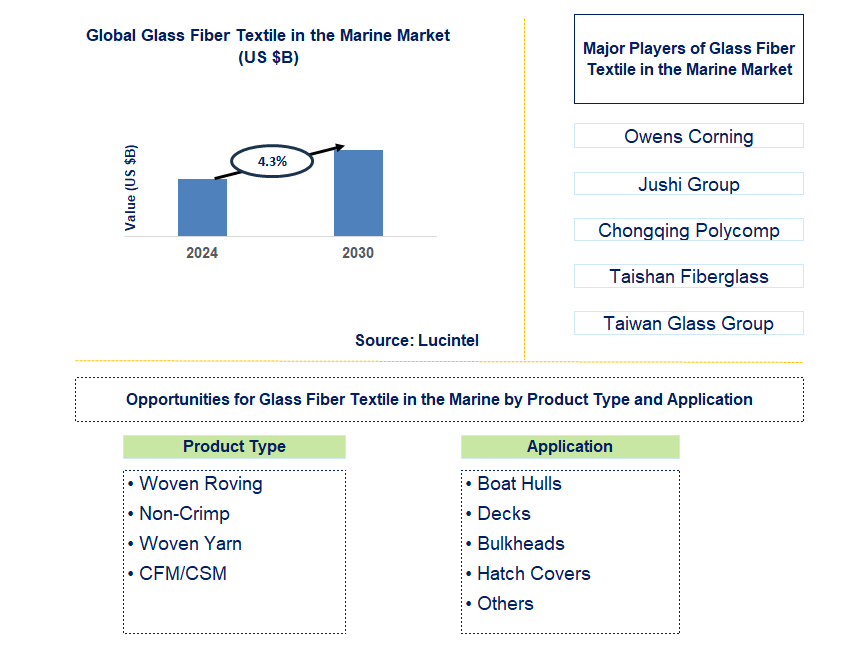
Key data points: The growth forecast = 4.3% annually for the next 6 years. Scroll below to get more insights. This market report covers trends, opportunities, and forecasts in the global glass fiber textile in the marine market to 2030 by product type (woven roving, non-crimp, woven yarn, and CFM/CSM), application (boat hulls, decks, bulkheads, hatch covers, and others), and region (North America, Europe, Asia Pacific, and the Rest of the World)
We'll send your sample report shortly.
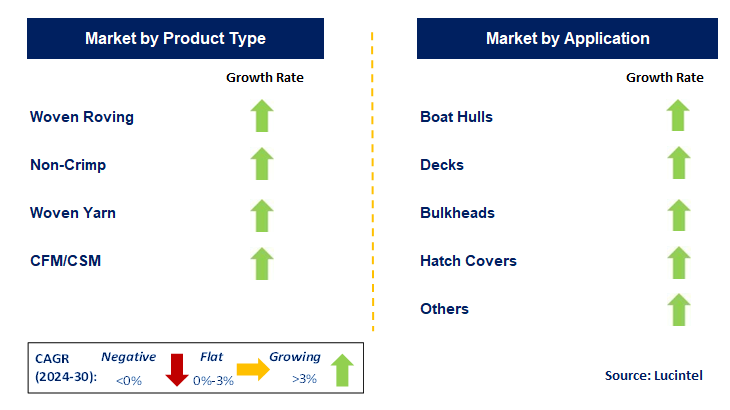
• Lucintel forecasts that, within the product type category, woven roving is expected to witness the highest growth over the forecast period.
• Within the application category, boat hull is expected to witness the highest growth.
• In terms of regions, APAC is expected to witness the highest growth over the forecast period. A more than 150-page report is developed to help in your business decisions.
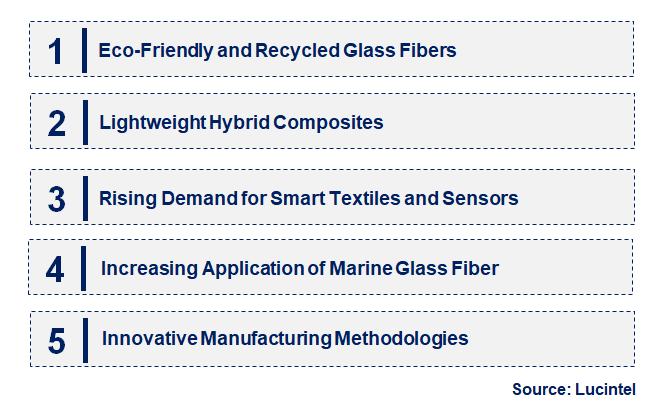
• Eco-Friendly and Recycled Glass Fibers: Environmentalism has changed the way people think about design in the marine industry. The use of recycled glass fibers has increased, which reduces the carbon footprint of glass fiber reinforced polymer composites in shipbuilding and repairs. Manufacturers are gradually shifting their focus to improving the recyclability of glass fiber textiles and developing a closed-loop paradigm, where products (other than waste) are recycled into new ones.
• Lightweight Hybrid Composites: There is an increasing demand for hybrid composites that combine glass fibers and carbon fibers in the marine industry. These composites are made primarily of glass fiber with carbon fiber added to improve performance, for example, in tensile strength and weight. Hybrid materials are extensively used in high-end recreational boats, racing yachts, and military vessels, where performance per unit weight is a critical factor.
• Rising Demand for Smart Textiles and Sensors: Smart textiles and sensors are being integrated into glass fiber composites for use in the marine sector. These textiles can incorporate sensors that monitor ship performance, track infrastructure fatigue, or provide real-time information about water conditions. Intelligent textile structures are particularly growing in advanced naval systems, which will enhance fuel efficiency and vessel safety.
• Increasing Application of Marine Glass Fiber: In addition to shipbuilding, glass fiber textiles are used in the construction of marine structures such as piers, docks, and coastal defense systems. Marine construction includes the use of GFRC (glass fiber reinforced concrete), which is ideal for marine applications as it does not rust or corrode, even in saltwater conditions. This trend helps minimize repair expenditures, increasing the durability of marine construction and boosting the market for infrastructure development projects in North America, Europe, and Asian coastal regions.
• Innovative Manufacturing Methodologies: The revolution in glass fiber textile production for marine applications in the last five years is attributed to the use of advanced manufacturing technologies like 3D weaving and automated composite layup systems. These technologies ensure high precision, shorter production cycles, and minimized waste, which improves manufacturing processes. These trends enhance sustainability, efficiency, and high performance in the use of glass fiber textiles in the marine market. With these developments in new technologies, glass fiber textiles will continue to be essential in advancing marine industries that require strength, durability, and minimal environmental impact.
• Improvement of Corrosion-Resistant Composites Based on Glass Fiber Reinforced Plastics: The adoption of high-performance corroded-proof plastic materials based on glass fibers for use in shipbuilding or marine structures has brought the utilization of such materials in the marine industry to a new level. These new composites are less affected by the aggressive nature of saltwater, thus reducing the maintenance factor and prolonging the operation of ships and marine facilities. Such advances have seen the increased use of glass fiber textiles in commercial shipping and leisure boating.
• Commercialization of Environment-Friendly Fiberglass Production: Some glass fiber manufacturers are moving towards more environmentally friendly and environmentally responsible production. These include the use of post-consumer glass, use of energy-efficient production processes and lowering emissions during manufacturing. Such shifts are largely urged by the growing need of the environment regulations and consumers require attention for greener solutions. It also assists companies to adhere to international environmental regulations and increase their competitiveness in the market.
• Integration of 3D Weaving Technology: In the course of time, the marine industry has made extensive use of 3D weaving technology to manufacture multilayered, lightweight, high-performance glass fiber textiles. This permits the fabrication of composite structures which are not only stronger but lighter hence enhancing the fuel consumption as well as performance of the marine vessels. This is very useful for high performance boats such as racing yachts where weight needs to be cut down drastically.
• Use of Glass Fiber in Hybrid Composite Materials: Hybrid composites with glass fibers and carbon fibers have gained popularity in the marine field due to a rise in demand for hybrid composite materials. Such materials provide better functionality: they are built of glass fibers, which add strength and durability, and carbon fibers, which add light construction. This has brought advancement in the field of luxury yachts, fast racing boats, and other ships of war that requires both strength and reduction in weight.
• Focus on Smart Textiles and Sensor Integration: Smart sensors are being fused onto glass fiber textiles to assess the health condition of marine vessels. These textiles are capable of detecting damages, such as cracks and other structural failures, and give feedback to the operators in real time. Such a technology’s enhancement in safety and efficiency and decrease in cost of operation is a major factor. They are however expected to find more applications in the future especially with the developments of smart textiles in the marine sector, stemming particularly from advanced naval vessels and autonomous ships. These developments are propelling the glass fiber textile market in the marine industry into more sustainable, efficient and performance-oriented level. The market thus is prepared for extending growth always on emerging technologies and bettering of production methods, mainly in outboard performance and green-oriented marine markets.
• Recreational Boating and Yachting: With the increasing love for leisure boating and yachting, there is a potential market for glass fiber textiles in the manufacture of lightweight, durable and high class boats. As more and more consumers increasingly demand highly effective and ecologically balanced vessels, manufacturers will be able to address this growing demand with advanced glass fiber composites that are lighter yet stronger and more efficient.
• Commercial Shipping and Vessels: In order to decrease fuel usage and improve the lifetime of the vessel, commercial shipping companies are using more and more lightweight and strong materials. The marine and ship building industries have great prospects for the use of glass fiber textiles for the construction of hulls, deck, and internal structures of the ships particularly with the ever increasing prices of fuel and tougher emission standards.
• Marine Infrastructure Docks, Piers and Coastal Protection: The construction sector worldwide is slowly adopting glass fiber textiles in marine construction because of their lightweight and corrosion free nature making them ideal in harsh environments. This includes their use in piers, docks as well as coastal reinforcement works. Glass fiber composites are emerging as potential materials that can be utilized in such applications due to a rising need for long lasting, environmentally friendly construction materials.
• Warships and Related Vessels: While researching construction materials for naval vessels such as submarines and aircraft carriers, the military and defense sectors came across the incorporation of glass fiber composite materials for some of the structures because of their weight and their corrosion resistance aspect. The strength of glass fiber composites equips nations with naval forces that are more active, effective, and affordable and thus growing the market in this segment.
• Autonomous and Smart Marine Vessels: Smart marine technology aspects and states of autonomous vessels provide specific needs to the market for glass fiber textiles with embedded sensors and smart materials. The fabric may also be worn to track weight and measure fatigue and damage to the structure of the vessel and control its functionality in the field. This may come to fruition as the maritime nubile utilizes more efficient and advanced boat technologies due to the industry change. These structural growth strategies also underlie the reasons for the great potential use of glass fiber textiles in the marine market. As the provision of advanced lightweight and environment-friendly and high-performance composite materials increases, glass fiber textiles will be prominent in revolutionizing the industry of recreational boats, commercial ships, warfare vessels, and marine facilities.
• Technological Advancements in Composite Materials: The ongoing development in the composite manufacturing technology particularly 3D weaving and automated layup processes forms the glass fiber textiles market’s main growth engine within the marine sector. It offers higher accuracy, lower production costs, and shorter cycle time. The more advanced production methods make available stronger, lighter, and cheaper materials that are suitable for high performance marine vessels like yachts, racing and military ships.
• Growing Needs for More Fuel-Efficient Ships Reduction in Ship Weight Using Material such as Glass Fiber Textiles: Since the marine industry is increasingly strained in terms of fuel consumption and ji emissions, so is the use of new lightweight materials quoting glass fiber textiles. Such materials assist in light weight of vessels thereby improving the efficiency of fuel in them which reduces the cost of operations. In the commercial shipping, recreational boating and even naval vessels, the use of glass fiber reinforced plastics offers weight reduction without compromising on the strength and durability.
• Sustainability and Environmental Regulations: With the increase in unrest over the sustainability of the environment on a broader geographical level, stakeholders in the marine sector have been constantly on searching of materials that affect the environment the least. Glass fiber textiles, in particular those of recyclable glass or of green resins, are able to meet such demands since they are able to provide ecologically safe substitutes to glass textiles. Countries with closely controlled environmental measures like North America and Europe for instance have high demand for green materials.
• Durability and Corrosion Resistance in Marine Environments: Glass fiber textiles have become a common type of fabric used in the marine industry due to their tough-compression features and corrosion resistant qualities. Typically, their ability to withstand salt water and UV radiation as well as extreme weather makes them suitable for use in exposing structures like boat hull, decks amongst others. The capacity for glass fiber composites to withstand bulk of wear and tear is leading to a decrease in the cost of maintaining infrastructure while improving the longevity of structures and equipment which is the basis of their increased use.
• Expansion of Global Athletic and Powered Boat Markets: Furthermore, the increasing adoption of leisure boating and yacht building across the globe, supported by growth in trade, is in turn favoring the use of glass fiber textiles. The growing trend of operating high quality and eco-friendly boats by improvised consumers in the leisure industry, has driven innovative designs in boat manufacture. In the commercial segment, ship constructors are incorporating glass fiber composites, which are both cost and eco-friendly. Challenges in the glass fiber textile in the marine market are:
• High Production Costs: Among the merits of glass fiber textiles is the growing market acceptance and awareness, however production of these types of textiles remains to be a big challenge. Glass-fiber composites consumption, however, entails consideration of associated costs in terms of specialized equipment, quality of the raw materials, and the Gen Z and social media drinking age 20 manufacturers to employ novel fabrication processes.
• Limited Consumer Awareness and Education: More or less the same is with the benefits derived from the glass fiber surfaces. Consumers’ awareness still remains reasonably low. A good number of boat owners and marine operators are in more familiar terms and materials such as based on Aluminum or steel. This can hinder the adoption of glass fiber textiles in some markets. Therefore, it is imperative to run education and awareness campaigns explaining the benefits of glass fiber textiles.
• Supply Chain and Raw Material Constraints: The production of high quality glass fibers and the raw materials of such glass fiber can suffer from global supply chains and geographical partitioning as well as raw materials’ volatile pricing. In particular, any stoppages in the supply of granular materials basing such as glass fibers or resins give a rise to extensive productional tilting and inflationary pressures upon pricing. The marine structure glass fiber textile market is influenced by an interplaying matrix of factors. On one hand, there are factors that are driving growth such as the development of new technology, appreciation rising for lightweight and fuel-efficient vessels, sustainability pressures, as well as the demand for long lasting corrosion resistant materials. But, there are such things as high costs of production, low awareness levels from consumers and challenges along the supply chain which deter even wider use of the glass fiber textiles in the marine industry.
• Owens Corning
• Jushi Group
• Chongqing Polycomp
• Taishan Fiberglass
• Taiwan Glass Group
• Nippon Electric Glass
• Sichuan Weibo
• 3B the Fiber Glass Company
• Johns Manville Corporation
• Nitto Boseki
• Woven Roving
• Non-Crimp
• Woven Yarn
• CFM/CSM
• Boat Hulls
• Decks
• Bulkheads
• Hatch Covers
• Others
• North America
• Europe
• Asia Pacific
• The Rest of the World
• United States: According to the recent statistics and analysis of glass fiber textile industry within the marine sector of the United States, it is primarily fueled by lightweight, high-performance composites currently used in constructing boats and marine structures. The increase in demand for and manufacture of recreational and commercial boats and more recently the increasing development of offshore wind farms have led to further usage of glass fiber textiles. Manufacturers in the USA are also aiming at increasing the recyclability of glass fibers and enlarging the production processes with green technologies.
• China: China expansion of the glass fiber textile industry, especially for the marine sector, has been rapid due to the flourishing ship construction market along with the country’s leading position in commercial as well as leisure vessels. It is also a region, which provides glass fiber fabrics and reinforcements both for the manufacture of smaller, and larger vessels and also for their repair and maintenance. In these recent years, Chinese manufacturers made considerable efforts in enhancing the quality of the glass fibers by increasing their tenacity and water repellency. Consequently, now China is one of the countries that export a good deal of the glass fiber textile products specifically for marine use, mostly to Southeast Asia and Europe.”
• Germany: Germany is well known for being technologically advanced in the marine and offshore renewal sectors, and the glass fiber textile domain is no exception. The German industry is trying to develop a lightweight and corrosion-resistant internal glass fiber textiles for yacht and ship building. Also considerable attention is directed towards improving the service life of these textiles especially in salt water. The pilotage electric or hybrid ships also raises the demand for special composites which fulfill the requirements of low weight and high durability of the vessels.
• India: There is a growing requirement of glass fiber textiles in the developing marine industry of India owing mainly to the construction and export of ships. The statutory location of India and the expanding shipbuilding industry are creating the need for water-proof and corrosion-resistant glass fiber textiles. In India, manufacturers are now developing and incorporating these textiles in the construction of various marine materials such as boats and decks.
• Japan: Owing to its long history as a pioneer in marine technology development, Japan manufactures glass fiber textiles that are important in the shipbuilding and ship repairing industries. This trend gave rise to the demand of advanced composite materials especially glass fiber textiles that are lightweight and high strength for the use in defense and commercial vessels. Japanese manufacturers are targeting the production of UAE which can help reduce the environmental impact of the marine industry by making use of recyclable materials.


• Owens Corning
• Jushi Group
• Chongqing Polycomp
• Taishan Fiberglass
• Taiwan Glass Group
• Nippon Electric Glass
• Sichuan Weibo
• 3B the Fiber Glass Company
• Johns Manville Corporation
• Nitto Boseki Q5. Which glass fiber textile in the marine market segment will be the largest in future? Answer: Lucintel forecasts that woven roving is expected to witness the highest growth over the forecast period. Q6. In glass fiber textile in the marine market, which region is expected to be the largest in next 6 years? Answer: APAC is expected to witness the highest growth over the forecast period. Q.7 Do we receive customization in this report? Answer: Yes, Lucintel provides 10% customization without any additional cost.


Choose a license that fits your team. Instant PDF delivery.
Prices exclude taxes. Instant delivery. Custom licensing available on request.
Market Report · May 18, 2026
Market Report · May 16, 2026
Market Report · May 16, 2026
Trusted partner for strategic intelligence and business growth


Receive a complimentary market analysis tailored to your industry. Our analysts will identify key growth opportunities and competitive dynamics specific to your business.

Market size, growth rate, and key trend analysis for your specific sector.

Top competitor positioning and market share analysis.

Strategic recommendations backed by data-driven insights.
Get curated market intelligence and competitive moves straight to your inbox.
By subscribing, you agree to receive our monthly insights. Unsubscribe anytime.
Receive a complimentary market analysis tailored to your industry. Our analysts will identify key growth opportunities and competitive dynamics specific to your business.
Market size, growth rate, and key trend analysis for your specific sector.
Top competitor positioning and market share analysis.
Strategic recommendations backed by data-driven insights.
Get curated market intelligence, emerging trends, and competitive moves straight to your inbox each month.
By subscribing, you agree to receive our monthly insights. Unsubscribe anytime.
We'll send your sample report shortly.