
'
...

The Impact of COVID-19 is included in Ghee Market Report. Buy it today to get an advantage.

Request the impact of COVID-19 on your product or industry


Ghee Market Trends and Forecast

The future of the global ghee market looks promising with opportunities in the retail and institutional markets. The global ghee market is expected to reach an estimated $5,584 billion by 2035 with a CAGR of 5.9% from 2026 to 2035. The major drivers for this market are the increasing demand for health-conscious products, the rising popularity of plant-based alternatives, and the growing awareness of ghees nutritional benefits.

• Lucintel forecasts that, within the source category, cow is expected to witness the highest growth over the forecast period.
• Within the end use category, retail is expected to witness higher growth.
• In terms of region, APAC is expected to witness the highest growth over the forecast period.
Gain valuable insights for your business decisions with our comprehensive 150+ page report. Sample figures with some insights are shown below.
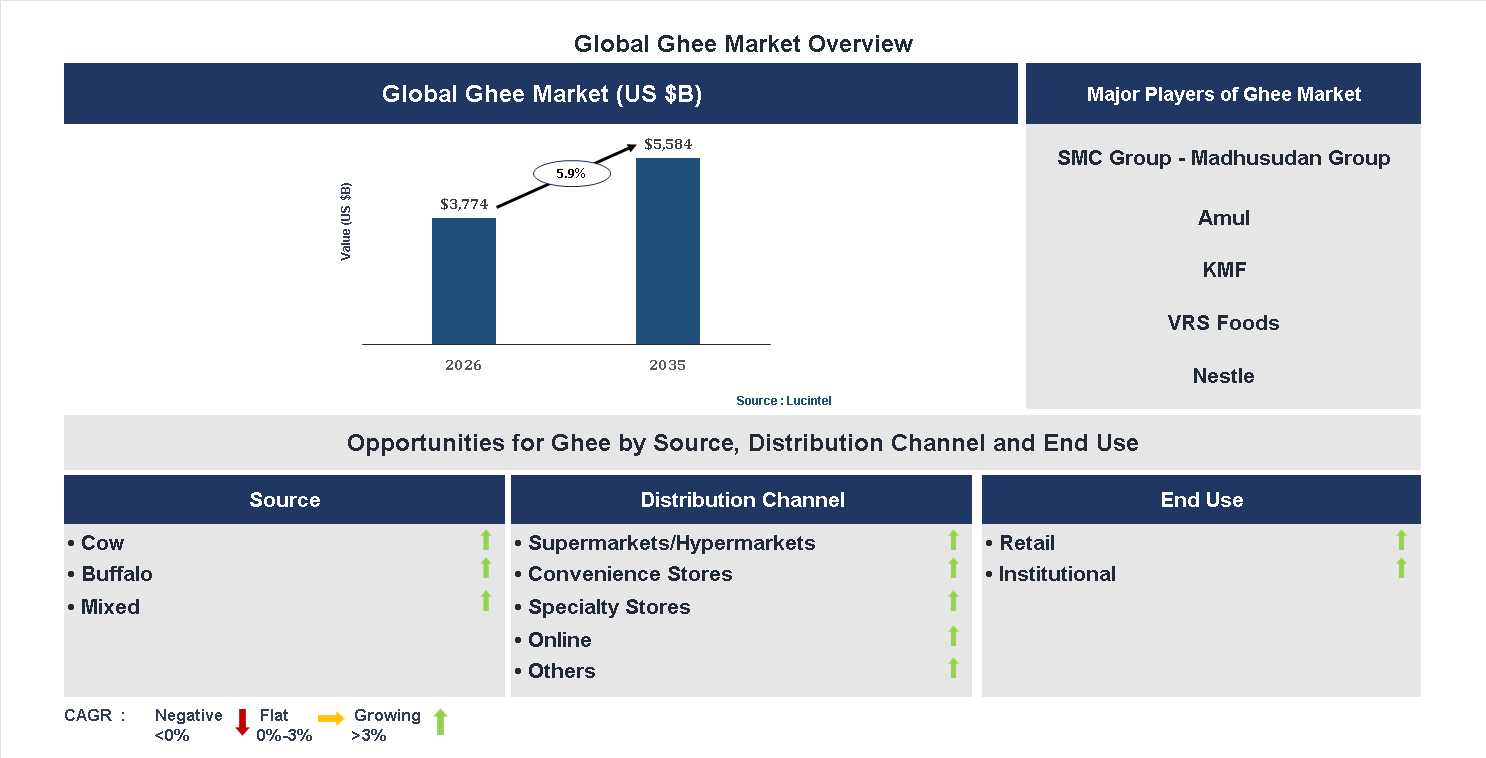
Ghee Market Trends and Forecast

Emerging Trends in the Ghee Market

The ghee market is experiencing significant transformation driven by changing consumer preferences, technological advancements, and increasing health consciousness. As traditional dietary staples evolve, new trends are emerging that influence production, marketing, and consumption patterns. These developments are shaping the future landscape of the ghee industry, creating opportunities for innovation and growth. Stakeholders must adapt to these shifts to stay competitive and meet evolving consumer demands. The following key trends highlight the major directions in which the ghee market is heading, reflecting broader shifts in health, sustainability, and digital engagement.

• Growing Demand for Organic and Natural Ghee: Consumers are increasingly seeking organic and natural ghee options due to rising health awareness and concerns over artificial additives. This trend encourages producers to adopt organic certification and transparent sourcing practices, which can command premium prices. The demand is driven by health benefits associated with pure, chemical-free products, and a desire for cleaner labels. As consumers become more conscious of product origins, organic ghee is gaining popularity in both traditional and modern retail channels, fostering market differentiation and encouraging sustainable farming practices.
• Innovation in Packaging and Convenience: The market is witnessing a shift towards innovative, eco-friendly, and convenient packaging solutions. Single-serve packs, resealable jars, and eco-conscious materials cater to busy lifestyles and environmentally aware consumers. These packaging innovations improve shelf life, ease of use, and reduce waste, enhancing consumer experience. Additionally, smart packaging with QR codes provides transparency about sourcing and quality, building consumer trust. This trend supports brand differentiation and appeals to a broader demographic, including urban and younger consumers seeking convenience without compromising quality.
• Rising Popularity of Ghee in Non-Traditional Markets: Ghee is increasingly gaining acceptance beyond traditional Indian and South Asian markets, driven by the global diaspora and health trends favoring natural fats. Western countries are witnessing a surge in demand for ghee as a cooking fat and health supplement, especially among health-conscious consumers and those following paleo or ketogenic diets. This expansion opens new avenues for exporters and brands to tap into international markets, diversify their product portfolios, and promote ghee as a versatile, healthful ingredient suitable for various cuisines and dietary needs.
• Technological Advancements in Production and Quality Control: Innovations such as automation, precision temperature control, and advanced filtration are enhancing ghee production efficiency and quality. These technologies ensure consistent product quality, improve shelf life, and reduce wastage. Additionally, digital tools enable better traceability and quality assurance, which are critical for meeting regulatory standards and consumer expectations. The adoption of such technologies helps manufacturers scale operations, reduce costs, and maintain high standards, ultimately strengthening market competitiveness and fostering consumer confidence in product safety and authenticity.
• Increasing Focus on Sustainability and Ethical Sourcing: Consumers and regulators are emphasizing sustainable practices and ethical sourcing in the ghee industry. This includes promoting pasture-raised dairy, reducing carbon footprints, and supporting local farmers. Brands adopting sustainable sourcing can enhance their brand image and appeal to environmentally conscious consumers. Initiatives such as eco-friendly packaging, waste reduction, and fair trade practices are becoming integral to business strategies. This trend not only addresses environmental concerns but also ensures long-term supply chain stability, aligning market growth with sustainability goals and fostering responsible consumption.

In summary, these emerging trends are collectively reshaping the ghee market by emphasizing health, innovation, sustainability, and global expansion. They are driving product differentiation, expanding consumer bases, and encouraging sustainable practices, ultimately fostering a more dynamic and responsible industry landscape.
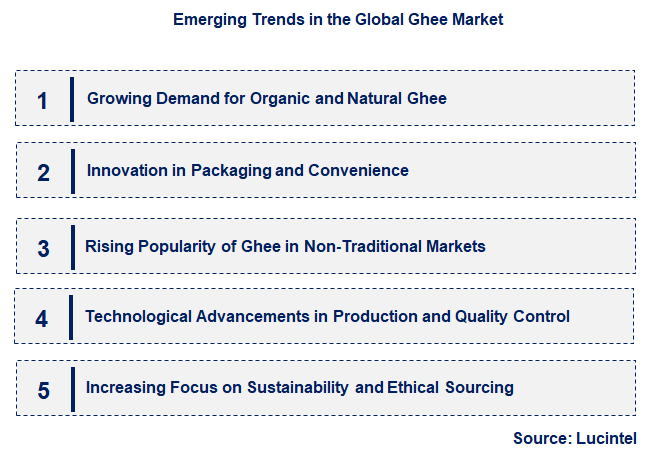
Emerging Trends in the Ghee Market

Recent Development in the Ghee Market

The ghee market is experiencing a significant growth driven by increasing health consciousness, rising demand for traditional and organic products, and expanding culinary applications worldwide. Innovations in packaging and product diversification are further fueling consumer interest. As consumers seek healthier alternatives and authentic flavors, the market is poised for substantial expansion. This dynamic environment presents numerous opportunities for manufacturers to innovate, expand their reach, and meet evolving consumer preferences, ultimately shaping the future landscape of the ghee industry.

• Growing Health Consciousness: Increasing awareness of health benefits associated with ghee, such as improved digestion and healthy fats, is boosting demand. Consumers are shifting towards natural, nutrient-rich products, encouraging producers to emphasize purity and health benefits. This trend is expanding the customer base beyond traditional markets to health-conscious segments, fostering product innovation and marketing strategies focused on wellness. As a result, the market is witnessing a surge in premium and organic ghee products, driving overall growth.
• Rising Demand for Organic and Natural Ghee: Consumers are increasingly prioritizing organic and chemical-free products, leading to a surge in organic ghee sales. This demand is driven by concerns over synthetic additives and preservatives in conventional products. Producers are investing in organic certification and sustainable sourcing to meet this demand. The shift towards organic ghee is creating new market segments, encouraging farmers and manufacturers to adopt eco-friendly practices, and enhancing brand credibility. This trend is expected to continue fueling market expansion.
• Expansion in Culinary and Foodservice Applications: Ghees versatility in cooking, baking, and frying is expanding its use in restaurants, catering, and packaged foods. Chefs and food manufacturers are incorporating ghee for its rich flavor and high smoke point. This diversification is opening new revenue streams and increasing product visibility in global cuisines. As consumers seek authentic flavors, the demand from the foodservice sector is rising, prompting companies to develop specialized packaging and formulations tailored for culinary use, further boosting market growth.
• Innovation in Packaging and Product Offerings: Advances in packaging, such as resealable jars and eco-friendly containers, are enhancing consumer convenience and sustainability. Additionally, product diversification into flavored, infused, and fortified ghee variants caters to evolving tastes and health needs. These innovations improve shelf life, ease of use, and appeal to a broader audience. Companies investing in attractive packaging and innovative products are gaining competitive advantages, expanding their market share, and attracting new customer segments, thereby accelerating overall industry growth.
• Digital Marketing and E-commerce Penetration: The rise of online retail platforms and digital marketing strategies is increasing ghees accessibility to a global audience. E-commerce enables brands to reach niche markets and promote organic and premium products directly to consumers. Social media campaigns and influencer collaborations are boosting brand awareness and consumer engagement. This digital shift is reducing reliance on traditional retail channels, expanding market reach, and facilitating rapid growth. As online sales grow, the market is becoming more competitive and innovative, fostering sustained development.

These developments are transforming the ghee market by expanding consumer choices, enhancing product quality, and increasing accessibility. The focus on health, organic options, culinary versatility, packaging innovation, and digital marketing is driving market expansion and diversification. As a result, the industry is poised for robust growth, attracting new entrants and meeting the evolving demands of global consumers. This dynamic environment promises sustained innovation and increased market competitiveness.

Strategic Growth Opportunities in the Ghee Market

The ghee market is experiencing significant growth driven by increasing consumer awareness of health benefits, rising demand for traditional and organic products, and expanding culinary applications across regions. Innovations in packaging and product variants are attracting diverse consumer segments. Additionally, the growing popularity of ethnic cuisines and the rising disposable incomes in emerging markets are fueling demand. Market players are focusing on strategic collaborations and expanding distribution channels to capitalize on these opportunities, ensuring sustained growth and market competitiveness.

• Growing Consumer Preference for Organic and Natural Ghee: Increasing awareness of health benefits associated with organic and natural ghee is driving demand. Consumers are seeking products free from additives and preservatives, favoring organic certifications. This trend encourages producers to adopt sustainable sourcing and production practices, creating premium product lines. The shift towards clean-label products is also influencing marketing strategies, boosting sales in health-conscious demographics and expanding market share.
• Expansion of E-commerce and Online Retail Channels: The rise of e-commerce platforms is transforming ghee distribution, making products more accessible to a broader audience. Online channels offer convenience, detailed product information, and competitive pricing, attracting urban and rural consumers alike. Market players are leveraging digital marketing and direct-to-consumer models to increase brand visibility. This expansion facilitates rapid product launches and customization, enabling companies to respond swiftly to consumer preferences and increase overall market penetration.
• Increasing Demand for Ethnic and Traditional Ghee Varieties: The growing popularity of ethnic cuisines, especially Indian, Middle Eastern, and Southeast Asian dishes, is boosting demand for traditional ghee varieties. Consumers are seeking authentic flavors and traditional preparation methods, which enhances the market for specialty ghee products. This trend encourages producers to innovate with regional recipes and packaging, catering to diaspora populations and culinary enthusiasts, thereby expanding the product portfolio and capturing niche markets.
• Rising Use of Ghee in Foodservice and Food Processing Industries: The foodservice sector, including restaurants, hotels, and catering services, is increasingly incorporating ghee for its flavor and cooking properties. The food processing industry is also utilizing ghee in bakery, confectionery, and snack manufacturing. This industrial demand supports higher production volumes and encourages product innovation tailored for commercial use. It also opens avenues for bulk supply contracts and long-term partnerships, contributing to overall market growth.
• Innovation in Packaging and Product Variants to Attract Consumers: Companies are investing in innovative packaging solutions such as resealable jars, eco-friendly containers, and portion-controlled packs to enhance convenience and sustainability. Additionally, introducing variants like flavored ghee, fortified ghee with added nutrients, and smaller pack sizes appeals to diverse consumer needs. These innovations improve shelf life, ease of use, and product appeal, helping brands differentiate themselves in a competitive market and expand their consumer base.

The overall impact of these growth opportunities is a dynamic and expanding ghee market, driven by consumer preferences, technological advancements, and strategic industry initiatives. These factors collectively foster innovation, increase accessibility, and cater to evolving dietary and culinary trends, ensuring sustained growth and increased market competitiveness globally.

Ghee Market Driver and Challenges

The ghee market is influenced by a variety of technological, economic, and regulatory factors that shape its growth and sustainability. Advances in processing technology and quality assurance have improved product standards, while economic factors such as rising disposable incomes and changing consumer preferences drive demand. Regulatory policies related to food safety and labeling also impact market operations. Additionally, cultural and health considerations influence consumption patterns. Navigating these drivers and challenges is essential for market players to capitalize on opportunities and address potential risks, ensuring the markets long-term growth and stability in a competitive environment.

The factors responsible for driving the ghee market include:-
• Increasing Health Awareness: Growing consumer awareness about the health benefits of ghee, such as its rich source of healthy fats, vitamins, and antioxidants, has led to increased demand. Consumers are shifting towards natural and traditional products, favoring ghee over processed oils. This trend is supported by marketing campaigns emphasizing ghees nutritional value, which boosts sales across regions. Moreover, the rise in vegetarian and vegan diets in some areas further propels ghee consumption as a dairy-based fat source. The health-conscious demographic is also seeking organic and preservative-free options, expanding the market scope. Overall, health awareness significantly influences consumer choices, fostering market growth.
• Technological Advancements in Production: Innovations in ghee manufacturing, such as improved extraction and refining techniques, have enhanced product quality and shelf life. Modern processing methods reduce impurities and improve flavor, color, and texture, making ghee more appealing to consumers. Automation and quality control systems ensure consistency and safety, meeting stringent food standards. These technological improvements also enable producers to scale operations efficiently, reduce costs, and introduce new product variants like organic or flavored ghee. As a result, manufacturers can cater to diverse consumer preferences and expand their market reach, driving overall industry growth.
• Growing Urbanization and Changing Lifestyles: Rapid urbanization has led to increased demand for convenient, ready-to-use food products, including ghee. Urban consumers prefer packaged, hygienic, and long-lasting ghee options, which have boosted retail sales. Additionally, busy lifestyles and dual-income households favor the use of ghee in daily cooking, baking, and snacking. The expansion of modern retail outlets, supermarkets, and e-commerce platforms has made ghee more accessible to a broader audience. Urbanization also influences dietary habits, with a preference for traditional foods, further supporting ghee consumption. This demographic shift is a key driver for sustained market expansion.
• Rising Disposable Income and Economic Growth: Economic development in emerging markets has increased disposable incomes, enabling consumers to purchase higher-quality and premium ghee products. As income levels rise, consumers are willing to spend more on health-oriented and branded ghee options, which often come at a premium price. This trend is particularly evident in developing countries where traditional diets are evolving, and consumers seek products that align with modern health standards. The growth of the middle class and increased urban employment further bolsters demand. Economic prosperity thus directly correlates with increased ghee consumption, fueling market expansion.
• Expansion of E-commerce and Retail Channels: The proliferation of online shopping platforms and modern retail outlets has significantly expanded ghees market reach. E-commerce offers consumers access to a wide variety of brands, product types, and price points, facilitating informed purchasing decisions. Retail chains and supermarkets provide convenient access to packaged ghee, ensuring consistent quality and safety standards. Digital marketing and targeted advertising also enhance brand visibility and consumer engagement. This omnichannel distribution approach caters to diverse consumer preferences, boosts sales, and enables market players to penetrate new regions rapidly. The growth of these channels is a vital driver for the ghee markets ongoing expansion.

The challenges facing the ghee market include:-
• Stringent Regulatory Standards: Increasing food safety regulations and labeling requirements pose compliance challenges for ghee manufacturers. Governments are implementing stricter standards related to ingredient transparency, quality assurance, and health claims, which necessitate significant investments in testing and certification processes. Non-compliance can lead to legal penalties, product recalls, and damage to brand reputation. Small and medium-sized producers may find it difficult to meet these evolving standards due to resource constraints. Navigating complex regulatory landscapes across different regions adds to operational complexities, potentially hindering market growth and innovation.
• Fluctuating Raw Material Prices: The cost of raw materials such as milk and ghee-making ingredients is highly volatile, influenced by seasonal variations, supply-demand imbalances, and climatic conditions. Price fluctuations impact profit margins and pricing strategies, making it challenging for producers to maintain consistent product pricing. Increased raw material costs can also lead to higher retail prices, potentially reducing consumer demand. Supply chain disruptions, especially during adverse weather events or pandemics, further exacerbate these issues. Managing procurement costs while maintaining quality standards remains a critical challenge for sustaining profitability in the ghee market.
• Competition from Alternative Fats and Oils: The market faces stiff competition from other edible fats and oils, such as butter, margarine, and plant-based oils, which are often perceived as healthier or more convenient. Consumer preferences are shifting towards low-fat or non-dairy alternatives, driven by health concerns and dietary restrictions. Additionally, price competition from cheaper oils can erode ghees market share, especially in price-sensitive regions. Innovation and differentiation are necessary to retain consumer interest, but intense competition can limit market expansion and profit margins. Adapting to changing consumer trends while maintaining traditional appeal is a persistent challenge.

In summary, the ghee market is shaped by a combination of technological innovations, rising health consciousness, urbanization, economic growth, and expanding distribution channels, all of which foster growth opportunities. However, regulatory complexities, raw material price volatility, and competition from alternative fats pose significant hurdles. These drivers and challenges collectively influence market dynamics, requiring industry players to innovate, adapt, and strategize effectively. The overall impact is a market with substantial growth potential, provided that companies can navigate regulatory landscapes, manage costs, and meet evolving consumer preferences.

List of Ghee Companies

Companies in the market compete on the basis of product quality offered. Major players in this market focus on expanding their manufacturing facilities, R&D investments, infrastructural development, and leverage integration opportunities across the value chain. With these strategies ghee companies cater increasing demand, ensure competitive effectiveness, develop innovative products & technologies, reduce production costs, and expand their customer base. Some of the ghee companies profiled in this report include-
• SMC Group - Madhusudan Group
• Amul
• KMF
• VRS Foods
• Nestle

Ghee Market by Segment

The study includes a forecast for the global ghee market by source, distribution channel, end use, and region.

Ghee Market by Source [Value from 2019 to 2035]:


• Cow
• Buffalo
• Mixed

Ghee Market by Distribution Channel [Value from 2019 to 2035]:


• Supermarkets/Hypermarkets
• Convenience Stores
• Specialty Stores
• Online
• Others

Ghee Market by End Use [Value from 2019 to 2035]:


• Retail
• Institutional

Ghee Market by Region [Value from 2019 to 2035]:


• North America
• Europe
• Asia Pacific
• The Rest of the World

Country Wise Outlook for the Ghee Market

The ghee market has experienced significant shifts driven by changing consumer preferences, health trends, and regional demand. As a traditional dietary staple, ghees popularity is expanding beyond its origins, influenced by innovations in production, packaging, and marketing. Countries are focusing on quality standards, organic options, and sustainable sourcing to meet increasing health consciousness. Market players are also exploring new distribution channels, including e-commerce, to reach broader audiences. These developments reflect a dynamic landscape where cultural preferences intersect with modern health trends, shaping the future trajectory of the ghee industry across key markets.

• United States: The US ghee market is witnessing rapid growth driven by increasing awareness of its health benefits and popularity among health-conscious consumers. Organic and grass-fed ghee options are gaining traction, with major brands expanding their product lines. E-commerce platforms are playing a crucial role in distribution, making ghee more accessible. Additionally, culinary innovation and fusion recipes are boosting demand in restaurants and households. The market is also seeing a rise in specialty stores and health food chains promoting ghee as a superfood, emphasizing its nutritional value and versatility.
• China: In China, the ghee market is expanding due to rising interest in traditional Indian and Middle Eastern cuisines. Consumers are increasingly seeking natural and organic products, prompting brands to introduce premium, high-quality ghee options. The growing middle class and urbanization are contributing to higher disposable incomes and demand for gourmet ingredients. E-commerce sales are surging, supported by platforms like Alibaba and JD.com. Health trends emphasizing clean eating and traditional remedies are also influencing consumer choices, leading to a focus on pure, additive-free ghee products.
• Germany: The German ghee market is characterized by a rising demand for organic and sustainably sourced products. Consumers are increasingly adopting traditional cooking ingredients with health benefits, including ghee, as part of a balanced diet. The market is driven by a growing number of health-conscious individuals and the popularity of Ayurveda-inspired wellness practices. Retailers are expanding their organic product offerings, and specialty health stores are prominent distribution channels. Innovation in packaging and labeling, emphasizing purity and quality, is helping brands differentiate themselves in a competitive landscape.
• India: As the birthplace of ghee, India remains the largest market, with steady growth fueled by cultural and religious practices. Urbanization and changing lifestyles are increasing the demand for packaged, hygienic ghee options. The market is witnessing innovations in packaging, such as easy-to-use containers and smaller packs for convenience. Organic and farm-fresh ghee segments are expanding, driven by health-conscious consumers. The government’s focus on promoting traditional foods and the rise of e-commerce platforms are further boosting sales. Regional variations in preferences continue to influence product offerings, with a focus on purity and authenticity.
• Japan: The Japanese ghee market is emerging, with increasing interest driven by health trends and culinary experimentation. Consumers are exploring ghee as a dairy alternative and for its purported health benefits, such as improved digestion and nutrient absorption. Premium and organic ghee products are gaining popularity in specialty stores and online. The market is also influenced by the growing popularity of Indian and Middle Eastern cuisines. Japanese companies are beginning to introduce locally produced ghee, emphasizing quality and purity. Overall, the market remains niche but shows promising growth potential as awareness spreads.

Lucintel Analytics Dashboard

Features of the Global Ghee Market

Market Size Estimates: Ghee market size estimation in terms of value ($B).
Trend and Forecast Analysis: Market trends (2019 to 2025) and forecast (2026 to 2035) by various segments and regions.
Segmentation Analysis: Ghee market size by source, distribution channel, end use, and region in terms of value ($B).
Regional Analysis: Ghee market breakdown by North America, Europe, Asia Pacific, and Rest of the World.
Growth Opportunities: Analysis of growth opportunities in different sources, distribution channels, end uses, and regions for the ghee market.
Strategic Analysis: This includes M&A, new product development, and competitive landscape of the ghee market.
Analysis of competitive intensity of the industry based on Porter’s Five Forces model.

Lucintel Consulting Services

FAQ

Q1. What is the ghee market size?
Answer: The global ghee market is expected to reach an estimated $5,584 billion by 2035.
Q2. What is the growth forecast for ghee market?
Answer: The global ghee market is expected to grow with a CAGR of 5.9% from 2026 to 2035.
Q3. What are the major drivers influencing the growth of the ghee market?
Answer: The major drivers for this market are the increasing demand for health-conscious products, the rising popularity of plant-based alternatives, and the growing awareness of ghees nutritional benefits.
Q4. What are the major segments for ghee market?
Answer: The future of the ghee market looks promising with opportunities in the retail and institutional markets.
Q5. Who are the key ghee market companies?
Answer: Some of the key ghee companies are as follows:
• SMC Group - Madhusudan Group
• Amul
• KMF
• VRS Foods
• Nestle
Q6. Which ghee market segment will be the largest in future?
Answer: Lucintel forecasts that, within the source category, cow is expected to witness the highest growth over the forecast period.
Q7. In ghee market, which region is expected to be the largest in next 5 years?
Answer: In terms of region, APAC is expected to witness the highest growth over the forecast period.
Q8. Do we receive customization in this report?
Answer: Yes, Lucintel provides 10% customization without any additional cost.

This report answers following 11 key questions:

Q.1. What are some of the most promising, high-growth opportunities for the ghee market by source (cow, buffalo, and mixed), distribution channel (supermarkets/hypermarkets, convenience stores, specialty stores, online, and others), end use (retail and institutional), and region (North America, Europe, Asia Pacific, and the Rest of the World)?
Q.2. Which segments will grow at a faster pace and why?
Q.3. Which region will grow at a faster pace and why?
Q.4. What are the key factors affecting market dynamics? What are the key challenges and business risks in this market?
Q.5. What are the business risks and competitive threats in this market?
Q.6. What are the emerging trends in this market and the reasons behind them?
Q.7. What are some of the changing demands of customers in the market?
Q.8. What are the new developments in the market? Which companies are leading these developments?
Q.9. Who are the major players in this market? What strategic initiatives are key players pursuing for business growth?
Q.10. What are some of the competing products in this market and how big of a threat do they pose for loss of market share by material or product substitution?
Q.11. What M&A activity has occurred in the last 7 years and what has its impact been on the industry?

For any questions related to Ghee Market, Ghee Market Size, Ghee Market Growth, Ghee Market Analysis, Ghee Market Report, Ghee Market Share, Ghee Market Trends, Ghee Market Forecast, Ghee Companies, write Lucintel analyst at email: helpdesk@lucintel.com. We will be glad to get back to you soon.
                                           Table of Contents

            1. Executive Summary

            2. Market Overview

                        2.1 Background and Classifications
                        2.2 Supply Chain

            3. Market Trends & Forecast Analysis

                        3.1 Macroeconomic Trends and Forecasts
                        3.2 Industry Drivers and Challenges
                        3.3 PESTLE Analysis
                        3.4 Patent Analysis
                        3.5 Regulatory Environment
                        3.6 Global Ghee Market Trends and Forecast

            4. Global Ghee Market by Source

                        4.1 Overview
                        4.2 Attractiveness Analysis by Source
                        4.3 Cow : Trends and Forecast 2019 to 2035
                        4.4 Buffalo : Trends and Forecast 2019 to 2035
                        4.5 Mixed : Trends and Forecast 2019 to 2035

            5. Global Ghee Market by Distribution Channel

                        5.1 Overview
                        5.2 Attractiveness Analysis by Distribution Channel
                        5.3 Supermarkets/Hypermarkets : Trends and Forecast 2019 to 2035
                        5.4 Convenience Stores : Trends and Forecast 2019 to 2035
                        5.5 Specialty Stores : Trends and Forecast 2019 to 2035
                        5.6 Online : Trends and Forecast 2019 to 2035
                        5.7 Others : Trends and Forecast 2019 to 2035

            6. Global Ghee Market by End Use

                        6.1 Overview
                        6.2 Attractiveness Analysis by End Use
                        6.3 Retail : Trends and Forecast 2019 to 2035
                        6.4 Institutional : Trends and Forecast 2019 to 2035

            7. Regional Analysis

                        7.1 Overview
                        7.2 Global Ghee Market by Region

            8. North American Ghee Market

                        8.1 Overview
                        8.2 North American Ghee Market by Source
                        8.3 North American Ghee Market by End Use
                        8.4 The United States Ghee Market
                        8.5 Canadian Ghee Market
                        8.6 Mexican Ghee Market

            9. European Ghee Market

                        9.1 Overview
                        9.2 European Ghee Market by Source
                        9.3 European Ghee Market by End Use
                        9.4 German Ghee Market
                        9.5 French Ghee Market
                        9.6 Italian Ghee Market
                        9.7 Spanish Ghee Market
                        9.8 The United Kingdom Ghee Market

            10. APAC Ghee Market

                        10.1 Overview
                        10.2 APAC Ghee Market by Source
                        10.3 APAC Ghee Market by End Use
                        10.4 Chinese Ghee Market
                        10.5 Indian Ghee Market
                        10.6 Japanese Ghee Market
                        10.7 South Korean Ghee Market
                        10.8 Indonesian Ghee Market

            11. ROW Ghee Market

                        11.1 Overview
                        11.2 ROW Ghee Market by Source
                        11.3 ROW Ghee Market by End Use
                        11.4 Middle Eastern Ghee Market
                        11.5 South American Ghee Market
                        11.6 African Ghee Market

            12. Competitor Analysis

                        12.1 Product Portfolio Analysis
                        12.2 Operational Integration
                        12.3 Porter’s Five Forces Analysis
                                    • Competitive Rivalry
                                    • Bargaining Power of Buyers
                                    • Bargaining Power of Suppliers
                                    • Threat of Substitutes
                                    • Threat of New Entrants
                        12.4 Market Share Analysis

            13. Opportunities & Strategic Analysis

                        13.1 Value Chain Analysis
                        13.2 Growth Opportunity Analysis
                                    13.2.1 Growth Opportunity by Source
                                    13.2.2 Growth Opportunity by Distribution Channel
                                    13.2.3 Growth Opportunity by End Use
                                    13.2.4 Growth Opportunity by Region
                        13.3 Emerging Trends in the Global Ghee Market
                        13.4 Strategic Analysis
                                    13.4.1 New Product Development
                                    13.4.2 Certification and Licensing
                                    13.4.3 Mergers, Acquisitions, Agreements, Collaborations, and Joint Ventures

            14. Company Profiles of the Leading Players Across the Value Chain

                        14.1 Competitive Analysis Overview
                        14.2 SMC Group - Madhusudan Group
                                    • Company Overview
                                    • Ghee Market Business Overview
                                    • New Product Development
                                    • Merger, Acquisition, and Collaboration
                                    • Certification and Licensing
                        14.3 Amul
                                    • Company Overview
                                    • Ghee Market Business Overview
                                    • New Product Development
                                    • Merger, Acquisition, and Collaboration
                                    • Certification and Licensing
                        14.4 KMF
                                    • Company Overview
                                    • Ghee Market Business Overview
                                    • New Product Development
                                    • Merger, Acquisition, and Collaboration
                                    • Certification and Licensing
                        14.5 VRS Foods
                                    • Company Overview
                                    • Ghee Market Business Overview
                                    • New Product Development
                                    • Merger, Acquisition, and Collaboration
                                    • Certification and Licensing
                        14.6 Nestle
                                    • Company Overview
                                    • Ghee Market Business Overview
                                    • New Product Development
                                    • Merger, Acquisition, and Collaboration
                                    • Certification and Licensing

            15. Appendix

                        15.1 List of Figures
                        15.2 List of Tables
                        15.3 Research Methodology
                        15.4 Disclaimer
                        15.5 Copyright
                        15.6 Abbreviations and Technical Units
                        15.7 About Us
                        15.8 Contact Us

                                               List of Figures


            Chapter 1

                        Figure 1.1: Trends and Forecast for the Global Ghee Market

            Chapter 2

                        Figure 2.1: Usage of Ghee Market
                        Figure 2.2: Classification of the Global Ghee Market
                        Figure 2.3: Supply Chain of the Global Ghee Market

            Chapter 3

                        Figure 3.1: Trends of the Global GDP Growth Rate
                        Figure 3.2: Trends of the Global Population Growth Rate
                        Figure 3.3: Trends of the Global Inflation Rate
                        Figure 3.4: Trends of the Global Unemployment Rate
                        Figure 3.5: Trends of the Regional GDP Growth Rate
                        Figure 3.6: Trends of the Regional Population Growth Rate
                        Figure 3.7: Trends of the Regional Inflation Rate
                        Figure 3.8: Trends of the Regional Unemployment Rate
                        Figure 3.9: Trends of Regional Per Capita Income
                        Figure 3.10: Forecast for the Global GDP Growth Rate
                        Figure 3.11: Forecast for the Global Population Growth Rate
                        Figure 3.12: Forecast for the Global Inflation Rate
                        Figure 3.13: Forecast for the Global Unemployment Rate
                        Figure 3.14: Forecast for the Regional GDP Growth Rate
                        Figure 3.15: Forecast for the Regional Population Growth Rate
                        Figure 3.16: Forecast for the Regional Inflation Rate
                        Figure 3.17: Forecast for the Regional Unemployment Rate
                        Figure 3.18: Forecast for Regional Per Capita Income
                        Figure 3.19: Driver and Challenges of the Ghee Market

            Chapter 4

                        Figure 4.1: Global Ghee Market by Source in 2019, 2025, and 2035
                        Figure 4.2: Trends of the Global Ghee Market ($B) by Source
                        Figure 4.3: Forecast for the Global Ghee Market ($B) by Source
                        Figure 4.4: Trends and Forecast for Cow in the Global Ghee Market (2019-2035)
                        Figure 4.5: Trends and Forecast for Buffalo in the Global Ghee Market (2019-2035)
                        Figure 4.6: Trends and Forecast for Mixed in the Global Ghee Market (2019-2035)

            Chapter 5

                        Figure 5.1: Global Ghee Market by Distribution Channel in 2019, 2025, and 2035
                        Figure 5.2: Trends of the Global Ghee Market ($B) by Distribution Channel
                        Figure 5.3: Forecast for the Global Ghee Market ($B) by Distribution Channel
                        Figure 5.4: Trends and Forecast for Supermarkets/Hypermarkets in the Global Ghee Market (2019-2035)
                        Figure 5.5: Trends and Forecast for Convenience Stores in the Global Ghee Market (2019-2035)
                        Figure 5.6: Trends and Forecast for Specialty Stores in the Global Ghee Market (2019-2035)
                        Figure 5.7: Trends and Forecast for Online in the Global Ghee Market (2019-2035)
                        Figure 5.8: Trends and Forecast for Others in the Global Ghee Market (2019-2035)

            Chapter 6

                        Figure 6.1: Global Ghee Market by End Use in 2019, 2025, and 2035
                        Figure 6.2: Trends of the Global Ghee Market ($B) by End Use
                        Figure 6.3: Forecast for the Global Ghee Market ($B) by End Use
                        Figure 6.4: Trends and Forecast for Retail in the Global Ghee Market (2019-2035)
                        Figure 6.5: Trends and Forecast for Institutional in the Global Ghee Market (2019-2035)

            Chapter 7

                        Figure 7.1: Trends of the Global Ghee Market ($B) by Region (2019-2025)
                        Figure 7.2: Forecast for the Global Ghee Market ($B) by Region (2026-2035)

            Chapter 8

                        Figure 8.1: Trends and Forecast for the North American Ghee Market (2019-2035)
                        Figure 8.2: North American Ghee Market by Source in 2019, 2025, and 2035
                        Figure 8.3: Trends of the North American Ghee Market ($B) by Source (2019-2025)
                        Figure 8.4: Forecast for the North American Ghee Market ($B) by Source (2026-2035)
                        Figure 8.5: North American Ghee Market by Distribution Channel in 2019, 2025, and 2035
                        Figure 8.6: Trends of the North American Ghee Market ($B) by Distribution Channel (2019-2025)
                        Figure 8.7: Forecast for the North American Ghee Market ($B) by Distribution Channel (2026-2035)
                        Figure 8.8: North American Ghee Market by End Use in 2019, 2025, and 2035
                        Figure 8.9: Trends of the North American Ghee Market ($B) by End Use (2019-2025)
                        Figure 8.10: Forecast for the North American Ghee Market ($B) by End Use (2026-2035)
                        Figure 8.11: Trends and Forecast for the United States Ghee Market ($B) (2019-2035)
                        Figure 8.12: Trends and Forecast for the Mexican Ghee Market ($B) (2019-2035)
                        Figure 8.13: Trends and Forecast for the Canadian Ghee Market ($B) (2019-2035)

            Chapter 9

                        Figure 9.1: Trends and Forecast for the European Ghee Market (2019-2035)
                        Figure 9.2: European Ghee Market by Source in 2019, 2025, and 2035
                        Figure 9.3: Trends of the European Ghee Market ($B) by Source (2019-2025)
                        Figure 9.4: Forecast for the European Ghee Market ($B) by Source (2026-2035)
                        Figure 9.5: European Ghee Market by Distribution Channel in 2019, 2025, and 2035
                        Figure 9.6: Trends of the European Ghee Market ($B) by Distribution Channel (2019-2025)
                        Figure 9.7: Forecast for the European Ghee Market ($B) by Distribution Channel (2026-2035)
                        Figure 9.8: European Ghee Market by End Use in 2019, 2025, and 2035
                        Figure 9.9: Trends of the European Ghee Market ($B) by End Use (2019-2025)
                        Figure 9.10: Forecast for the European Ghee Market ($B) by End Use (2026-2035)
                        Figure 9.11: Trends and Forecast for the German Ghee Market ($B) (2019-2035)
                        Figure 9.12: Trends and Forecast for the French Ghee Market ($B) (2019-2035)
                        Figure 9.13: Trends and Forecast for the Spanish Ghee Market ($B) (2019-2035)
                        Figure 9.14: Trends and Forecast for the Italian Ghee Market ($B) (2019-2035)
                        Figure 9.15: Trends and Forecast for the United Kingdom Ghee Market ($B) (2019-2035)

            Chapter 10

                        Figure 10.1: Trends and Forecast for the APAC Ghee Market (2019-2035)
                        Figure 10.2: APAC Ghee Market by Source in 2019, 2025, and 2035
                        Figure 10.3: Trends of the APAC Ghee Market ($B) by Source (2019-2025)
                        Figure 10.4: Forecast for the APAC Ghee Market ($B) by Source (2026-2035)
                        Figure 10.5: APAC Ghee Market by Distribution Channel in 2019, 2025, and 2035
                        Figure 10.6: Trends of the APAC Ghee Market ($B) by Distribution Channel (2019-2025)
                        Figure 10.7: Forecast for the APAC Ghee Market ($B) by Distribution Channel (2026-2035)
                        Figure 10.8: APAC Ghee Market by End Use in 2019, 2025, and 2035
                        Figure 10.9: Trends of the APAC Ghee Market ($B) by End Use (2019-2025)
                        Figure 10.10: Forecast for the APAC Ghee Market ($B) by End Use (2026-2035)
                        Figure 10.11: Trends and Forecast for the Japanese Ghee Market ($B) (2019-2035)
                        Figure 10.12: Trends and Forecast for the Indian Ghee Market ($B) (2019-2035)
                        Figure 10.13: Trends and Forecast for the Chinese Ghee Market ($B) (2019-2035)
                        Figure 10.14: Trends and Forecast for the South Korean Ghee Market ($B) (2019-2035)
                        Figure 10.15: Trends and Forecast for the Indonesian Ghee Market ($B) (2019-2035)

            Chapter 11

                        Figure 11.1: Trends and Forecast for the ROW Ghee Market (2019-2035)
                        Figure 11.2: ROW Ghee Market by Source in 2019, 2025, and 2035
                        Figure 11.3: Trends of the ROW Ghee Market ($B) by Source (2019-2025)
                        Figure 11.4: Forecast for the ROW Ghee Market ($B) by Source (2026-2035)
                        Figure 11.5: ROW Ghee Market by Distribution Channel in 2019, 2025, and 2035
                        Figure 11.6: Trends of the ROW Ghee Market ($B) by Distribution Channel (2019-2025)
                        Figure 11.7: Forecast for the ROW Ghee Market ($B) by Distribution Channel (2026-2035)
                        Figure 11.8: ROW Ghee Market by End Use in 2019, 2025, and 2035
                        Figure 11.9: Trends of the ROW Ghee Market ($B) by End Use (2019-2025)
                        Figure 11.10: Forecast for the ROW Ghee Market ($B) by End Use (2026-2035)
                        Figure 11.11: Trends and Forecast for the Middle Eastern Ghee Market ($B) (2019-2035)
                        Figure 11.12: Trends and Forecast for the South American Ghee Market ($B) (2019-2035)
                        Figure 11.13: Trends and Forecast for the African Ghee Market ($B) (2019-2035)

            Chapter 12

                        Figure 12.1: Porter’s Five Forces Analysis of the Global Ghee Market
                        Figure 12.2: Market Share (%) of Top Players in the Global Ghee Market (2025)

            Chapter 13

                        Figure 13.1: Growth Opportunities for the Global Ghee Market by Source
                        Figure 13.2: Growth Opportunities for the Global Ghee Market by Distribution Channel
                        Figure 13.3: Growth Opportunities for the Global Ghee Market by End Use
                        Figure 13.4: Growth Opportunities for the Global Ghee Market by Region
                        Figure 13.5: Emerging Trends in the Global Ghee Market

                                               List of Tables


            Chapter 1

                        Table 1.1: Growth Rate (%, 2024-2025) and CAGR (%, 2026-2035) of the Ghee Market by Source, Distribution Channel, and End Use
                        Table 1.2: Attractiveness Analysis for the Ghee Market by Region
                        Table 1.3: Global Ghee Market Parameters and Attributes

            Chapter 3

                        Table 3.1: Trends of the Global Ghee Market (2019-2025)
                        Table 3.2: Forecast for the Global Ghee Market (2026-2035)

            Chapter 4

                        Table 4.1: Attractiveness Analysis for the Global Ghee Market by Source
                        Table 4.2: Market Size and CAGR of Various Source in the Global Ghee Market (2019-2025)
                        Table 4.3: Market Size and CAGR of Various Source in the Global Ghee Market (2026-2035)
                        Table 4.4: Trends of Cow in the Global Ghee Market (2019-2025)
                        Table 4.5: Forecast for Cow in the Global Ghee Market (2026-2035)
                        Table 4.6: Trends of Buffalo in the Global Ghee Market (2019-2025)
                        Table 4.7: Forecast for Buffalo in the Global Ghee Market (2026-2035)
                        Table 4.8: Trends of Mixed in the Global Ghee Market (2019-2025)
                        Table 4.9: Forecast for Mixed in the Global Ghee Market (2026-2035)

            Chapter 5

                        Table 5.1: Attractiveness Analysis for the Global Ghee Market by Distribution Channel
                        Table 5.2: Market Size and CAGR of Various Distribution Channel in the Global Ghee Market (2019-2025)
                        Table 5.3: Market Size and CAGR of Various Distribution Channel in the Global Ghee Market (2026-2035)
                        Table 5.4: Trends of Supermarkets/Hypermarkets in the Global Ghee Market (2019-2025)
                        Table 5.5: Forecast for Supermarkets/Hypermarkets in the Global Ghee Market (2026-2035)
                        Table 5.6: Trends of Convenience Stores in the Global Ghee Market (2019-2025)
                        Table 5.7: Forecast for Convenience Stores in the Global Ghee Market (2026-2035)
                        Table 5.8: Trends of Specialty Stores in the Global Ghee Market (2019-2025)
                        Table 5.9: Forecast for Specialty Stores in the Global Ghee Market (2026-2035)
                        Table 5.10: Trends of Online in the Global Ghee Market (2019-2025)
                        Table 5.11: Forecast for Online in the Global Ghee Market (2026-2035)
                        Table 5.12: Trends of Others in the Global Ghee Market (2019-2025)
                        Table 5.13: Forecast for Others in the Global Ghee Market (2026-2035)

            Chapter 6

                        Table 6.1: Attractiveness Analysis for the Global Ghee Market by End Use
                        Table 6.2: Market Size and CAGR of Various End Use in the Global Ghee Market (2019-2025)
                        Table 6.3: Market Size and CAGR of Various End Use in the Global Ghee Market (2026-2035)
                        Table 6.4: Trends of Retail in the Global Ghee Market (2019-2025)
                        Table 6.5: Forecast for Retail in the Global Ghee Market (2026-2035)
                        Table 6.6: Trends of Institutional in the Global Ghee Market (2019-2025)
                        Table 6.7: Forecast for Institutional in the Global Ghee Market (2026-2035)

            Chapter 7

                        Table 7.1: Market Size and CAGR of Various Regions in the Global Ghee Market (2019-2025)
                        Table 7.2: Market Size and CAGR of Various Regions in the Global Ghee Market (2026-2035)

            Chapter 8

                        Table 8.1: Trends of the North American Ghee Market (2019-2025)
                        Table 8.2: Forecast for the North American Ghee Market (2026-2035)
                        Table 8.3: Market Size and CAGR of Various Source in the North American Ghee Market (2019-2025)
                        Table 8.4: Market Size and CAGR of Various Source in the North American Ghee Market (2026-2035)
                        Table 8.5: Market Size and CAGR of Various Distribution Channel in the North American Ghee Market (2019-2025)
                        Table 8.6: Market Size and CAGR of Various Distribution Channel in the North American Ghee Market (2026-2035)
                        Table 8.7: Market Size and CAGR of Various End Use in the North American Ghee Market (2019-2025)
                        Table 8.8: Market Size and CAGR of Various End Use in the North American Ghee Market (2026-2035)
                        Table 8.9: Trends and Forecast for the United States Ghee Market (2019-2035)
                        Table 8.10: Trends and Forecast for the Mexican Ghee Market (2019-2035)
                        Table 8.11: Trends and Forecast for the Canadian Ghee Market (2019-2035)

            Chapter 9

                        Table 9.1: Trends of the European Ghee Market (2019-2025)
                        Table 9.2: Forecast for the European Ghee Market (2026-2035)
                        Table 9.3: Market Size and CAGR of Various Source in the European Ghee Market (2019-2025)
                        Table 9.4: Market Size and CAGR of Various Source in the European Ghee Market (2026-2035)
                        Table 9.5: Market Size and CAGR of Various Distribution Channel in the European Ghee Market (2019-2025)
                        Table 9.6: Market Size and CAGR of Various Distribution Channel in the European Ghee Market (2026-2035)
                        Table 9.7: Market Size and CAGR of Various End Use in the European Ghee Market (2019-2025)
                        Table 9.8: Market Size and CAGR of Various End Use in the European Ghee Market (2026-2035)
                        Table 9.9: Trends and Forecast for the German Ghee Market (2019-2035)
                        Table 9.10: Trends and Forecast for the French Ghee Market (2019-2035)
                        Table 9.11: Trends and Forecast for the Spanish Ghee Market (2019-2035)
                        Table 9.12: Trends and Forecast for the Italian Ghee Market (2019-2035)
                        Table 9.13: Trends and Forecast for the United Kingdom Ghee Market (2019-2035)

            Chapter 10

                        Table 10.1: Trends of the APAC Ghee Market (2019-2025)
                        Table 10.2: Forecast for the APAC Ghee Market (2026-2035)
                        Table 10.3: Market Size and CAGR of Various Source in the APAC Ghee Market (2019-2025)
                        Table 10.4: Market Size and CAGR of Various Source in the APAC Ghee Market (2026-2035)
                        Table 10.5: Market Size and CAGR of Various Distribution Channel in the APAC Ghee Market (2019-2025)
                        Table 10.6: Market Size and CAGR of Various Distribution Channel in the APAC Ghee Market (2026-2035)
                        Table 10.7: Market Size and CAGR of Various End Use in the APAC Ghee Market (2019-2025)
                        Table 10.8: Market Size and CAGR of Various End Use in the APAC Ghee Market (2026-2035)
                        Table 10.9: Trends and Forecast for the Japanese Ghee Market (2019-2035)
                        Table 10.10: Trends and Forecast for the Indian Ghee Market (2019-2035)
                        Table 10.11: Trends and Forecast for the Chinese Ghee Market (2019-2035)
                        Table 10.12: Trends and Forecast for the South Korean Ghee Market (2019-2035)
                        Table 10.13: Trends and Forecast for the Indonesian Ghee Market (2019-2035)

            Chapter 11

                        Table 11.1: Trends of the ROW Ghee Market (2019-2025)
                        Table 11.2: Forecast for the ROW Ghee Market (2026-2035)
                        Table 11.3: Market Size and CAGR of Various Source in the ROW Ghee Market (2019-2025)
                        Table 11.4: Market Size and CAGR of Various Source in the ROW Ghee Market (2026-2035)
                        Table 11.5: Market Size and CAGR of Various Distribution Channel in the ROW Ghee Market (2019-2025)
                        Table 11.6: Market Size and CAGR of Various Distribution Channel in the ROW Ghee Market (2026-2035)
                        Table 11.7: Market Size and CAGR of Various End Use in the ROW Ghee Market (2019-2025)
                        Table 11.8: Market Size and CAGR of Various End Use in the ROW Ghee Market (2026-2035)
                        Table 11.9: Trends and Forecast for the Middle Eastern Ghee Market (2019-2035)
                        Table 11.10: Trends and Forecast for the South American Ghee Market (2019-2035)
                        Table 11.11: Trends and Forecast for the African Ghee Market (2019-2035)

            Chapter 12

                        Table 12.1: Product Mapping of Ghee Suppliers Based on Segments
                        Table 12.2: Operational Integration of Ghee Manufacturers
                        Table 12.3: Rankings of Suppliers Based on Ghee Revenue

            Chapter 13

                        Table 13.1: New Product Launches by Major Ghee Producers (2019-2025)
                        Table 13.2: Certification Acquired by Major Competitor in the Global Ghee Market

.

Buy full report or by chapter as follows

Price by License Type:
[-] Hide Chapter Details
[Chapter Number] [Chapter Name] [Chapter Number Of Pages] [Chapter Price]
Title/Chapter Name Pages Price
Full Report: Ghee Market Report: Trends, Forecast and Competitive Analysis to 2035 Full Report $ 4,850
A 150 Page Report
Lucintel has been in the business of market research and management consulting since 2000 and has published over 1000 market intelligence reports in various markets / applications and served over 1,000 clients worldwide. This study is a culmination of four months of full-time effort performed by Lucintel's analyst team. The analysts used the following sources for the creation and completion of this valuable report:
  • In-depth interviews of the major players in this market
  • Detailed secondary research from competitors’ financial statements and published data 
  • Extensive searches of published works, market, and database information pertaining to industry news, company press releases, and customer intentions
  • A compilation of the experiences, judgments, and insights of Lucintel’s professionals, who have analyzed and tracked this market over the years.
Extensive research and interviews are conducted across the supply chain of this market to estimate market share, market size, trends, drivers, challenges, and forecasts. Below is a brief summary of the primary interviews that were conducted by job function for this report.
 
Thus, Lucintel compiles vast amounts of data from numerous sources, validates the integrity of that data, and performs a comprehensive analysis. Lucintel then organizes the data, its findings, and insights into a concise report designed to support the strategic decision-making process. The figure below is a graphical representation of Lucintel’s research process. 
 

Please sign in below to get report brochure - Ghee Market Report.

At Lucintel, we respect your privacy and maintain the confidentiality of information / data provided by you
(Please enter your corporate email. * These fields are mandatory )

Follow us on

