
Report Feature
Genetically Modified Herbicide-resistant Rapid Detection Test Strip Market Trends and Forecast
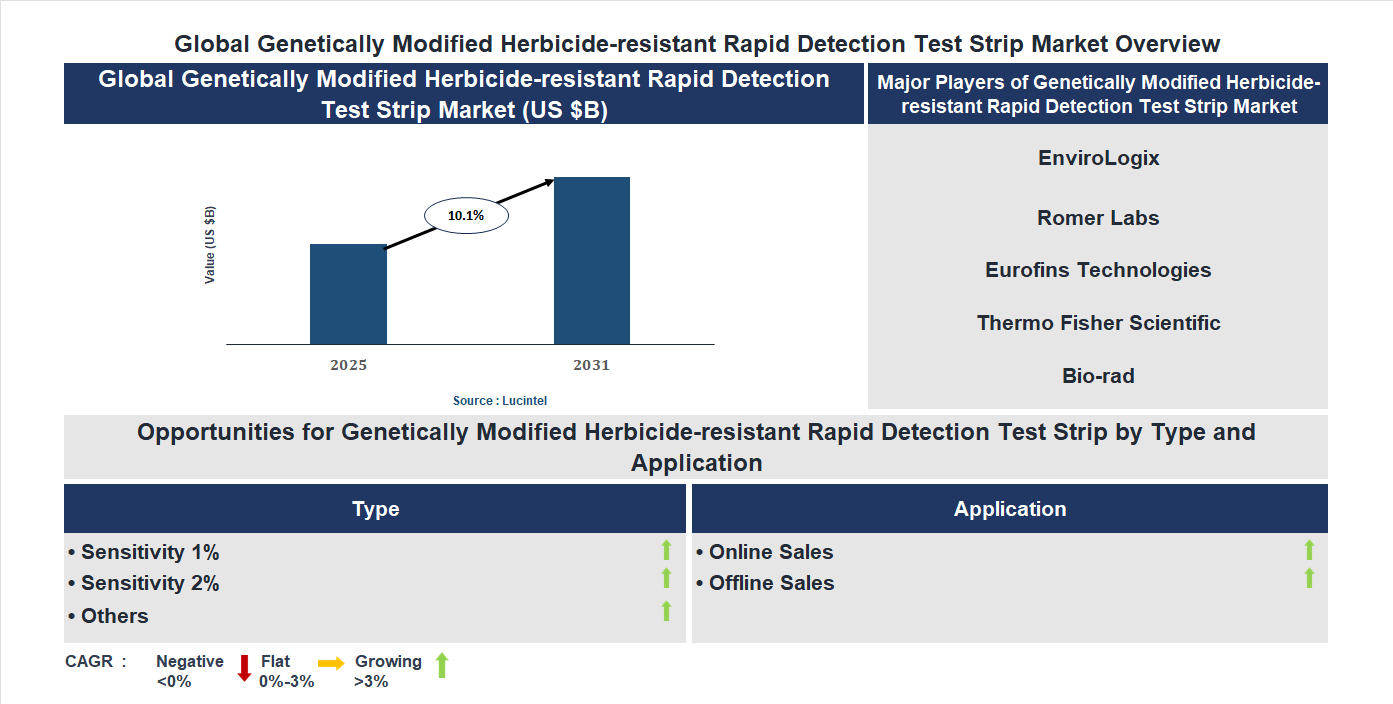
The future of the global genetically modified herbicide-resistant rapid detection test strip market looks promising with opportunities in the online sale and offline sale markets. The global genetically modified herbicide-resistant rapid detection test strip market is expected to grow with a CAGR of 10.1% from 2025 to 2031. The major drivers for this market are the increasing demand for rapid crop testing, the rising adoption of genetically modified crops, and the growing need for agricultural safety monitoring.• Lucintel forecasts that, within the type category, sensitivity 1% is expected to witness higher growth over the forecast period.
• Within the application category, online sale is expected to witness higher growth.
• In terms of region, APAC is expected to witness the highest growth over the forecast period. Gain valuable insights for your business decisions with our comprehensive 150+ page report. Sample figures with some insights are shown below.
Emerging Trends in the Genetically Modified Herbicide-resistant Rapid Detection Test Strip Market
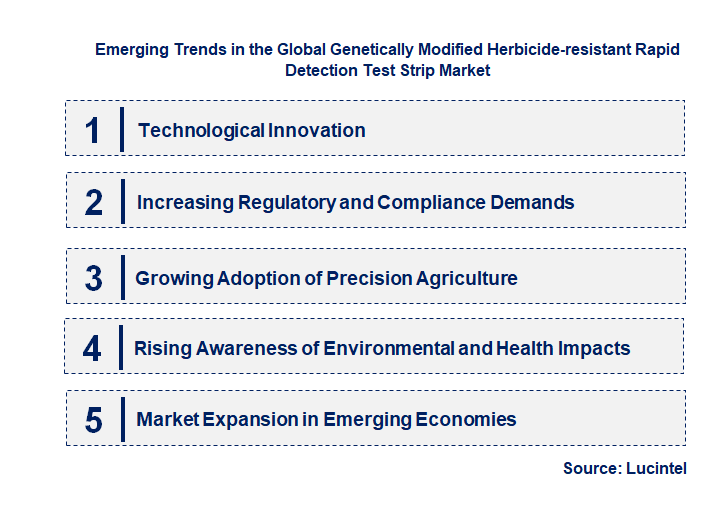
The genetically modified herbicide-resistant rapid detection test strip market is experiencing significant growth driven by advancements in biotechnology, increasing regulatory requirements, and the need for quick, accurate testing methods. As agricultural practices evolve, stakeholders demand more efficient tools to identify herbicide-resistant GM crops, ensuring compliance and sustainable farming. The market is also influenced by technological innovations, rising awareness about environmental impacts, and the push for integrated weed management strategies. These developments are transforming how farmers, regulators, and researchers approach crop management, leading to more precise, cost-effective, and environmentally friendly solutions. The following key trends highlight the markets dynamic evolution.• Technological Innovation: The market is witnessing the incorporation of nanotechnology and advanced biosensors into test strips, enhancing sensitivity, accuracy, and speed of detection. These innovations allow for real-time, on-site testing, reducing reliance on laboratory analysis. As a result, stakeholders can make quicker decisions regarding herbicide application and crop management, improving efficiency and reducing costs. This trend is also fostering the development of portable, user-friendly testing devices suitable for diverse agricultural settings.
• Increasing Regulatory and Compliance Demands: Governments and regulatory bodies worldwide are imposing more stringent rules for the approval, monitoring, and labeling of herbicide-resistant GM crops. This drives demand for reliable, rapid detection methods to ensure compliance and prevent illegal cultivation. The need for accurate testing supports traceability, reduces legal risks, and promotes transparency in the supply chain. Consequently, manufacturers are focusing on developing test strips that meet evolving regulatory standards, boosting market growth.
• Growing Adoption of Precision Agriculture: Precision agriculture emphasizes the use of technology to optimize crop yields and resource use. Rapid detection test strips are integral to this approach, enabling farmers to identify resistant weeds early and tailor herbicide applications accordingly. This minimizes chemical use, lowers environmental impact, and enhances crop productivity. The trend toward digital integration and data analytics is further amplifying the importance of rapid testing, making it a critical component of sustainable farming practices.
• Rising Awareness of Environmental and Health Impacts: Increasing awareness about the environmental and health risks associated with herbicide overuse is prompting farmers and regulators to adopt more responsible practices. Rapid detection test strips help monitor herbicide residues and resistance levels, facilitating better management strategies. This trend encourages the adoption of eco-friendly herbicide practices and supports the development of biodegradable or less toxic testing solutions, aligning market growth with sustainability goals.
• Market Expansion in Emerging Economies: Emerging economies in Asia, Africa, and Latin America are witnessing rapid agricultural development and increasing adoption of GM crops. The demand for rapid detection methods is rising to meet local regulatory requirements and ensure crop safety. Market expansion is driven by government initiatives, investments in biotech, and the need for affordable, accessible testing solutions. This trend is opening new opportunities for manufacturers and diversifying the market landscape. In summary, these trends are collectively reshaping the Genetically Modified Herbicide-Resistant Rapid Detection Test Strip Market by fostering innovation, enhancing regulatory compliance, promoting sustainable practices, and expanding geographic reach. As these developments continue, the market is poised for sustained growth, driven by technological advancements and increasing global emphasis on responsible agriculture.
Recent Development in the Genetically Modified Herbicide-resistant Rapid Detection Test Strip Market
The genetically modified herbicide-resistant rapid detection test strip market is experiencing significant growth driven by advancements in agricultural biotechnology and the need for quick, accurate detection methods. Increasing adoption of genetically modified crops resistant to herbicides is fueling demand for reliable testing solutions. Market players are focusing on innovative product development to meet regulatory standards and improve farm management practices. These developments are transforming how farmers and regulators monitor herbicide resistance, ensuring sustainable agriculture and crop protection.• Growing Adoption of Genetically Modified Crops: The rise in genetically modified crops resistant to herbicides is creating a substantial demand for rapid detection test strips. Farmers and agribusinesses seek quick, reliable tools to identify herbicide resistance, enabling better crop management and reducing crop losses. This trend is driven by the need for sustainable farming practices and regulatory compliance. As adoption increases globally, the market for detection strips is expanding, encouraging manufacturers to innovate and improve test accuracy and ease of use.
• Technological Advancements in Test Strip Design: Recent innovations in test strip technology have enhanced sensitivity, specificity, and ease of use. New materials and detection methods allow for faster results with minimal sample preparation. These advancements improve the reliability of resistance detection, helping farmers make informed decisions promptly. The integration of digital readouts and portable devices further boosts usability, expanding market reach. As technology evolves, the market is poised for increased adoption and broader application in various agricultural settings.
• Rising Regulatory and Market Pressures: Governments and regulatory bodies are implementing stricter guidelines for herbicide use and genetically modified crop monitoring. This regulatory environment drives demand for accurate detection tools to ensure compliance and prevent illegal cultivation. Market pressures from consumers and environmental groups also push for sustainable practices, encouraging the adoption of rapid detection methods. Consequently, manufacturers are developing more precise and compliant test strips, which are vital for market growth and regulatory adherence.
• Increasing Focus on Sustainable Agriculture: Sustainability initiatives emphasize reducing chemical overuse and minimizing environmental impact. Rapid detection test strips enable targeted herbicide application, reducing chemical runoff and promoting eco-friendly farming. This focus aligns with global sustainability goals, encouraging farmers to adopt precision agriculture techniques. The market benefits from this trend as demand for environmentally responsible solutions grows, prompting innovation in test strip technology to support sustainable practices and improve crop yields.
• Expansion into Emerging Markets: Emerging economies are witnessing increased adoption of genetically modified crops and modern farming techniques. The need for affordable, easy-to-use detection tools is rising in these regions to support regulatory compliance and crop management. Market expansion is driven by government initiatives, agricultural modernization, and increasing awareness of herbicide resistance issues. Companies are tailoring products to meet local needs, which accelerates market growth and broadens the global footprint of detection test strips. These recent developments are significantly impacting the market by driving innovation, expanding application areas, and enhancing regulatory compliance. The integration of advanced technology, increased adoption in emerging markets, and a focus on sustainability are fueling growth. As a result, the market is becoming more competitive, with improved products that support sustainable agriculture and effective crop management. Overall, these trends are shaping a robust future for genetically modified herbicide-resistant detection solutions.
Strategic Growth Opportunities in the Genetically Modified Herbicide-resistant Rapid Detection Test Strip Market
The genetically modified herbicide-resistant rapid detection test strip market is experiencing significant growth driven by increasing demand for quick, accurate, and cost-effective testing solutions in agriculture. Advancements in biotechnology and the need for sustainable weed management practices are fueling innovation. Market players are focusing on developing portable, easy-to-use test strips to enhance on-field decision-making. The integration of these test strips with digital platforms is also expanding their application scope, creating new opportunities for stakeholders across the agricultural sector.• Growing Adoption of Herbicide-Resistant Crops Drives Market Expansion: The rising cultivation of herbicide-resistant genetically modified crops necessitates rapid detection methods to monitor resistance levels. Farmers and agronomists seek quick, reliable testing tools to optimize herbicide use, prevent resistance spread, and improve crop yields. This demand fuels the development and adoption of genetically modified herbicide-resistant test strips, supporting sustainable weed management and reducing environmental impact.
• Technological Innovations Enhance Test Strip Accuracy and Usability: Advances in biosensor technology and nanomaterials are improving the sensitivity and specificity of detection test strips. These innovations enable rapid, on-site identification of herbicide resistance genes with minimal training. User-friendly designs and portable formats are making these test strips accessible to farmers and field workers, facilitating timely decision-making and reducing crop losses due to ineffective herbicide application.
• Increasing Focus on Sustainable Agriculture Promotes Market Growth: The global shift towards sustainable farming practices emphasizes reducing chemical usage and minimizing environmental impact. Rapid detection test strips help farmers identify resistant weeds early, enabling targeted herbicide application and reducing chemical overuse. This aligns with environmental regulations and consumer preferences, encouraging adoption and expanding the market for genetically modified herbicide-resistant test strips.
• Rising Investments in Agricultural Biotechnology Support Market Development: Governments, private investors, and research institutions are investing heavily in biotechnology to develop innovative solutions for crop protection. Funding for R&D activities accelerates the creation of advanced test strips with enhanced detection capabilities. These investments also promote commercialization and distribution, broadening access to effective testing tools and fostering market growth.
• Integration of Test Strips with Digital Platforms Facilitates Data-Driven Farming: The convergence of rapid detection test strips with digital agriculture platforms enables real-time data collection and analysis. Farmers can monitor resistance patterns across fields, optimize herbicide strategies, and share insights with agronomists. This integration enhances precision agriculture practices, improves resistance management, and opens new revenue streams for technology providers, further expanding the market. The overall impact of these opportunities is a robust, innovative market that supports sustainable, efficient weed management practices. As technology advances and adoption increases, the market is poised for continued growth, benefiting farmers, researchers, and environmental stakeholders by enabling smarter, more targeted agricultural interventions.
Genetically Modified Herbicide-resistant Rapid Detection Test Strip Market Driver and Challenges
The genetically modified herbicide-resistant rapid detection test strip market is influenced by a variety of technological, economic, and regulatory factors. Advances in biotechnology and diagnostic technologies are enabling faster and more accurate detection methods, which are crucial for agricultural management and regulatory compliance. Economic factors such as increasing demand for sustainable farming practices and the need to reduce crop losses are driving market growth. Regulatory frameworks and government policies aimed at monitoring genetically modified organisms (GMOs) also significantly impact market dynamics. However, challenges such as regulatory hurdles, public skepticism, and technological limitations pose obstacles to market expansion. Understanding these drivers and challenges is essential for stakeholders to navigate this evolving landscape effectively. The factors responsible for driving the genetically modified herbicide-resistant rapid detection test strip market include:• Technological Advancements: The development of innovative detection technologies, such as lateral flow assays and biosensors, has significantly improved the speed, sensitivity, and ease of use of test strips. These advancements enable farmers, regulators, and researchers to quickly identify herbicide-resistant GMOs in the field, facilitating timely decision-making. Continuous R&D efforts are expected to further enhance test accuracy and reduce costs, thereby broadening market adoption and application scope.
• Growing Adoption of GM Crops: The increasing cultivation of herbicide-resistant genetically modified crops worldwide is a major driver. Farmers prefer these crops for their ability to withstand herbicides, leading to higher yields and reduced crop losses. The need for effective monitoring tools to ensure compliance with regulations and prevent unauthorized use further fuels demand for rapid detection test strips, supporting sustainable agricultural practices.
• Stringent Regulatory Frameworks: Governments and regulatory agencies are implementing strict policies to monitor and control GMO presence in crops. These regulations necessitate reliable, rapid testing methods for compliance and traceability. The demand for standardized, easy-to-use test strips that can be deployed in the field is rising, encouraging manufacturers to innovate and expand their product offerings to meet regulatory requirements.
• Increasing Focus on Sustainable Agriculture: The global push towards sustainable farming practices emphasizes reducing chemical usage and minimizing environmental impact. Herbicide-resistant GM crops contribute to this goal by enabling targeted weed control. Rapid detection test strips support sustainable practices by allowing precise monitoring of GMO presence, helping farmers optimize herbicide application and reduce unnecessary chemical use, thus promoting environmental health. The challenges facing this genetically modified herbicide-resistant rapid detection test strip market include:
• Regulatory Hurdles and Approval Delays: The approval process for new detection technologies can be lengthy and complex, varying across regions. Regulatory uncertainties and stringent testing requirements can delay product launches and market penetration. Additionally, differing standards and policies across countries complicate international trade and adoption, hindering market growth and creating barriers for manufacturers.
• Public Skepticism and Ethical Concerns: Consumer apprehension regarding GMOs and genetically modified testing methods can impact market acceptance. Misinformation and ethical debates surrounding GM crops influence regulatory policies and market demand. Resistance from certain consumer groups and advocacy organizations may restrict the deployment of rapid detection test strips, especially in regions with strong anti-GMO sentiments.
• Technological Limitations and Accuracy Issues: Despite advancements, some test strips may face challenges related to sensitivity, specificity, and stability under field conditions. False positives or negatives can undermine confidence among users, leading to reluctance in adoption. Overcoming these technical limitations requires ongoing research and validation, which can be resource-intensive and time-consuming. In summary, the genetically modified herbicide-resistant rapid detection test strip market is shaped by technological innovations, increasing GMO cultivation, regulatory pressures, and sustainability initiatives. However, regulatory complexities, public perception issues, and technological constraints pose significant challenges. These factors collectively influence market growth, requiring stakeholders to navigate a complex environment that balances innovation with compliance and public acceptance. The markets future will depend on how effectively these drivers are leveraged and challenges addressed to foster sustainable and widespread adoption.
List of Genetically Modified Herbicide-resistant Rapid Detection Test Strip Companies
Companies in the market compete on the basis of product quality offered. Major players in this market focus on expanding their manufacturing facilities, R&D investments, infrastructural development, and leverage integration opportunities across the value chain. With these strategies genetically modified herbicide-resistant rapid detection test strip companies cater increasing demand, ensure competitive effectiveness, develop innovative products & technologies, reduce production costs, and expand their customer base. Some of the genetically modified herbicide-resistant rapid detection test strip companies profiled in this report include-• EnviroLogix
• Romer Labs
• Eurofins Technologies
• Thermo Fisher Scientific
• Bio-rad
• BIOTECON Diagnostics
• GENAXXON
• Merck
• Artron Laboratories
• Kogenebiotech
Genetically Modified Herbicide-resistant Rapid Detection Test Strip Market by Segment
The study includes a forecast for the global genetically modified herbicide-resistant rapid detection test strip market by type, application, and region.Genetically Modified Herbicide-resistant Rapid Detection Test Strip Market by Type [Value from 2019 to 2031]:
• Sensitivity 1%
• Sensitivity 2%
• Others
Genetically Modified Herbicide-resistant Rapid Detection Test Strip Market by Application [Value from 2019 to 2031]:
• Online Sales
• Offline Sales
Genetically Modified Herbicide-resistant Rapid Detection Test Strip Market by Region [Value from 2019 to 2031]:
• North America
• Europe
• Asia Pacific
• The Rest of the World
Country Wise Outlook for the Genetically Modified Herbicide-resistant Rapid Detection Test Strip Market
The genetically modified herbicide-resistant rapid detection test strip market is experiencing rapid growth driven by increasing regulatory scrutiny, technological advancements, and the need for quick, accurate testing methods. Countries are adopting innovative solutions to ensure compliance with safety standards and to facilitate trade. The markets evolution reflects broader trends in biotechnology, agriculture, and environmental safety, with key players investing in research and development. As the demand for efficient testing methods rises globally, each country is tailoring its strategies to meet specific regulatory and agricultural needs, fostering a competitive and dynamic market landscape.• United States: The US market has seen significant advancements with the approval of new test strips that offer higher sensitivity and faster results. Regulatory agencies like the EPA are promoting the adoption of rapid detection methods to monitor herbicide-resistant GM crops. Several startups and established biotech firms are collaborating to develop portable testing devices, expanding market reach. Increased funding for agricultural biotech research and stricter compliance standards are driving market growth, with a focus on environmental safety and sustainable farming practices.
• China: China is rapidly expanding its market for herbicide-resistant GM crop detection, driven by government initiatives to modernize agriculture and ensure food safety. The country has invested heavily in R&D, leading to the development of cost-effective, easy-to-use test strips suitable for large-scale deployment. Regulatory reforms are encouraging the adoption of rapid testing to monitor compliance with national standards. Domestic companies are gaining prominence by offering innovative solutions tailored to local agricultural practices, boosting overall market growth.
• Germany: Germanys market is characterized by stringent regulations and high-quality standards for GMO testing. The country has adopted advanced detection technologies, including multiplex test strips capable of identifying multiple GM traits simultaneously. German biotech firms are focusing on integrating rapid detection with digital data management systems to enhance traceability and reporting accuracy. The emphasis on environmental safety and consumer protection continues to drive innovation and market expansion within the country.
• India: India is witnessing a surge in demand for rapid detection test strips due to increasing awareness of GMO regulation compliance and food safety concerns. The government is promoting the use of rapid testing methods in the agricultural and food sectors to prevent illegal GMO cultivation. Local manufacturers are developing affordable, user-friendly test strips to cater to small-scale farmers and regulatory agencies. The market growth is also supported by international collaborations and funding aimed at improving agricultural productivity and safety standards.
• Japan: Japans market for herbicide-resistant GMO detection is characterized by high technological adoption and strict regulatory oversight. The country is investing in the development of highly sensitive, portable test strips that can be used in field conditions. Japanese companies are integrating rapid detection with IoT and data analytics to improve traceability and compliance monitoring. The focus remains on ensuring consumer safety and maintaining high standards for GMO testing, fostering innovation and steady market growth.

Features of the Global Genetically Modified Herbicide-resistant Rapid Detection Test Strip Market
Market Size Estimates: Genetically modified herbicide-resistant rapid detection test strip market size estimation in terms of value ($B). Trend and Forecast Analysis: Market trends (2019 to 2024) and forecast (2025 to 2031) by various segments and regions. Segmentation Analysis: Genetically modified herbicide-resistant rapid detection test strip market size by type, application, and region in terms of value ($B). Regional Analysis: Genetically modified herbicide-resistant rapid detection test strip market breakdown by North America, Europe, Asia Pacific, and Rest of the World. Growth Opportunities: Analysis of growth opportunities in different type, application, and regions for the genetically modified herbicide-resistant rapid detection test strip market. Strategic Analysis: This includes M&A, new product development, and competitive landscape of the genetically modified herbicide-resistant rapid detection test strip market. Analysis of competitive intensity of the industry based on Porter’s Five Forces model.
FAQ
Q1. What is the growth forecast for genetically modified herbicide-resistant rapid detection test strip market? Answer: The global genetically modified herbicide-resistant rapid detection test strip market is expected to grow with a CAGR of 10.1% from 2025 to 2031. Q2. What are the major drivers influencing the growth of the genetically modified herbicide-resistant rapid detection test strip market? Answer: The major drivers for this market are the increasing demand for rapid crop testing, the rising adoption of genetically modified crops, and the growing need for agricultural safety monitoring. Q3. What are the major segments for genetically modified herbicide-resistant rapid detection test strip market? Answer: The future of the genetically modified herbicide-resistant rapid detection test strip market looks promising with opportunities in the online sale and offline sale markets. Q4. Who are the key genetically modified herbicide-resistant rapid detection test strip market companies? Answer: Some of the key genetically modified herbicide-resistant rapid detection test strip companies are as follows:• EnviroLogix
• Romer Labs
• Eurofins Technologies
• Thermo Fisher Scientific
• Bio-rad
• BIOTECON Diagnostics
• GENAXXON
• Merck
• Artron Laboratories
• Kogenebiotech Q5. Which genetically modified herbicide-resistant rapid detection test strip market segment will be the largest in future? Answer: Lucintel forecasts that, within the type category, sensitivity 1% is expected to witness higher growth over the forecast period. Q6. In genetically modified herbicide-resistant rapid detection test strip market, which region is expected to be the largest in next 5 years? Answer: In terms of region, APAC is expected to witness the highest growth over the forecast period. Q7. Do we receive customization in this report? Answer: Yes, Lucintel provides 10% customization without any additional cost.
Table of Contents
List of Figures
List of Tables
Methodology
- In-depth interviews of the major players in this market
- Detailed secondary research from competitors’ financial statements and published data
- Extensive searches of published works, market, and database information pertaining to industry news, company press releases, and customer intentions
- A compilation of the experiences, judgments, and insights of Lucintel’s professionals, who have analyzed and tracked this market over the years.


Buy Now
Choose a license that fits your team. Instant PDF delivery.
Prices exclude taxes. Instant delivery. Custom licensing available on request.
Key Questions
- • What are some of the most promising, high-growth opportunities for the genetically modified herbicide-resistant rapid detection test strip market by type (sensitivity 1%, sensitivity 2%, and others), application (online sales and offline sales), and region (North America, Europe, Asia Pacific, and the Rest of the World)?
- • Which segments will grow at a faster pace and why?
- • Which region will grow at a faster pace and why?
- • What are the key factors affecting market dynamics? What are the key challenges and business risks in this market?
- • What are the business risks and competitive threats in this market?
- • What are the emerging trends in this market and the reasons behind them?
- • What are some of the changing demands of customers in the market?
- • What are the new developments in the market? Which companies are leading these developments?
- • Who are the major players in this market? What strategic initiatives are key players pursuing for business growth?
- • What are some of the competing products in this market and how big of a threat do they pose for loss of market share by material or product substitution?
- • What M&A activity has occurred in the last 6 years and what has its impact been on the industry? For any questions related to Genetically Modified Herbicide-resistant Rapid Detection Test Strip Market, Genetically Modified Herbicide-resistant Rapid Detection Test Strip Market Size, Genetically Modified Herbicide-resistant Rapid Detection Test Strip Market Growth, Genetically Modified Herbicide-resistant Rapid Detection Test Strip Market Analysis, Genetically Modified Herbicide-resistant Rapid Detection Test Strip Market Report, Genetically Modified Herbicide-resistant Rapid Detection Test Strip Market Share, Genetically Modified Herbicide-resistant Rapid Detection Test Strip Market Trends, Genetically Modified Herbicide-resistant Rapid Detection Test Strip Market Forecast, Genetically Modified Herbicide-resistant Rapid Detection Test Strip Companies, write Lucintel analyst at email: helpdesk@lucintel.com. We will be glad to get back to you soon.


