
Market Report · July 31, 2026

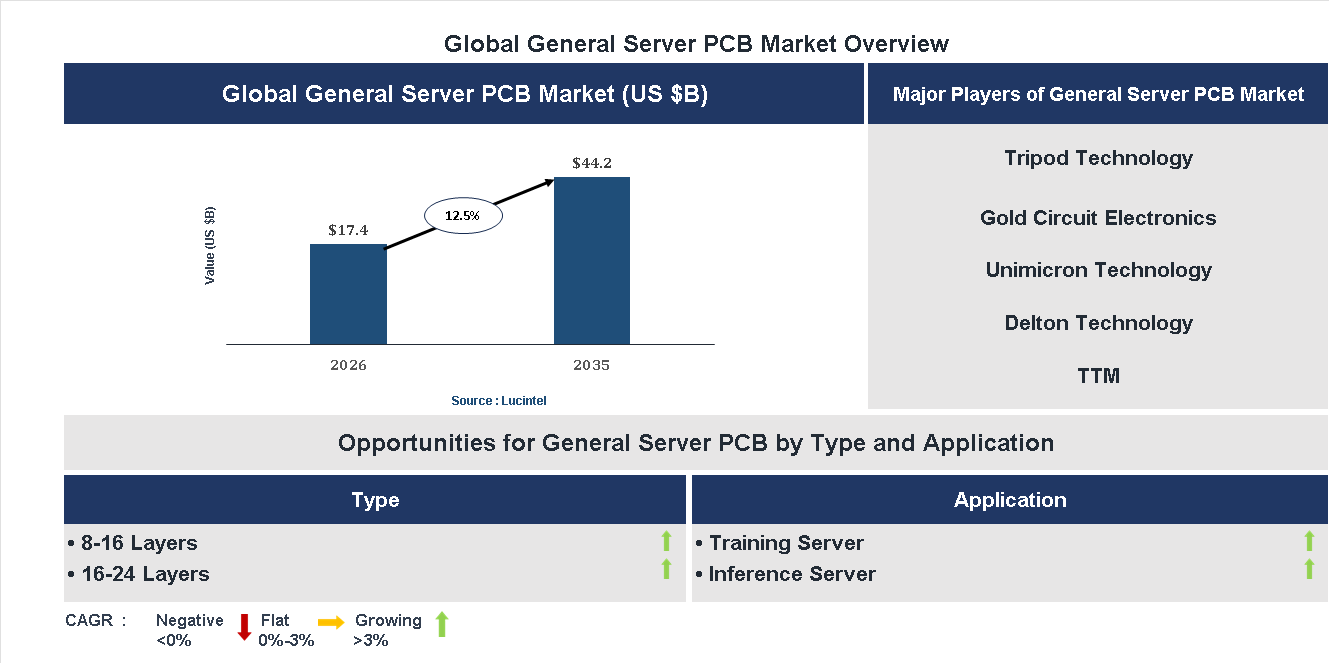
Key data points: The market size in 2035 = $44.4 billion, growth forecast = 12.5 %annually for the next 8 years. Scroll below to get more insights. This market report covers trends, opportunities and forecasts in general server PCB market to 2035 by type (8-16 layers and 16-24 layers), application (training server and inference server), and region (North America, Europe, Asia Pacific, and the Rest of the World)
We'll send your sample report shortly.
• Lucintel forecasts that, within the type category, 16-24 layer is expected to witness higher growth over the forecast period.
• Within the application category, inference server is expected to witness higher growth.
• In terms of region, APAC is expected to witness the highest growth over the forecast period. Gain valuable insights for your business decisions with our comprehensive 150+ page report. Sample figures with some insights are shown below.
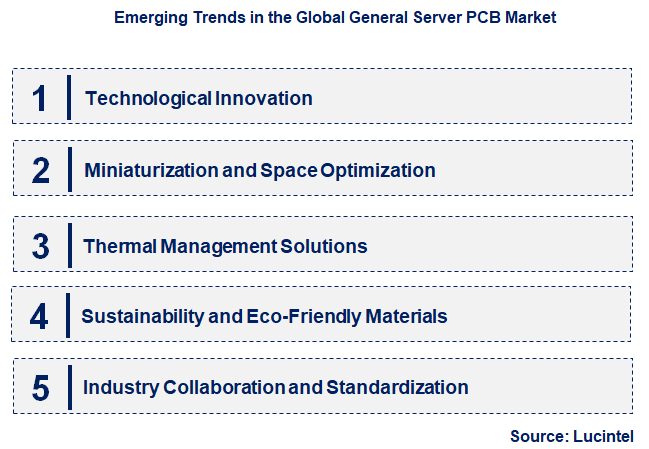
• Technological Innovation: The market is witnessing significant advancements in PCB materials and design techniques. High-frequency and high-speed PCBs are increasingly in demand to support faster data transfer rates and better signal integrity. Innovations such as flexible PCBs and embedded components are enabling more compact and efficient server designs. These technological improvements enhance performance, reduce size, and improve thermal management, which are critical for modern data centers. As a result, manufacturers are investing heavily in R&D to develop cutting-edge solutions that meet evolving industry standards and customer needs.
• Miniaturization and Space Optimization: As data centers seek to maximize space efficiency, there is a strong trend toward miniaturized server PCBs. Thinner, more compact PCBs allow for higher component density and better utilization of limited space within servers. This trend is driven by the demand for scalable, modular, and energy-efficient infrastructure. Miniaturization also facilitates easier integration of multiple functionalities into a single PCB, reducing overall system complexity and cost. Consequently, this trend is pushing manufacturers to innovate in PCB layering, material selection, and manufacturing precision to achieve optimal miniaturization without compromising performance.
• Thermal Management Solutions: With increasing power densities in servers, effective thermal management has become a critical focus. Advanced PCB designs incorporate integrated heat sinks, thermal vias, and specialized materials to dissipate heat efficiently. Improved thermal management enhances reliability, prolongs component lifespan, and maintains optimal operating conditions. As server workloads grow more intensive, the demand for innovative cooling solutions embedded within PCBs is rising. This trend is prompting the development of new materials and design strategies that can handle higher thermal loads while maintaining electrical performance, thereby ensuring the stability and efficiency of data center operations.
• Sustainability and Eco-Friendly Materials: Environmental concerns and regulatory pressures are driving the adoption of sustainable practices in the PCB industry. Manufacturers are exploring eco-friendly materials, such as halogen-free laminates and recyclable substrates, to reduce environmental impact. Additionally, energy-efficient manufacturing processes and waste reduction initiatives are gaining prominence. These efforts not only align with global sustainability goals but also appeal to environmentally conscious clients. The shift toward greener PCBs is reshaping supply chains, material sourcing, and product lifecycle management, ultimately fostering a more sustainable and responsible market environment.
• Industry Collaboration and Standardization: The market is increasingly characterized by collaborations among technology providers, manufacturers, and industry consortia to develop standardized solutions. These partnerships facilitate interoperability, reduce development costs, and accelerate innovation cycles. Standardization efforts focus on defining specifications for high-speed signals, thermal management, and environmental compliance. Such collaborations help streamline supply chains and ensure compatibility across different platforms and systems. As a result, the market benefits from increased reliability, reduced time-to-market, and enhanced customer confidence, fostering a more cohesive and competitive industry landscape. In summary, these emerging trends are collectively reshaping the general server PCB market by driving innovation, improving efficiency, and emphasizing sustainability. They are enabling data centers to become more scalable, reliable, and environmentally responsible, ultimately supporting the growing digital infrastructure needs of the modern world.
• Growing Demand for High-Performance PCBs: The increasing need for faster, more reliable servers is driving the development of advanced PCBs with enhanced thermal management, signal integrity, and durability. This growth opportunity enables manufacturers to innovate with materials like high-frequency substrates and multilayer designs, meeting the rigorous demands of modern data centers. As a result, the market is expanding, with a focus on customized solutions that improve server efficiency and lifespan.
• Adoption of Advanced Materials: The shift towards high-performance materials such as flexible PCBs, ceramic substrates, and high-frequency laminates is transforming the market. These materials offer better thermal management, reduced weight, and higher signal integrity, crucial for high-speed data processing. This development allows for more compact, efficient server designs, reducing overall system costs and improving performance, thus opening new avenues for manufacturers to cater to evolving technological needs.
• Integration of IoT and Edge Computing: The proliferation of IoT devices and edge computing applications is increasing the demand for specialized server PCBs capable of supporting diverse and complex functionalities. These PCBs must be highly reliable, compact, and capable of operating under varied environmental conditions. This trend is creating opportunities for innovative PCB designs that enhance connectivity, processing power, and energy efficiency, thereby expanding the market scope and encouraging technological advancements.
• Sustainability and Eco-Friendly Manufacturing: Environmental concerns are prompting the industry to adopt greener manufacturing practices, including the use of recyclable materials and the reduction of hazardous substances. Sustainable PCBs not only meet regulatory standards but also appeal to eco-conscious clients, fostering market growth. This development encourages manufacturers to innovate with eco-friendly materials and processes, ultimately leading to a more sustainable and competitive market landscape.
• Automation and Smart Manufacturing: The integration of automation, AI, and IoT in PCB production is improving precision, reducing costs, and increasing production speed. Smart manufacturing techniques enable real-time quality control and customization, meeting the specific needs of server applications. This technological advancement enhances overall market efficiency, reduces lead times, and supports the rapid deployment of innovative server PCBs, strengthening the industry’s capacity to meet growing global demand. The overall impact of these developments is a more dynamic, efficient, and sustainable market, capable of supporting the increasing technological complexity and data demands of modern infrastructure. These opportunities are fostering innovation, reducing costs, and improving product performance, which collectively drive growth and competitiveness in the general server PCB market.
• Growing Demand for High-Performance Server PCBs: The increasing need for high-speed data processing and storage has driven demand for advanced server PCBs with enhanced signal integrity, thermal management, and miniaturization. Data centers and cloud service providers require reliable, high-capacity PCBs to support faster processing speeds and higher bandwidth, creating significant opportunities for manufacturers to develop innovative, high-performance PCB solutions tailored to these demanding applications.
• Expansion of Data Centers and Cloud Infrastructure: The rapid proliferation of data centers worldwide, fueled by digital transformation and IoT adoption, is boosting the need for scalable, efficient server PCBs. As organizations migrate to cloud-based services, the demand for robust, cost-effective PCBs that can support increased server density and energy efficiency is rising. This expansion offers manufacturers opportunities to develop customized PCB designs that meet specific data center requirements.
• Adoption of Advanced Materials for Enhanced Durability: The integration of advanced materials such as high-frequency substrates and thermal management composites in server PCBs is gaining traction. These materials improve performance by reducing signal loss and managing heat dissipation, essential for high-density server environments. The shift towards more durable, reliable PCBs presents opportunities for material suppliers and manufacturers to innovate and capture market share through specialized product offerings.
• Increasing Focus on Miniaturization and Space Optimization: As server hardware becomes more compact, the demand for miniaturized PCBs with high component density is rising. This trend enables data centers to maximize space utilization and reduce overall infrastructure costs. Manufacturers investing in miniaturization technologies and flexible PCB designs can tap into this opportunity, providing solutions that meet the evolving needs of modern, space-constrained server environments.
• Rising Importance of Sustainability and Eco-Friendly Solutions: Environmental concerns and regulatory pressures are prompting the industry to adopt sustainable manufacturing practices and eco-friendly materials. Green PCBs with reduced hazardous substances and energy-efficient production processes are gaining popularity. Companies that innovate in sustainable PCB design and manufacturing can differentiate themselves, meet regulatory standards, and appeal to environmentally conscious clients, thereby expanding their market presence. The overall market landscape is poised for significant growth as these opportunities align with technological advancements and shifting industry demands. Companies that strategically invest in innovation, material development, and sustainable practices will be well-positioned to capitalize on the expanding server PCB market, ensuring long-term competitiveness and success.
• Technological Innovation: The continuous evolution of server technology demands advanced PCB designs that support higher speeds, better thermal management, and increased durability. Innovations such as high-density interconnects and flexible PCBs enable servers to handle greater workloads efficiently, fostering market growth. As data centers expand and require more powerful hardware, the need for sophisticated PCBs becomes critical, making technological progress a key driver.
• Growing Data Center Infrastructure: The surge in cloud computing, big data analytics, and IoT applications has led to an exponential increase in data center deployments worldwide. These data centers require reliable, high-performance server PCBs to ensure seamless operation. The expansion of data infrastructure directly correlates with increased demand for specialized PCBs, fueling market expansion.
• Rising Adoption of 5G and Edge Computing: The deployment of 5G networks and the rise of edge computing necessitate compact, efficient, and high-speed server components. PCBs designed for these applications must support high-frequency signals and thermal management, driving innovation and demand in the market. This technological shift opens new avenues for PCB manufacturers to develop specialized products.
• Economic Growth and IT Investment: Increased investments by governments and private enterprises in digital transformation initiatives bolster the demand for server hardware. As organizations upgrade their IT infrastructure to improve operational efficiency, the need for reliable and high-quality PCBs in servers becomes more pronounced, stimulating market growth. The challenges in the general server PCB market are:
• Supply Chain Disruptions: The global supply chain for electronic components, including PCBs, faces disruptions due to geopolitical tensions, pandemics, and logistical issues. These disruptions lead to delays, increased costs, and shortages, hampering market growth and affecting manufacturers ability to meet demand.
• Environmental Regulations and Sustainability Concerns: Stricter environmental standards regarding hazardous substances and waste management impose additional compliance costs on PCB manufacturers. Developing eco-friendly and recyclable PCBs is challenging but necessary, adding complexity and potential delays to product development.
• Rapid Technological Obsolescence: The fast-paced nature of technological advancements results in frequent product obsolescence. Manufacturers must continuously innovate to keep up with evolving server requirements, which increases R&D costs and risks of inventory obsolescence, impacting profitability and market stability. In summary, the general server PCB market is driven by technological advancements, expanding data infrastructure, and economic investments, which collectively foster growth. However, supply chain issues, regulatory pressures, and rapid technological changes pose significant challenges. These factors create a dynamic environment requiring strategic adaptation from market players. Overall, the markets future hinges on balancing innovation with resilience to external disruptions, ensuring sustainable growth amid evolving technological and regulatory landscapes.
• Tripod Technology
• Gold Circuit Electronics
• Unimicron Technology
• Delton Technology
• TTM
• Compeq Manufacturing
• Nippon Mektron
• Ibiden
• WUS Printed Circuit
• Avary Holding
• 8-16 Layers
• 16-24 Layers
• Training Server
• Inference Server
• North America
• Europe
• Asia Pacific
• The Rest of the World
• United States: The US market is focusing on high-density interconnect (HDI) PCBs and advanced materials to support data center expansion and 5G infrastructure. Leading companies are investing in R&D for miniaturization and thermal management solutions, boosting overall server performance and energy efficiency. The US also emphasizes sustainable manufacturing practices and supply chain resilience amid geopolitical tensions.
• China: China is rapidly advancing in high-volume production of cost-effective, reliable server PCBs, driven by domestic demand and government initiatives like Made in China 2025. The country is investing in automation and smart manufacturing to improve quality and reduce lead times. Chinese firms are also innovating in flexible and lightweight PCB designs to cater to emerging cloud and edge computing needs.
• Germany: Known for precision engineering, Germanys market emphasizes high-quality, durable PCBs with enhanced thermal and electrical performance. The focus is on integrating innovative materials and manufacturing techniques to support high-performance data centers and industrial applications. German companies are also exploring eco-friendly PCB production processes aligned with sustainability goals.
• India: The Indian market is witnessing rapid growth due to expanding data centers and digital infrastructure projects. Local manufacturers are adopting advanced PCB fabrication technologies to meet international standards. The government’s push for digital transformation and Make in India initiatives is fostering innovation in server PCB design, with a focus on cost efficiency and scalability.
• Japan: Japan continues to lead in high-reliability, high-performance PCB solutions for servers, emphasizing advanced materials and miniaturization. The country invests heavily in R&D for thermal management and electromagnetic interference (EMI) reduction. Japanese firms are also exploring environmentally sustainable manufacturing practices to maintain their competitive edge in the global market.


• Tripod Technology
• Gold Circuit Electronics
• Unimicron Technology
• Delton Technology
• TTM
• Compeq Manufacturing
• Nippon Mektron
• Ibiden
• WUS Printed Circuit
• Avary Holding Q6. Which general server PCB market segment will be the largest in future? Answer: Lucintel forecasts that, within the type category, 16-24 layer is expected to witness higher growth over the forecast period. Q7. In general server PCB market, which region is expected to be the largest in next 5 years? Answer: In terms of region, APAC is expected to witness the highest growth over the forecast period. Q8. Do we receive customization in this report? Answer: Yes, Lucintel provides 10% customization without any additional cost.


Choose a license that fits your team. Instant PDF delivery.
Prices exclude taxes. Instant delivery. Custom licensing available on request.
Market Report · July 31, 2026
Market Report · July 31, 2026
Market Report · July 31, 2026
Trusted partner for strategic intelligence and business growth


Receive a complimentary market analysis tailored to your industry. Our analysts will identify key growth opportunities and competitive dynamics specific to your business.

Market size, growth rate, and key trend analysis for your specific sector.

Top competitor positioning and market share analysis.

Strategic recommendations backed by data-driven insights.
Get curated market intelligence and competitive moves straight to your inbox.
By subscribing, you agree to receive our monthly insights. Unsubscribe anytime.
Receive a complimentary market analysis tailored to your industry. Our analysts will identify key growth opportunities and competitive dynamics specific to your business.
Market size, growth rate, and key trend analysis for your specific sector.
Top competitor positioning and market share analysis.
Strategic recommendations backed by data-driven insights.
Get curated market intelligence, emerging trends, and competitive moves straight to your inbox each month.
By subscribing, you agree to receive our monthly insights. Unsubscribe anytime.
We'll send your sample report shortly.