
Market Report · July 20, 2026

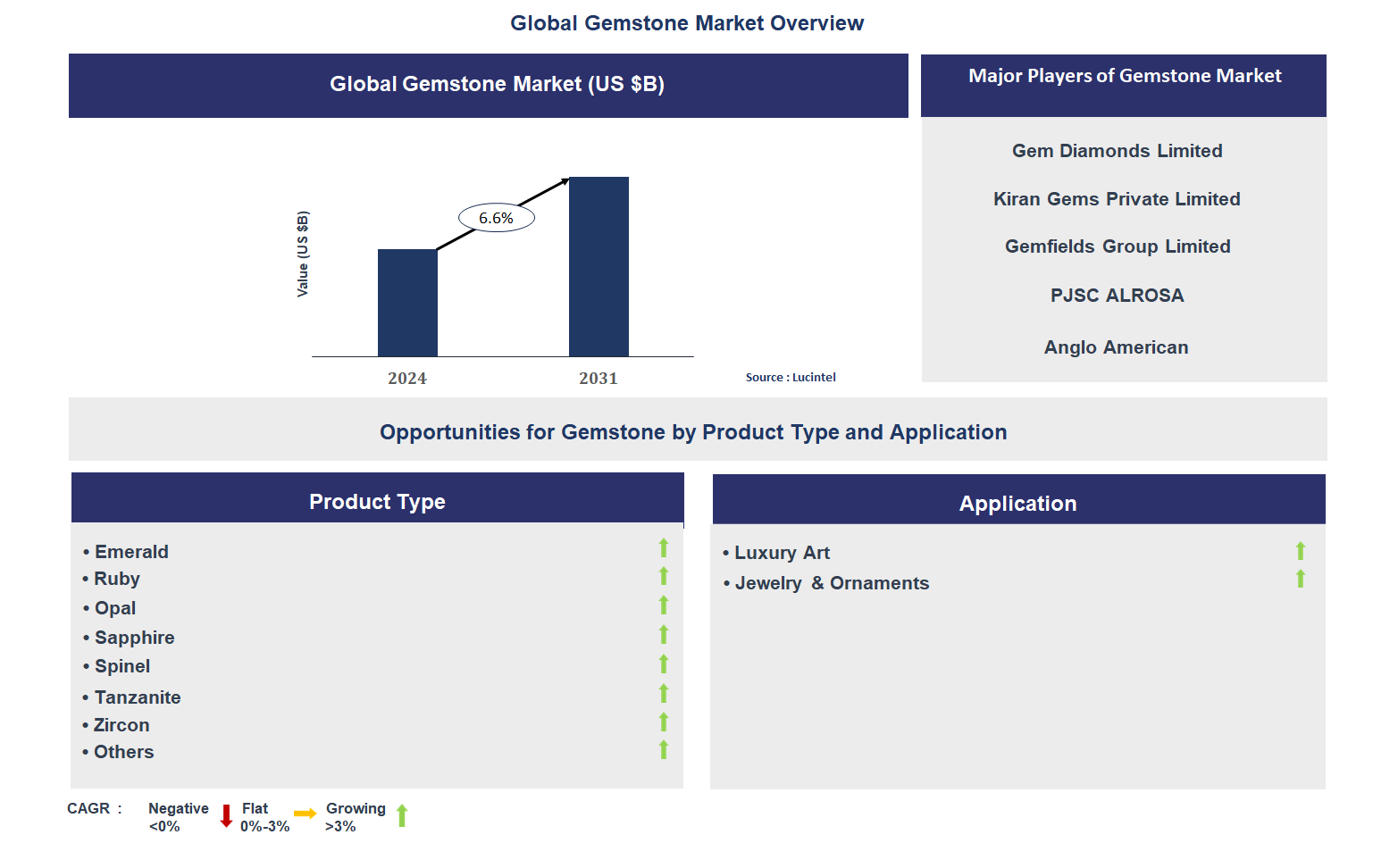
Key data points: The growth forecast = 6.6% annually for the next 7 years. Scroll below to get more insights. This market report covers trends, opportunities and forecasts in gemstone market to 2031 by product type (emerald, ruby, opal, sapphire, spinel, tanzanite, zircon, and others), application (luxury art and jewelry & ornaments), and region (North America, Europe, Asia Pacific, and the Rest of the World)
We'll send your sample report shortly.
• Lucintel forecasts that, within the product type category, emerald is expected to witness the highest growth over the forecast period.
• Within the application category, jewelry & ornament is expected to witness higher growth.
• In terms of region, APAC is expected to witness the highest growth over the forecast period. Gain valuable insights for your business decisions with our comprehensive 150+ page report. Sample figures with some insights are shown below.
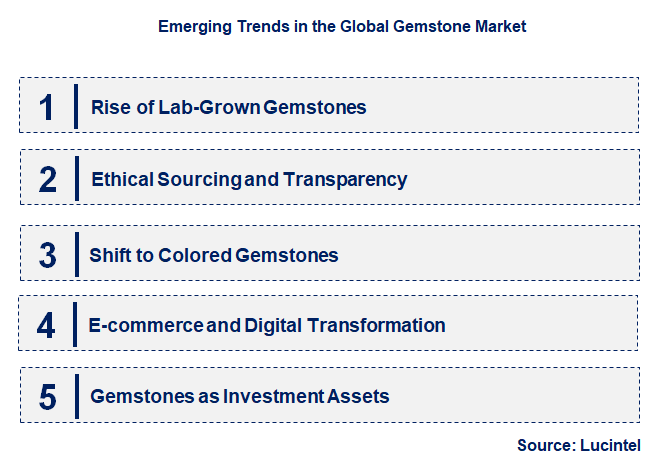
• Rise of Lab-Grown Gemstones: A key trend is the increasing acceptance and demand for lab-grown gemstones, including diamonds, rubies, and sapphires. These gems are chemically and optically identical to their natural counterparts but are more affordable and considered ethically and environmentally superior. This trend is democratizing the luxury market and appealing to younger, socially conscious consumers.
• Ethical Sourcing and Transparency: Consumers are increasingly demanding ethically sourced and conflict-free gemstones. This trend is driving the adoption of new technologies, such as blockchain, to provide a clear and verifiable origin story for each stone. This focus on transparency is rebuilding consumer trust and is becoming a key differentiator for brands.
• Shift to Colored Gemstones: There is a significant trend away from traditional diamond-centric jewelry toward vibrant colored gemstones. Rubies, emeralds, sapphires, and even lesser-known gems like spinel and tourmaline are gaining popularity. This trend reflects a desire for individuality and self-expression, as consumers seek unique, personalized pieces.
• E-commerce and Digital Transformation: The e-commerce channel has become a dominant force in the gemstone market. Online platforms offer a wider selection, competitive pricing, and virtual try-on tools. This trend is making gemstones more accessible to a global audience and is enabling smaller, independent brands to compete with established retailers.
• Gemstones as Investment Assets: A growing trend is the view of high-quality, rare gemstones as alternative investment assets. With the volatility of traditional markets, investors are increasingly diversifying their portfolios with tangible assets. This trend is driven by a steady appreciation in the value of top-quality colored gems. These emerging trends are fundamentally reshaping the gemstone market by prioritizing sustainability, transparency, and consumer individuality. The rise of lab-grown gems and a focus on ethical sourcing are making the industry more responsible and accessible. Meanwhile, the shift to colored gems and the growth of e-commerce are catering to a new generation of consumers who value personalization and unique expression.
• Blockchain for Provenance Tracking: A key recent development is the widespread adoption of blockchain technology for tracking gemstone provenance. This system creates a secure, unchangeable digital record of a stone’s journey from mine to market. This development addresses consumer demand for transparency and is helping to combat the issue of conflict minerals.
• Sophistication in Lab-Grown Production: The technology for creating lab-grown gemstones has become increasingly sophisticated. Manufacturers are now able to produce high-quality, larger-carat synthetic gems with fewer inclusions and more vibrant colors. This development is making them a more viable and attractive alternative to natural stones, especially in the fine jewelry sector.
• Focus on Niche and Untreated Gems: A significant development is the growing interest in niche and untreated gemstones. Consumers and collectors are seeking out unique, lesser-known stones like spinel and Paraiba tourmaline. There is also a strong preference for stones that have not been heat-treated or enhanced, which command a higher premium and are seen as more natural.
• Increased Collaboration and Partnerships: There is a recent development of increased collaboration between miners, cutters, and jewelers. These partnerships aim to create a more integrated and transparent supply chain. This is helping to streamline processes, reduce costs, and ensure that the value from a gemstone’s sale is more equitably shared among all stakeholders.
• Growth of The Colored Gemstone Market: The colored gemstone segment is experiencing significant growth, with its value appreciating at a faster rate than diamonds in recent years. This is driven by fashion trends and consumer desire for unique, vibrant jewelry pieces that stand out. This development is reshaping the industry’s focus and investment priorities. These recent developments are profoundly impacting the gemstone market by prioritizing transparency, ethical practices, and a wider range of product offerings. The use of blockchain and the sophistication of lab-grown gems are building consumer trust, while the focus on niche and colored stones is catering to a new generation of consumers who value individuality and unique expression.
• E-commerce and Digital Platforms: The e-commerce channel offers a prime growth opportunity. Brands can bypass traditional retail by selling directly to consumers through their own websites or marketplaces. The direct-to-consumer model allows for greater control over branding, customer relationships, and enables the use of digital tools like virtual try-on and online certification.
• Custom and Bespoke Jewelry: The custom and bespoke jewelry segment is a major growth area. Consumers are seeking unique, one-of-a-kind pieces that reflect their personal style. This opportunity involves providing a wide range of gemstones and collaborating with designers to create personalized jewelry that builds brand loyalty and commands a higher price point.
• Investment and High-Value Market: The investment-grade gemstone market is a significant growth area. Rare and high-quality colored gems are increasingly being viewed as alternative investment assets. Companies can capitalize on this by providing expert certification, offering secure storage, and catering to high-net-worth individuals seeking portfolio diversification.
• Ethical and Sustainable Jewelry: A strategic growth opportunity lies in capitalizing on the growing consumer demand for sustainable and ethically sourced products. Brands can differentiate themselves by using conflict-free stones, transparent sourcing practices, and eco-friendly packaging, appealing to environmentally conscious consumers and building a strong brand reputation.
• Astrology and Holistic Wellness: The use of gemstones in astrology and holistic wellness is an emerging growth opportunity, particularly in Asia. Consumers are purchasing specific gemstones for their perceived healing properties or astrological significance. Providing certified and ethically sourced stones for these applications is a key area for product diversification and market expansion. Strategic growth opportunities in the gemstone market are concentrated in high-value, consumer-centric segments. By focusing on e-commerce, custom jewelry, the investment market, and ethical sourcing, companies can align their strategies with the most dynamic parts of the market. This targeted approach will drive product innovation and market leadership, ensuring sustained growth and profitability.
• Gem Diamonds Limited
• Kiran Gems Private Limited
• Gemfields Group Limited
• PJSC ALROSA
• Anglo American
• Rio Tinto Group
• Debswana Diamond Company
• Blue Nile
• Chow Tai Fook Jewellery Group Limited
• Tiffany & Co.
• Emerald
• Ruby
• Opal
• Sapphire
• Spinel
• Tanzanite
• Zircon
• Others
• Luxury Art
• Jewelry & Ornaments
• North America
• Europe
• Asia Pacific
• The Rest of the World
• United States: The U.S. market is leading the charge in the demand for ethically sourced and certified gemstones. Consumers are increasingly valuing transparency, pushing for blockchain technology to track gem origins. There’s also a rising preference for colored gemstones, with sapphires, emeralds, and even Montana sapphires gaining popularity for their unique appeal and ethical credentials.
• China: China’s gemstone market is experiencing rapid expansion, fueled by a burgeoning middle class and a cultural affinity for fine jewelry. The market is shifting toward high-quality, unique, and colored gemstones. E-commerce platforms are becoming the dominant channel, and there is a growing interest in lab-grown diamonds and other synthetic gemstones as a more affordable and sustainable alternative.
• Germany: Germany’s market is characterized by a strong consumer base that values sustainability and quality. Recent developments are centered on the demand for certified, conflict-free gemstones and a preference for classic, high-quality pieces. There is also a growing interest in antique and vintage jewelry, which aligns with consumer values of timelessness and responsible consumption.
• India: India’s gemstone market is witnessing robust growth, driven by deep-rooted cultural and traditional significance. The wedding and festival segments are major drivers. Recent developments include a growing demand for lab-grown diamonds, especially among younger consumers, and a focus on contemporary, lightweight designs. India remains a global hub for diamond cutting and polishing.
• Japan: The Japanese gemstone market is highly sophisticated, focusing on precision and craftsmanship. Recent developments include a growing interest in unique, high-quality colored gemstones and a continued appreciation for pearls, which hold significant cultural importance. The market is also seeing an increase in online retail and a shift toward personalized and customized jewelry designs.


• Gem Diamonds Limited
• Kiran Gems Private Limited
• Gemfields Group Limited
• PJSC ALROSA
• Anglo American
• Rio Tinto Group
• Debswana Diamond Company
• Blue Nile
• Chow Tai Fook Jewellery Group Limited
• Tiffany & Co. Q5. Which gemstone market segment will be the largest in future? Answer: Lucintel forecasts that, within the product type category, emerald is expected to witness the highest growth over the forecast period. Q6. In gemstone market, which region is expected to be the largest in next 5 years? Answer: In terms of region, APAC is expected to witness the highest growth over the forecast period. Q7. Do we receive customization in this report? Answer: Yes, Lucintel provides 10% customization without any additional cost.


Choose a license that fits your team. Instant PDF delivery.
Prices exclude taxes. Instant delivery. Custom licensing available on request.
Market Report · July 20, 2026
Market Report · July 15, 2026
Market Report · July 15, 2026
Trusted partner for strategic intelligence and business growth


Receive a complimentary market analysis tailored to your industry. Our analysts will identify key growth opportunities and competitive dynamics specific to your business.

Market size, growth rate, and key trend analysis for your specific sector.

Top competitor positioning and market share analysis.

Strategic recommendations backed by data-driven insights.
Get curated market intelligence and competitive moves straight to your inbox.
By subscribing, you agree to receive our monthly insights. Unsubscribe anytime.
Receive a complimentary market analysis tailored to your industry. Our analysts will identify key growth opportunities and competitive dynamics specific to your business.
Market size, growth rate, and key trend analysis for your specific sector.
Top competitor positioning and market share analysis.
Strategic recommendations backed by data-driven insights.
Get curated market intelligence, emerging trends, and competitive moves straight to your inbox each month.
By subscribing, you agree to receive our monthly insights. Unsubscribe anytime.
We'll send your sample report shortly.