
Report Feature
GCC PPR Pipe Market Trends and Forecast
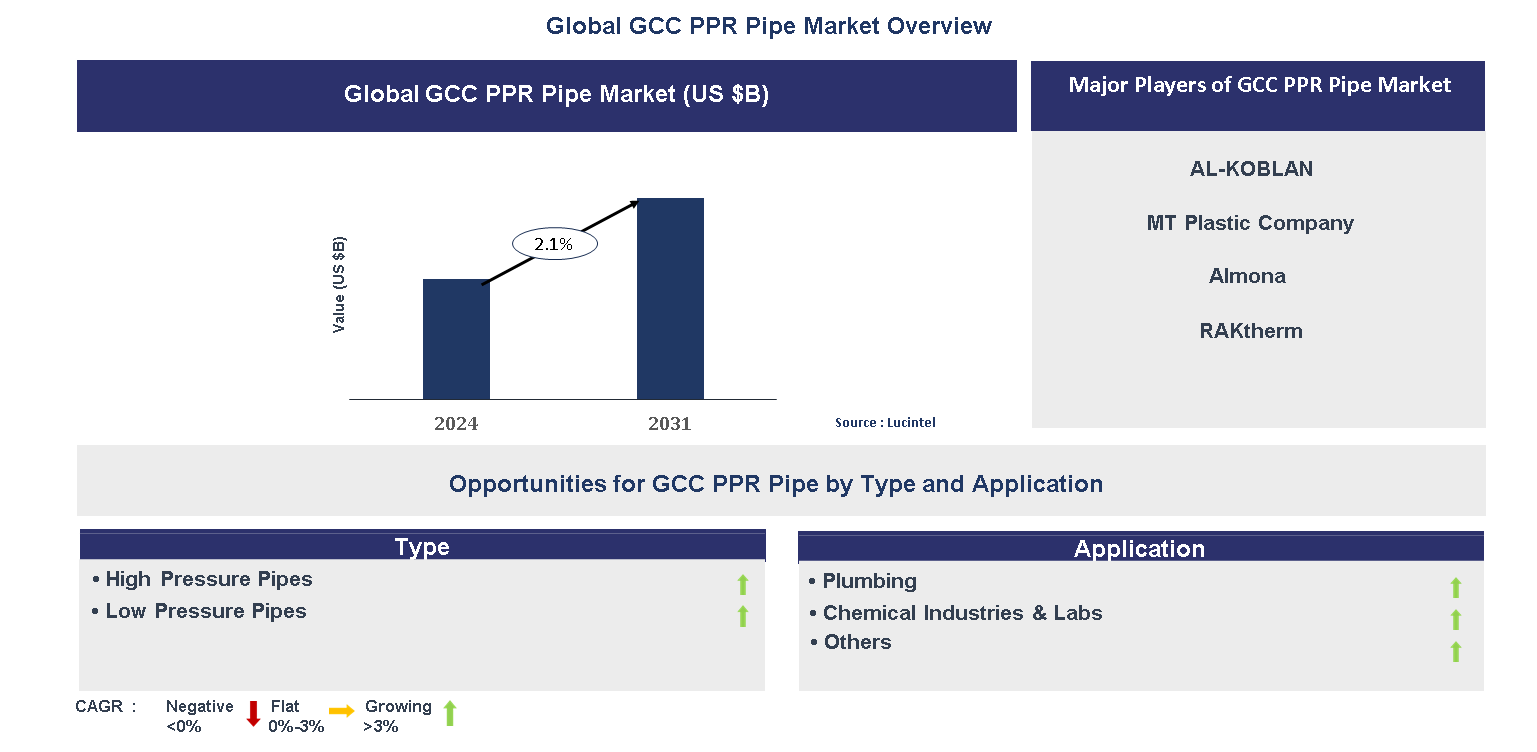
The future of the global GCC PPR pipe market looks promising with opportunities in the plumbing and chemical industry & lab markets. The global GCC PPR pipe market is expected to grow with a CAGR of 2.1% from 2025 to 2031. The major drivers for this market are the increasing infrastructure projects, the rising government initiatives for sustainable water management, and the growing demand durable plumbing solutions.• Lucintel forecasts that, within the type category, high pressure pipe is expected to witness higher growth over the forecast period.
• Within the application category, plumbing is expected to witness higher growth.
• In terms of region, APAC is expected to witness the highest growth over the forecast period. Gain valuable insights for your business decisions with our comprehensive 150+ page report. Sample figures with some insights are shown below.
Emerging Trends in the GCC PPR Pipe Market
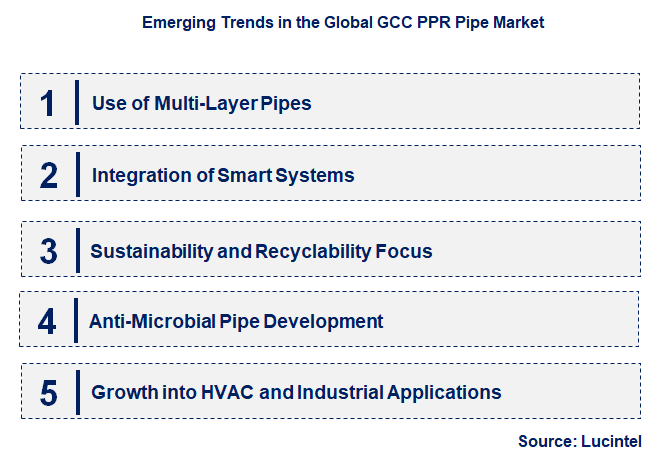
The GCC PPR pipe market is being transformed by a number of strong emerging trends which are radically changing the way plumbing and piping systems are being installed in the region. These trends are a direct reaction to the growing need for efficiency, durability, and sustainability in the region’s fast-developing urban hubs. They are propelling innovation beyond the conventional application of PPR pipes, making them a core element of contemporary, durable infrastructure.• Use of Multi-Layer Pipes: There is rapid uptake of multi-layer PPR pipes, which utilize various materials for augmented performance. For instance, a PPR pipe can be wrapped in a layer of aluminum or fiberglass to enhance its thermal stability and minimize thermal expansion, which is an important consideration in the hot climate of the GCC. This trend is affecting the market by providing a higher-performance alternative that can compete with conventional metal pipes in a greater number of high-pressure and high-temperature applications.
• Integration of Smart Systems: Integration of sensors and digital monitoring systems is a new trend. Smart pipes can give real-time information about water flow, pressure, and temperature, and leaks, structure problems, etc. This trend is affecting the market as it enables predictive maintenance, which minimizes expensive failures and enhances overall operational efficiency. It converts a pipe from a fixed part to a dynamic, data-generating element that increases system reliability and aids in water conservation efforts.
• Sustainability and Recyclability Focus: The industry is witnessing growing emphasis on the entire lifecycle of a product, including production, through disposal. The impetus for this is driven by a need for environmentally friendly products with a reduced environmental impact. Manufacturers are retaliating by creating PPR pipes that are more recyclable and by utilizing manufacturing processes that have lower energy demands. This is establishing a competitive edge for those companies that provide environmentally friendly and sustainable solutions that align with the long-term sustainability objectives of the GCC.
• Anti-Microbial Pipe Development: In the GCC region, where water quality is of particular importance, there has been a rise in the trend for developing anti-microbial PPR pipes. Such pipes contain additives that prevent bacteria and other microbial growth, ensuring better water quality and safety. This trend is transforming the market by broadening the applications of PPR pipes to critical applications like health-care facilities and food processing units, where there is a need for high hygiene.
• Growth into HVAC and Industrial Applications: Although conventionally applied for cold and hot water supply, PPR pipes are gaining acceptance in HVAC systems and industrial fluid transfer. The thermal efficiency and corrosion resistance of PPR pipes render them well-suited for use in these applications. This trend is affecting the market through diversifying revenues and offering PPR pipes as a solution that has many applications across a variety of industries in addition to residential and commercial plumbing. These trends are revolutionizing the GCC PPR pipe market deeply by making the technology smarter, more sustainable, and diverse. The transition towards a proactive service model from the traditional reactive model fueled by digitalization and advanced materials is building a more dynamic and robust market that is better placed to meet the complexities of contemporary industrial and infrastructure needs.
Recent Development in the GCC PPR Pipe Market
The GCC PPR pipe industry has witnessed several recent developments based on the ongoing requirements for efficiency and cost-cutting in diverse industrial settings. These developments indicate a trend away from simple operational tools toward more advanced, integrated systems offering superior capabilities and better performance. The major developments are a reflection of the industry’s dedication to innovation and the competition against the demands of contemporary infrastructure.• Advanced Manufacturing Technologies: One of the key advancements is the ubiquitous adoption of advanced manufacturing methods, including automated extrusion and continuous filament winding. Such technologies are enhancing the uniformity and quality of PPR pipes and minimizing manufacturing expenses. The effect of this innovation is a rise in the capacity of the market to manufacture high-quality pipes at a reduced price, thus making them competitive with conventional materials such as galvanized steel and copper and speeding up their uptake in high-rise construction activities.
• Development of High-Temperature and Pressure Systems: New innovations have been centered on the production of PPR pipes and fittings that are capable of handling higher pressure and temperatures, which qualify them for more challenging applications. The development is essential for hot water circulation and heating systems in residential and commercial buildings. The effect is a dramatic increase in the market because such sophisticated pipes can now enter areas previously ruled by metallic piping, including skyscrapers and industrial units.
• Advanced Fitting and Connection Systems: One major innovation is the advancement of fitting and connection systems for PPR pipes. Producers are designing new fusion welding equipment and push-fit systems that offer stronger, more secure, and simpler-to-install joints. This innovation is important because it eliminates the risk of leaks and failure, which can be hazardous and expensive. It also makes it easier to install for laborers and saves total project time, a big selling point for contractors.
• Higher Utilization of Fiber-Reinforced Pipes: The market is witnessing a significant upgrade in the higher utilization of fiber-reinforced PPR pipes. The pipes contain a core layer of composite material or glass fiber that significantly lowers the thermal expansion of the pipe and raises its stiffness. It is crucial for the hot climatic conditions of the GCC, as thermal expansion could lead to sagging and stress in the pipe system. This innovation is influencing the market by offering a more stable and dependable system for hot water supply and heating.
• Emphasis on Fire Retardant Characteristics: One recent innovation is the emphasis on creating PPR pipes with improved fire-retardant characteristics. This is very important for use in buildings where fire safety is at the top of the list. Producers are introducing flame retardant additives to the material and creating protective coatings to enhance fire resistance. This innovation is affecting the market by broadening the application of PPR pipes into more areas where fire safety is a major factor. These advancements are greatly influencing the GCC PPR pipe industry by making the technology stronger, more reliable, and smarter. They are making PPR pipes become a major solution for an increasingly broad scope of applications, cementing their role as a necessary equipment in the contemporary infrastructure.
Strategic Growth Opportunities in the GCC PPR Pipe Market
The GCC PPR pipe industry presents several strategic opportunities for growth across a host of applications, spurred by the demand for more efficient and long-lasting solutions in a demanding industrial environment. Through specialization in certain application areas, businesses can establish dedicated products and services to satisfy distinct customer requirements and cash in on evolving needs. It is not merely a question of selling products but delivering all-round solutions that cater to the distinct challenges of each industry.• Residential and Commercial Building Construction: One of the biggest strategic growth opportunities exists in supplying PPR pipes for the fast-growing residential and commercial building construction businesses in the GCC. Governments are spending billions of dollars on huge urbanization and new city developments like Neom and The Red Sea Project, and this opens a gigantic market for efficient and latest-generation plumbing systems.
• Hot and Cold-Water Supply Systems: The main application for PPR pipes, hot and cold water supply systems, offers the largest growth opportunity. As nations in the GCC spend on replacing their old water infrastructure, PPR pipes offer a good alternative to conventional metal pipes as they are resistant to corrosion, have a longer life span, and are easy to install. This sector is a secure and permanent market that plays a very important role in supplying a secure and dependable water supply to the increasing population.
• HVAC and Underfloor Heating Systems: The hot weather of the GCC provides a significant growth prospect in the HVAC industry, especially for district cooling and underfloor heating systems. PPR pipes, being very good thermal insulators, are perfectly suited for these systems. The prospect is to offer specialized pipes and fittings that can withstand the high and low temperatures needed for these systems, making PPR pipes an essential element in energy-efficient buildings.
• Industrial and Chemical Uses: The chemical and industrial industries are a high-value growth opportunity, as these industries have a need for pipes that can carry highly corrosive chemicals and fluids without damage. The potential is to offer custom PPR pipes with a particular set of chemical resistance characteristics and tolerance to high temperatures. This use involves intimate knowledge of the customer’s chemical processes and a high degree of engineering sophistication, providing a competitive advantage for specialized producers.
• Irrigation and Agriculture: With water shortage being a prime issue in the GCC, a strategic business opportunity is appearing in the agriculture industry. PPR pipes can be utilized to implement efficient drip and sprinkler irrigation systems that prevent water wastage and increase crop yield. The opportunity is in offering resistant and affordable pipes that can stay outside and ensure food security objectives for the region. These opportunities are influencing the GCC PPR pipe industry by propelling its development into a more specialized and application-driven business. By concentrating on high-growth, high-value areas, firms can distinguish themselves and establish a stronger business model, taking the generalized product beyond to being a key partner in the resolution of the advanced challenges of contemporary industry.
GCC PPR Pipe Market Driver and Challenges
The GCC PPR pipe market is a vibrant sector influenced by a multifaceted mix of drivers that fuel its expansion and challenges that limit its potential. The key drivers and challenges are diverse technological, economic, and regulatory factors. These forces must be understood to enable stakeholders to effectively position themselves in the market. On the one side, the drivers are forcing the market towards expansion and innovation, and on the other, the impediments are compelling businesses to innovate and seek new means of generating value. The factors responsible for driving the GCC PPR pipe market include: 1. Urbanization and Construction Boom: One of the main drivers is the quick urbanization and boom in residential, commercial, and industrial construction projects in the GCC. As governments spend capital in new cities and infrastructure, there arises an enormous requirement for advanced plumbing and piping solutions. PPR pipes, as a result of being cost-effective, light in weight, and having a long life span, are a Favorite pick for such big-ticket projects. 2. Corrosion Resistance: PPR pipes’ better corrosion resistance is one of the main drivers of growth, especially in the hot and dry climate of the GCC region. In contrast to conventional metal pipes that rot when exposed to chemicals and water, PPR pipes have their integrity intact, prolonging their life expectancy and lowering maintenance costs. This aspect makes them the top choice in a region where water quality and water scarcity are key issues. 3. Ease of Installation and Cost-Effectiveness: One of the primary factors fueling the market growth of PPR pipes is their lightweight character. They are much lighter than steel or copper alternatives, lowering transportation expenses and making installation easier. This characteristic makes them suitable for applications in areas that are far or hard to reach, as they need less heavy equipment and labor to install. 4. Technological innovations: The ongoing evolution of new technologies, including better resin chemistries and advanced processes, is a significant growth driver. These advances are producing higher-performance, longer-lasting pipes at lower prices, which is positioning them to be more competitive with conventional materials. 5. Increased Need for Hot Water Systems: GCC’s hot weather and the heavy need for hot water in residential and commercial complexes is one of the major drivers. PPR pipes are resistant to high temperature and possess high thermal insulation, and hence are a preferred option for hot water circulation and heating systems. Challenges in the GCC PPR pipe market are: 1. Alternative Material Competition: The biggest challenge is the strong competition from alternative piping materials like PEX, CPVC, and traditional metallic pipes. These materials have established market bases and may act as a hindrance to the mass use of PPR pipes. This is a challenge that makes manufacturers differentiate their products so clearly and underscore the long-term advantage of PPR pipes. 2. Lack of Technical Competence: One of the biggest challenges is the resultant lack of awareness and technical know-how that is necessary for correct installation. PPR pipes are simple to install, but they need the right tools and training to produce a failure-free, leak-free fusion weld. Failure to have adequately trained installers can cause failure and reputational loss to both manufacturers and installers, which can discourage potential customers. 3. Quality Control and Counterfeit Products: The industry is confronted with low-quality and counterfeit products, which can erode the trust of consumers and the reputation of the industry. It is a serious issue because pipe failure can cause extensive water damage and financial loss. The industry is reacting by creating tighter quality standards as well as informing consumers about the hazards of using fake products. In summary, the GCC PPR pipe market is at a turning point, with strong drivers propelling technology development and penetration into new applications, while strong challenges such as high competition and lack of technical competence pose obstacles. The overall effect of these is a market driven ever more by a dual emphasis: on offering both value-added, high-technology solutions for complicated industrial usage and offering cost-efficient, straightforward products for widespread use.List of GCC PPR Pipe Companies
Companies in the market compete on the basis of product quality offered. Major players in this market focus on expanding their manufacturing facilities, R&D investments, infrastructural development, and leverage integration opportunities across the value chain. With these strategies GCC PPR pipe companies cater increasing demand, ensure competitive effectiveness, develop innovative products & technologies, reduce production costs, and expand their customer base. Some of the GCC PPR pipe companies profiled in this report include-• AL-KOBLAN
• MT Plastic Company
• Almona
• RAKtherm
GCC PPR Pipe Market by Segment
The study includes a forecast for the global GCC PPR pipe market by type, application, and region.GCC PPR Pipe Market by Type [Value from 2019 to 2031]:
• High Pressure Pipes
• Low Pressure Pipes
GCC PPR Pipe Market by Application [Value from 2019 to 2031]:
• Plumbing
• Chemical Industries & Labs
• Others
GCC PPR Pipe Market by Region [Value from 2019 to 2031]:
• North America
• Europe
• Asia Pacific
• The Rest of the World
Country Wise Outlook for the GCC PPR Pipe Market
GCC PPR pipe market is a developing and vibrant industry fueled by increasing urbanization and megaproject construction. PPR pipes are becoming more widely accepted as a substitute for conventional metal pipes, particularly in the hot and dry climate of the GCC region, because of their superior resistance to corrosion, high temperature, and chemical deterioration. These characteristics render them suitable for broad application in hot and cold-water supply, heating circuits, and industrial fluid transfer. The recent trend is enhancing product quality, manufacturing effectiveness, and sustainability for keeping pace with growing residential, commercial, and industrial sector demand.• United States: The United States is not a major market for PPR pipes produced in GCC since it enjoys a well-established domestic market for other piping materials such as copper, CPVC, and PEX. Nevertheless, American manufacturers are monitoring advancements in the GCC to learn best practices and innovations in the PPR industry. Recent US activity is concentrated on multilayer piping systems and the incorporation of smart leak detection systems, a trend that mirrors the wider drive for intelligent and efficient plumbing solutions in commercial and residential buildings.
• China: China is a leading participant in the international PPR pipe market and a major exporter to the GCC. The current trends are focused on cost-efficient, high-volume production and the broadening of manufacturing capacity. The Chinese firms are utilizing their sophisticated, automated production facilities to satisfy a huge domestic market and to supply an expanding export market, including the GCC. The nation is also a substantial producer of raw materials, which grants it an edge.
• Germany: Germany’s market for PPR pipes is a market leader in high-quality, precision-engineered products for niche industrial and municipal applications. Recent advancements are focused on material science, with an emphasis on advanced resin systems for improved thermal stability and chemical resistance. The market is also driven by severe environment regulations and a concept of sustainable production, promoting the use of long-life, environment-friendly pipes. German companies are renowned for offering customized, high-performance solutions for intricate, high-risk projects.
• India: The Indian market is growing at a fast pace, driven by government policies of urbanization and infrastructure development. The recent trends are aimed at offering robust and affordable solutions in water supply, irrigation, and sewage networks. The market is very competitive, and more use of advanced manufacturing technologies is taking place to improve the quality of the product as well as address the rising domestic demand for durable, long-lasting pipes.
• Japan: Japanese market is technologically sophisticated and highly specialized, with emphasis on reliability and quality for mission-critical applications, especially for residential plumbing and HVAC installations. Recent innovations are focused on high-performance materials and digital technologies integration for remote monitoring. The country’s material science expertise is exploited to formulate special PPR pipe compositions that will endure extreme environments, with a long life expectancy and low maintenance, which is a priority requirement for a nation that is susceptible to natural disasters.

Features of the Global GCC PPR Pipe Market
Market Size Estimates: GCC PPR pipe market size estimation in terms of value ($B). Trend and Forecast Analysis: Market trends (2019 to 2024) and forecast (2025 to 2031) by various segments and regions. Segmentation Analysis: GCC PPR pipe market size by type, application, and region in terms of value ($B). Regional Analysis: GCC PPR pipe market breakdown by North America, Europe, Asia Pacific, and Rest of the World. Growth Opportunities: Analysis of growth opportunities in different types, applications, and regions for the GCC PPR pipe market. Strategic Analysis: This includes M&A, new product development, and competitive landscape of the GCC PPR pipe market. Analysis of competitive intensity of the industry based on Porter’s Five Forces model.
FAQ
Q1. What is the growth forecast for GCC PPR pipe market? Answer: The global GCC PPR pipe market is expected to grow with a CAGR of 2.1% from 2025 to 2031. Q2. What are the major drivers influencing the growth of the GCC PPR pipe market? Answer: The major drivers for this market are the increasing infrastructure projects, the rising government initiatives for sustainable water management, and the growing demand durable plumbing solutions. Q3. What are the major segments for GCC PPR pipe market? Answer: The future of the GCC PPR pipe market looks promising with opportunities in the plumbing and chemical industry & lab markets. Q4. Who are the key GCC PPR pipe market companies? Answer: Some of the key GCC PPR pipe companies are as follows:• AL-KOBLAN
• MT Plastic Company
• Almona
• RAKtherm Q5. Which GCC PPR pipe market segment will be the largest in future? Answer: Lucintel forecasts that, within the type category, high pressure pipe is expected to witness higher growth over the forecast period. Q6. In GCC PPR pipe market, which region is expected to be the largest in next 5 years? Answer: In terms of region, APAC is expected to witness the highest growth over the forecast period. Q7. Do we receive customization in this report? Answer: Yes, Lucintel provides 10% customization without any additional cost.
Table of Contents
List of Figures
List of Tables
Methodology
- In-depth interviews of the major players in this market
- Detailed secondary research from competitors’ financial statements and published data
- Extensive searches of published works, market, and database information pertaining to industry news, company press releases, and customer intentions
- A compilation of the experiences, judgments, and insights of Lucintel’s professionals, who have analyzed and tracked this market over the years.


Buy Now
Choose a license that fits your team. Instant PDF delivery.
Prices exclude taxes. Instant delivery. Custom licensing available on request.
Key Questions
- • What are some of the most promising, high-growth opportunities for the GCC PPR pipe market by type (high pressure pipes and low pressure pipes), application (plumbing, chemical industries & labs, and others), and region (North America, Europe, Asia Pacific, and the Rest of the World)?
- • Which segments will grow at a faster pace and why?
- • Which region will grow at a faster pace and why?
- • What are the key factors affecting market dynamics? What are the key challenges and business risks in this market?
- • What are the business risks and competitive threats in this market?
- • What are the emerging trends in this market and the reasons behind them?
- • What are some of the changing demands of customers in the market?
- • What are the new developments in the market? Which companies are leading these developments?
- • Who are the major players in this market? What strategic initiatives are key players pursuing for business growth?
- • What are some of the competing products in this market and how big of a threat do they pose for loss of market share by material or product substitution?
- • What M&A activity has occurred in the last 5 years and what has its impact been on the industry? For any questions related to GCC PPR Pipe Market, GCC PPR Pipe Market Size, GCC PPR Pipe Market Growth, GCC PPR Pipe Market Analysis, GCC PPR Pipe Market Report, GCC PPR Pipe Market Share, GCC PPR Pipe Market Trends, GCC PPR Pipe Market Forecast, GCC PPR Pipe Companies, write Lucintel analyst at email: helpdesk@lucintel.com. We will be glad to get back to you soon.


