
Report Feature
Gaseous Molecular Pollutant Filter Trends and Forecast
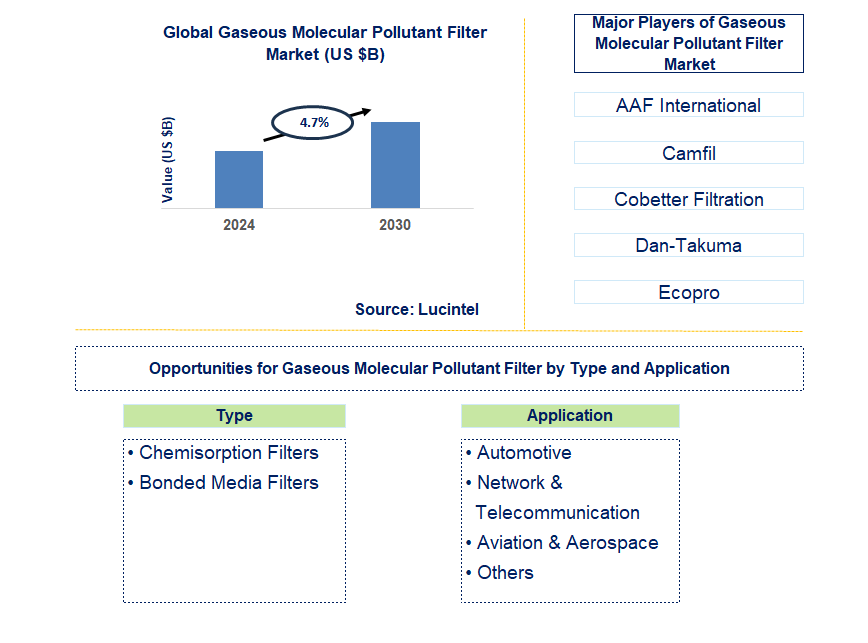
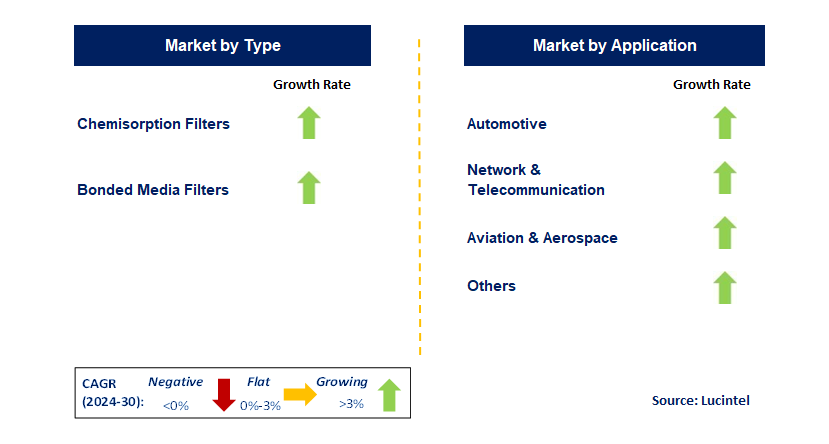
The future of the global gaseous molecular pollutant filter market looks promising with opportunities in the automotive, network & telecommunication, and aviation & aerospace markets. The global gaseous molecular pollutant filter market is expected to grow with a CAGR of 4.7% from 2024 to 2030. The major drivers for this market are rise in industrial activities and urbanization, growing concerns about indoor air quality, and expanding use of this filter in food processing and pharmaceutical industries.• Lucintel forecasts that, within the type category, chemisorption filter is expected to witness higher growth over the forecast period.
• Within the application category, automotive is expected to witness the highest growth.
• In terms of region, APAC is expected to witness the highest growth over the forecast period. Gain valuable insights for your business decisions with our comprehensive 150+ page report.
Emerging Trends in the Gaseous Molecular Pollutant Filter Market
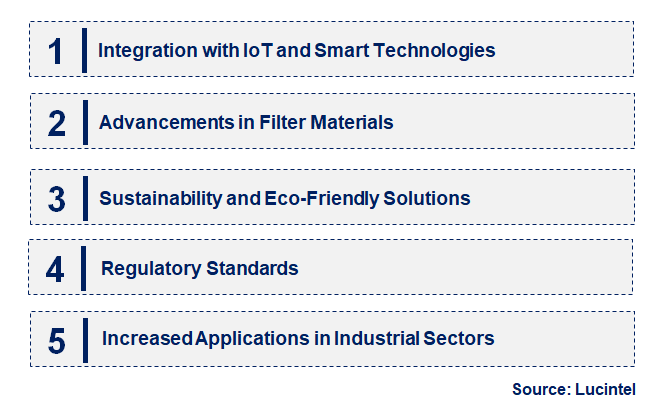
Emerging trends in the Gaseous Molecular Pollutant Filter market reflect the industry's response to high environmental concerns, regulatory pressures, and scientific breakthroughs. All these factors are altering the market by making filters more effective, increasing their applications, and promoting innovation in product development.• Integration with IoT and Smart Technologies: Integration with IoT and smart technologies is on the rise for real-time system monitoring. Filters can now be equipped with smart technology that sends data regarding air quality and filter performance. This creates an efficient and personalized method of pollution control. It greatly enhances user experience and allows for proactive maintenance.
• Advancements in Filter Materials: New nanomaterials and metal-organic frameworks are beginning to improve the efficiency and longevity of filters. Higher adsorption capacities and longer life expectancy suggest greater effectiveness and less maintenance for capturing gaseous pollutants.
• Sustainability and Eco-Friendly Solutions: More attention is being given to recycling filters and producing filters from renewable resources. This approach aligns with a general environmental commitment and is beneficial for reducing the ecological footprint of filter products. More companies are investing in research to design filters that are not only effective but also as eco-friendly as possible.
• Regulatory Standards: With increasing environmental regulatory standards, manufacturers are compelled to produce filters that meet stricter performance criteria. Compliance by filters ensures the removal of harmful pollutants, contributing to better air quality. This creates opportunities for innovation and standardization in the industry.
• Increased Applications in Industrial Sectors: Filters are being increasingly applied in industrial sectors for emission management, leading to improved air quality. This shift is inspired by tighter regulations and the need for environmentally friendly operations in industries. Industrial filters, in particular, are continuously evolving to handle diverse and challenging pollutants. The Gaseous Molecular Pollutant Filter market now has more scope due to improvements in filtering technology, growth in applications, and progress toward sustainability objectives, showing a significant shift toward smart, efficient, and environmentally friendly solutions for controlling air pollution.
Recent Developments in the Gaseous Molecular Pollutant Filter Market
Recent developments in the Gaseous Molecular Pollutant Filter market show how the industry is responding to growing environmental concerns and governmental demands. Innovations combined with changes in the market are driving improvements in filter technology and its applications.• High-Efficiency Filters: Advancements in filter technology have enabled the development of high-efficiency filters to trap gaseous pollutants. Improvements in materials and design enhancements lead to better performance and longer service life. This design is critical for meeting stricter air quality standards.
• Increased Use of Smart Technology: The use of smart technology in filters has significantly improved to include real-time monitoring and control. Smart filters are fitted with sensors and connectivity features that enable tracking of air quality and filter performance, which improves their efficiency.
• Growth in Regulatory Standards: Strict environmental regulations have increased the demand for stronger filtration technology. Governments have raised air quality standards, and manufacturers design their filters accordingly. This has led to more investment in research and development.
• Focus on Sustainable Materials: There is increased demand for sustainable and recyclable materials in filter production. Such products align with global sustainability goals, thus reducing the overall ecological footprint of filters. New sustainable materials and processes are increasingly in demand.
• Expansion into Emerging Regions: The market for gaseous molecular pollutant filters is expanding into emerging regions where urbanization and pollution levels are rising. Companies are focusing on these markets with solutions that are economical and customized to meet specific local air quality challenges. New developments in the Gaseous Molecular Pollutant Filter market are driven by upgrading technology, regulatory requirements, and addressing environmental needs. These developments represent the evolving solutions in the air quality industry committed to adapting to changing market demands.
Strategic Growth Opportunities for Gaseous Molecular Pollutant Filter Market
Strategic growth opportunities in the Gaseous Molecular Pollutant Filter market have emerged due to increasing pollution levels, regulatory requirements, and technological advancements. Opportunities can be identified and leveraged to yield high returns for businesses and help create better indoor air quality.• Increased Consumer Awareness: As more consumers become aware of indoor air quality, filters for home use are becoming increasingly advanced, with higher removal efficiencies and integration into smart home systems. This segment provides an enormous growth opportunity, as consumers prefer a healthier living environment.
• Industrial Emission Control: In the industrial sector, high-end filters are being used to control emissions and meet regulatory requirements. The demand for filters will surely increase with the complexity of emissions and the challenging environment. This application also has enormous growth potential as industries invest in pollution control technologies.
• Automotive Air Quality Management: Automotive air filters are evolving due to increasingly strict emission legislation and consumer demand for a cleaner interior environment. Advanced filter technologies are improving the performance of automotive air purifiers as well. Automotive air quality management is a growing area, with manufacturers showing much more interest in vehicle cabin air quality.
• Commercial Heating, Ventilation, and Air Conditioning Systems: Commercial buildings are investing in advanced HVAC systems to improve indoor air quality and meet regulatory standards. Filters used in these systems are becoming more advanced, incorporating technologies that enhance pollutant removal and energy efficiency. This is a fast-growing market opportunity since businesses are focusing on good air quality and energy savings.
• Healthcare Facilities: In healthcare facilities, where sterile environments are required to maintain cleanliness for patients and staff, the market demands high-performance filters. Specialty filters used in medical and laboratory facilities are gaining momentum. This represents an excellent niche for filter companies that can manufacture products that excel in filtration and durability. These strategic growth opportunities unveil a wide range of applications and a growing market size for gaseous molecular pollutant filters. Focus areas in residential, industrial, automotive, commercial, and healthcare applications are critical enablers for tapping into emerging trends and driving growth in the air quality management sector.
Gaseous Molecular Pollutant Filter Market Driver and Challenges
The gaseous molecular pollutant filter market is driven by a variety of major drivers and challenges. On one side are technological innovation, regulatory pressure, and economic factors, among other elements that play important roles in shaping the dynamics of the market and defining the success of filtration technologies. The factors responsible for driving the gaseous molecular pollutant filter market include:• Increased Air Quality Regulations: Greater levels of environmental regulations account for higher demand for advanced filters that meet stringent air quality requirements. As emission-reduction regulations are implemented by governments around the globe, there will be significant demand for high-performance filtration solutions. Regulatory pressure is forcing companies to innovate and enhance the development of filter technologies.
• Rising Pollution Levels: The rise in urbanization and industrial activities rapidly boosts pollution levels in the air, necessitating more efficient filtration solutions. Higher levels of pollution stimulate both consumers and industries to demand better filters for improved air quality and health. This trend encourages market growth and fuels innovation.
• Technological Advancements: Technological improvements in filter materials and technologies are enhancing the capabilities of gaseous molecular pollutant filters. Innovations in nanomaterials, smart filters, and advancements in adsorption techniques aim to enhance filter performance and open new market opportunities. Technological progress is one of the strongest drivers for market expansion and competitiveness.
• Consumer Awareness and Health Concerns: Increased awareness of the health effects of air pollution is pushing consumers to seek better filtration solutions. Consumers are becoming proactive in demanding products that enhance indoor air quality. The advancement of filters is being incorporated at a higher rate in both residential and commercial settings due to health concerns.
• Sustainability Trends: Sustainability and eco-friendliness are trending; therefore, companies are promoting more eco-friendly and recyclable filters. Companies in this industry are investing in sustainable materials and processes to align with global environmental goals, creating a trend of differentiation and innovation in the filter market. Challenges in the gaseous molecular pollutant filter market include:
• High Costs of High-Performance Filters: The production and manufacturing of high-performance filters can be expensive, limiting penetration into price-sensitive markets. High prices for products, mainly attributed to advanced materials and technology, make market entry challenging for manufacturers and consumers.
• Complexity of Filter Maintenance: More complicated filters may require complex maintenance and replacement processes, posing a challenge in their utilization. The complexity of maintaining high-performance filters can be a challenge for some consumers and businesses. This challenge should be addressed either by simplifying maintenance processes or by providing user-friendly solutions.
• Regulatory Compliance Costs: Compliance with stringent regulatory standards imposed on manufacturers by governments is expensive, leading to financial strain for companies. To stay updated on amendments and changes in regulations, continuous investment in research and development is necessary, which can strain resources. Managing these expenses while remaining competitive poses a significant challenge for the industry. The major drivers and challenges in the gaseous molecular pollutant filter market illustrate the complexities of addressing air quality issues. While regulatory pressures, rising pollution levels, and technological advancements boost demand in the gaseous molecular pollutant filter market, challenges such as high costs and maintenance complexity must be adeptly managed. Understanding these factors is crucial for navigating the market and leveraging growth and profitability opportunities.
List of Gaseous Molecular Pollutant Filter Companies
Companies in the market compete on the basis of product quality offered. Major players in this market focus on expanding their manufacturing facilities, R&D investments, infrastructural development, and leverage integration opportunities across the value chain. Through these strategies gaseous molecular pollutant filter companies cater increasing demand, ensure competitive effectiveness, develop innovative products & technologies, reduce production costs, and expand their customer base. Some of the gaseous molecular pollutant filter companies profiled in this report include-• AAF International
• Camfil
• Cobetter Filtration Equipment
• Dan-Takuma Technologies
• Ecopro
• Entegris
• Exyte Technology
• Purafil
• SV Techsol
• Yesiang Enterprise
Gaseous Molecular Pollutant Filter by Segment
The study includes a forecast for the global gaseous molecular pollutant filter market by type, application, and region.Gaseous Molecular Pollutant Filter Market by Type [Analysis by Value from 2018 to 2030]:
• Chemisorption Filters
• Bonded Media Filters
Gaseous Molecular Pollutant Filter Market by Application [Analysis by Value from 2018 to 2030]:
• Automotive
• Network & Telecommunication
• Aviation & Aerospace
• Others
Gaseous Molecular Pollutant Filter Market by Region [Analysis by Value from 2018 to 2030]:
• North America
• Europe
• Asia Pacific
• The Rest of the World
Country Wise Outlook for the Gaseous Molecular Pollutant Filter Market
The gaseous molecular pollutant filter market is increasingly shaped by expanding environmental regulations and a growing awareness of airborne pollution issues. Technological advancements, coupled with increased regulatory attention and an urgent need to address air pollution, are driving critical changes in global markets. Every region has unique problems and innovations that reflect priorities and approaches designed to counter gaseous pollutants.• United States: With stricter pollution policies and heightened public health consciousness in the U.S., there is a growing demand for superior filtration technologies. Developments include the production of high-molecular filtration-enabled HEPA filters and the increased use of smart filter technologies that communicate and adjust in real-time with air quality monitoring systems.
• China: The gaseous molecular pollutant filter market is booming in China as part of the larger initiative to combat severe air pollution in the country. There are various investments in materials and technologies that are more advanced than metal-organic frameworks and nanomaterials for higher efficiency in gas adsorption. Government policies increasingly focus on high-performance filters to meet stringent air quality standards.
• Germany: Germany's market is very sustainability- and innovation-oriented. The emphasis is on developing green filters and integrating them into building ventilation system designs. German companies are researching ways to make filters more durable and recyclable. Other efforts focus on producing filters that work harmoniously with renewable energy sources and minimize environmental impact.
• India: This market is in its growth phase due to higher urbanization and elevated pollution levels. The demand for low-cost, efficient, and effective filtration solutions is on the rise. Local manufacturers are adopting low-cost technology and increasing production levels to meet the needs of rapidly growing cities. Market growth can also be promoted through government schemes and awareness campaigns.
• Japan: In Japan, the market is expanding with high-technology solutions and the integration of smart home systems. Japanese companies are designing advanced filters that deliver better performance with significant energy savings. The industry is also experiencing a trend toward adopting filters in industrial applications to regulate emissions and improve air quality in manufacturing environments.

Features of the Global Gaseous Molecular Pollutant Filter Market
Market Size Estimates: Gaseous molecular pollutant filter market size estimation in terms of value ($B). Trend and Forecast Analysis: Market trends (2018 to 2023) and forecast (2024 to 2030) by various segments and regions. Segmentation Analysis: Gaseous molecular pollutant filter market size by type, application, and region in terms of value ($B). Regional Analysis: Gaseous molecular pollutant filter market breakdown by North America, Europe, Asia Pacific, and Rest of the World. Growth Opportunities: Analysis of growth opportunities in different types, applications, and regions for the gaseous molecular pollutant filter market. Strategic Analysis: This includes M&A, new product development, and competitive landscape of the gaseous molecular pollutant filter market. Analysis of competitive intensity of the industry based on Porter’s Five Forces model.If you are looking to expand your business in this market or adjacent markets, then contact us. We have done hundreds of strategic consulting projects in market entry, opportunity screening, due diligence, supply chain analysis, M & A, and more.

FAQ
Q1. What is the growth forecast for gaseous molecular pollutant filter market? Answer: The global gaseous molecular pollutant filter market is expected to grow with a CAGR of 4.7% from 2024 to 2030. Q2. What are the major drivers influencing the growth of the gaseous molecular pollutant filter market? Answer: The major drivers for this market are rise in industrial activities and urbanization, growing concerns about indoor air quality, and expanding use of this filter in food processing and pharmaceutical industries. Q3. What are the major segments for gaseous molecular pollutant filter market? Answer: The future of the gaseous molecular pollutant filter market looks promising with opportunities in the automotive, network & telecommunication, and aviation & aerospace markets. Q4. Who are the key gaseous molecular pollutant filter market companies? Answer: Some of the key gaseous molecular pollutant filter companies are as follows:• AAF International
• Camfil
• Cobetter Filtration Equipment
• Dan-Takuma Technologies
• Ecopro
• Entegris
• Exyte Technology
• Purafil
• SV Techsol
• Yesiang Enterprise Q5. Which gaseous molecular pollutant filter market segment will be the largest in future? Answer: Lucintel forecasts that chemisorption filter is expected to witness higher growth over the forecast period. Q6. In gaseous molecular pollutant filter market, which region is expected to be the largest in next 6 years? Answer: APAC is expected to witness the highest growth over the forecast period. Q.7 Do we receive customization in this report? Answer: Yes, Lucintel provides 10% customization without any additional cost.
Table of Contents
Methodology
- In-depth interviews of the major players in this market
- Detailed secondary research from competitors’ financial statements and published data
- Extensive searches of published works, market, and database information pertaining to industry news, company press releases, and customer intentions
- A compilation of the experiences, judgments, and insights of Lucintel’s professionals, who have analyzed and tracked this market over the years.


Buy Now
Choose a license that fits your team. Instant PDF delivery.
Prices exclude taxes. Instant delivery. Custom licensing available on request.
Key Questions
- • What are some of the most promising, high-growth opportunities for the gaseous molecular pollutant filter market by type (chemisorption filters and bonded media filters), application (automotive, network & telecommunication, aviation & aerospace, and others), and region (North America, Europe, Asia Pacific, and the Rest of the World)?
- • Which segments will grow at a faster pace and why?
- • Which region will grow at a faster pace and why?
- • What are the key factors affecting market dynamics? What are the key challenges and business risks in this market?
- • What are the business risks and competitive threats in this market?
- • What are the emerging trends in this market and the reasons behind them?
- • What are some of the changing demands of customers in the market?
- • What are the new developments in the market? Which companies are leading these developments?
- • Who are the major players in this market? What strategic initiatives are key players pursuing for business growth?
- • What are some of the competing products in this market and how big of a threat do they pose for loss of market share by material or product substitution?
- • What M&A activity has occurred in the last 5 years and what has its impact been on the industry? For any questions related to Gaseous Molecular Pollutant Filter Market, Gaseous Molecular Pollutant Filter Market Size, Gaseous Molecular Pollutant Filter Market Growth, Gaseous Molecular Pollutant Filter Market Analysis, Gaseous Molecular Pollutant Filter Market Report, Gaseous Molecular Pollutant Filter Market Share, Gaseous Molecular Pollutant Filter Market Trends, Gaseous Molecular Pollutant Filter Market Forecast, Gaseous Molecular Pollutant Filter Market Companies, write Lucintel analyst at email: helpdesk@lucintel.com. We will be glad to get back to you soon.


