
Market Report · July 15, 2026

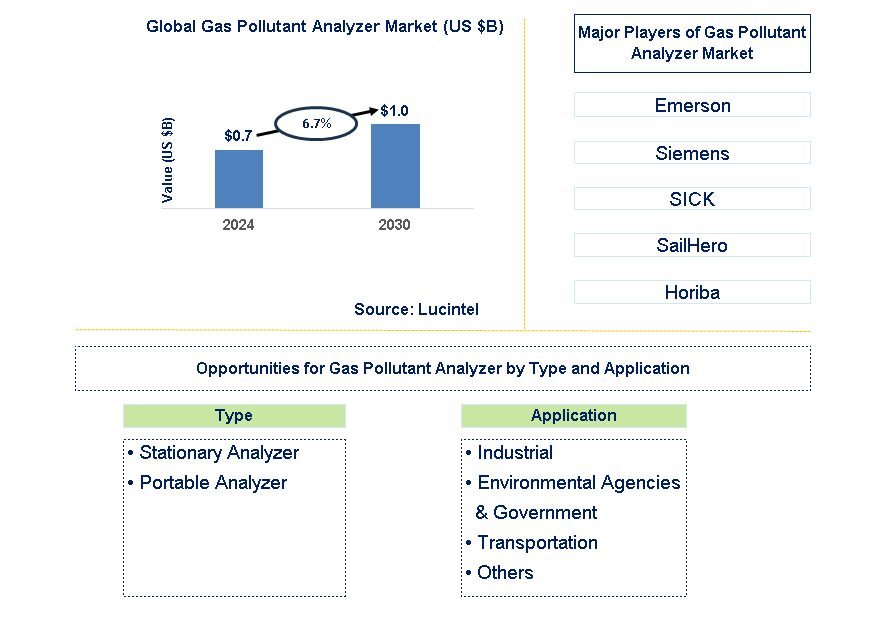
Key data points: The market size in 2030 = $1.0 billion, growth forecast = 6.7% annually for the next 6 years. Scroll below to get more insights. This market report covers trends, opportunities, and forecasts in the global gas pollutant analyzer market to 2030 by type (stationary analyzer and portable analyzer), application (industrial, environmental agencies & government, transportation, and others), and region (North America, Europe, Asia Pacific, and the Rest of the World)
We'll send your sample report shortly.
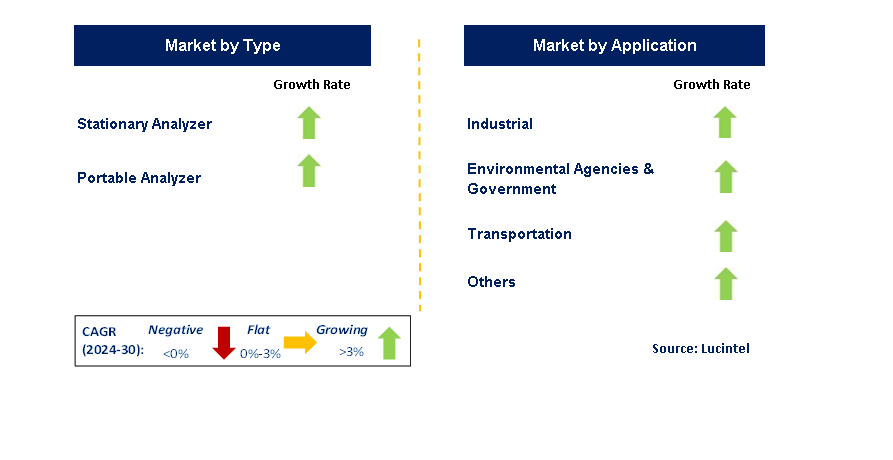
• Lucintel forecasts that, within the type category, stationary is expected to witness a higher growth over the forecast period due to its properties, such as provide more accurate data, require less maintenance, and longer lifespan.
• Within the application category, environmental agencies & government is expected to witness the highest growth over the forecast period due to increasing monitoring of air quality by municipals in cities, industrial areas, and rural areas.
• In terms of regions, APAC is expected to witness the highest growth over the forecast period due to rapid industrialization and urbanization and continuous growth of population, vehicular emissions, and industrial activities in the region. Gain valuable insights for your business decisions with our comprehensive 150+ page report.
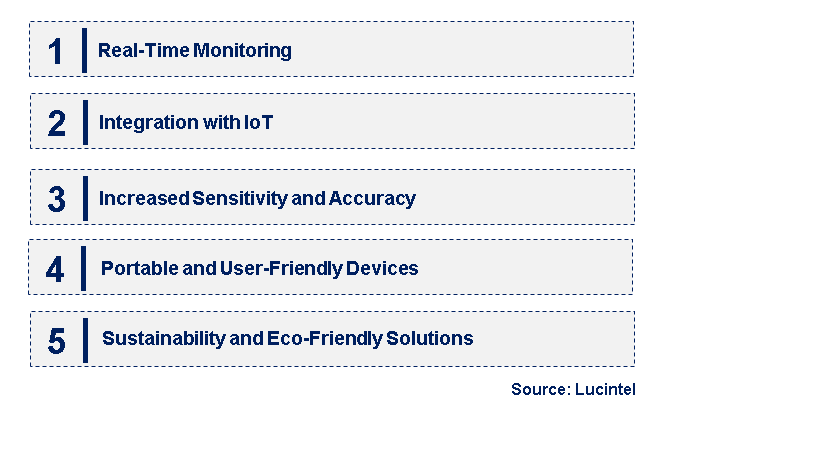
• Real-Time Monitoring: One of the emergent trends in the gas pollutant analyzer market is real-time monitoring. Modern analyzers now permit uninterrupted data collection and real-time data reporting, thus solving air quality problems instantaneously. This trend improves the pollution measures and the overall condition of the environment is managed in advance.
• Integration with IoT: Integration of Gas Pollutant Analyzers with Internet Of Things (IoT) Platforms is on the rise. Remote monitoring, data analysis and sharing are made easy and efficient by the use of IoT enabled analyzers enhancing air management systems. This expansion enables all rounded environmental management and urbanization projects.
• Increased Sensitivity and Accuracy: Overall, improved sensitivity and enhanced accuracy of gas analyzers are the current set of developments in the market. Some technologies allow detection of less concentration of pollutants but in greater accuracy. This is a significant trend as it enhances compliance with strict rules and accurate air quality measurements.
• Portable and User-Friendly Devices: There is an overwhelming appetite for portable (hand-held) gas analyzers. Due to advances in miniaturizing and designing, analyzers can be used by non-specialists and apply for different purposes. Use of portable devices is intended for field measurements and in transit monitoring thus broadening the scope of use in various sectors.
• Sustainability and Eco-Friendly Solutions: In the gas pollutant analyzer market, sustainability and eco-solutions are catching up with other emerging trends. The focus of manufacturers has been aimed at providing analyzers that have reduced power consumption, are made of eco-friendly materials, and have low emissions. Such trends are consistent with the worldwide quest for cleaner and safer methods of doing business. These emerging trends are all contributing in one way or the other towards positive change in the gas pollutant analyzer market through the improvement of technology, widening the scope of applications, and achieving ecological sustainability. Stakeholders ought to keep up with these trends in order to benefit from the new opportunities that they bring about as well as to respond to ongoing changes in the market.
• Advanced Sensor Technology: Advanced sensor technology is a notable advancement of the gas pollutant analyzer market. Newer sensor types such as electrochemical and some optical sensors have been developed which enable higher accuracy and sensitivity. This improvement makes it possible to capture the level of a number of pollutants in a more quantitative manner which enhances air quality monitoring.
• Integration with Data Analytics: It is worth noting the integration of gas analyzers with data analytics and this is quite a major achievement. Advanced analytics allow to obtain an overview of pollution levels and changes in their dynamics over time, which contributes to their control and management. This enhancement facilitates the fact that the analysis is predictive and aids the development of pollution prevention measures.
• Expansion of Multi-Gas Analyzers: The expansion of multi-gas analyzers is the key factor contributing to the growth of the market. These multi-gias are hard wares that measure more than one pollutant level in the air and provides overall air quality monitoring. Industrial and environmental multi- gas analyzers continue to be produced at a faster rate as they help to offer a better view of air quality.
• Steady Growth in Calibration and Maintenance: The reliability of the gas analyzers has improved with the advent of these upgraded calibration and maintenance practices. They increased self-calibration technology and low-maintenance designs have reduced downtimes and operating costs. It also improves the sustained accuracy of the analyzers making them more efficient towards the consumers as the users do not have to undergo the hassle of adjusting them.
• Regulatory Compliance Enhancements: Regulatory compliance enhancements are also influencing the market. The development of new standards and regulations is forcing to design and develop more effective adult responsibility analyzers. The manufacturers’ aim is to create such design products which meet international standards so as to target the entire global market with their devices. These modifications are particularly affecting the gas pollutant analyzer market due to strengthening of the technology, performance enhancement and regulatory adherence. As these changes proceed further, they are increasing the potential of gas analyzers and increasing their usage in other sectors.
• Monitoring of Industrial Emissions: Industrial emissions monitoring is another area which present great opportunity for growth. Because of the increased regulation on the environment, gas analyzers that can monitor emissions from industries of manufacture and processing are increasingly needed. This market demand drives the growth of more sophisticated analyzers designed for industrial use.
• Urban Air Quality Management: Management of urban air quality is also another potential area of growth for gas analyzers. With every city grappling with increasing levels of pollution, there’s a growing requirement for all-embracing monitoring systems. Monitoring systems that give real time data and are connected to smart city systems are highly required for effective management of urban air quality.
• Environmental compliance and reporting: Growth opportunities exist in the gas pollutant analyzer market, particularly in environmental compliance and reporting. Companies are often buying analyzers that help in the reporting and meeting of specific requirements. This is a growing trend due to the increasing regulatory demands and a greater focus on environmental issues.
• Agricultural and Agricultural Emissions: The agricultural sector is a good prospect for the use of gas analyzers for example in emission tests for livestock and farms. Technology, therefore, help in off-setting agricultural emissions and thus help in mitigating environmental impact and achieving set regulations.
• Healthcare and Indoor Air Quality: Healthcare and indoor air quality are also new areas of possible development. There is a growing demand for gas analyzers meant for measuring indoor air in public buildings such as hospitals, schools, and households. Such growth is driven by the increased awareness of health effects resulting from poor air quality and the healthy future indoor environments proposed. These strategic growth opportunities underline the major areas of development in the gas pollutant analyzer market. By tapping into these applications, stakeholders will be able to take a hold of growing trends and effectively meet the shifting needs of the market.
• Technological Progress: It is advances in sensor technology and data analytics that are propelling the gas pollutant analyzer market. Better analysis efficiency is evident in innovations such as better sensor performance, on-demand data transmission, and use of IoT in analyzers which enables more intelligent air quality management.
• Regulatory Considerations: Tough regulatory policies geared towards air quality management are a general driving force. Factors such as legally implemented environmental standards are being made more rigorous in most countries which contribute to the sales of high-quality gas analyzers that meet all the requirements. This driver is enhancing the creation and use of new and better monitoring systems.
• Growing Concern about the Air Quality: The increasing concern towards air quality and its health-related aspects brings momentum to the market. Gas analyzer demand relates to the need of the public and the government to lower the pollution and obtain better gas quality. This increase in awareness helps out in expanding and bringing new ideas into the market.
• Urbanization and Industrialization: Urbanization is closely linked with industrialization and brings about a growing need for effective air quality management systems. With the growth of cities and industrialization comes the increased need for gas analyzers to monitor and control pollution levels. This driver encourages the establishment of innovations in monitoring devices for different scope of work.
• Environmental Sustainability Initiatives: Environmental sustainability initiatives are affecting the growth of the global gas sensors market. Both corporations and authorities are committing resources towards the development of solutions that are environmentally friendly. Gas analyzers that contribute to such sustainability are sought after enhancing market growth and improvement in technology. Challenges in the gas pollutant analyzer market are:
• High Cost of Advanced Analyzers: The other problem that limits the growth of the market is the high pricing of advanced gas analyzers. It is noted that developing countries are associated with socio economic challenges and as such high technology is limited in terms of penetration despite achieving better performance. It is significant so that the market can be expanded without prejudice to operation costs.
• Regulatory Compliance Complexity: Regulatory compliance is complicated; rather, ensuring adherence is more complicated in itself. Every region countries have their own different standards and regulations hence difficulties in manufacturers making sure that their analyzers are compliant with every concerns. This aspect may influence market access as well as productivity.
• Technological Integration Issues: Technological integration issues are also one of the challenges that can impede effective utilization of new gas analyzer technologies. It might be problematic to introduce some systems into the market if there is a concern over current system compatibility or technical issues. Integration problems such as these must be resolved if the technology is to be rolled out successfully. There are growth drivers and inhibiting factors in the Gas Pollutant Analyzer Market which clearly depicts that a lot is happening in terms of technology, regulations and the level of economics. In order to respond to these factors in the changing market and to grow, it is necessary to cope up with the challenges while taking advantage of the market determinants.
• Emerson
• Siemens
• SICK
• SailHero
• Horiba
• Environment
• Fuji Electric
• Focused Photonics
• Teledyne API
• SDL Technology
• Stationary Analyzer
• Portable Analyzer
• Industrial
• Environmental Agencies & Government
• Transportation
• Others
• North America
• Europe
• Asia Pacific
• The Rest of the World
• United States: In the United States, the gas pollutant analyzer market has continued to witness strong growth energised by stringent environmental policies and renewed emphasis on the monitoring of air quality. New academic contributions include the new and improved analyzers that present higher precision and sensitivity for detection of a greater range of pollutants. New approaches such as real time response and data access using smart grids will also help in improving air quality management. Besides, the demand for compact and easy to handle equipment is rising, which caters to industrial and home applications as well.
• China: China's Gas Pollutant Analyzer is witnessing a huge market share due to the increasing activities of the country to reduce air pollution and enhance environmental monitoring. Recent developments include deploying laser based analyzers and more advanced methodologies of calibration. The growing stringency of environmental law also makes it obligatory to create more efficient and faithful analyzers. Further creep is provided by a new trend which propagates the intermixing of these units with IoT technologies for data acquisition and pollution management assigning more attention to be accurate and timely within the set pollution limits.
• India: The economic significance of the gas pollutant analyzer market in India is on the rise, as Overall, urbanization has increased and industrial activities have increased pollution. Recent enhancements entail the emergence of cheap and small sized analyzers that can work under different environmental circumstances. Innovations such as battery powered hand-held analyzers and instant data transmission are gaining ground. Promotion Program undertaken by the Indian government to ameliorate the quality and standard of air within the country is also a reason as to why more advanced gas analyzers are gaining popularity in different industries
• Japan: Gas Pollutant Analyzers in Japan are continually experiencing improvement owing to the concern of its people as regards to technological development yet protecting their environment. Recent developments include the marketing of analyzers involving new technologies that are sensitive and that have low limits of detection. Neoteric telehealth services connected these enhancements with a mobile phone that remotely monitors health. Moreover, the JAIC has put emphasis its goal on disaster management and environmental protection which is resulting in development of new generation of analyzers that are rugged and for use in responding to emergencies and mass vocals.


• Emerson
• Siemens
• SICK
• SailHero
• Horiba
• Environment
• Fuji Electric
• Focused Photonics
• Teledyne API
• SDL Technology Q6. Which gas pollutant analyzer market segment will be the largest in future? Answer: Lucintel forecasts that stationary is expected to witness a higher growth over the forecast period due to its properties, such as provide more accurate data, require less maintenance, and longer lifespan. Q7. In gas pollutant analyzer market, which region is expected to be the largest in next 5 years? Answer: APAC is expected to witness the highest growth over the forecast period due to rapid industrialization and urbanization and continuous growth of population, vehicular emissions, and industrial activities in the region. Q.8 Do we receive customization in this report? Answer: Yes, Lucintel provides 10% customization without any additional cost.


Choose a license that fits your team. Instant PDF delivery.
Prices exclude taxes. Instant delivery. Custom licensing available on request.
Market Report · July 15, 2026
Market Report · July 13, 2026
Market Report · July 13, 2026
Trusted partner for strategic intelligence and business growth


Receive a complimentary market analysis tailored to your industry. Our analysts will identify key growth opportunities and competitive dynamics specific to your business.

Market size, growth rate, and key trend analysis for your specific sector.

Top competitor positioning and market share analysis.

Strategic recommendations backed by data-driven insights.
Get curated market intelligence and competitive moves straight to your inbox.
By subscribing, you agree to receive our monthly insights. Unsubscribe anytime.
Receive a complimentary market analysis tailored to your industry. Our analysts will identify key growth opportunities and competitive dynamics specific to your business.
Market size, growth rate, and key trend analysis for your specific sector.
Top competitor positioning and market share analysis.
Strategic recommendations backed by data-driven insights.
Get curated market intelligence, emerging trends, and competitive moves straight to your inbox each month.
By subscribing, you agree to receive our monthly insights. Unsubscribe anytime.
We'll send your sample report shortly.