
Report Feature
Gas Analyzer, Sensor & Detector Market Trends and Forecast
The future of the global gas analyzer, sensor & detector market looks promising with opportunities in the oil & gas, chemical, healthcare, food & beverage, water treatment, and power generation markets. The global gas analyzer, sensor & detector market is expected to grow with a CAGR of 6.8% from 2025 to 2031. The major drivers for this market are the increasing demand for accurate emission monitoring, the rising need for industrial safety compliance, and the growing adoption of advanced gas detection systems.• Lucintel forecasts that, within the product type category, fixed gas analyzer is expected to witness the highest growth over the forecast period.
• Within the end use category, oil & gas is expected to witness the highest growth.
• In terms of region, North America is expected to witness the highest growth over the forecast period.
Gain valuable insights for your business decisions with our comprehensive 150+ page report. Sample figures with some insights are shown below.
Emerging Trends in the Gas Analyzer, Sensor & Detector Market
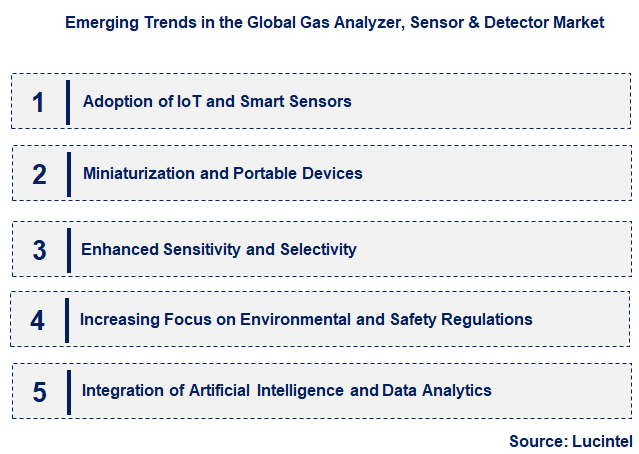
The gas analyzer, sensor & detector market is experiencing rapid evolution driven by technological advancements, increasing safety regulations, and a growing emphasis on environmental monitoring. As industries such as oil and gas, manufacturing, healthcare, and environmental management seek more accurate, reliable, and real-time solutions, market players are innovating to meet these demands. The integration of smart technologies, miniaturization, and enhanced sensitivity are shaping the future landscape. These developments are not only improving operational safety and compliance but also enabling new applications and expanding market reach. The following key trends highlight the major shifts currently influencing this dynamic market.• Adoption of IoT and Smart Sensors: The integration of Internet of Things (IoT) technology with gas sensors is transforming the market by enabling real-time data collection and remote monitoring. Smart sensors facilitate predictive maintenance, improve safety protocols, and optimize operational efficiency. This connectivity allows for seamless data sharing across platforms, enhancing decision-making processes. As industries increasingly adopt IoT, the demand for intelligent, connected gas analyzers is expected to surge, leading to more proactive safety measures and streamlined operations.
• Miniaturization and Portable Devices: Advances in sensor technology are leading to smaller, more portable gas analyzers that can be easily deployed in various environments. These compact devices offer high accuracy and quick response times, making them ideal for on-site inspections, emergency response, and personal safety applications. The trend toward miniaturization is expanding the usability of gas analyzers beyond traditional fixed installations, enabling broader adoption in fieldwork, remote locations, and mobile operations, thereby increasing market penetration.
• Enhanced Sensitivity and Selectivity: Innovations in sensor materials and detection techniques are significantly improving the sensitivity and selectivity of gas analyzers. These enhancements allow for the detection of trace gases at very low concentrations, which is critical for environmental monitoring, leak detection, and health safety. Improved accuracy reduces false alarms and enhances compliance with stringent safety standards. As a result, industries can better monitor hazardous gases, leading to safer workplaces and more effective environmental management.
• Increasing Focus on Environmental and Safety Regulations: Stricter government regulations and standards are driving the demand for advanced gas detection solutions. Industries are investing in high-performance analyzers to ensure compliance with environmental laws, workplace safety protocols, and emission standards. This regulatory landscape encourages innovation and adoption of more sophisticated, reliable, and compliant gas analyzers, fueling market growth. Companies that can offer solutions aligned with evolving regulations are gaining competitive advantages.
• Integration of Artificial Intelligence and Data Analytics: The incorporation of AI and advanced data analytics into gas analyzers is enabling predictive insights and automated decision-making. These technologies help identify patterns, predict potential hazards, and optimize maintenance schedules. AI-driven analytics improve the accuracy and efficiency of gas detection systems, reducing downtime and operational costs. As data-driven approaches become more prevalent, the market is moving toward smarter, more autonomous gas detection solutions that enhance safety and operational efficiency.
In summary, these emerging trends are collectively reshaping the gas analyzer, sensor & detector market by fostering innovation, improving safety and environmental compliance, and expanding application possibilities. The integration of smart technologies, miniaturization, and advanced analytics is creating more versatile, efficient, and reliable solutions, positioning the market for sustained growth and technological leadership.
Recent Development in the Gas Analyzer, Sensor & Detector Market
The gas analyzer, sensor & detector market has experienced significant growth driven by increasing safety regulations, technological advancements, and the rising demand across various industries such as oil and gas, healthcare, and environmental monitoring. Innovations in sensor technology and the integration of IoT have enhanced the accuracy, efficiency, and real-time monitoring capabilities of gas detection systems. Additionally, stringent government standards and the need for environmental protection are propelling market expansion. This dynamic landscape is marked by key developments that are shaping the future of gas analyzers, sensors, and detectors, influencing market strategies and investment trends.• Technological Advancements: Development of miniaturized, highly sensitive sensors has improved detection accuracy and response times, enabling more effective monitoring in confined or complex environments. These innovations have expanded application scopes and increased adoption in industrial safety and environmental monitoring, boosting market growth.
• Integration of IoT and Wireless Technologies: The incorporation of IoT-enabled sensors allows real-time data transmission and remote monitoring, enhancing operational efficiency and safety. This connectivity has facilitated predictive maintenance and faster decision-making, significantly impacting market competitiveness and expanding usage in smart infrastructure.
• Stringent Regulatory Standards: Governments worldwide are implementing stricter safety and environmental regulations, requiring industries to adopt advanced gas detection solutions. These standards have increased demand for compliant, reliable analyzers and detectors, driving market growth and encouraging innovation.
• Expansion in End-User Industries: The rising need for safety and environmental monitoring in industries such as oil and gas, healthcare, and manufacturing has led to increased adoption of gas analyzers and sensors. This diversification of applications has contributed to market expansion and diversification of product offerings.
• Focus on Portable and Personal Gas Detectors: The demand for portable, user-friendly gas detection devices has surged, especially in emergency response and personal safety applications. This trend has prompted manufacturers to develop compact, easy-to-use detectors, influencing product development and market segmentation.
In summary, these developments are collectively propelling the gas analyzer, sensor & detector market towards higher growth trajectories. Technological innovations, regulatory pressures, and expanding application areas are fostering increased adoption and product diversification. The market is becoming more sophisticated, with a focus on connectivity, portability, and compliance, which is expected to sustain its upward momentum in the coming years.
Strategic Growth Opportunities in the Gas Analyzer, Sensor & Detector Market
The gas analyzer, sensor & detector market is experiencing rapid expansion driven by increasing industrial safety regulations, environmental monitoring needs, and technological advancements. As industries seek more precise and reliable gas detection solutions, key growth opportunities are emerging across various applications. These developments are shaping the market landscape, offering new avenues for innovation and investment. Understanding these opportunities is crucial for stakeholders aiming to capitalize on the evolving demand and enhance their competitive edge in this dynamic sector.• Industrial Safety: Enhanced safety protocols are driving demand for advanced gas analyzers to detect hazardous gases, reducing workplace accidents and ensuring compliance with safety standards. This growth improves operational safety and minimizes liabilities for industries such as oil & gas, chemicals, and manufacturing.
• Environmental Monitoring: Rising environmental concerns and stricter regulations are boosting the adoption of sensors and detectors for air quality monitoring. This opportunity supports sustainable practices and helps governments and organizations meet environmental standards, fostering cleaner air and healthier communities.
• Healthcare Applications: The increasing use of gas sensors in medical diagnostics, respiratory devices, and patient monitoring is expanding the healthcare market. This growth enhances diagnostic accuracy, improves patient outcomes, and drives innovation in medical technology.
• Automotive Industry: The integration of gas sensors in vehicles for emissions control and safety systems is a significant growth area. This application reduces environmental impact, ensures compliance with emission standards, and promotes the development of cleaner transportation solutions.
• Food & Beverage Industry: Gas analyzers are increasingly used for quality control, spoilage detection, and packaging in the food sector. This opportunity ensures product safety, extends shelf life, and meets consumer demand for high-quality, safe food products.
In summary, these growth opportunities are significantly impacting the gas analyzer, sensor & detector market by expanding its applications, driving technological innovation, and fostering sustainable practices. As demand across industries continues to rise, the market is poised for substantial growth, offering lucrative prospects for manufacturers and stakeholders.
Gas Analyzer, Sensor & Detector Market Driver and Challenges
The gas analyzer, sensor & detector market is influenced by a variety of technological, economic, and regulatory factors. Rapid advancements in sensor technology and analytical methods are driving innovation, while increasing environmental concerns and stringent regulations are shaping market demand. Economic growth in industrial sectors such as oil & gas, manufacturing, and healthcare further propels market expansion. However, challenges such as high costs, technological complexity, and regulatory compliance issues pose significant hurdles. Understanding these drivers and challenges is essential for stakeholders to navigate the evolving landscape effectively and capitalize on emerging opportunities.The factors responsible for driving the gas analyzer, sensor & detector market include:-
• Technological Innovation: The continuous development of advanced sensors and analyzers enhances accuracy, sensitivity, and reliability, enabling better detection of gases in various applications. Innovations such as miniaturization and integration with IoT devices expand market potential, especially in smart monitoring systems. These technological improvements reduce response times and improve operational efficiency, making gas analyzers more accessible across industries. As industries prioritize safety and environmental compliance, the demand for cutting-edge sensor technology accelerates market growth, fostering new product development and competitive advantages.
• Increasing Environmental Regulations: Governments worldwide are implementing stricter environmental standards to control emissions and ensure safety. Regulations such as the Clean Air Act and European directives mandate the use of gas analyzers for monitoring pollutants in industrial emissions, workplaces, and ambient air. These regulatory frameworks compel industries to adopt advanced detection systems, thereby boosting market demand. Compliance not only helps avoid penalties but also enhances corporate reputation and sustainability efforts. As environmental concerns intensify, the market for reliable and compliant gas analyzers is expected to grow significantly.
• Growing Industrialization and Urbanization: Rapid industrial growth in sectors like oil & gas, chemicals, and manufacturing increases the need for continuous gas monitoring to ensure safety and operational efficiency. Urbanization leads to higher pollution levels, necessitating widespread air quality monitoring using sensors and detectors. The expansion of infrastructure projects and industrial facilities further amplifies demand for portable and fixed gas analyzers. This trend supports market growth by creating a steady demand for innovative, durable, and cost-effective gas detection solutions tailored to diverse industrial environments.
• Rising Adoption of IoT and Automation: Integration of gas analyzers with IoT platforms and automation systems enhances real-time monitoring, data collection, and predictive maintenance. This technological convergence allows industries to optimize processes, reduce downtime, and improve safety protocols. The deployment of smart sensors in remote or hazardous locations is facilitated by IoT connectivity, expanding market reach. As digital transformation accelerates across sectors, the demand for interconnected, intelligent gas detection systems is expected to surge, driving market expansion and opening new avenues for product development.
• Increasing Focus on Safety and Health: The emphasis on workplace safety and health standards is a key driver for the market. Gas analyzers are essential in detecting hazardous gases, preventing accidents, and ensuring compliance with occupational safety regulations. Industries such as mining, oil & gas, and chemical manufacturing prioritize gas detection to protect workers and minimize liabilities. The rising awareness of health risks associated with toxic gases further fuels demand for sensitive and reliable detection devices. This focus on safety not only sustains market growth but also encourages innovation in portable and user-friendly gas detection solutions.
The challenges facing this gas analyzer, sensor & detector market include:-
• High Cost of Advanced Equipment: The deployment of sophisticated gas analyzers and sensors often involves significant capital investment, which can be prohibitive for small and medium-sized enterprises. The costs associated with research, development, calibration, and maintenance add to the financial burden. This limits market penetration in cost-sensitive regions and sectors, restricting widespread adoption. Additionally, the high costs may deter organizations from upgrading existing systems, thereby impacting overall market growth and technological advancement.
• Technological Complexity and Maintenance: Gas analyzers and sensors require specialized knowledge for installation, calibration, and maintenance. Complex technology can lead to operational errors, inaccurate readings, and increased downtime if not properly managed. Regular calibration and sensor replacement are necessary to ensure accuracy, adding to operational costs. The need for skilled personnel and technical expertise poses a challenge, especially in remote or underdeveloped regions, potentially hindering market expansion and consistent performance.
• Regulatory and Compliance Challenges: Navigating diverse and evolving regulatory standards across different regions can be complex and resource-intensive. Companies must ensure their products meet various safety, environmental, and quality standards, which may involve extensive testing and certification processes. Non-compliance can result in legal penalties, product recalls, and reputational damage. The dynamic regulatory landscape requires continuous adaptation, increasing operational costs and delaying product launches, thereby impacting overall market growth.
In summary, the gas analyzer, sensor & detector market is driven by technological advancements, regulatory pressures, industrial growth, IoT integration, and safety priorities. However, high costs, technological complexity, and regulatory challenges pose significant hurdles. These factors collectively influence market dynamics, requiring stakeholders to innovate and adapt strategically. The overall impact is a market poised for growth, provided that companies address these challenges effectively and leverage emerging opportunities to meet evolving demands.
List of Gas Analyzer, Sensor & Detector Companies
Companies in the market compete on the basis of product quality offered. Major players in this market focus on expanding their manufacturing facilities, R&D investments, infrastructural development, and leverage integration opportunities across the value chain. With these strategies gas analyzer, sensor & detector companies cater increasing demand, ensure competitive effectiveness, develop innovative products & technologies, reduce production costs, and expand their customer base. Some of the gas analyzer, sensor & detector companies profiled in this report include-• ABB Ltd.
• Emerson Electric Co.
• Siemens AG
• Honeywell International Inc.
• Thermo Fisher Scientific Inc.
• General Electric Company
• Teledyne Technologies Incorporated
• Horiba, Ltd.
• Drägerwerk AG & Co. KGaA
• Yokogawa Electric Corporation
Gas Analyzer, Sensor & Detector Market by Segment
The study includes a forecast for the global gas analyzer, sensor & detector market by product type, technology, application, end use, and region.Gas Analyzer, Sensor & Detector Market by Product Type [Value from 2019 to 2031]:
• Fixed Gas Analyzer
• Portable Gas Analyzer
• Gas Sensors
• Gas Detectors
Gas Analyzer, Sensor & Detector Market by Technology [Value from 2019 to 2031]:
• Electrochemical
• Infrared
• Metal Oxide Semiconductor
• Catalytic
• Zirconia
• Others
Gas Analyzer, Sensor & Detector Market by Application [Value from 2019 to 2031]:
• Industrial
• Environmental Monitoring
• Medical
• Automotive
• Building Automation
• Others
Gas Analyzer, Sensor & Detector Market by End Use [Value from 2019 to 2031]:
• Oil & Gas
• Chemicals
• Healthcare
• Food & Beverages
• Water Treatment
• Power Generation
• Others
Gas Analyzer, Sensor & Detector Market by Region [Value from 2019 to 2031]:
• North America
• Europe
• Asia Pacific
• The Rest of the World
Country Wise Outlook for the Gas Analyzer, Sensor & Detector Market
The gas analyzer, sensor & detector market is experiencing rapid growth driven by increasing environmental regulations, technological advancements, and rising demand across various industries such as healthcare, manufacturing, and energy. Countries are investing heavily in innovation to improve detection accuracy, reduce costs, and enhance safety standards. The markets evolution is also influenced by the adoption of smart sensors and integration with IoT systems, enabling real-time monitoring and data analytics. As global awareness of environmental and safety issues intensifies, these developments are shaping the future landscape of gas analysis technology worldwide.• United States: The U.S. market is witnessing significant innovation with the integration of IoT and AI technologies, enhancing real-time monitoring capabilities. There is a growing adoption of portable and handheld gas analyzers for industrial safety and environmental monitoring. Regulatory pressures are prompting industries to upgrade their detection systems, especially in oil and gas, manufacturing, and healthcare sectors. Major players are investing in R&D to develop more accurate, compact, and cost-effective sensors. Additionally, the U.S. government is supporting initiatives to improve air quality monitoring, boosting demand for advanced gas analyzers.
• China: China is experiencing rapid market expansion driven by stringent environmental regulations and industrial growth. The country is focusing on developing high-performance sensors capable of detecting multiple gases simultaneously. Domestic companies are increasing their R&D efforts to compete with international brands, leading to technological advancements. The government’s emphasis on pollution control and energy efficiency is fueling demand for gas analyzers in sectors like coal, power generation, and chemical manufacturing. Moreover, China is investing in smart sensor networks to enable large-scale environmental monitoring and industrial safety applications.
• Germany: Germanys market is characterized by high-quality, precision gas analyzers used predominantly in automotive, chemical, and manufacturing industries. The country is leading in the development of innovative sensor technologies, including miniaturized and highly sensitive detectors. Strict EU environmental standards are driving demand for advanced detection systems to monitor air quality and industrial emissions. German companies are also focusing on integrating sensors with digital platforms for improved data management and predictive maintenance. The emphasis on sustainability and eco-friendly solutions is further accelerating technological advancements in this sector.
• India: The Indian market is rapidly growing due to increasing industrialization, urbanization, and environmental concerns. There is a rising demand for affordable and reliable gas analyzers to monitor air quality and industrial emissions. Local manufacturers are expanding their product portfolios, focusing on portable and easy-to-use sensors suitable for diverse applications. Government initiatives aimed at pollution control and clean energy are boosting market growth. Additionally, the adoption of smart sensors and IoT-enabled devices is increasing, helping industries comply with environmental regulations and improve safety standards across sectors like oil and gas, manufacturing, and agriculture.
• Japan: Japans market is driven by technological innovation and stringent safety standards. The country is focusing on developing highly sensitive, durable, and miniaturized gas sensors for use in industrial, automotive, and environmental applications. Japan is also investing in research to improve sensor longevity and accuracy under harsh conditions. The integration of gas analyzers with IoT and automation systems is gaining traction, supporting smart manufacturing and environmental monitoring. The government’s emphasis on disaster preparedness and air quality management is further propelling market growth, with Japanese firms leading in advanced sensor technology development.

Features of the Global Gas Analyzer, Sensor & Detector Market
Market Size Estimates: Gas analyzer, sensor & detector market size estimation in terms of value ($B).Trend and Forecast Analysis: Market trends (2019 to 2024) and forecast (2025 to 2031) by various segments and regions.
Segmentation Analysis: Gas analyzer, sensor & detector market size by various segments, such as by product type, technology, application, end use, and region in terms of value ($B).
Regional Analysis: Gas analyzer, sensor & detector market breakdown by North America, Europe, Asia Pacific, and Rest of the World.
Growth Opportunities: Analysis of growth opportunities in different product types, technologies, applications, end uses, and regions for the gas analyzer, sensor & detector market.
Strategic Analysis: This includes M&A, new product development, and competitive landscape of the gas analyzer, sensor & detector market.
Analysis of competitive intensity of the industry based on Porter’s Five Forces model.

FAQ
Q1. What is the growth forecast for gas analyzer, sensor & detector market?Answer: The global gas analyzer, sensor & detector market is expected to grow with a CAGR of 6.8% from 2025 to 2031.
Q2. What are the major drivers influencing the growth of the gas analyzer, sensor & detector market?
Answer: The major drivers for this market are the increasing demand for accurate emission monitoring, the rising need for industrial safety compliance, and the growing adoption of advanced gas detection systems.
Q3. What are the major segments for gas analyzer, sensor & detector market?
Answer: The future of the gas analyzer, sensor & detector market looks promising with opportunities in the oil & gas, chemical, healthcare, food & beverage, water treatment, and power generation markets.
Q4. Who are the key gas analyzer, sensor & detector market companies?
Answer: Some of the key gas analyzer, sensor & detector companies are as follows:
• ABB Ltd.
• Emerson Electric Co.
• Siemens AG
• Honeywell International Inc.
• Thermo Fisher Scientific Inc.
• General Electric Company
• Teledyne Technologies Incorporated
• Horiba, Ltd.
• Drägerwerk AG & Co. KGaA
• Yokogawa Electric Corporation
Q5. Which gas analyzer, sensor & detector market segment will be the largest in future?Answer: Lucintel forecasts that, within the product type category, fixed gas analyzer is expected to witness the highest growth over the forecast period.
Q6. In gas analyzer, sensor & detector market, which region is expected to be the largest in next 5 years?
Answer: In terms of region, North America is expected to witness the highest growth over the forecast period.
Q7. Do we receive customization in this report?
Answer: Yes, Lucintel provides 10% customization without any additional cost.
Table of Contents
List of Figures
List of Tables
Methodology
- In-depth interviews of the major players in this market
- Detailed secondary research from competitors’ financial statements and published data
- Extensive searches of published works, market, and database information pertaining to industry news, company press releases, and customer intentions
- A compilation of the experiences, judgments, and insights of Lucintel’s professionals, who have analyzed and tracked this market over the years.


Buy Now
Choose a license that fits your team. Instant PDF delivery.
Prices exclude taxes. Instant delivery. Custom licensing available on request.
Key Questions
- • What are some of the most promising, high-growth opportunities for the gas analyzer, sensor & detector market by product type (fixed gas analyzer, portable gas analyzer, gas sensors, and gas detectors), technology (electrochemical, infrared, metal oxide semiconductor, catalytic, zirconia, and others), application (industrial, environmental monitoring, medical, automotive, building automation, and others), end use (oil & gas, chemicals, healthcare, food & beverages, water treatment, power generation, and others), and region (North America, Europe, Asia Pacific, and the Rest of the World)?
- • Which segments will grow at a faster pace and why?
- • Which region will grow at a faster pace and why?
- • What are the key factors affecting market dynamics? What are the key challenges and business risks in this market?
- • What are the business risks and competitive threats in this market?
- • What are the emerging trends in this market and the reasons behind them?
- • What are some of the changing demands of customers in the market?
- • What are the new developments in the market? Which companies are leading these developments?
- • Who are the major players in this market? What strategic initiatives are key players pursuing for business growth?
- • What are some of the competing products in this market and how big of a threat do they pose for loss of market share by material or product substitution?
- • What M&A activity has occurred in the last 5 years and what has its impact been on the industry? For any questions related to Gas Analyzer, Sensor & Detector Market, Gas Analyzer, Sensor & Detector Market Size, Gas Analyzer, Sensor & Detector Market Growth, Gas Analyzer, Sensor & Detector Market Analysis, Gas Analyzer, Sensor & Detector Market Report, Gas Analyzer, Sensor & Detector Market Share, Gas Analyzer, Sensor & Detector Market Trends, Gas Analyzer, Sensor & Detector Market Forecast, Gas Analyzer, Sensor & Detector Companies, write Lucintel analyst at email: helpdesk@lucintel.com. We will be glad to get back to you soon.


