
Report Feature
Full Eye Model Market Trends and Forecast
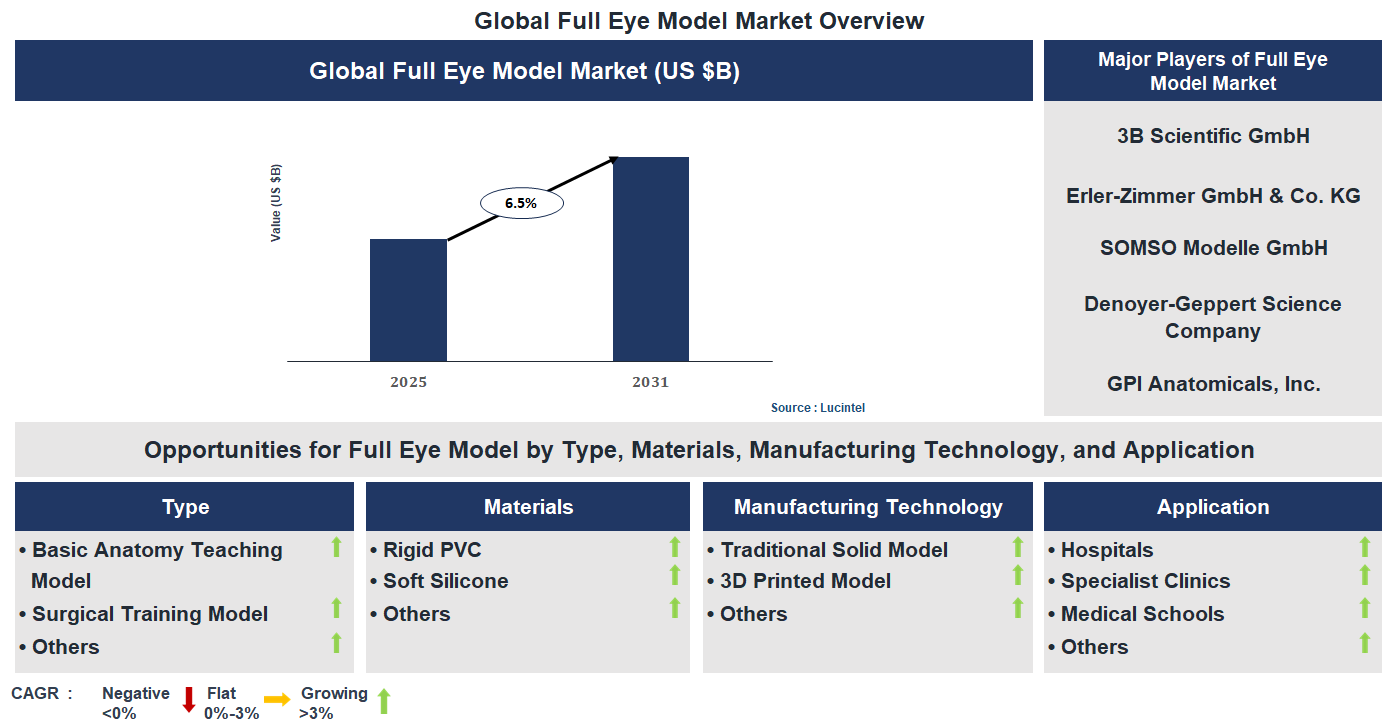
The future of the global full eye model market looks promising with opportunities in the hospital, specialist clinic, and medical school markets. The global full eye model market is expected to grow with a CAGR of 6.5% from 2025 to 2031. The major drivers for this market are the increasing demand for eye health education, the rising prevalence of eye disorders, and the growing use in medical training programs.• Lucintel forecasts that, within the type category, surgical training model is expected to witness higher growth over the forecast period.
• Within the application category, medical school is expected to witness the highest growth.
• In terms of region, APAC is expected to witness the highest growth over the forecast period. Gain valuable insights for your business decisions with our comprehensive 150+ page report. Sample figures with some insights are shown below.
Emerging Trends in the Full Eye Model Market
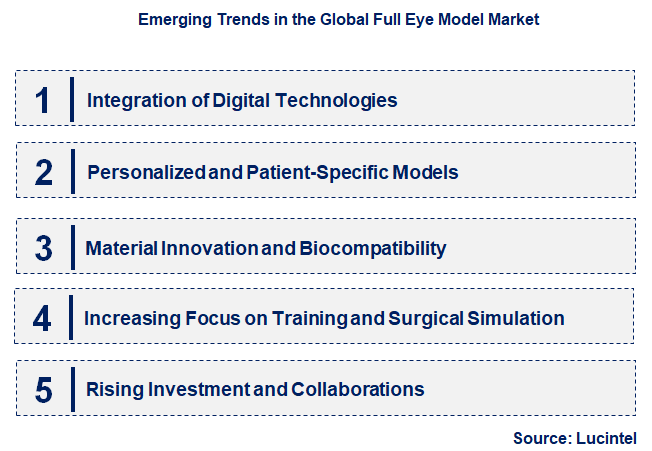
The full eye model market is experiencing rapid evolution driven by technological advancements, increasing demand for personalized healthcare, and a focus on improving diagnostic and treatment outcomes. As the ophthalmology and optometry fields advance, the development of sophisticated, accurate, and accessible eye models is becoming essential for training, research, and clinical applications. These trends are shaping the future landscape of eye care, making procedures safer, more effective, and more tailored to individual needs. The market is also witnessing a surge in innovative materials and digital integration, which are expanding the capabilities and applications of full eye models. These developments are set to transform how eye health is approached globally.• Integration of Digital Technologies: The adoption of virtual reality (VR), augmented reality (AR), and 3D printing is revolutionizing the creation and use of full eye models. These technologies enable highly detailed, customizable, and interactive models that enhance training, surgical planning, and patient education. Digital integration allows for real-time simulation and feedback, improving precision and outcomes. As these tools become more affordable and widespread, they are expected to significantly reduce training costs and improve the accuracy of diagnoses and procedures, making eye care more accessible and effective.
• Personalized and Patient-Specific Models: There is a growing demand for models tailored to individual patient anatomy and pathology. Advances in imaging techniques like OCT and MRI facilitate the creation of highly accurate, patient-specific eye models. These models improve surgical planning, allowing surgeons to rehearse procedures on a replica of the patient's eye, reducing risks and enhancing success rates. Personalized models also aid in understanding complex cases and developing targeted treatments, ultimately leading to better patient outcomes and more customized care.
• Material Innovation and Biocompatibility: The development of new materials that mimic the physical and optical properties of eye tissues is a key trend. These innovations improve the realism and durability of full eye models, making them more effective for training and research. Biocompatible materials also enable the creation of implantable or semi-implantable models for testing surgical devices and procedures. Enhanced material properties contribute to more accurate simulations, better training experiences, and the potential for developing new therapeutic devices, thus expanding the scope of applications in the market.
• Increasing Focus on Training and Surgical Simulation: The market is witnessing a surge in demand for high-fidelity eye models for training ophthalmologists and optometrists. These models provide a safe, repeatable environment for practicing complex procedures, reducing the learning curve and improving surgical skills. Simulation-based training is becoming a standard component of medical education, supported by technological advancements. This trend enhances patient safety, reduces training costs, and accelerates skill acquisition, ultimately leading to higher standards of eye care and more confident practitioners.
• Rising Investment and Collaborations: Investment from private companies, research institutions, and government agencies is fueling innovation in the full eye model market. Collaborations between technology firms, healthcare providers, and academic institutions are driving the development of advanced models and new applications. Funding supports research into novel materials, digital integration, and commercialization efforts. These investments accelerate product development, expand market reach, and foster innovation, ensuring that the market remains dynamic and responsive to emerging needs in eye health and surgical procedures. In summary, these trends are collectively transforming the full eye model market by enhancing realism, customization, and technological integration. They are improving training, surgical precision, and patient outcomes, making eye care more innovative, accessible, and effective. As these developments continue, the market is poised for significant growth and increased impact on global eye health management.
Recent Development in the Full Eye Model Market
The full eye model market is experiencing rapid advancements driven by technological innovations and increasing demand for comprehensive eye care solutions. These developments are transforming diagnostic accuracy, treatment options, and patient outcomes. As the industry evolves, key opportunities are emerging that promise to enhance clinical practices and expand market reach. Stakeholders are focusing on integrating new technologies, improving accessibility, and addressing unmet needs in eye health management, which collectively are shaping the future landscape of the market.• Technological Integration in Diagnostic Tools: The adoption of AI and machine learning in eye diagnostics is revolutionizing accuracy and efficiency. These technologies enable early detection of eye conditions, reducing the risk of vision loss. Enhanced imaging and data analysis improve treatment planning, leading to better patient outcomes. This integration is attracting investments and fostering innovation, ultimately expanding the market by offering more precise and accessible diagnostic solutions.
• Development of Personalized Eye Care Solutions: Customization in eye treatments is gaining momentum, driven by genetic research and advanced imaging. Personalized models allow for tailored interventions, improving efficacy and patient satisfaction. This approach addresses individual variability in eye conditions, reducing complications and enhancing recovery. The market benefits from increased demand for bespoke solutions, encouraging companies to innovate and diversify their product offerings.
• Expansion of Tele-ophthalmology Services: Telemedicine is increasingly incorporated into eye care, especially in remote and underserved areas. Virtual consultations and remote diagnostics improve access and reduce healthcare disparities. This development supports early detection and continuous monitoring, leading to timely interventions. The market is witnessing growth as tele-ophthalmology becomes a vital component of comprehensive eye care, driven by technological advancements and the need for accessible healthcare.
• Rising Focus on Pediatric and Geriatric Eye Care: The aging population and increased awareness of childhood eye health are fueling demand for specialized models. These models address age-specific conditions, improving diagnosis and treatment. Enhanced focus on pediatric and geriatric care expands market segments and promotes early intervention, reducing long-term complications. This trend encourages innovation tailored to vulnerable groups, broadening the scope and reach of the full eye model solutions.
• Increasing Investment in R&D for Advanced Materials: Investment in research for durable, biocompatible, and innovative materials is accelerating. These materials improve the functionality and longevity of eye models, making them more realistic and effective for training and surgical planning. Enhanced materials lead to better clinical outcomes and reduce costs. The market benefits from continuous innovation, attracting new players and expanding the range of high-quality, cost-effective eye models. These developments are significantly impacting the full eye model market by enhancing diagnostic precision, treatment personalization, and accessibility. They foster innovation, attract investments, and address unmet needs across diverse patient populations. As a result, the market is poised for sustained growth, improved clinical outcomes, and broader adoption of advanced eye care solutions, shaping a more efficient and inclusive future in eye health management.
Strategic Growth Opportunities in the Full Eye Model Market
The full eye model market is experiencing rapid growth driven by technological advancements, increasing demand for personalized eye care, and expanding applications in diagnostics and surgical planning. Innovations in 3D imaging and simulation are enhancing accuracy and patient outcomes. Rising awareness of eye health and aging populations further fuels market expansion. Strategic investments and collaborations are accelerating product development, creating new opportunities for healthcare providers, researchers, and device manufacturers to improve eye care solutions globally.• Integration of AI and Machine Learning for Enhanced Diagnostic Accuracy: The adoption of AI and machine learning in full eye models enables precise disease detection, personalized treatment planning, and improved surgical outcomes. These technologies facilitate real-time analysis of complex eye data, reducing diagnostic errors and increasing efficiency. As AI-driven tools become more sophisticated, they will revolutionize eye care by providing predictive insights and automating routine assessments, thus expanding the market for advanced full eye modeling solutions.
• Development of Portable and Cost-effective Eye Modeling Devices: The demand for affordable, portable eye models is rising, especially in remote and underdeveloped regions. Innovations in miniaturization and cost reduction make these devices accessible to a broader range of healthcare providers. Portable models enable on-site diagnostics, early detection, and timely intervention, which are crucial for preventing vision loss. This growth opportunity addresses the need for scalable eye care solutions, expanding market reach, and improving global eye health outcomes.
• Expansion of 3D Printing Technology for Customized Eye Models: 3D printing allows for the creation of highly personalized eye models tailored to individual patient anatomy. This technology enhances surgical planning, training, and device testing, leading to better clinical results. As 3D printing becomes more precise and affordable, its integration into full eye modeling will accelerate, enabling rapid prototyping and mass customization. This trend opens new avenues for innovation and market growth in ophthalmology.
• Increasing Adoption of Virtual Reality and Augmented Reality for Surgical Training and Planning: VR and AR technologies provide immersive, realistic simulations for ophthalmic surgeons, improving skills and confidence before actual procedures. These tools facilitate detailed visualization of complex eye structures, enhancing surgical precision. As VR and AR become more accessible and sophisticated, their use in training and preoperative planning will expand, reducing complications and improving patient outcomes. This growth supports the development of comprehensive, tech-driven eye care solutions.
• Rising Focus on Regenerative and Gene Therapies Integrated with Full Eye Models: Advances in regenerative medicine and gene therapy are transforming treatment options for degenerative eye diseases. Full eye models serve as essential platforms for testing and optimizing these innovative therapies, enabling precise delivery and efficacy assessment. The integration of these therapies with advanced modeling accelerates clinical trials and personalized treatment approaches. This convergence of technologies is poised to revolutionize eye care, creating significant market opportunities for biotech firms, device manufacturers, and healthcare providers. The overall market landscape is poised for substantial growth as these opportunities foster innovation, improve patient outcomes, and expand access to advanced eye care solutions worldwide.
Full Eye Model Market Driver and Challenges
The full eye model market is influenced by a variety of technological, economic, and regulatory factors that shape its growth and development. Advances in ophthalmic technology, increasing demand for precise eye models for surgical training, and regulatory approvals for innovative products are key drivers. Economic factors such as rising healthcare expenditure and the growing prevalence of eye disorders further propel market expansion. Conversely, challenges like high manufacturing costs, stringent regulatory requirements, and limited awareness in certain regions pose obstacles. Understanding these drivers and challenges is essential for stakeholders to navigate the market effectively and capitalize on emerging opportunities. The factors responsible for driving the full eye model market include:-• Technological Advancements: The development of sophisticated 3D printing and simulation technologies has revolutionized eye model manufacturing. These innovations enable highly accurate, customizable, and cost-effective models, which are crucial for surgical training and device testing. As technology continues to evolve, the market benefits from improved realism and functionality, attracting more healthcare providers and educational institutions. The integration of augmented reality (AR) and virtual reality (VR) further enhances training experiences, making these models indispensable tools in ophthalmology. This ongoing technological progress is expected to sustain market growth by meeting the increasing demand for realistic and versatile eye models.
• Rising Prevalence of Eye Disorders: The global increase in eye conditions such as glaucoma, diabetic retinopathy, and age-related macular degeneration significantly drives the demand for advanced training and simulation tools. As the incidence of these diseases rises due to aging populations and lifestyle factors, there is a heightened need for effective surgical training models. Full eye models provide realistic platforms for practicing complex procedures, reducing risks during actual surgeries. This growing burden of eye diseases directly correlates with increased investments in ophthalmic education and research, fueling market expansion as healthcare providers seek better training solutions.
• Increasing Adoption of Minimally Invasive Surgeries: The shift towards minimally invasive ophthalmic procedures, such as laser surgeries and micro-incisions, necessitates precise training tools. Full eye models offer realistic simulations for surgeons to refine their skills before performing actual procedures, thereby improving patient outcomes. The demand for such models is amplified by the need to reduce surgical errors and enhance safety. As hospitals and clinics adopt these advanced surgical techniques, the market for high-fidelity eye models expands correspondingly. This trend underscores the importance of realistic training aids in keeping pace with technological innovations in ophthalmic surgery.
• Growing Healthcare Expenditure and Investment: Rising healthcare budgets and increased funding for ophthalmic research and training programs are significant drivers. Governments, private organizations, and educational institutions are investing heavily in developing and acquiring high-quality eye models to improve surgical outcomes and patient care. This financial support facilitates innovation, manufacturing scale-up, and wider distribution of eye models. Additionally, the increasing affordability of advanced models due to technological improvements makes them accessible to a broader range of healthcare facilities, further propelling market growth.
• Expanding Medical Education and Training Programs: The global emphasis on enhancing ophthalmic education and skill development is a key driver. Medical schools and training centers are integrating full eye models into their curricula to provide hands-on experience in a controlled environment. This trend is driven by the need to improve surgical proficiency and patient safety. The adoption of simulation-based training reduces reliance on live surgeries, minimizes risks, and accelerates learning curves. As educational institutions recognize the benefits, the demand for realistic, durable, and cost-effective eye models continues to grow, supporting market expansion. The challenges facing this Market include:-
• High Manufacturing Costs: Producing highly detailed and anatomically accurate full eye models involves advanced materials, precision engineering, and sophisticated technology, leading to elevated costs. These expenses can limit affordability for smaller healthcare providers and educational institutions, restricting market penetration in developing regions. Additionally, maintaining quality standards and scaling production without compromising accuracy further increases costs. This financial barrier may slow down widespread adoption and hinder market growth, especially where budget constraints are significant.
• Stringent Regulatory Environment: The approval process for medical simulation devices and educational tools is often complex and time-consuming. Regulatory agencies require extensive validation, safety testing, and compliance with international standards, which can delay product launches and increase costs. Navigating these regulatory hurdles poses a significant challenge for manufacturers aiming to introduce innovative eye models. The uncertainty and lengthy approval timelines may discourage investment and slow down the introduction of new, advanced models into the market.
• Limited Awareness and Accessibility: Despite technological advancements, awareness about the benefits of full eye models remains limited in certain regions, particularly in developing countries. Lack of training infrastructure, insufficient marketing, and limited distribution channels hinder accessibility. This results in underutilization of available models and restricts market growth in these areas. Overcoming these barriers requires targeted educational initiatives and strategic partnerships to increase awareness and ensure broader availability of these essential training tools. In summary, the full eye model market is driven by rapid technological innovations, increasing prevalence of eye diseases, and a growing emphasis on minimally invasive surgeries and medical education. However, high manufacturing costs, regulatory complexities, and limited awareness pose significant challenges. These factors collectively influence market dynamics, requiring stakeholders to innovate, collaborate, and educate to harness growth opportunities. Overall, the market's future hinges on balancing technological progress with strategic efforts to address barriers, ensuring improved training, better patient outcomes, and expanded access worldwide.
List of Full Eye Model Companies
Companies in the market compete on the basis of product quality offered. Major players in this market focus on expanding their manufacturing facilities, R&D investments, infrastructural development, and leverage integration opportunities across the value chain. With these strategies full eye model companies cater increasing demand, ensure competitive effectiveness, develop innovative products & technologies, reduce production costs, and expand their customer base. Some of the full eye model companies profiled in this report include-• 3B Scientific GmbH
• Erler-Zimmer GmbH & Co. KG
• SOMSO Modelle GmbH
• Denoyer-Geppert Science Company
• GPI Anatomicals, Inc.
• EISCO Labs
• NetMed S.A.
• Anhui Yuan Technology Limited
• Xincheng Scientific Industries Co., Ltd
• honglian
Full Eye Model Market by Segment
The study includes a forecast for the global full eye model market by type, materials, manufacturing technology, application, and region.Full Eye Model Market by Type [Value from 2019 to 2031]:
• Basic Anatomy Teaching Model
• Surgical Training Model
• Others
Full Eye Model Market by Materials [Value from 2019 to 2031]:
• Rigid PVC
• Soft Silicone
• Others
Full Eye Model Market by Manufacturing Technology [Value from 2019 to 2031]:
• Traditional Solid Model
• 3D Printed Model
• Others
Full Eye Model Market by Application [Value from 2019 to 2031]:
• Hospitals
• Specialist Clinics
• Medical Schools
• Others
Full Eye Model Market by Region [Value from 2019 to 2031]:
• North America
• Europe
• Asia Pacific
• The Rest of the World
Country Wise Outlook for the Full Eye Model Market
The full eye model market is experiencing rapid growth driven by technological advancements, increasing demand for ophthalmic training, and innovations in medical simulation. As healthcare systems worldwide emphasize improved diagnostic and surgical techniques, the development and adoption of sophisticated eye models have become crucial. Countries are investing in research and development to enhance model realism, affordability, and accessibility. This global trend reflects a focus on better eye care, education, and surgical outcomes. The following summaries highlight recent developments in the United States, China, Germany, India, and Japan, illustrating diverse approaches and innovations in this expanding market.• United States: The US market has seen significant advancements with the integration of virtual reality and augmented reality in eye models, improving training precision. Leading institutions are collaborating with tech firms to develop high-fidelity, customizable models for surgical practice. Increased funding from government and private sectors supports research, and there is a rising adoption of 3D-printed eye models for cost-effective training solutions. The focus remains on enhancing realism and user experience to meet the growing demand for skilled ophthalmic professionals.
• China: China is rapidly expanding its full eye model market through government initiatives aimed at improving healthcare infrastructure. The country is investing heavily in developing affordable, portable eye models to address the needs of rural and underserved populations. Local manufacturers are innovating with biodegradable and eco-friendly materials, reducing costs and environmental impact. Additionally, China is focusing on integrating digital components into physical models, creating hybrid solutions that enhance training effectiveness and accessibility.
• Germany: Germany's market is characterized by a strong emphasis on research and development, with collaborations between universities and medical device companies. The country is pioneering the use of advanced materials to produce highly durable and realistic eye models. Germany also emphasizes regulatory compliance and quality standards, ensuring models meet stringent medical safety requirements. The adoption of these models in medical education and surgical planning is increasing, supported by government funding and industry partnerships.
• India: India is witnessing a surge in demand for affordable and scalable eye models due to the expanding ophthalmic healthcare sector. Local startups and manufacturers are developing low-cost, high-quality models tailored for training in resource-limited settings. The government’s focus on universal eye health and initiatives like Ayushman Bharat are driving market growth. Innovations include the use of locally sourced materials and simplified designs to make models accessible to a broader range of training institutions and practitioners.
• Japan: Japan's market is driven by technological innovation and a focus on precision medicine. The country is investing in smart eye models embedded with sensors and feedback systems to simulate real surgical conditions. Japanese companies are also exploring the integration of artificial intelligence to enhance training scenarios. The emphasis on minimally invasive procedures and advanced diagnostics is fueling demand for highly detailed and interactive models, with a strong focus on quality, safety, and cutting-edge technology.

Features of the Global Full Eye Model Market
Market Size Estimates: Full eye model market size estimation in terms of value ($B). Trend and Forecast Analysis: Market trends (2019 to 2024) and forecast (2025 to 2031) by various segments and regions. Segmentation Analysis: Full eye model market size by various segments, such as by type, materials, manufacturing technology, application, and region in terms of value ($B). Regional Analysis: Full eye model market breakdown by North America, Europe, Asia Pacific, and Rest of the World. Growth Opportunities: Analysis of growth opportunities in different types, materials, manufacturing technologies, applications, and regions for the full eye model market. Strategic Analysis: This includes M&A, new product development, and competitive landscape of the full eye model market. Analysis of competitive intensity of the industry based on Porter’s Five Forces model.
FAQ
Q1. What is the growth forecast for full eye model market? Answer: The global full eye model market is expected to grow with a CAGR of 6.5% from 2025 to 2031. Q2. What are the major drivers influencing the growth of the full eye model market? Answer: The major drivers for this market are the increasing demand for eye health education, the rising prevalence of eye disorders, and the growing use in medical training programs. Q3. What are the major segments for full eye model market? Answer: The future of the full eye model market looks promising with opportunities in the hospital, specialist clinic, and medical school markets. Q4. Who are the key full eye model market companies? Answer: Some of the key full eye model companies are as follows:• 3B Scientific GmbH
• Erler-Zimmer GmbH & Co. KG
• SOMSO Modelle GmbH
• Denoyer-Geppert Science Company
• GPI Anatomicals, Inc.
• EISCO Labs
• NetMed S.A.
• Anhui Yuan Technology Limited
• Xincheng Scientific Industries Co., Ltd
• honglian Q5. Which full eye model market segment will be the largest in future? Answer: Lucintel forecasts that, within the type category, surgical training model is expected to witness higher growth over the forecast period. Q6. In full eye model market, which region is expected to be the largest in next 5 years? Answer: In terms of region, APAC is expected to witness the highest growth over the forecast period. Q7. Do we receive customization in this report? Answer: Yes, Lucintel provides 10% customization without any additional cost.
Table of Contents
List of Figures
List of Tables
Methodology
- In-depth interviews of the major players in this market
- Detailed secondary research from competitors’ financial statements and published data
- Extensive searches of published works, market, and database information pertaining to industry news, company press releases, and customer intentions
- A compilation of the experiences, judgments, and insights of Lucintel’s professionals, who have analyzed and tracked this market over the years.


Buy Now
Choose a license that fits your team. Instant PDF delivery.
Prices exclude taxes. Instant delivery. Custom licensing available on request.
Key Questions
- • What are some of the most promising, high-growth opportunities for the full eye model market by type (basic anatomy teaching model, surgical training model, and others), materials (rigid PVC, soft silicone, and others), manufacturing technology (traditional solid model, 3D printed model, and others), application (hospitals, specialist clinics, medical schools, and others), and region (North America, Europe, Asia Pacific, and the Rest of the World)?
- • Which segments will grow at a faster pace and why?
- • Which region will grow at a faster pace and why?
- • What are the key factors affecting market dynamics? What are the key challenges and business risks in this market?
- • What are the business risks and competitive threats in this market?
- • What are the emerging trends in this market and the reasons behind them?
- • What are some of the changing demands of customers in the market?
- • What are the new developments in the market? Which companies are leading these developments?
- • Who are the major players in this market? What strategic initiatives are key players pursuing for business growth?
- • What are some of the competing products in this market and how big of a threat do they pose for loss of market share by material or product substitution?
- • What M&A activity has occurred in the last 6 years and what has its impact been on the industry? For any questions related to Full Eye Model Market, Full Eye Model Market Size, Full Eye Model Market Growth, Full Eye Model Market Analysis, Full Eye Model Market Report, Full Eye Model Market Share, Full Eye Model Market Trends, Full Eye Model Market Forecast, Full Eye Model Companies, write Lucintel analyst at email: helpdesk@lucintel.com. We will be glad to get back to you soon.


