
Market Report · May 18, 2026

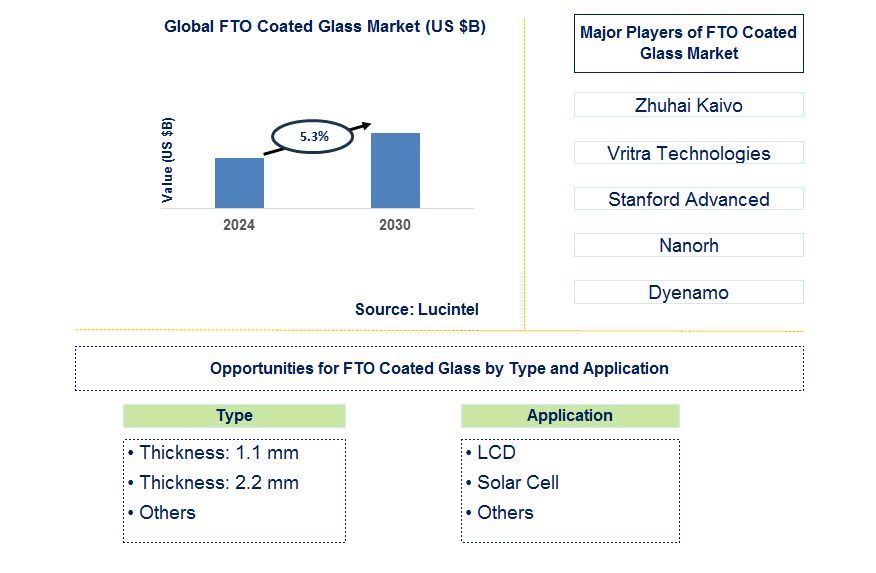
Key data points: The growth forecast = 5.3% annually for the next 6 years. Scroll below to get more insights. This market report covers trends, opportunities, and forecasts in the global FTO coated glass market to 2030 by type (thickness: 1.1 mm, thickness: 2.2 mm, and others), application (LCD, solar cell, and others), and region (North America, Europe, Asia Pacific, and the Rest of the World)
We'll send your sample report shortly.
• United States: In enhanced solar technologies, investments and development of renewable energy projects have involved making and applying FTO-coated glass to improve the efficiency of solar panels. FTO-coated glass is also being used by USA-based companies in smart building technologies.
• China: The production of FTO-coated glass in China is the fastest-growing in the country because of the solar power base and electronics industry. The government's climate policies for more renewable energy have allowed for growth and innovation in the production of FTO.
• Germany: The competition for higher performance of FTO glass for solar purposes is being led by German manufacturing companies. All of these factors have fostered the improvement of FTO glass for photovoltaic cells in Germany, given the high focus on clean energy equipment.
• India: In India, the most recent trends in FTO-coated glass have focused on the solar energy industry, underpinning the demand for cheaper and more reliable glass for solar module applications. Nearly all programs in favor of renewable energy by the central government have increased local capacities.
• Japan: FTO-coated glass developments in Japan have their origins in the manufacturing of consumer electronics. Companies are also developing FTO glass for use in touch panels and displays, in addition to solar energy applications.
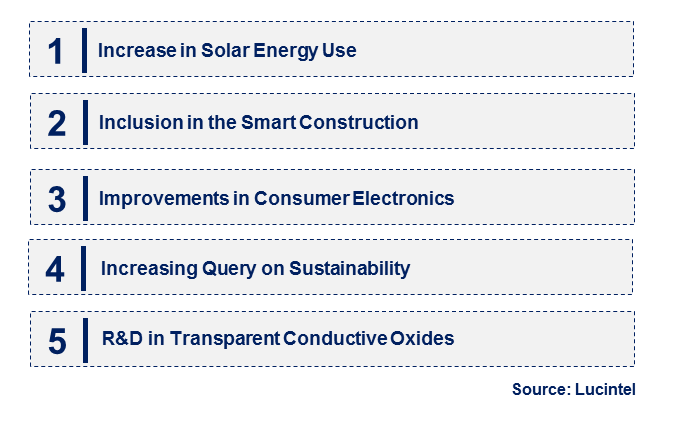
• Increase in Solar Energy Use: The increasing utilization of solar energy has prompted the use of FTO-coated glass in photovoltaic cells. This trend has been fueled by the global desire to offset the use of fossil fuels by moving toward solar energy and other clean sources, with innovations to improve solar panel energy conversion.
• Inclusion in Smart Construction: As smart windows and energy-efficient buildings grow, FTO-coated glass is making its way into them. This trend relies on improving building performance by incorporating windows that can manipulate internal light and thermal energy, thereby enhancing the buildings' eco-friendliness.
• Improvements in Consumer Electronics: FTO-coated glass in touchscreen and display panels is contributing significantly more than it initially did. Thin, conductive glass technology has been able to cater to the increased demand for high-end electronic devices.
• Increasing Demand for Sustainability: The upward trend in FTO glass production is leaning towards easier and cheaper supply. This change is necessitated by regulations and consumer demand for environmentally friendly materials.
• R&D in Transparent Conductive Oxides: Efforts to increase the conductivity and transparency of FTO-coated glass through research and development are still ongoing. This trend is imperative for improving various applications, particularly in solar cells and smart technology. Such trends are transforming the FTO-coated glass market as the focus on renewable energy, smart technology, and sustainability continues to grow, bringing new innovations to the market.
• Improved Efficiency of Solar Cells: The latest advancements have been directed at increasing the efficiency of FTO-coated glass incorporated within solar cells. Improvements lead to greater light acquisition and energy conversion, which, in turn, positively affect the operability of the solar panels.
• Smart Glass Technology: The incorporation of FTO-coated glass into smart glass technology has led to developments that aid in energy-efficient building designs. These advances make it possible to control the amount of light and heat entering a space, thus minimizing energy usage in both commercial and residential buildings.
• Expansion of Production Capacities: Many manufacturers in China and India have upscaled their production capacities to meet the increasing demand for FTO-coated glass in the solar and electronics industries. This contributes to lowering prices and enhancing the availability of goods in the market.
• Sustainable Manufacturing Processes: There have also been positive updates to the strategies for manufacturing FTO-coated glass. Manufacturers are implementing green technologies to reduce energy waste in production processes, supporting sustainability.
• Technological Collaboration: Rapid advancements in FTO-coated glass technologies have resulted from collaborative relationships formed between research institutions and manufacturers. Joint ventures have focused on improving conductivity and enhancing functionality across a range of applications. These developments are further accelerating sales and expansion in the FTO-coated glass market, particularly in the renewable energy, electronics, and construction sectors.
• Photovoltaic Cells: The growing adoption of solar energy is a huge growth potential area for FTO-coated glass in photovoltaic cells. Factors such as advancements that enhance energy conversion efficiency and durability are the main boosts to the growth of this sector.
• Smart Windows: There are opportunities for FTO-coated glass in energy-efficient windows in the smart building industry. FTO glass finds its place as a design element in constructions that are environmentally friendly because of its ability to vary light levels and temperature.
• Consumer Electronics: The demand for FTO-coated glass in touchscreens and displays continues to be robust within the electronics sector. The proliferation of mobile devices, wearables, and other consumer electronics provides great opportunities for the market.
• Automotive Applications: The commercial FTO-coated glass market is expanding into automotive applications, especially in windows and display screens that use FTO-coated glass. One of the factors driving the automotive industry is the transition to intelligent, connected vehicles.
• Research & Development: Further R&D efforts related to transparent conductive materials continue to provide great opportunities for growth. Better conductivity, transparency, and flexibility improve FTO-coated glass performance and expand its usage in new technologies. These growth opportunities are shaping the future of FTO-coated glass, and its competition in the coming years will be driven by growing consumption of renewable energy, smart buildings, and electronics.
• Technological Innovation: Developments in fabrication technologies have raised the efficiency of FTO-coated glass devices, particularly in the area of photovoltaics. New technologies enhance energy saving and lower costs, which in turn boost market growth.
• Growing Demand for Renewable Energy: Solar energy and other sustainable solutions have led to increased demand for FTO-coated glass, especially in photovoltaic cells and energy-efficient buildings.
• Sustainability Goals: FTO-coated glass has started expanding its market share owing to global initiatives aimed at lowering carbon emissions and promoting solar energy sources.
• Expansion of the Electronics Market: Touchscreen interfaces in display devices and television screens continue to create demand for FTO-coated glass due to the consumer electronics market. Growing smart gadgets are driving the market further.
• Government Support for Clean Energy: Various government programs supporting the deployment of clean energy have created an environment conducive to the development of the FTO-coated glass market, particularly in the solar energy segment. Challenges in the FTO-coated glass market include:
• High Cost of Production: The costs associated with the production of FTO-coated glass are quite high due to the need for specialized materials and processes. This discourages some manufacturers and end-users.
• Regulatory Barriers: Implementation of stringent regulations regarding environmental impact and the use of certain chemicals in the manufacture of FTO glass presents hurdles for manufacturers, especially in areas with tough environmental policies.
• Technical Limitations: Despite developments, there are still technical limitations regarding the conductivity and transparency of FTO-coated glass for some high-end applications, thus limiting its use in new technologies.
• Competition from Alternatives: Competition in the market also comes from ITO (Indium Tin Oxide) and other materials with similar properties, which present challenges for the use of FTO glass in certain areas.
• Supply Chain Issues: Disruptions in the supply chain, especially regarding the acquisition of raw materials and manufacturing components, may affect the production and distribution of FTO-coated glass. In conclusion, it is clear that various factors will influence the future direction of the FTO-coated glass market. While growth is driven by technological developments and increasing demand, drawbacks such as high costs and regulatory policies remain challenges.
• Zhuhai Kaivo Optoelectronic Technology
• Vritra Technologies
• Stanford Advanced Materials
• Nanorh
• Dyenamo
• NSG Group
• Ruilong Optoelectronics
• Jinge Solar Energy
• Kibing Group
• Hefei Crystal & Optoelectronic Materials
• Thickness: 1.1 mm
• Thickness: 2.2 mm
• Others
• LCD
• Solar Cell
• Others
• North America
• Europe
• Asia Pacific
• The Rest of the World
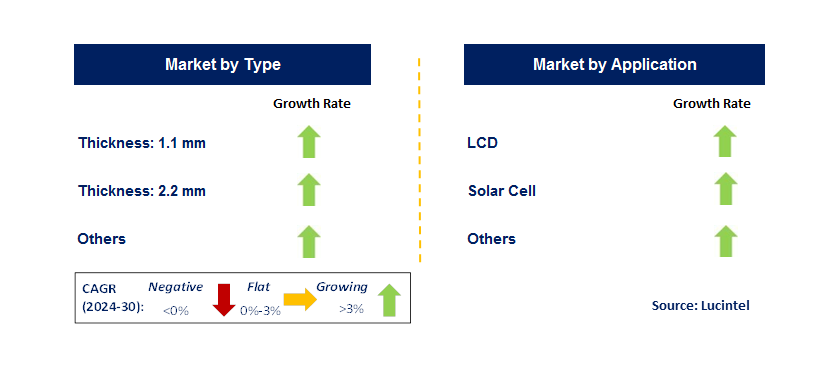
• Lucintel forecasts that, within the type category, thickness: 1.1 mm is expected to witness higher growth over the forecast period.
• Within the application category, lcd is expected to witness higher growth.
• In terms of regions, APAC is expected to witness the highest growth over the forecast period.

• Zhuhai Kaivo Optoelectronic Technology
• Vritra Technologies
• Stanford Advanced Materials
• Nanorh
• Dyenamo
• NSG Group
• Ruilong Optoelectronics
• Jinge Solar Energy
• Kibing Group
• Hefei Crystal & Optoelectronic Materials Q5. Which FTO coated glass market segment will be the largest in future? Answer: Lucintel forecasts that, within the type category, thickness: 1.1 mm is expected to witness higher growth over the forecast period. Q6. In FTO coated glass market, which region is expected to be the largest in next 5 years? Answer: In terms of regions, APAC is expected to witness the highest growth over the forecast period. Q.7 Do we receive customization in this report? Answer: Yes, Lucintel provides 10% customization without any additional cost.


Choose a license that fits your team. Instant PDF delivery.
Prices exclude taxes. Instant delivery. Custom licensing available on request.
Market Report · May 18, 2026
Market Report · May 16, 2026
Market Report · May 16, 2026
Trusted partner for strategic intelligence and business growth


Receive a complimentary market analysis tailored to your industry. Our analysts will identify key growth opportunities and competitive dynamics specific to your business.

Market size, growth rate, and key trend analysis for your specific sector.

Top competitor positioning and market share analysis.

Strategic recommendations backed by data-driven insights.
Get curated market intelligence and competitive moves straight to your inbox.
By subscribing, you agree to receive our monthly insights. Unsubscribe anytime.
Receive a complimentary market analysis tailored to your industry. Our analysts will identify key growth opportunities and competitive dynamics specific to your business.
Market size, growth rate, and key trend analysis for your specific sector.
Top competitor positioning and market share analysis.
Strategic recommendations backed by data-driven insights.
Get curated market intelligence, emerging trends, and competitive moves straight to your inbox each month.
By subscribing, you agree to receive our monthly insights. Unsubscribe anytime.
We'll send your sample report shortly.