
FRP Window Profile Market Trends and Forecast
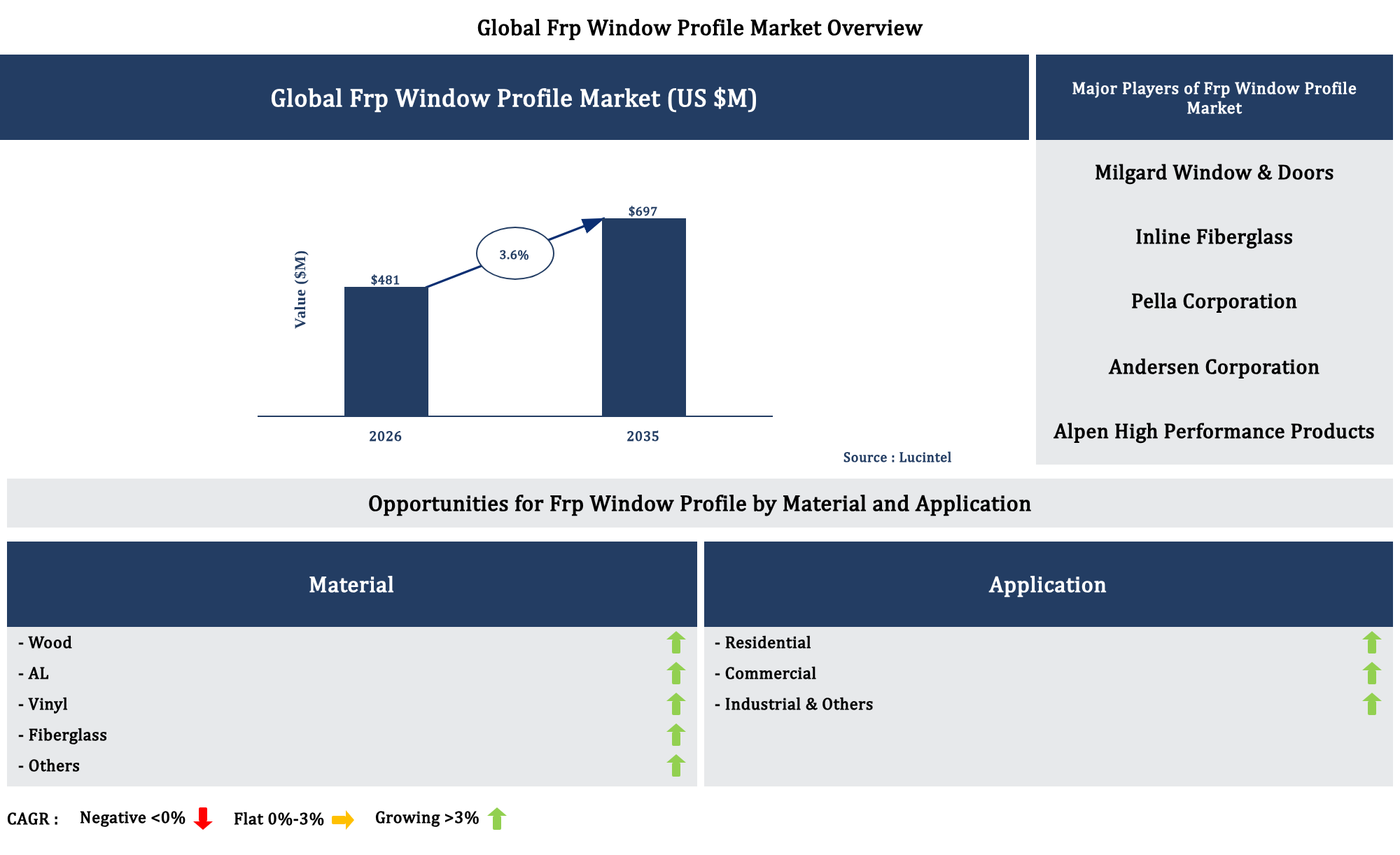
The future of the global FRP window profile market looks promising with opportunities in the residential, commercial, and industrial markets. The global FRP window profile market is expected to reach an estimated $697 million by 2035 with a CAGR of 3.6% from 2026 to 2035. The major drivers for this market are the growing use of FRP in harsh coastal & extreme weather conditions, the increasing preference for durable & corrosion-resistant window materials, and the rising government support for sustainable infrastructure development.
• Lucintel forecasts that, within the material category, fiberglass is expected to witness the highest growth over the forecast period.
• Within the application category, residential is expected to witness the highest growth.
• In terms of region, APAC is expected to witness the highest growth over the forecast period.
Gain valuable insights for your business decisions with our comprehensive 150+ page report. Sample figures with some insights are shown below.
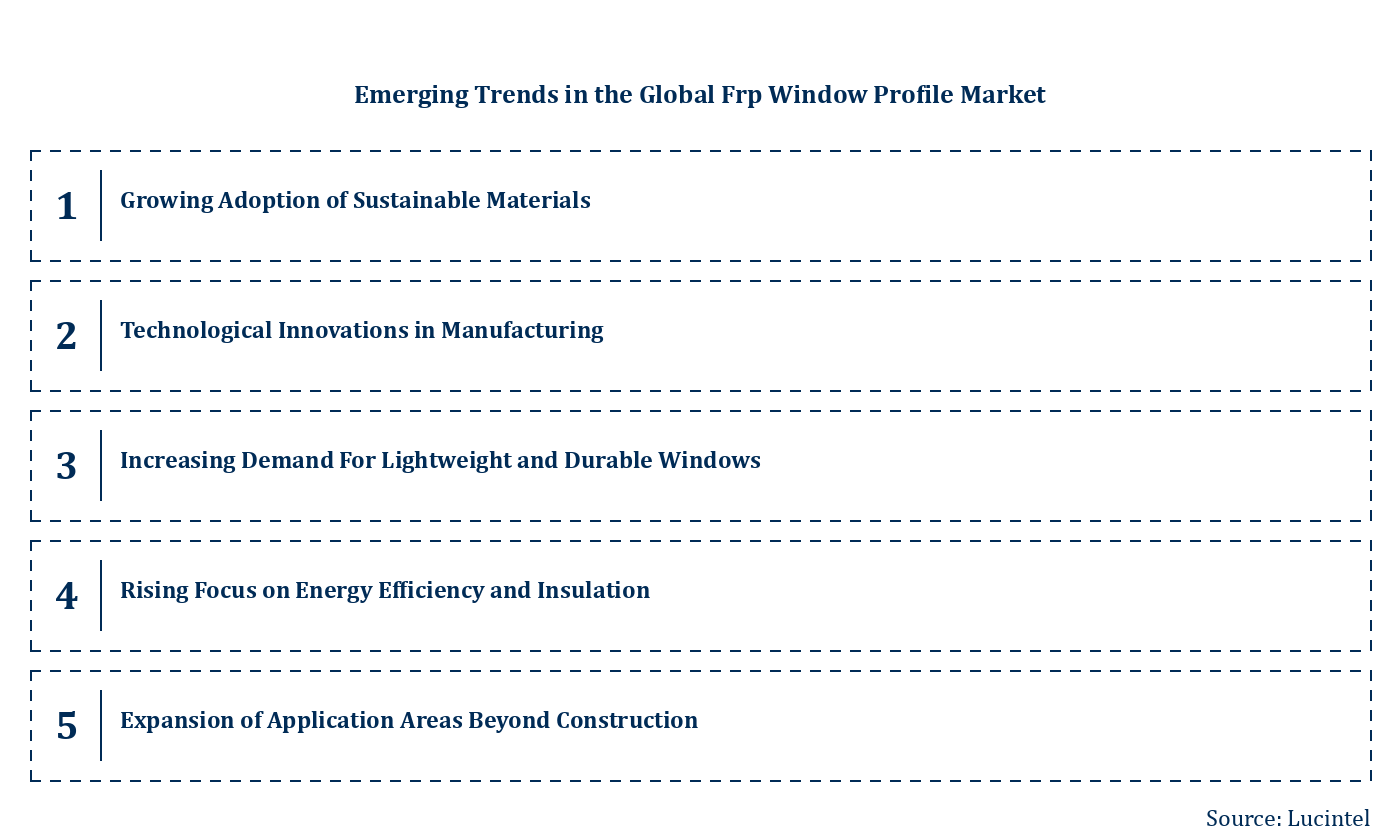
Emerging Trends in the FRP Window Profile Market
The FRP window profile market is experiencing rapid growth driven by technological advancements, increasing demand for durable and lightweight materials, and a shift towards sustainable construction practices. As industries seek innovative solutions to improve energy efficiency, safety, and aesthetics, the market is evolving with new materials, manufacturing techniques, and design preferences. These developments are not only expanding the application scope of FRP window profiles but also influencing market dynamics, competitive strategies, and customer expectations. Understanding these emerging trends is crucial for stakeholders aiming to capitalize on the market‘s potential and stay ahead in this competitive landscape.
• Growing Adoption of Sustainable Materials: Increasing environmental awareness and regulatory pressures are driving the demand for eco-friendly construction materials. FRP window profiles, being recyclable and energy-efficient, are gaining popularity as sustainable alternatives to traditional materials like aluminum and PVC. This trend encourages manufacturers to develop greener formulations and adopt eco-conscious manufacturing processes, which enhances their market appeal and aligns with global sustainability goals.
• Technological Innovations in Manufacturing: Advances in manufacturing technologies, such as automated fiber placement and 3D printing, are improving the precision, quality, and efficiency of FRP window profile production. These innovations reduce material wastage, lower production costs, and enable customization, thereby expanding the application scope. Enhanced manufacturing capabilities also facilitate the development of complex and innovative window designs, attracting architects and builders seeking aesthetic versatility.
• Increasing Demand for Lightweight and Durable Windows: The construction industry’s focus on lightweight yet durable materials is boosting the adoption of FRP window profiles. These profiles offer high strength-to-weight ratios, corrosion resistance, and low maintenance, making them ideal for various building types, including high-rise structures and coastal developments. This trend enhances building safety, reduces installation costs, and extends the lifespan of window systems, thereby driving market growth.
• Rising Focus on Energy Efficiency and Insulation: Energy-efficient buildings are a priority for modern construction, and FRP window profiles contribute significantly through their excellent thermal insulation properties. Their low thermal conductivity helps in reducing energy consumption for heating and cooling, aligning with green building standards. This trend encourages the integration of FRP profiles in sustainable building projects, boosting demand from environmentally conscious developers and regulatory bodies.
• Expansion of Application Areas Beyond Construction: The versatility of FRP window profiles is leading to their adoption in sectors such as transportation, industrial, and military applications. Their lightweight, high-strength, and corrosion-resistant properties make them suitable for use in vehicles, ships, and military equipment. This diversification broadens the market scope, stimulates innovation, and creates new revenue streams for manufacturers, further accelerating market expansion.
These emerging trends are transforming the FRP window profile market by promoting sustainability, technological advancement, and application diversification. They are driving innovation, improving product performance, and aligning the market with global environmental and safety standards. As a result, the market is becoming more competitive, dynamic, and poised for sustained growth in the coming years.
Recent Developments in the FRP Window Profile Market
The FRP window profile market is experiencing rapid growth driven by increasing demand for durable, lightweight, and corrosion-resistant window solutions across residential, commercial, and industrial sectors. Innovations in manufacturing processes and sustainable materials are further fueling market expansion. As construction standards evolve and environmental considerations become paramount, the market is poised for significant development. These trends present new opportunities for manufacturers to innovate and capture market share, ultimately transforming the landscape of window profile solutions worldwide.
• Growing Demand for Corrosion-Resistant Windows: The increasing need for durable window solutions in harsh environments, such as coastal and industrial areas, is boosting the adoption of FRP window profiles. Their resistance to corrosion, weathering, and chemical exposure makes them ideal for long-term applications. This demand is driving manufacturers to innovate with advanced composite materials, expanding market reach. The corrosion-resistant nature of FRP profiles reduces maintenance costs and enhances longevity, making them a preferred choice for architects and builders seeking sustainable, low-maintenance solutions.
• Rising Construction Activities in Emerging Economies: Rapid urbanization and infrastructure development in emerging markets are significantly contributing to the growth of the FRP window profile market. Governments are investing in affordable, durable building materials to meet housing and commercial needs. FRP profiles offer lightweight, easy-to-install, and cost-effective options that align with these development goals. As construction projects increase, the demand for innovative window solutions that meet safety and environmental standards is also rising, creating substantial market opportunities for manufacturers.
• Technological Advancements in Manufacturing Processes: Innovations such as automated fabrication, improved resin formulations, and fiber reinforcement techniques are enhancing the quality and performance of FRP window profiles. These advancements enable manufacturers to produce profiles with better strength, thermal insulation, and aesthetic appeal. The integration of sustainable materials and eco-friendly production methods is also gaining traction. These technological improvements are expanding application possibilities, reducing costs, and increasing competitiveness, thereby accelerating market growth and adoption across various sectors.
• Increasing Focus on Sustainable and Eco-Friendly Materials: Environmental concerns and regulatory pressures are prompting the adoption of sustainable building materials, including recycled fibers and bio-based resins in FRP profiles. These eco-friendly options reduce carbon footprints and align with green building standards such as LEED. Manufacturers investing in sustainable materials are gaining a competitive edge, attracting environmentally conscious consumers and clients. This shift towards sustainability is expected to drive innovation, expand market share, and promote the adoption of eco-friendly FRP window profiles globally.
• Growing Demand for Energy-Efficient Window Solutions: The emphasis on energy conservation and green building certifications is boosting the adoption of insulated and thermally efficient FRP window profiles. These profiles offer excellent thermal insulation properties, reducing energy consumption for heating and cooling. As building codes become more stringent, architects and developers prefer FRP profiles for their performance benefits. The market is witnessing increased R&D investments to enhance insulation capabilities, which will further expand the application scope and market size of energy-efficient FRP window profiles.
The recent developments in corrosion resistance, emerging market growth, manufacturing innovations, sustainability focus, and energy efficiency are collectively transforming the FRP window profile market. These opportunities are driving increased adoption, expanding application areas, and fostering technological advancements. As a result, the market is poised for sustained growth, with manufacturers gaining competitive advantages through innovation and sustainability. Overall, these developments are shaping a more resilient, eco-friendly, and efficient future for the FRP window profile industry.
Strategic Growth Opportunities in the FRP Window Profile Market
The FRP window profile market is experiencing significant growth driven by increasing demand for durable, lightweight, and corrosion-resistant materials across construction, industrial, and residential sectors. Innovations in manufacturing processes and expanding applications are creating new opportunities for market players. As environmental regulations tighten, sustainable and energy-efficient solutions are gaining prominence. The market‘s expansion is also fueled by rising urbanization and infrastructure development, prompting manufacturers to focus on product innovation and strategic collaborations to capture emerging opportunities.
• Growing Demand for Corrosion-Resistant and Lightweight Window Profiles in Construction: The construction industry’s need for durable, corrosion-resistant, and lightweight window solutions is boosting the adoption of FRP profiles. These profiles offer superior strength-to-weight ratios, reducing structural load and maintenance costs. Their resistance to environmental factors like moisture and chemicals makes them ideal for coastal and industrial buildings. As infrastructure projects increase globally, the demand for innovative, long-lasting window profiles is expected to rise, creating substantial growth opportunities for manufacturers.
• Increasing Adoption of Sustainable and Energy-Efficient Window Solutions: Sustainability trends are driving the market toward eco-friendly materials like FRP, which offer excellent thermal insulation and low environmental impact. Governments and regulatory bodies are promoting energy-efficient building practices, encouraging the use of FRP window profiles that contribute to reduced energy consumption. Manufacturers are investing in R&D to develop profiles with enhanced insulation properties and recyclable materials, aligning with green building standards and expanding market reach in eco-conscious regions.
• Technological Advancements in Manufacturing Processes: Innovations such as automated fabrication, 3D modeling, and advanced molding techniques are improving the quality, precision, and cost-effectiveness of FRP window profiles. These technological improvements enable customization, faster production cycles, and reduced waste, making FRP profiles more competitive against traditional materials. As manufacturers adopt Industry 4.0 practices, the market is poised for increased scalability, improved product performance, and broader application across various sectors.
• Expansion of Applications in Industrial and Transportation Sectors: Beyond construction, FRP window profiles are increasingly used in industrial facilities, transportation (trains, ships, aircraft), and infrastructure projects due to their lightweight and high-strength properties. These sectors demand materials that withstand harsh environments and reduce overall weight for efficiency. The diversification into these markets offers new revenue streams and growth avenues, encouraging manufacturers to develop specialized profiles tailored to specific industrial and transportation needs.
• Strategic Collaborations and Regional Market Expansion: Companies are forming alliances, joint ventures, and partnerships to enhance technological capabilities and expand their geographic presence. Emerging markets in Asia-Pacific, Latin America, and Africa present significant growth potential due to rapid urbanization and infrastructure development. Strategic investments in local manufacturing facilities and distribution networks are enabling market players to better serve regional demands, reduce costs, and accelerate market penetration, thereby fueling overall industry growth.
The overall impact of these opportunities is set to significantly accelerate the growth trajectory of the FRP window profile market, fostering innovation, expanding application scope, and enabling manufacturers to meet evolving customer and regulatory demands globally.
FRP Window Profile Market Driver and Challenges
The FRP window profile market is influenced by a variety of technological, economic, and regulatory factors that shape its growth trajectory. Advances in manufacturing technologies and material innovations have enhanced product quality and cost-efficiency, driving demand. Economic factors such as increasing construction activities and infrastructure development contribute significantly to market expansion. Regulatory standards related to safety, energy efficiency, and environmental sustainability also impact market dynamics, encouraging the adoption of FRP profiles over traditional materials. Additionally, consumer preferences for durable, lightweight, and low-maintenance window solutions further propel market growth. However, the market faces challenges stemming from high production costs, fluctuating raw material prices, and stringent regulatory compliance, which could hinder expansion. Understanding these drivers and challenges is essential for stakeholders to navigate the evolving landscape effectively.
The factors responsible for driving the FRP window profile market include:
• Technological Advancements: The continuous development of manufacturing processes and material innovations has led to higher quality, durability, and cost-efficiency of FRP window profiles. These technological improvements enable manufacturers to produce profiles with enhanced strength, weather resistance, and aesthetic appeal, meeting the growing demand from construction and renovation sectors. Automation and precision engineering have also reduced production time and waste, making FRP profiles more accessible and affordable. As research progresses, new composite formulations and fabrication techniques are expected to further boost market competitiveness and product performance, attracting more end-users seeking sustainable and long-lasting window solutions.
• Growing Construction and Infrastructure Development: Rapid urbanization and infrastructure projects across emerging and developed economies are fueling demand for durable, lightweight, and low-maintenance window profiles. The construction industry’s shift towards energy-efficient and environmentally friendly building materials has increased the adoption of FRP profiles, which offer excellent thermal insulation and corrosion resistance. Commercial, residential, and industrial sectors are investing heavily in modern window solutions, creating a substantial market opportunity. Government initiatives promoting sustainable construction practices and green building certifications further incentivize the use of FRP profiles, supporting market growth in both new constructions and renovation projects.
• Environmental Regulations and Sustainability Trends: Increasing emphasis on environmental sustainability and strict regulatory standards are driving the adoption of eco-friendly building materials like FRP window profiles. These profiles are recyclable, have a lower carbon footprint compared to traditional materials like aluminum and wood, and contribute to energy conservation in buildings. Governments worldwide are implementing policies that promote green building practices, which favor the use of sustainable materials. This regulatory push encourages manufacturers to innovate and expand their product offerings, aligning with global sustainability goals. Consequently, the market benefits from a growing consumer base that prioritizes environmentally responsible construction solutions.
• Cost-Effectiveness and Low Maintenance: The economic benefits of FRP window profiles, including their low maintenance requirements and long lifespan, are significant drivers of market growth. Unlike wood or metal, FRP profiles resist corrosion, pests, and weathering, reducing the need for frequent repairs or replacements. Their energy-efficient properties also lead to lower utility costs for end-users. Although initial manufacturing costs can be high, the overall lifecycle cost savings make FRP profiles an attractive option for builders and homeowners. This cost-effectiveness, combined with ease of installation and aesthetic versatility, enhances their appeal across various construction projects, thereby expanding market reach.
• Increasing Awareness and Adoption of Sustainable Building Materials: Growing awareness among consumers, architects, and builders about the benefits of sustainable and eco-friendly materials is boosting the adoption of FRP window profiles. Educational campaigns, industry certifications, and green building standards are promoting the advantages of FRP profiles, such as durability, recyclability, and energy efficiency. As sustainability becomes a key criterion in project planning, stakeholders prefer materials that align with environmental goals. This shift in perception and preference is expanding the market, encouraging manufacturers to innovate and develop more sustainable product lines, ultimately fostering a more environmentally conscious construction industry.
The challenges facing this Market include:
• High Production Costs: Despite their benefits, FRP window profiles involve complex manufacturing processes that require specialized equipment and materials, leading to higher production costs compared to traditional materials. These costs can limit market penetration, especially in price-sensitive regions or projects. Additionally, economies of scale are still developing, which means that smaller manufacturers may face difficulties in achieving cost competitiveness. The high initial investment in manufacturing infrastructure and raw materials can also impact profit margins, potentially hindering widespread adoption unless offset by premium pricing or increased demand.
• Fluctuating Raw Material Prices: The market for FRP window profiles heavily depends on the availability and cost of raw materials such as fiberglass and resins. Volatility in raw material prices, driven by global supply chain disruptions, geopolitical tensions, or raw material shortages, can significantly impact manufacturing costs and profit margins. Price fluctuations may also lead to unpredictability in product pricing, affecting competitiveness and customer confidence. Manufacturers need to develop strategies for raw material procurement and cost management to mitigate these risks and ensure stable supply and pricing.
• Stringent Regulatory Compliance: The FRP window profile market faces challenges related to evolving regulatory standards concerning safety, environmental impact, and building codes. Compliance with these regulations often requires additional testing, certification, and quality assurance processes, increasing time-to-market and costs. Non-compliance can result in legal penalties, product recalls, or loss of market access. As regulations become more rigorous, manufacturers must invest in research and development to meet new standards, which can be resource-intensive. Navigating diverse regulatory landscapes across regions adds complexity, potentially limiting market expansion and product acceptance.
The FRP window profile market is driven by technological innovations, construction growth, sustainability trends, cost benefits, and increasing awareness of eco-friendly materials. However, high production costs, raw material price volatility, and regulatory challenges pose significant hurdles. These factors collectively influence market dynamics, requiring stakeholders to innovate, adapt, and strategize effectively. The overall impact is a market poised for growth with opportunities for sustainable development, provided that challenges are managed through technological advancements and strategic planning.
List of FRP Window Profile Companies
Companies in the market compete on the basis of product quality offered. Major players in this market focus on expanding their manufacturing facilities, R&D investments, infrastructural development, and leverage integration opportunities across the value chain. With these strategies FRP window profile companies cater increasing demand, ensure competitive effectiveness, develop innovative products & technologies, reduce production costs, and expand their customer base. Some of the FRP window profile companies profiled in this report include-
• Milgard Window & Doors
• Inline Fiberglass
• Pella Corporation
• Andersen Corporation
• Alpen High Performance Products
FRP Window Profile Market by Segment
The study includes a forecast for the global FRP window profile market by material, application, and region.
FRP Window Profile Market by Material [Value from 2019 to 2035]:
• Wood
• AL
• Vinyl
• Fiberglass
• Others
FRP Window Profile Market by Application [Value from 2019 to 2035]:
• Residential
• Commercial
• Industrial & Others
FRP Window Profile Market by Region [Value from 2019 to 2035]:
• North America
• Europe
• Asia Pacific
• The Rest of the World
Country Wise Outlook for the FRP Window Profile Market
The FRP window profile market has experienced significant growth driven by increasing demand for durable, lightweight, and corrosion-resistant materials across various industries. Technological advancements, environmental considerations, and expanding construction activities have spurred innovation and market expansion globally. Countries are adopting new manufacturing techniques, enhancing product quality, and integrating sustainable practices to meet rising consumer and industrial needs. The market‘s evolution reflects a shift towards more efficient, eco-friendly, and cost-effective window solutions, with key developments emerging in major economies. These changes are shaping the future landscape of the FRP window profile industry, influencing supply chains, product offerings, and competitive dynamics.
• United States: The US market has seen increased adoption of FRP window profiles in commercial and residential construction, driven by stringent building codes and sustainability initiatives. Innovations in manufacturing have improved product strength and thermal insulation properties. Companies are focusing on eco-friendly materials and energy-efficient designs, aligning with green building standards. The rise of modular construction and renovation projects further boosts demand. Additionally, technological integration such as smart window systems is gaining traction, enhancing functionality and market appeal.
• China: China remains the largest market for FRP window profiles, with rapid urbanization and infrastructure development fueling growth. Manufacturers are investing in advanced production facilities to meet rising domestic demand. The government’s emphasis on sustainable construction practices has led to increased use of eco-friendly materials. Local companies are expanding their product portfolios to include customized solutions for diverse architectural needs. The market is also witnessing a shift towards automation and digitalization in manufacturing processes, improving efficiency and product quality.
• Germany: Germany‘s market is characterized by high-quality standards and a focus on innovation. The country emphasizes energy-efficient and sustainable building materials, which has driven the adoption of advanced FRP window profiles. German manufacturers are integrating cutting-edge technologies such as automation and robotics to enhance precision and reduce costs. The market benefits from strong regulatory support for green building practices and a robust construction sector. Additionally, there is a growing trend towards designing profiles with enhanced thermal insulation and durability to meet stringent environmental regulations.
• India: The Indian FRP window profile market is experiencing rapid growth due to expanding urbanization and infrastructure projects. Cost-effective and durable solutions are in high demand, prompting manufacturers to innovate with affordable yet high-performance profiles. The government’s focus on affordable housing and smart city initiatives further accelerates market development. Local companies are adopting modern manufacturing techniques and exploring export opportunities. The market is also witnessing increased awareness of sustainable construction practices, encouraging the adoption of eco-friendly materials.
• Japan: Japan’s market is driven by a strong emphasis on energy efficiency and disaster-resistant construction. Advanced FRP window profiles are being developed to withstand seismic activity and harsh weather conditions. Japanese manufacturers are investing in research and development to improve product performance and environmental sustainability. The market benefits from strict building codes and a focus on innovative, high-quality solutions. Additionally, the trend towards smart and automated window systems is gaining popularity, aligning with Japan’s technological advancements and sustainability goals.
Features of the Global FRP Window Profile Market
Market Size Estimates: Frp window profile market size estimation in terms of value ($M).
Trend and Forecast Analysis: Market trends (2019 to 2025) and forecast (2026 to 2035) by various segments and regions.
Segmentation Analysis: Frp window profile market size by material, application, and region in terms of value ($M).
Regional Analysis: Frp window profile market breakdown by North America, Europe, Asia Pacific, and Rest of the World.
Growth Opportunities: Analysis of growth opportunities in different material, application, and regions for the FRP window profile market.
Strategic Analysis: This includes M&A, new product development, and competitive landscape of the FRP window profile market.
Analysis of competitive intensity of the industry based on Porter’s Five Forces model.
FAQ
Q1. What is the FRP window profile market size?
Answer: The global FRP window profile market is expected to reach an estimated $697 million by 2035.
Q2. What is the growth forecast for FRP window profile market?
Answer: The global FRP window profile market is expected to grow with a CAGR of 3.6% from 2026 to 2035.
Q3. What are the major drivers influencing the growth of the FRP window profile market?
Answer: The major drivers for this market are the growing use of FRP in harsh coastal & extreme weather conditions, the increasing preference for durable & corrosion-resistant window materials, and the rising government support for sustainable infrastructure development.
Q4. What are the major segments for FRP window profile market?
Answer: The future of the FRP window profile market looks promising with opportunities in the residential, commercial, and industrial markets.
Q5. Who are the key FRP window profile market companies?
Answer: Some of the key FRP window profile companies are as follows:
• Milgard Window & Doors
• Inline Fiberglass
• Pella Corporation
• Andersen Corporation
• Alpen High Performance Products
Q6. Which FRP window profile market segment will be the largest in future?
Answer: Lucintel forecasts that, within the material category, fiberglass is expected to witness the highest growth over the forecast period.
Q7. In FRP window profile market, which region is expected to be the largest in next 8 years?
Answer: In terms of region, APAC is expected to witness the highest growth over the forecast period.
Q8. Do we receive customization in this report?
Answer: Yes, Lucintel provides 10% customization without any additional cost.
This report answers following 11 key questions:
Q.1. What are some of the most promising, high-growth opportunities for the FRP window profile market by material (wood, AL, vinyl, fiberglass, and others), application (residential, commercial, and industrial & others), and region (North America, Europe, Asia Pacific, and the Rest of the World)?
Q.2. Which segments will grow at a faster pace and why?
Q.3. Which region will grow at a faster pace and why?
Q.4. What are the key factors affecting market dynamics? What are the key challenges and business risks in this market?
Q.5. What are the business risks and competitive threats in this market?
Q.6. What are the emerging trends in this market and the reasons behind them?
Q.7. What are some of the changing demands of customers in the market?
Q.8. What are the new developments in the market? Which companies are leading these developments?
Q.9. Who are the major players in this market? What strategic initiatives are key players pursuing for business growth?
Q.10. What are some of the competing products in this market and how big of a threat do they pose for loss of market share by material or product substitution?
Q.11. What M&A activity has occurred in the last 5 years and what has its impact been on the industry?
For any questions related to FRP Window Profile Market, FRP Window Profile Market Size, FRP Window Profile Market Growth, FRP Window Profile Market Analysis, FRP Window Profile Market Report, FRP Window Profile Market Share, FRP Window Profile Market Trends, FRP Window Profile Market Forecast, FRP Window Profile Companies, write Lucintel analyst at email: helpdesk@lucintel.com. We will be glad to get back to you soon.