
Market Report · July 31, 2026

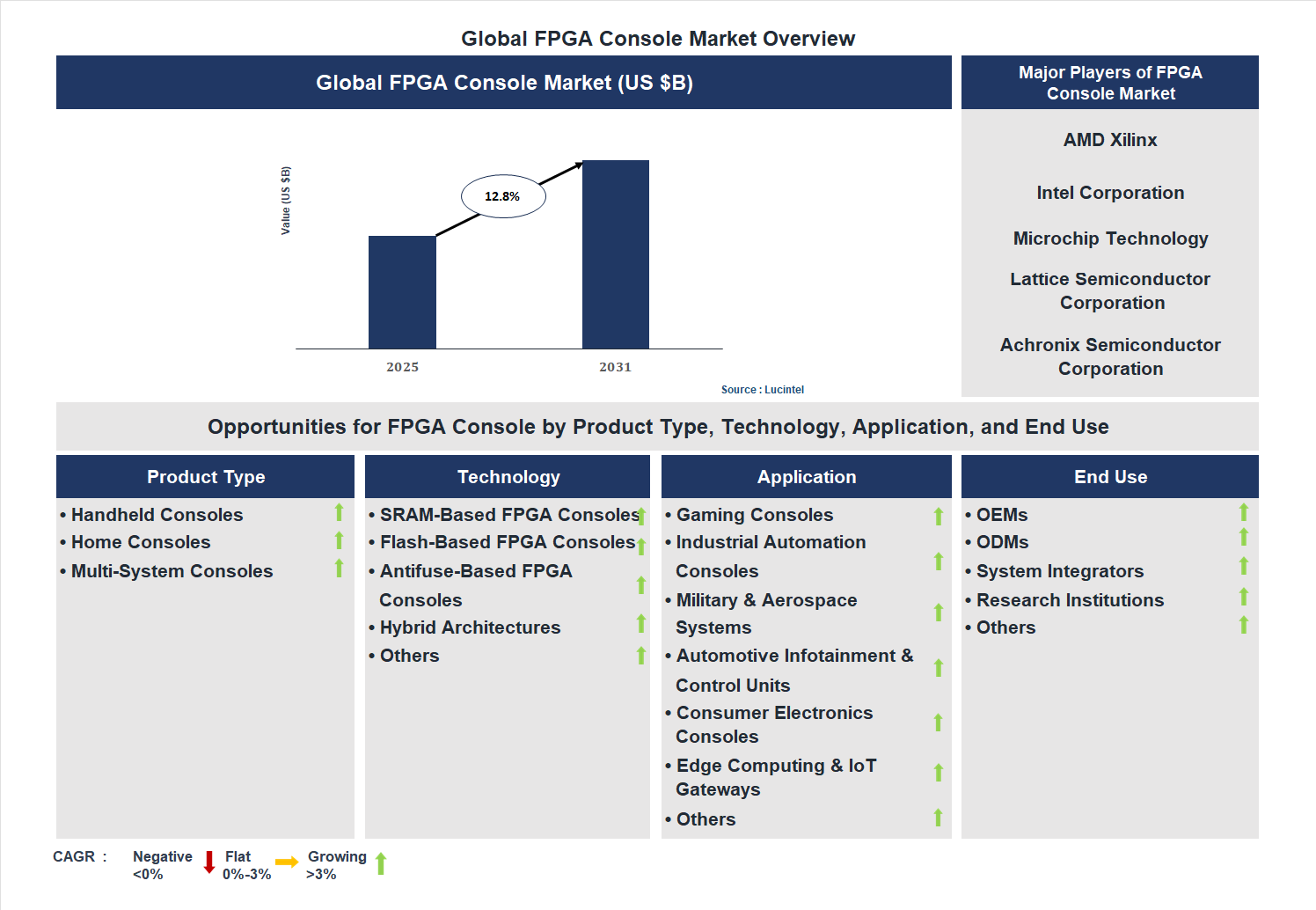
Key data points: The growth forecast = 12.8% annually for the next 7 years. Scroll below to get more insights. This market report covers trends, opportunities and forecasts in FPGA console market to 2031 by product type (handheld consoles, home consoles, and multi-system consoles), technology (SRAM-based FPGA consoles, flash-based FPGA consoles, antifuse-based FPGA consoles, hybrid architectures, and others), application (gaming consoles, industrial automation consoles, military & aerospace systems, automotive infotainment & control units, consumer electronics consoles, edge computing & IoT gateways, and others), end use (OEMs, ODMs, system integrators, research institutions, and others), and region (North America, Europe, Asia Pacific, and the Rest of the World)
We'll send your sample report shortly.
• Lucintel forecasts that, within the product type category, handheld console is expected to witness the highest growth over the forecast period.
• Within the end use category, ODM is expected to witness the highest growth.
• In terms of region, APAC is expected to witness the highest growth over the forecast period. Gain valuable insights for your business decisions with our comprehensive 150+ page report. Sample figures with some insights are shown below.
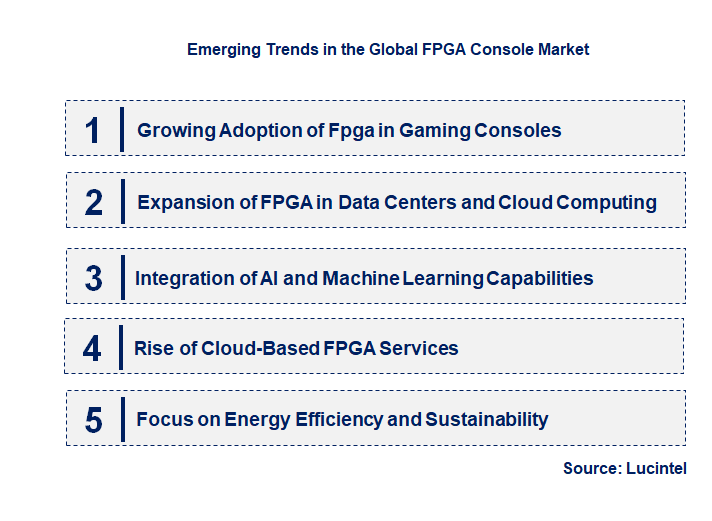
• Growing Adoption of FPGA in Gaming Consoles: The gaming industry is increasingly integrating FPGA technology into consoles to enhance performance and customization. Companies like sony and microsoft are exploring FPGA-based solutions to deliver more immersive experiences, reduce latency, and enable real-time updates. This trend allows for hardware flexibility, enabling consoles to adapt to new gaming formats and technologies without complete hardware overhauls. As a result, consumers benefit from more versatile and future-proof gaming systems, while manufacturers can reduce costs associated with hardware redesigns. The integration of FPGA in gaming consoles is expected to drive innovation and extend product lifecycles.
• Expansion of FPGA in Data Centers and Cloud Computing: Data centers are adopting FPGA technology to accelerate workloads, improve energy efficiency, and reduce latency. Cloud service providers such as amazon and google are deploying FPGA accelerators to optimize AI, machine learning, and big data analytics. This trend is driven by the need for scalable, customizable hardware solutions that can be tailored to specific applications. FPGAs reconfigurability allows data centers to adapt quickly to evolving computational demands, leading to cost savings and performance improvements. As cloud providers expand their FPGA offerings, the market for FPGA consoles tailored for data center use is poised for significant growth.
• Integration of AI and Machine Learning Capabilities: The incorporation of AI and machine learning into FPGA consoles is transforming their functionality. Companies like intel and xilinx are developing FPGA platforms with embedded AI capabilities, enabling real-time data processing and decision-making. This trend enhances applications in autonomous vehicles, industrial automation, and healthcare. FPGAs ability to perform parallel processing makes it ideal for AI workloads, offering high speed and low latency. The integration of AI accelerates innovation, allowing developers to create smarter, more efficient systems. This convergence is expected to open new markets and expand the use cases for FPGA consoles.
• Rise of Cloud-Based FPGA Services: Cloud providers are offering FPGA-as-a-Service, allowing users to access reconfigurable hardware remotely. This trend reduces the need for significant capital investment in physical hardware and provides flexibility for developers and enterprises. Companies like amazon web services and microsoft azure are leading this shift, enabling clients to deploy FPGA resources on demand for specific tasks such as cryptography, data processing, and AI inference. Cloud-based FPGA services democratize access to high-performance hardware, fostering innovation and enabling smaller firms to leverage FPGA technology without extensive infrastructure. This trend is likely to accelerate market growth and adoption.
• Focus on Energy Efficiency and Sustainability: As environmental concerns grow, FPGA manufacturers are prioritizing energy-efficient designs and sustainable manufacturing practices. Innovations in low-power FPGA architectures and the use of eco-friendly materials are reducing the environmental footprint of FPGA consoles. This trend aligns with global efforts to promote sustainability in technology, appealing to environmentally conscious consumers and organizations. Energy-efficient FPGA consoles not only lower operational costs but also support corporate sustainability goals. The emphasis on green technology is reshaping product development strategies and positioning FPGA consoles as a responsible choice for future-proof, eco-friendly solutions. In summary, these trends are collectively reshaping the FPGA console market by enhancing performance, expanding application areas, and promoting sustainable practices. The integration of FPGA technology into gaming, data centers, and AI applications is driving innovation, reducing costs, and broadening market accessibility. As these developments continue, the FPGA console market is set to become more versatile, efficient, and aligned with emerging technological and environmental priorities.
• technological innovation: Companies like intel and xilinx have launched advanced FPGA consoles with higher processing speeds and lower power consumption, improving overall performance and enabling new applications in AI, data centers, and embedded systems. This innovation boosts market competitiveness and attracts new customers seeking cutting-edge solutions.
• strategic partnerships: Collaborations between FPGA manufacturers and software developers, such as xilinx partnering with cloud service providers, facilitate integrated solutions that simplify FPGA deployment. These alliances expand market access, foster ecosystem development, and accelerate adoption across industries.
• expanding application areas: The FPGA console market is witnessing increased adoption in sectors like automotive, telecommunications, and aerospace. This diversification broadens the customer base, drives demand for specialized FPGA solutions, and stimulates market growth beyond traditional segments.
• integration with AI and machine learning: Companies are integrating FPGA consoles with AI and ML frameworks to enhance processing capabilities. This development enables real-time data analysis and decision-making, positioning FPGA consoles as essential components in next-generation intelligent systems.
• regulatory and supply chain developments: Governments and industry bodies are implementing new standards and policies to ensure supply chain security and product reliability. These regulations influence manufacturing practices, increase compliance costs, but ultimately promote market stability and consumer trust. In summary, these recent developments are significantly impacting the FPGA console market by enhancing technological capabilities, expanding application domains, fostering strategic collaborations, and ensuring regulatory compliance. Collectively, they are driving growth, increasing competitiveness, and positioning FPGA consoles as vital components in advanced computing solutions across multiple industries.
• Gaming: Enhanced Graphics and Real-time Processing : The gaming industry benefits from FPGA consoles through improved graphics rendering and real-time processing capabilities, providing immersive experiences and reducing latency. Companies like xilinx are developing specialized FPGA solutions to meet high-performance gaming demands, boosting user engagement and expanding market share.
• Data Centers: Accelerated Data Processing and AI Integration : In data centers, FPGA consoles enable accelerated data processing and AI workloads, improving efficiency and reducing energy consumption. firms such as intel are integrating FPGA technology to optimize cloud computing services, attracting enterprise clients and increasing revenue streams.
• Automotive: Advanced Driver Assistance Systems (ADAS) and Autonomous Vehicles : The automotive sector leverages FPGA consoles for ADAS and autonomous vehicle systems, offering real-time data processing and enhanced safety features. companies like altera are developing rugged FPGA solutions to meet automotive industry standards, driving innovation and safety.
• Aerospace: High-Performance Computing and Signal Processing : Aerospace applications utilize FPGA consoles for high-performance computing, satellite communication, and signal processing. aerospace firms are adopting FPGA technology to improve system reliability and reduce weight, leading to more efficient space missions and defense systems.
• Industrial Automation: Robotics and Smart Manufacturing : In industrial automation, FPGA consoles facilitate robotics control and smart manufacturing processes, enabling precise operations and real-time monitoring. companies such as microsemi are providing tailored FPGA solutions to enhance automation efficiency and reduce downtime. In summary, these growth opportunities are significantly impacting the FPGA console market by expanding its application scope, driving technological innovation, and fostering competitive advantages. As industries increasingly adopt FPGA solutions, market growth is expected to accelerate, creating new revenue streams and enhancing product capabilities across sectors.
• technological innovation: The continuous evolution of FPGA technology enables higher processing speeds, lower power consumption, and greater flexibility, which are critical for gaming consoles, data centers, and embedded systems. As FPGA capabilities expand, manufacturers can develop more sophisticated and customizable consoles, attracting a broader customer base. This innovation also allows for rapid adaptation to emerging trends such as AI and machine learning, further fueling market growth. The ability to reprogram FPGA hardware post-deployment offers a significant advantage over traditional fixed-function chips, making FPGA consoles highly attractive for future-proofing investments.
• increasing demand for high-performance gaming and data processing: The surge in gaming popularity and the proliferation of data-intensive applications drive the need for powerful hardware solutions. FPGA consoles provide customizable architectures that can handle complex graphics, real-time processing, and AI integration, meeting the demands of modern gaming and enterprise applications. As consumers seek more immersive experiences and businesses require efficient data handling, FPGA consoles become essential. This demand is further supported by the growth of cloud gaming, virtual reality, and big data analytics, which require adaptable and high-performance hardware solutions.
• economic growth and digital transformation: Rapid economic development in emerging markets such as Asia-Pacific and Latin America boosts the adoption of advanced computing solutions, including FPGA consoles. Governments and private sectors are investing heavily in digital infrastructure, smart devices, and automation, creating a fertile environment for FPGA technology deployment. The increasing affordability of FPGA-based systems and the expansion of the tech ecosystem contribute to market growth. Moreover, digital transformation initiatives across industries encourage the integration of FPGA consoles for customized, efficient, and scalable solutions, fostering long-term market expansion.
• regulatory support and standardization: Governments and industry bodies are implementing policies and standards that promote the adoption of FPGA technology. Regulatory frameworks aimed at enhancing cybersecurity, data privacy, and electronic waste management influence FPGA console development and deployment. Standardization efforts facilitate interoperability and reduce development costs, encouraging manufacturers to innovate and expand their product offerings. Supportive regulatory environments also attract investments and foster collaborations, accelerating market growth and ensuring compliance with evolving legal requirements. The challenges in the FPGA console market are:
• high development and manufacturing costs: Developing FPGA-based consoles involves significant investment in research, design, and testing. The complexity of FPGA architectures and the need for specialized expertise increase production costs, which can limit profitability and market competitiveness. Small and medium-sized companies may find it difficult to compete with larger players due to these financial barriers. Additionally, the costs associated with frequent hardware updates and customization can hinder rapid product cycles, impacting overall market agility. This financial burden may slow innovation and restrict market entry for new players.
• rapid technological obsolescence: The fast-paced nature of FPGA technology means that hardware can become outdated quickly. As new FPGA models with enhanced features are released, existing consoles risk becoming obsolete, leading to increased pressure on manufacturers to continuously upgrade their products. This rapid obsolescence can result in higher R&D expenses and inventory management challenges. It also impacts consumer confidence, as frequent upgrades may be necessary to stay competitive, potentially discouraging long-term investments in FPGA consoles.
• stringent regulatory standards: Evolving regulations related to cybersecurity, data privacy, and electronic waste management pose compliance challenges for FPGA console manufacturers. Meeting these standards often requires additional testing, certification, and modifications, increasing time-to-market and costs. Non-compliance can lead to legal penalties, reputational damage, and market restrictions. Navigating diverse regulatory landscapes across regions adds complexity, especially for companies aiming for global reach. These regulatory hurdles can slow innovation and limit the deployment of FPGA consoles in certain sectors or geographies. In summary, the FPGA console market is driven by technological advancements, rising demand for high-performance solutions, economic growth, and supportive regulations. However, high development costs, rapid obsolescence, and regulatory challenges pose significant hurdles. These factors collectively influence market dynamics, requiring stakeholders to innovate strategically and adapt swiftly. While opportunities for growth are substantial, addressing these challenges is crucial for sustainable expansion. Overall, the markets future will depend on balancing innovation with cost management and regulatory compliance, shaping a competitive and evolving landscape.
• AMD Xilinx
• Intel Corporation
• Microchip Technology
• Lattice Semiconductor Corporation
• Achronix Semiconductor Corporation
• QuickLogic Corporation
• Efinix
• Flex Logix Technologies
• NanoXplore
• GOWIN Semiconductor
• Handheld Consoles
• Home Consoles
• Multi-System Consoles
• SRAM-Based FPGA Consoles
• Flash-Based FPGA Consoles
• Antifuse-Based FPGA Consoles
• Hybrid Architectures
• Others
• Gaming Consoles
• Industrial Automation Consoles
• Military & Aerospace Systems
• Automotive Infotainment & Control Units
• Consumer Electronics Consoles
• Edge Computing & IoT Gateways
• Others
• OEMs
• ODMs
• System Integrators
• Research Institutions
• Others
• North America
• Europe
• Asia Pacific
• The Rest of the World
• United States, the FPGA console market is witnessing rapid growth driven by companies like xilinx and intel, focusing on high-performance gaming and data center applications. The adoption of FPGA-based solutions in cloud computing and AI accelerators is expanding, supported by strong technological innovation and strategic partnerships. The US government is also investing in FPGA research for defense and security applications, further boosting market prospects.
• China is experiencing a surge in FPGA console development, with companies such as smic and hiSilicon leading the charge. The government’s emphasis on self-reliance and domestic innovation is fostering local FPGA ecosystem growth. The market is expanding into sectors like telecommunications, smart manufacturing, and automotive electronics, with increased investments in R&D and manufacturing capacity to reduce dependence on foreign suppliers.
• Germanys FPGA console market is characterized by a focus on industrial automation, automotive, and telecommunications sectors. Companies like infineon and microchip are advancing FPGA integration for smart factories and autonomous vehicles. The region benefits from strong industrial standards and a skilled workforce, which facilitate innovation and the adoption of FPGA solutions in high-reliability applications.
• India is witnessing a rising interest in FPGA technology, driven by startups and established firms such as xilinx and altera. The focus is on developing cost-effective FPGA solutions for telecommunications, defense, and IoT applications. Government initiatives promoting digital infrastructure and manufacturing are encouraging local innovation, leading to increased FPGA adoption in various sectors.
• Japans FPGA console market is evolving with a focus on consumer electronics, robotics, and automotive applications. Companies like tokyo electron and microchip are developing advanced FPGA solutions to enhance automation and smart device capabilities. The region’s emphasis on quality and reliability is fostering the integration of FPGA technology into critical systems, supported by government and industry collaborations to promote innovation.


• AMD Xilinx
• Intel Corporation
• Microchip Technology
• Lattice Semiconductor Corporation
• Achronix Semiconductor Corporation
• QuickLogic Corporation
• Efinix
• Flex Logix Technologies
• NanoXplore
• GOWIN Semiconductor Q5. Which FPGA console market segment will be the largest in future? Answer: Lucintel forecasts that, within the product type category, handheld console is expected to witness the highest growth over the forecast period. Q6. In FPGA console market, which region is expected to be the largest in next 5 years? Answer: In terms of region, APAC is expected to witness the highest growth over the forecast period. Q7. Do we receive customization in this report? Answer: Yes, Lucintel provides 10% customization without any additional cost.


Choose a license that fits your team. Instant PDF delivery.
Prices exclude taxes. Instant delivery. Custom licensing available on request.
Market Report · July 31, 2026
Market Report · July 31, 2026
Market Report · July 31, 2026
Trusted partner for strategic intelligence and business growth


Receive a complimentary market analysis tailored to your industry. Our analysts will identify key growth opportunities and competitive dynamics specific to your business.

Market size, growth rate, and key trend analysis for your specific sector.

Top competitor positioning and market share analysis.

Strategic recommendations backed by data-driven insights.
Get curated market intelligence and competitive moves straight to your inbox.
By subscribing, you agree to receive our monthly insights. Unsubscribe anytime.
Receive a complimentary market analysis tailored to your industry. Our analysts will identify key growth opportunities and competitive dynamics specific to your business.
Market size, growth rate, and key trend analysis for your specific sector.
Top competitor positioning and market share analysis.
Strategic recommendations backed by data-driven insights.
Get curated market intelligence, emerging trends, and competitive moves straight to your inbox each month.
By subscribing, you agree to receive our monthly insights. Unsubscribe anytime.
We'll send your sample report shortly.