
Market Report · July 15, 2026

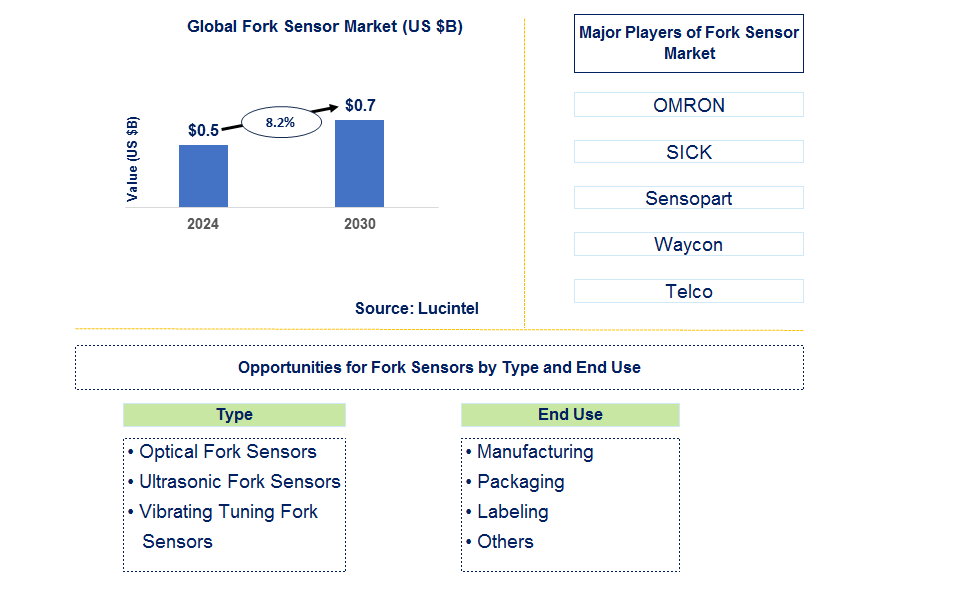
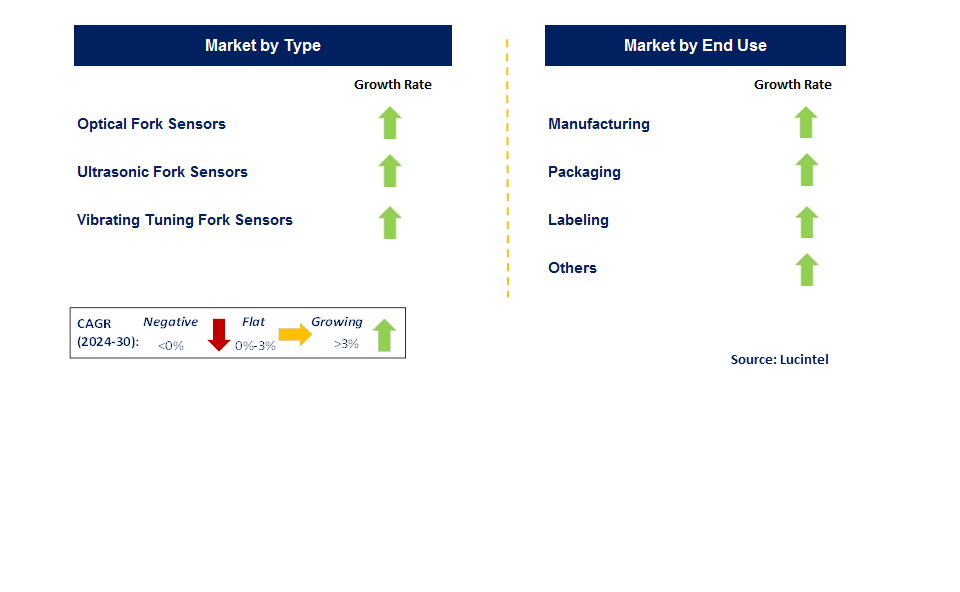
Key data points: The market size in 2030 = $0.7 billion, growth forecast = 8.2% annually next 6 years. Scroll below to get more insights. This market report covers trends, opportunities, and forecast in the global fork sensor market to 2030 by type (optical fork sensors, ultrasonic fork sensors, and vibrating tuning fork sensors), end use (manufacturing, packaging, labeling, and others), and region (North America, Europe, Asia Pacific, and the Rest of the World)
We'll send your sample report shortly.
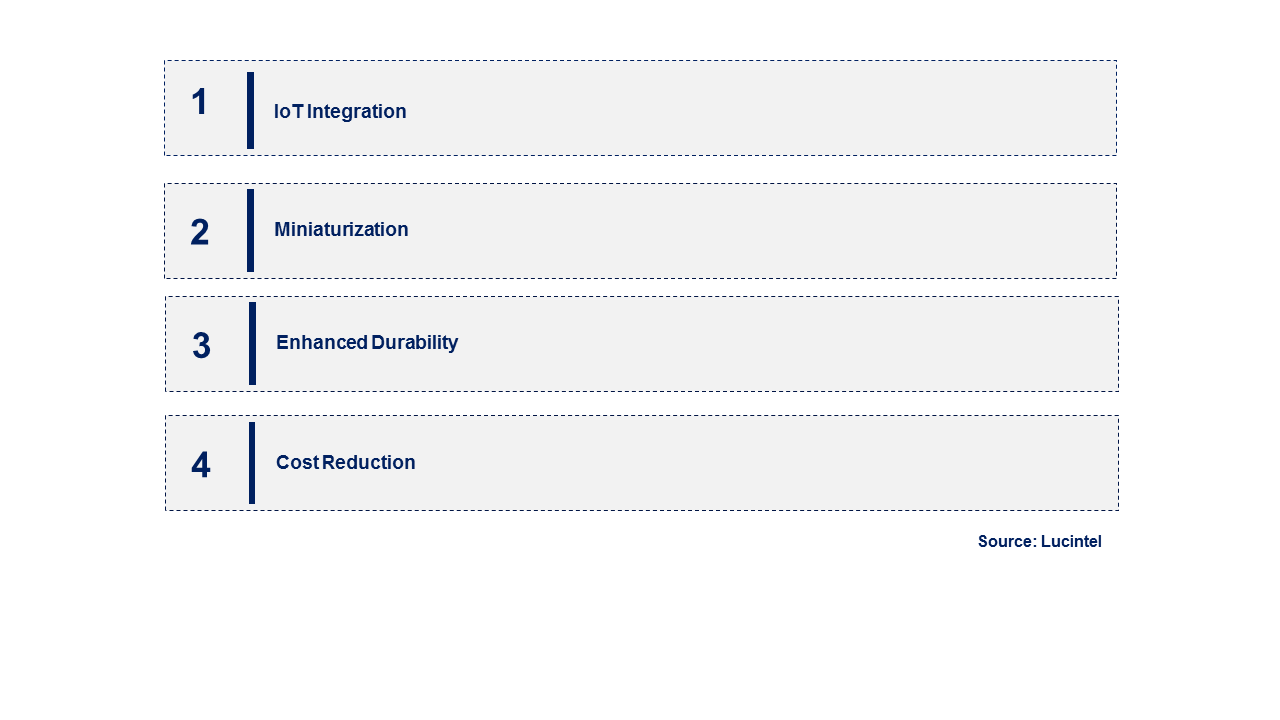
• IoT Integration: This kind of fork sensors make it easy for data transmission and real-time monitoring making it possible to achieve operational efficiency improvements as well as predictive maintenance. This trend leads to an increase in automation hence smarter manufacturing process hence more efficient production with less down time.
• Miniaturization: Advancements in technology have allowed for development of smaller and compact versions of fork sensors. Such a development allows its integration into tight spaces such as smaller machines thus supporting applications within limited space requiring precision.
• Enhanced Durability: New materials and coatings are enhancing durability levels among fork sensors so that they can withstand harsh environments. In particular, an improved resistance to factors like temperature extreme or chemicals extend longevity while decreasing maintenance periods for one’s sensor system.
• Cost Reduction: The cost of fork sensors has been decreasing due to technological advancements and economies of scale. As a result, more affordable sensors have started to reach out industries more widely and this in turn has facilitated higher adoption rates and market expansion. These changes transform the functionality, price and scope of the fork sensor market. They are part of a continuously improving, flexible, cost effective terrain for sensing applications.
• IoT Integration: With time, fork sensors include Internet of Things (IoT) technology allowing real time data collection and remote monitoring. Predictive maintenance is supported through this integration increasing operational efficiency that makes industries perform better hence lowering downtime.
• Advanced Materials: Improved materials have made modern fork sensors last longer and offer higher reliability. Thus new coatings or composites enhance their environmental resistance making it possible for them to be used for a longer period without regular repair or maintenance.
• Enhanced Accuracy: Significant improvements in accuracy have been made in recent times by fork sensors developers. The improved sensitivity and precision are critical for high fidelity measurements required by applications like manufacturing quality control or very detailed inventory management systems.
• Miniaturization: Today’s advances allow production of smaller sizes of fork-based sensors with improved performance characteristics compared with traditional models. They can be built into smaller spaces snugly thus broadening their use into more intricate machines resulting in expanded versatility among them. These developments drive the improvement of functional features, strength and affordability of fork sensors. They are generating the performance benchmarks which are sought after and stimulate growth within a variety of industrial sectors.
• Manufacturing Automation: Precise measurements and real-time feedback that come with fork sensors form an integral part of the automation process used in manufacturing. Improved production lines coupled with better quality control systems through deployment of such types of technologies leads to more automated manufacturing solutions.
• Warehouse Management: In logistics and warehousing, fork sensors play a big role in inventory tracking as well as management. This is because they provide precise data on item locations or potential movements thereby making warehouse operations easier and enhancing supply chain management strategies.
• Packaging Industry: Fork sensors have become very important where packaging is concerned as far as measurement of package size or quality aspects are concerned. This application allows for more autonomic packaging procedures thereby increasing operational efficiency.
• Robotics Integration: For fine detection and measurements needed during tasks being performed by robots; nowadays one can find a wide range of forks-based sensor models being utilized increasingly within robotized areas. Advanced robotic systems support this type of integration thus driving growth in robotics industry while expanding its application dimensions.
• Agriculture Technology: Fork sensors find usage in agriculture for processes like stock taking to equipment condition monitoring etc. Such reliance on smart farming techniques makes it possible for farmers to run efficiently hence raising productivity overall levels within farms at large scale. These growth opportunities are shaping the fork sensor market by expanding its applications and enhancing its value across different industries. They drive innovation and adoption, contributing to the markets overall growth and evolution.
• OMRON
• SICK
• SensoPart
• Waycon
• Telco
• STM Sensors
• Bindicator
• Datalogic
• Leuze Electronic
• Baumer
• Optical Fork Sensors
• Ultrasonic Fork Sensors
• Vibrating Tuning Fork Sensors
• Manufacturing
• Packaging
• Labeling
• Others
• North America
• Europe
• Asia Pacific
• The Rest of the World
• United States: In the US, fork sensors are increasingly integrating advanced IoT capabilities for real-time data monitoring and predictive maintenance purposes. This aligns with broader trends pushing for Industry 4.0 technologies. Besides, manufacturers aim at enhancing sensor accuracy as well as durability aiming at meeting stringent quality standards.
• China: There has been a huge spike in the use of fork sensors within China’s booming manufacturing sector. New developments include improved integration into automated systems as well as increased use of sensors in logistic management and warehouse operations among others. Furthermore, local manufacturers push for cost-effectiveness without compromising on quality.
• Germany: Germany focuses on precision mechanisms when improving fork sensors coupled with energy efficient techniques. The country’s automotive as well as industrial sectors have created demand for high-performance sensors that can be incorporated seamlessly into complex set-ups.Innovations also relate to improved communication interfaces or advanced calibration techniques.
• India: Affordability is a key issue when it comes to making fork sensors accessible by small businesses through production facilities located locally e.g., India. Recent changes revolve around producing or assembling closer to the market which helps in reducing the prices. Additionally, there has been growing demand for sensors that can be used across various industries including manufacturing and agriculture.
• Japan: The Japanese fork sensor market is characterized by cutting-edge developments in miniaturization and high-resolution sensing. Japanese companies are leading in developing sensors with enhanced capabilities for fine-detection tasks, crucial for robotics and high-precision manufacturing processes.


• OMRON
• SICK
• SensoPart
• Waycon
• Telco
• STM Sensors
• Bindicator
• Datalogic
• Leuze Electronic
• Baumer Q6. Which fork sensor market segment will be the largest in future? Answer: Lucintel forecasts that optical fork sensor is expected to witness the highest growth over the forecast period as it ensures high accuracy and precision in detecting objects. Q7. In fork sensor market, which region is expected to be the largest in next 5 years? Answer: Europe is expected to witness highest growth over the forecast period due to high technological advancements and existence of major players. Q.8 Do we receive customization in this report? Answer: Yes, Lucintel provides 10% customization without any additional cost.


Choose a license that fits your team. Instant PDF delivery.
Prices exclude taxes. Instant delivery. Custom licensing available on request.
Market Report · July 15, 2026
Market Report · July 13, 2026
Market Report · July 13, 2026
Trusted partner for strategic intelligence and business growth


Receive a complimentary market analysis tailored to your industry. Our analysts will identify key growth opportunities and competitive dynamics specific to your business.

Market size, growth rate, and key trend analysis for your specific sector.

Top competitor positioning and market share analysis.

Strategic recommendations backed by data-driven insights.
Get curated market intelligence and competitive moves straight to your inbox.
By subscribing, you agree to receive our monthly insights. Unsubscribe anytime.
Receive a complimentary market analysis tailored to your industry. Our analysts will identify key growth opportunities and competitive dynamics specific to your business.
Market size, growth rate, and key trend analysis for your specific sector.
Top competitor positioning and market share analysis.
Strategic recommendations backed by data-driven insights.
Get curated market intelligence, emerging trends, and competitive moves straight to your inbox each month.
By subscribing, you agree to receive our monthly insights. Unsubscribe anytime.
We'll send your sample report shortly.