
Food Service Packaging Market Report: Trends, Forecast and Competitive Analysis to 2035

Key data points: The market size in 2035 = $201.3 billion, growth forecast = 4.3% annually for the next 8 years. Scroll below to get more insights. This market report covers trends, opportunities and forecasts in food service packaging market to 2035 by packaging type (clamshells, cups & tubs, trays & containers, sachets & pouches, and others), application (dairy products, fruits and vegetables, baked goods, and others), end use (quick-service restaurants (QSR), full-service restaurants (FSR), institutional catering, hospitality & cafes, and others), and region (North America, Europe, Asia Pacific, and the Rest of the World)

Publisher: Lucintel Last Updated: July 2026
See Pricing

Download Sample Report

| ✨ New Download Sample report — Get instant insights! | ✨ New Download Sample report — Get instant insights!

Food Service Packaging Market Report: Trends, Forecast and Competitive Analysis to 2035

Food Service Packaging Market

The future of the global food service packaging market looks promising with opportunities in the quick-service restaurant (QSR), full-service restaurant (FSR), institutional catering, and hospitality & cafe markets. The global food service packaging market is expected to reach an estimated $201.3 billion by 2035 with a CAGR of 4.3% from 2026 to 2035. The major drivers for this market are the increasing demand for online food delivery services, the rising demand for eco-friendly & recyclable packaging, and the growing demand for quick service restaurants & cloud kitchens.

  • Lucintel forecasts that, within the packaging type category, clamshell is expected to witness the highest growth over the forecast period due to growing takeaway and delivery services accelerate clamshell usage.
  • Within the end use category, quick-service restaurants are expected to witness the highest growth due to affordable convenience dining, which accelerates quick-service restaurant adoption.
  • In terms of regions, APAC is expected to witness the highest growth over the forecast period due to rising disposable incomes, which increase foodservice packaging consumption.

Gain valuable insights for your business decisions with our comprehensive 150+ page report. Sample figures with some insights are shown below.
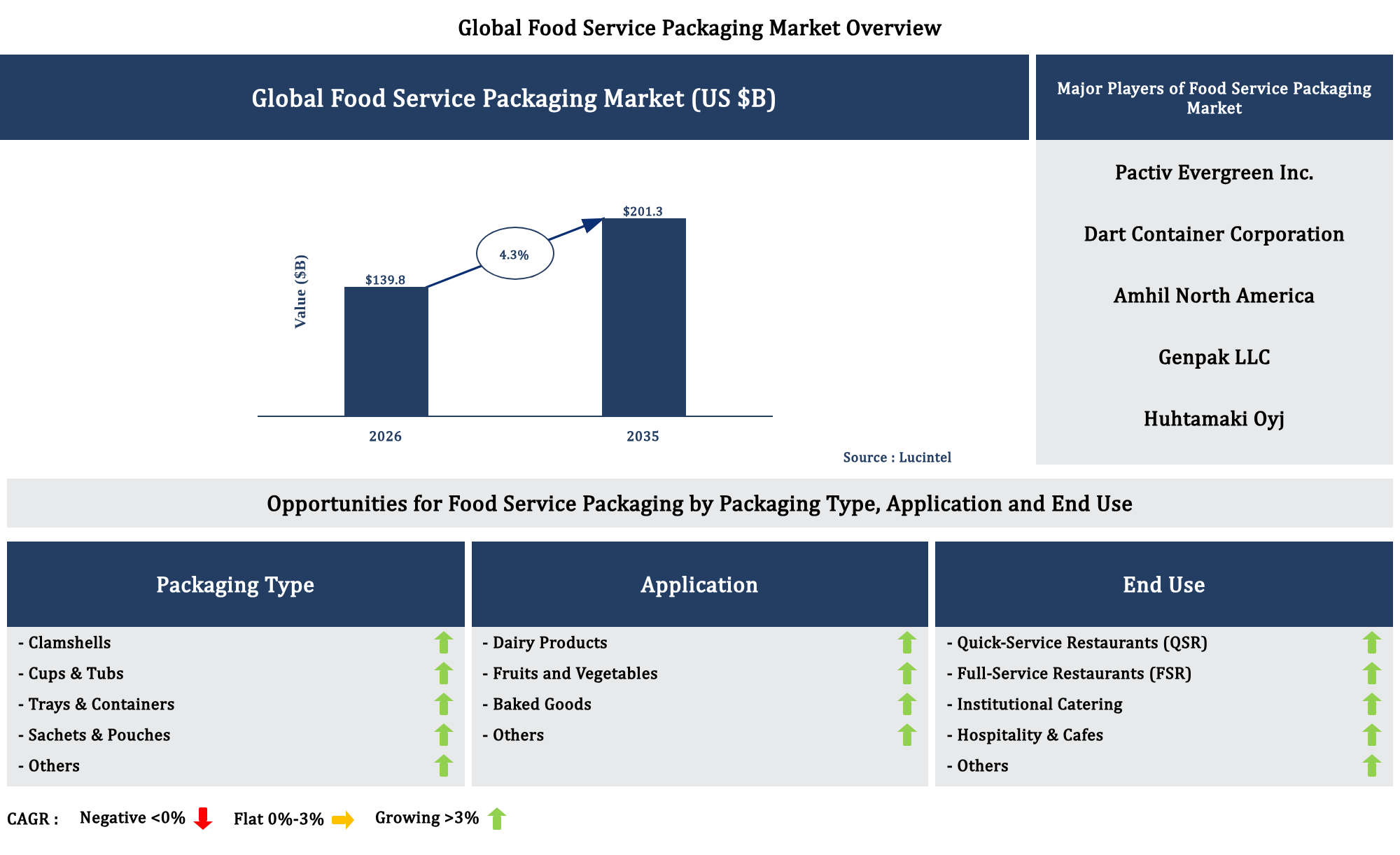
Food Service Packaging Market

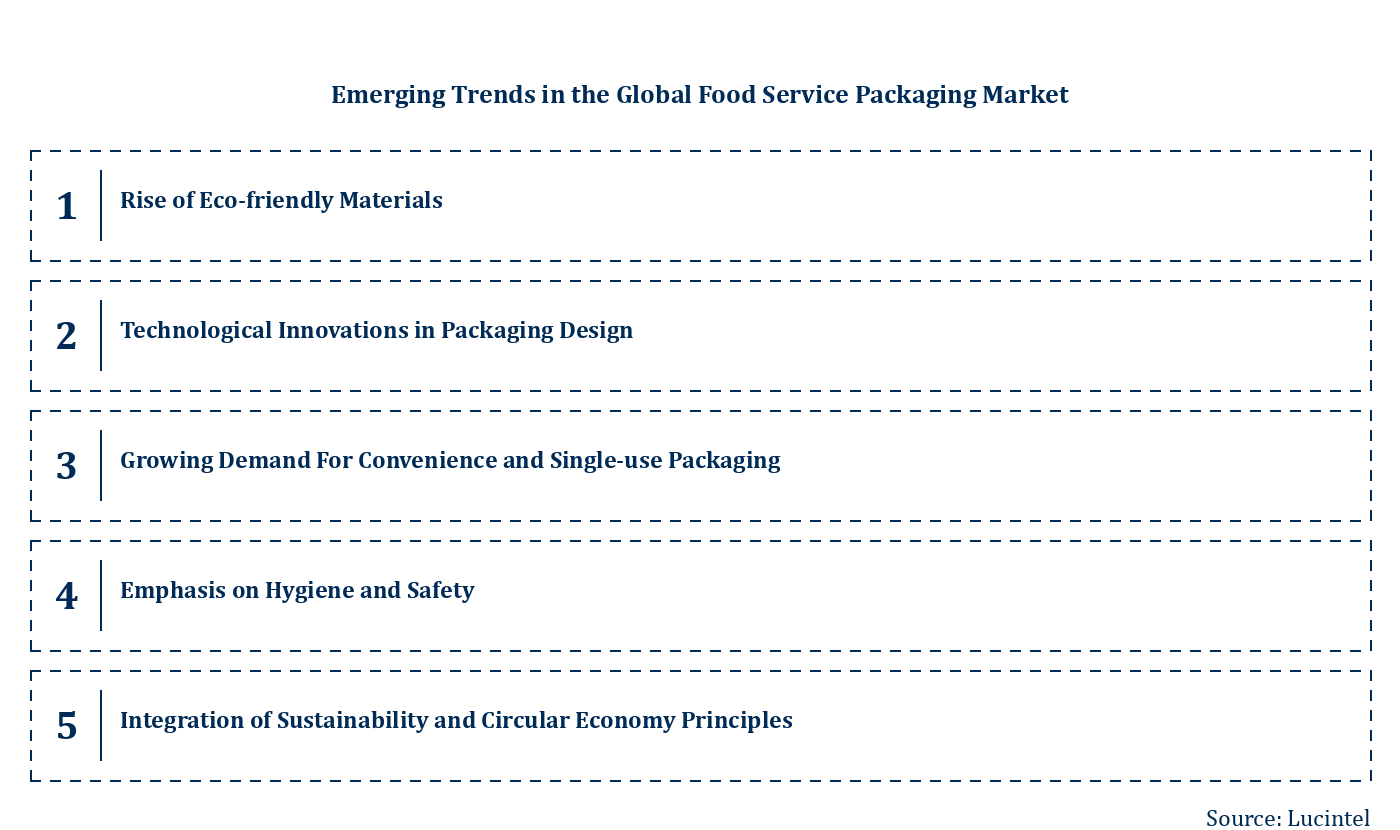
Emerging Trends in the Food Service Packaging Market

The food service packaging market is experiencing rapid evolution driven by changing consumer preferences, technological advancements, and increasing environmental concerns. As the demand for sustainable, convenient, and innovative packaging solutions grows, industry players are adopting new materials, designs, and practices to stay competitive. These developments are not only enhancing customer experience but also addressing regulatory pressures and environmental challenges. The following key trends highlight the transformative shifts shaping this market, reflecting a move towards more sustainable, efficient, and customer-centric packaging solutions that are redefining industry standards and expectations.

  • Rise of Eco-Friendly Materials: The market is increasingly adopting biodegradable, compostable, and recyclable materials to reduce environmental impact. Consumers and regulators are demanding sustainable options, prompting companies to innovate with plant-based plastics, paperboard, and other eco-conscious materials. This shift helps brands improve their sustainability profiles, meet regulatory requirements, and appeal to environmentally conscious consumers, ultimately driving growth in eco-friendly packaging solutions.
  • Technological Innovations in Packaging Design: Advanced manufacturing techniques such as 3D printing, smart packaging, and vacuum sealing are transforming product presentation and preservation. These innovations enhance functionality, extend shelf life, and improve user experience. Smart packaging, with features like QR codes and temperature indicators, also enables better supply chain tracking and consumer engagement, making packaging more interactive and informative, which boosts brand loyalty and reduces waste.
  • Growing Demand for Convenience and Single-Use Packaging: Consumers increasingly prefer portable, easy-to-use packaging that supports on-the-go lifestyles. Single-use containers, portion packs, and resealable options are gaining popularity across foodservice outlets. This trend drives innovation in lightweight, durable, and leak-proof packaging solutions that cater to fast-paced consumer needs while also raising concerns about waste management and environmental impact.
  • Emphasis on Hygiene and Safety: The COVID-19 pandemic accelerated the focus on hygiene in food packaging. Contactless dispensing, tamper-evident seals, and antimicrobial coatings are now standard features. These measures ensure food safety, build consumer trust, and comply with stringent health regulations. The emphasis on hygiene is prompting manufacturers to develop safer, more hygienic packaging options that can withstand rigorous sanitation protocols.
  • Integration of Sustainability and Circular Economy Principles: Companies are adopting circular economy models by designing packaging for reuse, recycling, and minimal waste. Initiatives include take-back programs, refillable containers, and packaging made from recycled materials. This trend aligns with global sustainability goals, reduces environmental footprint, and appeals to eco-conscious consumers, ultimately fostering a more sustainable and resilient food service packaging industry.

These trends are collectively reshaping the food service packaging market by emphasizing sustainability, technological advancement, convenience, safety, and circular economy principles. They are driving innovation, improving consumer experience, and addressing environmental challenges, leading to a more sustainable and competitive industry landscape.
Food Service Packaging Market by country

Recent Developments in the Food Service Packaging Market

The food service packaging market is experiencing rapid growth driven by increasing demand for convenience foods, expanding food delivery services, and rising health and safety standards. Innovations in sustainable materials and customization options are also shaping the industry landscape. As consumers prioritize eco-friendly and innovative packaging solutions, companies are investing heavily in research and development. These developments are creating new opportunities for market expansion, improving product safety, and enhancing consumer experience, ultimately transforming the food service packaging industry into a more sustainable and customer-centric sector.

  • Growing Demand for Eco-Friendly Packaging: The shift towards sustainable materials is driven by environmental concerns and regulatory pressures, leading to increased adoption of biodegradable, compostable, and recyclable packaging options. This trend is encouraging companies to innovate with plant-based plastics and other eco-conscious materials, reducing plastic waste and carbon footprint. The market benefits from enhanced brand reputation and consumer loyalty, while also complying with stricter environmental regulations. Overall, eco-friendly packaging is becoming a key differentiator in the competitive landscape.
  • Expansion of Food Delivery Services: The rise of online food ordering platforms has significantly boosted demand for convenient, durable, and leak-proof packaging solutions. This growth is driven by changing consumer lifestyles, urbanization, and the COVID-19 pandemic, which accelerated food delivery adoption. Companies are developing specialized packaging that maintains food temperature, freshness, and presentation during transit. This trend is creating new revenue streams and market segments, encouraging innovation in materials and design, and fostering partnerships between packaging firms and food delivery providers.
  • Technological Innovations in Packaging: Advances in materials science and manufacturing processes are enabling the development of smarter, more functional packaging solutions. Innovations include antimicrobial coatings, temperature-sensitive indicators, and biodegradable films with enhanced barrier properties. These technologies improve food safety, extend shelf life, and reduce waste. The integration of digital features like QR codes for traceability and consumer engagement is also gaining traction. Such innovations are elevating product value, meeting regulatory standards, and aligning with consumer preferences for safety and sustainability.
  • Customization and Branding Opportunities: Companies are increasingly leveraging packaging as a marketing tool by offering customized designs, logos, and messaging that enhance brand visibility. This trend helps differentiate products in a crowded marketplace and appeals to consumer preferences for personalized experiences. Advanced printing techniques and flexible packaging formats enable brands to create eye-catching, functional, and sustainable packaging solutions. Customization also allows for better portion control and convenience, improving overall customer satisfaction and loyalty, thus driving market growth.
  • Focus on Safety and Hygiene Standards: The pandemic heightened awareness around food safety, prompting companies to adopt advanced packaging solutions that ensure hygiene and prevent contamination. Innovations include tamper-evident seals, antimicrobial coatings, and sealed packaging that extend shelf life and reduce spoilage. Regulatory compliance and consumer trust are driving investments in safer packaging materials and designs. This focus on safety standards is fostering innovation, increasing consumer confidence, and expanding market opportunities for companies that prioritize health and hygiene in their packaging solutions.

The overall impact of these developments is a more sustainable, innovative, and consumer-focused food service packaging market. These opportunities are driving industry growth, enhancing product safety, and fostering brand differentiation, ultimately shaping a resilient and forward-looking industry landscape.

Strategic Growth Opportunities in the Food Service Packaging Market

The food service packaging market is experiencing rapid expansion driven by increasing demand for convenient, sustainable, and innovative packaging solutions. Growth is fueled by rising urbanization, changing consumer preferences, and the need for safety and hygiene in food delivery and takeaway services. Technological advancements and environmental regulations are also shaping market dynamics, creating opportunities for manufacturers to develop eco-friendly and cost-effective packaging options. This evolving landscape offers significant potential for market players to capitalize on emerging trends and expand their footprint globally.

  • Growing Demand for Eco-Friendly Packaging Solutions: Increasing environmental awareness and regulations are pushing food service providers to adopt sustainable packaging options. Biodegradable, compostable, and recyclable materials are gaining popularity, reducing plastic waste and carbon footprint. Companies investing in eco-friendly innovations can meet consumer expectations and comply with regulations, gaining a competitive advantage. This shift also opens opportunities for new product development, partnerships, and market differentiation in a crowded industry.
  • Expansion of Takeout and Delivery Services Driving Packaging Innovation: The surge in food delivery and takeout services has created a need for specialized packaging that maintains food quality, temperature, and safety during transit. Innovations include leak-proof containers, microwave-safe packaging, and portion-controlled options. Companies that develop durable, convenient, and environmentally friendly packaging solutions can capture a larger share of this growing segment. Enhanced packaging also improves customer experience, fostering brand loyalty and repeat business.
  • Adoption of Smart Packaging for Enhanced Food Safety and Traceability: Smart packaging incorporating sensors, QR codes, and RFID technology offers real-time monitoring of food freshness, temperature, and contamination risks. This technology enhances food safety, reduces waste, and improves supply chain transparency. Market players investing in smart packaging can differentiate their offerings, meet regulatory standards, and build consumer trust. The integration of IoT and data analytics further expands opportunities for innovative, value-added packaging solutions.
  • Increasing Focus on Customization and Branding Opportunities: Customizable packaging allows brands to enhance visibility, communicate sustainability efforts, and create a unique consumer experience. Innovative printing techniques, personalized designs, and functional features like resealable closures are gaining traction. This trend enables companies to strengthen brand identity and attract niche markets. Investing in customizable packaging solutions can lead to increased market share, customer engagement, and premium pricing strategies.
  • Rising Demand for Convenience and Single-use Packaging Solutions: Consumers seek easy-to-use, portable, and disposable packaging options for on-the-go consumption. Single-use containers, foldable boxes, and portion packs cater to busy lifestyles and convenience needs. Manufacturers focusing on lightweight, cost-effective, and environmentally responsible single-use packaging can capitalize on this trend. The growth of quick-service restaurants and food trucks further amplifies demand, creating opportunities for innovation and market expansion.

The overall market landscape is poised for significant growth as companies leverage these opportunities to meet evolving consumer needs, enhance sustainability, and incorporate technological advancements, ultimately driving innovation and competitiveness in the food service packaging industry.

Food Service Packaging Market Drivers and Challenges

The food service packaging market is influenced by a variety of technological, economic, and regulatory factors that shape its growth and development. Innovations in packaging materials, sustainability initiatives, and changing consumer preferences are key drivers. Economic factors such as rising disposable incomes and the expansion of the foodservice industry also play significant roles. Additionally, regulatory standards concerning safety, hygiene, and environmental impact market dynamics. These elements collectively create opportunities and challenges that determine the market s trajectory. Understanding these drivers and challenges is essential for stakeholders to navigate the evolving landscape effectively and capitalize on emerging trends.

The factors responsible for driving the food service packaging market include:-

  • Technological Innovations: The development of advanced packaging materials, such as biodegradable plastics and smart packaging, enhances product shelf life, safety, and convenience. These innovations meet consumer demand for sustainable and functional packaging solutions, thereby boosting market growth. Companies investing in R&D to improve packaging durability and eco-friendliness are gaining competitive advantages. The integration of technology also enables better customization and branding, attracting more customers. As consumer awareness about environmental issues increases, the adoption of innovative, eco-friendly packaging solutions is expected to accelerate, further propelling market expansion.
  • Sustainability and Eco-Friendly Trends: Growing environmental concerns and regulatory pressures are driving the shift toward sustainable packaging options. Consumers prefer brands that demonstrate environmental responsibility, prompting companies to adopt biodegradable, recyclable, and compostable materials. Governments are implementing stricter regulations to reduce plastic waste, encouraging the industry to innovate with eco-conscious alternatives. This trend not only reduces environmental impact but also enhances brand reputation and customer loyalty. As sustainability becomes a core business strategy, the market for eco-friendly food service packaging is poised for significant growth, aligning economic benefits with environmental stewardship.
  • Expansion of Foodservice Industry: The global increase in foodservice outlets, including restaurants, cafes, and fast-food chains, directly fuels demand for packaging solutions. Urbanization, changing lifestyles, and a rise in on-the-go consumption contribute to this expansion. The growth of delivery and takeout services further amplifies the need for durable, leak-proof, and convenient packaging. As the foodservice industry continues to evolve, the demand for innovative packaging that ensures food safety, maintains quality, and enhances customer experience will intensify, driving market growth across regions.
  • Rising Disposable Income and Changing Consumer Preferences: Increased disposable incomes, especially in emerging economies, lead to higher spending on dining out and takeaway services. Consumers are seeking convenient, hygienic, and visually appealing packaging options that enhance their dining experience. The demand for premium and customized packaging solutions is also rising, encouraging manufacturers to develop innovative designs and materials. This shift in consumer preferences supports market expansion by creating opportunities for premium product offerings and differentiated packaging solutions that cater to diverse customer needs.
  • Regulatory Frameworks and Standards: Stringent regulations concerning food safety, hygiene, and environmental impact influence packaging material choices and design. Governments worldwide are enforcing standards that require the use of food-grade, non-toxic, and environmentally safe materials. Compliance with these regulations can increase manufacturing costs, but it also drives innovation in safer, sustainable packaging options. Navigating complex regulatory landscapes requires continuous adaptation, but it ultimately promotes higher quality standards and consumer trust, fostering a more resilient and responsible market environment.

The challenges facing the food service packaging market include:-

  • Fluctuating Raw Material Prices: The cost of raw materials such as plastics, paper, and biodegradable materials can be highly volatile due to supply chain disruptions, geopolitical tensions, and environmental regulations. These fluctuations impact manufacturing costs and profit margins, forcing companies to adjust pricing strategies. Additionally, reliance on specific raw materials can lead to supply shortages, delaying production and delivery schedules. Managing these price fluctuations requires strategic sourcing and inventory management, but persistent volatility remains a significant challenge for sustainable growth.
  • Environmental Regulations and Compliance Costs: While regulations promote sustainability, they also impose compliance costs that can be burdensome, especially for small and medium-sized enterprises. Upgrading facilities, adopting new materials, and ensuring adherence to evolving standards require substantial investments. Non-compliance can result in penalties, product recalls, and damage to brand reputation. Balancing regulatory requirements with cost-effective operations is complex, and failure to adapt can hinder market competitiveness. This ongoing regulatory landscape necessitates continuous innovation and resource allocation, posing a significant challenge to market players.
  • Consumer Awareness and Demand for Eco-Friendly Packaging: Although there is a growing preference for sustainable packaging, consumer awareness varies across regions. In some markets, price sensitivity and lack of awareness hinder the adoption of eco-friendly options. Additionally, eco-friendly materials often come with higher costs, which can be passed on to consumers, potentially reducing demand. Educating consumers and shifting preferences toward sustainable options requires strategic marketing and time. Overcoming these barriers is essential for the widespread adoption of environmentally responsible packaging solutions, but it remains a complex challenge.

The food service packaging market is driven by technological advancements, sustainability trends, industry expansion, changing consumer preferences, and regulatory frameworks. However, it faces challenges such as raw material price volatility, compliance costs, and varying consumer awareness. These factors collectively influence market growth, requiring stakeholders to innovate, adapt, and strategize effectively. The interplay of drivers and challenges will shape the future landscape, demanding a balanced approach to capitalize on opportunities while mitigating risks. Overall, the market s evolution hinges on sustainable innovation and regulatory compliance, ensuring long-term resilience and growth.

List of Food Service Packaging Market Companies

Companies in the market compete on the basis of product quality offered. Major players in this market focus on expanding their manufacturing facilities, R&D investments, infrastructural development, and leverage integration opportunities across the value chain. Through these strategies food service packaging market companies cater increasing demand, ensure competitive effectiveness, develop innovative products & technologies, reduce production costs, and expand their customer base. Some of the food service packaging market companies profiled in this report include-

  • Pactiv Evergreen Inc.
  • Dart Container Corporation
  • Amhil North America
  • Genpak LLC
  • Huhtamaki Oyj
  • Novolex Holdings LLC
  • Sabert Corporation
  • Silgan Holdings Inc.
  • B & R Plastics Inc.
  • Graphic Packaging Holding Company

Food Service Packaging Market by Segment

The study includes a forecast for the global food service packaging market by packaging type, application, end use, and region.

  • Food Service Packaging Market by Packaging Type [Value from 2019 to 2035]:
    • Clamshells
    • Cups & Tubs
    • Trays & Containers
    • Sachets & Pouches
    • Others
  • Food Service Packaging Market by Application [Value from 2019 to 2035]:
    • Dairy Products
    • Fruits and Vegetables
    • Baked Goods
    • Others
  • Food Service Packaging Market by End Use [Value from 2019 to 2035]:
    • Quick-Service Restaurants (QSR)
    • Full-Service Restaurants (FSR)
    • Institutional Catering
    • Hospitality & Cafes
    • Others
  • Food Service Packaging Market by Region [Value ($B) from 2019 to 2035]:
    • North America
    • Europe
    • Asia Pacific
    • The Rest of the World

Country Wise Outlook for the Food Service Packaging Market

  • North America
  • Europe
  • Asia Pacific
  • The Rest of the World

Features of the Food Service Packaging Market

  • Market Size Estimates: Food service packaging market size estimation in terms of value ($B).
  • Trend and Forecast Analysis: Market trends (2019 to 2025) and forecast (2026 to 2035) by various segments and regions.
  • Segmentation Analysis: Food service packaging market size by packaging type, application, end use, and region in terms of value ($B).
  • Regional Analysis: Food service packaging market breakdown by North America, Europe, Asia Pacific, and Rest of the World.
  • Growth Opportunities: Analysis of growth opportunities in different packaging types, applications, end uses, and regions for the food service packaging market.
  • Strategic Analysis: This includes M&A, new product development, and competitive landscape of the food service packaging market.
  • Analysis of competitive intensity of the industry based on Porter’s Five Forces model.

Top 5 Companies

  • Pactiv Evergreen Inc.
  • Dart Container Corporation
  • Amhil North America
  • Genpak LLC
  • Huhtamaki Oyj

Table of Contents

1. Executive Summary
14.1 Competitive Analysis Overview

List of Figures

List of Tables

Methodology

Lucintel has been in the business of market research and management consulting since 2000 and has published over 1000 market intelligence reports in various markets / applications and served over 1,000 clients worldwide. This study is a culmination of four months of full-time effort performed by Lucintel's analyst team. The analysts used the following sources for the creation and completion of this valuable report:

  • In-depth interviews of the major players in this market
  • Detailed secondary research from competitors' financial statements and published data
  • Extensive searches of published works, market, and database information pertaining to industry news, company press releases, and customer intentions
  • A compilation of the experiences, judgments, and insights of Lucintel's professionals, who have analyzed and tracked this market over the years.

Extensive research and interviews are conducted across the supply chain of this market to estimate market share, market size, trends, drivers, challenges, and forecasts. Below is a brief summary of the primary interviews that were conducted by job function for this report.

Lucintel's methodology for market research

Thus, Lucintel compiles vast amounts of data from numerous sources, validates the integrity of that data, and performs a comprehensive analysis. Lucintel then organizes the data, its findings, and insights into a concise report designed to support the strategic decision-making process. The figure below is a graphical representation of Lucintel's research process.

Primary interviews by job function

Buy Now

Choose a license that fits your team. Instant PDF delivery.

Market Report

1 User PDF

$4,850
Buy Now

Market Report

2-5 Users PDF

$6,700
Buy Now

Market Report

Corporate PDF

$8,850
Buy Now

Market Report

Global PDF

$10,000
Buy Now

Prices exclude taxes. Instant delivery. Custom licensing available on request.

Frequently Asked Questions

What is the food service packaging market size?
The global food service packaging market is expected to reach an estimated $201.3 billion by 2035.
What is the growth forecast for food service packaging market?
The global food service packaging market is expected to grow with a CAGR of 4.3% from 2026 to 2035.
What are the major drivers influencing the growth of the food service packaging market?
The major drivers for this market are the increasing demand for online food delivery services, the rising demand for eco friendly & recyclable packaging, and the growing demand for quick service restaurants & cloud kitchens.
What are the major segments for food service packaging market?
The future of the food service packaging market looks promising with opportunities in the quick-service restaurant (QSR), full-service restaurant (FSR), institutional catering, and hospitality & cafe markets.
Who are the key food service packaging market companies?

Some of the key food service packaging companies are as follows:

  • Pactiv Evergreen Inc.
  • Dart Container Corporation
  • Amhil North America
  • Genpak LLC
  • Huhtamaki Oyj
  • Novolex Holdings LLC
  • Sabert Corporation
  • Silgan Holdings Inc.
  • B & R Plastics Inc.
  • Graphic Packaging Holding Company
Which food service packaging market segment will be the largest in future?
Lucintel forecasts that, within the packaging type category, clamshell is expected to witness the highest growth over the forecast period.
In food service packaging market, which region is expected to be the largest in next 5 years?
In terms of region, APAC is expected to witness the highest growth over the forecast period.
Do we receive customization in this report?
Yes, Lucintel provides 10% customization without any additional cost.

Key Questions

  • What are some of the most promising, high-growth opportunities for the food service packaging market by packaging type (clamshells, cups & tubs, trays & containers, sachets & pouches, and others), application (dairy products, fruits and vegetables, baked goods, and others), end use (quick-service restaurants (QSR), full-service restaurants (FSR), institutional catering, hospitality & cafes, and others), and region (North America, Europe, Asia Pacific, and the Rest of the World)?
  • Which segments will grow at a faster pace and why?
  • Which region will grow at a faster pace and why?
  • What are the key factors affecting market dynamics? What are the key challenges and business risks in this market?
  • What are the business risks and competitive threats in this market?
  • What are the emerging trends in this market and the reasons behind them?
  • What are some of the changing demands of customers in the market?
  • What are the new developments in the market? Which companies are leading these developments?
  • Who are the major players in this market? What strategic initiatives are key players pursuing for business growth?
  • What are some of the competing products in this market and how big of a threat do they pose for loss of market share by material or product substitution?
  • What M&A activity has occurred in the last 7 years and what has its impact been on the industry?
Why Choose Us

The Lucintel Advantage

Trusted partner for strategic intelligence and business growth

25+ Years Excellence

25+ Years Excellence

Quarter century of proven expertise in management consulting and market research across global markets.
Game-Changer Ideas

Game-Changer Ideas

Innovative strategies and actionable insights that help clients become the smartest in their industry.
Global Reach

Global Reach

Extensive coverage across 50+ industries and markets worldwide with localized expertise.
Start Your Growth Journey

Get Your Free
Market Intelligence
Briefing

Receive a complimentary market analysis tailored to your industry. Our analysts will identify key growth opportunities and competitive dynamics specific to your business.

Custom Market Snapshot

Market size, growth rate, and key trend analysis for your specific sector.

Competitive Landscape Overview

Top competitor positioning and market share analysis.

Growth Opportunity Identification

Strategic recommendations backed by data-driven insights.

Subscribe

Subscribe to our Newsletter

Get curated market intelligence and competitive moves straight to your inbox.

By subscribing, you agree to receive our monthly insights. Unsubscribe anytime.

Industry Trends Market Signals Opportunities Competitor Moves
