
Market Report · July 22, 2026

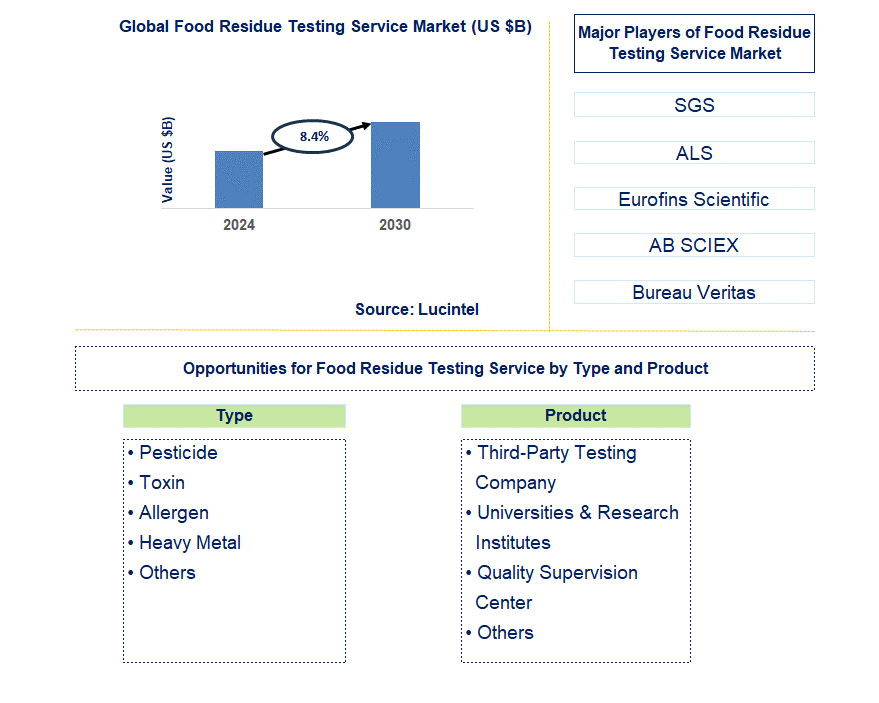
Key data points: The growth forecast = 8.4% annually for the next 6 years. Scroll below to get more insights. This market report covers trends, opportunities, and forecast in the global food residue testing service market to 2030 by type (pesticide, toxin, allergen, heavy metal, and others), product (third-party testing company, universities & research institutes, quality supervision center, and others), and region (North America, Europe, Asia Pacific, and the Rest of the World)
We'll send your sample report shortly.
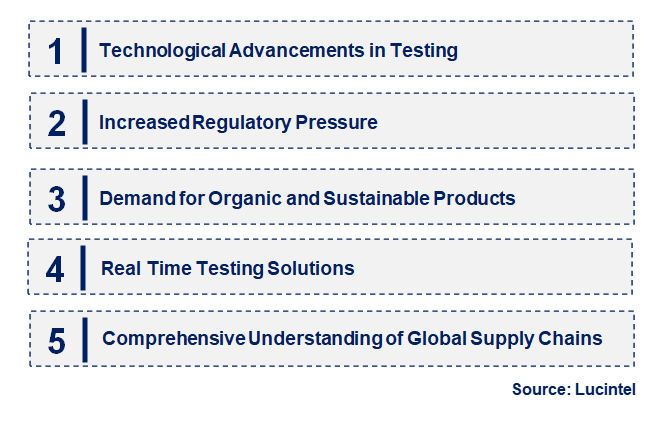
• Technological Advancements in Testing: The implementation of more advanced methods, such as LC-MS and GC-MS, in laboratory operations has enhanced the accuracy and efficiency of detection. These technologies allow for the detection of residues in a single assay, shortening the testing time and providing critical precision needed to meet rigorous compliance guidelines.
• Increased Regulatory Pressure: There is worldwide pressure among national authorities to enhance food safety standards, which has increased the demand for more testing services. Compliance with regulations, including MRL measures within the EU and FDA standards, is necessitating more extensive testing operations across all major regions.
• Demand for Organic and Sustainable Products: The increase in consumption of organic and sustainable foods by consumers has created a larger market for residue testing to ensure these foods are free from harmful chemicals. Testing services are looking to develop these market segments by offering specialized services for organic certification.
• Real-Time Testing Solutions: There is a growing trend towards seeking efficient testing solutions that can be conducted in real time, rather than taking hours or days. Food producers and retailers are adopting sophisticated techniques such as biosensors and rapid test kits to achieve quick turnaround times with minimal risk to safety.
• Comprehensive Understanding of Global Supply Chains: Food supply chains are increasingly globalized, leading to a rise in demand for testing services suitable for the international arena. Testing labs understand that their services must comply with the laws of other countries, hence the need for high-quality testing services. The food residue testing service market is benefiting from these emerging trends, which improve food safety, strengthen technological capabilities, and ensure stricter regulatory compliance. The market is evolving to meet demands for quick turnaround times, enhanced reliability, and standardization of testing products at a global level.
• Implementation of Improved Testing Technologies: High-tech methods such as liquid chromatography-mass spectrometry (LC-MS) and gas chromatography-mass spectrometry (GC-MS) are being adopted more widely, enhancing the speed and accuracy of residue detection. This enables a detailed evaluation of a variety of contaminants that could be present in foodstuffs.
• More Regulatory Measures: The minimum residue limits (MRLs) are undergoing many changes in countries such as China, the EU, and the US, triggered by food safety scandals and heightened consumer demand for safe food. These changes are increasing the need for regular and comprehensive food residue analyses, especially during processing phases.
• The Rise of Organic Food Residue Testing: Shifts in consumption patterns toward organic and sustainable foods have increased the demand for testing services that certify the absence of synthetic substances in these products. Organic food testing is now a distinct market segment.
• The Increase in Food Exports: The expansion of international trade in food products, particularly from India and China, has further fueled the demand for food product residue testing services. Companies are obligated to uphold the quality standards of the nations to which they export their food items, necessitating the use of modern technologies for thorough testing.
• New Demand Side: The increased availability of information about food is empowering consumers to demand that producers provide detailed safety information about their products. Testing services are emerging as part of the supply chain, as companies seek to protect their products and maintain consumer confidence. These dynamics are enhancing the food residue testing service market by improving testing capabilities, receiving government support, and fulfilling the need for safer, more traceable food. Companies that adopt sophisticated testing methods and comply with regulatory requirements will be better positioned to compete in this rapidly evolving market.
• Expansion into Emerging Markets: The rapidly growing economies of India and China are expected to provide more food products to the global market, presenting opportunities for food testing service providers to enter these regions. Adapting services to local markets and upgrading testing facilities to meet international standards will create new revenue streams.
• Organic Food Testing Services: As more consumers embrace organic food, there is a growing market segment for residue testing services that specialize in organic certification compliance. This is an area where companies can provide specialized services.
• Development of Real-Time Testing Kits: The increasing demand for milk and dairy products is expected to drive the market for rapid testing solutions. Investing in biosensors and quick test technologies presents attractive growth opportunities for service providers.
• Third-Party Testing for Global Compliance: The rise in food exports creates opportunities for testing services to offer third-party certification and testing for exported food items. This will aid food safety compliance among producers, helping them access additional markets.
• Integration of AI and Automation: The testing industry is evolving with the introduction of automation and artificial intelligence, leading to more convenient, faster, and reliable results. Companies that automate their testing processes are likely to achieve greater operational efficiency. These strategic growth opportunities highlight the need for strengthening the food residue testing service market through technological advancements, geographic expansion, and specialized areas like organic food testing. Companies that fill these gaps will be better positioned to respond to changing market needs.
• Stringent Regulatory Requirements: Governments worldwide are implementing more regulations to ensure food safety, resulting in increased safety testing for food residues. Companies must comply with these regulations to avoid penalties and market recalls, which enhances market growth.
• Increasing Levels of Consumer Awareness: As consumer interest in food safety practices grows, there is a greater demand for accessible and thorough examinations of food products. This heightened awareness is leading to increased investment in reliable food residue testing services.
• Improvements in Technology: Recent advancements, such as LC-MS and real-time testing kits, have improved the efficacy and accuracy of residue detection. These innovations are enhancing testing capacity and driving market growth.
• Internationalization of Food Supply Chains: The growing complexity of global food supply chains necessitates uniform residue testing services. Food exporters must adhere to international regulations, increasing the demand for reliable testing services.
• Increase in Food Trade: The growth of food exports, particularly from developing nations, is boosting the demand for testing services. There is a need in these countries to meet safety standards set by importing nations, raising the demand for residue testing. Challenges in the food residue testing service market include:
• High Testing Costs: Advanced testing technologies and high-quality equipment can be expensive, posing a challenge for smaller producers. High costs may create barriers to entry, especially in emerging markets.
• Regulatory Complexity: Navigating diverse regulatory jurisdictions requires a thorough understanding of various limits and safety factors, making it challenging for testing laboratories to maintain consistent quality and service.
• Lack of Testing Infrastructure in Developing Regions: Some developing nations lack sophisticated testing mechanisms to ensure food safety, necessitating investments in infrastructure. Regulatory pressure, consumer demand for safe food, and advancements in technology are key drivers of the food residue testing service market. However, challenges such as high testing costs, regulatory complexity, and inadequate infrastructure in emerging regions must be addressed to ensure continued growth. Companies that navigate these challenges while leveraging growth opportunities will remain competitive in this rapidly changing market.
• SGS
• ALS
• Eurofins Scientific
• AB SCIEX
• Bureau Veritas
• Intertek
• Arbro Pharmaceuticals Private
• Fera Science
• AGQ Labs
• Waters Agricultural Laboratories
• Pesticide
• Toxin
• Allergen
• Heavy Metal
• Others
• Third-Party Testing Company
• Universities & Research Institutes
• Quality Supervision Center
• Others
• North America
• Europe
• Asia Pacific
• The Rest of the World
• United States: The growth of food residue testing services in the U.S. is supported by increased scrutiny from regulatory bodies such as the FDA and EPA. Consequently, more advanced analytical techniques, including high-performance liquid chromatography (HPLC) and mass spectrometry, are being used to detect contaminants like pesticides and antibiotics. Heightened consumer awareness is prompting food manufacturers to utilize external testing services to prevent product withdrawals, positively contributing to market expansion.
• China: The food residue testing service market in China is experiencing substantial growth due to the expanding food safety regulations enforced by the AQSIQ. The country is adopting innovative testing methods, including ELISA and LC-MS, to detect pesticide and antibiotic residues. Additionally, food exports are making the market in China more expansive, necessitating compliance with international safety standards and advanced testing.
• Germany: In Germany, the food residue testing service market is influenced by European Union regulations, including high Maximum Residue Limits (MRL). Food safety is a priority for German firms seeking to employ modern technologies such as gas chromatography and high-performance liquid chromatography. The market’s growth in Germany and other EU countries is further driven by increasing consumer demand for thorough residue testing due to heightened awareness and interest in organic and sustainable foods.
• India: The Indian market for food residue testing services continues to expand as the FSSAI and other regulatory bodies implement improved food safety standards. Food testing laboratories are employing sophisticated technologies such as PCR and mass spectrometry to detect pesticide and antibiotic residues. With the escalation of food safety issues linked to rising exports, Indian firms are focusing more on compliance, leading to consistent demand for residue analysis through testing.
• Japan: In Japan, the food residue testing service market is closely tied to overall food safety, governed by the Ministry of Health, Labor and Welfare, which enforces relevant food safety laws and procedures. Japanese laboratories are adopting innovative technologies like gas chromatography-mass spectrometry (GC-MS) to detect pesticide, antibiotic, and heavy metal residues. Changing dietary patterns, extensive foreign markets, and health-conscious consumers are facilitating the growth of high-standard residue testing services across the food industry.


• SGS
• ALS
• Eurofins Scientific
• AB SCIEX
• Bureau Veritas
• Intertek
• Arbro Pharmaceuticals Private
• Fera Science
• AGQ Labs
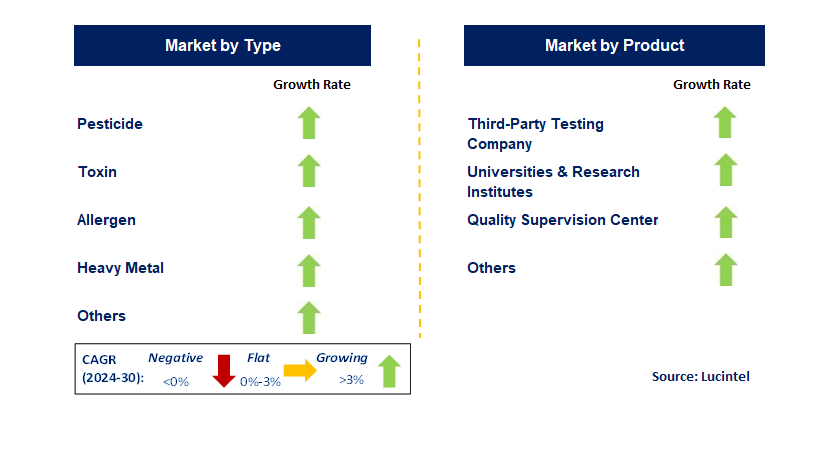
• Waters Agricultural Laboratories Q5. Which food residue testing service market segment will be the largest in the future? Answer: Lucintel forecasts that pesticide is expected to witness the highest growth over the forecast period. Q6. In the food residue testing service market, which region is expected to be the largest in the next 5 years? Answer: North America is expected to witness the highest growth over the forecast period. Q.7 Do we receive customization in this report? Answer: Yes, Lucintel provides 10% customization without any additional cost.


Choose a license that fits your team. Instant PDF delivery.
Prices exclude taxes. Instant delivery. Custom licensing available on request.
Market Report · July 22, 2026
Market Report · July 16, 2026
Market Report · May 18, 2026
Trusted partner for strategic intelligence and business growth


Receive a complimentary market analysis tailored to your industry. Our analysts will identify key growth opportunities and competitive dynamics specific to your business.

Market size, growth rate, and key trend analysis for your specific sector.

Top competitor positioning and market share analysis.

Strategic recommendations backed by data-driven insights.
Get curated market intelligence and competitive moves straight to your inbox.
By subscribing, you agree to receive our monthly insights. Unsubscribe anytime.
Receive a complimentary market analysis tailored to your industry. Our analysts will identify key growth opportunities and competitive dynamics specific to your business.
Market size, growth rate, and key trend analysis for your specific sector.
Top competitor positioning and market share analysis.
Strategic recommendations backed by data-driven insights.
Get curated market intelligence, emerging trends, and competitive moves straight to your inbox each month.
By subscribing, you agree to receive our monthly insights. Unsubscribe anytime.
We'll send your sample report shortly.