
Report Feature
Food Processing and Handling Equipment Market Trends and Forecast
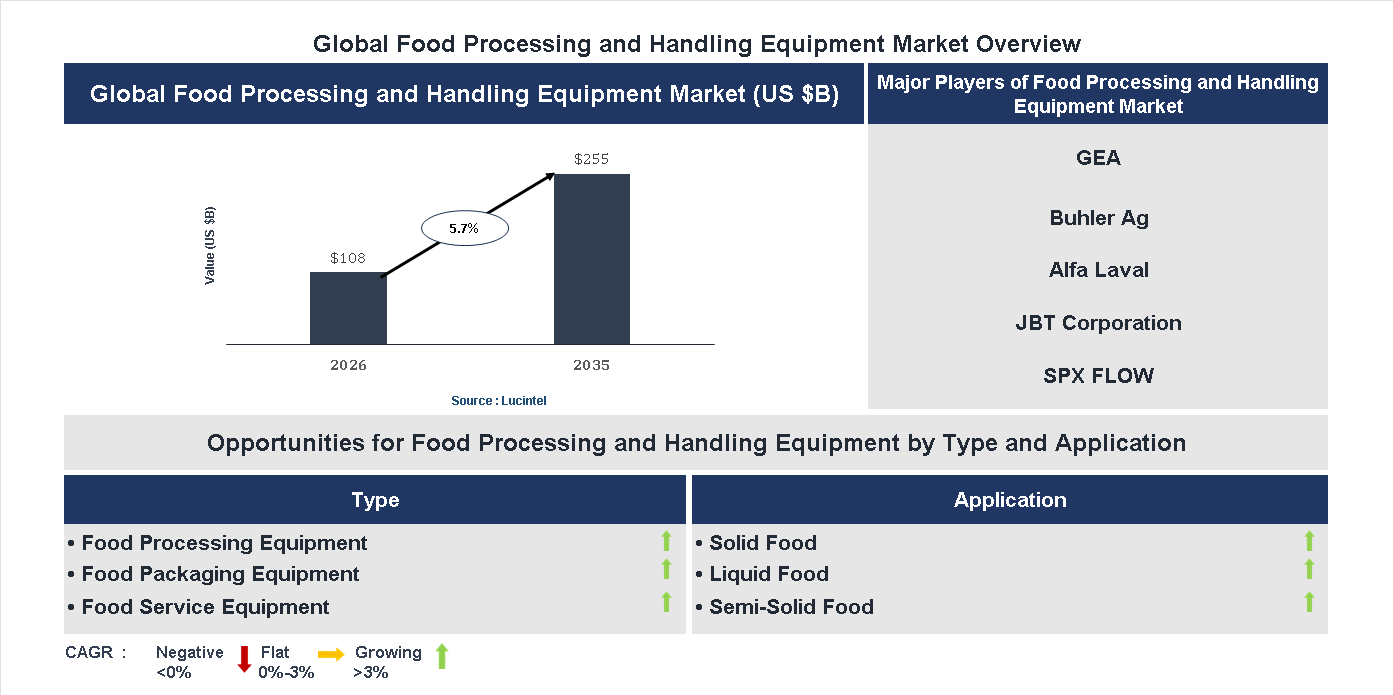
The future of the global food processing and handling equipment market looks promising with opportunities in the solid food, liquid food, and semi-solid food markets. The global food processing and handling equipment market is expected to reach an estimated $255 billion by 2035 with a CAGR of 5.7% from 2026 to 2035. The major drivers for this market are the increasing demand for automated processing solutions, the rising need for food safety standards, and the growing focus on efficiency in production.• Lucintel forecasts that, within the type category, food processing equipment is expected to witness the highest growth over the forecast period.
• Within the application category, liquid food is expected to witness the highest growth.
• In terms of region, APAC is expected to witness the highest growth over the forecast period. Gain valuable insights for your business decisions with our comprehensive 150+ page report. Sample figures with some insights are shown below.
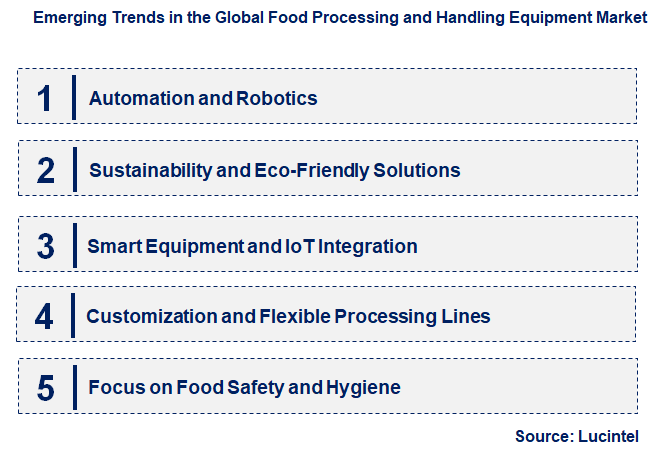
Emerging Trends in the Food Processing and Handling Equipment Market
The food processing and handling equipment market is experiencing rapid evolution driven by technological advancements, changing consumer preferences, and increasing regulatory standards. As the industry adapts to these shifts, new trends are emerging that are transforming how food is processed, packaged, and distributed. These developments are not only enhancing efficiency and safety but also promoting sustainability and innovation within the sector. Companies are investing heavily in research and development to stay competitive and meet the demands of a globalized market. Understanding these key trends is essential for stakeholders aiming to capitalize on growth opportunities and navigate the complexities of this dynamic industry.• Automation and Robotics: The integration of automation and robotics in food processing enhances efficiency, reduces labor costs, and improves product consistency. Automated systems handle tasks such as sorting, packaging, and quality control, minimizing human error and increasing throughput. Robotics also enables processing in hazardous environments, ensuring worker safety. This trend accelerates production cycles and allows for 24/7 operations, meeting rising demand while maintaining high standards of hygiene and precision. As technology advances, the adoption of AI-powered robots is expected to further optimize operations and reduce operational costs.
• Sustainability and Eco-Friendly Solutions: Growing environmental concerns are prompting the industry to adopt sustainable practices. This includes the use of energy-efficient machinery, waste reduction techniques, and eco-friendly packaging materials. Companies are investing in technologies that minimize water and energy consumption, reduce carbon footprints, and promote recycling. These initiatives not only align with regulatory requirements but also appeal to environmentally conscious consumers. Sustainable equipment design is becoming a key differentiator, helping companies improve their brand image and meet corporate social responsibility goals while reducing operational costs.
• Smart Equipment and IoT Integration: The incorporation of Internet of Things (IoT) technology into food processing equipment is revolutionizing operational management. Smart sensors and connected devices enable real-time monitoring of equipment performance, predictive maintenance, and quality assurance. This integration reduces downtime, prevents equipment failure, and ensures consistent product quality. Data collected from IoT devices helps optimize processes, improve traceability, and facilitate compliance with safety standards. As IoT adoption grows, the industry is moving toward more intelligent, data-driven operations that enhance productivity and reduce waste.
• Customization and Flexible Processing Lines: Consumer demand for personalized and diverse food products is driving the need for flexible processing equipment. Modular and adaptable machinery allows manufacturers to quickly switch between product types, sizes, and packaging formats. This flexibility reduces downtime and increases responsiveness to market trends. Customization also extends to processing parameters, enabling precise control over product characteristics. The trend supports small-batch production and artisanal foods, catering to niche markets. As a result, companies can better meet customer preferences and reduce inventory costs, fostering innovation and competitiveness.
• Focus on Food Safety and Hygiene: Stringent safety regulations and consumer awareness are emphasizing the importance of hygiene in food processing. Advanced cleaning-in-place (CIP) systems, antimicrobial surfaces, and sealed equipment designs are becoming standard. These innovations help prevent contamination, ensure compliance with safety standards, and extend shelf life. Enhanced monitoring systems track hygiene practices and detect potential hazards early. The emphasis on safety and hygiene not only protects consumers but also reduces recalls and legal liabilities for manufacturers. This trend underscores the critical role of technological innovation in safeguarding public health and maintaining market trust. These emerging trends, automation, sustainability, IoT integration, equipment flexibility, and enhanced safety, are collectively reshaping the food processing and handling equipment market. They are driving increased efficiency, safety, and customization, while also promoting environmentally responsible practices. As these trends continue to evolve, they will enable industry players to meet the growing demands of consumers and regulators, fostering innovation and sustainable growth in the sector.
Recent Development in the Food Processing and Handling Equipment Market
The food processing and handling equipment market is experiencing rapid growth driven by technological advancements, increasing demand for processed foods, and expanding foodservice industries worldwide. Innovations in automation, sustainability initiatives, and rising consumer preferences for convenience foods are shaping the market landscape. These developments are creating new opportunities for manufacturers and suppliers, fostering market expansion across regions. As the industry adapts to changing consumer needs and regulatory standards, understanding these key growth areas is essential for stakeholders aiming to capitalize on emerging trends.• Automation and Robotics in Food Processing: Enhancing Efficiency and Safety: Automation and robotics are revolutionizing food processing by increasing production speed, reducing labor costs, and improving safety standards. Advanced machinery enables precise handling, consistent quality, and reduced contamination risks. This shift not only boosts productivity but also aligns with stringent hygiene regulations. Companies adopting automation are gaining competitive advantages, meeting rising demand for large-scale, efficient processing solutions, and ensuring compliance with food safety standards. The integration of AI and IoT further optimizes operations, making processes smarter and more responsive.
• Sustainability Initiatives Drive Equipment Innovation: Sustainability is a key focus, prompting the development of eco-friendly processing and handling equipment. Innovations include energy-efficient machines, water-saving technologies, and waste reduction systems. These advancements help companies reduce their carbon footprint and comply with environmental regulations. The market benefits from increased demand for sustainable solutions, attracting environmentally conscious clients. Equipment manufacturers are investing in green technologies, which not only improve operational efficiency but also enhance brand reputation and meet consumer expectations for responsible production practices.
• Growing Demand for Processed and Convenience Foods: The rising consumer preference for ready-to-eat and convenience foods is fueling the need for specialized processing equipment. This trend is driven by busy lifestyles and urbanization, prompting manufacturers to develop faster, more efficient processing lines. Equipment that ensures longer shelf life, preserves nutritional value, and maintains product quality is in high demand. This growth creates opportunities for innovation in packaging, preservation, and processing technologies, enabling companies to meet market needs while expanding their product portfolios.
• Technological Advancements in Food Safety and Quality Control: Cutting-edge technologies such as sensors, machine vision, and real-time monitoring are transforming quality control in food processing. These innovations enable early detection of contaminants, precise measurement, and consistent product quality. Enhanced safety protocols reduce recalls and ensure compliance with international standards. The adoption of these technologies improves consumer trust, minimizes waste, and streamlines regulatory adherence. As safety concerns grow, the market sees increased investment in advanced inspection and testing equipment, fostering safer food production environments.
• Expansion of Food Processing Equipment in Emerging Markets: Emerging markets present significant growth opportunities due to rising disposable incomes, urbanization, and expanding food industries. Investment in modern processing and handling equipment is accelerating, driven by infrastructure development and government initiatives. This expansion helps improve food quality, safety, and shelf life, supporting local food industries and exports. Market players are focusing on affordable, scalable solutions tailored to these regions’ needs. The growth in emerging markets is expected to substantially increase global demand for food processing and handling equipment. These developments are significantly transforming the food processing and handling equipment market by enhancing efficiency, sustainability, safety, and accessibility. Automation and technological innovations are streamlining operations, while sustainability efforts align industry practices with environmental standards. Growing demand for processed foods and expansion into emerging markets are broadening the market scope. Collectively, these trends are fostering a dynamic, resilient industry poised for sustained growth, offering numerous opportunities for stakeholders to innovate and expand their market presence.
Strategic Growth Opportunities in the Food Processing and Handling Equipment Market
The food processing and handling equipment market is experiencing rapid expansion driven by increasing demand for processed foods, technological advancements, and evolving consumer preferences. Innovations in automation, sustainability initiatives, and expanding applications across various food sectors are creating significant growth opportunities. Companies are investing heavily in R&D to develop efficient, cost-effective, and eco-friendly equipment. This dynamic environment offers numerous avenues for market players to capitalize on emerging trends, improve operational efficiencies, and meet the rising global demand for safe, high-quality food products.• Growing Demand for Automation in Food Processing Equipment: Automation enhances efficiency, reduces labor costs, and improves product consistency. The adoption of robotic systems and smart machinery is increasing across food manufacturing plants, enabling faster production cycles and better quality control. This trend is driven by the need for higher productivity, safety standards, and compliance with stringent regulations. As automation technology becomes more affordable and sophisticated, market growth is expected to accelerate, especially in large-scale processing facilities.
• Increasing Focus on Sustainability and Eco-Friendly Equipment: Sustainability initiatives are prompting manufacturers to develop energy-efficient, water-saving, and environmentally friendly processing solutions. Equipment that minimizes waste, reduces carbon footprint, and utilizes renewable energy sources is gaining popularity. Governments and consumers are demanding greener practices, encouraging companies to innovate in eco-conscious machinery. This shift not only supports environmental goals but also offers cost savings, making sustainable equipment a key growth driver in the market.
• Expansion of Food Processing Equipment in Emerging Markets: Rapid urbanization, rising disposable incomes, and changing dietary habits are fueling demand for processed foods in emerging economies. Local food industries are investing in modern processing and handling equipment to meet quality standards and expand product offerings. This growth is supported by favorable government policies, infrastructure development, and increasing foreign direct investment. As a result, emerging markets present substantial opportunities for equipment manufacturers to establish a strong presence and capture new customer segments.
• Technological Innovations in Food Safety and Quality Control: Advanced sensors, IoT integration, and real-time monitoring systems are transforming food safety protocols. Equipment with enhanced detection capabilities helps prevent contamination, ensure compliance, and improve traceability. These innovations are critical amid increasing regulatory scrutiny and consumer awareness. Companies investing in such technologies can differentiate their offerings, reduce recalls, and build trust. The ongoing development of smart, connected machinery is expected to significantly impact the market by elevating safety standards and operational efficiency.
• Rising Adoption of Modular and Customizable Equipment Solutions: Modular systems offer flexibility, scalability, and ease of maintenance, appealing to diverse processing needs. Customizable equipment allows manufacturers to tailor solutions to specific product requirements, improving efficiency and reducing downtime. This trend supports small and medium-sized enterprises seeking adaptable and cost-effective options. As food processing operations become more complex, the demand for versatile, modular machinery is expected to grow, enabling companies to optimize production lines and respond swiftly to market changes. These growth opportunities are poised to significantly influence the food processing and handling equipment market by fostering innovation, expanding geographic reach, and enhancing operational efficiencies. Embracing automation, sustainability, technological advancements, and customization will enable industry players to meet evolving consumer demands and regulatory standards. Overall, these trends will drive market expansion, improve product quality, and support sustainable growth in the global food processing sector.
Food Processing and Handling Equipment Market Driver and Challenges
The food processing and handling equipment market is influenced by a variety of technological, economic, and regulatory factors. Rapid advancements in automation and smart technology are transforming processing lines, increasing efficiency and safety. Economic factors such as rising consumer demand for processed foods and expanding foodservice industries drive market growth. Regulatory standards related to food safety and hygiene compel manufacturers to innovate and upgrade equipment. Additionally, sustainability concerns and environmental regulations are shaping product development and operational practices. These drivers and challenges collectively impact market dynamics, influencing investment, innovation, and competitive strategies within the industry. The factors responsible for driving the food processing and handling equipment market include:• Technological Innovation: The integration of automation, robotics, and IoT in food processing equipment enhances efficiency, reduces labor costs, and improves product quality. Advanced sensors and data analytics enable real-time monitoring and predictive maintenance, minimizing downtime. These innovations meet increasing consumer demand for safe, high-quality, and consistent food products. As technology becomes more affordable and accessible, manufacturers are adopting smarter equipment, which accelerates market growth and encourages new product development.
• Rising Consumer Demand for Processed Foods: Changing lifestyles, urbanization, and busy schedules have led to increased consumption of packaged and convenience foods. This surge boosts demand for efficient processing and handling equipment capable of producing large volumes quickly while maintaining safety standards. The growing preference for ready-to-eat meals and health-conscious products further fuels innovation in equipment that caters to specific dietary needs, expanding market opportunities across regions.
• Expansion of Foodservice Industry: The global foodservice sector, including restaurants, catering, and institutional food providers, is experiencing rapid growth. This expansion necessitates high-capacity, versatile processing and handling equipment to meet diverse operational requirements. Equipment that ensures quick turnaround, hygiene, and compliance with safety standards is in high demand. The rise in fast-food chains and institutional catering services directly contributes to increased sales of specialized food processing machinery, supporting market expansion.
• Regulatory and Food Safety Standards: Stringent government regulations and international food safety standards compel manufacturers to develop compliant equipment. These standards demand features such as easy cleaning, contamination prevention, and traceability. Compliance drives innovation in design and materials, often increasing equipment costs but ensuring safer food processing environments. The evolving regulatory landscape encourages continuous technological upgrades, fostering a competitive environment focused on safety and quality.
• Growing Focus on Sustainability: Environmental concerns and sustainability initiatives influence equipment design and operational practices. Manufacturers are developing energy-efficient, water-saving, and eco-friendly machinery to reduce environmental impact. Adoption of sustainable practices not only aligns with regulatory requirements but also appeals to environmentally conscious consumers. This focus on sustainability drives innovation in equipment materials, energy management systems, and waste reduction technologies, shaping the future landscape of the market. The challenges facing the food processing and handling equipment market include:
• High Capital Investment: The adoption of advanced processing and handling equipment requires significant capital expenditure, which can be a barrier for small and medium-sized enterprises. The costs associated with purchasing, installing, and maintaining sophisticated machinery can limit market entry and expansion, especially in developing regions. Additionally, rapid technological changes may lead to frequent upgrades, further increasing financial burdens and impacting profitability.
• Rapid Technological Changes: The fast pace of technological innovation can pose challenges for manufacturers and users alike. Keeping up with the latest advancements requires continuous investment in R&D and staff training. Older equipment may become obsolete quickly, leading to increased costs for upgrades or replacements. This rapid evolution can also create compatibility issues, complicating integration with existing systems and hindering seamless operations.
• Stringent Regulatory Environment: While regulations aim to ensure food safety, they can also impose complex compliance requirements that vary across regions. Navigating these diverse standards demands significant resources and expertise, potentially delaying product launches and increasing costs. Non-compliance risks include legal penalties, product recalls, and damage to brand reputation, making regulatory adherence a critical but challenging aspect of market operations. The food processing and handling equipment market is shaped by technological advancements, rising consumer demand, industry expansion, regulatory standards, and sustainability initiatives. However, high investment costs, rapid technological changes, and complex regulatory environments pose significant challenges. These factors collectively influence market growth, innovation, and competitiveness. Companies that effectively navigate these drivers and challenges can capitalize on emerging opportunities, ensuring sustainable growth and a strong market presence in the evolving landscape.
List of Food Processing and Handling Equipment Companies
Companies in the market compete on the basis of product quality offered. Major players in this market focus on expanding their manufacturing facilities, R&D investments, infrastructural development, and leverage integration opportunities across the value chain. With these strategies food processing and handling equipment companies cater increasing demand, ensure competitive effectiveness, develop innovative products & technologies, reduce production costs, and expand their customer base. Some of the food processing and handling equipment companies profiled in this report include-• GEA
• Buhler Ag
• Alfa Laval
• JBT Corporation
• SPX FLOW
• Robert Bosch
• IMA Group
• Middleby Corporation
• Dover Corporation
• Tetra Laval
Food Processing and Handling Equipment Market by Segment
The study includes a forecast for the global food processing and handling equipment market by type, application, and region.Food Processing and Handling Equipment Market by Type [Value from 2019 to 2035]:
• Food Processing Equipment
• Food Packaging Equipment
• Food Service Equipment
Food Processing and Handling Equipment Market by Application [Value from 2019 to 2035]:
• Solid Food
• Liquid Food
• Semi-Solid Food
Food Processing and Handling Equipment Market by Region [Value from 2019 to 2035]:
• North America
• Europe
• Asia Pacific
• The Rest of the World
Country Wise Outlook for the Food Processing and Handling Equipment Market
The food processing and handling equipment market has experienced significant growth driven by technological innovations, increasing demand for processed foods, and evolving consumer preferences worldwide. Countries are investing in advanced machinery to improve efficiency, safety, and sustainability. The markets expansion is also influenced by regulatory changes and the rising focus on food safety standards. As global supply chains become more complex, countries are adopting smarter, more automated solutions to meet the demands of a growing population and changing dietary habits. This dynamic landscape reflects a blend of technological progress and strategic investments across key regions.• United States: The U.S. market has seen rapid adoption of automation and smart technology in food processing equipment, driven by the need for efficiency and safety. Innovations in robotics and IoT integration are enhancing production lines. The focus on sustainable and energy-efficient machinery is increasing, supported by strict food safety regulations. The rise of plant-based foods has also spurred demand for specialized processing equipment. Additionally, mergers and acquisitions are consolidating market players, fostering innovation, and expanding product portfolios.
• China: China’s food processing equipment market is expanding due to rising urbanization and changing consumer preferences for packaged and processed foods. The government’s support for food safety standards and modernization initiatives is boosting demand for advanced machinery. Local manufacturers are investing in R&D to develop innovative, cost-effective solutions. The growth of e-commerce and retail sectors is also driving the need for efficient handling and processing equipment. Moreover, China is increasingly adopting automation to improve productivity and meet international quality standards.
• Germany: Germany remains a leader in high-quality, technologically advanced food processing equipment within Europe. The focus is on precision engineering, energy efficiency, and sustainability. German companies are innovating in automation, robotics, and hygienic design to meet stringent EU regulations. The market is also witnessing a shift towards flexible, modular equipment to accommodate diverse product lines. The emphasis on organic and health-conscious foods is influencing equipment design, with a focus on preserving nutritional value and reducing waste. Exporting to global markets remains a key growth driver for German manufacturers.
• India: The Indian food processing equipment market is experiencing rapid growth due to increasing urbanization, rising disposable incomes, and government initiatives like the Make in India campaign. There is a rising demand for processed foods, snacks, and beverages, prompting investments in modern machinery. Small and medium enterprises are adopting automated solutions to improve productivity. The government’s focus on infrastructure development and food safety standards is further boosting the market. Additionally, local manufacturers are expanding their product offerings to cater to diverse regional cuisines and export markets, fostering innovation and competitiveness.
• Japan: Japan’s market is characterized by advanced technology adoption, with a focus on automation, robotics, and energy efficiency. The country’s aging population is driving demand for highly automated and user-friendly equipment. Innovations in hygienic design and food safety are prominent, aligning with strict domestic regulations. Japan is also investing in sustainable solutions, such as energy-saving machinery and waste reduction systems. The market is witnessing a shift towards multifunctional equipment capable of handling a variety of food products. Collaboration between technology firms and food manufacturers is fostering cutting-edge developments in processing and handling equipment.

Features of the Global Food Processing and Handling Equipment Market
Market Size Estimates: Food processing and handling equipment market size estimation in terms of value ($B). Trend and Forecast Analysis: Market trends (2019 to 2025) and forecast (2026 to 2035) by various segments and regions. Segmentation Analysis: Food processing and handling equipment market size by type, application, and region in terms of value ($B). Regional Analysis: Food processing and handling equipment market breakdown by North America, Europe, Asia Pacific, and Rest of the World. Growth Opportunities: Analysis of growth opportunities in different types, applications, and regions for the food processing and handling equipment market. Strategic Analysis: This includes M&A, new product development, and competitive landscape of the food processing and handling equipment market. Analysis of competitive intensity of the industry based on Porter’s Five Forces model.
FAQ
Q1. What is the food processing and handling equipment market size? Answer: The global food processing and handling equipment market is expected to reach an estimated $255 billion by 2035. Q2. What is the growth forecast for food processing and handling equipment market? Answer: The global food processing and handling equipment market is expected to grow with a CAGR of 5.7% from 2026 to 2035. Q3. What are the major drivers influencing the growth of the food processing and handling equipment market? Answer: The major drivers for this market are the increasing demand for automated processing solutions, the rising need for food safety standards, and the growing focus on efficiency in production. Q4. What are the major segments for food processing and handling equipment market? Answer: The future of the food processing and handling equipment market looks promising with opportunities in the solid food, liquid food, and semi-solid food markets. Q5. Who are the key food processing and handling equipment market companies? Answer: Some of the key food processing and handling equipment companies are as follows:• GEA
• Buhler Ag
• Alfa Laval
• JBT Corporation
• SPX FLOW
• Robert Bosch
• IMA Group
• Middleby Corporation
• Dover Corporation
• Tetra Laval Q6. Which food processing and handling equipment market segment will be the largest in future? Answer: Lucintel forecasts that, within the type category, food processing equipment is expected to witness the highest growth over the forecast period. Q7. In food processing and handling equipment market, which region is expected to be the largest in next 8 years? Answer: In terms of region, APAC is expected to witness the highest growth over the forecast period. Q8. Do we receive customization in this report? Answer: Yes, Lucintel provides 10% customization without any additional cost.
Table of Contents
List of Figures
List of Tables
Methodology
- In-depth interviews of the major players in this market
- Detailed secondary research from competitors’ financial statements and published data
- Extensive searches of published works, market, and database information pertaining to industry news, company press releases, and customer intentions
- A compilation of the experiences, judgments, and insights of Lucintel’s professionals, who have analyzed and tracked this market over the years.


Buy Now
Choose a license that fits your team. Instant PDF delivery.
Prices exclude taxes. Instant delivery. Custom licensing available on request.
Key Questions
- • What are some of the most promising, high-growth opportunities for the food processing and handling equipment market by type (food processing equipment, food packaging equipment, and food service equipment), application (solid food, liquid food, and semi-solid food), and region (North America, Europe, Asia Pacific, and the Rest of the World)?
- • Which segments will grow at a faster pace and why?
- • Which region will grow at a faster pace and why?
- • What are the key factors affecting market dynamics? What are the key challenges and business risks in this market?
- • What are the business risks and competitive threats in this market?
- • What are the emerging trends in this market and the reasons behind them?
- • What are some of the changing demands of customers in the market?
- • What are the new developments in the market? Which companies are leading these developments?
- • Who are the major players in this market? What strategic initiatives are key players pursuing for business growth?
- • What are some of the competing products in this market and how big of a threat do they pose for loss of market share by material or product substitution?
- • What M&A activity has occurred in the last 7 years and what has its impact been on the industry? For any questions related to Food Processing and Handling Equipment Market, Food Processing and Handling Equipment Market Size, Food Processing and Handling Equipment Market Growth, Food Processing and Handling Equipment Market Analysis, Food Processing and Handling Equipment Market Report, Food Processing and Handling Equipment Market Share, Food Processing and Handling Equipment Market Trends, Food Processing and Handling Equipment Market Forecast, Food Processing and Handling Equipment Companies, write Lucintel analyst at email: helpdesk@lucintel.com. We will be glad to get back to you soon.


