
'
...

The Impact of COVID-19 is included in Food Intolerance Product Market Report. Buy it today to get an advantage.

Request the impact of COVID-19 on your product or industry


Food Intolerance Product Market Trends and Forecast

The future of the global food intolerance product market looks promising with opportunities in the supermarket & hypermarket, convenience store, and online store markets. The global food intolerance product market is expected to reach an estimated $17.7 billion by 2035 with a CAGR of 4.4% from 2026 to 2035. The major drivers for this market are the increasing preference for digestive health solutions, the rising demand for allergen free foods, and the growing adoption of personalized diet choices.

• Lucintel forecasts that, within the type category, bakery product is expected to witness the highest growth over the forecast period.
• Within the distribution channel category, supermarket & hypermarket is expected to witness the highest growth.
• In terms of region, APAC is expected to witness the highest growth over the forecast period.
Gain valuable insights for your business decisions with our comprehensive 150+ page report. Sample figures with some insights are shown below.
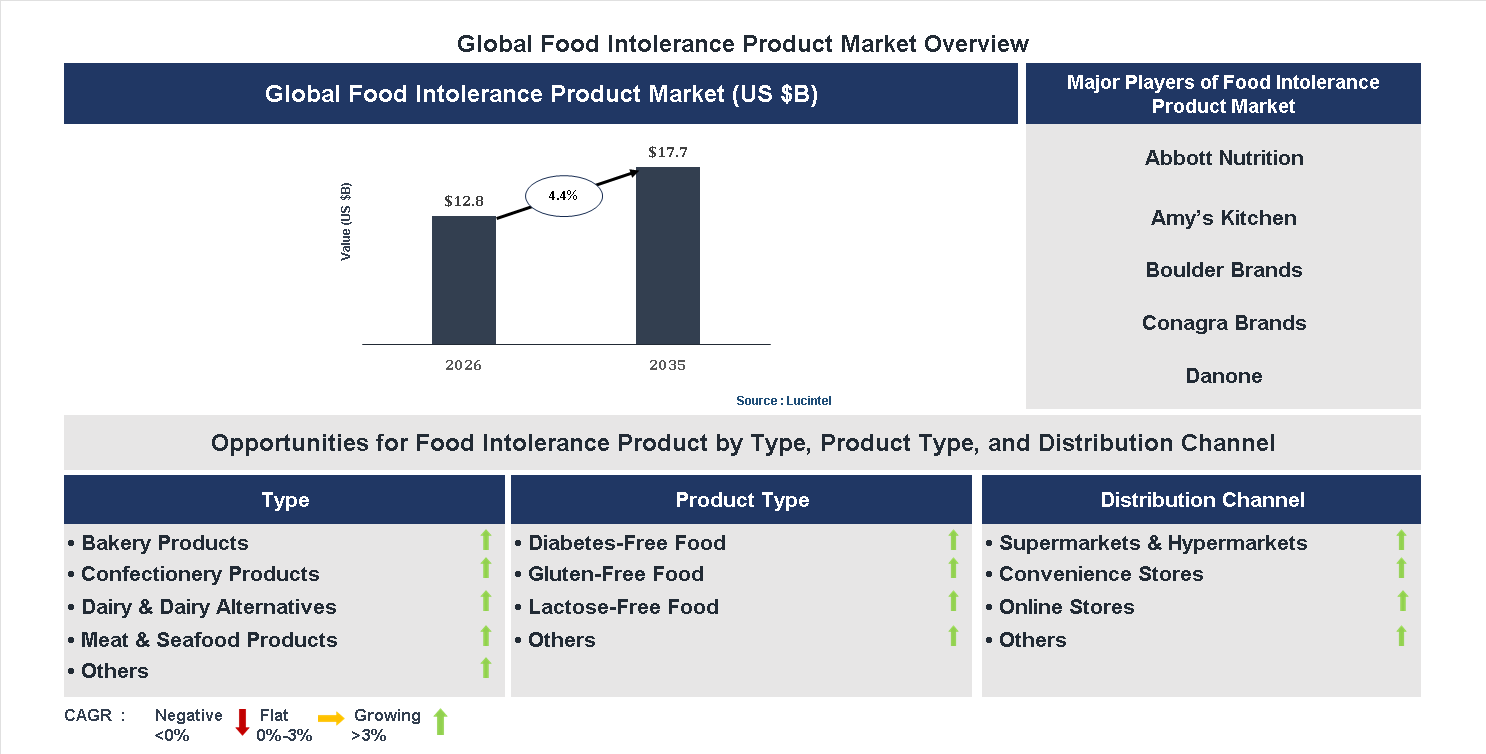
Food Intolerance Product Market Trends and Forecast

Emerging Trends in the Food Intolerance Product Market

The food intolerance product market is experiencing rapid growth driven by increasing awareness of food sensitivities, advancements in food technology, and a rising demand for personalized nutrition. Consumers are seeking alternatives that cater to specific dietary needs, leading to innovation and diversification within the industry. This evolving landscape is influenced by health trends, technological innovations, and changing consumer preferences, which are collectively reshaping how food intolerance products are developed, marketed, and consumed. These developments are creating new opportunities for manufacturers and retailers while also presenting challenges related to regulation and product authenticity.

• Growing Consumer Awareness: Increased awareness about food intolerances and sensitivities is driving demand for specialized products. Consumers are more informed through digital platforms, health campaigns, and medical advice, leading to a shift from general dietary options to targeted solutions. This trend encourages companies to develop products that address specific intolerances such as gluten, lactose, and soy, fostering innovation and expanding market options. As awareness grows, consumers are more willing to pay premium prices for trusted, effective products, which boosts market growth and encourages transparency and labeling accuracy.
• Technological Innovations In Food Development: Advances in food technology are enabling the creation of more effective and diverse intolerance-friendly products. Techniques such as enzyme technology, fermentation, and plant-based alternatives are improving product texture, taste, and nutritional value. These innovations allow for the development of products that closely mimic traditional foods, increasing consumer acceptance. Additionally, rapid testing and personalized nutrition platforms are helping manufacturers tailor products to individual needs, enhancing consumer trust and satisfaction. This trend is making intolerance-friendly foods more accessible, appealing, and effective.
• Rise of Plant-Based and Alternative Ingredients: The shift towards plant-based diets and alternative ingredients is significantly impacting the market. Plant-based proteins, dairy substitutes, and gluten-free grains are becoming staples in intolerance-friendly products. This trend caters to both health-conscious consumers and those with specific food sensitivities, expanding the product portfolio. The use of innovative ingredients like pea protein, coconut milk, and cassava flour offers new opportunities for product development. As plant-based options become more mainstream, they are driving market growth and encouraging brands to innovate with sustainable, allergen-free ingredients.
• Increasing Regulatory Focus and Certification: Governments and industry bodies are implementing stricter regulations and certification standards for food intolerance products. This includes clear labeling, allergen testing, and quality assurance protocols to ensure consumer safety. Certification programs such as gluten-free, dairy-free, and allergen-free labels are gaining importance, building consumer trust. Companies investing in compliance and certification are gaining competitive advantages, while regulatory developments are encouraging transparency and accountability. This trend enhances product credibility and helps consumers make informed choices, ultimately fostering market stability and growth.
• Expansion of E-Commerce and Direct-to-Consumer Channels: The growth of online retail platforms is transforming how intolerance products are marketed and sold. E-commerce offers consumers greater access to a wide range of products, detailed information, and reviews, facilitating informed purchasing decisions. Direct-to-consumer models enable brands to build stronger relationships with customers, gather feedback, and tailor offerings. The convenience of online shopping, coupled with targeted marketing and subscription services, is accelerating market penetration. This trend is especially significant in reaching niche markets and consumers in remote areas, thereby expanding the overall market reach and driving sales growth.

These trends are collectively reshaping the food intolerance product market by fostering innovation, enhancing consumer trust, and expanding accessibility. As awareness, technology, and regulatory standards evolve, the market is becoming more dynamic, personalized, and competitive. These developments are not only meeting the growing demand for specialized foods but also paving the way for sustainable growth and new opportunities within the industry.
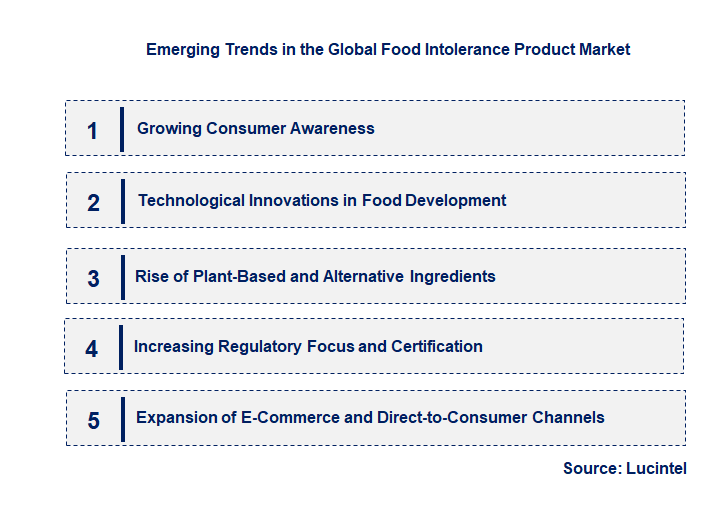
Emerging Trends in the Food Intolerance Product Market

Recent Development in the Food Intolerance Product Market

The food intolerance product market is experiencing rapid growth driven by increasing awareness of food sensitivities and a rising demand for specialized dietary options. Consumers are seeking alternatives that cater to their health needs, prompting innovation and expansion within the industry. Advances in technology and a better understanding of food intolerances are fueling product development. This evolving landscape presents significant opportunities for manufacturers, retailers, and health professionals to meet consumer needs and capture market share.

• Growing Consumer Awareness: Increased awareness of food intolerances has led consumers to seek specialized products, expanding the market. As more individuals recognize symptoms and seek solutions, demand for tailored food options rises, encouraging companies to innovate. This trend boosts sales of gluten-free, dairy-free, and allergen-free products, fostering market growth and encouraging new entrants to develop targeted offerings.
• Innovation in Product Formulations: Advances in food technology enable the development of diverse intolerance-friendly products. Companies are investing in research to create tasty, nutritious alternatives that meet dietary restrictions. This innovation enhances consumer satisfaction and broadens product choices, leading to increased market penetration. The focus on clean labels and natural ingredients also appeals to health-conscious consumers, further expanding the market.
• Expansion of Distribution Channels: E-commerce platforms and specialty stores are increasingly accessible for intolerance products. Online retailing offers convenience and a wider reach, allowing consumers to access a variety of options easily. Retail partnerships with health stores and supermarkets are also growing, improving product visibility. This expansion enhances consumer access, drives sales, and accelerates market growth across different regions.
• Rising Investment and Strategic Partnerships: Investment in research and development, along with strategic collaborations, is accelerating product innovation. Companies are partnering with health organizations and startups to develop new formulations and expand product lines. These collaborations foster technological advancements and market competitiveness, attracting more consumers. Increased funding and partnerships are vital for sustaining growth and meeting evolving consumer demands.
• Regulatory and Labeling Improvements: Clearer regulations and labeling standards increase consumer confidence in intolerance products. Governments are implementing stricter guidelines to ensure product safety and transparency. Accurate labeling helps consumers make informed choices, boosting trust and demand. This regulatory environment encourages manufacturers to maintain high standards, fostering market stability and growth as consumers increasingly prioritize safety and authenticity.

These developments are significantly transforming the food intolerance product market by enhancing product diversity, accessibility, and consumer trust. The market is poised for sustained growth as innovation, distribution, and regulatory improvements continue to meet the evolving needs of health-conscious consumers.

Strategic Growth Opportunities in the Food Intolerance Product Market

The food intolerance product market is experiencing rapid expansion driven by increasing awareness of food sensitivities and a rising demand for specialized dietary options. Consumers are seeking effective solutions to manage intolerances, prompting innovation and diversification in product offerings. Market players are focusing on product development, distribution channels, and personalized nutrition to capture growth opportunities. This evolving landscape presents significant potential for brands to meet consumer needs and establish a competitive edge in a growing industry.

• Growing Consumer Awareness and Demand for Specialized Products: Increasing awareness of food intolerances and sensitivities is fueling demand for targeted products. Consumers are actively seeking gluten-free, lactose-free, and allergen-free options, prompting manufacturers to develop innovative, safe, and effective solutions. This trend is supported by rising health consciousness and the desire for a better quality of life, creating opportunities for brands to expand their product lines and reach new customer segments.
• Innovation in Food Intolerance Product Formulations: Advances in food technology are enabling the development of more effective and palatable intolerance-friendly products. Companies are investing in research to create alternatives that mimic traditional textures and flavors without triggering sensitivities. This innovation enhances consumer acceptance and satisfaction, driving market growth. The focus on clean-label, natural ingredients also aligns with consumer preferences for healthier options, further expanding market potential.
• Expansion of Distribution Channels and E-commerce Platforms: The growth of online retail and specialty stores is facilitating easier access to food intolerance products. E-commerce platforms enable brands to reach a broader audience, including niche markets and remote areas. Strategic partnerships with supermarkets, health stores, and online marketplaces are increasing product visibility and availability. This expansion supports faster adoption, boosts sales, and allows companies to gather valuable consumer data for targeted marketing.
• Increasing Focus on Personalized Nutrition and Custom Solutions: Personalized nutrition is gaining traction as consumers seek tailored dietary solutions for their specific intolerances. Companies are leveraging data and diagnostics to offer customized products and meal plans. This approach enhances customer loyalty and satisfaction by addressing individual needs more precisely. The trend encourages innovation in product development, marketing strategies, and service offerings, positioning brands as leaders in the personalized health and wellness space.
• Rising Regulatory Support and Industry Standards: Governments and industry bodies are implementing regulations and standards to ensure product safety and transparency. This regulatory environment encourages companies to adhere to high-quality manufacturing practices and clear labeling, building consumer trust. Compliance with these standards can serve as a competitive advantage, facilitating market entry and expansion. Additionally, regulatory support promotes innovation and investment in research, fostering sustainable growth within the food intolerance product market.

The overall impact of these opportunities is a dynamic and expanding market landscape. Companies that innovate, adapt to consumer preferences, and leverage distribution channels will be well-positioned for sustained growth. As awareness and demand continue to rise, the market is poised for significant development, benefiting consumers with more effective, accessible, and personalized food intolerance solutions.

Food Intolerance Product Market Driver and Challenges

The food intolerance product market is influenced by a variety of technological, economic, and regulatory factors that shape its growth and development. Advances in food testing technologies and increased awareness about food sensitivities are driving demand for specialized products. Economic factors such as rising disposable incomes and changing consumer lifestyles contribute to market expansion. Regulatory frameworks around food safety and labeling standards also impact product development and marketing strategies. Additionally, evolving consumer preferences for healthier and allergen-free foods further propel market growth. However, the market faces challenges related to product innovation costs, regulatory compliance complexities, and consumer trust issues. Understanding these drivers and challenges is essential for stakeholders aiming to capitalize on market opportunities.

The factors responsible for driving the food intolerance product market include:-
• Technological Advancements: The development of sophisticated food testing and labeling technologies has enabled companies to produce accurate, allergen-free, and gluten-free products. These innovations improve product safety and consumer confidence, fostering market growth. As technology continues to evolve, companies can better identify and eliminate potential allergens, expanding product offerings and catering to a broader consumer base. This technological progress also facilitates personalized nutrition solutions, further boosting demand.
• Rising Consumer Awareness: Increased awareness about food intolerances and allergies has led consumers to seek specialized products. Educational campaigns, social media influence, and healthcare provider recommendations have heightened sensitivity towards food ingredients. Consumers are now more vigilant about reading labels and choosing products that cater to their dietary restrictions, which significantly drives market demand for intolerance-specific foods.
• Changing Lifestyle and Dietary Trends: Modern lifestyles characterized by busy schedules and a focus on health have increased demand for convenient, healthy, and allergen-free food options. The shift towards plant-based, gluten-free, and dairy-free diets has created a substantial market for intolerance-specific products. This trend is reinforced by the growing popularity of clean eating and wellness movements, encouraging consumers to opt for products that align with their health goals.
• Regulatory Support and Standards: Governments and regulatory bodies are implementing stricter food safety and labeling standards to protect consumers. Clear labeling of allergens and intolerances enhances transparency and consumer trust, encouraging product innovation and market expansion. Compliance with these regulations also helps companies avoid legal issues and build brand credibility, further stimulating market growth.
• Innovation in Product Development: Companies are investing in research and development to create innovative food intolerance products that meet consumer needs. This includes developing new formulations, textures, and flavors that appeal to a broad audience. Such innovation not only enhances product appeal but also allows companies to differentiate themselves in a competitive market, driving overall growth.

The challenges facing the food intolerance product market include:-
• High Product Development Costs: Developing specialized food intolerance products requires significant investment in research, testing, and quality assurance. These costs can be prohibitive for small and medium-sized enterprises, limiting market entry and innovation. Additionally, maintaining consistent product quality and safety standards adds to operational expenses, which can impact profit margins and pricing strategies.
• Regulatory Compliance Complexities: Navigating diverse and evolving food safety regulations across different regions poses a significant challenge. Companies must ensure accurate labeling, allergen declarations, and compliance with local standards, which can be resource-intensive. Non-compliance risks legal penalties, product recalls, and damage to brand reputation, making regulatory adherence a critical but challenging aspect of market operations.
• Consumer Trust and Perception Issues: Despite increasing awareness, some consumers remain skeptical about the efficacy and safety of food intolerance products. Misinformation, false claims, and a lack of standardization can undermine consumer confidence. Building trust requires transparent communication, rigorous testing, and consistent quality, which can be difficult and costly to sustain, especially for new entrants in the market.

The food intolerance product market is driven by technological innovations, rising awareness, lifestyle shifts, regulatory support, and product development efforts. However, high development costs, regulatory complexities, and consumer trust issues pose significant challenges. These factors collectively influence market dynamics, requiring stakeholders to balance innovation with compliance and transparency. Overall, the markets growth potential remains strong, provided companies effectively address these challenges and leverage emerging opportunities to meet evolving consumer demands.

List of Food Intolerance Product Companies

Companies in the market compete on the basis of product quality offered. Major players in this market focus on expanding their manufacturing facilities, R&D investments, infrastructural development, and leverage integration opportunities across the value chain. With these strategies food intolerance product companies cater increasing demand, ensure competitive effectiveness, develop innovative products & technologies, reduce production costs, and expand their customer base. Some of the food intolerance product companies profiled in this report include-
• Abbott Nutrition
• Amy’s Kitchen
• Boulder Brands
• Conagra Brands
• Danone
• Dr. Schar AG/SPA
• Fifty-50 Foods
• General Mills
• Kellogg Company
• Nestle

Food Intolerance Product Market by Segment

The study includes a forecast for the global food intolerance product market by type, product type, distribution channel, and region.

Food Intolerance Product Market by Type [Value from 2019 to 2035]:


• Bakery Products
• Confectionery Products
• Dairy & Dairy Alternatives
• Meat & Seafood Products
• Others

Food Intolerance Product Market by Product Type [Value from 2019 to 2035]:


• Diabetes-Free Food
• Gluten-Free Food
• Lactose-Free Food
• Others

Food Intolerance Product Market by Distribution Channel [Value from 2019 to 2035]:


• Supermarkets & Hypermarkets
• Convenience Stores
• Online Stores
• Others

Food Intolerance Product Market by Region [Value from 2019 to 2035]:


• North America
• Europe
• Asia Pacific
• The Rest of the World

Country Wise Outlook for the Food Intolerance Product Market

The food intolerance product market has experienced significant growth driven by increasing awareness of food sensitivities, rising health consciousness, and advancements in food testing technologies. Consumers are seeking specialized products that cater to dietary restrictions, prompting companies to innovate and expand their offerings. Regulatory frameworks are evolving to ensure product safety and transparency, while e-commerce platforms facilitate wider access to these products. As the market matures, key players are investing in research and development to improve product efficacy and variety. The following summaries highlight recent developments in the United States, China, Germany, India, and Japan, reflecting regional trends and innovations.

• United States: The US market has seen a surge in plant-based and gluten-free food intolerance products, with major brands expanding their product lines. Innovations in lab testing and personalized nutrition are gaining popularity, supported by increased consumer demand for transparency and health benefits. Regulatory agencies are emphasizing stricter labeling standards to ensure consumer safety. E-commerce sales continue to grow rapidly, making these products more accessible nationwide. Additionally, collaborations between food companies and health tech startups are fostering new diagnostic tools and tailored dietary solutions.
• China: The Chinese market is witnessing rapid growth due to rising awareness of food allergies and intolerances. Local companies are developing affordable, innovative products such as dairy-free and gluten-free snacks to meet increasing consumer demand. The government is promoting food safety standards and encouraging research into food intolerance detection methods. E-commerce platforms like Alibaba and JD.com are expanding their offerings, making specialized products more accessible. There is also a growing trend of integrating traditional Chinese medicine principles with modern food intolerance management, creating unique product options.
• Germany: Germanys market is characterized by a strong focus on organic and natural food intolerance products. Consumer preferences lean toward minimally processed, allergen-free options, with a significant emphasis on gluten and lactose-free products. Regulatory bodies enforce strict labeling and safety standards, fostering consumer trust. Local startups and established brands are investing in innovative testing kits and functional foods aimed at managing food sensitivities. The market also benefits from a well-developed distribution network, including health food stores and online channels, supporting widespread adoption of these products.
• India: The Indian food intolerance product market is emerging, driven by increasing awareness of food allergies and sensitivities among urban populations. Companies are introducing affordable, culturally adapted products such as gluten-free flours and dairy-free snacks. The government is working to improve food safety regulations and promote awareness campaigns. E-commerce platforms are playing a crucial role in expanding access to specialized products in tier 2 and tier 3 cities. Traditional dietary practices are being integrated with modern food intolerance solutions, creating a unique market landscape that caters to diverse consumer needs.
• Japan: Japans market is characterized by high consumer awareness and demand for high-quality, safe food intolerance products. Innovations include enzyme-based supplements and allergen-free processed foods tailored to Japanese dietary preferences. Regulatory agencies enforce rigorous safety standards, ensuring product reliability. The market benefits from advanced food testing technologies and a strong focus on health and wellness. Local companies are also exploring functional foods that support gut health and immune function. E-commerce and specialty health stores are key distribution channels, facilitating widespread access to these products across the country.

Lucintel Analytics Dashboard

Features of the Global Food Intolerance Product Market

Market Size Estimates: Food intolerance product market size estimation in terms of value ($B).
Trend and Forecast Analysis: Market trends (2019 to 2025) and forecast (2026 to 2035) by various segments and regions.
Segmentation Analysis: Food intolerance product market size by type, product type, distribution channel, and region in terms of value ($B).
Regional Analysis: Food intolerance product market breakdown by North America, Europe, Asia Pacific, and Rest of the World.
Growth Opportunities: Analysis of growth opportunities in different types, product types, distribution channels, and regions for the food intolerance product market.
Strategic Analysis: This includes M&A, new product development, and competitive landscape of the food intolerance product market.
Analysis of competitive intensity of the industry based on Porter’s Five Forces model.

Lucintel Consulting Services

FAQ

Q1. What is the food intolerance product market size?
Answer: The global food intolerance product market is expected to reach an estimated $17.7 billion by 2035.
Q2. What is the growth forecast for food intolerance product market?
Answer: The global food intolerance product market is expected to grow with a CAGR of 4.4% from 2026 to 2035.
Q3. What are the major drivers influencing the growth of the food intolerance product market?
Answer: The major drivers for this market are the increasing preference for digestive health solutions, the rising demand for allergen free foods, and the growing adoption of personalized diet choices.
Q4. What are the major segments for food intolerance product market?
Answer: The future of the food intolerance product market looks promising with opportunities in the supermarket & hypermarket, convenience store, and online store markets.
Q5. Who are the key food intolerance product market companies?
Answer: Some of the key food intolerance product companies are as follows:
• Abbott Nutrition
• Amy’s Kitchen
• Boulder Brands
• Conagra Brands
• Danone
• Dr. Schar AG/SPA
• Fifty-50 Foods
• General Mills
• Kellogg Company
• Nestle
Q6. Which food intolerance product market segment will be the largest in future?
Answer: Lucintel forecasts that, within the type category, bakery product is expected to witness the highest growth over the forecast period.
Q7. In food intolerance product market, which region is expected to be the largest in next 5 years?
Answer: In terms of region, APAC is expected to witness the highest growth over the forecast period.
Q8. Do we receive customization in this report?
Answer: Yes, Lucintel provides 10% customization without any additional cost.

This report answers following 11 key questions:

Q.1. What are some of the most promising, high-growth opportunities for the food intolerance product market by type (bakery products, confectionery products, dairy & dairy alternatives, meat & seafood products, and others), product type (diabetes-free food, gluten-free food, lactose-free food, and others), distribution channel (supermarkets & hypermarkets, convenience stores, online stores, and others), and region (North America, Europe, Asia Pacific, and the Rest of the World)?
Q.2. Which segments will grow at a faster pace and why?
Q.3. Which region will grow at a faster pace and why?
Q.4. What are the key factors affecting market dynamics? What are the key challenges and business risks in this market?
Q.5. What are the business risks and competitive threats in this market?
Q.6. What are the emerging trends in this market and the reasons behind them?
Q.7. What are some of the changing demands of customers in the market?
Q.8. What are the new developments in the market? Which companies are leading these developments?
Q.9. Who are the major players in this market? What strategic initiatives are key players pursuing for business growth?
Q.10. What are some of the competing products in this market and how big of a threat do they pose for loss of market share by material or product substitution?
Q.11. What M&A activity has occurred in the last 7 years and what has its impact been on the industry?

For any questions related to Food Intolerance Product Market, Food Intolerance Product Market Size, Food Intolerance Product Market Growth, Food Intolerance Product Market Analysis, Food Intolerance Product Market Report, Food Intolerance Product Market Share, Food Intolerance Product Market Trends, Food Intolerance Product Market Forecast, Food Intolerance Product Companies, write Lucintel analyst at email: helpdesk@lucintel.com. We will be glad to get back to you soon.
                                           Table of Contents

            1. Executive Summary

            2. Market Overview

                        2.1 Background and Classifications
                        2.2 Supply Chain

            3. Market Trends & Forecast Analysis

                        3.1 Macroeconomic Trends and Forecasts
                        3.2 Industry Drivers and Challenges
                        3.3 PESTLE Analysis
                        3.4 Patent Analysis
                        3.5 Regulatory Environment
                        3.6 Global Food Intolerance Product Market Trends and Forecast

            4. Global Food Intolerance Product Market by Type

                        4.1 Overview
                        4.2 Attractiveness Analysis by Type
                        4.3 Bakery Products : Trends and Forecast 2019 to 2035
                        4.4 Confectionery Products : Trends and Forecast 2019 to 2035
                        4.5 Dairy & Dairy Alternatives : Trends and Forecast 2019 to 2035
                        4.6 Meat & Seafood Products : Trends and Forecast 2019 to 2035
                        4.7 Others : Trends and Forecast 2019 to 2035

            5. Global Food Intolerance Product Market by Product Type

                        5.1 Overview
                        5.2 Attractiveness Analysis by Product Type
                        5.3 Diabetes-Free Food : Trends and Forecast 2019 to 2035
                        5.4 Gluten-Free Food : Trends and Forecast 2019 to 2035
                        5.5 Lactose-Free Food : Trends and Forecast 2019 to 2035
                        5.6 Others : Trends and Forecast 2019 to 2035

            6. Global Food Intolerance Product Market by Distribution Channel

                        6.1 Overview
                        6.2 Attractiveness Analysis by Distribution Channel
                        6.3 Supermarkets & Hypermarkets : Trends and Forecast 2019 to 2035
                        6.4 Convenience Stores : Trends and Forecast 2019 to 2035
                        6.5 Online Stores : Trends and Forecast 2019 to 2035
                        6.6 Others : Trends and Forecast 2019 to 2035

            7. Regional Analysis

                        7.1 Overview
                        7.2 Global Food Intolerance Product Market by Region

            8. North American Food Intolerance Product Market

                        8.1 Overview
                        8.2 North American Food Intolerance Product Market by Type
                        8.3 North American Food Intolerance Product Market by Distribution Channel
                        8.4 The United States Food Intolerance Product Market
                        8.5 Canadian Food Intolerance Product Market
                        8.6 Mexican Food Intolerance Product Market

            9. European Food Intolerance Product Market

                        9.1 Overview
                        9.2 European Food Intolerance Product Market by Type
                        9.3 European Food Intolerance Product Market by Distribution Channel
                        9.4 German Food Intolerance Product Market
                        9.5 French Food Intolerance Product Market
                        9.6 Italian Food Intolerance Product Market
                        9.7 Spanish Food Intolerance Product Market
                        9.8 The United Kingdom Food Intolerance Product Market

            10. APAC Food Intolerance Product Market

                        10.1 Overview
                        10.2 APAC Food Intolerance Product Market by Type
                        10.3 APAC Food Intolerance Product Market by Distribution Channel
                        10.4 Chinese Food Intolerance Product Market
                        10.5 Indian Food Intolerance Product Market
                        10.6 Japanese Food Intolerance Product Market
                        10.7 South Korean Food Intolerance Product Market
                        10.8 Indonesian Food Intolerance Product Market

            11. ROW Food Intolerance Product Market

                        11.1 Overview
                        11.2 ROW Food Intolerance Product Market by Type
                        11.3 ROW Food Intolerance Product Market by Distribution Channel
                        11.4 Middle Eastern Food Intolerance Product Market
                        11.5 South American Food Intolerance Product Market
                        11.6 African Food Intolerance Product Market

            12. Competitor Analysis

                        12.1 Product Portfolio Analysis
                        12.2 Operational Integration
                        12.3 Porter’s Five Forces Analysis
                                    • Competitive Rivalry
                                    • Bargaining Power of Buyers
                                    • Bargaining Power of Suppliers
                                    • Threat of Substitutes
                                    • Threat of New Entrants
                        12.4 Market Share Analysis

            13. Opportunities & Strategic Analysis

                        13.1 Value Chain Analysis
                        13.2 Growth Opportunity Analysis
                                    13.2.1 Growth Opportunity by Type
                                    13.2.2 Growth Opportunity by Product Type
                                    13.2.3 Growth Opportunity by Distribution Channel
                                    13.2.4 Growth Opportunity by Region
                        13.3 Emerging Trends in the Global Food Intolerance Product Market
                        13.4 Strategic Analysis
                                    13.4.1 New Product Development
                                    13.4.2 Certification and Licensing
                                    13.4.3 Mergers, Acquisitions, Agreements, Collaborations, and Joint Ventures

            14. Company Profiles of the Leading Players Across the Value Chain

                        14.1 Competitive Analysis Overview
                        14.2 Abbott Nutrition
                                    • Company Overview
                                    • Food Intolerance Product Market Business Overview
                                    • New Product Development
                                    • Merger, Acquisition, and Collaboration
                                    • Certification and Licensing
                        14.3 Amy’s Kitchen
                                    • Company Overview
                                    • Food Intolerance Product Market Business Overview
                                    • New Product Development
                                    • Merger, Acquisition, and Collaboration
                                    • Certification and Licensing
                        14.4 Boulder Brands
                                    • Company Overview
                                    • Food Intolerance Product Market Business Overview
                                    • New Product Development
                                    • Merger, Acquisition, and Collaboration
                                    • Certification and Licensing
                        14.5 Conagra Brands
                                    • Company Overview
                                    • Food Intolerance Product Market Business Overview
                                    • New Product Development
                                    • Merger, Acquisition, and Collaboration
                                    • Certification and Licensing
                        14.6 Danone
                                    • Company Overview
                                    • Food Intolerance Product Market Business Overview
                                    • New Product Development
                                    • Merger, Acquisition, and Collaboration
                                    • Certification and Licensing
                        14.7 Dr. Schar AG/SPA
                                    • Company Overview
                                    • Food Intolerance Product Market Business Overview
                                    • New Product Development
                                    • Merger, Acquisition, and Collaboration
                                    • Certification and Licensing
                        14.8 Fifty-50 Foods
                                    • Company Overview
                                    • Food Intolerance Product Market Business Overview
                                    • New Product Development
                                    • Merger, Acquisition, and Collaboration
                                    • Certification and Licensing
                        14.9 General Mills
                                    • Company Overview
                                    • Food Intolerance Product Market Business Overview
                                    • New Product Development
                                    • Merger, Acquisition, and Collaboration
                                    • Certification and Licensing
                        14.10 Kellogg Company
                                    • Company Overview
                                    • Food Intolerance Product Market Business Overview
                                    • New Product Development
                                    • Merger, Acquisition, and Collaboration
                                    • Certification and Licensing
                        14.11 Nestle
                                    • Company Overview
                                    • Food Intolerance Product Market Business Overview
                                    • New Product Development
                                    • Merger, Acquisition, and Collaboration
                                    • Certification and Licensing

            15. Appendix

                        15.1 List of Figures
                        15.2 List of Tables
                        15.3 Research Methodology
                        15.4 Disclaimer
                        15.5 Copyright
                        15.6 Abbreviations and Technical Units
                        15.7 About Us
                        15.8 Contact Us

                                               List of Figures


            Chapter 1

                        Figure 1.1: Trends and Forecast for the Global Food Intolerance Product Market

            Chapter 2

                        Figure 2.1: Usage of Food Intolerance Product Market
                        Figure 2.2: Classification of the Global Food Intolerance Product Market
                        Figure 2.3: Supply Chain of the Global Food Intolerance Product Market

            Chapter 3

                        Figure 3.1: Trends of the Global GDP Growth Rate
                        Figure 3.2: Trends of the Global Population Growth Rate
                        Figure 3.3: Trends of the Global Inflation Rate
                        Figure 3.4: Trends of the Global Unemployment Rate
                        Figure 3.5: Trends of the Regional GDP Growth Rate
                        Figure 3.6: Trends of the Regional Population Growth Rate
                        Figure 3.7: Trends of the Regional Inflation Rate
                        Figure 3.8: Trends of the Regional Unemployment Rate
                        Figure 3.9: Trends of Regional Per Capita Income
                        Figure 3.10: Forecast for the Global GDP Growth Rate
                        Figure 3.11: Forecast for the Global Population Growth Rate
                        Figure 3.12: Forecast for the Global Inflation Rate
                        Figure 3.13: Forecast for the Global Unemployment Rate
                        Figure 3.14: Forecast for the Regional GDP Growth Rate
                        Figure 3.15: Forecast for the Regional Population Growth Rate
                        Figure 3.16: Forecast for the Regional Inflation Rate
                        Figure 3.17: Forecast for the Regional Unemployment Rate
                        Figure 3.18: Forecast for Regional Per Capita Income
                        Figure 3.19: Driver and Challenges of the Food Intolerance Product Market

            Chapter 4

                        Figure 4.1: Global Food Intolerance Product Market by Type in 2019, 2025, and 2035
                        Figure 4.2: Trends of the Global Food Intolerance Product Market ($B) by Type
                        Figure 4.3: Forecast for the Global Food Intolerance Product Market ($B) by Type
                        Figure 4.4: Trends and Forecast for Bakery Products in the Global Food Intolerance Product Market (2019-2035)
                        Figure 4.5: Trends and Forecast for Confectionery Products in the Global Food Intolerance Product Market (2019-2035)
                        Figure 4.6: Trends and Forecast for Dairy & Dairy Alternatives in the Global Food Intolerance Product Market (2019-2035)
                        Figure 4.7: Trends and Forecast for Meat & Seafood Products in the Global Food Intolerance Product Market (2019-2035)
                        Figure 4.8: Trends and Forecast for Others in the Global Food Intolerance Product Market (2019-2035)

            Chapter 5

                        Figure 5.1: Global Food Intolerance Product Market by Product Type in 2019, 2025, and 2035
                        Figure 5.2: Trends of the Global Food Intolerance Product Market ($B) by Product Type
                        Figure 5.3: Forecast for the Global Food Intolerance Product Market ($B) by Product Type
                        Figure 5.4: Trends and Forecast for Diabetes-Free Food in the Global Food Intolerance Product Market (2019-2035)
                        Figure 5.5: Trends and Forecast for Gluten-Free Food in the Global Food Intolerance Product Market (2019-2035)
                        Figure 5.6: Trends and Forecast for Lactose-Free Food in the Global Food Intolerance Product Market (2019-2035)
                        Figure 5.7: Trends and Forecast for Others in the Global Food Intolerance Product Market (2019-2035)

            Chapter 6

                        Figure 6.1: Global Food Intolerance Product Market by Distribution Channel in 2019, 2025, and 2035
                        Figure 6.2: Trends of the Global Food Intolerance Product Market ($B) by Distribution Channel
                        Figure 6.3: Forecast for the Global Food Intolerance Product Market ($B) by Distribution Channel
                        Figure 6.4: Trends and Forecast for Supermarkets & Hypermarkets in the Global Food Intolerance Product Market (2019-2035)
                        Figure 6.5: Trends and Forecast for Convenience Stores in the Global Food Intolerance Product Market (2019-2035)
                        Figure 6.6: Trends and Forecast for Online Stores in the Global Food Intolerance Product Market (2019-2035)
                        Figure 6.7: Trends and Forecast for Others in the Global Food Intolerance Product Market (2019-2035)

            Chapter 7

                        Figure 7.1: Trends of the Global Food Intolerance Product Market ($B) by Region (2019-2025)
                        Figure 7.2: Forecast for the Global Food Intolerance Product Market ($B) by Region (2026-2035)

            Chapter 8

                        Figure 8.1: Trends and Forecast for the North American Food Intolerance Product Market (2019-2035)
                        Figure 8.2: North American Food Intolerance Product Market by Type in 2019, 2025, and 2035
                        Figure 8.3: Trends of the North American Food Intolerance Product Market ($B) by Type (2019-2025)
                        Figure 8.4: Forecast for the North American Food Intolerance Product Market ($B) by Type (2026-2035)
                        Figure 8.5: North American Food Intolerance Product Market by Product Type in 2019, 2025, and 2035
                        Figure 8.6: Trends of the North American Food Intolerance Product Market ($B) by Product Type (2019-2025)
                        Figure 8.7: Forecast for the North American Food Intolerance Product Market ($B) by Product Type (2026-2035)
                        Figure 8.8: North American Food Intolerance Product Market by Distribution Channel in 2019, 2025, and 2035
                        Figure 8.9: Trends of the North American Food Intolerance Product Market ($B) by Distribution Channel (2019-2025)
                        Figure 8.10: Forecast for the North American Food Intolerance Product Market ($B) by Distribution Channel (2026-2035)
                        Figure 8.11: Trends and Forecast for the United States Food Intolerance Product Market ($B) (2019-2035)
                        Figure 8.12: Trends and Forecast for the Mexican Food Intolerance Product Market ($B) (2019-2035)
                        Figure 8.13: Trends and Forecast for the Canadian Food Intolerance Product Market ($B) (2019-2035)

            Chapter 9

                        Figure 9.1: Trends and Forecast for the European Food Intolerance Product Market (2019-2035)
                        Figure 9.2: European Food Intolerance Product Market by Type in 2019, 2025, and 2035
                        Figure 9.3: Trends of the European Food Intolerance Product Market ($B) by Type (2019-2025)
                        Figure 9.4: Forecast for the European Food Intolerance Product Market ($B) by Type (2026-2035)
                        Figure 9.5: European Food Intolerance Product Market by Product Type in 2019, 2025, and 2035
                        Figure 9.6: Trends of the European Food Intolerance Product Market ($B) by Product Type (2019-2025)
                        Figure 9.7: Forecast for the European Food Intolerance Product Market ($B) by Product Type (2026-2035)
                        Figure 9.8: European Food Intolerance Product Market by Distribution Channel in 2019, 2025, and 2035
                        Figure 9.9: Trends of the European Food Intolerance Product Market ($B) by Distribution Channel (2019-2025)
                        Figure 9.10: Forecast for the European Food Intolerance Product Market ($B) by Distribution Channel (2026-2035)
                        Figure 9.11: Trends and Forecast for the German Food Intolerance Product Market ($B) (2019-2035)
                        Figure 9.12: Trends and Forecast for the French Food Intolerance Product Market ($B) (2019-2035)
                        Figure 9.13: Trends and Forecast for the Spanish Food Intolerance Product Market ($B) (2019-2035)
                        Figure 9.14: Trends and Forecast for the Italian Food Intolerance Product Market ($B) (2019-2035)
                        Figure 9.15: Trends and Forecast for the United Kingdom Food Intolerance Product Market ($B) (2019-2035)

            Chapter 10

                        Figure 10.1: Trends and Forecast for the APAC Food Intolerance Product Market (2019-2035)
                        Figure 10.2: APAC Food Intolerance Product Market by Type in 2019, 2025, and 2035
                        Figure 10.3: Trends of the APAC Food Intolerance Product Market ($B) by Type (2019-2025)
                        Figure 10.4: Forecast for the APAC Food Intolerance Product Market ($B) by Type (2026-2035)
                        Figure 10.5: APAC Food Intolerance Product Market by Product Type in 2019, 2025, and 2035
                        Figure 10.6: Trends of the APAC Food Intolerance Product Market ($B) by Product Type (2019-2025)
                        Figure 10.7: Forecast for the APAC Food Intolerance Product Market ($B) by Product Type (2026-2035)
                        Figure 10.8: APAC Food Intolerance Product Market by Distribution Channel in 2019, 2025, and 2035
                        Figure 10.9: Trends of the APAC Food Intolerance Product Market ($B) by Distribution Channel (2019-2025)
                        Figure 10.10: Forecast for the APAC Food Intolerance Product Market ($B) by Distribution Channel (2026-2035)
                        Figure 10.11: Trends and Forecast for the Japanese Food Intolerance Product Market ($B) (2019-2035)
                        Figure 10.12: Trends and Forecast for the Indian Food Intolerance Product Market ($B) (2019-2035)
                        Figure 10.13: Trends and Forecast for the Chinese Food Intolerance Product Market ($B) (2019-2035)
                        Figure 10.14: Trends and Forecast for the South Korean Food Intolerance Product Market ($B) (2019-2035)
                        Figure 10.15: Trends and Forecast for the Indonesian Food Intolerance Product Market ($B) (2019-2035)

            Chapter 11

                        Figure 11.1: Trends and Forecast for the ROW Food Intolerance Product Market (2019-2035)
                        Figure 11.2: ROW Food Intolerance Product Market by Type in 2019, 2025, and 2035
                        Figure 11.3: Trends of the ROW Food Intolerance Product Market ($B) by Type (2019-2025)
                        Figure 11.4: Forecast for the ROW Food Intolerance Product Market ($B) by Type (2026-2035)
                        Figure 11.5: ROW Food Intolerance Product Market by Product Type in 2019, 2025, and 2035
                        Figure 11.6: Trends of the ROW Food Intolerance Product Market ($B) by Product Type (2019-2025)
                        Figure 11.7: Forecast for the ROW Food Intolerance Product Market ($B) by Product Type (2026-2035)
                        Figure 11.8: ROW Food Intolerance Product Market by Distribution Channel in 2019, 2025, and 2035
                        Figure 11.9: Trends of the ROW Food Intolerance Product Market ($B) by Distribution Channel (2019-2025)
                        Figure 11.10: Forecast for the ROW Food Intolerance Product Market ($B) by Distribution Channel (2026-2035)
                        Figure 11.11: Trends and Forecast for the Middle Eastern Food Intolerance Product Market ($B) (2019-2035)
                        Figure 11.12: Trends and Forecast for the South American Food Intolerance Product Market ($B) (2019-2035)
                        Figure 11.13: Trends and Forecast for the African Food Intolerance Product Market ($B) (2019-2035)

            Chapter 12

                        Figure 12.1: Porter’s Five Forces Analysis of the Global Food Intolerance Product Market
                        Figure 12.2: Market Share (%) of Top Players in the Global Food Intolerance Product Market (2025)

            Chapter 13

                        Figure 13.1: Growth Opportunities for the Global Food Intolerance Product Market by Type
                        Figure 13.2: Growth Opportunities for the Global Food Intolerance Product Market by Product Type
                        Figure 13.3: Growth Opportunities for the Global Food Intolerance Product Market by Distribution Channel
                        Figure 13.4: Growth Opportunities for the Global Food Intolerance Product Market by Region
                        Figure 13.5: Emerging Trends in the Global Food Intolerance Product Market

                                               List of Tables


            Chapter 1

                        Table 1.1: Growth Rate (%, 2024-2025) and CAGR (%, 2026-2035) of the Food Intolerance Product Market by Type, Product Type, and Distribution Channel
                        Table 1.2: Attractiveness Analysis for the Food Intolerance Product Market by Region
                        Table 1.3: Global Food Intolerance Product Market Parameters and Attributes

            Chapter 3

                        Table 3.1: Trends of the Global Food Intolerance Product Market (2019-2025)
                        Table 3.2: Forecast for the Global Food Intolerance Product Market (2026-2035)

            Chapter 4

                        Table 4.1: Attractiveness Analysis for the Global Food Intolerance Product Market by Type
                        Table 4.2: Market Size and CAGR of Various Type in the Global Food Intolerance Product Market (2019-2025)
                        Table 4.3: Market Size and CAGR of Various Type in the Global Food Intolerance Product Market (2026-2035)
                        Table 4.4: Trends of Bakery Products in the Global Food Intolerance Product Market (2019-2025)
                        Table 4.5: Forecast for Bakery Products in the Global Food Intolerance Product Market (2026-2035)
                        Table 4.6: Trends of Confectionery Products in the Global Food Intolerance Product Market (2019-2025)
                        Table 4.7: Forecast for Confectionery Products in the Global Food Intolerance Product Market (2026-2035)
                        Table 4.8: Trends of Dairy & Dairy Alternatives in the Global Food Intolerance Product Market (2019-2025)
                        Table 4.9: Forecast for Dairy & Dairy Alternatives in the Global Food Intolerance Product Market (2026-2035)
                        Table 4.10: Trends of Meat & Seafood Products in the Global Food Intolerance Product Market (2019-2025)
                        Table 4.11: Forecast for Meat & Seafood Products in the Global Food Intolerance Product Market (2026-2035)
                        Table 4.12: Trends of Others in the Global Food Intolerance Product Market (2019-2025)
                        Table 4.13: Forecast for Others in the Global Food Intolerance Product Market (2026-2035)

            Chapter 5

                        Table 5.1: Attractiveness Analysis for the Global Food Intolerance Product Market by Product Type
                        Table 5.2: Market Size and CAGR of Various Product Type in the Global Food Intolerance Product Market (2019-2025)
                        Table 5.3: Market Size and CAGR of Various Product Type in the Global Food Intolerance Product Market (2026-2035)
                        Table 5.4: Trends of Diabetes-Free Food in the Global Food Intolerance Product Market (2019-2025)
                        Table 5.5: Forecast for Diabetes-Free Food in the Global Food Intolerance Product Market (2026-2035)
                        Table 5.6: Trends of Gluten-Free Food in the Global Food Intolerance Product Market (2019-2025)
                        Table 5.7: Forecast for Gluten-Free Food in the Global Food Intolerance Product Market (2026-2035)
                        Table 5.8: Trends of Lactose-Free Food in the Global Food Intolerance Product Market (2019-2025)
                        Table 5.9: Forecast for Lactose-Free Food in the Global Food Intolerance Product Market (2026-2035)
                        Table 5.10: Trends of Others in the Global Food Intolerance Product Market (2019-2025)
                        Table 5.11: Forecast for Others in the Global Food Intolerance Product Market (2026-2035)

            Chapter 6

                        Table 6.1: Attractiveness Analysis for the Global Food Intolerance Product Market by Distribution Channel
                        Table 6.2: Market Size and CAGR of Various Distribution Channel in the Global Food Intolerance Product Market (2019-2025)
                        Table 6.3: Market Size and CAGR of Various Distribution Channel in the Global Food Intolerance Product Market (2026-2035)
                        Table 6.4: Trends of Supermarkets & Hypermarkets in the Global Food Intolerance Product Market (2019-2025)
                        Table 6.5: Forecast for Supermarkets & Hypermarkets in the Global Food Intolerance Product Market (2026-2035)
                        Table 6.6: Trends of Convenience Stores in the Global Food Intolerance Product Market (2019-2025)
                        Table 6.7: Forecast for Convenience Stores in the Global Food Intolerance Product Market (2026-2035)
                        Table 6.8: Trends of Online Stores in the Global Food Intolerance Product Market (2019-2025)
                        Table 6.9: Forecast for Online Stores in the Global Food Intolerance Product Market (2026-2035)
                        Table 6.10: Trends of Others in the Global Food Intolerance Product Market (2019-2025)
                        Table 6.11: Forecast for Others in the Global Food Intolerance Product Market (2026-2035)

            Chapter 7

                        Table 7.1: Market Size and CAGR of Various Regions in the Global Food Intolerance Product Market (2019-2025)
                        Table 7.2: Market Size and CAGR of Various Regions in the Global Food Intolerance Product Market (2026-2035)

            Chapter 8

                        Table 8.1: Trends of the North American Food Intolerance Product Market (2019-2025)
                        Table 8.2: Forecast for the North American Food Intolerance Product Market (2026-2035)
                        Table 8.3: Market Size and CAGR of Various Type in the North American Food Intolerance Product Market (2019-2025)
                        Table 8.4: Market Size and CAGR of Various Type in the North American Food Intolerance Product Market (2026-2035)
                        Table 8.5: Market Size and CAGR of Various Product Type in the North American Food Intolerance Product Market (2019-2025)
                        Table 8.6: Market Size and CAGR of Various Product Type in the North American Food Intolerance Product Market (2026-2035)
                        Table 8.7: Market Size and CAGR of Various Distribution Channel in the North American Food Intolerance Product Market (2019-2025)
                        Table 8.8: Market Size and CAGR of Various Distribution Channel in the North American Food Intolerance Product Market (2026-2035)
                        Table 8.9: Trends and Forecast for the United States Food Intolerance Product Market (2019-2035)
                        Table 8.10: Trends and Forecast for the Mexican Food Intolerance Product Market (2019-2035)
                        Table 8.11: Trends and Forecast for the Canadian Food Intolerance Product Market (2019-2035)

            Chapter 9

                        Table 9.1: Trends of the European Food Intolerance Product Market (2019-2025)
                        Table 9.2: Forecast for the European Food Intolerance Product Market (2026-2035)
                        Table 9.3: Market Size and CAGR of Various Type in the European Food Intolerance Product Market (2019-2025)
                        Table 9.4: Market Size and CAGR of Various Type in the European Food Intolerance Product Market (2026-2035)
                        Table 9.5: Market Size and CAGR of Various Product Type in the European Food Intolerance Product Market (2019-2025)
                        Table 9.6: Market Size and CAGR of Various Product Type in the European Food Intolerance Product Market (2026-2035)
                        Table 9.7: Market Size and CAGR of Various Distribution Channel in the European Food Intolerance Product Market (2019-2025)
                        Table 9.8: Market Size and CAGR of Various Distribution Channel in the European Food Intolerance Product Market (2026-2035)
                        Table 9.9: Trends and Forecast for the German Food Intolerance Product Market (2019-2035)
                        Table 9.10: Trends and Forecast for the French Food Intolerance Product Market (2019-2035)
                        Table 9.11: Trends and Forecast for the Spanish Food Intolerance Product Market (2019-2035)
                        Table 9.12: Trends and Forecast for the Italian Food Intolerance Product Market (2019-2035)
                        Table 9.13: Trends and Forecast for the United Kingdom Food Intolerance Product Market (2019-2035)

            Chapter 10

                        Table 10.1: Trends of the APAC Food Intolerance Product Market (2019-2025)
                        Table 10.2: Forecast for the APAC Food Intolerance Product Market (2026-2035)
                        Table 10.3: Market Size and CAGR of Various Type in the APAC Food Intolerance Product Market (2019-2025)
                        Table 10.4: Market Size and CAGR of Various Type in the APAC Food Intolerance Product Market (2026-2035)
                        Table 10.5: Market Size and CAGR of Various Product Type in the APAC Food Intolerance Product Market (2019-2025)
                        Table 10.6: Market Size and CAGR of Various Product Type in the APAC Food Intolerance Product Market (2026-2035)
                        Table 10.7: Market Size and CAGR of Various Distribution Channel in the APAC Food Intolerance Product Market (2019-2025)
                        Table 10.8: Market Size and CAGR of Various Distribution Channel in the APAC Food Intolerance Product Market (2026-2035)
                        Table 10.9: Trends and Forecast for the Japanese Food Intolerance Product Market (2019-2035)
                        Table 10.10: Trends and Forecast for the Indian Food Intolerance Product Market (2019-2035)
                        Table 10.11: Trends and Forecast for the Chinese Food Intolerance Product Market (2019-2035)
                        Table 10.12: Trends and Forecast for the South Korean Food Intolerance Product Market (2019-2035)
                        Table 10.13: Trends and Forecast for the Indonesian Food Intolerance Product Market (2019-2035)

            Chapter 11

                        Table 11.1: Trends of the ROW Food Intolerance Product Market (2019-2025)
                        Table 11.2: Forecast for the ROW Food Intolerance Product Market (2026-2035)
                        Table 11.3: Market Size and CAGR of Various Type in the ROW Food Intolerance Product Market (2019-2025)
                        Table 11.4: Market Size and CAGR of Various Type in the ROW Food Intolerance Product Market (2026-2035)
                        Table 11.5: Market Size and CAGR of Various Product Type in the ROW Food Intolerance Product Market (2019-2025)
                        Table 11.6: Market Size and CAGR of Various Product Type in the ROW Food Intolerance Product Market (2026-2035)
                        Table 11.7: Market Size and CAGR of Various Distribution Channel in the ROW Food Intolerance Product Market (2019-2025)
                        Table 11.8: Market Size and CAGR of Various Distribution Channel in the ROW Food Intolerance Product Market (2026-2035)
                        Table 11.9: Trends and Forecast for the Middle Eastern Food Intolerance Product Market (2019-2035)
                        Table 11.10: Trends and Forecast for the South American Food Intolerance Product Market (2019-2035)
                        Table 11.11: Trends and Forecast for the African Food Intolerance Product Market (2019-2035)

            Chapter 12

                        Table 12.1: Product Mapping of Food Intolerance Product Suppliers Based on Segments
                        Table 12.2: Operational Integration of Food Intolerance Product Manufacturers
                        Table 12.3: Rankings of Suppliers Based on Food Intolerance Product Revenue

            Chapter 13

                        Table 13.1: New Product Launches by Major Food Intolerance Product Producers (2019-2025)
                        Table 13.2: Certification Acquired by Major Competitor in the Global Food Intolerance Product Market

.

Buy full report or by chapter as follows

Price by License Type:
[-] Hide Chapter Details
[Chapter Number] [Chapter Name] [Chapter Number Of Pages] [Chapter Price]
Title/Chapter Name Pages Price
Full Report: Food Intolerance Product Market Report: Trends, Forecast and Competitive Analysis to 2035 Full Report $ 4,850
A 150 Page Report
Lucintel has been in the business of market research and management consulting since 2000 and has published over 1000 market intelligence reports in various markets / applications and served over 1,000 clients worldwide. This study is a culmination of four months of full-time effort performed by Lucintel's analyst team. The analysts used the following sources for the creation and completion of this valuable report:
  • In-depth interviews of the major players in this market
  • Detailed secondary research from competitors’ financial statements and published data 
  • Extensive searches of published works, market, and database information pertaining to industry news, company press releases, and customer intentions
  • A compilation of the experiences, judgments, and insights of Lucintel’s professionals, who have analyzed and tracked this market over the years.
Extensive research and interviews are conducted across the supply chain of this market to estimate market share, market size, trends, drivers, challenges, and forecasts. Below is a brief summary of the primary interviews that were conducted by job function for this report.
 
Thus, Lucintel compiles vast amounts of data from numerous sources, validates the integrity of that data, and performs a comprehensive analysis. Lucintel then organizes the data, its findings, and insights into a concise report designed to support the strategic decision-making process. The figure below is a graphical representation of Lucintel’s research process. 
 

Please sign in below to get report brochure - Food Intolerance Product Market Report.

At Lucintel, we respect your privacy and maintain the confidentiality of information / data provided by you
(Please enter your corporate email. * These fields are mandatory )

Follow us on