
Market Report · July 22, 2026

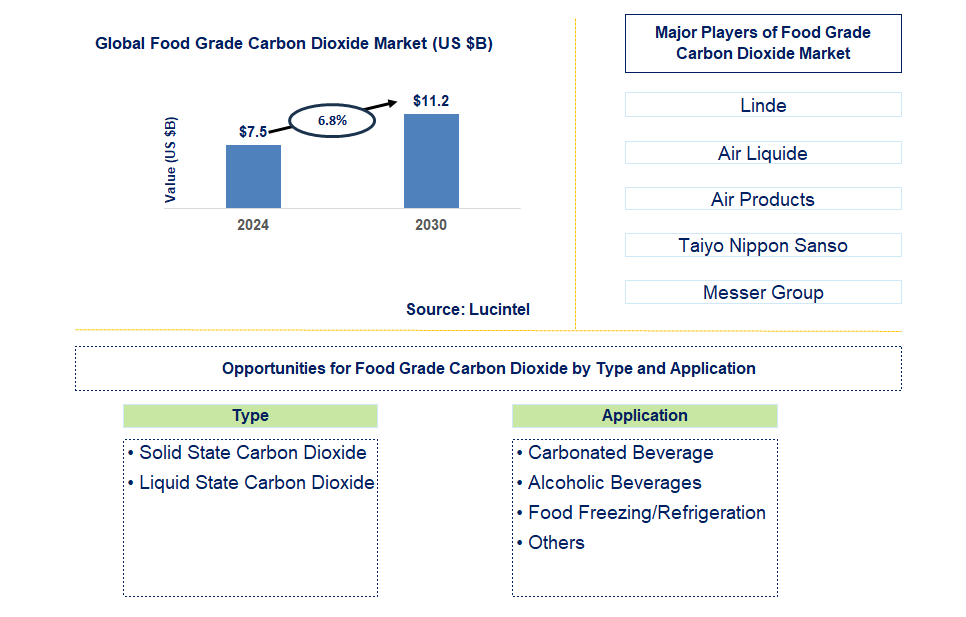
Key data points: The market size in 2030 = $11.2 billion, growth forecast = 6.8% annually for the next 6 years. Scroll below to get more insights. This market report covers trends, opportunities, and forecast in the global food grade carbon dioxide market to 2030 by type (solid state carbon dioxide and liquid state carbon dioxide), application (carbonated beverage, alcoholic beverages, food freezing/refrigeration, and others), and region (North America, Europe, Asia Pacific, and the Rest of the World)
We'll send your sample report shortly.
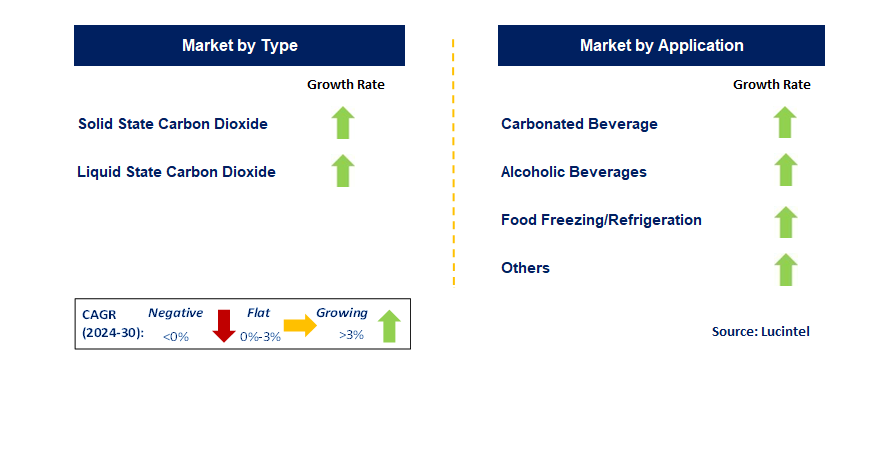
• Lucintel forecasts that, within the type category, solid-state carbon dioxide is expected to witness a higher growth over the forecast period.
• Within the application category, carbonated beverage is expected to witness the highest growth.
• In terms of regions, APAC is expected to witness the highest growth over the forecast period. A more than 150-page report is developed to help in your business decisions.
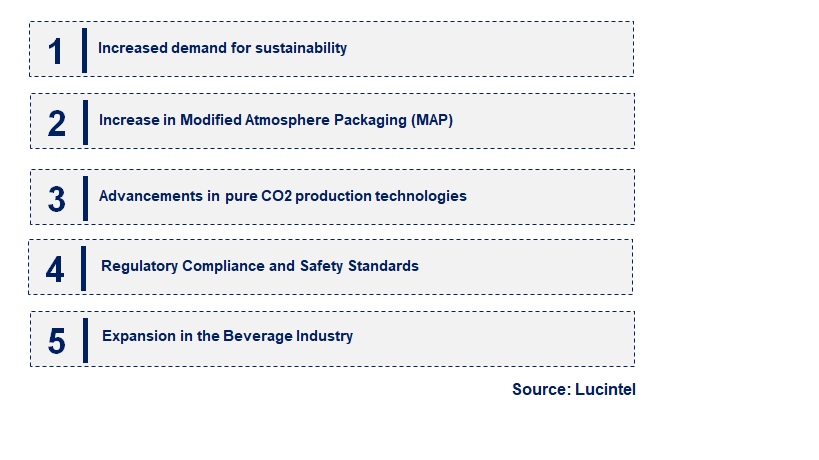
• Increased demand for sustainability: The demand for sustainability is pushing manufacturers to look for more environmentally friendly sources of food grade carbon dioxide, such as through natural fermentation processes. This reduces the carbon footprint and, above all, leaves an opportunity for much more circular economy practices in the industry, upgrading overall environmental responsibility.
• Increase in modified atmosphere packaging (MAP): Increasingly, food manufacturers are using MAP. They seek to find a means of improving the shelf life and quality of their products. Minimizing spoilage and waste at a more appreciable rate can be achieved through the use of food grade CO2 in companies' packaging. This meets the increasing demands of consumers to have fresh, high-quality products.
• Advancements in pure CO2 production technologies: Recent advances in purification and recovery technologies are transforming the production process. Innovations in membrane separation and cryogenic distillation have enabled manufacturers to produce higher purity grades of food grade carbon dioxide.
• Regulatory compliance and safety standards: Strict food safety regulations are forcing companies to raise their quality control measures. In doing so, they are aligning with the established standards of the industry. The main reason they are focusing on safety is not only to protect consumers but also to gain an advantage for their brands and the trust people have in food grade carbon dioxide products.
• Expansion in the beverage industry: Ongoing expansion in the beverage industry, especially in carbonated beverages and craft brewing, is fueling the demand for food grade CO2. The more new brands and products that come in, the stronger the requirement for a reliable, high-quality CO2 supply. Emerging trends in the food grade carbon dioxide market reflect a significant shift toward sustainability and innovation in food preservation methods. The increasing adoption of carbon dioxide for modified atmosphere packaging (MAP) and carbonated beverages is driving demand as consumers seek fresher and longer-lasting products. Additionally, advancements in carbon capture technologies are paving the way for greener production processes, aligning with global sustainability goals. The market is also witnessing a rise in collaborations between CO2 suppliers and food manufacturers to develop customized solutions tailored to specific preservation needs. As these trends continue to evolve, the food grade carbon dioxide market is set for robust growth, enhancing food quality and safety while minimizing environmental impact.
• Innovations in production technologies: Firms significantly invest in innovation and research to improve the production of carbon dioxide technologies. This primarily aims at strategies that ensure production efficiency, minimize waste production, and provide food grade pure carbon dioxide for every application.
• Sustainability practices: Manufacturers are rapidly embracing sustainable practices. They engage in reducing emissions produced from renewable energy sources used in their production processes to align with international environmental targets.
• Collaboration with industry stakeholders: Strategic partnerships and collaborations among CO2 suppliers and food manufacturers are increasingly becoming normal, ensuring knowledge-sharing and innovation in applied applications and processing techniques.
• Market consolidation trends: The market for food grade carbon dioxide is consolidating as companies try to enhance their market positions through mergers and acquisitions by extending their product portfolios and geographical presence. Recent developments in the food grade carbon dioxide market have highlighted significant advancements in production and purification technologies, enhancing the safety and quality of CO2 used in food applications. The increasing adoption of carbon dioxide for modified atmosphere packaging (MAP) has gained traction, improving the shelf life and freshness of perishable products. Furthermore, there is a growing emphasis on sustainable practices, with more companies exploring carbon capture and utilization methods to meet environmental standards. These trends indicate a dynamic shift in the market, positioning food grade carbon dioxide as a critical component in modern food preservation and processing strategies.
• Beverage industry growth in beer and carbonated beverages: There is high strategic growth opportunity for the beverage industry, as these products offer premium quality refreshing drinks and exhibit a more reliable carbonation solution.
• Food preservation techniques: Food preservation techniques represent the increasing demand for longer shelf-life products and growing usage of carbon dioxide in food grade applications like modified atmosphere packaging (MAP). Here, manufacturers get an effective solution against loss due to spoilage and improve the freshness of products.
• Convenience foods market: The increased demand for convenience foods and prepared meals is fueling the market for high-performance packaging solutions that utilize food grade CO2 to improve the quality and convenience of food choices for more hectic lifestyles.
• Food and beverage e-commerce: E-commerce development within the food and beverage industry creates opportunities for suppliers of food grade carbon dioxide to provide innovative packaging solutions that guarantee the quality of products in shipment and storage. Strategic growth in the food grade carbon dioxide market is propelled by the rising demand for food preservation and packaging solutions, as well as the increasing focus on sustainability in the food industry. Companies are investing in advanced production technologies to enhance the efficiency and quality of carbon dioxide capture and purification processes. Additionally, partnerships with food manufacturers and distributors are being established to expand market reach and develop tailored solutions that meet specific preservation needs. As consumer awareness of food safety and quality grows, the market is well positioned for robust expansion, driven by innovative applications in food and beverage preservation and processing.
• Linde
• Air Liquide
• Air Products
• Taiyo Nippon Sanso
• Messer Group
• BASF
• SOL Group
• Solid State Carbon Dioxide
• Liquid State Carbon Dioxide
• Carbonated Beverage
• Alcoholic Beverages
• Food Freezing/Refrigeration
• Others
• North America
• Europe
• Asia Pacific
• The Rest of the World
• United States: In the United States, the food grade carbon dioxide market is bolstered by the booming beverage industry, especially in carbonated drinks and craft brewing.
• China: China's food grade carbon dioxide market is rapidly expanding, driven by its growing beverage and food processing industries, which are increasingly demanding high-purity CO2.
• Germany: In Germany, the food grade carbon dioxide market is characterized by a strong commitment to quality and sustainability, with manufacturers investing in advanced technologies to produce high-purity CO2.
• India: India's food grade carbon dioxide market is gaining momentum as the country enhances its manufacturing capabilities and experiences growth in the food and beverage sector.
• Japan: Japan's food grade carbon dioxide market is focused on high-quality production standards and technological innovation, catering to the needs of a sophisticated beverage sector.


• Linde
• Air Liquide
• Air Products
• Taiyo Nippon Sanso
• Messer Group
• BASF
• SOL Group Q6. Which food grade carbon dioxide market segment will be the largest in future? Answer: Lucintel forecasts that, within the type category, solid-state carbon dioxide is expected to witness a higher growth over the forecast period. Q7. In food grade carbon dioxide market, which region is expected to be the largest in next 5 years? Answer: In terms of regions, APAC is expected to witness the highest growth over the forecast period. Q.8 Do we receive customization in this report? Answer: Yes, Lucintel provides 10% customization without any additional cost.


Choose a license that fits your team. Instant PDF delivery.
Prices exclude taxes. Instant delivery. Custom licensing available on request.
Market Report · July 22, 2026
Market Report · July 22, 2026
Market Report · July 22, 2026
Trusted partner for strategic intelligence and business growth


Receive a complimentary market analysis tailored to your industry. Our analysts will identify key growth opportunities and competitive dynamics specific to your business.

Market size, growth rate, and key trend analysis for your specific sector.

Top competitor positioning and market share analysis.

Strategic recommendations backed by data-driven insights.
Get curated market intelligence and competitive moves straight to your inbox.
By subscribing, you agree to receive our monthly insights. Unsubscribe anytime.
Receive a complimentary market analysis tailored to your industry. Our analysts will identify key growth opportunities and competitive dynamics specific to your business.
Market size, growth rate, and key trend analysis for your specific sector.
Top competitor positioning and market share analysis.
Strategic recommendations backed by data-driven insights.
Get curated market intelligence, emerging trends, and competitive moves straight to your inbox each month.
By subscribing, you agree to receive our monthly insights. Unsubscribe anytime.
We'll send your sample report shortly.