
Market Report · July 31, 2026

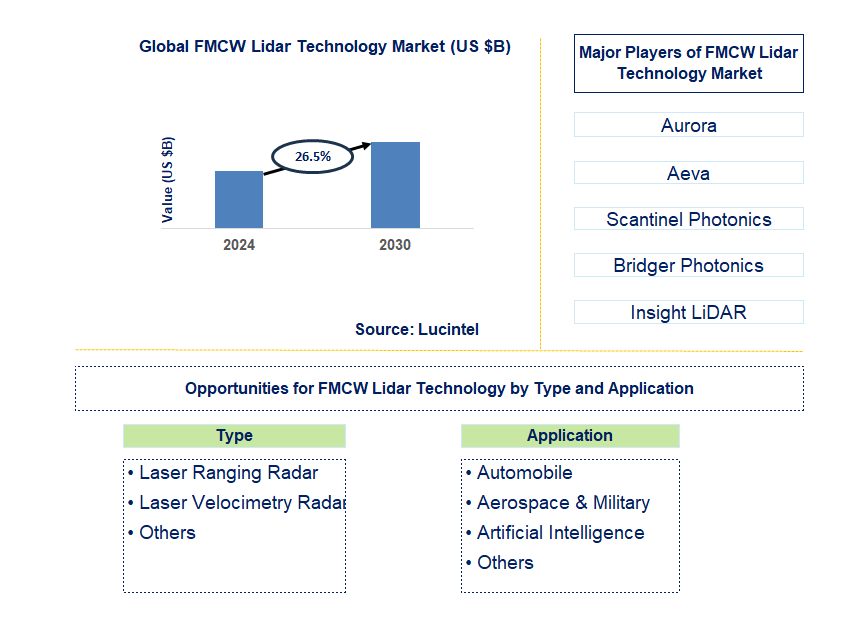
Key data points: The growth forecast = 26.5% annually for the next 6 years. Scroll below to get more insights. This market report covers trends, opportunities, and forecasts in the global fmcw lidar technology market to 2030 by type (laser ranging radar, laser velocimetry radar, and others), application (automobile, aerospace & military, artificial intelligence, and others), and region (North America, Europe, Asia Pacific, and the Rest of the World)
We'll send your sample report shortly.
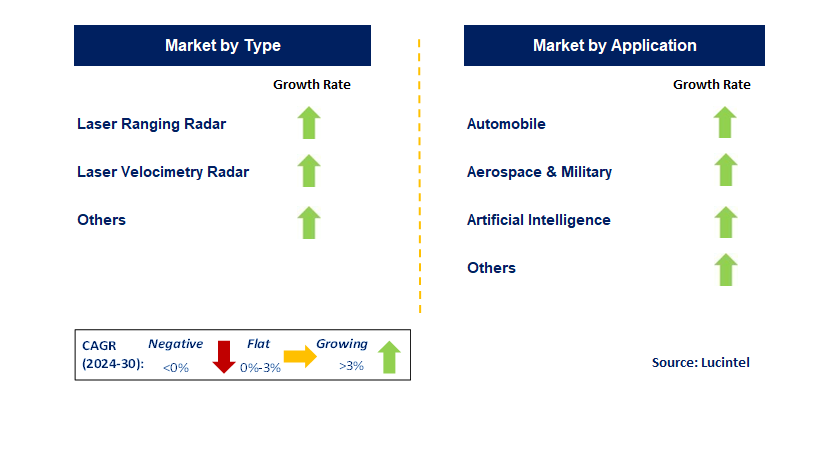
• Lucintel forecasts that, within the type category, laser ranging radar is expected to witness a higher growth over the forecast period.
• Within the application category, automobile is expected to witness the highest growth over the forecast period.
• In terms of region, APAC is expected to witness the highest growth over the forecast period. A more than 150-page report is developed to help in your business decisions.
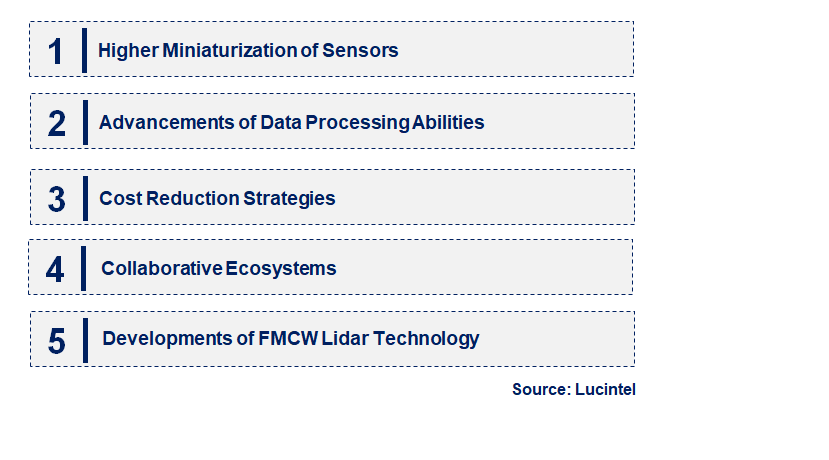
• Higher Miniaturization of Sensors: The miniaturization of FMCW Lidar sensors enables them to be applied in smaller devices, making the technology deployable in consumer electronics and compact vehicles. This makes the technology more diverse, affordable, and applicable across a broad range of devices, from smartphones to drones, maximizing market reach and encouraging more entries into the marketplace.
• Advancements in Data Processing Abilities: Advances in data processing algorithms further help develop more accurate and efficient FMCW Lidar systems. Improved machine learning techniques have made it possible to interpret sensor data more intelligently, enabling trusted real-time applications, from autonomous vehicle functionalities to smart city infrastructure and industrial automation, ultimately improving the user experience.
• Cost Reduction Strategies: There is an ongoing effort to reduce the production cost of FMCW Lidar technology to make it economically viable. New materials and production methods are being developed to lower prices significantly, democratizing access to Lidar technology, increasing its penetration across all sectors, and promoting wider adoption. Innovations will thrive as a result.
• Collaborative Ecosystems: Emergent FMCW Lidar Market: Innovation in the FMCW Lidar market is driven by increasing collaboration between technology providers, automotive manufacturers, and regulatory bodies. Partnerships and joint ventures are accelerating the research and development process, leading to faster-than-expected rollouts of advanced Lidar solutions in various applications, making the market more dynamic.
• Developments in FMCW Lidar Technology: Major firms are shaping the developments of FMCW Lidar technology with a strong emphasis on sustainability. They are focusing on sustainable production and design principles to create environmentally friendly solutions that reduce emissions, waste, and resource consumption. Environmental sensing is also a key area of focus. This trend aligns with global sustainability goals and opens new markets for Lidar technology in conservation and smart city planning, promoting greater responsibility within the industry. These trends collectively influence and shape the FMCW Lidar technology market, broadening its applicability and accessibility across industries, driving significant growth opportunities in alignment with the modern needs of societies involved.
• Development of Solid-State Lidar: The emergence of solid-state FMCW Lidar systems has transformed the market. These systems offer high ruggedness and reliability, making them applicable in diverse fields, from automobiles to drones. Their compact design lowers costs, improves integration, and has led to extensive adoption in autonomous technologies, significantly impacting market dynamics.
• Integration with AI Technologies: FMCW Lidar is increasingly being integrated with AI to enhance data interpretation and decision-making. This integration improves obstacle detection in autonomous vehicles, boosting safety and performance. Companies are focusing on AI-driven analytics to maximize the use of Lidar data for competitive advantage.
• Advancements in Multi-Target Detection: Recent advances in FMCW Lidar’s multi-target detection capabilities have improved its performance in crowded environments. This development is crucial for urban and transportation applications, where identifying multiple objects is essential to ensure safety and operational efficiency, supporting the viability and reliability of autonomous systems.
• Higher Resolution and Range: Technological advancements have significantly improved the range and resolution of FMCW Lidar systems. These improvements lead to more accurate distance measurements and object recognition, which are vital for applications in autonomous vehicles, robotics, and environmental monitoring, thus expanding their applicability and enhancing market appeal.
• Global Collaborations and Partnerships: Global collaborations between companies and research institutions are accelerating the development of FMCW Lidar technologies. These partnerships combine expertise and resources to drive rapid innovation and the introduction of next-generation Lidar solutions that better meet market needs, enriching the industry landscape. These advancements position FMCW Lidar technology as a foundation for further developments in automation, transportation, and smart infrastructure, driving market growth and technological evolution to meet the needs of the modern world.
• Autonomous Vehicles: FMCW Lidar technology is a key growth segment in the automotive space. Lidar systems are crucial for developing advanced autonomous vehicles, improving safety and navigability. This trend is expected to lead to safer, more efficient vehicles, and companies have the opportunity to innovate and create tailor-made solutions to meet emerging market needs.
• Smart Cities: FMCW Lidar technology is being increasingly applied in smart city initiatives, driving demand in urban planning and management. Lidar systems support accurate mapping, traffic monitoring, and environmental assessments, providing essential data for city planners to improve infrastructure, service delivery, and sustainable urban development, enhancing quality of life.
• Robotics and Automation: FMCW Lidar is becoming more prominent in robotics, especially for navigation and spatial awareness. With Lidar technology, robots can perform more effectively in complex environments, increasing their applications in manufacturing, logistics, and service industries. This growth presents substantial opportunities for companies specializing in robotic solutions, driving innovation and competitiveness.
• Environmental Monitoring: FMCW Lidar is an emerging tool in environmental monitoring. Its applications include assessing deforestation and urban heat islands, as well as evaluating contamination levels. The technology provides critical data to environmental scientists and policymakers, supporting better decision-making and effective conservation strategies that contribute to global sustainability.
• Agricultural Applications: FMCW Lidar is proving valuable in precision agriculture by providing detailed topographical data and monitoring crop health. This offers a promising opportunity for companies looking to innovate in agricultural technology solutions that help farmers make better decisions and improve productivity and sustainability. These strategic growth opportunities demonstrate the wide applicability of FMCW Lidar technology. The technology holds immense potential for innovation across sectors while addressing urgent global challenges.
• Increased Demand for Autonomous Solutions: One of the biggest drivers for FMCW Lidar technology is the growing demand for autonomous vehicles. As industries push for improved safety, efficiency, and navigation, Lidar systems become critical. This emergent demand fuels innovation in increasingly sophisticated and reliable solutions for various applications.
• Technological Advancements: The FMCW Lidar market is driven by continuous developments in sensor technology, data processing algorithms, and AI integration. These advancements improve accuracy and reliability, making Lidar systems applicable across various sectors. Companies focusing on R&D will be well-positioned to meet the changing demands of consumers and industries.
• Government Initiatives and Regulations: Supportive government policies and regulatory frameworks are key drivers for the adoption of FMCW Lidar technology. Initiatives focused on road safety and urban planning improve safety standards, creating a favorable investment climate for Lidar systems. Regulatory compliance drives innovation as companies respond to changing standards.
• Investment in Smart Infrastructure: Advancements in FMCW Lidar technology for smart city projects are boosting the Lidar market. Cities are increasingly adopting Lidar for traffic management and environmental monitoring, presenting significant opportunities for companies that can provide viable Lidar solutions. Challenges in the FMCW Lidar technology market include:
• Cost-Effectiveness of Lidar Solutions: The reduced costs of FMCW Lidar technology make it accessible to a broader range of industries. As manufacturing processes improve and economies of scale are achieved, Lidar solutions become more affordable, increasing adoption and expanding market opportunities.
• High Upfront Cost Barriers: High initial costs remain an obstacle for many potential users of FMCW Lidar technology. Large upfront investments discourage small firms and organizations in developing regions from adopting Lidar systems, limiting market penetration and slowing growth in certain segments.
• Regulatory Challenges: Inconsistent regulatory frameworks pose significant challenges in navigating the FMCW Lidar market. Multiple regulations across regions complicate market entry for manufacturers and service providers. These inconsistencies can slow the adoption of Lidar technology and hinder innovation, leaving businesses uncertain about investing in the market. In summary, factors such as increased demand, technological innovation, and government support are driving the FMCW Lidar technology market. However, significant challenges, including high initial costs and regulatory hurdles, must be overcome to unlock maximum growth potential and enable widespread use across sectors.
• Aurora
• Aeva
• Scantinel Photonics
• Bridger Photonics
• Insight LiDAR
• iLidar
• OURS
• Laser Ranging Radar
• Laser Velocimetry Radar
• Others
• Automobile
• Aerospace & Military
• Artificial Intelligence
• Others
• North America
• Europe
• Asia Pacific
• The Rest of the World
• United States: The U.S. is a leading market for FMCW Lidar technology, particularly in the autonomous vehicle sector. Major companies have invested heavily in sensor systems focused on safety and efficiency. Collaborative efforts between automobile manufacturers and tech firms are driving innovation, and regulatory support enhances market expansion, creating an ideal environment for growth.
• China: China has widely adopted FMCW Lidar technology across industries, with a focus on smart city initiatives and industrial automation. Government incentives and infrastructure investments have accelerated Lidar deployments for traffic management and environmental monitoring, significantly enhancing urban planning and operational efficiency in metropolitan areas.
• Germany: Germany is concentrating on integrating FMCW Lidar into automotive applications. Several automotive giants are investing heavily in R&D to improve Lidar performance, particularly in challenging weather conditions, positioning German companies as leaders in advanced autonomous driving technologies.
• India: The FMCW Lidar market in India is emerging rapidly, with applications in agriculture, urban planning, and more. Start-ups and tech companies are exploring low-cost Lidar solutions to improve accuracy across various sectors. Government support is fostering innovation and adoption, paving the way for a thriving market landscape.
• Japan: Japan is integrating FMCW Lidar technology in the robotics and automation sector. Companies are focusing on enhancing the navigation accuracy and spatial awareness capabilities of robotic systems, which is crucial for improving manufacturing, logistics, and service robots to increase productivity and operational efficiency in a competitive market.


• Aurora
• Aeva
• Scantinel Photonics
• Bridger Photonics
• Insight LiDAR
• iLidar
• OURS Q5. Which fmcw lidar technology market segment will be the largest in future? Answer: Lucintel forecasts that laser ranging radar is expected to witness higher growth over the forecast period. Q6. In fmcw lidar technology market, which region is expected to be the largest in next 5 years? Answer: APAC is expected to witness highest growth over the forecast period. Q.7 Do we receive customization in this report? Answer: Yes, Lucintel provides 10% customization without any additional cost.


Choose a license that fits your team. Instant PDF delivery.
Prices exclude taxes. Instant delivery. Custom licensing available on request.
Market Report · July 31, 2026
Market Report · July 31, 2026
Market Report · July 31, 2026
Trusted partner for strategic intelligence and business growth


Receive a complimentary market analysis tailored to your industry. Our analysts will identify key growth opportunities and competitive dynamics specific to your business.

Market size, growth rate, and key trend analysis for your specific sector.

Top competitor positioning and market share analysis.

Strategic recommendations backed by data-driven insights.
Get curated market intelligence and competitive moves straight to your inbox.
By subscribing, you agree to receive our monthly insights. Unsubscribe anytime.
Receive a complimentary market analysis tailored to your industry. Our analysts will identify key growth opportunities and competitive dynamics specific to your business.
Market size, growth rate, and key trend analysis for your specific sector.
Top competitor positioning and market share analysis.
Strategic recommendations backed by data-driven insights.
Get curated market intelligence, emerging trends, and competitive moves straight to your inbox each month.
By subscribing, you agree to receive our monthly insights. Unsubscribe anytime.
We'll send your sample report shortly.