
Report Feature
Flexible Magnetic Sensor Market Trends and Forecast
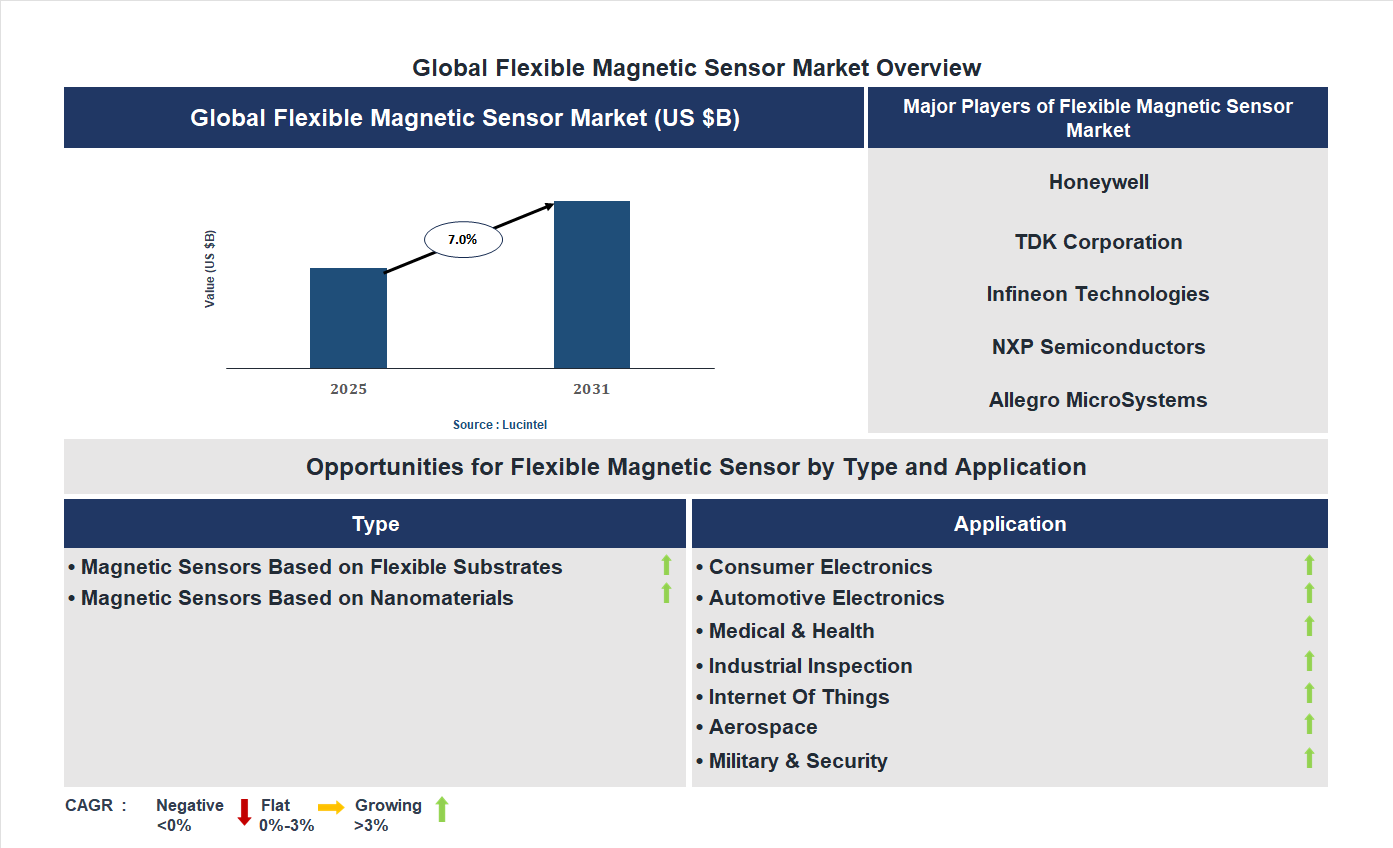
The future of the global flexible magnetic sensor market looks promising with opportunities in the consumer electronics, automotive electronics, medical & health, industrial inspection, internet of thing, aerospace, and military & security markets. The global flexible magnetic sensor market is expected to grow with a CAGR of 7.0% from 2025 to 2031. The major drivers for this market are the increasing demand for flexible sensing technologies, the rising adoption in wearable electronic devices, and the growing use in automotive electronic systems.• Lucintel forecasts that, within the type category, magnetic sensor based on nanomaterial is expected to witness higher growth over the forecast period.
• Within the application category, automotive electronics is expected to witness the highest growth.
• In terms of region, APAC is expected to witness the highest growth over the forecast period. Gain valuable insights for your business decisions with our comprehensive 150+ page report. Sample figures with some insights are shown below.
Emerging Trends in the Flexible Magnetic Sensor Market
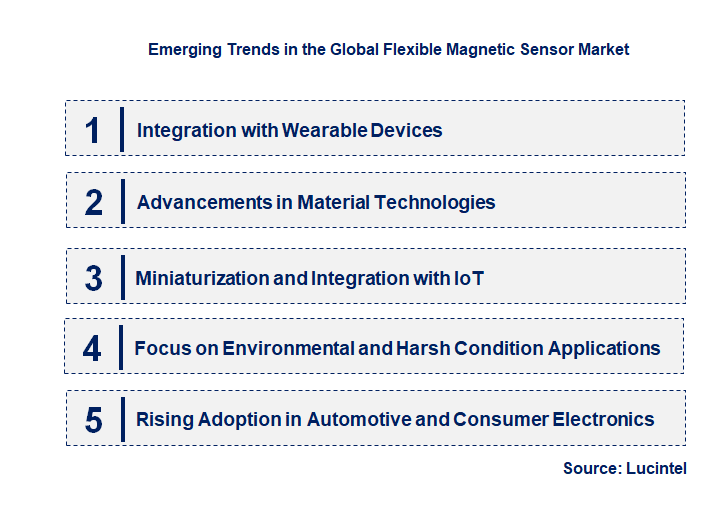
The flexible magnetic sensor market is experiencing rapid growth driven by technological advancements and increasing demand across various industries. As devices become more compact, adaptable, and integrated into everyday life, the need for flexible, durable, and highly sensitive magnetic sensors is rising. Innovations in materials, miniaturization, and IoT integration are shaping the future of this market. Companies are investing heavily in R&D to develop sensors that can withstand harsh environments while maintaining high performance. These developments are not only expanding the applications of magnetic sensors but also transforming how industries approach sensing solutions, leading to more innovative, efficient, and versatile products.• Integration with Wearable Devices: The demand for flexible magnetic sensors in wearable technology is surging. These sensors enable health monitoring, fitness tracking, and personalized medical devices by providing accurate magnetic field detection in flexible, lightweight formats. Their ability to conform to body contours enhances user comfort and device performance. As wearable tech becomes more mainstream, the need for flexible, reliable sensors that can operate seamlessly in dynamic environments is driving market growth. This trend is fostering innovation in sensor design, making health and fitness monitoring more accessible and precise.
• Advancements in Material Technologies: New materials such as flexible polymers, nanomaterials, and composites are revolutionizing sensor fabrication. These materials offer enhanced flexibility, durability, and sensitivity, allowing sensors to withstand bending, stretching, and environmental stresses. The adoption of such advanced materials improves sensor lifespan and performance, opening up applications in flexible electronics, robotics, and medical devices. This trend is crucial for developing next-generation sensors that are both high-performing and adaptable to various form factors, thereby expanding the market’s scope and potential.
• Miniaturization and Integration with IoT: The trend toward miniaturization enables magnetic sensors to be embedded into compact and complex systems. Integration with IoT platforms allows real-time data collection, remote monitoring, and automation across industries such as automotive, healthcare, and consumer electronics. Smaller, smarter sensors facilitate the development of connected devices that are more efficient and user-friendly. This integration is transforming traditional sensing applications into intelligent systems, enhancing operational efficiency, predictive maintenance, and user experience, and significantly expanding market opportunities.
• Focus on Environmental and Harsh Condition Applications: The market is witnessing increased demand for sensors capable of operating reliably in extreme environments, including high temperatures, moisture, and mechanical stress. Flexible magnetic sensors designed for such conditions are vital in industrial automation, aerospace, and oil & gas sectors. Their robustness ensures continuous operation and safety in challenging settings. This focus on durability and environmental resilience is driving innovation in sensor design, broadening application horizons, and ensuring market growth in sectors requiring high-performance sensing solutions under harsh conditions.
• Rising Adoption in Automotive and Consumer Electronics: The automotive industry is increasingly integrating flexible magnetic sensors for applications like position sensing, electric vehicle motors, and advanced driver-assistance systems (ADAS). Similarly, consumer electronics benefit from flexible sensors in smartphones, tablets, and gaming devices for enhanced user interaction. The trend toward flexible, lightweight sensors supports the development of smarter, more responsive products. This adoption accelerates market expansion, encourages technological innovation, and underscores the importance of flexible magnetic sensors in creating more connected, efficient, and user-centric devices. In summary, these emerging trends are fundamentally reshaping the flexible magnetic sensor market by fostering innovation, expanding application areas, and enhancing sensor performance and durability. The integration of advanced materials, miniaturization, and environmental resilience is enabling new possibilities across industries, making sensors more adaptable, reliable, and integral to the evolving landscape of smart, connected devices.
Recent Development in the Flexible Magnetic Sensor Market
The flexible magnetic sensor market has experienced significant growth driven by advancements in wearable technology, IoT applications, and flexible electronics. As industries seek more adaptable and durable sensing solutions, the market is evolving rapidly with innovative materials and integration techniques. These developments are enhancing sensor performance, expanding application areas, and reducing costs, thereby attracting new players and investments. The increasing demand for flexible, lightweight, and high-precision sensors is fueling market expansion. This dynamic environment is fostering collaborations between tech companies and research institutions, leading to groundbreaking products that meet the needs of modern electronics and healthcare sectors.• Material Innovation: Development of new flexible, durable, and high-sensitivity magnetic materials has improved sensor performance and longevity, enabling their use in more demanding environments and expanding application possibilities.
• Miniaturization and Integration: Advances in microfabrication techniques have led to smaller, more integrated sensors that can be embedded into wearable devices, consumer electronics, and medical implants, enhancing user comfort and device functionality.
• Enhanced Sensitivity and Accuracy: Improvements in sensor design and signal processing algorithms have increased sensitivity and accuracy, making these sensors suitable for precise applications such as navigation, robotics, and healthcare monitoring.
• Cost Reduction and Scalability: Manufacturing innovations and economies of scale have lowered production costs, making flexible magnetic sensors more accessible for mass-market applications and encouraging widespread adoption.
• Growing Application Areas: The market is witnessing expansion into new sectors such as healthcare (wearable health monitors), automotive (flexible sensors for autonomous vehicles), and consumer electronics, driven by the need for flexible, reliable sensing solutions. In summary, these developments are significantly impacting the flexible magnetic sensor market by enhancing product performance, reducing costs, and broadening application scopes. The market is becoming more competitive and innovative, with increased adoption across various industries, ultimately accelerating growth and technological progress.
Strategic Growth Opportunities in the Flexible Magnetic Sensor Market
The flexible magnetic sensor market is experiencing rapid growth driven by technological advancements and increasing demand across various industries. As applications become more diverse, the need for adaptable, high-performance sensors is paramount. This evolution is opening new avenues for innovation, enabling smarter, more efficient systems. Key growth opportunities are emerging across different sectors, driven by the need for flexibility, miniaturization, and enhanced sensitivity. These developments are transforming the market landscape, fostering new product development, and expanding application scopes. Companies that capitalize on these opportunities will be well-positioned to lead in this dynamic environment, ultimately shaping the future of flexible magnetic sensing technology.• Consumer Electronics: The integration of flexible magnetic sensors into wearable technology enhances user experience through improved motion detection and health monitoring, driving market growth and innovation in consumer electronics.
• Automotive Industry: Flexible magnetic sensors are increasingly used in automotive applications for advanced driver-assistance systems (ADAS) and autonomous vehicles, improving safety, reliability, and enabling new functionalities.
• Healthcare Sector: These sensors facilitate non-invasive diagnostics, flexible implantable devices, and real-time health monitoring, significantly impacting patient care and expanding healthcare applications.
• Industrial Automation: Flexible magnetic sensors improve the precision and durability of industrial robots and machinery, enabling better process control, predictive maintenance, and operational efficiency.
• Smart Packaging and Retail: Incorporating flexible magnetic sensors into packaging enhances inventory management, anti-theft measures, and consumer engagement, opening new revenue streams and improving supply chain visibility. In summary, these growth opportunities are significantly impacting the flexible magnetic sensor market by broadening application horizons, fostering innovation, and driving demand across multiple sectors. This diversification is leading to increased market size, competitive advancements, and a more resilient industry poised for sustained growth.
Flexible Magnetic Sensor Market Driver and Challenges
The flexible magnetic sensor market is influenced by a variety of technological, economic, and regulatory factors that shape its growth trajectory. Advances in flexible electronics and sensor technology are enabling new applications across industries such as healthcare, automotive, and consumer electronics. Economic factors like increasing demand for wearable devices and IoT integration are driving market expansion. Regulatory standards concerning safety, data privacy, and environmental impact also play a crucial role in shaping product development and deployment. Navigating these drivers and challenges is essential for stakeholders aiming to capitalize on emerging opportunities while addressing potential barriers in this dynamic landscape. The factors responsible for driving the flexible magnetic sensor market include:• Technological Innovation: The rapid development of flexible, lightweight, and highly sensitive magnetic sensors is a key driver. Innovations in materials such as flexible polymers and nanomaterials enhance sensor performance, enabling their integration into wearable devices, flexible displays, and smart packaging. These advancements facilitate real-time data collection, improve accuracy, and expand application possibilities, thus fueling market growth. As technology continues to evolve, the cost of manufacturing flexible sensors decreases, making them more accessible across various sectors.
• Growing Adoption in Healthcare: The healthcare industry is increasingly adopting flexible magnetic sensors for applications like wearable health monitors, prosthetics, and minimally invasive diagnostic tools. These sensors offer non-invasive, real-time monitoring of vital signs and magnetic fields, improving patient outcomes. The rising prevalence of chronic diseases and the aging population further boost demand. Additionally, regulatory approvals and technological improvements are making these sensors more reliable and affordable, encouraging widespread adoption in medical devices.
• Expansion of IoT and Smart Devices: The proliferation of Internet of Things (IoT) devices and smart systems is a significant growth driver. Flexible magnetic sensors are integral to smart home systems, industrial automation, and automotive applications, providing precise magnetic field detection in compact, flexible formats. Their ability to operate in diverse environments and integrate seamlessly with wireless communication modules enhances their appeal. As IoT networks expand, the demand for flexible, durable sensors that can be embedded into various surfaces and objects increases, propelling market growth.
• Automotive Industry Integration: The automotive sector is increasingly incorporating flexible magnetic sensors for applications such as position sensing, speed detection, and anti-theft systems. These sensors contribute to vehicle safety, navigation, and autonomous driving features. Their flexibility allows integration into curved surfaces and complex geometries within vehicles, offering design versatility. Regulatory standards for vehicle safety and the push toward electric and autonomous vehicles further stimulate demand. As automotive manufacturers seek lightweight, reliable sensors, the market for flexible magnetic sensors is poised for significant expansion.
• Regulatory and Environmental Factors: Stringent safety, environmental, and data privacy regulations influence the market. Compliance with standards such as RoHS and REACH ensures environmentally friendly manufacturing processes. Data privacy laws impact the deployment of sensors in healthcare and consumer electronics, requiring secure data handling. Regulatory approvals can be time-consuming but are essential for market acceptance. These factors encourage innovation in eco-friendly materials and secure data transmission, shaping product development and market strategies. The challenges facing this Marketflexible magnetic sensor market include:
• High Manufacturing Costs: Despite technological advancements, producing flexible magnetic sensors remains costly due to complex fabrication processes and expensive materials like nanomaterials and specialized polymers. These costs hinder mass production and affordability, especially for low-cost consumer applications. Additionally, scaling up manufacturing while maintaining quality and performance standards presents significant challenges, potentially limiting market penetration and slowing overall growth.
• Technical Limitations and Reliability: Flexible magnetic sensors often face issues related to durability, sensitivity, and stability over time. Mechanical stress, environmental factors such as humidity and temperature fluctuations, can degrade sensor performance. Ensuring consistent accuracy and long-term reliability in diverse operating conditions remains a challenge. Overcoming these technical limitations requires ongoing research and development, which can be resource-intensive and delay commercialization.
• Regulatory and Standardization Barriers: Navigating complex regulatory landscapes and establishing industry standards pose significant hurdles. Variations in regulations across regions can delay product launches and increase compliance costs. Lack of standardized testing protocols for flexible magnetic sensors complicates quality assurance and interoperability. These barriers can restrict market entry, especially for new entrants, and slow the pace of innovation and adoption. In summary, the flexible magnetic sensor market is driven by technological innovations, expanding applications in healthcare, IoT, and automotive sectors, and supportive regulatory trends. However, high manufacturing costs, technical reliability issues, and regulatory barriers present notable challenges. The interplay of these factors will shape the market’s evolution, requiring stakeholders to innovate continuously and navigate complex compliance landscapes. Overall, the market holds substantial growth potential, provided these drivers are harnessed effectively and challenges are addressed strategically.
List of Flexible Magnetic Sensor Companies
Companies in the market compete on the basis of product quality offered. Major players in this market focus on expanding their manufacturing facilities, R&D investments, infrastructural development, and leverage integration opportunities across the value chain. With these strategies flexible magnetic sensor companies cater increasing demand, ensure competitive effectiveness, develop innovative products & technologies, reduce production costs, and expand their customer base. Some of the flexible magnetic sensor companies profiled in this report include-• Honeywell
• TDK Corporation
• Infineon Technologies
• NXP Semiconductors
• Allegro MicroSystems
• Asahi Kasei Microdevices
• Melexis
• AMS
• TE Connectivity
• Murata Manufacturing
Flexible Magnetic Sensor Market by Segment
The study includes a forecast for the global flexible magnetic sensor market by type, application, and region.Flexible Magnetic Sensor Market by Type [Value from 2019 to 2031]:
• Magnetic Sensors Based on Flexible Substrates
• Magnetic Sensors Based on Nanomaterials
Flexible Magnetic Sensor Market by Application [Value from 2019 to 2031]:
• Consumer Electronics
• Automotive Electronics
• Medical & Health
• Industrial Inspection
• Internet Of Things
• Aerospace
• Military & Security
Flexible Magnetic Sensor Market by Region [Value from 2019 to 2031]:
• North America
• Europe
• Asia Pacific
• The Rest of the World
Country Wise Outlook for the Flexible Magnetic Sensor Market
The flexible magnetic sensor market has experienced significant growth driven by advancements in wearable technology, automotive applications, and consumer electronics. As industries seek more adaptable and durable sensing solutions, innovations in materials and manufacturing processes have accelerated. Countries like the United States, China, Germany, India, and Japan are at the forefront, each contributing unique developments that shape the global landscape. These nations are investing heavily in research and development to enhance sensor performance, reduce costs, and expand application areas, reflecting a broader trend toward smarter, more flexible electronic systems.• United States: The US market has seen rapid innovation in flexible magnetic sensors, driven by the automotive and healthcare sectors. Leading tech companies are developing sensors with higher sensitivity and durability for wearable devices and autonomous vehicles. The focus on integrating sensors with IoT platforms has also increased, enabling smarter data collection and analysis. Government funding for research in flexible electronics further supports advancements, making the US a key player in this market.
• China: China is experiencing substantial growth in flexible magnetic sensor production, fueled by its robust electronics manufacturing industry. The country is investing in developing low-cost, high-performance sensors for consumer electronics, smart wearables, and robotics. Local companies are expanding their R&D capabilities, leading to innovations in sensor miniaturization and energy efficiency. Government initiatives aim to boost domestic innovation, positioning China as a major hub for flexible sensor technology.
• Germany: Germany's market focus is on high-precision, industrial-grade flexible magnetic sensors, especially for automotive and manufacturing applications. The country emphasizes quality and reliability, integrating sensors into advanced automation systems. German research institutions collaborate with industry leaders to develop sensors with enhanced environmental resistance and long-term stability. This approach supports Germany’s reputation for engineering excellence and innovation in industrial sensing solutions.
• India: India is rapidly adopting flexible magnetic sensors across sectors like healthcare, consumer electronics, and agriculture. The market benefits from increasing investments in electronics manufacturing and a growing startup ecosystem. Indian companies are working on cost-effective sensor solutions tailored for local needs, such as wearable health devices and smart farming tools. Government initiatives promoting electronics manufacturing are expected to further accelerate market growth and technological development.
• Japan: Japan remains a leader in advanced sensor technology, focusing on miniaturization and integration with robotics and automation systems. Japanese firms are developing highly sensitive, durable, flexible magnetic sensors for use in industrial robots, medical devices, and consumer electronics. The country’s emphasis on innovation and quality ensures the deployment of reliable sensors in demanding environments. Ongoing research aims to improve sensor flexibility, energy efficiency, and integration with emerging technologies like AI and IoT.

Features of the Global Flexible Magnetic Sensor Market
Market Size Estimates: Flexible magnetic sensor market size estimation in terms of value ($B). Trend and Forecast Analysis: Market trends (2019 to 2024) and forecast (2025 to 2031) by various segments and regions. Segmentation Analysis: Flexible magnetic sensor market size by type, application, and region in terms of value ($B). Regional Analysis: Flexible magnetic sensor market breakdown by North America, Europe, Asia Pacific, and Rest of the World. Growth Opportunities: Analysis of growth opportunities in different types, applications, and regions for the flexible magnetic sensor market. Strategic Analysis: This includes M&A, new product development, and competitive landscape of the flexible magnetic sensor market. Analysis of competitive intensity of the industry based on Porter’s Five Forces model.
FAQ
Q1. What is the growth forecast for flexible magnetic sensor market? Answer: The global flexible magnetic sensor market is expected to grow with a CAGR of 7.0% from 2025 to 2031. Q2. What are the major drivers influencing the growth of the flexible magnetic sensor market? Answer: The major drivers for this market are the increasing demand for flexible sensing technologies, the rising adoption in wearable electronic devices, and the growing use in automotive electronic systems. Q3. What are the major segments for flexible magnetic sensor market? Answer: The future of the flexible magnetic sensor market looks promising with opportunities in the consumer electronics, automotive electronics, medical & health, industrial inspection, internet of thing, aerospace, and military & security markets. Q4. Who are the key flexible magnetic sensor market companies? Answer: Some of the key flexible magnetic sensor companies are as follows:• Honeywell
• TDK Corporation
• Infineon Technologies
• NXP Semiconductors
• Allegro MicroSystems
• Asahi Kasei Microdevices
• Melexis
• AMS
• TE Connectivity
• Murata Manufacturing Q5. Which flexible magnetic sensor market segment will be the largest in future? Answer: Lucintel forecasts that, within the type category, magnetic sensor based on nanomaterial is expected to witness higher growth over the forecast period. Q6. In flexible magnetic sensor market, which region is expected to be the largest in next 5 years? Answer: In terms of region, APAC is expected to witness the highest growth over the forecast period. Q7. Do we receive customization in this report? Answer: Yes, Lucintel provides 10% customization without any additional cost.
Table of Contents
List of Figures
List of Tables
Methodology
- In-depth interviews of the major players in this market
- Detailed secondary research from competitors’ financial statements and published data
- Extensive searches of published works, market, and database information pertaining to industry news, company press releases, and customer intentions
- A compilation of the experiences, judgments, and insights of Lucintel’s professionals, who have analyzed and tracked this market over the years.


Buy Now
Choose a license that fits your team. Instant PDF delivery.
Prices exclude taxes. Instant delivery. Custom licensing available on request.
Key Questions
- • What are some of the most promising, high-growth opportunities for the flexible magnetic sensor market by type (magnetic sensors based on flexible substrates and magnetic sensors based on nanomaterials), application (consumer electronics, automotive electronics, medical & health, industrial inspection, internet of things, aerospace, and military & security), and region (North America, Europe, Asia Pacific, and the Rest of the World)?
- • Which segments will grow at a faster pace and why?
- • Which region will grow at a faster pace and why?
- • What are the key factors affecting market dynamics? What are the key challenges and business risks in this market?
- • What are the business risks and competitive threats in this market?
- • What are the emerging trends in this market and the reasons behind them?
- • What are some of the changing demands of customers in the market?
- • What are the new developments in the market? Which companies are leading these developments?
- • Who are the major players in this market? What strategic initiatives are key players pursuing for business growth?
- • What are some of the competing products in this market and how big of a threat do they pose for loss of market share by material or product substitution?
- • What M&A activity has occurred in the last 6 years and what has its impact been on the industry? For any questions related to Flexible Magnetic Sensor Market, Flexible Magnetic Sensor Market Size, Flexible Magnetic Sensor Market Growth, Flexible Magnetic Sensor Market Analysis, Flexible Magnetic Sensor Market Report, Flexible Magnetic Sensor Market Share, Flexible Magnetic Sensor Market Trends, Flexible Magnetic Sensor Market Forecast, Flexible Magnetic Sensor Companies, write Lucintel analyst at email: helpdesk@lucintel.com. We will be glad to get back to you soon.


