
Market Report · July 15, 2026

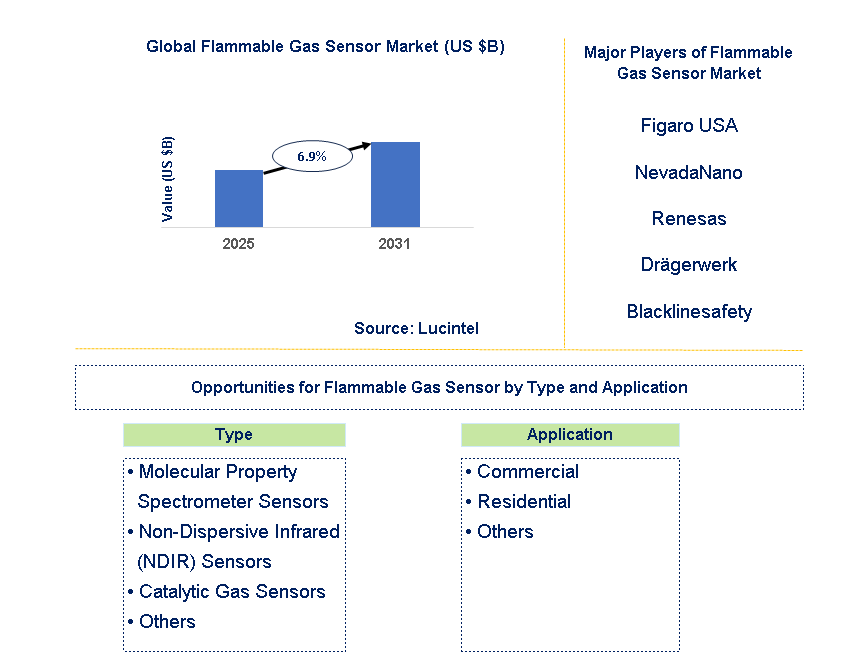
Key data points: The growth forecast = 6.9% annually for the next 7 years. Scroll below to get more insights. This market report covers Trends, opportunities and forecasts in flammable gas sensor market to 2031 by type (molecular property spectrometer sensors, non-dispersive infrared (NDIR) sensors, catalytic gas sensors, and others), application (commercial, residential, and others), and region (North America, Europe, Asia Pacific, and the Rest of the World)
We'll send your sample report shortly.
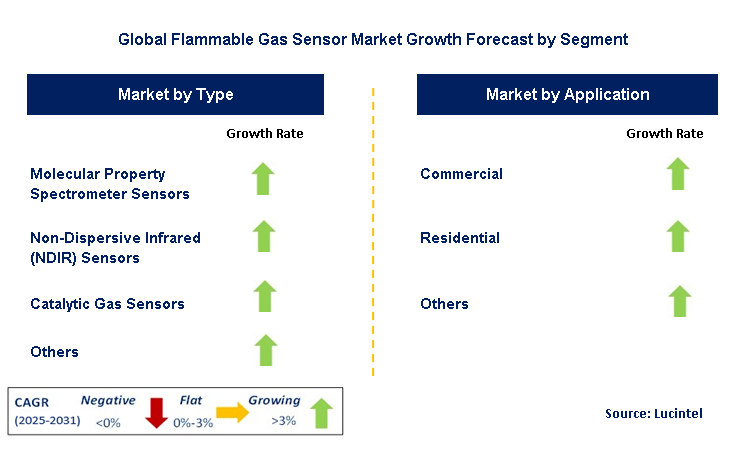
• Lucintel forecasts that, within the type category, non-dispersive infrared sensor is expected to witness the highest growth over the forecast period due to its high accuracy, sensitivity, and long-term stability.
• Within the application category, commercial is expected to witness the highest growth.
• In terms of region, APAC is expected to witness the highest growth over the forecast period due to rise in manufacturing, energy and chemical industries.
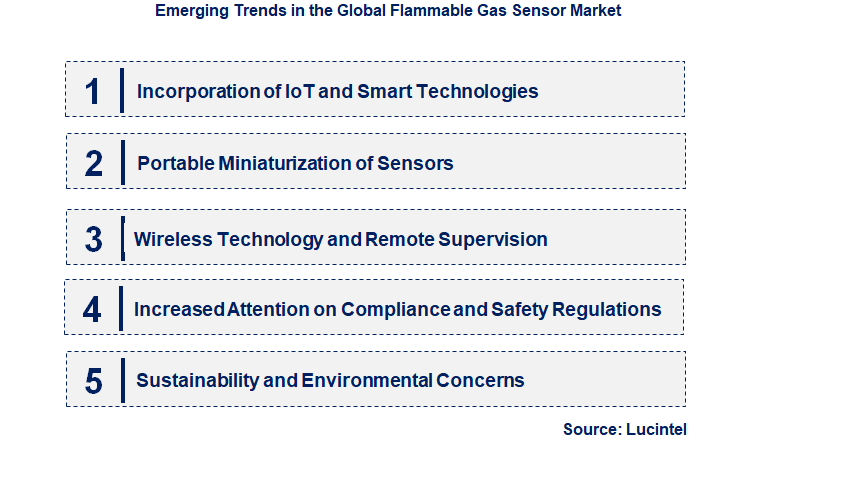
• Incorporation of IoT and Smart Technologies: Merging the Internet Of Things (IoT) technologies into flammable gas sensors is a new trend that facilitates data access, data monitoring, and control. IoT sensors, for instance, have the capability of sending data from the sensors to the central system in real time, which improves gas leaks safety measures by allowing faster responses. This technology is useful in industrial conditions where there is a need for quick response and action. Moreover, IoT integration assists in automated maintenance by providing predictive analytics that lowers nonproductive time. Flammable gas IoT sensors are critical in modern safety infrastructure as the trend of smart factories and automated systems continues to gain traction.
• Portable Miniaturization of Sensors: The miniaturization trend of flammable gas sensors is on the rise as compact and portable devices become more in demand. Portable small-sized sensors can easily be placed in industrial and domestic environments, making them more suitable for personal safety and easier monitoring from a distance. Users get greater convenience in gas leak detection with these compact gadgets because remote measurements can be taken in hard to reach places. This trend is important in oil and gas, mining, and chemicals industries where employees spend a considerable amount of time in dangerous working environments. Redesigning the shape and size of gas sensors makes it possible to meet the safety guidelines performed without meeting the needed efficiency.
• Wireless Technology and Remote Supervision: The introduction of wireless communications technology into gas sensors systems is allowing for remote monitoring and control. With wireless technologies, there is no longer a requirement for hardwired connections in gas sensors systems, which enhances installation and operational flexibility. These systems are useful in dangerous places where wired systems may be harmful. Operators can also access real time data leading to immediate action in case of gas leaks or other dangerous situations. The advancements in wireless sensor networks (WSNs) coupled with the need for constant monitoring in oil, gas, and chemical industries has triggered this shift.
• Increased Attention on Compliance and Safety Regulations: All over the world, there is stricter enforcement of industrial safety and environmental protection. With this, there is increased attention to ensure that gas sensors are safe and in compliance to set standards. For example, OSHA (Occupational Safety and Health Administration) in the USA and ATEX (Atmospheres Explosibles) in Europe set regulations that increase for manufacturers to developed performance sensors that meet the necessary safety parameters. This stimulates innovation in the sensor technology to make sure they comply with the safety measures to minimize risks of accidents and provide the safe working environment needed by industries dealing with hazardous gases.
• Sustainability and Environmental Concerns: With the rise in global caution towards the environment and climate change, the development of flammable gas sensors is also being given a sustainability consideration. Manufacturers are trying to design sensors that are environmentally friendly and efficient. This comes from the need to reduce waste and extend the life of sensor devices. Moreover, sustainability is also being realized in economists through the low power consumption technology used in the design of the sensors which increases battery life and reduces electronic wastes. In some industries like oil and gas and chemical industry, the positive change in the business practice is now a requirement for the social responsibility of the business. The gas sensors market is changing due to these new movements - IoT integration, miniaturization, the addition of wireless communication, meeting safety compliances, and focusing on sustainability. Manufacturers are adopting advanced gas detection systems that are eco-friendly and easy to operate in a remote way. All of these changes not only increase safety during the operations but also place a much higher importance on innovation and sustainability in gas detection systems in industries.
• Progress in Semiconductor Sensors Technology: With the diode and multiturn potentiometer and sensor diffusing technology came a revolution in the flammable gas sensor market. To date, semiconductor based sensors have offered increased sensitivity, rapid flammable gas response times, and lower overall power consumption. Their ability to detect extremely low concentrations of flammable gases, crucial for early leak detection, makes them superior to legacy sensors. Moreover, they have high accuracy in measurements, and they are affordable, which makes these sensors attractive for permanent installations. The substantiated findings advanced the market, especially in oil and gas sectors, wherein devices capable of pinpointing modest leaks preemptively have valuable importance for safety risks management.
• Multi-Gas Detection Systems: The rise of multi-gas detection systems is revolutionising how industries monitor the possibility of gas leakages. These systems can monitor various gases at the same time, enhancing safety and improving operational productivity. Multi-gas sensors are crucial in settings like chemical plants or refineries that deal with a combination of dangerous gases. Multi-gas detection systems allow for the monitoring of several types of gases simultaneously, improving the safety of industries that are on constant alert for toxic and flammable gases. This enhancement guarantees quicker response and detection times to different hazards, which elevates safety.
• New Wave of Sensors: Smaller And More Portable These days, the market for gas sensors is shifting towards flagrant gas sensor miniaturization, sensor portability, and wearable sensor technologies. For instance, compact and portable gas sensors are being increasingly used in personal safety devices, especially in mining and construction industries where employees are constantly working in remote locations where hazardous gases can be present. These sensors are lightweight, easily portable and can be incorporated into wearable items like helmets and safety vests so that workers can be subjected to continuous monitoring for gas exposure. In addition, these sensors have a wide range of applications including domestic and automotive use, thus widening the market and increasing adoption.
• Wireless and IoT Automation Done By Sensors: Wireless communication technology and the Internet of Things (IoT) has radically made advances in flammable gas sensors and enabled wireless communication of real-time data to centralized monitoring systems. This allows operators to receive real-time information and act on it beforehand if any gas leaks or hazardous situations develop. Besides, IoT integrated sensors can work individually as smart peripherals for rest of the systems and provide continuous analytics along with monitoring for optimizing maintenance and gas detection schedules. It has greatly enhanced safety, particularly in areas where rapid response to emergencies is crucial, such as oil refineries, chemical plants, and manufacturing facilities.
• Enhanced Sensitivity and Durability: The evolution of sensor technology flammable gas sensors have more sensitive and durable. Newer sensors can sense lower concentrations of gases, allowing leaks to be warned of well in advance, thus mitigating danger. Furthermore, newer materials, such as corrosion-resistant coatings and stronger protective structures, make these sensors more durable to harsh conditions. This added toughness is critical in the mining and offshore oil rig industries where the operational environment is more rugged. Furthermore, as gas sensors become more dependable and durable, the expenses associated with their upkeep need not be as high. This improves the economic feasibility of safety systems. Current trends in the market, such as the development of semiconductor sensors, multi-gas scan, miniaturization, wireless IoT integration, and improved sensitivity and strength, are transforming the flammable gas sensor industry. The industry development provides expanded safety measures by improving the monitoring of gas leakages and dangerous situations in real time. Additionally, these innovations are diversifying the scope of the market. The proliferation of portable, IoT-friendly systems as well as multi-gas detection systems is making gas sensors more ubiquitous within and outside the industry. While safety and efficiency continue to be of primary concern, these developments are shaping the future of the flammable gas sensor industry.
• Oil and Gas Sector The oil and gas segment remains one of the key drivers for the growth of the sensors for flammable gas market. It is one of the most dangerous fields when operated, so preventing accidents due to flammable gas leaks is imperative. There is a rapid increase in the adoption of advanced gas sensors for real time leak detection, real time monitoring, and predictive maintenance within this sector. Growing alarming focus towards automation and remote monitoring is expected to trigger the demand for IoT and wireless operated sensors. Particularly, these sensors protect people, mitigate environmental hazards, and ensure compliance with tougher safety regulations, thus offering high growth opportunities.
• Chemical Manufacturing: Gas leakages pose a hazard in the chemical manufacturing industry due to the nature of chemicals used. Reliable and precise sensors capable of monitoring and detecting flammable and hazardous gases are in high demand. With the implementation of Industry 4.0 in chemical plants, gas sensors are progressively interfacing with IoT platforms and automated processes. The market has also seen an increased demand for multi-gas sensors that simultaneously detect various hazardous and flammable gases. The movement towards connected monitoring systems for real-time supervision presents a wide scope of growth for the flammable gas sensors market.
• Automotive Industry: The automotive industry is seeing great progress in the safety systems with more focus on flammable gas detection especially for electric vehicles (EVs) and hybrid vehicles. The growing adoption of electric vehicles and their related battery technologies makes it more important to detect gases like hydrogen or methane in fuel cells and battery systems. In addition, there is still market demand generated for the sensors used in automotive applications for detection of exhaust gases and prevention of harmful emissions by internal combustion engines. As the car makers improve safety in vehicles, compliance with stringent environmental rules is increasing the need for gas sensors.
• Ensuring Safety in Commercial and Residential Spaces: Due to an increase in concern for gas leaks in appliances such as stoves, heaters, and boilers, there is a growth in the demand for flammable gas sensors in both residential and commercial spaces. This segment has excellent growth prospects due to higher adoption rates of IoT smart homes and safety appliances. Smart home systems with gas sensors have the ability to provide immediate notifications and remote management which helps to prevent dangerous gas accumulation. There are increasing levels of concern for safety in residential buildings as well as governmental policies regarding air quality and gas leaks which means that the market for flammable gas sensors in homes and businesses is going to grow.
• Mining Industry: In the mining sector, exposure to highly flammable gases such as methane remains a safety concern. Thus, gas sensors are pivotal in ensuring workers’ safety. These sensors help identify hazardous gas levels in real-time, allowing for evacuation or intervention to take place ahead of time. There is an increasing development in autonomous and remote-controlled systems in the mining sector which could leverage the adoption of portable wireless gas sensors for safety systems. As enhanced safety measures and regulations become the norm, the sensor market for flammable gases will undoubtedly grow in this application area. The gaps in the flammable gas sensor market for oil and gas, chemical production, automotive, residential and commercial safety, and even mining highlight a tremendous market growth potential. These sectors are looking for better solutions that incorporate higher safety standards, lower threats, and adherence to policies, which in turn increases the need for sophisticated gas detection technology. The increasing focus on IoT, smart technology, and smaller devices will augment these possibilities, giving vast room for growth and development in gas sensors as well as for their design and functionality.
• Figaro USA
• NevadaNano
• Renesas
• Drägerwerk
• Blacklinesafety
• International Gas Detectors
• TQ Environmental
• SGX Sensortech
• Honeywell International
• Euro-Gas
• Molecular Property Spectrometer Sensors
• Non-Dispersive Infrared (NDIR) Sensors
• Catalytic Gas Sensors
• Others
• Commercial
• Residential
• Others
• North America
• Europe
• Asia Pacific
• The Rest of the World
• United States: Increased focus on environmental safety and protection has led to the expansion of the Flamable gas sensor market. The oil and gas sector, utilities, and chemicals have had their gas leak detection regulations tightened, leading them to becoming major consumers of flamable gas sensors. Other industries have also accelerated the technologies they use by employing semiconductor sensors and sophisticated wireless communication, turning the market more competitive. Consequently, these sensors are now in higher demand due to the increase in smart safety system implementation. R&D spending in the US has been increasing due to the focus on making sensors more reliable and sensitive.
• China: The combination of industrial expansion and urbanization is propelling the growth of flammable gas sensors in the manufacturing sector in China. The further development of industrial safety and pollution control has led to an increase in the use of more sophisticated gas detection systems. In addition, China’s effort to improve the quality of air has resulted in a greater use of gas sensors for many applications. This is accompanied by new funding for development of sensor technology, as local companies are concentrating on low-cost and high performance gas detectors. With the tightening of environmental regulations and policies by the Chinese government, there will be an increased demand for the sensors.
• Germany: The German economy has a powerful industrial base, focusing on safety, reasons which already make the flammable gas sensor industry one of the most developed in Europe. There has been a focus on enhanced sensors which incorporate real time monitoring, integration with IoT systems, and increased energ efficiency. Stringent policies in the European Union regarding industrial safety and gas emissions has driven the need for more reliable, accurate, and real time gas detection solutions This has forced German manufacturers to try and complete the charge with sensor design innovations and advanced calibration techniques in the sensors to make them more accurate This has also created a strong local and international market for flammable gas sensors.
• India: For India, the expanding oil and gas, chemicals, and mining industries are the standards for the developing market for flammable gas sensors. India has also been modernizing its infrastructure and industrials which is further driving the implementation of safety systems and gas detectors. There has been increased focus on industrial safety especially in more hazardous industries which drives the need for gas sensor technology In addition to that, there has also been a great focus on reducing air pollution which naturally increases the demand for gas sensors to monitor the emissions. The local manufacturers have focused on creating the most cost effective sensors to capture the domestic market as well as the international market.
• Japan: As a frontrunner in technological development, Japan has witnessed strong growth in its flammable gas sensor market. The stringent safety regulations of the country, especially in nuclear power, automotive, and manufacturing, have enabled the adoption of sophisticated gas detection methods. Japanese industries are renowned for their precision and reliability, which is why there is emphasis on the fabrication of real-time, highly durable, and miniaturized sensors. In addition, the growing enthusiasm by Japan towards smart cities and IoT integration will open new avenues for application of gas sensors in urban places, increasing the market for flammable gas sensors.


• Figaro USA
• NevadaNano
• Renesas
• Drägerwerk
• Blacklinesafety
• International Gas Detectors
• TQ Environmental
• SGX Sensortech
• Honeywell International
• Euro-Gas Q5. Which flammable gas sensor market segment will be the largest in future? Answer: Lucintel forecasts that, within the type category, non-dispersive infrared sensor is expected to witness the highest growth over the forecast period due to its high accuracy, sensitivity, and long-term stability. Q6. In flammable gas sensor market, which region is expected to be the largest in next 5 years? Answer: In terms of region, APAC is expected to witness the highest growth over the forecast period due to rise in manufacturing, energy and chemical industries. Q7. Do we receive customization in this report? Answer: Yes, Lucintel provides 10% customization without any additional cost.


Choose a license that fits your team. Instant PDF delivery.
Prices exclude taxes. Instant delivery. Custom licensing available on request.
Market Report · July 15, 2026
Market Report · July 13, 2026
Market Report · July 13, 2026
Trusted partner for strategic intelligence and business growth


Receive a complimentary market analysis tailored to your industry. Our analysts will identify key growth opportunities and competitive dynamics specific to your business.

Market size, growth rate, and key trend analysis for your specific sector.

Top competitor positioning and market share analysis.

Strategic recommendations backed by data-driven insights.
Get curated market intelligence and competitive moves straight to your inbox.
By subscribing, you agree to receive our monthly insights. Unsubscribe anytime.
Receive a complimentary market analysis tailored to your industry. Our analysts will identify key growth opportunities and competitive dynamics specific to your business.
Market size, growth rate, and key trend analysis for your specific sector.
Top competitor positioning and market share analysis.
Strategic recommendations backed by data-driven insights.
Get curated market intelligence, emerging trends, and competitive moves straight to your inbox each month.
By subscribing, you agree to receive our monthly insights. Unsubscribe anytime.
We'll send your sample report shortly.