
Market Report · July 31, 2026

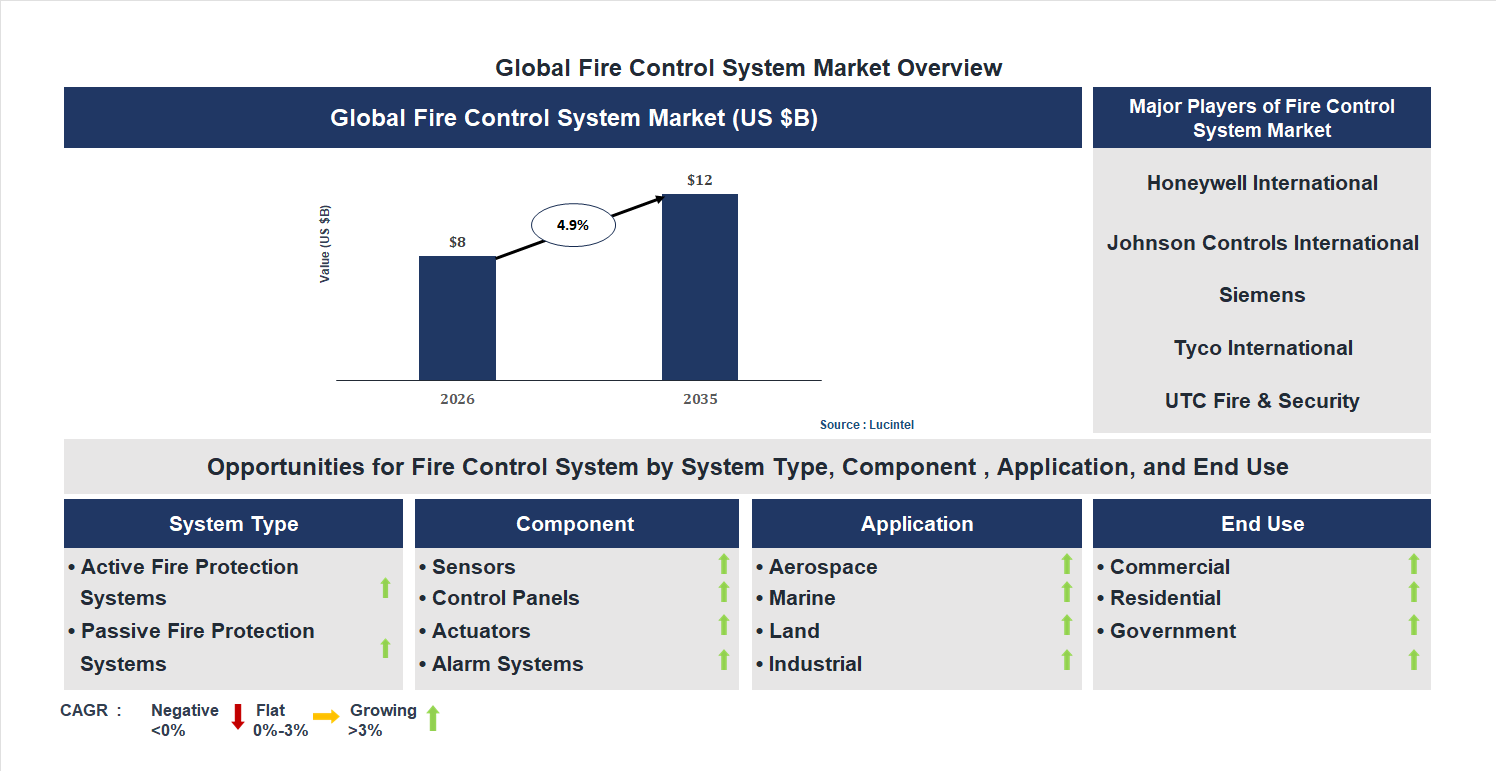
Key data points: The market size in 2035 = $12 billion, growth forecast = 4.9% annually for the next 8 years. Scroll below to get more insights. This market report covers trends, opportunities and forecasts in fire control system market to 2035 by system type (active fire protection systems and passive fire protection systems), component (sensors, control panels, actuators, and alarm systems), application (aerospace, marine, land, and industrial), end use (commercial, residential, and government), and region (North America, Europe, Asia Pacific, and the Rest of the World)
We'll send your sample report shortly.
• Lucintel forecasts that, within the system type category, active fire protection system is expected to witness higher growth over the forecast period.
• Within the end use category, commercial is expected to witness the highest growth.
• In terms of region, APAC is expected to witness the highest growth over the forecast period. Gain valuable insights for your business decisions with our comprehensive 150+ page report. Sample figures with some insights are shown below.
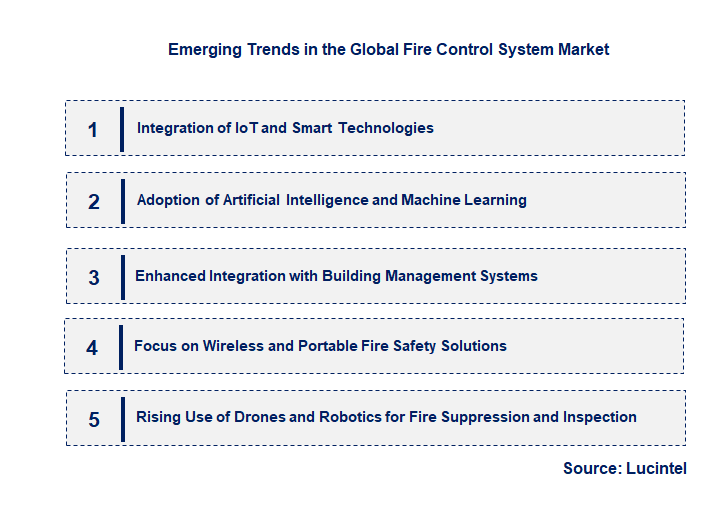
• Integration of IoT and Smart Technologies: The incorporation of Internet of Things (IoT) devices into fire control systems enables real-time monitoring, remote management, and predictive maintenance. Smart sensors detect fire hazards early, providing instant alerts and reducing response times. This integration enhances system reliability and allows for seamless communication between various safety devices, leading to more proactive fire prevention strategies. The impact is significant in smart buildings, industrial facilities, and military applications, where rapid decision-making is critical.
• Adoption of Artificial Intelligence and Machine Learning: AI and ML algorithms are increasingly being embedded into fire control systems to improve detection accuracy and automate response actions. These technologies analyze data patterns to distinguish between false alarms and genuine threats, minimizing disruptions. AI-driven systems can also predict fire spread and suggest optimal evacuation routes, enhancing safety protocols. This trend is transforming traditional fire detection into intelligent, adaptive systems capable of learning and evolving with changing environments.
• Enhanced Integration with Building Management Systems: Modern fire control systems are now integrated with comprehensive Building Management Systems (BMS), allowing centralized control and coordination. This integration facilitates better resource allocation, real-time status updates, and automated responses such as shutting down HVAC systems or activating sprinklers. It improves overall building safety and operational efficiency, especially in complex infrastructures like airports, hospitals, and commercial complexes. The synergy between fire safety and building management is creating more resilient and responsive environments.
• Focus on Wireless and Portable Fire Safety Solutions: The shift towards wireless fire detection and portable fire safety devices offers greater flexibility and ease of installation. Wireless systems reduce infrastructure costs and enable quick deployment in retrofit projects or temporary setups. Portable extinguishers, detectors, and alarms are increasingly used in industrial sites, outdoor events, and remote locations. This trend enhances fire safety coverage in hard-to-reach or rapidly changing environments, ensuring timely intervention and reducing potential damages.
• Rising Use of Drones and Robotics for Fire Suppression and Inspection: Drones and robotic systems are emerging as valuable tools for fire suppression, inspection, and rescue operations. They can access hazardous or inaccessible areas, providing real-time visuals and data to responders. Drones equipped with thermal imaging detect hotspots, while robots can deliver extinguishing agents or assist in evacuations. This trend improves safety for personnel and increases operational efficiency during emergencies, especially in large-scale industrial fires, wildfires, or military scenarios. In summary, these trends are collectively reshaping the fire control system market by making fire safety solutions smarter, more integrated, and adaptable to diverse environments. The adoption of advanced technologies like IoT, AI, and robotics is leading to more proactive, efficient, and reliable fire management strategies. As these innovations continue to evolve, the market is poised for significant growth, driven by the increasing demand for enhanced safety across commercial, industrial, and military sectors.
• Integration of AI and IoT Technologies: Transforming Fire Detection and Response: The incorporation of artificial intelligence (AI) and Internet of Things (IoT) in fire control systems is revolutionizing safety protocols. These technologies enable real-time monitoring, predictive analytics, and automated responses, significantly reducing response times and minimizing damage. Enhanced data collection improves system accuracy and reliability, leading to smarter fire safety solutions. This integration is expected to expand market reach, especially in smart buildings and industrial facilities, fostering safer environments and reducing operational risks.
• Adoption of Wireless and Remote Monitoring Systems: Increasing demand for wireless fire control solutions is driven by the need for flexible, scalable, and easy-to-install systems. Remote monitoring allows centralized control and instant alerts, improving emergency response efficiency. Wireless systems reduce installation costs and enable retrofitting in existing structures without extensive infrastructure changes. This trend is particularly prominent in large commercial complexes, airports, and industrial sites, where rapid deployment and real-time oversight are critical. The shift enhances overall safety and operational continuity.
• Development of Eco-Friendly and Sustainable Fire Suppression Agents: Growing environmental concerns are prompting the industry to develop eco-friendly fire suppression agents. These alternatives, such as clean agents and water mist systems, offer effective fire suppression with minimal environmental impact. They are suitable for sensitive environments like data centers and museums, where traditional chemicals could cause damage. The adoption of sustainable agents is boosting market growth, aligning safety with environmental responsibility, and opening new avenues for manufacturers focused on green solutions.
• Expansion of Digital Training and Simulation Platforms: Digital training tools and simulation platforms are transforming fire safety education and preparedness. Virtual reality (VR) and augmented reality (AR) enable realistic scenario-based training, improving response skills without physical risks. These platforms facilitate cost-effective, scalable, and accessible training programs for personnel across industries. Enhanced training improves system effectiveness and compliance with safety standards. The growth of digital platforms is fostering a more knowledgeable workforce, reducing human error, and strengthening overall fire safety management.
• Increasing Focus on Smart Building Integration: The integration of fire control systems with smart building management platforms is creating comprehensive safety ecosystems. These systems enable seamless communication between fire alarms, security, HVAC, and access control, ensuring coordinated responses during emergencies. Smart integration enhances occupant safety, optimizes evacuation procedures, and reduces false alarms. It also supports data-driven maintenance and system upgrades. This development is particularly impactful in high-rise buildings, hospitals, and commercial complexes, driving market expansion and elevating safety standards. The overall impact of these developments is a more advanced, efficient, and environmentally conscious fire control market. Enhanced safety features, technological integration, and smarter systems are improving response times, reducing damages, and ensuring compliance with evolving regulations. These innovations are fostering growth opportunities, attracting investments, and setting new benchmarks for fire safety standards worldwide.
• Integration of IoT and Smart Technologies in Fire Control Systems: The adoption of IoT-enabled fire control systems enhances real-time monitoring, predictive maintenance, and automated response capabilities. These systems improve safety efficiency in commercial buildings, industrial plants, and transportation hubs. IoT integration allows for centralized control, data analytics, and remote management, reducing response times and minimizing damage. As smart building initiatives grow, the demand for connected fire control solutions is expected to surge, creating significant growth opportunities across multiple sectors.
• Increasing Adoption of Wireless and Wireless-Enabled Fire Detection Systems: Wireless fire detection systems offer flexible installation, scalability, and cost-effectiveness compared to traditional wired systems. They are ideal for retrofitting existing structures and hard-to-reach areas. Wireless sensors and alarms facilitate faster deployment and easier maintenance, making them attractive for residential, commercial, and industrial applications. The rising preference for wireless solutions is driven by technological advancements and the need for minimal disruption during installation, opening avenues for market expansion.
• Growing Demand for Fire Suppression Systems in Industrial and Oil & Gas Sectors: The industrial and oil & gas sectors require robust fire suppression systems to prevent catastrophic incidents. Innovations in foam, gas, and water mist suppression technologies provide effective fire control in hazardous environments. Stringent safety regulations and increasing industrial activities boost demand for these systems. Additionally, the integration of automation and remote monitoring enhances operational safety. This segment presents lucrative opportunities for manufacturers to develop specialized, high-capacity suppression solutions tailored to sector-specific needs.
• Expansion of Fire Control Systems in Commercial and Residential Buildings: The surge in urban development and smart city projects drives the adoption of advanced fire control systems in commercial complexes, residential towers, and public infrastructure. Features like automated sprinklers, smoke detection, and emergency communication systems improve safety standards. Building codes increasingly mandate integrated fire safety solutions, encouraging market growth. The focus on sustainable and energy-efficient systems also influences product development, creating opportunities for innovative, eco-friendly fire safety solutions tailored to modern construction.
• Development of AI and Data Analytics for Fire Risk Assessment and Management: Artificial intelligence and data analytics enable predictive fire risk assessment, real-time threat detection, and optimized response strategies. These technologies improve decision-making, reduce false alarms, and enhance resource allocation. AI-driven systems can analyze vast data from sensors, weather conditions, and historical incidents to forecast potential fire hazards. The integration of AI in fire control systems is expected to revolutionize fire safety management, offering smarter, more proactive solutions that significantly mitigate risks across various applications. The overall market growth is poised to accelerate as these opportunities foster innovation, improve safety standards, and meet increasing regulatory and consumer demands, ensuring a resilient and technologically advanced fire control system landscape.
• Technological Innovation: The rapid development of advanced fire control technologies, including automation, AI integration, and precision targeting, enhances system efficiency and effectiveness. These innovations enable military and defense agencies to improve response times, accuracy, and operational capabilities, thereby increasing demand for modern fire control solutions. As technology continues to evolve, manufacturers are investing heavily in R&D to stay competitive, which further propels market growth.
• Military Modernization Programs: Governments worldwide are prioritizing modernization of their armed forces, which involves upgrading existing fire control systems and deploying new ones. These programs are driven by geopolitical tensions, the need for enhanced defense capabilities, and the desire to maintain strategic superiority. Increased defense budgets and procurement initiatives directly contribute to expanding the market for advanced fire control systems.
• Increasing Defense Spending: Rising defense budgets across various countries, especially in North America, Europe, and Asia-Pacific, are fueling demand for sophisticated fire control systems. Governments are allocating funds to enhance their military infrastructure, including weapon systems, surveillance, and targeting solutions. This financial commitment supports ongoing research, development, and procurement activities within the market.
• Integration of AI and Automation: The incorporation of artificial intelligence and automation into fire control systems is transforming military operations. These technologies enable real-time data processing, autonomous targeting, and improved decision-making, which are critical in modern warfare. The adoption of AI-driven solutions enhances operational efficiency and reduces human error, making fire control systems more reliable and appealing to defense agencies.
• Growing Demand for Naval and Airborne Fire Control Systems: The expanding need for advanced fire control solutions in naval vessels and aircraft is a significant market driver. Enhanced maritime security, anti-piracy operations, and aerial combat scenarios require precise and reliable fire control systems. This demand is prompting manufacturers to develop specialized solutions tailored for naval and airborne platforms, further expanding the market. The challenges facing the fire control system market include:
• Regulatory and Export Restrictions: Stringent government regulations and export controls on military technology pose significant barriers to market growth. Countries often restrict the transfer of advanced fire control systems to certain regions or entities, limiting market access and international sales. Navigating complex regulatory environments requires compliance and can delay procurement processes, impacting overall market expansion.
• High Development and Maintenance Costs: Developing cutting-edge fire control systems involves substantial R&D investments, which can be a barrier for smaller players. Additionally, the high costs associated with maintenance, upgrades, and training can deter adoption, especially among budget-constrained defense agencies. These financial challenges can slow down the deployment of new systems and limit market growth.
• Rapid Technological Obsolescence: The fast pace of technological change means that fire control systems can become outdated quickly. Keeping systems updated with the latest features and capabilities requires continuous investment, which can be challenging for defense organizations. This rapid obsolescence risk discourages long-term investments and complicates procurement strategies. The fire control system market is driven by technological advancements, modernization initiatives, increased defense spending, and integration of AI, while facing challenges such as regulatory restrictions, high costs, and rapid technological obsolescence. These factors collectively shape the market landscape, influencing growth trajectories and strategic decisions. The ongoing evolution of military needs and technological innovation promises continued expansion, provided stakeholders effectively navigate regulatory and financial hurdles. Overall, the markets future hinges on balancing innovation with compliance and cost management to meet the dynamic demands of modern defense operations.
• Honeywell International
• Johnson Controls International
• Siemens
• Tyco International
• UTC Fire & Security
• Bosch Security Systems
• Schneider Electric
• Active Fire Protection Systems
• Passive Fire Protection Systems
• Sensors
• Control Panels
• Actuators
• Alarm Systems
• Aerospace
• Marine
• Land
• Industrial
• Commercial
• Residential
• Government
• North America
• Europe
• Asia Pacific
• The Rest of the World
• United States: The US market has seen substantial investments in advanced fire control systems, focusing on integrating artificial intelligence and machine learning for improved targeting accuracy. The Department of Defense has prioritized modernization programs, including the deployment of networked, multi-sensor systems that enhance battlefield awareness. Innovations in missile guidance and automated fire control are also prominent, with collaborations between defense contractors and military agencies driving technological progress.
• China: China has rapidly advanced its fire control technology, emphasizing indigenous development and integration with its missile and artillery systems. The country has made significant progress in deploying automated and network-centric fire control solutions, enhancing its battlefield responsiveness. Recent initiatives include the modernization of existing systems and the development of new, more precise weapon guidance technologies, aligning with its broader military modernization goals.
• Germany: Germany continues to focus on high-precision, integrated fire control systems for its armed forces, emphasizing interoperability within NATO frameworks. Recent developments include the adoption of digitalized command and control systems that improve real-time data sharing and decision-making. Germany is also investing in upgrading existing artillery and missile systems with advanced targeting and tracking capabilities, ensuring compatibility with allied forces.
• India: India has increased its focus on indigenous fire control system development, aiming to reduce reliance on foreign technology. Recent advancements include the deployment of automated fire control systems in its artillery units and the modernization of missile guidance systems. The country is also investing in integrating fire control solutions with its evolving network-centric warfare capabilities, enhancing operational efficiency and battlefield coordination.
• Japan: Japan has prioritized the enhancement of its fire control systems to bolster its defense against regional threats. Recent developments include the integration of advanced radar and sensor technologies to improve target detection and tracking. Japan is also working on modernizing its missile guidance and fire control systems, with an emphasis on interoperability with allied forces and incorporating cutting-edge automation and AI features for improved operational readiness.


• Honeywell International
• Johnson Controls International
• Siemens
• Tyco International
• UTC Fire & Security
• Bosch Security Systems
• Schneider Electric Q6. Which fire control system market segment will be the largest in future? Answer: Lucintel forecasts that, within the system type category, active fire protection system is expected to witness higher growth over the forecast period. Q7. In fire control system market, which region is expected to be the largest in next 8 years? Answer: In terms of region, APAC is expected to witness the highest growth over the forecast period. Q8. Do we receive customization in this report? Answer: Yes, Lucintel provides 10% customization without any additional cost.


Choose a license that fits your team. Instant PDF delivery.
Prices exclude taxes. Instant delivery. Custom licensing available on request.
Market Report · July 31, 2026
Market Report · July 31, 2026
Market Report · July 31, 2026
Trusted partner for strategic intelligence and business growth


Receive a complimentary market analysis tailored to your industry. Our analysts will identify key growth opportunities and competitive dynamics specific to your business.

Market size, growth rate, and key trend analysis for your specific sector.

Top competitor positioning and market share analysis.

Strategic recommendations backed by data-driven insights.
Get curated market intelligence and competitive moves straight to your inbox.
By subscribing, you agree to receive our monthly insights. Unsubscribe anytime.
Receive a complimentary market analysis tailored to your industry. Our analysts will identify key growth opportunities and competitive dynamics specific to your business.
Market size, growth rate, and key trend analysis for your specific sector.
Top competitor positioning and market share analysis.
Strategic recommendations backed by data-driven insights.
Get curated market intelligence, emerging trends, and competitive moves straight to your inbox each month.
By subscribing, you agree to receive our monthly insights. Unsubscribe anytime.
We'll send your sample report shortly.