
Market Report · July 31, 2026

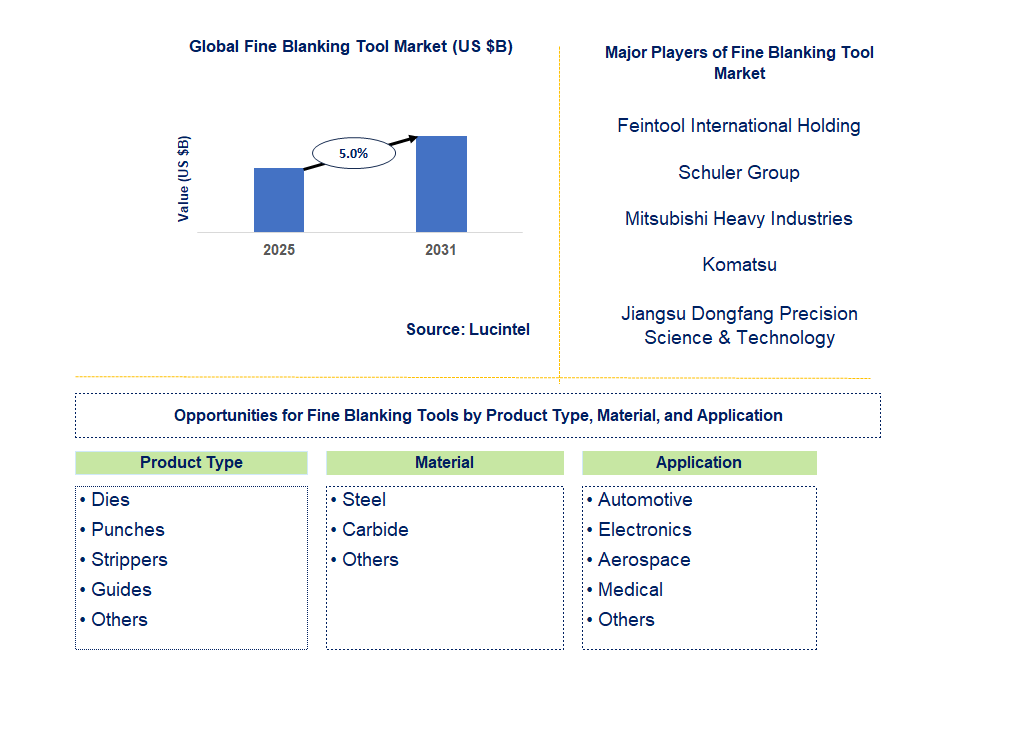
Key data points: The growth forecast = 5.0% annually for the next 7 years. Scroll below to get more insights. This market report covers trends, opportunities and forecasts in fine blanking tool market to 2031 by product type (dies, punches, strippers, guides, and others), material (steel, carbide, and others), application (automotive, electronics, aerospace, medical, and others), and region (North America, Europe, Asia Pacific, and the Rest of the World)
We'll send your sample report shortly.
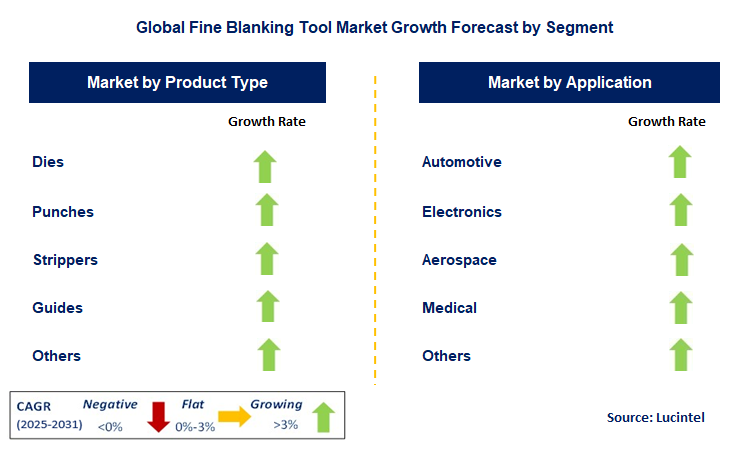
• Lucintel forecasts that, within the product type category, die is expected to witness the highest growth over the forecast period.
• Within the application category, automotive is expected to witness the highest growth.
• In terms of region, APAC is expected to witness the highest growth over the forecast period. Gain valuable insights for your business decisions with our comprehensive 150+ page report. Sample figures with some insights are shown below.
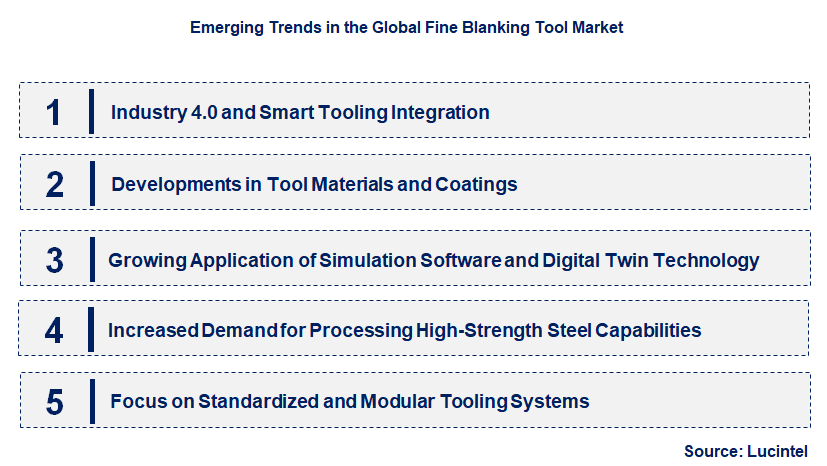
• Industry 4.0 and Smart Tooling Integration: Industry 4.0 concepts are becoming more dominant in the market, hence the formation of smart fine blanking tools with built-in sensors. These sensors track real-time parameters including temperature, pressure, tool wear, and lubrication, enabling predictive maintenance and improved performance. This trend allows for considerable reduction in downtime, increased tool life, and enhanced efficiency and quality of the fine blanking process through data-driven decision-making and autonomous adjustments.
• Developments in Tool Materials and Coatings: One of the significant trends is ongoing development in tool materials and coatings. Suppliers are using state-of-the-art high-speed steels, powder metallurgy steels, and carbide grades, frequently in conjunction with proprietary physical vapor deposition (PVD) or chemical vapor deposition (CVD) coatings. These coatings and materials increase hardness, wear resistance, and decrease friction, resulting in tool life being dramatically extended, better component quality, and lower maintenance costs, particularly when working with difficult-to-machine materials.
• Growing Application of Simulation Software and Digital Twin Technology: Fine blanking tool design is making greater use of simulation software (FEA) and digital twin technology. These technologies enable engineers to simulate and optimize tool designs virtually, forecast the behavior of materials, detect potential problems, and improve manufacturing processes prior to actual production. The trend saves time and expenses in development, minimizes trial and error, and guarantees the output of highly efficient and reliable tools from the very beginning, thus speeding up innovation.
• Increased Demand for Processing High-Strength Steel Capabilities: The need for lightweighting by the automotive market for fuel efficiency and electric vehicles is driving the demand for fine blanking tools to process high-strength steels (HSS) and advanced high-strength steels (AHSS). This trend requires tools with stronger strength, wear, and stronger designs to manage the added stress and wear of these materials, driving tool makers to advance in material science and structural strength.
• Focus on Standardized and Modular Tooling Systems: Increased focus is being laid on standardized and modular fine blanking tool systems. This enables more flexibility, faster changeover, and lower setup times, especially for the production of families of parts or when design changes occur frequently. Standardization also leads to lower manufacturing costs and lead times for the tools, making it possible to be more agile and cost-effective in manufacturing with high precision. Such new trends are cumulatively transforming the fine blanking tooling market by supporting a shift towards more intelligent, robust, and better-designed tooling solutions. The implementation of smart technologies, smarter materials, and smarter simulation methods is improving productivity and quality of parts in many industries. This transformation guarantees a future where fine blanking processes become more accurate, affordable, and responsive to the sophisticated requirements of today’s production.
• Use of Advanced High-Performance Tool Steels: Another main development of recent years is the extensive implementation of advanced high-performance tool steels, including specialized powder metallurgy steels and high-carbon, high-chromium alloys. These materials provide higher hardness, toughness, and resistance to wear than conventional tool steels. Their application allows fine blanking tools to survive catastrophic pressures and abrasive environments, leading to a long tool life, lower maintenance, and higher consistency in manufacturing high-quality parts.
• Multi-Layer and Nanocomposite Coatings Integration: Most recent advances involve the advanced deployment of multi-layer and nanocomposite coatings, including Tin, TiC, Alcorn, and DLC. These advanced coatings are used to decrease friction, galling and deliver outstanding wear protection, especially in processing difficult-to-machine materials like high-strength steel. This innovation results in improved tool performance, cleaner cutting, and enables more production volumes without sacrificing part quality, thus enhancing overall efficiency.
• Sensor-Based Monitoring System Implementation: One of the most revolutionary advances has been to directly incorporate sensors into fine blanking tools. These smart tools measure key parameters such as force, temperature, vibration, and tool wear in real time while operating. This information provides predictive maintenance, optimized lubrication, and early warnings of impending problems, reducing unplanned downtime by orders of magnitude and allowing proactive adjustments to ensure consistent part quality and prolong the operational life of the tool.
• Additive Manufacturing for Tool Components: Additive manufacturing, especially for intricate internal geometries or fine blanking tool component prototypes, is a significant recent advancement. Though not yet for complete tools, 3D printing facilitates quick prototyping, complex cooling channels, and weight savings in specific areas of the tool. This innovation speeds up the design cycle, allows for more complex and optimized tool designs, and has the potential to minimize the cost of manufacturing certain tool components.
• Simulation Software Development for Fine Blanking: The last few years have witnessed the evolution of more advanced and specialized simulation software packages exclusively designed for fine blanking operations. Such software programs enable engineers to precisely model material flow, stress distribution, and potential defects in the blanking process. This facilitates in-depth process optimization and tool design verification on the computer, resulting in extremely efficient tools that deliver superior quality parts in the very first production run, with much less trial and error. These new advances are synergistically affecting the fine blanking tool market by extending the limits of precision manufacturing. Emphasis on higher quality materials, advanced coatings, intelligent monitoring, and digital simulation is resulting in more durable, efficient tools and parts of unprecedented quality. This development is inherently increasing productivity, lowering costs, and allowing for the manufacture of complex, high-quality parts in a broad array of industries.
• Automotive Sector: The automotive industry is the largest application area, and the trend towards electric vehicles (EVs) is an enormous growth opportunity. EVs need many high-precision parts, i.e., stator and rotor laminations, busbars, and several sensors, all of which will find application for fine blanking. Strategic development consists of designing specialized tools for new EV materials, such as advanced electrical steels and copper alloys, and making tools capable of fulfilling the high-volume and high-quality requirements of EV manufacturing.
• Consumer Electronics and Devices: The ongoing miniaturization and rising sophistication of electronic components and consumer electronics provide a huge growth opportunity. Fine blanking is well-suited to create small, complex pieces with great precision for smartphones, tablets, wearables, and other electronic devices. Businesses can strategically address this market by creating equipment that can be used to work with thin, fragile materials with precision and accuracy beyond human capabilities, fulfilling the need for high-volume defect-free manufacturing.
• Medical Device Production: The medical device market, with its high-quality requirements and need for precision, burr-free parts, is a highly profitable growth opportunity. Fine blanking is applied to surgical instruments, implants, and other medical apparatus parts. Strategic growth entails specializing in tools for biocompatible materials, traceability, and compliance with strict regulatory standards, concentrating on tools that provide ultra-precision and sterile parts essential to patient safety and device performance.
• Industrial Equipment and Machinery: The manufacturing of industrial equipment and machinery, such as gears, levers, cams, and other complex mechanical components, remains a dominant use for fine blanking. With advancements in machines, the need for increased precision and endurance in their parts is essential. Future opportunities exist in creating strong tools that can handle thicker gauge material and intricate geometries with precision consistency, satisfying the heavy-duty and precision demands of this industry.
• Aerospace and Defense: Aerospace and defense industries need parts with high strength-to-weight ratios, dimensional precision, and reliability, so fine blanking is an appropriate manufacturing process for some parts. Though volumes may be weaker, the critical nature and high value of these components create a high-end growth opportunity. Strategic emphasis is to create tools for innovative alloys, maintain strict quality control, and achieve required certifications for producing parts that satisfy the stringent safety and performance standards of these markets. Such strategic opportunities for growth are set to have a profound effect on the fine blanking tool industry through specialization and innovation in a wide range of industrial applications. By recognizing and responding to the specific needs of the automotive (particularly EV), electronics, medical device, industrial machinery, and aerospace industries, manufacturers can create customized, high-performance tooling solutions. This emphasis on particular applications will result in increased market penetration, revenue growth, and establish fine blanking as an essential manufacturing process for precision components worldwide.
• Feintool International Holding
• Schuler Group
• Mitsubishi Heavy Industries
• Komatsu
• Jiangsu Dongfang Precision Science & Technology
• Hitachi Zosen Corporation
• Nippon Steel & Sumitomo Metal Corporation
• Sakamura Machine
• Hydrel
• Meadville Forg
• Dies
• Punches
• Strippers
• Guides
• Others
• Steel
• Carbide
• Others
• Automotive
• Electronics
• Aerospace
• Medical
• Others
• North America
• Europe
• Asia Pacific
• The Rest of the World
• United States: The United States fine blanking tool market is dominated by a strong focus on cutting-edge materials and coatings to achieve longer tool life and better performance. Increasing utilization of simulation software and additive manufacturing methods is being used to refine tool design and speed up prototyping. The market serves extensively to the automotive sector, more so for parts used in electric vehicles, as well as to the aerospace industry, where high accuracy and reliability are critical.
• China: The Chinese fine blanking tool market is experiencing strong growth, driven by its enormous manufacturing base and growing need for precision parts in automotive, consumer electronics, and industrial machinery. Domestic manufacturers are rapidly advancing their technical capabilities, emphasizing low-cost solutions while aiming for increased precision and durability. Encouragement from the government for industry upgrading and domestic consumption further drives market growth and technical progress.
• Germany: Germany is an advanced and very innovative marketplace for fine blanking tools, renowned for engineering excellence and high-precision manufacturing. There are major developments incorporating Industry 4.0 principles that allow smart tooling with built-in sensors for real-time feedback of tool wear and performance. There are robust preferences for custom-engineered solutions for complicated geometries and high-strength materials, mainly for its advanced automotive and machinery sectors.
• India: The market for India’s fine blanking tools is seeing steady growth due to the growing automotive and manufacturing sectors. Although there is still a large share of traditional tooling in the market, more advanced, higher-precision tools are in greater demand. Domestic manufacturers are spending more on improved materials and processes, many times through joint ventures, to keep up with changing domestic and foreign customers’ quality requirements, especially for export-oriented applications.
• Japan: The Japanese fine blanking tool industry is characterized by its state-of-the-art technology, precise quality control, and commitment to long-term performance. Recent trends involve the application of exotic tool steels, ceramic composites, and newer surface treatments to provide outstanding wear resistance and dimensional stability. The industry is mainly catering to its high-precision automotive components, electronics, and medical device sectors, which are strongly emphasizing reliability and ultra-high accuracy in production.


• Feintool International Holding
• Schuler Group
• Mitsubishi Heavy Industries
• Komatsu
• Jiangsu Dongfang Precision Science & Technology
• Hitachi Zosen Corporation
• Nippon Steel & Sumitomo Metal Corporation
• Sakamura Machine
• Hydrel
• Meadville Forging Company Q5. Which fine blanking tool market segment will be the largest in future? Answer: Lucintel forecasts that, within the product type category, die is expected to witness the highest growth over the forecast period. Q6. In fine blanking tool market, which region is expected to be the largest in next 5 years? Answer: In terms of region, APAC is expected to witness the highest growth over the forecast period. Q7. Do we receive customization in this report? Answer: Yes, Lucintel provides 10% customization without any additional cost.


Choose a license that fits your team. Instant PDF delivery.
Prices exclude taxes. Instant delivery. Custom licensing available on request.
Market Report · July 31, 2026
Market Report · July 22, 2026
Market Report · July 20, 2026
Trusted partner for strategic intelligence and business growth


Receive a complimentary market analysis tailored to your industry. Our analysts will identify key growth opportunities and competitive dynamics specific to your business.

Market size, growth rate, and key trend analysis for your specific sector.

Top competitor positioning and market share analysis.

Strategic recommendations backed by data-driven insights.
Get curated market intelligence and competitive moves straight to your inbox.
By subscribing, you agree to receive our monthly insights. Unsubscribe anytime.
Receive a complimentary market analysis tailored to your industry. Our analysts will identify key growth opportunities and competitive dynamics specific to your business.
Market size, growth rate, and key trend analysis for your specific sector.
Top competitor positioning and market share analysis.
Strategic recommendations backed by data-driven insights.
Get curated market intelligence, emerging trends, and competitive moves straight to your inbox each month.
By subscribing, you agree to receive our monthly insights. Unsubscribe anytime.
We'll send your sample report shortly.