
Market Report · May 18, 2026

This market report covers trends, opportunities, and forecasts in the global fiber optic sunlight simulator market to 2031 by technology (monolithic and component), application (mechanical engineering, automotive industry, aerospace, chemical industry, and medical technology), and region (North America, Europe, Asia Pacific, and the Rest of the World)
We'll send your sample report shortly.
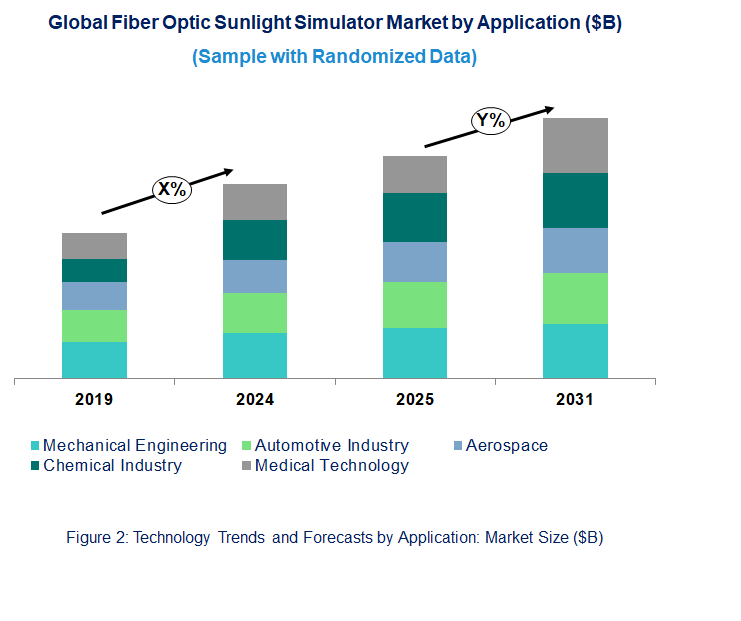
• Advancements in LED-based Lighting Technology: The use of LED-based light sources in fiber optic sunlight simulators has become a dominant trend. LED technology offers improved energy efficiency, a longer lifespan, and better color rendering compared to traditional light sources like incandescent bulbs. This advancement is helping industries develop more precise and sustainable simulation systems.
• Integration of Smart Control Systems: Smart control systems are being incorporated into sunlight simulators to enhance precision and adaptability. These systems allow for real-time adjustments, enabling users to simulate different lighting conditions based on geographical location, time of day, and weather. This trend is especially beneficial for industries like automotive, where realistic environmental simulations are critical for testing.
• Miniaturization and Compact System Designs: As demand for more portable and space-efficient sunlight simulators grows, manufacturers are focusing on miniaturizing fiber optic systems. The move toward compact, monolithic designs allows for easier installation and greater flexibility in research and development, especially in areas like aerospace and medical technology.
• Customization for Industry-Specific Applications: There is an increasing trend toward the customization of fiber optic sunlight simulators for specific applications in industries like automotive, mechanical engineering, and medical technology. Tailored simulators that mimic real-world lighting conditions are being developed to meet the unique testing requirements of each sector, enhancing their performance and efficiency.
• Focus on Environmental Sustainability: With a rising focus on sustainable solutions, there is an increasing demand for environmentally friendly fiber optic sunlight simulators. Manufacturers are developing systems that use energy-efficient materials and reduce power consumption, aligning with the global push for reducing carbon footprints in industries such as automotive and aerospace. The emerging trends in the fiber optic sunlight simulator market are transforming the landscape by making simulators more efficient, customizable, and sustainable. From LED lighting advancements to smart controls and miniaturization, these trends are enabling industries to adopt more effective and environmentally friendly sunlight simulation solutions. As these technologies continue to evolve, they will likely play an integral role in advancing research, testing, and development across a variety of industries.
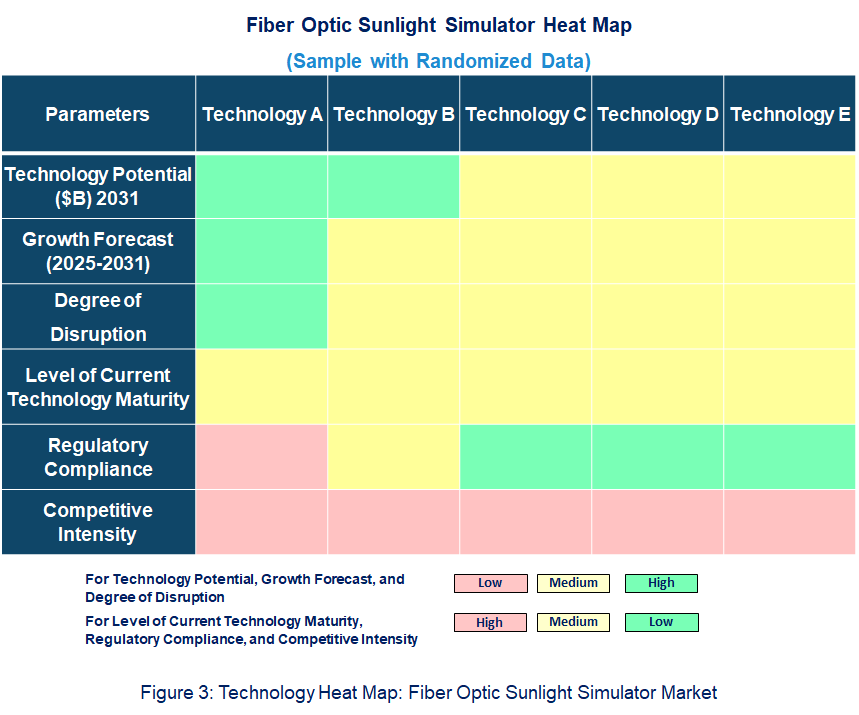
• Potential in Technology: The technology potential of the fiber optic sunlight simulator market is substantial, driven by advancements in fiber optics, LED lighting, and smart control systems. These simulators are crucial for industries like automotive, aerospace, medical technology, and mechanical engineering, where precise environmental testing and simulation of natural sunlight are necessary. Fiber optic sunlight simulators can replicate realistic outdoor lighting conditions, enabling more accurate testing of materials, components, and technologies under controlled conditions. The use of energy-efficient LEDs further boosts the environmental appeal, reducing energy consumption while maintaining high-performance standards.
• Degree of Disruption: The degree of disruption in this market is moderate, as fiber optic sunlight simulators offer significant improvements over traditional lighting systems in terms of energy efficiency, accuracy, and adaptability. However, widespread adoption may face challenges related to high initial costs and the integration of new technologies with existing testing infrastructures.
• Current Technology Maturity Level: Technology maturity in the fiber optic sunlight simulator market is advancing steadily, with most systems now operating at a mature stage in industries like automotive and aerospace. The introduction of smart control systems and miniaturized, customizable designs continues to enhance their versatility and ease of use.
• Regulatory Compliance: Regulatory compliance is crucial, with standards for environmental testing and safety playing a key role. Manufacturers must adhere to industry-specific regulations for lighting, energy consumption, and simulation accuracy to ensure the widespread adoption of these technologies.
• Sciencetech: Sciencetech has made significant strides with its cutting-edge fiber optic sunlight simulators. The company has focused on optimizing its solar simulators to meet international standards for light intensity and spectrum accuracy, especially for testing photovoltaic devices. Their advancements are particularly relevant in renewable energy applications and material science testing, driving further adoption in the industry.
• SAN-EI: SAN-EI has introduced new developments in fiber optic sunlight simulation technology by enhancing the precision and intensity of its simulators. Their systems are being tailored for industries like aerospace, where exact replication of sunlight conditions is essential for testing components under real-world scenarios. This positions SAN-EI as a leader in providing highly accurate testing solutions for critical industries.
• Abet: Abet has further refined its fiber optic sunlight simulators by integrating more powerful LEDs and improved optical systems. Their simulators now offer better spectrum accuracy and energy efficiency, catering to sectors such as the automotive and chemical industries, where sunlight simulation is crucial for testing material durability and performance.
• BF Engineering GmbH: BF Engineering GmbH has focused on developing compact and energy-efficient sunlight simulators. Their innovations are particularly useful in medical technology, where precise lighting conditions are required for testing medical devices and diagnostics. By making the systems more compact, they have expanded their applicability across different testing environments.
• Sanyou Inc.: Sanyou Inc. has been enhancing its fiber optic sunlight simulators by focusing on versatility and customization. Their products are becoming increasingly popular in mechanical engineering applications where different light spectra and intensities are required for testing a wide range of materials. Sanyou's ability to offer tailor-made solutions is driving the growth of the simulator market. These developments demonstrate the growing demand for advanced fiber optic sunlight simulators, with key players continuously innovating to improve their offerings. The progress made by companies like Sciencetech, SAN-EI, Abet, BF Engineering GmbH, and Sanyou Inc. is setting the stage for further market expansion across diverse industries, fostering a more sustainable and efficient approach to environmental testing.
• Technological Advancements in Simulation Accuracy: Advancements in fiber optic and LED technologies are enabling more precise sunlight simulators, which are critical for industries such as automotive, aerospace, and medical technology. These innovations increase the efficiency and reliability of testing, driving demand for high-quality simulators capable of mimicking real-world conditions with high accuracy.
• Rising Demand for Sustainability Testing: With growing concerns about climate change, industries are increasingly focusing on sustainability. Fiber optic sunlight simulators play a key role in replicating natural sunlight conditions to test solar panels, materials, and products for their environmental impact. This growing demand for eco-friendly testing solutions fuels market growth.
• Government Regulations and Standards: As governments introduce stricter regulations for product testing, particularly in sectors such as automotive, aerospace, and medical technologies, the demand for reliable testing equipment such as fiber optic sunlight simulators increases. Compliance with these regulations ensures the adoption of high-quality simulators and drives investment in the sector.
• Expanding Applications in New Industries: The growing demand for precise sunlight simulation across diverse sectors, including pharmaceuticals and food industries, is expanding the market. Fiber optic sunlight simulators are finding applications beyond traditional sectors, driving innovation and opening new growth opportunities.
• Improvement in Cost-Effectiveness and Energy Efficiency: Advancements in materials and energy-efficient technologies are making fiber optic sunlight simulators more cost-effective. As their energy consumption decreases and overall costs lower, simulators become more accessible to smaller enterprises and diverse industries, broadening the market's scope and enhancing its reach. Challenges:
• High Initial Investment: The high cost of advanced fiber optic sunlight simulators remains a challenge for many companies, especially smaller businesses or startups. The significant upfront cost of acquiring and setting up these simulators can act as a barrier to entry, limiting their widespread adoption.
• Complexity of Customization: As industries demand more specialized simulators tailored to specific testing needs, the complexity and development time required to create customized systems increase. This poses a challenge in terms of production speed and cost, which could slow the adoption rate of fiber optic sunlight simulators.
• Regulatory Compliance and Certification: Achieving and maintaining compliance with international standards and certifications in industries such as aerospace, automotive, and medical technology can be challenging. This regulatory complexity often requires ongoing testing, adjustments, and approvals, which can delay market growth and increase operational costs. In conclusion, the fiber optic sunlight simulator market is experiencing significant growth driven by technological advancements, regulatory requirements, and an increasing demand for sustainability testing. However, challenges such as high costs, complexity in customization, and regulatory compliance need to be overcome for the market to reach its full potential. As these hurdles are addressed, the market will continue to expand, offering innovative solutions across a range of industries.
• Sciencetech
• SAN-EI
• Abet
• BF Engineering GmbH
• Sanyou Inc
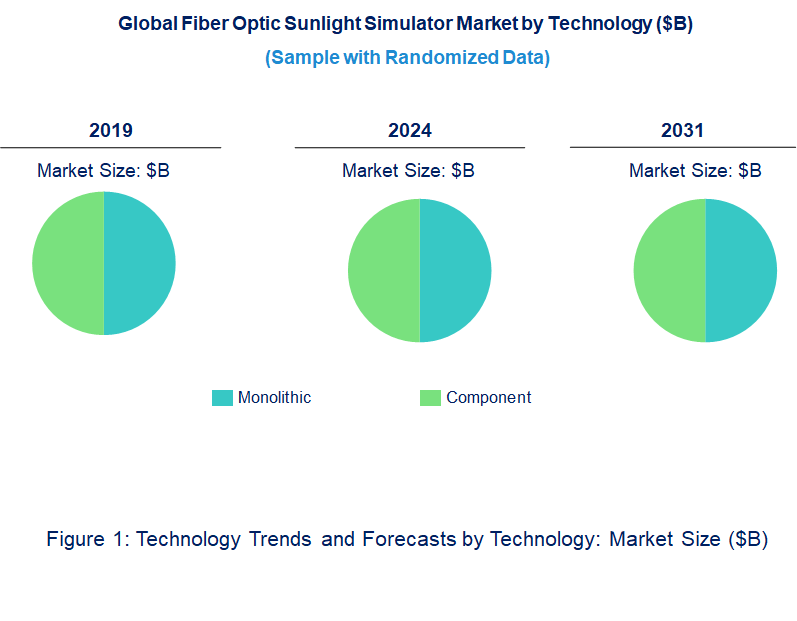
• Technology Readiness: Regarding technology readiness, Monolithic and Component technologies differ in their stage of maturity. Monolithic designs are highly advanced, with many companies offering reliable and commercially available models. These designs are well-integrated, but customization is limited. Component-based systems are also well-established but offer more flexibility in tailoring specific functionalities for various applications. Competitive intensity is high in both categories, with major players vying for leadership, while regulatory compliance remains a top priority, particularly in sectors like aerospace and medical testing. Both technologies are critical for applications in sustainability testing, solar energy, material development, and environmental simulations, providing a robust and adaptable solution to meet industry-specific demands.
• Competitive Intensity and Regulatory Compliance: In terms of competitive intensity and regulatory compliance, both Monolithic and Component technologies face high competition from established players in the fiber optic and optical simulation industries. Monolithic systems, due to their efficiency and compactness, are becoming increasingly popular but are met with strong competition from modular component-based systems, which offer greater adaptability. Regulatory compliance is a critical factor for both technologies, especially in highly regulated sectors like aerospace, automotive, and medical industries, where safety and accuracy standards must be met. Manufacturers must ensure compliance with local and international standards to gain market access, which often involves extensive testing and certifications.
• Disruption Potential: The disruption potential of different technologies, such as Monolithic and Component, for the fiber optic sunlight simulator market lies in their ability to transform testing accuracy and efficiency. Monolithic designs are expected to drive major advancements in compact, high-performance simulators, reducing system complexity and enhancing reliability. Component-based simulators, however, allow for modular configurations, offering flexibility and scalability. Both technologies promise substantial disruption by improving energy efficiency, reducing costs, and expanding the range of applications in industries like automotive, aerospace, and medical technology. The integration of cutting-edge materials, energy sources, and precision optics will likely accelerate market adoption, leading to more precise, cost-effective, and customizable sunlight simulators.
• Monolithic
• Component
• Mechanical Engineering
• Automotive Industry
• Aerospace
• Chemical Industry
• Medical Technology
• North America
• Europe
• Asia Pacific
• The Rest of the World
• Latest Developments and Innovations in the Fiber Optic Sunlight Simulator Technologies
• Companies / Ecosystems
• Strategic Opportunities by Technology Type


Choose a license that fits your team. Instant PDF delivery.
Prices exclude taxes. Instant delivery. Custom licensing available on request.
Market Report · May 18, 2026
Market Report · May 18, 2026
Market Report · May 18, 2026
Trusted partner for strategic intelligence and business growth


Receive a complimentary market analysis tailored to your industry. Our analysts will identify key growth opportunities and competitive dynamics specific to your business.

Market size, growth rate, and key trend analysis for your specific sector.

Top competitor positioning and market share analysis.

Strategic recommendations backed by data-driven insights.
Get curated market intelligence and competitive moves straight to your inbox.
By subscribing, you agree to receive our monthly insights. Unsubscribe anytime.
Receive a complimentary market analysis tailored to your industry. Our analysts will identify key growth opportunities and competitive dynamics specific to your business.
Market size, growth rate, and key trend analysis for your specific sector.
Top competitor positioning and market share analysis.
Strategic recommendations backed by data-driven insights.
Get curated market intelligence, emerging trends, and competitive moves straight to your inbox each month.
By subscribing, you agree to receive our monthly insights. Unsubscribe anytime.
We'll send your sample report shortly.