
Report Feature
Femur Model Market Trends and Forecast
The future of the global femur model market looks promising with opportunities in the hospital and medical school markets. The global femur model market is expected to grow with a CAGR of 6.5% from 2025 to 2031. The major drivers for this market are the increasing demand for educational anatomical models, the rising adoption of 3D printed femur models, and the growing focus on surgical training tools.• Lucintel forecasts that, within the type category, pathological femur model is expected to witness higher growth over the forecast period.
• Within the application category, medical school is expected to witness higher growth.
• In terms of region, APAC is expected to witness the highest growth over the forecast period. Gain valuable insights for your business decisions with our comprehensive 150+ page report. Sample figures with some insights are shown below.
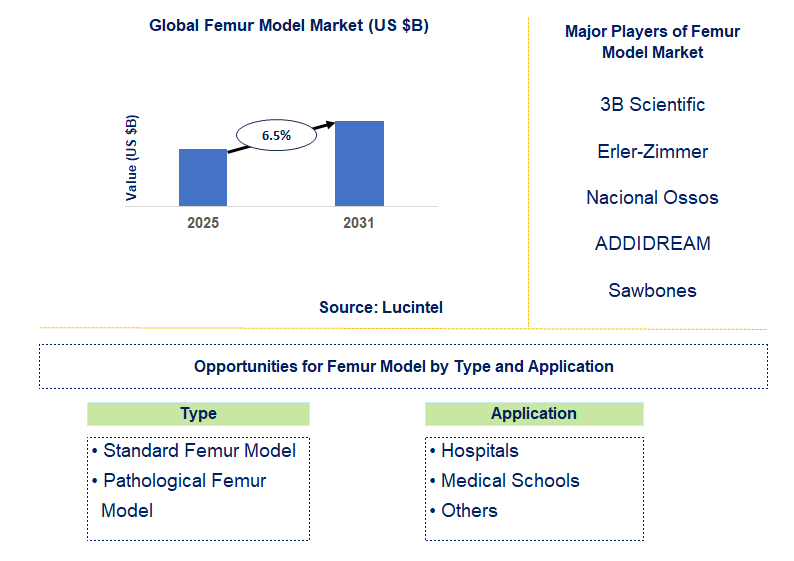
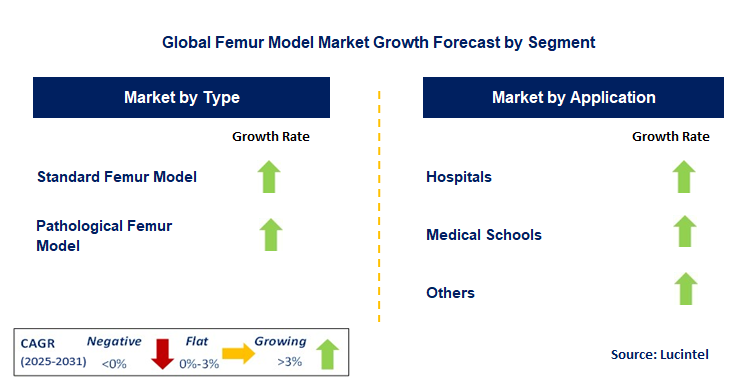
Emerging Trends in the Femur Model Market
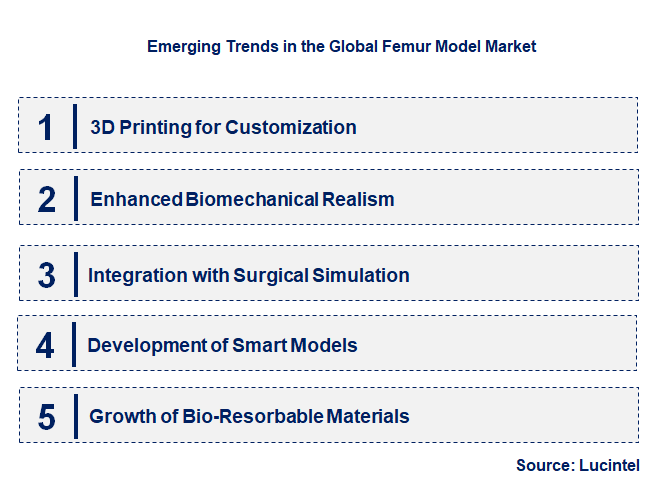
The femur model market is being redefined by several key trends that reflect a broader industry shift toward personalization, realism, and efficiency. These trends are moving the market beyond basic educational tools and positioning femur models as essential components of modern surgical planning and medical research.• 3D Printing for Customization: This trend involves using 3D printing technology to create patient-specific femur models from medical scans. The impact is a revolutionary change in pre-operative planning, allowing surgeons to practice complex procedures on a model that perfectly matches the patient's anatomy. This reduces surgical risks and shortens operating room time.
• Enhanced Biomechanical Realism: A key trend is the development of models that not only look like a femur but also have similar mechanical properties to human bone. The impact is a more realistic training and testing environment. These advanced models are invaluable for testing new orthopedic implants, as they provide a more accurate simulation of how the implant will perform in the human body.
• Integration with Surgical Simulation: The market is seeing a trend of integrating physical femur models with digital surgical simulation platforms. The impact is a hybrid training solution that combines the tactile feedback of a physical model with the data and analytics of a digital simulation. This creates a comprehensive training environment for surgeons.
• Development of Smart Models: This trend involves embedding sensors and intelligent technologies into femur models to provide real-time feedback during surgical training. The impact is a more data-driven and objective training experience. These "smart" models can measure forces, angles, and other parameters, allowing instructors to provide precise feedback on a trainee's performance.
• Growth of Bio-Resorbable Materials: There is an emerging trend of using bio-resorbable and biodegradable materials for models, particularly in surgical applications. The impact is a more sustainable and environmentally friendly product. This trend appeals to hospitals and institutions looking to reduce their environmental footprint and align with global sustainability initiatives. These emerging trends are fundamentally reshaping the femur model market, making products more personalized, functional, and technologically advanced. The focus on 3D printing and biomechanical realism is creating new value in surgical planning and research, while the integration with digital technology is transforming how medical professionals are trained and assessed.
Recent Development in the Femur Model Market
The femur model market is witnessing dynamic developments, driven by a growing demand for realistic anatomical replicas for medical education, surgical training, and research. These developments are centered on technological innovation, strategic business expansions, and a focus on product specialization to meet diverse market needs.• Widespread Adoption of 3D Printing: The proliferation of 3D printing technology is a major development in the market. The impact is a significant increase in the customization and precision of femur models. This allows for the creation of models with specific pathologies or fractures, providing an invaluable tool for surgical training and implant testing.
• Entry of New High-Tech Companies: The market is seeing a rise in new, technology-focused companies specializing in medical models. The impact is a surge in innovation and competition. These new entrants are leveraging advanced manufacturing techniques and materials science to create highly realistic and functional femur models, challenging established market players.
• Development of Anatomically Correct Materials: A key development is the creation of new composite materials that more accurately mimic the texture, density, and biomechanical properties of human bone. The impact is an improved training and research experience. These materials allow surgeons to practice procedures like drilling and cutting with a feel that is much closer to real-life surgery.
• Strategic Partnerships and Collaborations: There has been an increase in partnerships between model manufacturers, universities, and medical device companies. The impact is a collaborative approach to product development. This allows manufacturers to create models that are specifically designed to test a new implant or train surgeons on a particular surgical technique.
• Expansion into Digital and Virtual Models: Alongside physical models, there is a growing development in creating high-fidelity digital and virtual reality (VR) models. The impact is a more accessible and cost-effective training tool. These digital models allow for a wider range of simulations without the need for physical prototypes, particularly useful for remote learning. These recent developments are collectively transforming the femur model market into a more technologically advanced and interconnected industry. The widespread adoption of 3D printing, the focus on material realism, and the rise of digital models are not only improving the quality of the products but are also fundamentally changing how medical education and surgical training are conducted.
Strategic Growth Opportunities in the Femur Model Market
The femur model market offers strategic growth opportunities across key applications, driven by the increasing need for advanced medical training and research. These opportunities are focused on expanding into new segments and leveraging technology to create high-value products that solve specific problems for medical professionals.• Targeting Surgical Training Centers: A key growth opportunity is to provide specialized femur models to surgical training centers and residency programs. The impact is a stable and recurring revenue stream. By creating models with specific anatomical complexities or pathologies, companies can become an essential partner in training the next generation of orthopedic surgeons.
• Collaboration with Orthopedic Device Manufacturers: Partnering with companies that develop and manufacture orthopedic implants is a significant opportunity. The impact is the creation of models designed to test new implants and demonstrate their effectiveness. This allows device manufacturers to validate their products and provides a powerful marketing tool for their sales teams.
• Expansion into Biomedical Research: The biomedical research sector, particularly in biomechanics and material science, offers a high-value growth opportunity. The impact is a demand for highly accurate and customizable models for testing the mechanical properties of new materials or evaluating the effects of different forces on the femur.
• Developing Models for Patient Education: There is an opportunity to create simplified, less expensive femur models for patient education and physical therapy. The impact is an improvement in patient understanding of their condition and treatment. These models can help patients visualize a fracture or an upcoming surgery, leading to better compliance and a quicker recovery.
• Entering the Veterinary Medicine Market: The veterinary market presents an untapped growth opportunity for femur models used in animal orthopedics. The impact is a new application for existing products. Companies can adapt their human femur models to animals, providing tools for training veterinary surgeons and helping to advance animal health. These strategic growth opportunities highlight the market's potential beyond its traditional educational base. By focusing on high-value applications in surgical training and research, and by expanding into new sectors like veterinary medicine and patient education, the femur model market can achieve significant growth and establish itself as a critical component of the broader medical industry.
Femur Model Market Driver and Challenges
The femur model market is influenced by a combination of powerful drivers and significant challenges. The major drivers, including the growth of the medical industry and technological innovation, are pushing the market toward expansion. However, it must also address key challenges related to high costs and the need for rigorous quality control to ensure sustained growth. The factors responsible for driving the femur model market include: 1. Rising Demand for Surgical Training: The increasing number of orthopedic surgeries and the need for continuous education for surgeons is a primary driver. Realistic femur models are essential for practicing complex procedures. This fuels a constant demand for high-quality, anatomically correct models for surgical simulation and residency programs. 2. Technological Advancements in 3D Printing: The rapid evolution of 3D printing technology is a major driver, enabling the creation of patient-specific and highly detailed models. This allows for a new level of customization and realism, which is critical for pre-operative planning. It also makes the models more accessible and cost-effective than traditional methods. 3. Growth of the Medical Device Industry: The continuous innovation and launch of new orthopedic implants and surgical tools drive the demand for femur models. Manufacturers use these models to test new products and demonstrate their effectiveness to surgeons. This creates a symbiotic relationship that fuels both industries' growth. 4. Increasing Prevalence of Bone-Related Diseases: The rising incidence of conditions like osteoporosis and arthritis, particularly in an aging global population, is a significant driver. This leads to an increase in hip and knee replacement surgeries and a corresponding demand for femur models for training and research. 5. Demand for Personalized Medicine: The shift toward personalized medicine in healthcare is a key driver. Patient-specific femur models, created from medical imaging data, are an integral part of this trend. They allow for a tailored approach to surgery, which can improve outcomes and reduce the risk of complications. Challenges in the femur model market are: 1. High Cost of Advanced Models: The production of highly realistic, patient-specific models using advanced materials and 3D printing technology is a significant challenge due to the high costs involved. This can make these models prohibitively expensive for smaller institutions or individual practitioners, limiting market penetration. 2. Need for Regulatory Approval: Femur models used for surgical planning and medical device testing may fall under strict regulatory guidelines. The need for rigorous approval processes and quality control can be a significant challenge. This adds to the cost and time of development and can be a barrier to entry for new companies. 3. Competition from Digital Alternatives: The rise of digital and virtual reality (VR) models poses a challenge to physical femur models. While physical models offer tactile feedback, digital alternatives are often more cost-effective and accessible for remote learning. This competition forces physical model manufacturers to innovate to maintain their market relevance. The femur model market is experiencing robust growth driven by the demands of a modern healthcare system and the power of technological innovation. However, it must strategically address challenges related to cost, regulatory hurdles, and competition from digital alternatives. Successfully navigating these factors will be crucial for the market's continued expansion and its essential role in advancing medical education and surgical practice.List of Femur Model Companies
Companies in the market compete on the basis of product quality offered. Major players in this market focus on expanding their manufacturing facilities, R&D investments, infrastructural development, and leverage integration opportunities across the value chain. With these strategies femur model companies cater increasing demand, ensure competitive effectiveness, develop innovative products & technologies, reduce production costs, and expand their customer base. Some of the femur model companies profiled in this report include-• 3B Scientific
• Erler-Zimmer
• Nacional Ossos
• ADDIDREAM
• Sawbones
• 3D LifePrints
• Créaplast
• Stratasys
• Axial3D
• SYNBONE
Femur Model Market by Segment
The study includes a forecast for the global femur model market by type, application, and region.Femur Model Market by Type [Value from 2019 to 2031]:
• Standard Femur Model
• Pathological Femur Model
Femur Model Market by Application [Value from 2019 to 2031]:
• Hospitals
• Medical Schools
• Others
Femur Model Market by Region [Value from 2019 to 2031]:
• North America
• Europe
• Asia Pacific
• The Rest of the World
Country Wise Outlook for the Femur Model Market
The femur model market is undergoing significant transformation, driven by a convergence of technological advancements and a growing demand for realistic and functional anatomical replicas. Recent developments are centered on the integration of 3D printing and advanced materials, which are enhancing the utility of these models for surgical planning, medical education, and biomechanical research.• United States: The U.S. market is a leader in high-end, technologically advanced femur models, with developments focused on patient-specific models created from CT and MRI scans. These models are crucial for pre-operative surgical planning and personalized implant design, helping to reduce surgical time and improve patient outcomes. The market is driven by high investment in healthcare and strong adoption of new technologies.
• China: China’s market is rapidly growing, driven by increasing healthcare expenditure and a large population. Recent developments include a strong focus on the mass production of affordable, high-quality femur models for medical students and educational institutions. Additionally, China is a major patent filer in the orthopedic sector, indicating a rising emphasis on local innovation in medical devices and models.
• Germany: Germany’s femur model market is characterized by a commitment to precision engineering and quality. Recent developments are centered on using advanced materials that closely mimic the biomechanical properties of real bone. The market is also seeing a rise in specialized models for research and development, particularly for testing new surgical techniques and medical implants.
• India: The Indian market is experiencing robust growth fueled by a rapidly expanding healthcare infrastructure and a large student population. Recent developments are focused on a mix of affordable, imported models for medical education and an increase in local manufacturing. Partnerships with international companies are also improving the availability of advanced, specialized models.
• Japan: Japan's femur model market is stable and mature, with recent developments focusing on the integration of sophisticated technology. The market sees a strong demand for high-fidelity models used in advanced medical training and surgical simulation. Manufacturers are also exploring the use of new materials to create models with a highly realistic look and feel.

Features of the Global Femur Model Market
Market Size Estimates: Femur model market size estimation in terms of value ($B). Trend and Forecast Analysis: Market trends (2019 to 2024) and forecast (2025 to 2031) by various segments and regions. Segmentation Analysis: Femur model market size by type, application, and region in terms of value ($B). Regional Analysis: Femur model market breakdown by North America, Europe, Asia Pacific, and Rest of the World. Growth Opportunities: Analysis of growth opportunities in different types, applications, and regions for the femur model market. Strategic Analysis: This includes M&A, new product development, and competitive landscape of the femur model market. Analysis of competitive intensity of the industry based on Porter’s Five Forces model.
FAQ
Q1. What is the growth forecast for femur model market? Answer: The global femur model market is expected to grow with a CAGR of 6.5% from 2025 to 2031. Q2. What are the major drivers influencing the growth of the femur model market? Answer: The major drivers for this market are the increasing demand for educational anatomical models, the rising adoption of 3d printed femur models, and the growing focus on surgical training tools. Q3. What are the major segments for femur model market? Answer: The future of the femur model market looks promising with opportunities in the hospital and medical school markets. Q4. Who are the key femur model market companies? Answer: Some of the key femur model companies are as follows:• 3B Scientific
• Erler-Zimmer
• Nacional Ossos
• ADDIDREAM
• Sawbones
• 3D LifePrints
• Créaplast
• Stratasys
• Axial3D
• SYNBONE Q5. Which femur model market segment will be the largest in future? Answer: Lucintel forecasts that, within the type category, pathological femur model is expected to witness higher growth over the forecast period. Q6. In femur model market, which region is expected to be the largest in next 5 years? Answer: In terms of region, APAC is expected to witness the highest growth over the forecast period. Q7. Do we receive customization in this report? Answer: Yes, Lucintel provides 10% customization without any additional cost.
Table of Contents
Methodology
- In-depth interviews of the major players in this market
- Detailed secondary research from competitors’ financial statements and published data
- Extensive searches of published works, market, and database information pertaining to industry news, company press releases, and customer intentions
- A compilation of the experiences, judgments, and insights of Lucintel’s professionals, who have analyzed and tracked this market over the years.


Buy Now
Choose a license that fits your team. Instant PDF delivery.
Prices exclude taxes. Instant delivery. Custom licensing available on request.
Key Questions
- • What are some of the most promising, high-growth opportunities for the femur model market by type (standard femur model and pathological femur model), application (hospitals, medical schools, and others), and region (North America, Europe, Asia Pacific, and the Rest of the World)?
- • Which segments will grow at a faster pace and why?
- • Which region will grow at a faster pace and why?
- • What are the key factors affecting market dynamics? What are the key challenges and business risks in this market?
- • What are the business risks and competitive threats in this market?
- • What are the emerging trends in this market and the reasons behind them?
- • What are some of the changing demands of customers in the market?
- • What are the new developments in the market? Which companies are leading these developments?
- • Who are the major players in this market? What strategic initiatives are key players pursuing for business growth?
- • What are some of the competing products in this market and how big of a threat do they pose for loss of market share by material or product substitution?
- • What M&A activity has occurred in the last 5 years and what has its impact been on the industry? For any questions related to Femur Model Market, Femur Model Market Size, Femur Model Market Growth, Femur Model Market Analysis, Femur Model Market Report, Femur Model Market Share, Femur Model Market Trends, Femur Model Market Forecast, Femur Model Companies, write Lucintel analyst at email: helpdesk@lucintel.com. We will be glad to get back to you soon.


