
Market Report · July 20, 2026

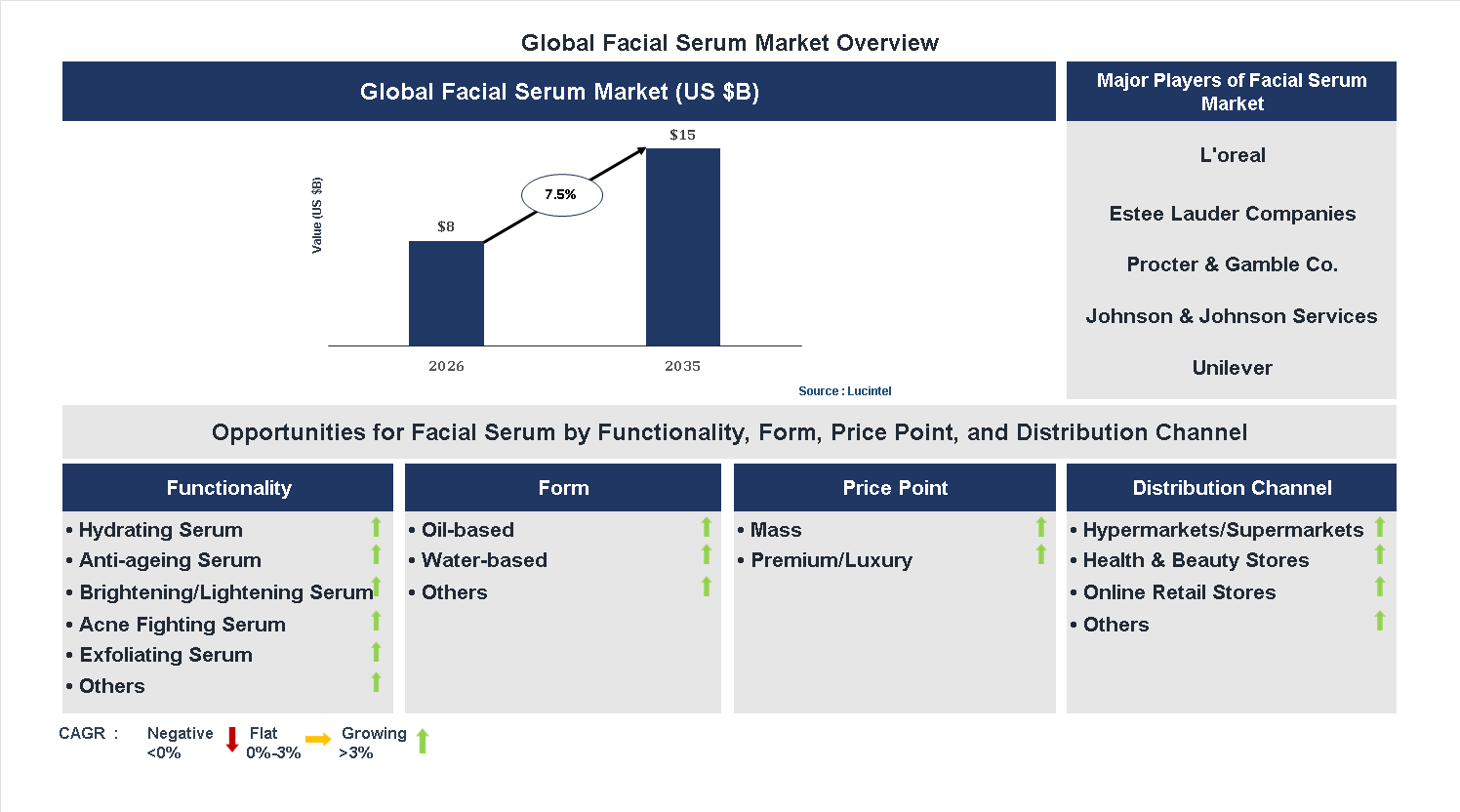
Key data points: The market size in 2035 = $15 billion, growth forecast = 7.5% annually for the next 8 years. Scroll below to get more insights. This market report covers trends, opportunities and forecasts in facial serum market to 2035 by functionality (hydrating serum, anti-ageing serum, brightening/lightening serum, acne fighting serum, exfoliating serum, and others), form (oil-based, water-based, and others), price point (mass and premium/luxury), distribution channel (hypermarkets/supermarkets, health & beauty stores, online retail stores, and others), and region (North America, Europe, Asia Pacific, and the Rest of the World)
We'll send your sample report shortly.
• Lucintel forecasts that, within the form category, water-based is expected to witness higher growth over the forecast period.
• Within the functionality category, anti-ageing serum is expected to witness the highest growth.
• In terms of region, APAC is expected to witness the highest growth over the forecast period. Gain valuable insights for your business decisions with our comprehensive 150+ page report. Sample figures with some insights are shown below.
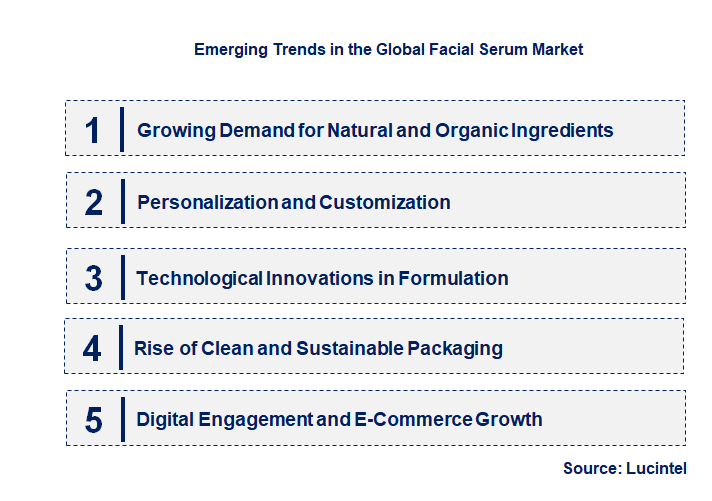
• Growing Demand for Natural and Organic Ingredients: Consumers are increasingly prioritizing clean beauty, seeking facial serums made with natural, organic, and non-toxic ingredients. This trend reflects a broader shift towards health-conscious and environmentally friendly products. Brands are reformulating products to include plant-based extracts, essential oils, and organic compounds, which appeal to eco-conscious consumers. The demand for transparency and ingredient authenticity is driving innovation and marketing strategies. This trend is expected to boost sales of natural serums and encourage brands to adopt sustainable sourcing and eco-friendly packaging.
• Personalization and Customization: The market is witnessing a surge in personalized skincare solutions tailored to individual skin types, concerns, and preferences. Advanced diagnostics, AI-driven skin analysis, and data-driven formulations enable brands to offer customized serums. Consumers value products that address specific issues like aging, hyperpigmentation, or acne with targeted ingredients. Personalization enhances customer engagement and loyalty, fostering a more intimate brand relationship. This trend is reshaping product development, with companies investing in technology to deliver bespoke formulations, thereby increasing market differentiation and consumer satisfaction.
• Technological Innovations in Formulation: Cutting-edge technologies such as encapsulation, nanotechnology, and bioengineering are revolutionizing serum formulations. These innovations improve ingredient stability, enhance absorption, and deliver active compounds more effectively. For example, encapsulation protects sensitive ingredients and allows for controlled release, increasing efficacy. Nanotechnology enables smaller particles to penetrate deeper into the skin, providing faster results. These advancements are driving product efficacy and consumer trust, encouraging brands to invest in R&D. As a result, the market is seeing more potent, innovative serums that meet high-performance expectations.
• Rise of Clean and Sustainable Packaging: Environmental concerns are prompting brands to adopt eco-friendly packaging solutions for facial serums. Recyclable, biodegradable, and refillable containers are gaining popularity among consumers who prioritize sustainability. Brands are also reducing plastic use and exploring innovative packaging materials to minimize environmental impact. This shift not only appeals to eco-conscious buyers but also aligns with regulatory pressures and corporate social responsibility goals. The emphasis on sustainable packaging is influencing product design, marketing, and supply chain practices, fostering a more environmentally responsible market landscape.
• Digital Engagement and E-Commerce Growth: The proliferation of digital platforms and e-commerce channels is transforming how consumers discover, evaluate, and purchase facial serums. Virtual try-ons, augmented reality, and online consultations enhance the shopping experience. Social media influencers and beauty bloggers significantly influence purchasing decisions, driving brand visibility and consumer engagement. The convenience of online shopping, coupled with targeted digital marketing, is expanding market reach globally. Brands are investing in digital strategies, including personalized advertising and direct-to-consumer models, to capitalize on this trend. This shift is making the market more accessible, competitive, and consumer-centric. These emerging trends are reshaping the facial serum market by fostering innovation, emphasizing sustainability, and enhancing consumer engagement. The focus on natural ingredients, personalization, technological advancements, eco-friendly packaging, and digital channels is creating a more dynamic, responsible, and customer-focused industry. Companies that adapt to these trends are poised to gain a competitive edge and meet evolving consumer expectations effectively.
• Growing Consumer Awareness and Demand for Natural Products: The increasing focus on skincare health and wellness has led consumers to seek natural, organic, and clean-label facial serums. This trend is encouraging brands to develop formulations with plant-based ingredients, free from harmful chemicals. As consumers become more educated about skincare benefits, they prefer products that align with their values, boosting sales and market growth. This shift is also prompting innovation in ingredient sourcing and product transparency.
• Technological Innovations in Formulation and Delivery: Advances in biotechnology and formulation techniques are enabling the development of more effective and stable serums. Innovations such as encapsulation and microemulsion technologies improve ingredient stability and skin penetration. These technological improvements enhance product efficacy, leading to higher consumer satisfaction and loyalty. Companies investing in R&D are gaining competitive advantages by offering cutting-edge products that deliver visible results faster.
• Rise of Personalized Skincare Solutions: The demand for personalized skincare is transforming the facial serum market. Consumers now prefer products tailored to their unique skin types and concerns, driven by digital skin analysis tools and AI-driven recommendations. Brands offering customized serums are gaining market share by providing targeted solutions, fostering brand loyalty, and increasing consumer engagement. This trend encourages innovation in formulation and marketing strategies, creating a more customer-centric market environment.
• Expansion of E-commerce and Digital Marketing: The growth of online retail channels and social media platforms has significantly expanded market reach. Consumers can now access a wide range of products with detailed reviews and tutorials, influencing purchasing decisions. Digital marketing strategies, including influencer collaborations and targeted advertising, boost brand visibility and sales. E-commerce also facilitates direct consumer feedback, enabling brands to quickly adapt to market preferences and launch new products efficiently.
• Increasing Focus on Sustainability and Eco-Friendly Packaging: Sustainability initiatives are becoming central to market growth, with brands adopting eco-friendly packaging and sustainable sourcing practices. Consumers are increasingly conscious of environmental impacts and prefer brands that demonstrate social responsibility. This shift encourages innovation in biodegradable packaging and refillable containers, reducing waste. Companies adopting sustainable practices are enhancing brand reputation and attracting environmentally conscious consumers, thereby expanding their market share and fostering long-term growth. These developments are collectively transforming the facial serum market by fostering innovation, enhancing consumer engagement, and promoting sustainability. The market is becoming more dynamic, competitive, and customer-focused, leading to increased product diversity and higher growth potential. As brands adapt to these trends, they are better positioned to meet evolving consumer needs, ensuring sustained market expansion and profitability.
• Expanding Consumer Demand for Anti-Aging and Skin Brightening Serums: The rising aging population and beauty-conscious consumers are fueling demand for serums that target wrinkles, fine lines, and dull skin. Innovative formulations with active ingredients like retinol, hyaluronic acid, and vitamin C are gaining popularity. Brands focusing on anti-aging and skin-brightening solutions can capitalize on this trend by offering tailored products that deliver visible results, thereby increasing market share and consumer loyalty.
• Growing Preference for Natural and Organic Ingredients in Facial Serums: Consumers are increasingly seeking products with natural, organic, and clean-label ingredients due to health and environmental concerns. This shift encourages brands to develop serums with plant-based extracts, essential oils, and eco-friendly formulations. The demand for transparency and sustainability in product ingredients is expected to drive innovation and differentiation, opening new avenues for market players to attract eco-conscious customers.
• Technological Innovations Enhancing Product Efficacy and Delivery: Advances in formulation technology, such as encapsulation and nanotechnology, improve the stability, absorption, and targeted delivery of active ingredients in facial serums. These innovations enable the development of highly effective products with longer shelf lives and better skin penetration. Companies investing in R&D to incorporate such technologies can offer superior products, gaining competitive advantage and expanding their consumer base.
• Rising Adoption of E-Commerce and Digital Marketing Strategies: The proliferation of online shopping platforms and social media has transformed how consumers discover and purchase facial serums. Digital marketing, influencer collaborations, and personalized online experiences are boosting product visibility and sales. Brands leveraging data analytics and e-commerce channels can reach wider audiences, offer customized recommendations, and respond swiftly to market trends, thereby accelerating growth and market penetration.
• Increasing Focus on Men’s Skincare and Gender-Neutral Products: The mens grooming segment is witnessing significant growth, with a rising demand for specialized facial serums that address mens skin concerns such as oiliness, roughness, and aging. Additionally, gender-neutral formulations appeal to a broader demographic. Companies developing inclusive, targeted products for men and gender-neutral markets can tap into new customer segments, diversify their portfolios, and drive overall market expansion. The overall market outlook is positively influenced by these growth opportunities, fostering innovation, expanding consumer bases, and encouraging sustainable practices. As brands adapt to evolving consumer preferences and technological advancements, the facial serum market is poised for substantial growth, offering lucrative prospects for industry stakeholders.
• Technological Innovation: The development of advanced formulations and delivery systems enhances product efficacy, attracting consumers seeking visible results. Innovations like encapsulation and bioavailability improvements allow serums to penetrate deeper, offering targeted benefits such as anti-aging, hydration, and brightening. Companies investing in R&D are launching novel products that meet the rising demand for personalized skincare solutions, thus fueling market growth. The integration of technology also enables better product stability and longer shelf life, further appealing to consumers and retailers alike.
• Rising Consumer Awareness and Preference for Natural Products: Consumers are increasingly aware of the ingredients in their skincare products and prefer natural, organic, and cruelty-free options. This shift is driven by greater access to information and a desire for safer, environmentally friendly products. As a result, brands are reformulating serums with plant-based extracts, essential oils, and clean labels, which boosts sales and market expansion. The trend towards transparency and sustainability is compelling companies to innovate and adapt, thereby expanding the market scope.
• Economic Growth and Increasing Disposable Income: Economic development in emerging markets has led to higher disposable incomes, enabling consumers to spend more on premium skincare products like facial serums. As consumers prioritize self-care and invest in skincare routines, demand for high-quality, effective serums rises. This economic upliftment also encourages brand expansion into new regions, fostering market growth. The willingness to spend on luxury and anti-aging products further propels the market, making it more accessible to a broader demographic.
• E-commerce and Digital Marketing Expansion: The proliferation of online retail channels and digital marketing strategies has significantly increased product accessibility and consumer engagement. E-commerce platforms provide a wide range of options, reviews, and competitive pricing, attracting a global customer base. Social media influencers and targeted advertising boost brand visibility and educate consumers about serum benefits. This digital shift reduces barriers to entry for new brands and accelerates market penetration, contributing to rapid growth and innovation within the sector. The challenges facing the facial serum market include:
• Regulatory Complexities and Compliance: The skincare industry faces stringent regulations concerning ingredient safety, labeling, and claims, which vary across regions. Navigating these regulatory frameworks can be costly and time-consuming, delaying product launches and increasing compliance risks. Non-compliance may lead to legal penalties, product recalls, and damage to brand reputation. As regulations evolve, companies must continuously adapt their formulations and marketing strategies, which can hinder innovation and market agility.
• Market Saturation and Intense Competition: The facial serum market is highly competitive, with numerous established brands and new entrants vying for consumer attention. Differentiating products becomes challenging amid a plethora of options, leading to price wars and reduced profit margins. Market saturation also limits growth opportunities in mature regions, forcing companies to seek new markets or innovate further. This intense competition pressures brands to invest heavily in marketing, R&D, and packaging to maintain market share.
• Supply Chain Disruptions and Raw Material Scarcity: Global supply chain issues, including transportation delays, raw material shortages, and geopolitical tensions, impact the availability and cost of ingredients and packaging materials. These disruptions can lead to production delays, increased costs, and inventory shortages, affecting product availability and profitability. The reliance on specific natural ingredients also makes the market vulnerable to environmental factors and climate change, which can threaten supply stability and increase prices, thereby constraining growth. The facial serum market is driven by technological advancements, consumer preferences for natural products, economic growth, and digital marketing expansion. However, regulatory hurdles, market saturation, and supply chain issues pose significant challenges. These factors collectively influence the market’s growth potential, requiring companies to innovate strategically while managing risks effectively. Overall, the markets future depends on balancing innovation with compliance and supply chain resilience to sustain growth and meet evolving consumer demands.
• Loreal
• Estee Lauder Companies
• Procter & Gamble Co.
• Johnson & Johnson Services
• Unilever
• Shiseido
• Amorepacific Group
• Augustinus Bader
• Honasa Consumer Limited
• Clarins Group
• Hydrating Serum
• Anti-ageing Serum
• Brightening/Lightening Serum
• Acne Fighting Serum
• Exfoliating Serum
• Others
• Oil-based
• Water-based
• Others
• Mass
• Premium/Luxury
• Hypermarkets/Supermarkets
• Health & Beauty Stores
• Online Retail Stores
• Others
• North America
• Europe
• Asia Pacific
• The Rest of the World
• United States: The US facial serum market has seen rapid expansion, with a focus on anti-aging and antioxidant-rich formulations. Major brands are investing in clean beauty and organic ingredients, responding to consumer demand for transparency and sustainability. E-commerce sales continue to grow, driven by digital influencers and personalized skincare routines. Innovations in delivery systems, such as encapsulation technology, enhance product efficacy. Regulatory agencies are emphasizing ingredient safety, prompting brands to reformulate products. The market is also witnessing increased adoption of cruelty-free and vegan options, aligning with ethical consumer preferences.
• China: Chinas facial serum market is booming, fueled by a rising middle class and increasing beauty consciousness. Local brands are gaining ground by offering affordable, innovative products tailored to Asian skin types. There is a strong emphasis on whitening and brightening serums, reflecting cultural beauty standards. E-commerce platforms like Tmall and JD.com are pivotal for distribution, with live-streaming marketing boosting sales. International brands are expanding presence through online channels and physical stores. Ingredient trends include herbal extracts and traditional Chinese medicine components. Regulatory reforms are focusing on safety standards, encouraging brands to improve product transparency and quality.
• Germany: The German market emphasizes natural and organic facial serums, driven by consumers preference for sustainable and eco-friendly products. Brands are incorporating bioactive ingredients and reducing synthetic chemicals. There is a growing trend toward minimalist formulations with transparent labeling. The market benefits from stringent EU regulations ensuring product safety and efficacy. Innovation in packaging, such as biodegradable containers, is gaining popularity. Consumers are also interested in serums that address specific skin concerns like sensitivity and pigmentation. Digital marketing and e-commerce are expanding access to niche and premium products, fostering a competitive landscape.
• India: The Indian facial serum market is experiencing rapid growth, with a focus on affordability and multifunctional benefits. Consumers are increasingly adopting serums for hydration, brightening, and anti-aging. Local brands are innovating with herbal and Ayurvedic ingredients, appealing to traditional preferences. The rise of e-commerce platforms like Amazon and Flipkart has expanded reach, especially in Tier 2 and Tier 3 cities. There is a rising awareness of skincare routines among young consumers. Regulatory frameworks are evolving to ensure product safety, encouraging brands to adopt higher quality standards. The market is also witnessing a surge in natural and organic product offerings.
• Japan: Japans facial serum market is characterized by a focus on advanced technology and high-quality ingredients. Consumers prefer products with anti-aging, moisturizing, and brightening properties. The market is driven by innovation in delivery systems, such as micro-encapsulation and slow-release formulations. Natural ingredients like rice extract and green tea are popular, aligning with Japan’s tradition of skincare rooted in nature. Regulatory standards are strict, ensuring product safety and efficacy. The trend toward minimalism and multifunctionality influences product development. Digital marketing and influencer collaborations are increasingly important for reaching tech-savvy Japanese consumers, fostering steady market growth.


• Loreal
• Estee Lauder Companies
• Procter & Gamble Co.
• Johnson & Johnson Services
• Unilever
• Shiseido
• Amorepacific Group
• Augustinus Bader
• Honasa Consumer Limited
• Clarins Group Q6. Which facial serum market segment will be the largest in future? Answer: Lucintel forecasts that, within the form category, water-based is expected to witness higher growth over the forecast period. Q7. In facial serum market, which region is expected to be the largest in next 5 years? Answer: In terms of region, APAC is expected to witness the highest growth over the forecast period. Q8. Do we receive customization in this report? Answer: Yes, Lucintel provides 10% customization without any additional cost.


Choose a license that fits your team. Instant PDF delivery.
Prices exclude taxes. Instant delivery. Custom licensing available on request.
Market Report · July 20, 2026
Market Report · July 15, 2026
Market Report · July 15, 2026
Trusted partner for strategic intelligence and business growth


Receive a complimentary market analysis tailored to your industry. Our analysts will identify key growth opportunities and competitive dynamics specific to your business.

Market size, growth rate, and key trend analysis for your specific sector.

Top competitor positioning and market share analysis.

Strategic recommendations backed by data-driven insights.
Get curated market intelligence and competitive moves straight to your inbox.
By subscribing, you agree to receive our monthly insights. Unsubscribe anytime.
Receive a complimentary market analysis tailored to your industry. Our analysts will identify key growth opportunities and competitive dynamics specific to your business.
Market size, growth rate, and key trend analysis for your specific sector.
Top competitor positioning and market share analysis.
Strategic recommendations backed by data-driven insights.
Get curated market intelligence, emerging trends, and competitive moves straight to your inbox each month.
By subscribing, you agree to receive our monthly insights. Unsubscribe anytime.
We'll send your sample report shortly.