
Report Feature
Facade Access Equipment Market Trends and Forecast
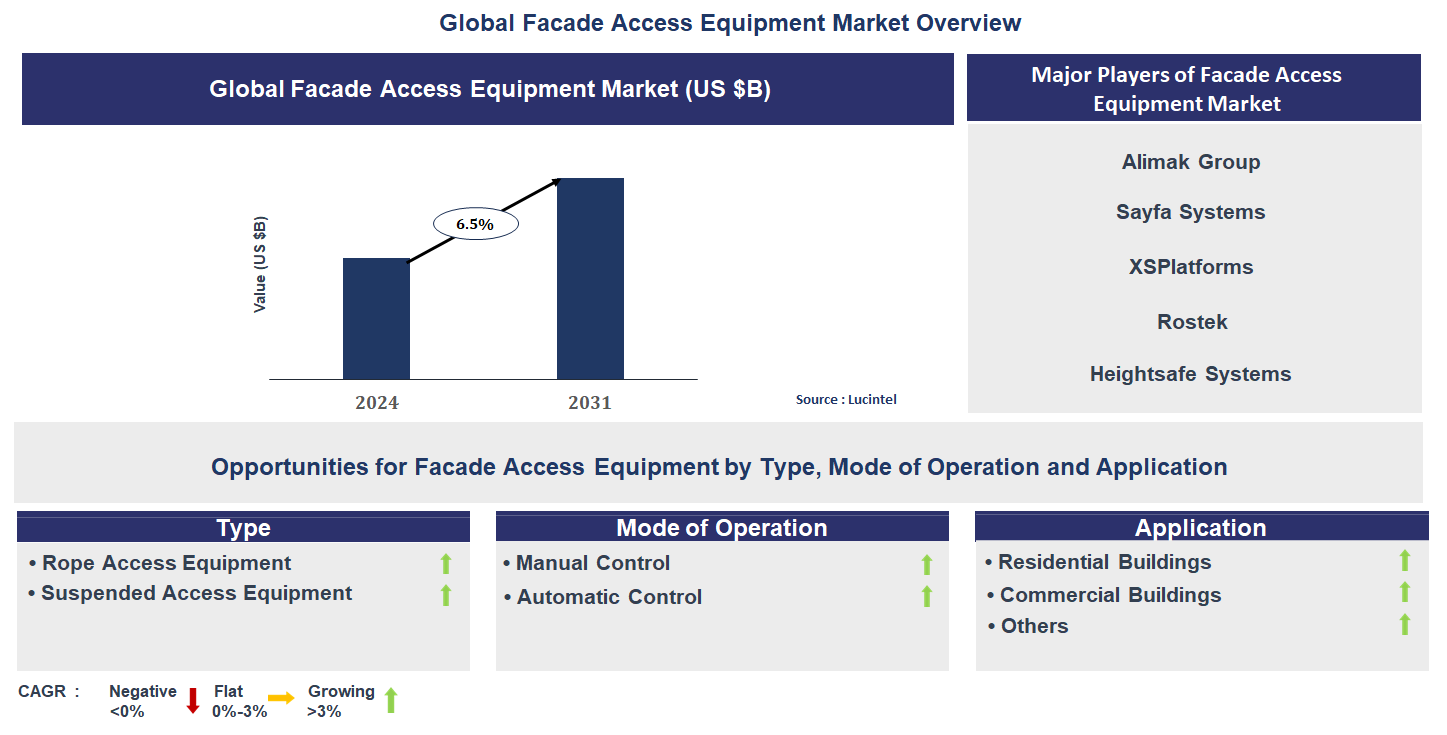
The future of the global facade access equipment market looks promising with opportunities in the residential building and commercial building markets. The global facade access equipment market is expected to grow with a CAGR of 6.5% from 2025 to 2031. The major drivers for this market are the increasing demand from construction industry, the rising focus on building safety regulations, and the growing adoption in high-rise building maintenance.• Lucintel forecasts that, within the type category, rope access equipment is expected to witness higher growth over the forecast period.
• Within the application category, commercial building is expected to witness higher growth.
• In terms of region, APAC is expected to witness the highest growth over the forecast period. Gain valuable insights for your business decisions with our comprehensive 150+ page report. Sample figures with some insights are shown below.
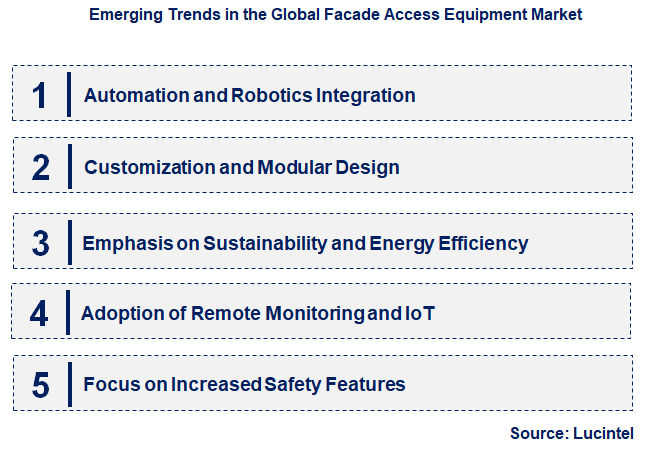
Emerging Trends in the Facade Access Equipment Market
The facade access equipment industry is transforming at its core, driven by technological advancements, changing architectural style, and world-wide emphasis on sustainability and employee safety. Those emerging trends are shifting the industry away from emphasis on functional simplicity to one of intelligent, integrated, and highly specialized solutions. With increasing height and complexity of buildings, the need for equipment that can rise up to these challenges with safety and effectiveness is on the rise.• Automation and Robotics Integration: The foremost trend is automation and robotics integration. Manufacturers are creating Building Maintenance Units (BMUs) and other access systems with computerized controls, sensors, and robotic arms for facade inspection and cleaning. The systems can travel through difficult building facades, gather information, and execute tasks with little human intervention. This movement is affecting the market by increasing operational efficiency greatly, decreasing labor expenses, and, above all, making workers safer by lessening the manual effort involved at high altitudes.
• Customization and Modular Design: The trend is moving towards customization and modular design. Contemporary buildings boast distinct and frequently non-linear facades, necessitating specialized access equipment. Companies are now providing modular systems that are readily configurable and can be readily adapted to a building’s distinctive architectural features. This affects the market by providing a more flexible and responsive product solution, which is an essential success factor for a very broad range of projects from greenfield to retrofit.
• Emphasis on Sustainability and Energy Efficiency: There is a strong trend towards sustainability and energy efficiency. The equipment is being manufactured in such a way that it uses less power and can service buildings with green facades, including living walls and solar panels. This is influencing the market by bringing facade access equipment into line with a global movement towards sustainable building and building operations. Its potential to service and maintain these green features is proving to be a major selling point.
• Adoption of Remote Monitoring and IoT: The market is witnessing a high wave in the adoption of remote monitoring and IoT. BMUs are being fitted with sensors that gather details about their usage, performance, and maintenance requirements. The data is sent to a central platform and used for real-time remote monitoring and predictive maintenance. This is affecting the market by enhancing equipment reliability, cutting downtime, and decreasing long-term maintenance costs for building owners and managers.
• Focus on Increased Safety Features: One of the prominent trends is the increased focus on increased safety features. Due to tighter regulations and increased concern for the safety of workers, facade access equipment is being constructed with more advanced safety features like automatic braking, anti-sway technology, and obstacle detection. This is affecting the market by making safety a key competitive discriminator. It also facilitates enhancing a reputation for reliability and ensuring regulation and compliance with international standards. These trends in the making are reworking the facade access equipment industry as a whole by turning it into a high-technology business all about intelligence, efficiency, and safety. The intersection of hardware advancements with software and data analytics is building an integrated and advanced value chain.
Recent Development in the Facade Access Equipment Market
The facade access equipment industry is seeing very fast developments, spurred by the sophistication of contemporary building facades and an international drive for safer construction and maintenance. The latest developments are impacting product innovation, production processes, and end-use applications. The industry is seeing the adoption of more advanced safety features and the embedding of smart technology to boost operational effectiveness.• Robotics and Automation in Maintenance: One key trend is robotics and automation in maintenance. Businesses are introducing new robotic facade cleaning and inspection systems that can be used independently on building facades. These robots can climb buildings and clean windows, for example, or inspect facades for damage. This is affecting the market by providing a safer, faster, and less expensive alternative to traditional human-controlled systems. It also lowers the risk to laborers, especially in dangerous settings.
• Introduction of Light-Weight and High-Strength Materials: One of the major developments is the introduction of light-weight and high-strength materials. The companies are employing advanced alloys and composites to design facade access equipment that is lighter in weight but stronger. It is having an impact on the market by decreasing the structural load on a building and facilitating easy transportation and installation of the equipment. The materials also enhance the lifespan of the equipment and tolerance towards extreme weather conditions.
• Advanced Digital Design and Simulation: Latest trends indicate a significant emphasis on advanced digital design and simulation. There is increased application of Building Information Modeling (BIM) and virtual reality (VR) by manufacturers to digitally design and simulate facade access equipment prior to its construction. The process ensures identification and elimination of possible design errors to achieve perfectly fitted equipment for a building’s specific facade. This is affecting the market by compressing the design cycle, cutting costs, and enhancing the performance of the final product.
• Strategic Acquisitions and Partnerships: The industry is experiencing a high growth of strategic partnerships and acquisitions. Large industry players are acquiring or partnering with tech companies to bring new capabilities, like automated controls and data analytics, into their products. It is affecting the market by making it more integrated value chain and enabling companies to provide more complete solutions to their customers.
• Aftermarket Services Expansion: The strong expansion of the aftermarket services sector is a key trend. With the installed base of facade access equipment expanding, there is a growing requirement for specialized repair, maintenance, and upgrade services. Firms are providing complete service contracts and predictive maintenance solutions to protect the long-term reliability and safety of their equipment. This is affecting the market by generating a high-margin, recurring revenue stream for makers and service providers. These pivotal developments are all cumulatively influencing the facade access equipment market by pushing the industry toward a more evolved, competitive, and customer-facing industry. The demand for technological advancement and the emergence of digital solutions are giving rise to new opportunities for growth, while concerns regarding safety and post-sales support are essentially redefining the market.
Strategic Growth Opportunities in the Facade Access Equipment Market
The facade access equipment market offers great strategic growth prospects fueled by changing architectural trends, a worldwide focus on safety, and increasing demand for effective building maintenance. Such prospects go beyond mainstream construction and exist in niche, value-added applications within multiple industries. To leverage these prospects, industry players need to prioritize innovation, product differentiation, and strategic partnerships. By targeting these specific growth areas, companies can secure a competitive edge and ensure long-term profitability.• Growing into the High-rise Residential Market: The high-rise residential market is an important strategic growth area. With urbanization and growth in population, there are more and more high-rise residential structures that need periodic facade cleaning. This is a different market from the commercial side, usually demanding more smaller-sized, discreet, and visually integrated equipment. This has the effect of making the market a high-volume, recurring source of revenue for many companies.
• Targeting the Infrastructure and Public Works Segment: The infrastructure and public works segment is a prime growth opportunity. Public buildings, bridges, dams, and other large-scale infrastructure projects need specialized and frequently custom-designed facade access equipment for inspection and maintenance. This affects the market by creating a stable source of demand from a vital sector. The long-term duration of these projects and the requirement for durable, dependable equipment make this a profitable segment.
• Capitalizing on the Retrofitting and Renovation Market: The retrofit and renovation market offers a strong growth opportunity. While urban centers get refaced, there is increased demand to renovate and refurbish older buildings. These types of projects frequently demand customized facade access solutions that will be able to traverse existing buildings and architectural features. This has the effect of providing a high-margin opportunity that is less vulnerable to the ups and downs of new construction cycles.
• Solutions Development for Green Facade Buildings: There is a strategic opportunity in targeting buildings with solar panels and green facades. To maintain such facades, comprising living walls and building-integrated photovoltaics (BIPV), it is needed to use special equipment capable of dealing with fragile plant life or fragile solar panels. This has the effect of creating a high-value niche that is essential to a broad array of sustainable industries in the market.
• Targeting Aftermarket Services and Predictive Maintenance: An attractive strategy is to target aftermarket services and predictive maintenance. As the installed base for facade access equipment expands, there is a growing demand for specialized repair and maintenance. Businesses that can provide end-to-end service packages, such as remote monitoring and predictive maintenance, will possess a huge competitive advantage. This affects the market by generating a high-margin, recurring revenue stream. These strategic growth prospects are transforming the facade access equipment market by compelling a transition from a commodity bulk business to one based on specialist, high-margin products and services. Through targeting high-growth markets and adopting the trend towards sustainability, organizations can tap new sources of revenue, create differentiation compared to the competition, and establish a more secure marketplace position in the future.
Facade Access Equipment Market Driver and Challenges
The facade access equipment industry is influenced by the interplay of a sophisticated mix of key drivers and challenges across a range of technological, economic, and regulatory determinants. An increase in the global construction market, especially the growth of high-rise and complex structures, is fueling the growth of the industry. Emphasis on the safety of workers and incorporation of intelligent technologies are also enhancing innovation. But this growth is moderated by serious challenges associated with high levels of capital costs, the requirement of skilled labor, and ferocious competition. The factors responsible for driving the facade access equipment market include: 1. Growing Demand for Commercial and Residential Construction: The main spur for the facade access equipment market is the steady rise in commercial and residential building, especially in city areas. Increased high-rise building and skyscraper constructions around the world create the need to employ specialized machines for efficient and safe maintenance. With buildings rising higher and more complex, the demand for sophisticated access solutions is a key driver of demand. 2. Increasing Emphasis on Workers Safety and Regulations: The industry is influenced by an extensive emphasis on workers safety and tougher regulations. Governments and regulatory agencies globally are imposing tougher standards on safety for work at height. This is forcing building owners and construction firms to make investments in certified and dependable facade access equipment, which mitigates the risk of accidents and helps comply with regulations. 3. Technological Innovations and Automation: Automation efforts and technological developments are the major drivers. The incorporation of sensors, robotics, and remote monitoring features into facade access equipment is making it more efficient and minimizing the amount of manual effort required. Automated systems are able to accomplish tasks more quickly and precisely, which is an essential success factor for an array of projects. 4. Growing Demand for Building Maintenance: The demand is growing steadily and consistently for building maintenance solutions. Facades must be cleaned and maintained regularly to uphold their appearance as well as structural integrity. Modern facades use advanced materials like glass and composites, and such materials necessitate professional cleaning and inspection, thus driving demand for top-quality access equipment. 5. Aesthetic Complexity of Contemporary Architecture: The rising aesthetic complexity of contemporary architecture is another major driver. Most new buildings have unusual shapes, angles, and materials that are hard to reach with conventional methods. This is fueling the need for custom-engineered and highly versatile facade access equipment, which can be designed to fit a building’s particular architectural design. Challenges in the facade access equipment market are: 1. High Upfront Capital and Operating Expenditures: The industry is presented with a major challenge of the high upfront capital and operating expenditures of facade access equipment. The technology’s complexity, the use of high-strength materials, and the requirement for custom engineering make the systems very costly. This can pose a hurdle to small building owners or construction firms. 2. Demand for Skilled and Specialized Labor: The industry is confronted with a massive challenge by the demand for skilled and specialized labor. Trained staff are needed for the installation, operation, and maintenance of advanced facade access equipment. The lack of skilled labor can result in delayed project periods as well as elevated labor costs, which can affect the growth of the industry, especially in certain areas. 3. High Competition and Price Fluctuations: The competition is very high, and price fluctuations are a serious challenge for the market. There are many worldwide and regional contenders with a variety of products, which can cause a price war and diminishing profit margins. Also, raw material prices, i.e., steel and aluminum, can be fluctuating, which can affect manufacturing costs. By and large, the facade access equipment industry is marked by a robust growth pattern fueled by the world construction boom and an increased emphasis on safety and technicality. The growing trend towards high-rise and complicated buildings as well as tougher safety standards is leading to a steady demand for sophisticated access solutions. But the market has to operate through major challenges such as high capital expenditure, the requirement for skilled labor, and high levels of competition.List of Facade Access Equipment Companies
Companies in the market compete on the basis of product quality offered. Major players in this market focus on expanding their manufacturing facilities, R&D investments, infrastructural development, and leverage integration opportunities across the value chain. With these strategies facade access equipment companies cater increasing demand, ensure competitive effectiveness, develop innovative products & technologies, reduce production costs, and expand their customer base. Some of the facade access equipment companies profiled in this report include-• Alimak Group
• Sayfa Systems
• XSPlatforms
• Rostek
• Heightsafe Systems
• FBA Gomyl
• Atlas Anchor Systems
Facade Access Equipment Market by Segment
The study includes a forecast for the global facade access equipment market by type, mode of operation, application, and region.Facade Access Equipment Market by Type [Value from 2019 to 2031]:
• Rope Access Equipment
• Suspended Access Equipment
Facade Access Equipment Market by Mode of Operation [Value from 2019 to 2031]:
• Manual Control
• Automatic Control
Facade Access Equipment Market by Application [Value from 2019 to 2031]:
• Residential Buildings
• Commercial Buildings
• Others
Facade Access Equipment Market by Region [Value from 2019 to 2031]:
• North America
• Europe
• Asia Pacific
• The Rest of the World
Country Wise Outlook for the Facade Access Equipment Market
The facade access equipment industry is witnessing a dramatic shift, fueled by the growing construction of high-rise, complex buildings across the world. As building designs grow more innovative and complex, the demand for advanced and specialized equipment to facilitate safe and efficient maintenance increases. Recent advancements focus on incorporating emerging technologies, including automation and robotics, to improve worker safety and efficiency of operations. The market is also influenced by an increasing emphasis on sustainability and the necessity of servicing green buildings and intelligent facades.• United States: In the United States, the Facade Access Equipment market is growing robustly, with growth fueled by soaring commercial and residential high-rise building construction in major cities. One of the most important trends is the greater use of smart technology in Building Maintenance Units (BMUs), such as automated control systems and remote diagnostics for predictive maintenance. There is also a greater focus on custom-engineered solutions to maintain complex and unusual building designs, which is an important competitive advantage.
• China: China’s Facade Access Equipment market is the biggest and fastest-growing in the world, driven by the high pace of urbanization and the ongoing construction of high-rise buildings and mega-projects. Recent trends are focused on the mass production of a vast array of facade access equipment to satisfy unprecedented levels of construction. The emphasis lies in the integration of high production capacity with enhanced safety levels and technology integration, such as the implementation of sophisticated control systems for enhanced efficiency and user-friendliness.
• Germany: The German Facade Access Equipment market is marked by high emphasis on engineering, ruggedness, and strict adherence to high European safety standards. Major advances involve the development and manufacture of very specialized equipment specifically for intricate architectural designs and historic buildings. There is increased demand for the utilization of sustainable and energy-efficient materials in the manufacturing process to lower the carbon footprint of the production process.
• India: India’s Facade Access Equipment market is at a nascent but high-growth stage, fueled by the rapid urbanization in the country and the construction of new residential and commercial structures. One major development is increasing awareness and use of professional facade access systems over conventional, unsafe practices. The market is witnessing an entry of high-quality, long-lasting equipment both from local and international players. The trend towards smart cities and green building certifications is fueling the need for sophisticated and reliable maintenance solutions.
• Japan: The Facade Access Equipment market in Japan is mature and characterized by intense focus on precision, dependability, and seismic resistance. The focus in recent times has been on developing highly sophisticated, automated systems that are capable of withstanding the nation’s high levels of seismic activity and harsh weather conditions. There is a trend in the market towards the use of high-performance, lightweight materials to enhance operating efficiency and minimize the structural load on the building. Equipment that needs little or no manual intervention is also strongly emphasized, which helps tackle the issue of the aging population and labor shortages in the country.

Features of the Global Facade Access Equipment Market
Market Size Estimates: Facade access equipment market size estimation in terms of value ($B). Trend and Forecast Analysis: Market trends (2019 to 2024) and forecast (2025 to 2031) by various segments and regions. Segmentation Analysis: Facade access equipment market size by type, mode of operation, application, and region in terms of value ($B). Regional Analysis: Facade access equipment market breakdown by North America, Europe, Asia Pacific, and Rest of the World. Growth Opportunities: Analysis of growth opportunities in different types, modes of operation, applications, and regions for the facade access equipment market. Strategic Analysis: This includes M&A, new product development, and competitive landscape of the facade access equipment market. Analysis of competitive intensity of the industry based on Porter’s Five Forces model.
FAQ
Q1. What is the growth forecast for facade access equipment market? Answer: The global facade access equipment market is expected to grow with a CAGR of 6.5% from 2025 to 2031. Q2. What are the major drivers influencing the growth of the facade access equipment market? Answer: The major drivers for this market are the increasing demand from construction industry, the rising focus on building safety regulations, and the growing adoption in high-rise building maintenance. Q3. What are the major segments for facade access equipment market? Answer: The future of the facade access equipment market looks promising with opportunities in the residential building and commercial building markets. Q4. Who are the key facade access equipment market companies? Answer: Some of the key facade access equipment companies are as follows:• Alimak Group
• Sayfa Systems
• XSPlatforms
• Rostek
• Heightsafe Systems
• FBA Gomyl
• Atlas Anchor Systems Q5. Which facade access equipment market segment will be the largest in future? Answer: Lucintel forecasts that, within the type category, rope access equipment is expected to witness higher growth over the forecast period. Q6. In facade access equipment market, which region is expected to be the largest in next 5 years? Answer: In terms of region, APAC is expected to witness the highest growth over the forecast period. Q7. Do we receive customization in this report? Answer: Yes, Lucintel provides 10% customization without any additional cost.
Table of Contents
List of Figures
List of Tables
Methodology
- In-depth interviews of the major players in this market
- Detailed secondary research from competitors’ financial statements and published data
- Extensive searches of published works, market, and database information pertaining to industry news, company press releases, and customer intentions
- A compilation of the experiences, judgments, and insights of Lucintel’s professionals, who have analyzed and tracked this market over the years.


Buy Now
Choose a license that fits your team. Instant PDF delivery.
Prices exclude taxes. Instant delivery. Custom licensing available on request.
Key Questions
- • What are some of the most promising, high-growth opportunities for the facade access equipment market by type (rope access equipment and suspended access equipment), mode of operation (manual control and automatic control), application (residential buildings, commercial buildings, and others), and region (North America, Europe, Asia Pacific, and the Rest of the World)?
- • Which segments will grow at a faster pace and why?
- • Which region will grow at a faster pace and why?
- • What are the key factors affecting market dynamics? What are the key challenges and business risks in this market?
- • What are the business risks and competitive threats in this market?
- • What are the emerging trends in this market and the reasons behind them?
- • What are some of the changing demands of customers in the market?
- • What are the new developments in the market? Which companies are leading these developments?
- • Who are the major players in this market? What strategic initiatives are key players pursuing for business growth?
- • What are some of the competing products in this market and how big of a threat do they pose for loss of market share by material or product substitution?
- • What M&A activity has occurred in the last 5 years and what has its impact been on the industry? For any questions related to Facade Access Equipment Market, Facade Access Equipment Market Size, Facade Access Equipment Market Growth, Facade Access Equipment Market Analysis, Facade Access Equipment Market Report, Facade Access Equipment Market Share, Facade Access Equipment Market Trends, Facade Access Equipment Market Forecast, Facade Access Equipment Companies, write Lucintel analyst at email: helpdesk@lucintel.com. We will be glad to get back to you soon.


