
Market Report · May 18, 2026

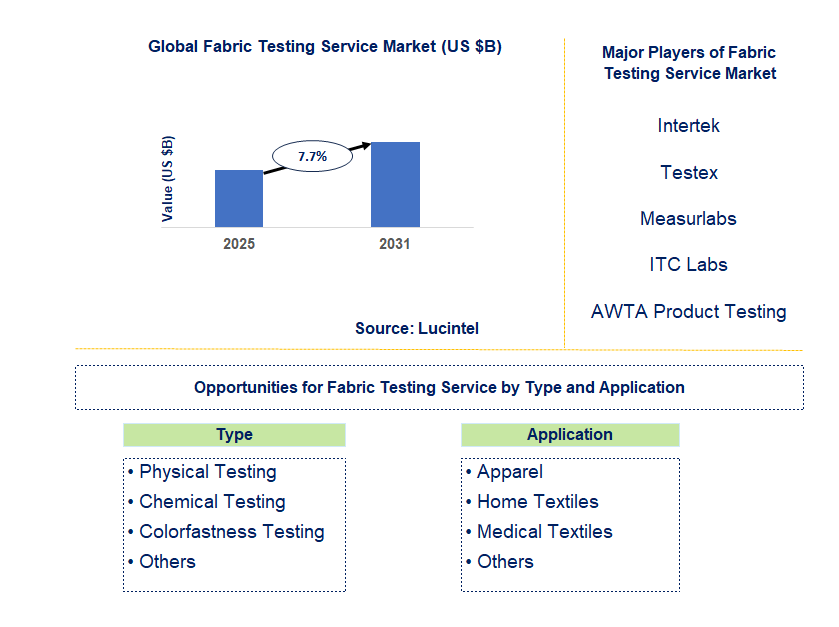
Key data points: The growth forecast = 7.7% annually for the next 7 years. Scroll below to get more insights. This market report covers Trends, opportunities and forecasts in fabric testing service market to 2031 by type (physical testing, chemical testing, colorfastness testing, and others), application (apparel, home textiles, medical textiles, and others), and region (North America, Europe, Asia Pacific, and the Rest of the World)
We'll send your sample report shortly.
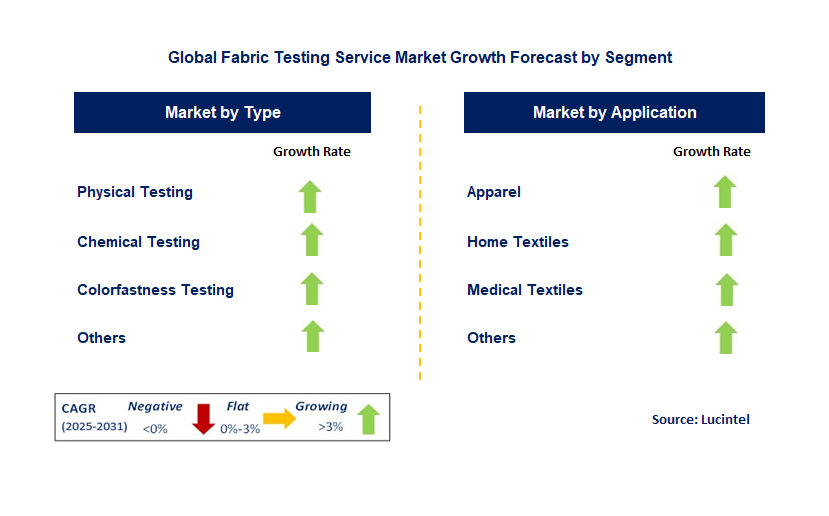
• Lucintel forecasts that, within the type category, physical testing is expected to witness the highest growth over the forecast period.
• Within the application category, apparel is expected to witness the highest growth.
• In terms of region, APAC is expected to witness the highest growth over the forecast period.
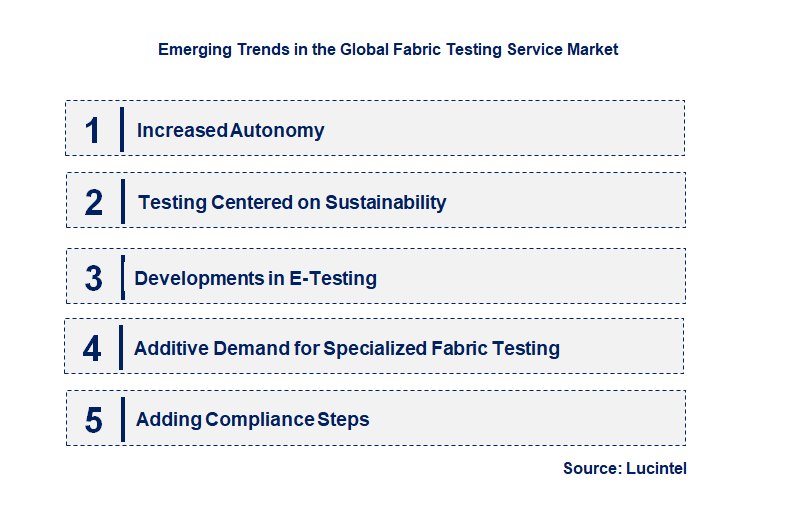
• Increased Autonomy: The integration of AI and automation in fabric testing services is revolutionizing the industry. Efficiency and accuracy of automated systems is achieved through AI technology in fabric inspection and testing. AI-powered image recognition and machine learning algorithms make it possible to identify, automatically, numerous defects, thus reducing the need for manual inspection. The automation results in improved productivity and elimination of human mistakes within testing procedures. For instance, fabric testing automation serves the need for mass manufacture of textiles.
• Testing Centered on Sustainability: Concerns about the environment and sustainable practices are propelling the development of more sustainable testing approaches. Environmentally friendly practices that utilize no water or chemicals for testing are becoming more popular. Certifications like OEKO-TEX and GOTS are gaining popularity in the industry to certify that textiles are ecological and safe. There is a need for sustainable testing solutions to validate claims of biodegradable fabrics and circular economy initiatives to assist brand sustainability efforts.
• Developments in E-Testing: The use of the internet to transform testing services by incorporating cloud facilities, blockchain for supply chain verification, and data analytics monitoring passes is changing testing services. Cloud-based testing services allow for remote testing and sharing of results and documentation of tests done for compliance. Blockchain improves tracking and transparency within the supply chain for brands combating counterfeit goods and compliance to high-standards of quality.
• Additive Demand for Specialized Fabric Testing: The advent of smart textiles alongside performance fabrics, and technical textiles increases the need for specialized fabric testing. Some evolving testing services now include thermal regulation, antimicrobial effectiveness, moisture-wicking, and UV protection. The highest demand for functional testing of textiles is for the sportswear sector, most medical textiles, and protective clothing where reliability and extreme durability is essential.
• Adding Compliance Steps: Various regions have different quality regulations on textiles which increases the testing procedures and the adoption of safety measures like REACH, CPSIA, and ISO certifications are now mandatory. Compliance testing services are now needed as governing bodies are restricting more chemicals being used in textiles deemed harmful. New developments are adopting eco-friendly and sustainable practices that meet consumer demand alongside complex regulations which the fabric testing service market has to follow. The goals of the industry are also changing towards improved effectiveness and cleanliness for the environment, assuring that eco-standards are met along with consumer need.
• AI and Machine Learning Integration in Testing Procedure: Machine learning (ML) and Artificial Intelligence (AI) have automated pattern recognition, predictive analysis, defect identification and classification, and anomaly detection improving the accuracy and efficiency of fabric testing. With less human input, the chances for mistakes are minimized. AI systems have enhanced the efficiency of quality control processes in industries such as fashion and technical textiles, where fabric integrity is crucial, leading to faster TURNAROUND TIMES.
• The Development of Eco-Friendly and Sustainable Testing Procedure: As a result of an increasing focus on sustainability, fabric testing services have adopted more eco-friendly methods. These include waterless testing, application of biodegradable chemicals, and the use of energy-efficient machinery. These methods assist brands to align with environmental compliance requirements and fulfill the market’s growing needs for eco-friendly products.
• Implementation of Automation and Robotics In Testing Laboratory: Testing laboratories have started to use automated equipment and robots in their works in order to increase efficiency. Human interaction is limited with the introduction of robotic arms and automated testing rigs that allow for high through-put sample analysis. This advancement increases consistency, reduces costs, and improves the volume of tests conducted by large scale textile producers.
• Greater Emphasis on Meeting International Standard: International legislative bodies are continuously tightening their testing procedures which creates a need for more sophisticated testing techniques. The compliance with regulations such as REACH in Europe, and CPSIA in the USA have increased the need for more accurate testing methods. Service providers are continuously improving their testing methods to ensure products meet internationally accepted safety and quality requirements.
• Development of Remote and Digital Testing Method: These types of testing can now be done digitally or on the cloud, allowing manufacturers to access test data in real time from anywhere. With remote access to test data, global supply chains have become more efficient and reliable, reducing costs and improving transparency in quality control, especially for global players in the textile business with multiple production units. These developments are improving the fabric testing service market by boosting market efficiencies, enhancing compliance, and meeting sustainability targets. Providers of services have to keep pace with technological changes to remain competitive and support the advancement of the industry.
• Testing Related to High-Performance Sportswear is Emerging: The market pace of blue sign certified high-performance sports apparel with moisture-wicking, antimicrobial, and UV-blocking features is growing. Verification tests that brand laboratories conduct for quality assurance are essential. Because of the tremendous and often unfulfilled demands for performance-oriented and durable sportswear, laboratories are scaling their capabilities to address market needs.
• Growth In Medical And Healthcare Textiles Testing: The medical textiles industry including surgical masks, gowns, and ready-made wounds, cleaning, and dressing requires extensive testing for biocompatibility, durability, and antimicrobial property. There is an increase in spending on the testing of medical textiles to certifying these products and standards of quality.
• Development In Automotive Textiles Testing: Automobiles require tested flame resistance, abrasive resistance, and UV stability on their trimming fabrics, some of which include headliners and seats. There is an increased need for lightweight, sustainable materials for textiles as electric vehicles gain popularity. Testing of fabric materials significantly impacts the failure of safety, service life, and durability criteria.
• Testing of Smart Textiles and Wearable Technology Integration: Smart textiles featuring sensors and other electronic components can now be categorized under a specific type of fabric testing. Moreover, Service providers are creating specific procedures to evaluate the electrical smart wearables and IoT textiles.
• An Upward Demand for Setting Home Textiles: Nowadays consumers have an increased interest in the comfort and sustainability of bedding, upholstery, and curtains. There is increased demand in fabric testing services that focus on colorfastness, fire resistance, and hypoallergenic qualities as many brands are trying to gain competitive advantage in the home furnishing market. These opportunities in growth are focused on the changing market demand from different sectors that depend on the quality of the fabric. It is also apparent that advanced technologies in the field of textiles serve the need to fulfill the expectation of many customers and hence, garment testing service providers must diversify their services.
• Intertek
• Testex
• Measurlabs
• ITC Labs
• AWTA Product Testing
• Eurofins Scientific
• Enviropass
• TexTest
• Professional Testing Laboratory
• Sgt Group
• Physical Testing
• Chemical Testing
• Colorfastness Testing
• Others
• Apparel
• Home Textiles
• Medical Textiles
• Others
• North America
• Europe
• Asia Pacific
• The Rest of the World
• United States: Automated testing solutions are being adopted more widely in the US fabric testing service Market to improve precision and efficiency. Eco-friendly verification of textiles requires brand compliance, thus identity verification using Textiles Sustainability Testing Verification Protocols is gaining traction. A surge in the regulatory safety mandates has increased the need for more comprehensive performance testing of medical and protective textiles. There is also development for innovation with collaboration from research institutions and international standards along with fabric testing firms which is changing methodologies and bringing new undiscovered approaches for international standard compliance.
• China: China continues to dominate the world in fabric production, and there is rapid growth in the market of fabric testing services due to domestic and international regulations. The Government has tightened control over the textile exports by instituting more comprehensive testing procedures aimed at meeting international compliance standards. The application of automated systems and digital quality control systems is improving testing efficacy. Furthermore, Chinese textile firms are adopting green testing methods to aid in the sustainable production of textiles in China, addressing global environmental concerns and consumer demand for ethically produced textiles.
• Germany: Germany's fabric testing service sector is known for its high accuracy testing methods and sustainability practices. The country is experiencing notable growth in eco-certification testing services owing to a robust market for sustainable textiles. Advanced digital technologies are being adopted for better compliance and traceability of examination including blockchain for effective supply chain transparency. Also, Germany’s leadership in the area of technical textiles has increased the need, therefore, demand for specialized fabric testing services for automotive and industrial use has also grown.
• India: India is one of the countries that is adopting new low cost and easy to use testing facilities for SMEs, which is undoubtedly ensuring quality compliance for local manufacturers. This is happening alongside the growing accessibility of testing services for small and medium enterprises (SMEs) in India, dubbed as the “fabric testing services market”. Alongside, the implementation of updated national standards, international accreditation processes, and quality compliance checking are gearing up credibility in the market. The fabric testing service market of India has seen significant growth due to the rapid increase of the textile industry and government implementation of quality testing. India is also becoming familiar with automated fabric analysis and digital testing procedures, which is aiming at improved accuracy as well as faster turnaround time for results.
• Japan: Japan has also seen remarkable growth in the robotic fabric testing solutions, which are prone to minimizing errors and bolstering efficiency. In addition, the country’s smart textile testing is ensuring compliance with wearable and e-textiles dubbed as the forefront of smart textile testing. The automated processes in fabric testing have also seen implementation of nanotechnology which has greatly aided the manufacturers in developing new range of materials with fabric testing. Alongside, international regulatory associations with Japanese firms is boosting compliance to global trade textiles and marking Japan as the frontrunner in robotic fabric testing.


• Intertek
• Testex
• Measurlabs
• ITC Labs
• AWTA Product Testing
• Eurofins Scientific
• Enviropass
• TexTest
• Professional Testing Laboratory
• Sgt Group Q5. Which fabric testing service market segment will be the largest in future? Answer: Lucintel forecasts that, within the type category, physical testing is expected to witness the highest growth over the forecast period. Q6. In fabric testing service market, which region is expected to be the largest in next 5 years? Answer: In terms of region, APAC is expected to witness the highest growth over the forecast period. Q7. Do we receive customization in this report? Answer: Yes, Lucintel provides 10% customization without any additional cost.


Choose a license that fits your team. Instant PDF delivery.
Prices exclude taxes. Instant delivery. Custom licensing available on request.
Market Report · May 18, 2026
Market Report · May 18, 2026
Market Report · May 18, 2026
Trusted partner for strategic intelligence and business growth


Receive a complimentary market analysis tailored to your industry. Our analysts will identify key growth opportunities and competitive dynamics specific to your business.

Market size, growth rate, and key trend analysis for your specific sector.

Top competitor positioning and market share analysis.

Strategic recommendations backed by data-driven insights.
Get curated market intelligence and competitive moves straight to your inbox.
By subscribing, you agree to receive our monthly insights. Unsubscribe anytime.
Receive a complimentary market analysis tailored to your industry. Our analysts will identify key growth opportunities and competitive dynamics specific to your business.
Market size, growth rate, and key trend analysis for your specific sector.
Top competitor positioning and market share analysis.
Strategic recommendations backed by data-driven insights.
Get curated market intelligence, emerging trends, and competitive moves straight to your inbox each month.
By subscribing, you agree to receive our monthly insights. Unsubscribe anytime.
We'll send your sample report shortly.