
Report Feature
Eye Needle Market Trends and Forecast
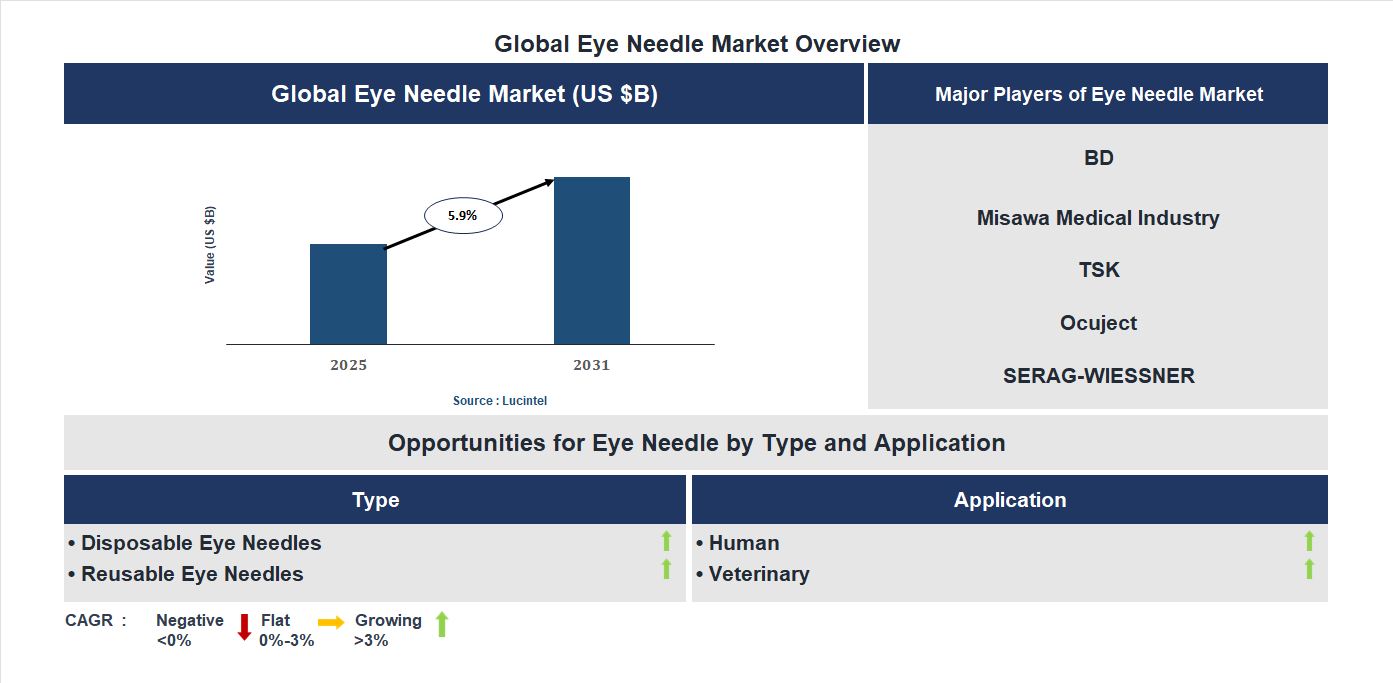
The future of the global eye needle market looks promising with opportunities in the human and veterinary markets. The global eye needle market is expected to grow with a CAGR of 5.9% from 2025 to 2031. The major drivers for this market are the increasing prevalence of ophthalmic disorders, the rising volume of eye surgical procedures, and the growing demand for precision ophthalmic instruments.• Lucintel forecasts that, within the type category, disposable eye needle is expected to witness higher growth over the forecast period.
• Within the application category, human is expected to witness higher growth.
• In terms of region, APAC is expected to witness the highest growth over the forecast period. Gain valuable insights for your business decisions with our comprehensive 150+ page report. Sample figures with some insights are shown below.
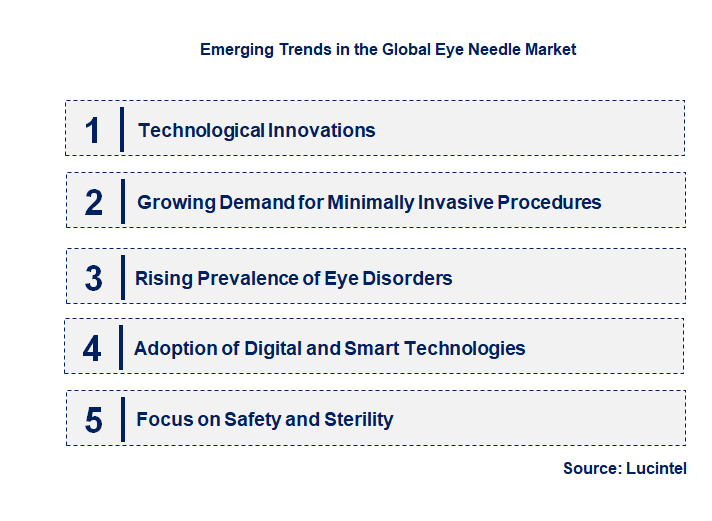
Emerging Trends in the Eye Needle Market
The eye needle market is experiencing rapid evolution driven by technological advancements, changing consumer preferences, and increasing demand for precision in ophthalmic procedures. As healthcare providers seek minimally invasive options and improved patient outcomes, the market is adapting to incorporate innovative materials, enhanced safety features, and digital integration. These developments are not only expanding the scope of eye care treatments but also making procedures more accessible and efficient. Understanding these emerging trends is crucial for stakeholders aiming to capitalize on new opportunities and stay competitive in this dynamic landscape.• Technological Innovations: The integration of advanced materials and precision engineering is transforming eye needle design. Innovations such as ultra-fine needles and biocompatible coatings reduce patient discomfort and improve accuracy during injections. Digital enhancements, including real-time imaging and automated delivery systems, are increasing procedural success rates. These technological advancements are enabling ophthalmologists to perform complex procedures with greater confidence, reducing complications, and enhancing overall patient care. As a result, the market is witnessing increased adoption of high-tech eye needles, driving growth and innovation.
• Growing Demand for Minimally Invasive Procedures: Patients and healthcare providers are favoring minimally invasive eye treatments to reduce recovery time and discomfort. This trend is fueling the development of smaller, more precise needles that can deliver medications or perform injections with minimal tissue damage. The shift towards outpatient procedures and the desire for quicker recovery are pushing manufacturers to innovate in needle design and delivery systems. This demand is expanding the market, encouraging the adoption of advanced eye needles that facilitate safer, faster, and more comfortable treatments, ultimately improving patient satisfaction and outcomes.
• Rising Prevalence of Eye Disorders: Increasing incidences of age-related macular degeneration, diabetic retinopathy, and glaucoma are boosting the need for effective injection therapies. As these conditions become more prevalent globally, the demand for specialized eye needles for intravitreal injections and other treatments is rising. This trend is prompting manufacturers to develop needles tailored for specific procedures, enhancing precision and safety. The growing patient population and expanding treatment options are expected to sustain market growth, with innovations focused on improving efficacy and reducing adverse effects associated with eye injections.
• Adoption of Digital and Smart Technologies: The integration of digital tools and smart technologies is revolutionizing the eye needle market. Features such as automated injection systems, real-time feedback, and data tracking are improving procedural accuracy and safety. These technologies enable personalized treatment plans and better monitoring of patient outcomes. Additionally, digital platforms facilitate training and skill enhancement for practitioners. The adoption of smart eye needles is creating new opportunities for market expansion, making procedures more efficient, and ensuring higher standards of care, which are critical in a rapidly evolving healthcare landscape.
• Focus on Safety and Sterility: Ensuring safety and sterility during eye procedures remains a top priority. Innovations include pre-sterilized, single-use needles and improved packaging that prevent contamination. Enhanced safety features, such as needle guards and safety locks, are reducing needlestick injuries and cross-contamination risks. Regulatory standards are also becoming more stringent, prompting manufacturers to innovate in sterilization and safety protocols. This focus on safety not only protects patients and healthcare workers but also boosts confidence in eye injection procedures, fostering market growth and encouraging the adoption of safer, more reliable eye needle products. In summary, these emerging trends are collectively reshaping the eye needle market by fostering innovation, improving safety, and expanding treatment options. They are enabling more precise, minimally invasive, and patient-friendly procedures, which are essential for meeting the growing demand for effective eye care solutions. As these trends continue to evolve, they will drive sustained market growth and technological advancement, ultimately enhancing patient outcomes and transforming ophthalmic treatment paradigms.
Recent Development in the Eye Needle Market
The eye needle market is experiencing rapid advancements driven by technological innovations and increasing demand for precise ophthalmic procedures. As eye care needs grow globally, manufacturers are focusing on developing specialized needles that enhance safety, comfort, and efficiency. These developments are opening new opportunities for healthcare providers and patients alike, fostering market expansion. The integration of advanced materials and techniques is also contributing to improved clinical outcomes, making the market highly dynamic and competitive.• Technological Innovations in Needle Design: The development of ultra-thin, flexible, and ergonomically designed eye needles is revolutionizing ophthalmic surgeries. These innovations reduce patient discomfort, minimize tissue trauma, and improve surgical precision. Enhanced needle materials, such as biocompatible polymers and coated surfaces, are increasing durability and reducing infection risks. As a result, ophthalmologists can perform complex procedures more efficiently, boosting confidence in minimally invasive techniques. This progress is expected to expand the market by attracting new users and increasing procedure volumes.
• Growing Demand for Minimally Invasive Procedures: The rising preference for minimally invasive eye surgeries is significantly impacting the eye needle market. Patients seek quicker recovery times, less pain, and fewer complications, prompting surgeons to adopt advanced needle technologies. This trend is driving manufacturers to innovate needles that facilitate precise injections and delicate tissue handling. The demand is particularly high in cataract, glaucoma, and retinal surgeries. As awareness and healthcare infrastructure improve, the market for specialized eye needles is projected to grow substantially, supporting better patient outcomes.
• Increasing Adoption of Advanced Materials: The use of innovative materials like silicone, polyimide, and coated metals in eye needles is enhancing performance and safety. These materials offer superior flexibility, biocompatibility, and reduced friction, leading to more accurate injections and less tissue damage. The adoption of such materials is also extending needle lifespan and reducing costs. This shift is enabling manufacturers to produce high-quality, reliable products that meet stringent safety standards, thereby expanding their market share and encouraging further research and development.
• Regulatory Approvals and Standardization: Stringent regulatory frameworks and standardization efforts are shaping the eye needle market by ensuring product safety and efficacy. Recent approvals of novel needle designs by health authorities are boosting market confidence and facilitating wider adoption. Standardization initiatives are also promoting uniform quality and performance benchmarks, encouraging manufacturers to innovate within regulatory boundaries. These developments are fostering trust among healthcare providers and patients, ultimately accelerating market growth and encouraging global expansion of advanced eye needle products.
• Integration of Digital Technologies and Customization: The incorporation of digital technologies, such as laser-guided systems and real-time imaging, is enabling highly customized eye needle procedures. These innovations improve surgical accuracy, reduce complications, and enhance patient outcomes. Customizable needles tailored to specific procedures and patient needs are gaining popularity, supported by advancements in manufacturing and materials. This integration is transforming traditional ophthalmic practices, creating new market segments, and attracting investments in smart, connected surgical tools, thereby driving overall market growth. Conclusion (80 Words) – These recent developments are significantly transforming the eye needle market by enhancing safety, precision, and patient comfort. Technological innovations, material advancements, and regulatory support are fostering a more efficient and reliable industry. The increasing demand for minimally invasive procedures and digital integration is expanding market opportunities. Collectively, these trends are driving growth, encouraging innovation, and positioning the eye needle market for sustained expansion in the coming years.
Strategic Growth Opportunities in the Eye Needle Market
The eye needle market is experiencing significant growth driven by advancements in ophthalmic procedures, increasing prevalence of eye disorders, and technological innovations. As demand for minimally invasive treatments rises, manufacturers are focusing on developing specialized needles to improve patient outcomes and procedural efficiency. Expanding applications across diagnostics, surgeries, and drug delivery are creating new opportunities. Strategic investments and collaborations are further fueling market expansion, making it a promising sector for stakeholders seeking long-term growth and innovation.• Expansion of Ophthalmic Surgical Procedures: The rising incidence of eye conditions such as cataracts, glaucoma, and diabetic retinopathy is boosting demand for advanced surgical tools, including specialized eye needles. Innovations in needle design improve precision, reduce trauma, and enhance patient recovery. As healthcare infrastructure improves globally, especially in emerging markets, the need for efficient, minimally invasive surgical solutions will continue to grow, creating substantial opportunities for market players to develop and introduce new needle technologies tailored for complex ophthalmic surgeries.
• Increasing Adoption of Diagnostic and Imaging Techniques: The growing use of diagnostic procedures like intravitreal injections and ocular biopsies requires specialized eye needles that ensure accuracy and safety. Advances in imaging-guided interventions demand needles compatible with high-precision equipment. As ophthalmic diagnostics become more sophisticated, the need for needles that facilitate minimally invasive, accurate, and safe procedures will expand, encouraging manufacturers to innovate and diversify their product offerings to meet these evolving clinical requirements.
• Rising Demand for Drug Delivery Systems in Ophthalmology: The increasing prevalence of chronic eye diseases such as age-related macular degeneration and diabetic retinopathy necessitates effective drug delivery methods. Eye needles designed for intravitreal injections and sustained-release implants are critical for targeted therapy. The development of biocompatible, low-pain, and easy-to-use needles will drive market growth, as pharmaceutical companies and clinicians seek reliable tools to improve treatment efficacy, patient comfort, and compliance in managing ocular diseases.
• Technological Innovations in Needle Materials and Design: Advances in materials science have led to the development of ultra-thin, flexible, and biocompatible needles that minimize patient discomfort and procedural risks. Innovations such as laser-cut, beveled, and coated needles enhance performance and safety. Continuous R&D efforts are expected to produce next-generation eye needles with improved durability, precision, and ease of use, opening new avenues for market expansion and enabling clinicians to perform complex procedures with greater confidence and efficiency.
• Growing Focus on Minimally Invasive and Outpatient Procedures: The shift towards outpatient ophthalmic treatments emphasizes the need for needles that facilitate quick, safe, and minimally traumatic interventions. Compact, disposable, and easy-to-sterilize needles are increasingly preferred in clinics and ambulatory settings. This trend encourages manufacturers to develop user-friendly, cost-effective eye needles that support rapid procedures, reduce infection risks, and improve patient throughput, thereby expanding market reach and fostering innovation in needle design tailored for outpatient ophthalmology. In conclusion, these growth opportunities collectively are poised to significantly enhance the eye needle market by fostering innovation, expanding application areas, and improving procedural outcomes. As technological advancements and clinical demands evolve, stakeholders who capitalize on these opportunities will be well-positioned to achieve sustained growth and leadership in the ophthalmic device industry.
Eye Needle Market Driver and Challenges
The eye needle market is influenced by a variety of technological, economic, and regulatory factors that shape its growth and development. Advances in medical technology, increasing demand for minimally invasive procedures, and evolving regulatory standards are key drivers. Economic factors such as rising healthcare expenditure and the growing prevalence of eye-related conditions further propel market expansion. However, the market also faces challenges, including stringent regulatory approvals, high manufacturing costs, and concerns over sterilization and safety standards. Understanding these drivers and challenges is essential for stakeholders to navigate the dynamic landscape of the eye needle market effectively. The factors responsible for driving the eye needle market include:-• Technological Advancements: The development of innovative eye needle designs and materials enhances precision, safety, and patient comfort. These innovations enable minimally invasive procedures, reducing recovery time and improving outcomes. As technology continues to evolve, manufacturers can offer more specialized and efficient products, fueling market growth. Additionally, integration with imaging and diagnostic tools further boosts the adoption of advanced eye needles, making procedures more accurate and less invasive.
• Increasing Prevalence of Eye Diseases: The rising incidence of eye conditions such as glaucoma, diabetic retinopathy, and age-related macular degeneration drives demand for specialized eye needles. As the global population ages and lifestyle factors contribute to eye health issues, the need for effective treatment options grows. This increased prevalence necessitates the use of precise and reliable needles for injections and surgeries, expanding the market.
• Growing Adoption of Minimally Invasive Procedures: The shift towards less invasive treatment options in ophthalmology is a significant driver. Patients prefer procedures with shorter recovery times and fewer complications, which require specialized eye needles. Surgeons are increasingly adopting minimally invasive techniques, boosting demand for high-quality, precision-engineered needles suitable for such procedures.
• Regulatory Support and Standards: Governments and health authorities are implementing stricter regulations to ensure safety and efficacy in medical devices, including eye needles. Compliance with these standards encourages innovation and quality improvements, fostering market growth. Regulatory frameworks also facilitate international trade and acceptance, expanding market reach and consumer confidence. The challenges in the eye needle market are:
• Stringent Regulatory Approvals: The process of obtaining regulatory approval for new eye needle products is complex and time-consuming. Regulatory agencies require extensive testing and documentation to ensure safety and efficacy, which can delay product launches and increase costs. Navigating different regional regulations adds to the complexity, potentially hindering market entry for new players.
• High Manufacturing Costs: Producing high-precision eye needles involves advanced materials and manufacturing processes, leading to elevated costs. These expenses can impact pricing strategies and profit margins, especially for smaller manufacturers. Additionally, maintaining quality standards to meet regulatory requirements further increases production costs.
• Concerns Over Sterilization and Safety: Ensuring the sterility and safety of eye needles is critical to prevent infections and complications. Challenges related to sterilization processes, such as maintaining needle integrity and avoiding contamination, can impact product reliability. These safety concerns necessitate rigorous quality control measures, which can add to manufacturing complexity and costs. In summary, the eye needle market is driven by technological innovations, increasing eye health issues, and regulatory support, which collectively promote growth. However, challenges such as regulatory hurdles, high production costs, and safety concerns pose significant barriers. The interplay of these factors will shape the market’s trajectory, requiring stakeholders to innovate while navigating regulatory and safety landscapes. Overall, the market’s future hinges on balancing technological progress with effective management of these challenges to meet the growing demand for safe, effective ophthalmic solutions.
List of Eye Needle Companies
Companies in the market compete on the basis of product quality offered. Major players in this market focus on expanding their manufacturing facilities, R&D investments, infrastructural development, and leverage integration opportunities across the value chain. With these strategies eye needle companies cater increasing demand, ensure competitive effectiveness, develop innovative products & technologies, reduce production costs, and expand their customer base. Some of the eye needle companies profiled in this report include-• BD
• Misawa Medical Industry
• TSK
• Ocuject
• SERAG-WIESSNER
• West
• StaClear
• Zero Residual
• West
• Terumo
Eye Needle Market by Segment
The study includes a forecast for the global eye needle market by type, application, and region.Eye Needle Market by Type [Value from 2019 to 2031]:
• Disposable Eye Needles
• Reusable Eye Needles
Eye Needle Market by Application [Value from 2019 to 2031]:
• Human
• Veterinary
Eye Needle Market by Region [Value from 2019 to 2031]:
• North America
• Europe
• Asia Pacific
• The Rest of the World
Country Wise Outlook for the Eye Needle Market
The eye needle market has experienced significant advancements driven by technological innovations, increasing demand for minimally invasive procedures, and expanding healthcare infrastructure worldwide. As eye care becomes more sophisticated, countries are adopting new materials, designs, and techniques to improve patient outcomes and reduce procedure times. Regulatory approvals and rising awareness about eye health also influence market growth. The following summaries highlight recent developments in the United States, China, Germany, India, and Japan, reflecting their unique contributions and challenges in this evolving sector.• United States: The US market has seen rapid adoption of advanced eye needle technologies, including ultra-fine needles and improved biocompatible materials. Innovations in drug delivery systems for retinal diseases and glaucoma are prominent, supported by strong R&D investments and regulatory approvals. Telemedicine integration and minimally invasive procedures are gaining popularity, enhancing patient comfort and outcomes. The increasing prevalence of age-related eye conditions further drives demand, prompting manufacturers to develop specialized needles for targeted treatments.
• China: China’s eye needle market is expanding due to rising healthcare infrastructure and government initiatives to improve eye care services. Local manufacturers are investing in R&D to develop cost-effective, high-quality needles suitable for large-scale ophthalmic procedures. The country is witnessing a surge in cataract surgeries and diabetic retinopathy treatments, boosting demand for innovative needle designs. Additionally, increasing awareness and training programs are encouraging the adoption of advanced techniques, positioning China as a key growth hub in the region.
• Germany: Germany’s market is characterized by high-quality standards and stringent regulatory frameworks, fostering innovation in eye needle materials and designs. The focus is on developing needles that minimize patient discomfort and reduce infection risks. Germany’s strong healthcare system and emphasis on research have led to the adoption of precision-engineered needles for complex ophthalmic surgeries. The market also benefits from collaborations between medical device companies and academic institutions, promoting the development of cutting-edge solutions tailored to European patient needs.
• India: The Indian eye needle market is witnessing rapid growth driven by the increasing prevalence of eye disorders and expanding ophthalmic healthcare facilities. Local manufacturers are producing affordable, high-quality needles to cater to a large population base. The rise in cataract surgeries, diabetic retinopathy treatments, and government schemes for eye health is fueling demand. Innovations focus on improving needle ergonomics and reducing procedure-related complications. The growing awareness and training initiatives are further supporting the adoption of advanced eye care technologies across urban and rural areas.
• Japan: Japan’s market is characterized by technological sophistication and a focus on minimally invasive procedures. The country is investing in research to develop ultra-fine, precision-engineered eye needles that enhance patient comfort and surgical accuracy. Japan’s aging population increases the demand for advanced eye treatments, prompting innovations in needle design and materials. The market benefits from strong regulatory standards and collaborations between industry and academia, fostering the development of innovative solutions for complex ophthalmic conditions. Additionally, Japan emphasizes sustainable and biocompatible materials in needle manufacturing.

Features of the Global Eye Needle Market
Market Size Estimates: Eye needle market size estimation in terms of value ($B). Trend and Forecast Analysis: Market trends (2019 to 2024) and forecast (2025 to 2031) by various segments and regions. Segmentation Analysis: Eye needle market size by type, application, and region in terms of value ($B). Regional Analysis: Eye needle market breakdown by North America, Europe, Asia Pacific, and Rest of the World. Growth Opportunities: Analysis of growth opportunities in different types, applications, and regions for the eye needle market. Strategic Analysis: This includes M&A, new product development, and competitive landscape of the eye needle market. Analysis of competitive intensity of the industry based on Porter’s Five Forces model.
FAQ
Q1. What is the growth forecast for eye needle market? Answer: The global eye needle market is expected to grow with a CAGR of 5.9% from 2025 to 2031. Q2. What are the major drivers influencing the growth of the eye needle market? Answer: The major drivers for this market are the increasing prevalence of ophthalmic disorders, the rising volume of eye surgical procedures, and the growing demand for precision ophthalmic instruments. Q3. What are the major segments for eye needle market? Answer: The future of the eye needle market looks promising with opportunities in the human and veterinary markets. Q4. Who are the key eye needle market companies? Answer: Some of the key eye needle companies are as follows:• BD
• Misawa Medical Industry
• TSK
• Ocuject
• SERAG-WIESSNER
• West
• StaClear
• Zero Residual
• West
• Terumo Q5. Which eye needle market segment will be the largest in future? Answer: Lucintel forecasts that, within the type category, disposable eye needle is expected to witness higher growth over the forecast period. Q6. In eye needle market, which region is expected to be the largest in next 5 years? Answer: In terms of region, APAC is expected to witness the highest growth over the forecast period. Q7. Do we receive customization in this report? Answer: Yes, Lucintel provides 10% customization without any additional cost.
Table of Contents
List of Figures
List of Tables
Methodology
- In-depth interviews of the major players in this market
- Detailed secondary research from competitors’ financial statements and published data
- Extensive searches of published works, market, and database information pertaining to industry news, company press releases, and customer intentions
- A compilation of the experiences, judgments, and insights of Lucintel’s professionals, who have analyzed and tracked this market over the years.


Buy Now
Choose a license that fits your team. Instant PDF delivery.
Prices exclude taxes. Instant delivery. Custom licensing available on request.
Key Questions
- • What are some of the most promising, high-growth opportunities for the eye needle market by type (disposable eye needles and reusable eye needles), application (human and veterinary), and region (North America, Europe, Asia Pacific, and the Rest of the World)?
- • Which segments will grow at a faster pace and why?
- • Which region will grow at a faster pace and why?
- • What are the key factors affecting market dynamics? What are the key challenges and business risks in this market?
- • What are the business risks and competitive threats in this market?
- • What are the emerging trends in this market and the reasons behind them?
- • What are some of the changing demands of customers in the market?
- • What are the new developments in the market? Which companies are leading these developments?
- • Who are the major players in this market? What strategic initiatives are key players pursuing for business growth?
- • What are some of the competing products in this market and how big of a threat do they pose for loss of market share by material or product substitution?
- • What M&A activity has occurred in the last 6 years and what has its impact been on the industry? For any questions related to Eye Needle Market, Eye Needle Market Size, Eye Needle Market Growth, Eye Needle Market Analysis, Eye Needle Market Report, Eye Needle Market Share, Eye Needle Market Trends, Eye Needle Market Forecast, Eye Needle Companies, write Lucintel analyst at email: helpdesk@lucintel.com. We will be glad to get back to you soon.


