
Report Feature
Extra Coarse Salt Market Trends and Forecast
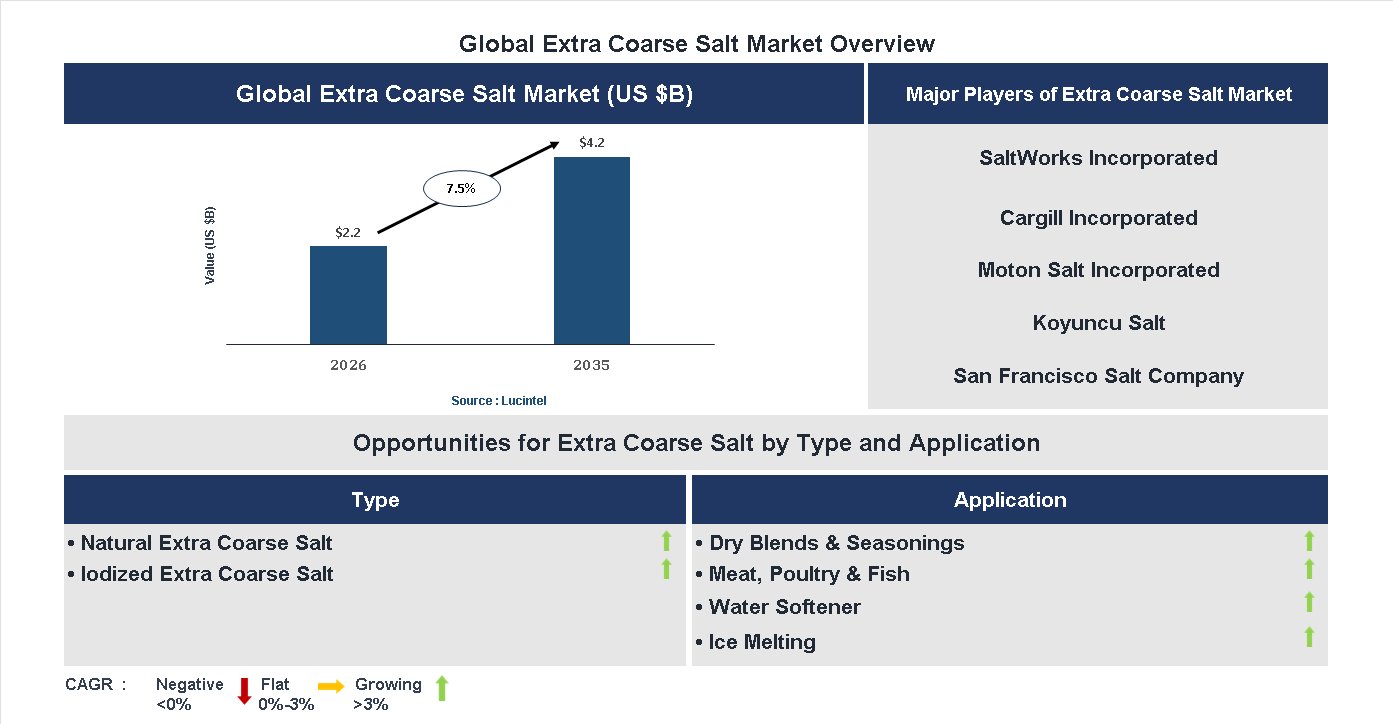
The future of the global extra coarse salt market looks promising with opportunities in the dry blend & seasoning, meat, poultry & fish, water softener, and ice melting markets. The global extra coarse salt market is expected to reach an estimated $4.2 billion by 2035 with a CAGR of 7.5% from 2026 to 2035. The major drivers for this market are the increasing use in gourmet cooking, the rising demand for natural salt varieties, and the growing application in food processing.• Lucintel forecasts that, within the type category, natural extra coarse salt is expected to witness higher growth over the forecast period.
• Within the application category, meat, poultry & fish is expected to witness the highest growth.
• In terms of region, APAC is expected to witness the highest growth over the forecast period. Gain valuable insights for your business decisions with our comprehensive 150+ page report. Sample figures with some insights are shown below.
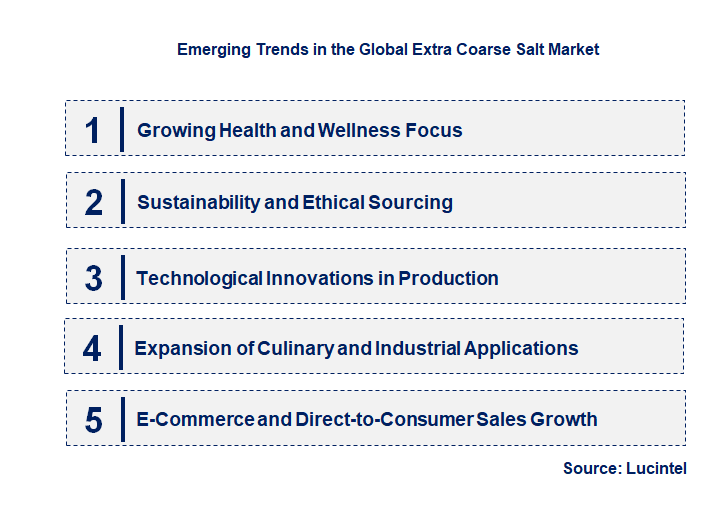
Emerging Trends in the Extra Coarse Salt Market
The extra coarse salt market is experiencing a significant transformation driven by changing consumer preferences, technological advancements, and sustainability concerns. As health consciousness rises and culinary trends evolve, the industry is adapting to meet new demands for quality, sourcing transparency, and innovative applications. These developments are not only expanding market opportunities but also reshaping competitive dynamics and supply chain strategies. Understanding these emerging trends is crucial for stakeholders aiming to capitalize on growth prospects and navigate potential challenges effectively. The following key trends highlight the major shifts currently shaping the extra coarse salt market landscape.• Growing Health and Wellness Focus: Consumers are increasingly seeking natural, minimally processed products, boosting demand for pure, additive-free extra coarse salt. This trend emphasizes health benefits such as mineral content and low sodium levels, encouraging brands to highlight these attributes. As health awareness rises, the market is witnessing a shift towards premium, organic, and sustainably sourced salts, which appeal to health-conscious buyers. This focus on wellness is driving product innovation and marketing strategies aimed at transparency and purity, ultimately expanding the consumer base and elevating market standards.
• Sustainability and Ethical Sourcing: Environmental concerns and ethical considerations are influencing sourcing practices in the salt industry. Companies are adopting sustainable extraction methods, reducing environmental footprints, and ensuring fair labor practices. Consumers are increasingly favoring brands that demonstrate environmental responsibility, prompting market players to invest in eco-friendly production and transparent supply chains. This trend enhances brand reputation and aligns with global sustainability goals, fostering long-term customer loyalty and opening new market segments focused on eco-conscious products.
• Technological Innovations in Production: Advances in mining, evaporation, and refining technologies are improving the efficiency, quality, and consistency of extra coarse salt. Automation and precision control systems enable better management of mineral content and particle size, ensuring product uniformity. These innovations reduce costs, minimize waste, and enhance scalability, allowing producers to meet rising demand more effectively. Additionally, technological developments facilitate the creation of customized salt grades for specific applications, broadening market opportunities across culinary, industrial, and pharmaceutical sectors.
• Expansion of Culinary and Industrial Applications: The versatility of extra coarse salt is fueling its adoption beyond traditional culinary uses. Chefs and food manufacturers utilize it for finishing dishes, enhancing texture, and flavor. Industrial applications include water treatment, de-icing, and chemical manufacturing, which are expanding due to increased infrastructure development and climate considerations. This diversification is driving demand across multiple sectors, encouraging product innovation tailored to specific needs. As applications grow, the market benefits from increased revenue streams and reduced dependency on a single industry segment.
• E-commerce and Direct-to-Consumer Sales Growth: The rise of online retail platforms is transforming distribution channels for extra coarse salt. Consumers now prefer purchasing through e-commerce due to convenience, product variety, and access to detailed product information. Brands are leveraging digital marketing, subscription models, and direct-to-consumer sales to build brand loyalty and gather customer insights. This trend reduces reliance on traditional retail outlets, lowers distribution costs, and enables rapid market expansion. As digital adoption accelerates, the market is becoming more accessible, competitive, and responsive to consumer preferences. These emerging trends are collectively reshaping the extra coarse salt market by emphasizing health, sustainability, technological advancement, application diversification, and digitalization. These shifts are fostering innovation, improving supply chain efficiency, and expanding market reach, ultimately creating a more dynamic and resilient industry poised for sustained growth.
Recent Development in the Extra Coarse Salt Market
The extra coarse salt market is experiencing significant growth driven by increasing demand in the culinary, industrial, and health sectors. Innovations in production processes and expanding applications are opening new opportunities for manufacturers. Consumer preferences for natural and organic products are also fueling market expansion. Additionally, rising awareness of health benefits associated with salt consumption is influencing market dynamics. These developments are shaping a competitive landscape, encouraging innovation, and expanding the market reach globally.• Growing Demand in Culinary Industry: The culinary sectors shift towards natural, textured salts like extra coarse salt is boosting market growth. Chefs and consumers prefer it for its texture and flavor enhancement, leading to increased usage in gourmet cooking and food presentation. This trend is expanding the customer base and encouraging product innovation, which in turn drives sales and market expansion.
• Industrial Applications Expansion: Extra coarse salt is increasingly used in industrial processes such as water treatment, de-icing, and chemical manufacturing. Its durability and effectiveness make it a preferred choice, leading to higher industrial demand. This diversification of applications is broadening the market scope and creating new revenue streams for producers.
• Health and Wellness Trends: Rising awareness about health benefits associated with natural salts is influencing consumer choices. Extra coarse salt, perceived as less processed, is gaining popularity among health-conscious consumers. This trend is encouraging manufacturers to promote their purity and natural qualities, thereby expanding market share and fostering product differentiation.
• Innovations in Production Techniques: Advances in extraction and processing methods are improving salt quality and reducing costs. These innovations enable manufacturers to meet increasing demand efficiently and sustainably. Enhanced production capabilities are also facilitating the development of customized salt products, which attract niche markets and support overall market growth.
• Increasing Organic and Natural Product Demand: Consumers are increasingly seeking organic and minimally processed products, including salts. Extra coarse salt, marketed as a natural and unrefined product, aligns with this trend. The rising preference for organic options is encouraging brands to develop and promote premium, natural salt varieties, thereby expanding market opportunities and consumer loyalty. These developments are significantly impacting the extra coarse salt market by expanding its applications, improving product quality, and aligning with consumer health and natural product preferences. The market is becoming more diverse and competitive, with increased innovation and sustainability efforts. Overall, these trends are driving growth, opening new opportunities, and strengthening the market’s global presence.
Strategic Growth Opportunities in the Extra Coarse Salt Market
The extra coarse salt market is experiencing significant growth driven by increasing demand across various industries such as food processing, health and wellness, and industrial applications. Innovations in packaging, sustainable sourcing, and expanding regional markets are creating new opportunities for manufacturers. As consumer preferences shift towards natural and minimally processed products, the market is poised for expansion. Strategic investments in R&D and supply chain optimization will further enhance market competitiveness and meet rising global demand efficiently.• Expanding Food Industry Applications: Extra coarse salt is increasingly used in food preservation, seasoning, and gourmet cooking, driven by consumer preference for natural ingredients. The rise of artisanal and organic food products boosts demand for high-quality salt varieties. Foodservice sectors are adopting extra coarse salt for its texture and flavor enhancement, creating growth opportunities for suppliers. Additionally, the trend toward clean-label products encourages the use of minimally processed salts, further expanding market reach.
• Growing Health and Wellness Trends: Consumers are seeking natural, mineral-rich salts for health benefits, fueling demand for extra coarse salt. Its perceived purity and minimal processing appeal to health-conscious buyers. The market benefits from increased awareness of mineral content and the role of salt in nutrition. Wellness-focused products, including bath salts and dietary supplements, also contribute to growth. Manufacturers are innovating with organic and sustainably sourced options to meet this rising health-driven demand.
• Industrial and Commercial Usage Expansion: Extra coarse salt is vital in industrial applications such as de-icing, water treatment, and chemical manufacturing. Its durability and effectiveness in these processes make it a preferred choice. The expansion of infrastructure projects and increased focus on road safety during winter seasons drive demand for large quantities of coarse salt. Industrial players are investing in bulk production and logistics to capitalize on this steady growth segment.
• Innovation in Packaging and Distribution: Advancements in packaging technology, such as eco-friendly and resealable bags, improve product shelf life and consumer convenience. Enhanced distribution channels, including online platforms and specialty stores, broaden market access. Strategic partnerships with retailers and foodservice providers facilitate wider product availability. These innovations help manufacturers differentiate their offerings, reduce costs, and meet the evolving needs of diverse customer segments, thereby boosting overall market growth.
• Regional Market Penetration and Sustainability Initiatives: Emerging markets in Asia, Africa, and Latin America present substantial growth opportunities due to rising disposable incomes and urbanization. Companies are focusing on local sourcing and sustainable extraction methods to appeal to environmentally conscious consumers. Certification standards and eco-labeling are gaining importance, encouraging sustainable practices. Expanding regional distribution networks and tailoring products to local preferences will enable market players to capture new customer bases and sustain long-term growth. The overall impact of these opportunities is set to significantly enhance the market’s growth trajectory, fostering innovation, expanding regional presence, and aligning with consumer preferences for natural, sustainable, and versatile salt products.
Extra Coarse Salt Market Driver and Challenges
The extra coarse salt market is influenced by a variety of technological, economic, and regulatory factors that shape its growth and development. Advances in extraction and processing technologies enhance product quality and supply chain efficiency, while economic trends such as rising health consciousness and demand for natural ingredients drive market expansion. Regulatory frameworks concerning food safety and environmental standards also impact production and distribution practices. Additionally, consumer preferences for organic and specialty salts influence market dynamics. Navigating these drivers and challenges is essential for stakeholders aiming to capitalize on opportunities and mitigate risks within this niche segment of the salt industry. The factors responsible for driving the extra coarse salt market include:-• Increasing Health and Wellness Trends: The rising consumer focus on natural, minimally processed foods has significantly boosted demand for extra coarse salt, which is perceived as a healthier, less refined option. This trend is driven by growing awareness of the health benefits associated with natural salts, such as mineral content and lower processing levels. As consumers seek organic and additive-free products, the market for extra coarse salt is expanding, especially in health-conscious regions. This shift encourages producers to innovate and promote their products as premium, natural alternatives, thereby fueling market growth and opening new distribution channels.
• Growth in Food Processing and Culinary Applications: The food industry’s increasing reliance on high-quality, textured salts for flavor enhancement and presentation is a major driver. Extra coarse salt is favored in gourmet cooking, restaurant applications, and artisanal food products due to its texture and visual appeal. The rise of home cooking and culinary tourism further amplifies demand, as chefs and consumers prefer premium ingredients. This trend encourages manufacturers to develop specialized packaging and branding strategies, expanding their market reach. The integration of extra coarse salt into diverse culinary applications sustains steady demand and supports industry innovation.
• Expansion of the Hospitality and Foodservice Sectors: The global hospitality industry’s growth, including hotels, restaurants, and catering services, significantly contributes to the demand for extra coarse salt. Chefs and culinary establishments prefer this salt for its texture and flavor profile, which enhances the presentation and taste of dishes. As the hospitality sector recovers and expands post-pandemic, the demand for premium ingredients like extra coarse salt is expected to rise. This sector’s preference for high-quality, artisanal ingredients encourages suppliers to increase production and diversify offerings, thereby strengthening the market’s overall growth trajectory.
• Technological Advancements in Extraction and Processing: Innovations in salt mining, refining, and packaging technologies have improved the quality, purity, and shelf life of extra coarse salt. Modern extraction methods reduce environmental impact and increase yield efficiency, making production more sustainable and cost-effective. Advanced processing techniques enable the production of consistent, high-quality products that meet stringent food safety standards. Additionally, innovations in packaging extend shelf life and facilitate easier transportation. These technological improvements support market expansion by ensuring product availability, quality assurance, and compliance with regulatory requirements.
• Rising Demand for Organic and Natural Food Products: Consumers increasingly prefer organic and natural ingredients, which directly benefits the extra coarse salt market. Organic certification and eco-friendly production practices appeal to environmentally conscious buyers. This demand encourages producers to adopt sustainable mining and processing methods, further differentiating their products in a competitive market. The trend towards clean-label foods and transparency in sourcing enhances consumer trust and brand loyalty. As a result, the market experiences sustained growth driven by the expanding segment of health-conscious and environmentally aware consumers. The challenges facing the extra coarse salt market include:-
• Regulatory and Environmental Constraints: Stringent regulations related to food safety, environmental protection, and sustainable mining practices pose significant hurdles. Compliance with diverse regional standards increases operational costs and complicates supply chain management. Environmental concerns about salt mining, such as land degradation and water usage, require companies to adopt eco-friendly practices, which may involve substantial investment. Navigating these regulatory landscapes demands continuous adaptation and can delay product launches or expansion plans, impacting overall market growth.
• Price Volatility and Supply Chain Disruptions: Fluctuations in raw material costs, transportation issues, and geopolitical tensions can lead to price volatility and supply chain disruptions. These factors affect the availability and pricing of extra coarse salt, impacting profit margins and consumer prices. Supply chain interruptions, especially during global crises, can result in shortages and reduced market stability. Companies must develop resilient logistics strategies and diversify sourcing to mitigate these risks, which can increase operational complexity and costs.
• Competition from Alternative Salts and Fluctuating Consumer Preferences: The market faces competition from other types of salts, such as Himalayan, sea, and flavored salts, which may appeal to different consumer segments. Additionally, changing culinary trends and health perceptions can shift demand away from traditional extra coarse salt. Companies need to innovate continuously and adapt marketing strategies to retain market share. Failure to align with evolving consumer preferences or to differentiate products effectively could hinder growth and profitability. The extra coarse salt market is driven by health trends, culinary applications, technological innovations, and sector growth, while regulatory, supply chain, and competitive challenges pose risks. These factors collectively influence market stability and expansion prospects. Strategic adaptation to technological advancements and consumer preferences, alongside effective regulatory compliance, will be crucial for sustained growth. Addressing supply chain vulnerabilities and differentiating products through branding and quality assurance will further enhance market resilience. Overall, the market’s future hinges on balancing innovation with sustainability and consumer trust.
List of Extra Coarse Salt Companies
Companies in the market compete on the basis of product quality offered. Major players in this market focus on expanding their manufacturing facilities, R&D investments, infrastructural development, and leverage integration opportunities across the value chain. With these strategies extra coarse salt companies cater increasing demand, ensure competitive effectiveness, develop innovative products & technologies, reduce production costs, and expand their customer base. Some of the extra coarse salt companies profiled in this report include-• SaltWorks Incorporated
• Cargill Incorporated
• Moton Salt Incorporated
• Koyuncu Salt
• San Francisco Salt Company
• Southwest Salt Company
• Jacobsen Salt Company
• Windsor Salt
• Compass Minerals
• ZOUTMAN
Extra Coarse Salt Market by Segment
The study includes a forecast for the global extra coarse salt market by type, application, and region.Extra Coarse Salt Market by Type [Value from 2019 to 2035]:
• Natural Extra Coarse Salt
• Iodized Extra Coarse Salt
Extra Coarse Salt Market by Application [Value from 2019 to 2035]:
• Dry Blends & Seasonings
• Meat, Poultry & Fish
• Water Softener
• Ice Melting
Extra Coarse Salt Market by Region [Value from 2019 to 2035]:
• North America
• Europe
• Asia Pacific
• The Rest of the World
Country Wise Outlook for the Extra Coarse Salt Market
The extra coarse salt market has experienced notable shifts driven by evolving consumer preferences, technological innovations, and regulatory changes across major economies. As health consciousness and culinary trends influence demand, countries are adopting new extraction methods, sustainable practices, and expanding product applications. These developments reflect a global push towards quality, sustainability, and diversification in salt products, impacting supply chains and market strategies worldwide. The following summaries highlight recent key advancements and trends in the United States, China, Germany, India, and Japan within this market.• United States: The U.S. market has seen increased demand for organic and sustainably sourced extra coarse salt, driven by health-conscious consumers. Innovations in mining and processing techniques have improved product purity and texture. Retailers are expanding premium offerings, and there is a growing trend toward artisanal and gourmet salt products. Regulatory standards are tightening, encouraging companies to adopt eco-friendly practices. Additionally, the foodservice industry is increasingly incorporating extra coarse salt for flavor and presentation, boosting overall market growth.
• China: China’s market for extra coarse salt is expanding rapidly due to rising urbanization and changing dietary habits. Local producers are investing in modern extraction facilities and adopting environmentally sustainable methods. The government’s focus on food safety and quality standards has led to stricter regulations, prompting industry upgrades. There is also a surge in exports of high-quality salt to international markets. Domestic demand is driven by the food processing sector and traditional culinary uses, with innovations in packaging and branding enhancing competitiveness.
• Germany: Germany’s market is characterized by a strong emphasis on organic and natural products, with consumers favoring sustainably harvested extra coarse salt. The country is investing in advanced mining technologies to reduce environmental impact. There is a notable increase in the use of extra coarse salt in the food industry, especially in gourmet and health-oriented products. Regulatory frameworks promote transparency and quality assurance, encouraging companies to adopt eco-friendly practices. The market also benefits from a growing interest in artisanal and regional salt varieties, supporting local producers.
• India: The Indian market for extra coarse salt is witnessing significant growth due to increasing demand from the food processing and hospitality sectors. Traditional harvesting methods are gradually being replaced by modern, sustainable techniques. Government initiatives aimed at promoting mineral-based industries are supporting market expansion. Consumers are becoming more aware of health benefits, favoring natural and unrefined salts. The market is also seeing innovations in packaging and branding to cater to urban and premium segments, with exports gradually increasing as quality standards improve.
• Japan: Japan’s market is driven by a focus on health, purity, and culinary excellence. The country is adopting advanced extraction and refining technologies to produce high-quality extra coarse salt. There is a rising trend of using premium salts in fine dining and traditional cuisine. Regulatory standards emphasize safety and environmental sustainability, encouraging eco-friendly practices. The market also benefits from a growing interest in artisanal and regional salts, with consumers willing to pay a premium for unique, high-quality products. Innovations in packaging and marketing are further supporting market growth.

Features of the Global Extra Coarse Salt Market
Market Size Estimates: Extra coarse salt market size estimation in terms of value ($B). Trend and Forecast Analysis: Market trends (2019 to 2025) and forecast (2026 to 2035) by various segments and regions. Segmentation Analysis: Extra coarse salt market size by type, application, and region in terms of value ($B). Regional Analysis: Extra coarse salt market breakdown by North America, Europe, Asia Pacific, and Rest of the World. Growth Opportunities: Analysis of growth opportunities in different types, applications, and regions for the extra coarse salt market. Strategic Analysis: This includes M&A, new product development, and competitive landscape of the extra coarse salt market. Analysis of competitive intensity of the industry based on Porter’s Five Forces model.
FAQ
Q1. What is the extra coarse salt market size? Answer: The global extra coarse salt market is expected to reach an estimated $4.2 billion by 2035. Q2. What is the growth forecast for extra coarse salt market? Answer: The global extra coarse salt market is expected to grow with a CAGR of 7.5% from 2026 to 2035. Q3. What are the major drivers influencing the growth of the extra coarse salt market? Answer: The major drivers for this market are the increasing use in gourmet cooking, the rising demand for natural salt varieties, and the growing application in food processing. Q4. What are the major segments for extra coarse salt market? Answer: The future of the extra coarse salt market looks promising with opportunities in the dry blend & seasoning, meat, poultry & fish, water softener, and ice melting markets. Q5. Who are the key extra coarse salt market companies? Answer: Some of the key extra coarse salt companies are as follows:• SaltWorks Incorporated
• Cargill Incorporated
• Moton Salt Incorporated
• Koyuncu Salt
• San Francisco Salt Company
• Southwest Salt Company
• Jacobsen Salt Company
• Windsor Salt
• Compass Minerals
• ZOUTMAN Q6. Which extra coarse salt market segment will be the largest in future? Answer: Lucintel forecasts that, within the type category, natural extra coarse salt is expected to witness higher growth over the forecast period. Q7. In extra coarse salt market, which region is expected to be the largest in next 5 years? Answer: In terms of region, APAC is expected to witness the highest growth over the forecast period. Q8. Do we receive customization in this report? Answer: Yes, Lucintel provides 10% customization without any additional cost.
Table of Contents
List of Figures
List of Tables
Methodology
- In-depth interviews of the major players in this market
- Detailed secondary research from competitors’ financial statements and published data
- Extensive searches of published works, market, and database information pertaining to industry news, company press releases, and customer intentions
- A compilation of the experiences, judgments, and insights of Lucintel’s professionals, who have analyzed and tracked this market over the years.


Buy Now
Choose a license that fits your team. Instant PDF delivery.
Prices exclude taxes. Instant delivery. Custom licensing available on request.
Key Questions
- • What are some of the most promising, high-growth opportunities for the extra coarse salt market by type (natural extra coarse salt and iodized extra coarse salt), application (dry blends & seasonings, meat, poultry & fish, water softener, and ice melting), and region (North America, Europe, Asia Pacific, and the Rest of the World)?
- • Which segments will grow at a faster pace and why?
- • Which region will grow at a faster pace and why?
- • What are the key factors affecting market dynamics? What are the key challenges and business risks in this market?
- • What are the business risks and competitive threats in this market?
- • What are the emerging trends in this market and the reasons behind them?
- • What are some of the changing demands of customers in the market?
- • What are the new developments in the market? Which companies are leading these developments?
- • Who are the major players in this market? What strategic initiatives are key players pursuing for business growth?
- • What are some of the competing products in this market and how big of a threat do they pose for loss of market share by material or product substitution?
- • What M&A activity has occurred in the last 7 years and what has its impact been on the industry? For any questions related to Extra Coarse Salt Market, Extra Coarse Salt Market Size, Extra Coarse Salt Market Growth, Extra Coarse Salt Market Analysis, Extra Coarse Salt Market Report, Extra Coarse Salt Market Share, Extra Coarse Salt Market Trends, Extra Coarse Salt Market Forecast, Extra Coarse Salt Companies, write Lucintel analyst at email: helpdesk@lucintel.com. We will be glad to get back to you soon.


