
Exosome Research Market Trends and Forecast
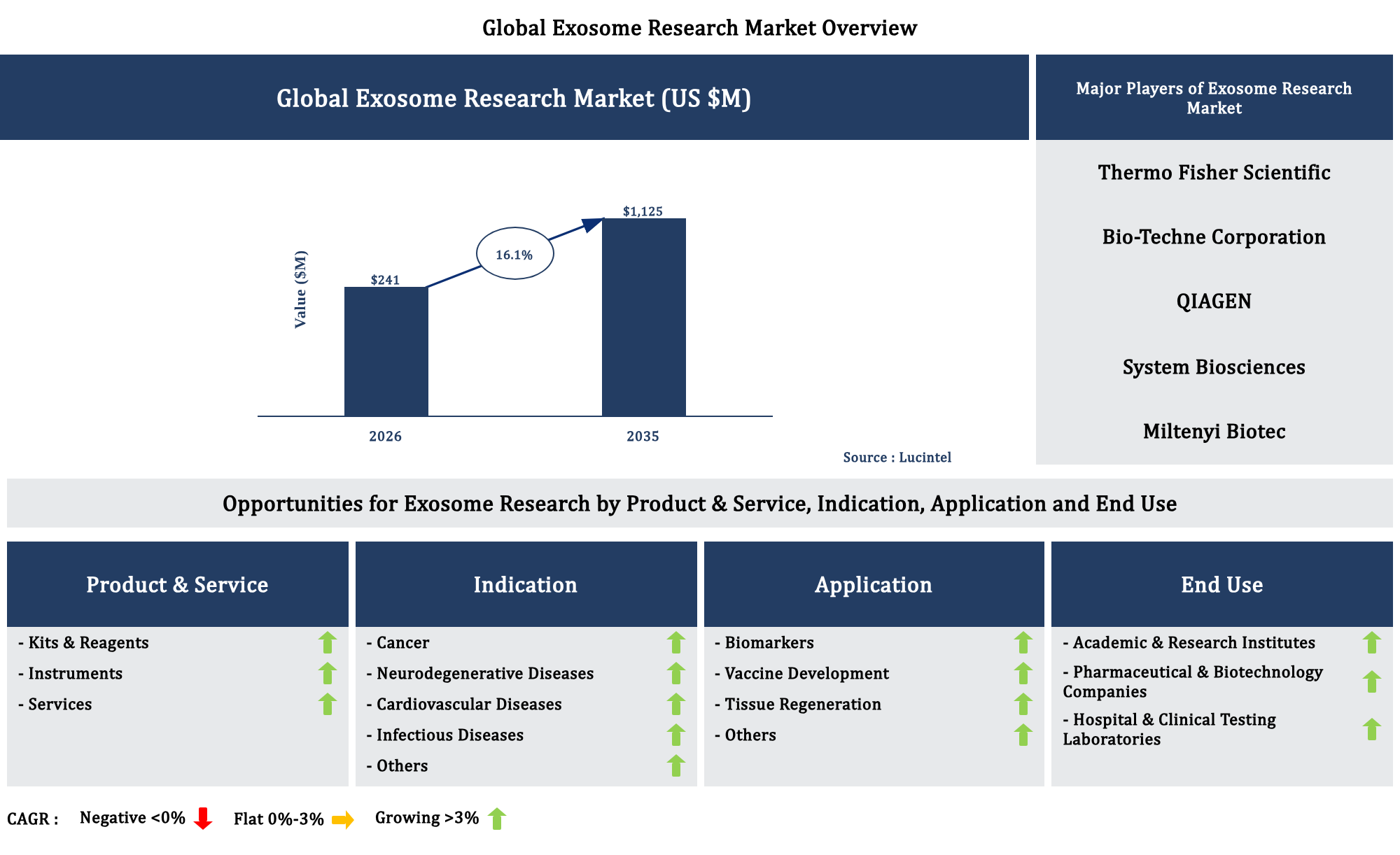
The future of the global exosome research market looks promising with opportunities in the academic & research institute, pharmaceutical & biotechnology company, and hospital & clinical testing laboratory markets. The global exosome research market is expected to reach an estimated $1,125 million by 2035 with a CAGR of 16.1% from 2026 to 2035. The major drivers for this market are the increasing use of exosomes in disease diagnosis, the rising demand for personalized medicine solutions, and the growing applications in drug delivery systems.
• Lucintel forecasts that, within the product & service category, kit & reagent is expected to witness higher growth over the forecast period.
• Within the end use category, pharmaceutical & biotechnology is expected to witness the highest growth.
• In terms of region, APAC is expected to witness the highest growth over the forecast period.
Gain valuable insights for your business decisions with our comprehensive 150+ page report. Sample figures with some insights are shown below.
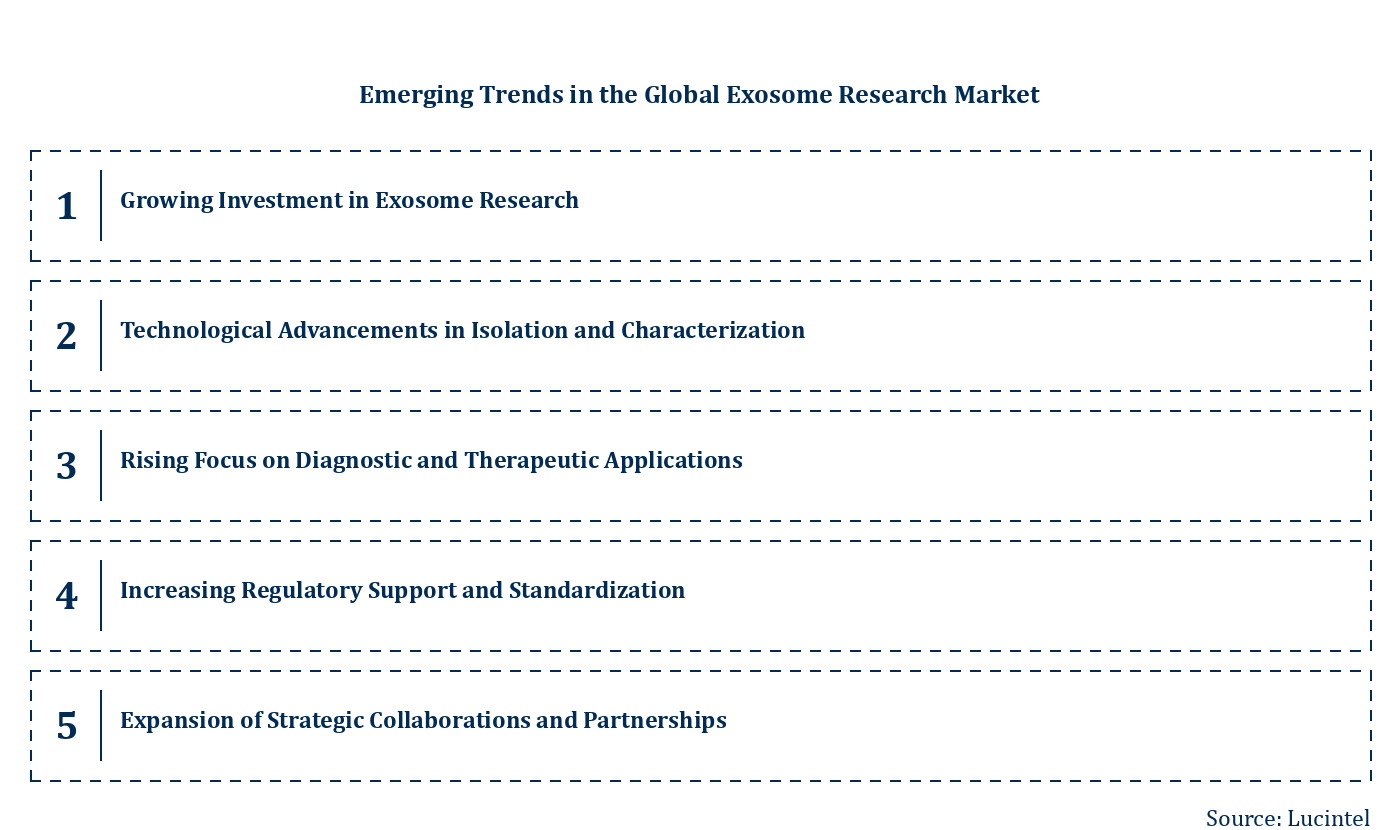
Emerging Trends in the Exosome Research Market
The exosome research market is experiencing rapid growth driven by advancements in biotechnology, increasing interest in cell communication, and the potential for diagnostic and therapeutic applications. As researchers explore the roles of exosomes in disease progression and treatment, the market is witnessing innovative developments and expanding applications. This evolution is influenced by technological innovations, rising investments, and a growing understanding of exosome biology. These trends are not only expanding the market size but also transforming how diseases are diagnosed and treated, paving the way for personalized medicine and targeted therapies. The following key trends highlight the major developments shaping this dynamic market.
• Growing Investment in Exosome Research: Increased funding from government agencies, private investors, and pharmaceutical companies is accelerating research activities. This financial support enables the development of advanced isolation and characterization techniques, fostering innovation. As investments grow, more startups and established firms are entering the market, leading to a surge in product development and commercialization efforts. This trend is crucial for translating research findings into clinical applications, ultimately expanding market opportunities and driving industry growth.
• Technological Advancements in Isolation and Characterization: New methods such as microfluidics, ultracentrifugation, and affinity capture are improving the efficiency and purity of exosome isolation. Enhanced characterization techniques, including nanoparticle tracking analysis and flow cytometry, allow for better understanding of exosome contents. These innovations facilitate more accurate diagnostics and targeted therapies, reducing costs and increasing accessibility. As technology advances, the ability to analyze exosomes at a higher resolution will open new avenues for research and clinical applications, significantly impacting the market landscape.
• Rising Focus on Diagnostic and Therapeutic Applications: Exosomes are increasingly recognized for their potential in early disease detection, drug delivery, and regenerative medicine. Their ability to carry biomolecules makes them ideal for non-invasive diagnostics and personalized treatment strategies. The development of exosome-based biomarkers for cancer, neurodegenerative diseases, and infectious diseases is gaining momentum. This focus is driving demand for specialized products and services, transforming the market from primarily research-oriented to clinical and commercial applications, thereby expanding its scope and revenue potential.
• Increasing Regulatory Support and Standardization: Regulatory agencies are beginning to establish guidelines for exosome-based diagnostics and therapeutics, providing a clearer pathway for market approval. Standardization of isolation, characterization, and storage protocols is improving reproducibility and quality control. This regulatory clarity boosts confidence among investors and manufacturers, encouraging commercialization. As standards evolve, more products will meet regulatory requirements, accelerating market entry and adoption in clinical settings, which is vital for sustainable growth and market expansion.
• Expansion of Strategic Collaborations and Partnerships: Companies, research institutions, and biotech firms are forming alliances to share expertise, technology, and resources. These collaborations facilitate faster innovation, clinical validation, and commercialization of exosome-based products. Partnerships also help in navigating regulatory pathways and expanding geographic reach. This trend enhances market competitiveness and accelerates product development cycles, ultimately leading to a broader adoption of exosome technologies across healthcare sectors. Such collaborations are essential for overcoming technical and regulatory challenges, fostering a more integrated and robust market environment.
These emerging trends are collectively reshaping the exosome research market by fostering innovation, improving technological capabilities, and expanding clinical applications. They are driving increased investment, regulatory clarity, and strategic collaborations, which are essential for translating research into real-world healthcare solutions. As a result, the market is poised for significant growth, with the potential to revolutionize diagnostics, therapeutics, and personalized medicine.
Recent Developments in the Exosome Research Market
The exosome research market is experiencing rapid growth driven by advancements in biotechnology and increasing interest in cell communication and disease diagnostics. Innovations in isolation techniques, biomarker discovery, and therapeutic applications are expanding market opportunities. As research accelerates, new collaborations and funding are fueling development. This evolving landscape offers significant potential for healthcare, diagnostics, and personalized medicine, attracting stakeholders worldwide. The following developments highlight key areas shaping the future of exosome research and its market trajectory.
• Improved Isolation Techniques: Enhanced methods like microfluidics and ultracentrifugation are increasing purity and yield, enabling more accurate research. These innovations reduce processing time and costs, making exosome studies more accessible. As a result, researchers can better understand disease mechanisms, leading to faster biomarker discovery and therapeutic development. This progress is attracting investments and expanding the market for exosome isolation kits and tools.
• Advances in Biomarker Discovery: Exosomes are rich sources of disease-specific biomarkers, especially for cancer and neurodegenerative disorders. Recent studies have identified novel exosomal proteins and nucleic acids, improving diagnostic accuracy. These discoveries facilitate early detection and personalized treatment strategies, boosting demand for exosome-based diagnostics. The market benefits from increased clinical validation and commercialization of biomarker assays, opening new revenue streams.
• Therapeutic Potential of Exosomes: Exosomes are emerging as delivery vehicles for drugs, RNA, and proteins due to their biocompatibility and targeting capabilities. Recent developments include engineered exosomes for targeted therapy, especially in cancer and inflammatory diseases. This innovation is creating new therapeutic avenues, attracting pharmaceutical investments. The market is expanding as clinical trials progress, promising minimally invasive treatments with fewer side effects.
• Growing Investment and Collaborations: Increased funding from government agencies, private investors, and industry partnerships is accelerating research and commercialization. Strategic collaborations between biotech firms and academic institutions are fostering innovation. These investments support the development of new products, tools, and platforms, driving market growth. The influx of capital and partnerships is positioning the exosome research market for sustained expansion and technological breakthroughs.
• Regulatory and Standardization Progress: Efforts to establish standardized protocols and regulatory frameworks are improving reproducibility and clinical translation. Recent guidelines from health authorities are facilitating approval processes for exosome-based diagnostics and therapeutics. This progress reduces barriers to market entry, encouraging commercialization. As regulations evolve, confidence in exosome applications increases, attracting more stakeholders and expanding the market scope.
The overall impact of these developments is a robust, expanding exosome research market characterized by technological innovation, increased investment, and clinical translation. These factors are driving growth, fostering new applications, and positioning exosomes as vital tools in diagnostics and therapeutics, ultimately transforming healthcare and personalized medicine.
Strategic Growth Opportunities in the Exosome Research Market
The exosome research market is experiencing rapid expansion driven by advancements in biotechnology and increasing interest in cell communication and biomarker discovery. Growing applications in diagnostics, therapeutics, and personalized medicine are fueling demand. Key opportunities include technological innovations, expanding clinical research, and emerging therapeutic uses. Companies and researchers are investing heavily to unlock exosomes‘ potential, promising significant growth and new revenue streams. Strategic focus on these areas will shape the future landscape of exosome research and its integration into healthcare solutions.
• Technological Advancements in Exosome Isolation and Characterization Techniques: Innovations such as microfluidics, nanotechnology, and high-throughput sequencing are improving the efficiency, purity, and scalability of exosome isolation. These developments enable more precise analysis, facilitate large-scale studies, and reduce costs, thereby accelerating research progress. Enhanced detection and quantification methods are expanding the scope of exosome applications in diagnostics and therapeutics, making the market more accessible and attractive for investment and development.
• Growing Demand for Exosome-Based Biomarkers in Disease Diagnosis: Exosomes carry molecular signatures reflective of their cell of origin, making them ideal for non-invasive diagnostics. The increasing prevalence of cancer, neurodegenerative, and infectious diseases drives demand for reliable biomarkers. Advances in omics technologies enable detailed exosomal cargo analysis, improving early detection, prognosis, and treatment monitoring. This trend is fostering collaborations between biotech firms and healthcare providers, expanding the clinical utility and commercial potential of exosome-based diagnostics.
• Expansion of Exosome Therapeutics for Targeted Drug Delivery: Exosomes‘ natural ability to cross biological barriers and deliver cargo to specific cells makes them promising drug delivery vehicles. Researchers are exploring engineered exosomes for targeted therapy in cancer, inflammatory diseases, and regenerative medicine. The development of scalable production methods and loading techniques is critical. This opportunity is expected to revolutionize personalized medicine, reduce side effects, and improve treatment efficacy, attracting significant investment and regulatory interest.
• Increasing Research and Development Activities in Regenerative Medicine: Exosomes derived from stem cells are gaining attention for their regenerative properties, promoting tissue repair and reducing inflammation. R&D efforts focus on harnessing exosomes for wound healing, cardiovascular repair, and neuroregeneration. Advances in understanding exosomal signaling pathways are facilitating the development of novel therapies. This expanding research landscape is creating new market segments, encouraging collaborations, and driving commercialization of exosome-based regenerative solutions.
• Rising Investments and Collaborations in Exosome Research and Commercialization: The market is witnessing increased funding from venture capital, pharmaceutical companies, and academic institutions. Strategic partnerships are forming to develop standardized protocols, scalable manufacturing, and regulatory frameworks. These collaborations accelerate clinical trials and product development, fostering innovation. The influx of capital and expertise is expected to propel the market forward, enabling widespread adoption of exosome-based diagnostics and therapeutics, and establishing a robust ecosystem for future growth.
The overall impact of these opportunities is set to significantly accelerate the growth of the exosome research market, fostering innovation, expanding clinical applications, and driving commercialization. As technological and scientific advancements continue, the market is poised for substantial expansion, offering new solutions for disease diagnosis, treatment, and regenerative medicine. Strategic investments and collaborations will be crucial in unlocking the full potential of exosomes, shaping the future of personalized healthcare.
Exosome Research Market Driver and Challenges
The exosome research market is influenced by a variety of technological, economic, and regulatory factors that shape its growth trajectory. Advances in nanotechnology and molecular biology have enabled more precise isolation and characterization of exosomes, fueling research activities. Economic factors such as increasing funding from government agencies and private investors are supporting innovation and development. Regulatory frameworks are evolving to ensure safety and standardization, which impacts market dynamics. Additionally, rising awareness of exosomes‘ potential in diagnostics and therapeutics is driving demand. However, challenges such as high costs, technical complexities, and regulatory uncertainties also pose significant hurdles. Overall, these drivers and challenges collectively determine the market‘s future growth and innovation potential.
The factors responsible for driving the exosome research market include:
• Technological Advancements: The development of sophisticated isolation and characterization techniques, such as ultracentrifugation, microfluidics, and nanotechnology, has significantly enhanced the ability to study exosomes. These innovations improve accuracy, efficiency, and reproducibility, enabling researchers to explore exosomes‘ diagnostic and therapeutic potential more effectively. As technology continues to evolve, the market benefits from increased research capabilities, leading to new discoveries and applications. This ongoing innovation attracts investments and accelerates product development, making exosome research more accessible and impactful.
• Rising Prevalence of Chronic Diseases: The increasing incidence of cancer, neurodegenerative disorders, cardiovascular diseases, and infectious diseases worldwide is a major driver. Exosomes play a crucial role in disease diagnosis, prognosis, and therapy, offering minimally invasive options. The growing burden of these diseases prompts extensive research into exosomal biomarkers and drug delivery systems, fueling market growth. Healthcare systems are investing heavily in early detection and personalized medicine, which further propels demand for exosome-based research tools and products.
• Growing Investment and Funding: Governments, private investors, and pharmaceutical companies are increasing funding for exosome research. Grants, venture capital, and strategic collaborations are supporting the development of new technologies, research projects, and commercial products. This financial backing accelerates innovation, reduces time-to-market, and expands research scope. The influx of capital also encourages startups and established firms to explore exosome applications, fostering a competitive and dynamic market environment.
• Increasing Adoption in Diagnostics and Therapeutics: Exosomes are increasingly recognized for their potential in non-invasive diagnostics and targeted drug delivery. Their ability to carry molecular information makes them ideal biomarkers for early disease detection. Additionally, exosomes can be engineered to deliver therapeutic agents directly to target cells, reducing side effects. The expanding pipeline of exosome-based diagnostic kits and therapeutics is attracting pharmaceutical and biotech companies, further driving market expansion and commercialization efforts.
• Regulatory Developments and Standardization: The evolving regulatory landscape is both a driver and a challenge. Clear guidelines and standards for exosome isolation, characterization, and clinical application are essential for market growth. Recent regulatory initiatives aim to establish safety, efficacy, and quality benchmarks, which build confidence among stakeholders. However, the lack of universally accepted standards and regulatory pathways can delay product approval and commercialization, posing hurdles for market players.
The challenges facing the exosome research market include:
• High Costs and Technical Complexities: Exosome research requires sophisticated equipment, specialized expertise, and high-quality reagents, leading to substantial costs. The technical complexity of isolating pure exosomes and ensuring reproducibility hampers widespread adoption, especially in smaller laboratories. These factors increase overall research expenses and limit accessibility, slowing down innovation and commercialization. Overcoming these barriers necessitates technological simplification and cost reduction strategies, which are still under development.
• Lack of Standardization and Regulatory Clarity: The absence of universally accepted protocols for exosome isolation, characterization, and quantification creates variability in research outcomes. This inconsistency hampers data comparability and regulatory approval processes. Moreover, regulatory frameworks are still evolving, leading to uncertainty about clinical translation pathways. This ambiguity discourages investment and slows product development, impacting market growth and credibility.
• Ethical and Privacy Concerns: The use of exosomes in diagnostics and therapeutics involves handling sensitive biological data, raising ethical and privacy issues. Concerns about data security, consent, and potential misuse can hinder research collaborations and commercialization. Additionally, ethical debates surrounding the use of biological materials may lead to stricter regulations, further complicating research activities and delaying market entry.
The exosome research market is driven by technological innovations, increasing disease prevalence, substantial funding, and expanding applications in diagnostics and therapeutics. However, high costs, technical challenges, regulatory uncertainties, and ethical concerns pose significant hurdles. These factors collectively influence the pace of market growth, with ongoing developments needed to address challenges and harness opportunities. The market‘s future will depend on balancing innovation with regulatory and ethical considerations, ultimately shaping its trajectory toward personalized medicine and advanced diagnostics.
List of Exosome Research Companies
Companies in the market compete on the basis of product quality offered. Major players in this market focus on expanding their manufacturing facilities, R&D investments, infrastructural development, and leverage integration opportunities across the value chain. With these strategies exosome research companies cater increasing demand, ensure competitive effectiveness, develop innovative products & technologies, reduce production costs, and expand their customer base. Some of the exosome research companies profiled in this report include-
• Thermo Fisher Scientific
• Bio-Techne Corporation
• QIAGEN
• System Biosciences
• Miltenyi Biotec
• NanoSomiX
• NorgenBiotek Corp.
Exosome Research Market by Segment
The study includes a forecast for the global exosome research market by product & service, indication, application, end use, and region.
Exosome Research Market by Product & Service [Value from 2019 to 2035]:
• Kits & Reagents
• Instruments
• Services
Exosome Research Market by Indication [Value from 2019 to 2035]:
• Cancer
• Neurodegenerative Diseases
• Cardiovascular Diseases
• Infectious Diseases
• Others
Exosome Research Market by Application [Value from 2019 to 2035]:
• Biomarkers
• Vaccine Development
• Tissue Regeneration
• Others
Exosome Research Market by End Use [Value from 2019 to 2035]:
• Academic & Research Institutes
• Pharmaceutical & Biotechnology Companies
• Hospital & Clinical Testing Laboratories
Exosome Research Market by Region [Value from 2019 to 2035]:
• North America
• Europe
• Asia Pacific
• The Rest of the World
Country Wise Outlook for the Exosome Research Market
The exosome research market has experienced significant growth driven by advancements in biotechnology, increasing investment in regenerative medicine, and expanding applications in diagnostics and therapeutics. As scientific understanding deepens, countries are competing to lead innovation, develop new technologies, and establish regulatory frameworks. The United States, China, Germany, India, and Japan are at the forefront, each contributing uniquely to this evolving landscape. These developments reflect a global push toward harnessing exosomes for medical breakthroughs, with collaborations and investments accelerating progress across sectors.
• United States: The US leads in exosome research with major biotech firms and academic institutions investing heavily in innovative diagnostics and therapeutics. Recent advancements include FDA approvals for exosome-based clinical trials and increased commercialization efforts. The government’s funding initiatives and private sector collaborations are fostering rapid growth, especially in personalized medicine and cancer treatment applications.
• China: China has rapidly expanded its exosome research capabilities, focusing on regenerative medicine and cancer diagnostics. Government policies support biotech innovation, leading to increased research publications and new startups. Notably, Chinese companies are developing scalable exosome production techniques and exploring their use in drug delivery systems, positioning China as a key player in the global market.
• Germany: Germany emphasizes regulatory frameworks and quality standards for exosome-based products, fostering a robust research environment. Recent developments include advancements in exosome isolation technologies and clinical trials for neurodegenerative diseases. The country’s strong biotech ecosystem and collaborations with European institutions are driving innovation and commercialization.
• India: India is witnessing a surge in exosome research driven by academic institutions and startups focusing on affordable diagnostics and therapeutics. Recent progress includes developing cost-effective exosome isolation methods and exploring applications in infectious diseases and cancer. Government initiatives aim to boost biotech infrastructure and research funding, supporting market growth.
• Japan: Japan is advancing in exosome research with a focus on regenerative medicine and personalized therapies. Recent developments include innovative exosome-based drug delivery systems and clinical trials targeting age-related diseases. The country’s strong pharmaceutical industry and research institutions are key contributors to technological advancements and market expansion.
Features of the Global Exosome Research Market
Market Size Estimates: Exosome research market size estimation in terms of value ($M).
Trend and Forecast Analysis: Market trends (2019 to 2025) and forecast (2026 to 2035) by various segments and regions.
Segmentation Analysis: Exosome research market size by various segments, such as by product & service, indication, application, end use, and region in terms of value ($M).
Regional Analysis: Exosome research market breakdown by North America, Europe, Asia Pacific, and Rest of the World.
Growth Opportunities: Analysis of growth opportunities in different product & service, indication, application, end use, and regions for the exosome research market.
Strategic Analysis: This includes M&A, new product development, and competitive landscape of the exosome research market.
Analysis of competitive intensity of the industry based on Porter’s Five Forces model.
FAQ
Q1. What is the exosome research market size?
Answer: The global exosome research market is expected to reach an estimated $1,125 million by 2035.
Q2. What is the growth forecast for exosome research market?
Answer: The global exosome research market is expected to grow with a CAGR of 16.1% from 2026 to 2035.
Q3. What are the major drivers influencing the growth of the exosome research market?
Answer: The major drivers for this market are the increasing use of exosomes in disease diagnosis, the rising demand for personalized medicine solutions, and the growing applications in drug delivery systems.
Q4. What are the major segments for exosome research market?
Answer: The future of the exosome research market looks promising with opportunities in the academic & research institute, pharmaceutical & biotechnology company, and hospital & clinical testing laboratory markets.
Q5. Who are the key exosome research market companies?
Answer: Some of the key exosome research companies are as follows:
• Thermo Fisher Scientific
• Bio-Techne Corporation
• QIAGEN
• System Biosciences
• Miltenyi Biotec
• NanoSomiX
• NorgenBiotek Corp.
Q6. Which exosome research market segment will be the largest in future?
Answer: Lucintel forecasts that, within the product & service category, kit & reagent is expected to witness higher growth over the forecast period.
Q7. In exosome research market, which region is expected to be the largest in next 8 years?
Answer: In terms of region, APAC is expected to witness the highest growth over the forecast period.
Q8. Do we receive customization in this report?
Answer: Yes, Lucintel provides 10% customization without any additional cost.
This report answers following 11 key questions:
Q.1. What are some of the most promising, high-growth opportunities for the exosome research market by product & service (kits & reagents, instruments, and services), indication (cancer, neurodegenerative diseases, cardiovascular diseases, infectious diseases, and others), application (biomarkers, vaccine development, tissue regeneration, and others), end use (academic & research institutes, pharmaceutical & biotechnology companies, and hospital & clinical testing laboratories), and region (North America, Europe, Asia Pacific, and the Rest of the World)?
Q.2. Which segments will grow at a faster pace and why?
Q.3. Which region will grow at a faster pace and why?
Q.4. What are the key factors affecting market dynamics? What are the key challenges and business risks in this market?
Q.5. What are the business risks and competitive threats in this market?
Q.6. What are the emerging trends in this market and the reasons behind them?
Q.7. What are some of the changing demands of customers in the market?
Q.8. What are the new developments in the market? Which companies are leading these developments?
Q.9. Who are the major players in this market? What strategic initiatives are key players pursuing for business growth?
Q.10. What are some of the competing products in this market and how big of a threat do they pose for loss of market share by material or product substitution?
Q.11. What M&A activity has occurred in the last 5 years and what has its impact been on the industry?
For any questions related to Exosome Research Market, Exosome Research Market Size, Exosome Research Market Growth, Exosome Research Market Analysis, Exosome Research Market Report, Exosome Research Market Share, Exosome Research Market Trends, Exosome Research Market Forecast, Exosome Research Companies, write Lucintel analyst at email: helpdesk@lucintel.com. We will be glad to get back to you soon.
