
Report Feature
Ethyleneamine Market Trends and Forecast
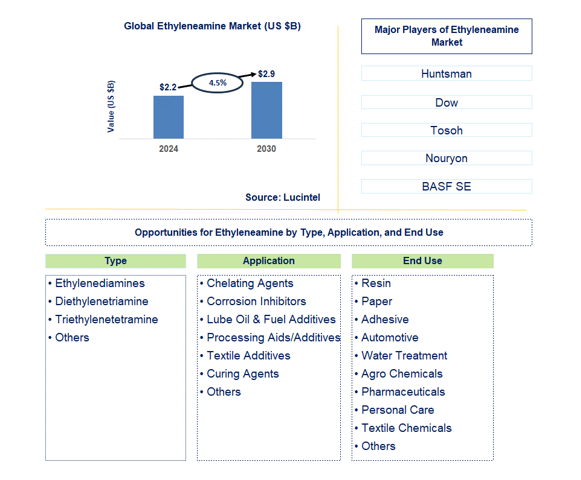
The future of the global ethyleneamine market looks promising with opportunities in the resin, paper, automotive, adhesive, water treatment, agriculture, pharmaceutical, personal care, and textile markets. The global ethyleneamine market is expected to grow with a CAGR of 1.8% from 2025 to 2031. The major drivers for this market are the increasing demand in agriculture, the rising use in coatings, and the growing adoption in chemicals.• Lucintel forecasts that, within the type category, ethylenediamine is expected to witness the highest growth over the forecast period.
• Within the application category, adhesive is expected to witness the highest growth.
• In terms of region, APAC is expected to witness the highest growth over the forecast period. Gain valuable insights for your business decisions with our comprehensive 150+ page report. Sample figures with some insights are shown below.
Emerging Trends in the Ethyleneamine Market
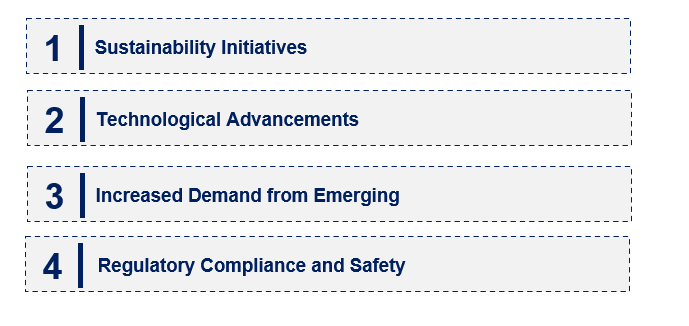
The ethyleneamine market is in a process of radical transformation, with a number of dominant trends defining its future. These trends are in response to a mix of worldwide sustainability targets, technological development, and changing industrial needs. The sector is trending toward more specialized, high-performance, and sustainable products, as well as grappling with the challenges of a global supply chain. Those companies that are able to shift according to such trends by investing in research and clean technologies will be sufficiently well-placed to address the changing needs of the world market.• Increasing Emphasis on Bio-based and Sustainable Products: There is a sharp shift towards bio-based and sustainable ethyleneamines. This is fueled by mounting environmental legislation and consumer pressure for cleaner products. Producers are opening up new routes of manufacture based on renewable raw materials, and some producers are making investments in new processes aimed at lowering their carbon footprint. This trend is well established in the agrochemicals and personal care industries, where end-consumers are going out of their way to use environmentally friendly ingredients.
• Expansion to High-Performance Applications: The industry is experiencing growing demand for ethyleneamines in high-performance applications, including epoxy curing agents, polyamide resins, and high-performance lubricants. The trend is being fueled by the construction, automotive, and electronics sectors’ requirement for stronger, more durable, and more efficient materials. Producers are creating new ethyleneamine derivatives with customized properties to satisfy the particular needs of these high-value market segments, abandoning commodity production.
• Move towards Water Treatment and Resource Management: The water treatment industry is turning out to be a high-growth sector. The reason is growing global water scarcity coupled with increased environmental regulations for water purity. Ethyleneamines are employed to manufacture chelating agents that neutralize heavy metal ions from water as well as to synthesize flocculants that help in the purification of water. This product is developing a stable and high-demand market segment since industrial and municipal water treatment is increasingly becoming important in the world.
• Growing Demand from the Auto Industry: The auto industry is one of the leading drivers of trends, and demand for ethyleneimine’s is growing for conventional as well as electric vehicles. In conventional vehicles, ethyleneimines are employed in fuel and lubricant additives to enhance performance and lower emissions. In the fast-expanding electric vehicle (EV) sector, they are being used in new applications in battery chemistry and specialty coatings. This trend is developing a twin growth opportunity for manufacturers in a major end-use sector.
• Digitalization and Automation in Production: Digitalization and automation are a dominant trend in ethyleneamine production. The use of Internet of Things (IoT) sensors, predictive analytics, and process automation is used by companies to increase production efficiency, minimize waste, and maintain product consistency. The technologies are also aiding in the optimization of supply chains and logistics, rendering the market more agile and sensitive to customer demand. This trend is making the industry more competitive and affordable. Collectively, these trends are redefining the ethyleneamine market. The trend towards sustainability and high-performance uses indicates a higher emphasis on quality and environment responsibility. The growth in water treatment and automotive applications demonstrates the responsiveness of the market, while digitalization is reshaping the business model, making the industry more efficient and data-oriented. This blending of trends is providing a more dynamic and competitive market, which forces market participants to be innovative and adjust.
Recent Development in the Ethyleneamine Market
The market for ethyleneamine is undergoing a number of key trends that shape its growth and trajectory. The transformation is fueled by advances in technology, shifting end-user needs, and strategic investments by industry leaders. The market is shifting towards higher-value and specialized applications and also toward catering to the increasing demand for more sustainable and efficient production processes. All these developments are not only creating the current scenario but are also creating the platform for future growth and innovation within the industry.• Capacity Expansion and New Plant Investments: Another notable development has been the investment in new plants and expansion of existing plants by giant chemical corporations, especially in Asia. This is a reaction to the high demand from fast-industrializing countries and the desire to have a secure supply chain. The investments are meant to enhance capacity for production and efficiency, so that the market is in a position to address the expanding requirements of priority end-use markets such as agriculture, adhesives, and automotive.
• Technological Advances in Synthesis: One major development is the development of synthesis and production technology for ethyleneamines. Producers are investing in new, higher-efficiency processes that lower energy input and raise product yield. For instance, companies are looking into new catalytic processes that provide greater control over the product blend, allowing them to yield greater amounts of the higher-value derivatives such as TETA (triethylenetetramine) and DETA (diethylenetriamine).
• Expansion in Water Treatment Applications: Water treatment has become a principal sector of expansion. The growing demand for clean water as a result of population increase and industrialization has promoted enormous demand for ethyleneamine-based flocculants and chelating agents. This expansion is building up a stable and high-rate market segment since municipalities and industrial complexes all over the globe are putting money into sophisticated water purification technologies that use these chemicals.
• Higher Utilization in Sealants and Adhesives: The sealants and adhesives sector is a major force behind recent trends. Ethyleneamines find application as epoxy curing agents to achieve robust and long-lasting bonds in several applications such as construction, automotive, and electronics. The development of these sectors has resulted in a parallel increase in the demand for ethyleneimines. This trend is encouraging companies to manufacture specialty grades of ethyleneimines with specific properties for these high-performance end-markets.
• Strategic Mergers and Partnerships: Strategic partnerships, mergers, and joint ventures among major market players are recent developments. These partnerships are being created in order to concentrate market share, obtain new technology, and penetrate new geographic markets. For instance, a merger between two entities could result in an improved supply chain and a wider product range. This trend is influencing the competitive landscape, with a shift towards consolidation and increased cooperation among producers. These advancements are profoundly affecting the ethyleneamine market. The emphasis on new technologies and capacity expansion is increasing the benchmark for production, while the diversification into water treatment and adhesives is expanding the reach of the market. The consolidation of the industry on a strategic level through mergers and partnerships is building a stronger and more efficient competitive environment. All of these factors combined are reflective of a market that is mature yet extremely innovative and set for further growth.
Strategic Growth Opportunities in the Ethyleneamine Market
The ethyleneamine market offers a number of strategic growth opportunities based on its multifunctional properties and rising demand in high-value applications. Firms should seize these opportunities by emphasizing product differentiation, innovation, and detailed knowledge of end-user requirements. By venturing beyond conventional commodity manufacturing and concentrating on certain specific applications, firms can create additional revenue streams and gain a solid competitive foundation in the marketplace.• High-Performance Chelating Agents: The biggest strategic opportunity for growth exists in the water treatment market. The goal is to find and bring to market high-performance ethyleneamine-based chelating agents for municipal and industrial water treatment. This entails research investment to develop new products that are extremely effective at picking up heavy metals and other impurities. By providing specialized products, firms can obtain long-term agreements with water treatment plants and, in the process, establish a steady and lucrative revenue stream.
• Specialty Corrosion Inhibitors: The oil and gas sector presents a strong strategic growth opportunity. The chance is to be a top manufacturer of ethyleneamine derivatives for use as corrosion inhibitors and demulsifies. This involves maintaining high industry standards and making investments in process manufacture that ensures purity and consistency. Through this, firms can obtain long-term contracts from oil and gas corporations, especially for offshore and deep-water drilling operations wherein material integrity is of premium importance.
• High-Purity Adhesives and Resins: The electronics industry offers a highly profitable strategic market. With ongoing miniaturization of electronic components, there is increasing demand for high-purity ethyleneamine derivatives as adhesives, encapsulants, and epoxy curing agents for circuit boards and semiconductors. The challenge is to create and sell specialized grades with improved thermal stability and electrical insulation. This will allow them to win a high-value market segment and establish themselves as major suppliers to the rapidly expanding electronics industry.
• Future Fuel and Lubricant Additives: The automotive sector is a strategic imperative. Ethyleneamines are fuel and lubricant additives, which are used to enhance the performance of engines and lower emissions. The challenge is to create and sell advanced formulations that will address the requirements of newer, high-efficiency engines and the emerging electric vehicle market. This means collaborating with auto manufacturers to design proprietary solutions that help improve performance while maintaining severe environmental regulations.
• Bio-based and Sustainable Formulations: There is an important strategic opportunity in the agrochemicals market, especially with the worldwide drive for sustainable agriculture. Ethyleneamines act as intermediates in the manufacture of fungicides and pesticides. The opportunity is to produce and sell bio-based and sustainable ethyleneamine derivatives in these markets. This is not only in line with green objectives but also is a point of differentiation by offering a widening group of environmentally oriented farmers and consumers. These growth opportunities of strategic importance are transforming the ethyleneamine market. Through specialization in high-value applications and product customization to address particular industry requirements, businesses can ascend the value chain. The innovation focus in water treatment, oil and gas, and electronics, and a sustainability focus in agrochemicals, will drive market expansion and create new industry leaders.
Ethyleneamine Market Driver and Challenges
The world ethyleneamine market is influenced by a dynamic combination of strong drivers and key challenges. The drivers are mostly based on technological advancement and economic growth, which are opening up new applications and triggering demand rise. On the other hand, the challenges are mainly linked to raw material price fluctuation, strict regulations, and competition from alternatives, which may discourage production and raise operating costs. Navigating this dynamic landscape requires a strategic approach that leverages opportunities while mitigating risks, ultimately influencing the market’s overall trajectory. The factors responsible for driving the ethyleneamine market include: 1. Growing Demand in End-Use Industries: One of the strongest drivers of the ethyleneamine market is the growing demand from major end-use industries. The need for ethyleneamines as a curing agent from the adhesives and sealants sector is growing consistently, fueled by the growing construction, automotive, and packaging sectors. The oil and gas and agricultural sectors also depend on ethyleneamines due to its application in agrochemicals and corrosion inhibitors. The wide variety of applications guarantees a steady and strong demand. 2. Increasing Industrialization and Water Treatment: World expansion in industrialization and urbanization is the most basic inducement. This is creating rising demand for a broad array of products utilizing ethyleneamines, especially for water treatment. With increasing countries emphasizing clean water availability and environmental control, demand for ethyleneamine-based chemicals to treat water and control waste is rising. This trend sets up a solid, long-term basis for market expansion. 3. Production Technological Advances: Advances in production technologies are spearheading the market. Improved and more cost-efficient synthesis technologies are enabling producers to enhance their profitability. Catalysis advances and process control are also yielding higher-purity products with higher quality consistency. These technological advances are imperative to satisfying the high expectations of high-value applications such as electronics and drugs. 4. Growth of the Automotive and Aerospace Industry: These are the main driving forces. Ethyleneamines are utilized in the manufacturing of high-performance materials such as composites and epoxy resins, and fuel and lubricant additives. The ongoing development in these industries, such as the manufacture of lighter and more fuel-efficient cars and advanced airplanes, is generating a consistent need for ethyleneamine-based products. 5. Demand for Agrochemicals: Global population expansion and the requirement for more food production are fueling the demand for agrochemicals. Ethyleneamines are critical intermediates in manufacturing a host of pesticides and fungicides. As producers around the globe aim to enhance crop yields and defend against pathogens, demand for ethyleneamine-based agrochemicals will increase progressively. Challenges in the ethyleneamine market are: 1. Raw Material Price Volatility: One of the main challenges facing the ethyleneamine market is raw material price volatility, specifically in its raw materials, i.e., ethylene dichloride and ammonia. Instability in the world oil and gas markets will directly affect the price of these raw materials, thereby affecting ethyleneamine production cost. This unreliability becomes a challenge to make timely predictions of costs and estimate profit margins by producers, significantly challenging market stability. 2. Health and Safety Issues: Ethyleneamines are one group of chemicals that have a variety of health and safety issues, such as skin irritation and respiratory problems. This creates an issue for the manufacturer, which has to spend money on special handling and safety measures. The requirement to meet strict occupational health and safety regulations can raise the cost of doing business and administrative requirements, especially in areas with strong labor laws. 3. Substitute Competition: Ethyleneamines compete with other chemicals in most of their uses. In certain adhesive and resin uses, for example, other amine-based curing agents can be substituted. In the petroleum and gas industry, there are other corrosion inhibitors as well. All this competition forces manufacturers to continuously innovate and bring out the differentiating benefits of ethyleneamines so that they can retain their market share and competitive advantage. Overall, the ethyleneamine market has a promising future as a result of strong demand from a wide range of industries and continuing technological advances. Growth is moderated, however, by major challenges in the form of raw material price volatility, health and safety issues, and substitute competition. The future of the market will be shaped by its capacity to face these challenges with sustainable operations, emphasis on high-purity products, and careful diversification into new, high-growth uses, ultimately generating a more robust and dynamic market.List of Ethyleneamine Companies
Companies in the market compete on the basis of product quality offered. Major players in this market focus on expanding their manufacturing facilities, R&D investments, infrastructural development, and leverage integration opportunities across the value chain. With these strategies ethyleneamine companies cater increasing demand, ensure competitive effectiveness, develop innovative products & technologies, reduce production costs, and expand their customer base. Some of the ethyleneamine companies profiled in this report include-• Akzonobel
• Arabian Amines Company
• BASF
• Delamine
• Diamines and Chemicals
• DowDuPont
• Huntsman Corporation
Ethyleneamine Market by Segment
The study includes a forecast for the global ethyleneamine market by type, application, and region.Ethyleneamine Market by Type [Value from 2019 to 2031]:
• Ethylenediamine
• Diethylenetriamine
• Triethylenetetramine
• Others
Ethyleneamine Market by Application [Value from 2019 to 2031]:
• Resin
• Paper
• Automotive
• Adhesive
• Water Treatment
• Agriculture
• Pharmaceutical
• Personal Care
• Textile
Ethyleneamine Market by Region [Value from 2019 to 2031]:
• North America
• Europe
• Asia Pacific
• The Rest of the World
Country Wise Outlook for the Ethyleneamine Market
The international market for ethyleneamine is a critical segment of the chemical sector, given its broad applications across a variety of industries. Ethyleneamines are a series of organic materials produced from ethylene and ammonia, used as crucial building blocks for such products as adhesives, resins, fuel additives, and agrochemicals. Recent trends are being defined by the intricate balance of supply and demand, with a dramatic move towards high-value applications and an international emphasis on sustainability and efficiency.• United States: The U.S. ethyleneamine industry is supported by high demand from the automotive, oil and gas, and water treatment sectors. Recent trends involve more emphasis on using ethyleneamines in high-performance fuel additives and lubricants to comply with more stringent environmental regulations. Major manufacturers are making capital investments in upgrading plants for greater efficiency and fewer carbon emissions. The industry is also gaining from expanding demand for specialty chemicals utilized in oil and gas operations, especially as corrosion inhibitors and processing aids.
• China: China is the globe’s largest producer and user of ethyleneamines. Recent changes are characterized by large capacity additions and technology upgradation to serve its booming manufacturing, construction, and agricultural industries. The government policies promoting industrial upgrading and domestic dependency are driving domestic production. Chinese manufacturers are also increasingly emphasizing the production of high-purity ethyleneamines to serve the expanding needs of its electronics and specialty chemicals industries and to compete in export markets.
• Germany: Germany’s ethyleneamine market is a world leader in specialty and high-value derivatives. More recent advances are directed toward green and sustainable production techniques, in accordance with rigorous European environmental legislation. German companies lead research and development work on new applications in high-performance polymers, coatings, and advanced materials. The economy is also spurred by a robust automobile sector that requires high-quality fuel and lubricant additives, and a viable agricultural sector employing sophisticated agrochemicals.
• India: India is one of the growth markets of prime importance, with recent activity focused on raising domestic production capacity to keep up with growing demand from its automotive, ago, and textiles industries. The "Make in India" program and other policies are promoting domestic production and decreasing import dependency. India’s economy is being driven by its growing agriculture sector, which employs ethyleneamines as fungicide and pesticide intermediates. Demand for water treatment chemicals is also increasing in the country because of urbanization.
• Japan: The Japanese market is very quality- and specialized application-oriented. Some of the recent trends are a strong push to supply high-purity ethyleneamine derivatives to the advanced materials and electronics sectors, including semiconductor production and high-performance adhesives. Japanese firms are investing in development and research to develop new formulations with higher thermal and electrical properties, so they become critical building blocks for future technologies. The market is driven by innovation, not volume.

Features of the Global Ethyleneamine Market
Market Size Estimates: Ethyleneamine market size estimation in terms of value ($B). Trend and Forecast Analysis: Market trends (2019 to 2024) and forecast (2025 to 2031) by various segments and regions. Segmentation Analysis: Ethyleneamine market size by type, application, and region in terms of value ($B). Regional Analysis: Ethyleneamine market breakdown by North America, Europe, Asia Pacific, and Rest of the World. Growth Opportunities: Analysis of growth opportunities in different types, applications, and regions for the ethyleneamine market. Strategic Analysis: This includes M&A, new product development, and competitive landscape of the ethyleneamine market. Analysis of competitive intensity of the industry based on Porter’s Five Forces model.
FAQ
Q1. What is the growth forecast for ethyleneamine market? Answer: The global ethyleneamine market is expected to grow with a CAGR of 1.8% from 2025 to 2031. Q2. What are the major drivers influencing the growth of the ethyleneamine market? Answer: The major drivers for this market are the increasing demand in agriculture, the rising use in coatings, and the growing adoption in chemicals. Q3. What are the major segments for ethyleneamine market? Answer: The future of the ethyleneamine market looks promising with opportunities in the resin, paper, automotive, adhesive, water treatment, agriculture, pharmaceutical, personal care, and textile markets. Q4. Who are the key ethyleneamine market companies? Answer: Some of the key ethyleneamine companies are as follows:• Akzonobel
• Arabian Amines Company
• BASF
• Delamine
• Diamines and Chemicals
• DowDuPont
• Huntsman Corporation Q5. Which ethyleneamine market segment will be the largest in future? Answer: Lucintel forecasts that, within the type category, ethylenediamine is expected to witness the highest growth over the forecast period. Q6. In ethyleneamine market, which region is expected to be the largest in next 5 years? Answer: In terms of region, APAC is expected to witness the highest growth over the forecast period. Q7. Do we receive customization in this report? Answer: Yes, Lucintel provides 10% customization without any additional cost.
Table of Contents
List of Figures
List of Tables
Methodology
- In-depth interviews of the major players in this market
- Detailed secondary research from competitors’ financial statements and published data
- Extensive searches of published works, market, and database information pertaining to industry news, company press releases, and customer intentions
- A compilation of the experiences, judgments, and insights of Lucintel’s professionals, who have analyzed and tracked this market over the years.


Buy Now
Choose a license that fits your team. Instant PDF delivery.
Prices exclude taxes. Instant delivery. Custom licensing available on request.
Key Questions
- • What are some of the most promising, high-growth opportunities for the ethyleneamine market by type (ethylenediamine, diethylenetriamine, triethylenetetramine, and others), application (resin, paper, automotive, adhesive, water treatment, agriculture, pharmaceutical, personal care, and textile), and region (North America, Europe, Asia Pacific, and the Rest of the World)?
- • Which segments will grow at a faster pace and why?
- • Which region will grow at a faster pace and why?
- • What are the key factors affecting market dynamics? What are the key challenges and business risks in this market?
- • What are the business risks and competitive threats in this market?
- • What are the emerging trends in this market and the reasons behind them?
- • What are some of the changing demands of customers in the market?
- • What are the new developments in the market? Which companies are leading these developments?
- • Who are the major players in this market? What strategic initiatives are key players pursuing for business growth?
- • What are some of the competing products in this market and how big of a threat do they pose for loss of market share by material or product substitution?
- • What M&A activity has occurred in the last 5 years and what has its impact been on the industry? For any questions related to Ethyleneamine Market, Ethyleneamine Market Size, Ethyleneamine Market Growth, Ethyleneamine Market Analysis, Ethyleneamine Market Report, Ethyleneamine Market Share, Ethyleneamine Market Trends, Ethyleneamine Market Forecast, Ethyleneamine Companies, write Lucintel analyst at email: helpdesk@lucintel.com. We will be glad to get back to you soon.


