
Close Lucintel Chat
Didn't Find What You're Looking for?
Call us at +1972 636 5056 or write at helpdesk@Lucintel.com
Ask an Expert Provide Custom Requirements Download Sample Report Search Available Reports
  • helpdesk@Lucintel.com
  • |
  • Call Lucintel +1 972 636 5056
  • |
  • Login
  • |
  • Register
  • |
  • Search
  • |
'
...

The Impact of COVID-19 is included in Ethylene Glycol Market Report. Buy it today to get an advantage.

Request the impact of COVID-19 on your product or industry


Ethylene Glycol Market Trends and Forecast

The future of the global ethylene glycol market looks promising with opportunities in the textile, automotive, healthcare & pharmaceutical, industrial application, chemical, packaging, and construction markets. The global ethylene glycol market is expected to grow with a CAGR of 6.7% from 2025 to 2031. The major drivers for this market are the increasing demand from the automotive sector, the growth in PET production, and the expanding polyester production.

• Lucintel forecasts that, within the product category, monoethylene glycol is expected to witness the highest growth over the forecast period.
• Within the end use category, textile is expected to witness the highest growth.
• In terms of region, APAC is expected to witness the highest growth over the forecast period.
Gain valuable insights for your business decisions with our comprehensive 150+ page report. Sample figures with some insights are shown below.
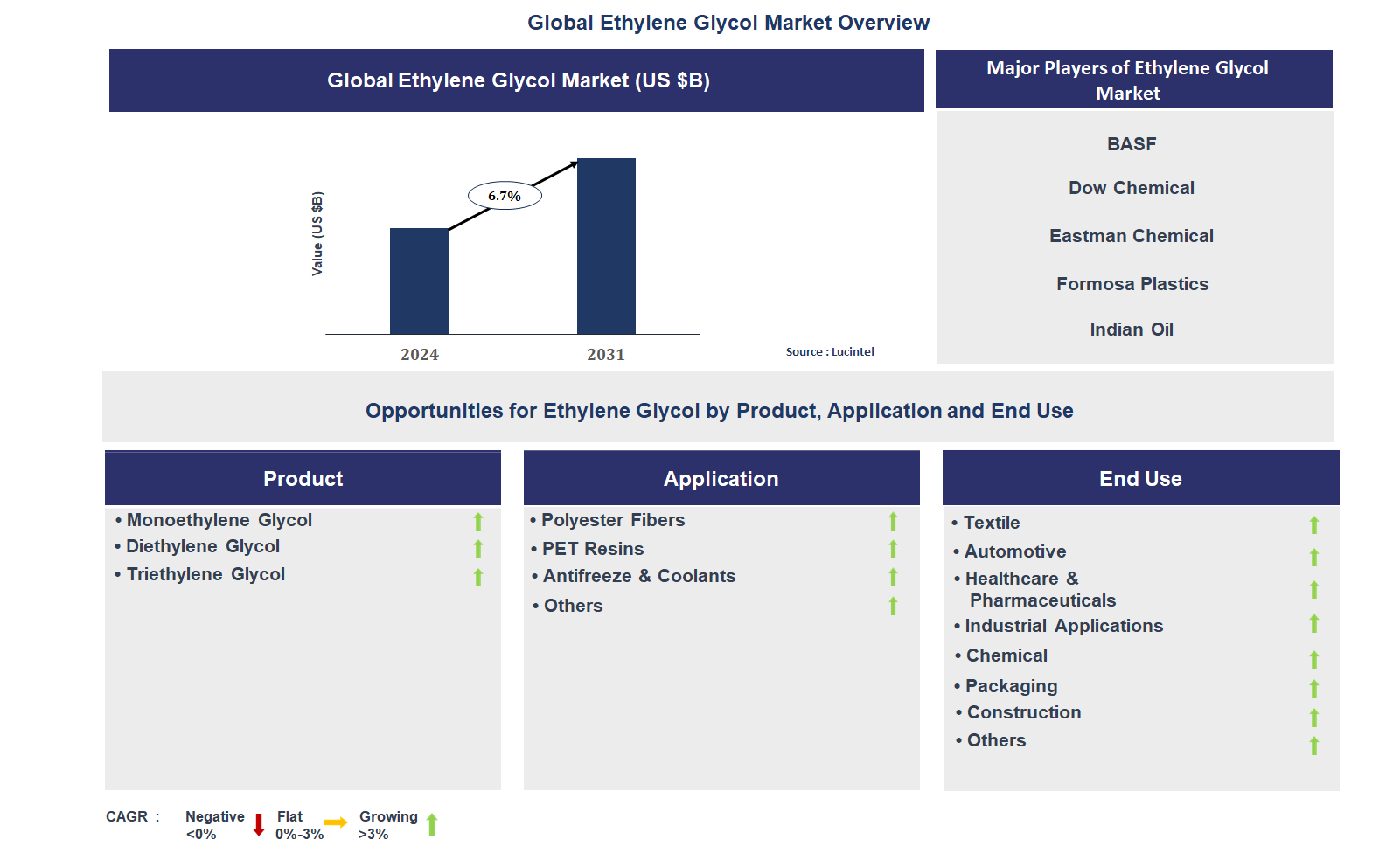
Ethylene Glycol Market Trends and Forecast

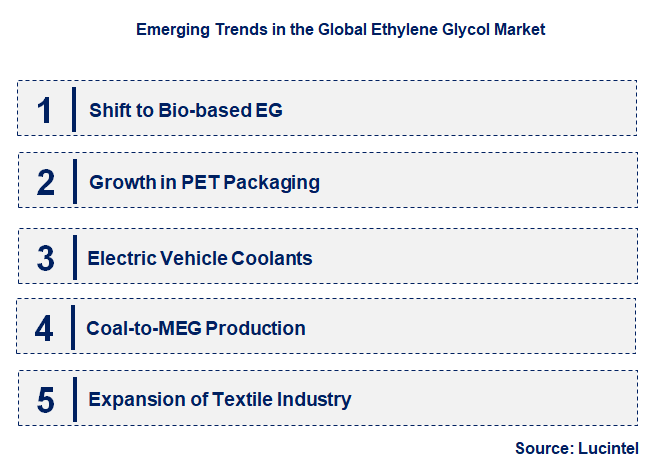
Emerging Trends in the Ethylene Glycol Market

The ethylene glycol market is witnessing several emerging trends that are fundamentally reshaping its landscape. These trends are rooted in a global push toward sustainability, technological advancements, and a diversification of end-use applications, moving the market beyond traditional uses and into new, high-growth sectors.
• Shift to Bio-based EG: A key trend is the development of bio-based ethylene glycol from renewable feedstocks like glycerin and corn sugar. This is a direct response to environmental concerns and the need to reduce reliance on fossil fuels. This shift is attracting significant investment and is poised to create a more sustainable and environmentally friendly market.
• Growth in PET Packaging: The market is seeing a sustained trend of increased demand for PET resins in packaging. This is driven by consumer preference for lightweight, recyclable, and convenient packaging for food, beverages, and other consumer goods. The growth of e-commerce and urbanization in emerging economies is further accelerating this trend.
• Electric Vehicle Coolants: A significant emerging trend is the use of EG as a coolant in electric vehicle batteries and thermal management systems. Unlike traditional combustion engines, EVs require specialized cooling solutions to maintain battery performance and longevity. This creates a new and substantial growth opportunity for the EG market.
• Coal-to-MEG Production: In regions like China, there is a strong trend toward using coal as a feedstock for monoethylene glycol (MEG) production. This provides a cost-effective alternative to traditional oil-based methods. This trend is altering global supply-demand dynamics and reducing dependency on volatile crude oil prices.
• Expansion of Textile Industry: The textile industry, especially in Asia, is driving a strong trend in demand for polyester fibers. The use of EG as a key raw material for polyester is growing due to its durability, versatility, and affordability. This trend is supported by rising disposable incomes and changing fashion trends in developing nations.
These trends are reshaping the ethylene glycol market by fostering a more diverse and resilient industry. They are moving EG from a bulk chemical to a specialized product with applications in new sectors, while also promoting more sustainable production methods, ensuring the markets long-term growth and relevance in a changing global economy.
Emerging Trends in the Ethylene Glycol Market

Recent Development in the Ethylene Glycol Market

Recent developments in the ethylene glycol market are characterized by large-scale investments in production capacity and a move towards more sustainable and technologically advanced manufacturing processes. These developments are aimed at optimizing supply chains, reducing costs, and meeting the changing demands of end-use industries.
• Mega-Project Capacity Expansions: A key development is the commissioning of new, large-scale EG production facilities, particularly in Asia and the Middle East. These mega-projects, often integrated with refineries, are increasing global supply and shifting the production landscape. This development is putting downward pressure on prices but also ensuring a more stable global supply.
• Focus on Low-Carbon Production: Major producers are increasingly focusing on developing low-emission and eco-friendly EG production processes. This involves strategic partnerships to research and implement technologies that significantly reduce carbon footprints. This development is crucial for meeting stringent environmental regulations and corporate sustainability goals.
• Strategic Mergers and Acquisitions: The market is seeing a number of strategic mergers and acquisitions aimed at consolidating market share and expanding geographic reach. These moves are enabling companies to gain a competitive advantage by integrating upstream and downstream operations, and by securing access to key raw materials and end-use markets.
• Rise of Coal-Based Production: In a significant development, coal-to-EG production technology is gaining prominence, particularly in China. This is a strategic move to leverage abundant domestic coal reserves, reduce reliance on ethylene imports, and improve cost competitiveness. This development is altering the traditional supply chain and pricing structure.
• Technological Advancements in Coolant Formulations: There is a notable development in the formulation of EG-based coolants, driven by the growth of electric vehicles (EVs). New formulations are being developed to meet the specific thermal management requirements of EV batteries and electronics. This development is opening up a high-value niche market.
These developments are collectively impacting the ethylene glycol market by creating a more competitive, efficient, and resilient industry. The push for larger, more sustainable production facilities and strategic business moves are setting the stage for future growth and ensuring that the market can effectively respond to both opportunities and challenges.

Strategic Growth Opportunities in the Ethylene Glycol Market

Strategic growth opportunities in the ethylene glycol market are centered on its diverse applications in industries that are experiencing rapid growth and a push toward sustainability. By capitalizing on these opportunities, market players can ensure long-term profitability and expand their market presence.
• Polyester Fiber Manufacturing: The polyester fiber market presents a significant growth opportunity, especially with rising demand for textiles in emerging economies. The durability, low cost, and wrinkle resistance of polyester make it a preferred material for apparel and home furnishings, directly driving the demand for ethylene glycol as a key raw material.
• PET Resin for Packaging: The increasing use of polyethylene terephthalate (PET) for food and beverage packaging offers a major growth opportunity. Consumers are opting for lightweight, safe, and recyclable packaging. This is fueling a strong and consistent demand for ethylene glycol, which is a key component in PET resin production.
• Antifreeze and Coolants for EVs: The rapid adoption of electric vehicles is creating a strategic growth opportunity for ethylene glycol in the automotive sector. EVs require specialized coolant formulations to manage the thermal loads of their battery packs and electronic components. This high-growth segment offers a lucrative new market.
• Chemical Intermediates and Solvents: Ethylene glycol serves as a crucial chemical intermediate for a wide range of products, including glycol ethers, polyurethane, and unsaturated polyester resins. The continued growth and diversification of the chemical industry are creating a steady and robust demand for EG in these applications.
• De-icing and Aircraft Anti-icing Fluids: The aviation industry provides a niche but important growth opportunity. Ethylene glycol is a primary component in de-icing and anti-icing fluids for aircraft. As air travel continues to expand globally, particularly in cold-weather regions, the demand for these specialty fluids will rise.
These opportunities are impacting the ethylene glycol market by expanding its applications into high-value, high-growth sectors. This diversification reduces the markets reliance on traditional segments, making it more resilient to economic fluctuations and fostering innovation to meet the unique demands of new applications.

Ethylene Glycol Market Driver and Challenges

The ethylene glycol market is shaped by a complex interplay of drivers and challenges. The major drivers are increasing demand from key end-use industries and advancements in production technology, while key challenges include volatile raw material prices and environmental concerns.
The factors responsible for driving the ethylene glycol market include:
1. Growing Polyester and PET Demand: The expanding textile industry and the rising demand for PET packaging are the primary drivers. Polyester fibers are essential for apparel and industrial textiles, while PET is critical for food and beverage containers. This continuous demand from consumer-driven sectors ensures a stable and growing market for ethylene glycol.
2. Urbanization and Industrialization: Rapid urbanization and industrialization in emerging economies, particularly in the Asia-Pacific region, are major drivers. This leads to increased demand for infrastructure, construction materials, and a wide array of consumer goods, all of which use ethylene glycol in some form, from pipes to paints and packaging.
3. Automotive Industry Growth: The automotive sector is a key driver, with ethylene glycol used extensively in antifreeze and coolants. The growth in vehicle production, both traditional and electric, directly correlates with demand. The need for efficient thermal management in both internal combustion engines and EV batteries sustains this market.
4. Technological Advancements: Innovations in production technology, such as the development of more efficient catalysts and the use of alternative feedstocks like coal and biomass, are driving the market. These advancements are helping to reduce production costs and environmental impact, making ethylene glycol a more competitive and sustainable option.
5. Global Population Growth: The steady increase in the global population is a fundamental driver. A larger population means higher demand for consumer goods, clothing, and packaged foods, all of which rely on ethylene glycol in their production. This trend provides a long-term, stable growth foundation for the market.
Challenges in the ethylene glycol market are:
1. Volatile Raw Material Prices: A significant challenge is the volatility of ethylene prices, which are linked to crude oil. Fluctuations in feedstock costs directly impact the profitability of EG producers. This instability makes long-term planning difficult and can affect the competitiveness of EG against alternative materials.
2. Environmental and Health Concerns: Ethylene glycol is a toxic substance and its production process can be energy-intensive. There are increasing environmental and health concerns and regulations, especially in developed countries, regarding its handling and disposal. This can lead to higher compliance costs and may limit its use in certain sensitive applications.
3. Competition from Alternatives: The market faces competition from alternative chemicals, such as bio-based propylene glycol and other substitutes, in certain applications. As these alternatives become more cost-effective and environmentally friendly, they can erode the market share of ethylene glycol, especially in antifreeze and coolant markets.
The drivers and challenges are creating a dynamic environment for the ethylene glycol market. While strong demand from key industries like textiles and packaging is propelling growth, the market must navigate challenges related to cost volatility and sustainability. The ability of manufacturers to innovate and adapt will be crucial to overcoming these hurdles and securing long-term market leadership.

List of Ethylene Glycol Companies

Companies in the market compete on the basis of product quality offered. Major players in this market focus on expanding their manufacturing facilities, R&D investments, infrastructural development, and leverage integration opportunities across the value chain. With these strategies ethylene glycol companies cater increasing demand, ensure competitive effectiveness, develop innovative products & technologies, reduce production costs, and expand their customer base. Some of the ethylene glycol companies profiled in this report include-
• BASF
• Dow Chemical
• Eastman Chemical
• Formosa Plastics
• Indian Oil
• Ineos Group
• LG Chem
• LOTTE Chemical
• LyondellBasell
• Mitsubishi Chemical

Ethylene Glycol Market by Segment

The study includes a forecast for the global ethylene glycol market by product, application, end use, and region.

Ethylene Glycol Market by Product [Value from 2019 to 2031]:


• Monoethylene Glycol
• Diethylene Glycol
• Triethylene Glycol

Ethylene Glycol Market by Application [Value from 2019 to 2031]:


• Polyester Fibers
• PET Resins
• Antifreeze & Coolants
• Others

Ethylene Glycol Market by End Use [Value from 2019 to 2031]:


• Textile
• Automotive
• Healthcare & Pharmaceuticals
• Industrial Applications
• Chemical
• Packaging
• Construction
• Others

Ethylene Glycol Market by Region [Value from 2019 to 2031]:


• North America
• Europe
• Asia Pacific
• The Rest of the World

Country Wise Outlook for the Ethylene Glycol Market

The ethylene glycol market is undergoing significant transformation, driven by a complex interplay of global supply chain dynamics, technological innovation, and evolving end-use demands. The primary applications in polyester fiber, PET resins for packaging, and automotive coolants are at the forefront of this change, with regional markets responding to unique economic and regulatory pressures.
• United States: The U.S. market is benefiting from a cost advantage due to the shale gas boom, which provides a cheap and abundant source of ethylene. Major producers are investing in new plants and expansions, ensuring a steady supply of EG for domestic use in antifreeze and PET production, and maintaining a competitive edge.
• China: Chinas ethylene glycol market has seen rapid growth, primarily fueled by massive expansion in polyester and PET production. The country is becoming less reliant on imports due to new coal-to-EG and mega refinery projects. However, recent developments show some oversupply and price volatility due to weak downstream demand.
• Germany: As a key market in Europe, Germany is adapting to changing market conditions with a focus on sustainability. While facing pressure from global oversupply, the market is stable, with a strong emphasis on high-quality and specialty applications. German companies are exploring new technologies to improve efficiency and reduce their carbon footprint.
• India: Indias EG market is driven by strong domestic demand, particularly from the textile and packaging industries. While production capacity has grown, it is not enough to meet the increasing demand, making India a significant importer. The governments push for infrastructure development and manufacturing further supports demand.
• Japan: Japans market is characterized by a high-tech approach, with a focus on specialized applications. The demand for EG is stable, with a strong emphasis on its use in high-quality PET for food and beverage packaging and in coolants for the growing electric vehicle (EV) sector.

Lucintel Analytics Dashboard

Features of the Global Ethylene Glycol Market

Market Size Estimates: Ethylene glycol market size estimation in terms of value ($B).
Trend and Forecast Analysis: Market trends (2019 to 2024) and forecast (2025 to 2031) by various segments and regions.
Segmentation Analysis: Ethylene glycol market size by product, application, end use, and region in terms of value ($B).
Regional Analysis: Ethylene glycol market breakdown by North America, Europe, Asia Pacific, and Rest of the World.
Growth Opportunities: Analysis of growth opportunities in different products, applications, end uses, and regions for the ethylene glycol market.
Strategic Analysis: This includes M&A, new product development, and competitive landscape of the ethylene glycol market.
Analysis of competitive intensity of the industry based on Porter’s Five Forces model.

Lucintel Consulting Services

FAQ

Q1. What is the growth forecast for ethylene glycol market?
Answer: The global ethylene glycol market is expected to grow with a CAGR of 6.7% from 2025 to 2031.
Q2. What are the major drivers influencing the growth of the ethylene glycol market?
Answer: The major drivers for this market are the increasing demand from the automotive sector, the growth in pet production, and the expanding polyester production.
Q3. What are the major segments for ethylene glycol market?
Answer: The future of the ethylene glycol market looks promising with opportunities in the textile, automotive, healthcare & pharmaceutical, industrial application, chemical, packaging, and construction markets.
Q4. Who are the key ethylene glycol market companies?
Answer: Some of the key ethylene glycol companies are as follows:
• BASF
• Dow Chemical
• Eastman Chemical
• Formosa Plastics
• Indian Oil
• Ineos Group
• LG Chem
• LOTTE Chemical
• LyondellBasell
• Mitsubishi Chemical
Q5. Which ethylene glycol market segment will be the largest in future?
Answer: Lucintel forecasts that, within the product category, monoethylene glycol is expected to witness the highest growth over the forecast period.
Q6. In ethylene glycol market, which region is expected to be the largest in next 5 years?
Answer: In terms of region, APAC is expected to witness the highest growth over the forecast period.
Q7. Do we receive customization in this report?
Answer: Yes, Lucintel provides 10% customization without any additional cost.

This report answers following 11 key questions:

Q.1. What are some of the most promising, high-growth opportunities for the ethylene glycol market by product (monoethylene glycol, diethylene glycol, and triethylene glycol), application (polyester fibers, PET resins, antifreeze & coolants, and others), end use (textile, automotive, healthcare & pharmaceuticals, industrial applications, chemical, packaging, construction, and others), and region (North America, Europe, Asia Pacific, and the Rest of the World)?
Q.2. Which segments will grow at a faster pace and why?
Q.3. Which region will grow at a faster pace and why?
Q.4. What are the key factors affecting market dynamics? What are the key challenges and business risks in this market?
Q.5. What are the business risks and competitive threats in this market?
Q.6. What are the emerging trends in this market and the reasons behind them?
Q.7. What are some of the changing demands of customers in the market?
Q.8. What are the new developments in the market? Which companies are leading these developments?
Q.9. Who are the major players in this market? What strategic initiatives are key players pursuing for business growth?
Q.10. What are some of the competing products in this market and how big of a threat do they pose for loss of market share by material or product substitution?
Q.11. What M&A activity has occurred in the last 5 years and what has its impact been on the industry?

For any questions related to Ethylene Glycol Market, Ethylene Glycol Market Size, Ethylene Glycol Market Growth, Ethylene Glycol Market Analysis, Ethylene Glycol Market Report, Ethylene Glycol Market Share, Ethylene Glycol Market Trends, Ethylene Glycol Market Forecast, Ethylene Glycol Companies, write Lucintel analyst at email: helpdesk@lucintel.com. We will be glad to get back to you soon.
                                           Table of Contents

            1. Executive Summary

            2. Market Overview

                        2.1 Background and Classifications
                        2.2 Supply Chain

            3. Market Trends & Forecast Analysis

                        3.1 Macroeconomic Trends and Forecasts
                        3.2 Industry Drivers and Challenges
                        3.3 PESTLE Analysis
                        3.4 Patent Analysis
                        3.5 Regulatory Environment
                        3.6 Global Ethylene Glycol Market Trends and Forecast

            4. Global Ethylene Glycol Market by Product

                        4.1 Overview
                        4.2 Attractiveness Analysis by Product
                        4.3 Monoethylene Glycol : Trends and Forecast 2025 to 2031
                        4.4 Diethylene Glycol : Trends and Forecast 2025 to 2031
                        4.5 Triethylene Glycol : Trends and Forecast 2025 to 2031

            5. Global Ethylene Glycol Market by Application

                        5.1 Overview
                        5.2 Attractiveness Analysis by Application
                        5.3 Polyester Fibers : Trends and Forecast 2025 to 2031
                        5.4 Pet Resins : Trends and Forecast 2025 to 2031
                        5.5 Antifreeze & Coolants : Trends and Forecast 2025 to 2031
                        5.6 Others : Trends and Forecast 2025 to 2031

            6. Global Ethylene Glycol Market by End Use

                        6.1 Overview
                        6.2 Attractiveness Analysis by End Use
                        6.3 Textile : Trends and Forecast 2025 to 2031
                        6.4 Automotive : Trends and Forecast 2025 to 2031
                        6.5 Healthcare & Pharmaceuticals : Trends and Forecast 2025 to 2031
                        6.6 Industrial Applications : Trends and Forecast 2025 to 2031
                        6.7 Chemical : Trends and Forecast 2025 to 2031
                        6.8 Packaging : Trends and Forecast 2025 to 2031
                        6.9 Construction : Trends and Forecast 2025 to 2031
                        6.10 Others : Trends and Forecast 2025 to 2031

            7. Regional Analysis

                        7.1 Overview
                        7.2 Global Ethylene Glycol Market by Region

            8. North American Ethylene Glycol Market

                        8.1 Overview
                        8.2 North American Ethylene Glycol Market by Product
                        8.3 North American Ethylene Glycol Market by End Use
                        8.4 The United States Ethylene Glycol Market
                        8.5 Canadian Ethylene Glycol Market
                        8.6 Mexican Ethylene Glycol Market

            9. European Ethylene Glycol Market

                        9.1 Overview
                        9.2 European Ethylene Glycol Market by Product
                        9.3 European Ethylene Glycol Market by End Use
                        9.4 German Ethylene Glycol Market
                        9.5 French Ethylene Glycol Market
                        9.6 Italian Ethylene Glycol Market
                        9.7 Spanish Ethylene Glycol Market
                        9.8 The United Kingdom Ethylene Glycol Market

            10. APAC Ethylene Glycol Market

                        10.1 Overview
                        10.2 APAC Ethylene Glycol Market by Product
                        10.3 APAC Ethylene Glycol Market by End Use
                        10.4 Chinese Ethylene Glycol Market
                        10.5 Indian Ethylene Glycol Market
                        10.6 Japanese Ethylene Glycol Market
                        10.7 South Korean Ethylene Glycol Market
                        10.8 Indonesian Ethylene Glycol Market

            11. ROW Ethylene Glycol Market

                        11.1 Overview
                        11.2 ROW Ethylene Glycol Market by Product
                        11.3 ROW Ethylene Glycol Market by End Use
                        11.4 Middle Eastern Ethylene Glycol Market
                        11.5 South American Ethylene Glycol Market
                        11.6 African Ethylene Glycol Market

            12. Competitor Analysis

                        12.1 Product Portfolio Analysis
                        12.2 Operational Integration
                        12.3 Porter’s Five Forces Analysis
                                    • Competitive Rivalry
                                    • Bargaining Power of Buyers
                                    • Bargaining Power of Suppliers
                                    • Threat of Substitutes
                                    • Threat of New Entrants
                        12.4 Market Share Analysis

            13. Opportunities & Strategic Analysis

                        13.1 Value Chain Analysis
                        13.2 Growth Opportunity Analysis
                                    13.2.1 Growth Opportunity by Product
                                    13.2.2 Growth Opportunity by Application
                                    13.2.3 Growth Opportunity by End Use
                        13.3 Emerging Trends in the Global Ethylene Glycol Market
                        13.4 Strategic Analysis
                                    13.4.1 New Product Development
                                    13.4.2 Certification and Licensing
                                    13.4.3 Mergers, Acquisitions, Agreements, Collaborations, and Joint Ventures

            14. Company Profiles of the Leading Players Across the Value Chain

                        14.1 Competitive Analysis
                        14.2 BASF
                                    • Company Overview
                                    • Ethylene Glycol Market Business Overview
                                    • New Product Development
                                    • Merger, Acquisition, and Collaboration
                                    • Certification and Licensing
                        14.3 Dow Chemical
                                    • Company Overview
                                    • Ethylene Glycol Market Business Overview
                                    • New Product Development
                                    • Merger, Acquisition, and Collaboration
                                    • Certification and Licensing
                        14.4 Eastman Chemical
                                    • Company Overview
                                    • Ethylene Glycol Market Business Overview
                                    • New Product Development
                                    • Merger, Acquisition, and Collaboration
                                    • Certification and Licensing
                        14.5 Formosa Plastics
                                    • Company Overview
                                    • Ethylene Glycol Market Business Overview
                                    • New Product Development
                                    • Merger, Acquisition, and Collaboration
                                    • Certification and Licensing
                        14.6 Indian Oil
                                    • Company Overview
                                    • Ethylene Glycol Market Business Overview
                                    • New Product Development
                                    • Merger, Acquisition, and Collaboration
                                    • Certification and Licensing
                        14.7 Ineos Group
                                    • Company Overview
                                    • Ethylene Glycol Market Business Overview
                                    • New Product Development
                                    • Merger, Acquisition, and Collaboration
                                    • Certification and Licensing
                        14.8 LG Chem
                                    • Company Overview
                                    • Ethylene Glycol Market Business Overview
                                    • New Product Development
                                    • Merger, Acquisition, and Collaboration
                                    • Certification and Licensing
                        14.9 LOTTE Chemical
                                    • Company Overview
                                    • Ethylene Glycol Market Business Overview
                                    • New Product Development
                                    • Merger, Acquisition, and Collaboration
                                    • Certification and Licensing
                        14.10 LyondellBasell
                                    • Company Overview
                                    • Ethylene Glycol Market Business Overview
                                    • New Product Development
                                    • Merger, Acquisition, and Collaboration
                                    • Certification and Licensing
                        14.11 Mitsubishi Chemical
                                    • Company Overview
                                    • Ethylene Glycol Market Business Overview
                                    • New Product Development
                                    • Merger, Acquisition, and Collaboration
                                    • Certification and Licensing

            15. Appendix

                        15.1 List of Figures
                        15.2 List of Tables
                        15.3 Research Methodology
                        15.4 Disclaimer
                        15.5 Copyright
                        15.6 Abbreviations and Technical Units
                        15.7 About Us
                        15.8 Contact Us

                                               List of Figures


            Chapter 1

                        Figure 1.1: Trends and Forecast for the Global Ethylene Glycol Market

            Chapter 2

                        Figure 2.1: Usage of Ethylene Glycol Market
                        Figure 2.2: Classification of the Global Ethylene Glycol Market
                        Figure 2.3: Supply Chain of the Global Ethylene Glycol Market
                        Figure 2.4: Driver and Challenges of the Ethylene Glycol Market

            Chapter 3

                        Figure 3.1: Trends of the Global GDP Growth Rate
                        Figure 3.2: Trends of the Global Population Growth Rate
                        Figure 3.3: Trends of the Global Inflation Rate
                        Figure 3.4: Trends of the Global Unemployment Rate
                        Figure 3.5: Trends of the Regional GDP Growth Rate
                        Figure 3.6: Trends of the Regional Population Growth Rate
                        Figure 3.7: Trends of the Regional Inflation Rate
                        Figure 3.8: Trends of the Regional Unemployment Rate
                        Figure 3.9: Trends of Regional Per Capita Income
                        Figure 3.10: Forecast for the Global GDP Growth Rate
                        Figure 3.11: Forecast for the Global Population Growth Rate
                        Figure 3.12: Forecast for the Global Inflation Rate
                        Figure 3.13: Forecast for the Global Unemployment Rate
                        Figure 3.14: Forecast for the Regional GDP Growth Rate
                        Figure 3.15: Forecast for the Regional Population Growth Rate
                        Figure 3.16: Forecast for the Regional Inflation Rate
                        Figure 3.17: Forecast for the Regional Unemployment Rate
                        Figure 3.18: Forecast for Regional Per Capita Income

            Chapter 4

                        Figure 4.1: Global Ethylene Glycol Market by Product in 2019, 2024, and 2031
                        Figure 4.2: Trends of the Global Ethylene Glycol Market ($B) by Product
                        Figure 4.3: Forecast for the Global Ethylene Glycol Market ($B) by Product
                        Figure 4.4: Trends and Forecast for Monoethylene Glycol in the Global Ethylene Glycol Market (2019-2031)
                        Figure 4.5: Trends and Forecast for Diethylene Glycol in the Global Ethylene Glycol Market (2019-2031)
                        Figure 4.6: Trends and Forecast for Triethylene Glycol in the Global Ethylene Glycol Market (2019-2031)

            Chapter 5

                        Figure 5.1: Global Ethylene Glycol Market by Application in 2019, 2024, and 2031
                        Figure 5.2: Trends of the Global Ethylene Glycol Market ($B) by Application
                        Figure 5.3: Forecast for the Global Ethylene Glycol Market ($B) by Application
                        Figure 5.4: Trends and Forecast for Polyester Fibers in the Global Ethylene Glycol Market (2019-2031)
                        Figure 5.5: Trends and Forecast for Pet Resins in the Global Ethylene Glycol Market (2019-2031)
                        Figure 5.6: Trends and Forecast for Antifreeze & Coolants in the Global Ethylene Glycol Market (2019-2031)
                        Figure 5.7: Trends and Forecast for Others in the Global Ethylene Glycol Market (2019-2031)

            Chapter 6

                        Figure 6.1: Global Ethylene Glycol Market by End Use in 2019, 2024, and 2031
                        Figure 6.2: Trends of the Global Ethylene Glycol Market ($B) by End Use
                        Figure 6.3: Forecast for the Global Ethylene Glycol Market ($B) by End Use
                        Figure 6.4: Trends and Forecast for Textile in the Global Ethylene Glycol Market (2019-2031)
                        Figure 6.5: Trends and Forecast for Automotive in the Global Ethylene Glycol Market (2019-2031)
                        Figure 6.6: Trends and Forecast for Healthcare & Pharmaceuticals in the Global Ethylene Glycol Market (2019-2031)
                        Figure 6.7: Trends and Forecast for Industrial Applications in the Global Ethylene Glycol Market (2019-2031)
                        Figure 6.8: Trends and Forecast for Chemical in the Global Ethylene Glycol Market (2019-2031)
                        Figure 6.9: Trends and Forecast for Packaging in the Global Ethylene Glycol Market (2019-2031)
                        Figure 6.10: Trends and Forecast for Construction in the Global Ethylene Glycol Market (2019-2031)
                        Figure 6.11: Trends and Forecast for Others in the Global Ethylene Glycol Market (2019-2031)

            Chapter 7

                        Figure 7.1: Trends of the Global Ethylene Glycol Market ($B) by Region (2019-2024)
                        Figure 7.2: Forecast for the Global Ethylene Glycol Market ($B) by Region (2025-2031)

            Chapter 8

                        Figure 8.1: Trends and Forecast for the North American Ethylene Glycol Market (2019-2031)
                        Figure 8.2: North American Ethylene Glycol Market by Product in 2019, 2024, and 2031
                        Figure 8.3: Trends of the North American Ethylene Glycol Market ($B) by Product (2019-2024)
                        Figure 8.4: Forecast for the North American Ethylene Glycol Market ($B) by Product (2025-2031)
                        Figure 8.5: North American Ethylene Glycol Market by Application in 2019, 2024, and 2031
                        Figure 8.6: Trends of the North American Ethylene Glycol Market ($B) by Application (2019-2024)
                        Figure 8.7: Forecast for the North American Ethylene Glycol Market ($B) by Application (2025-2031)
                        Figure 8.8: North American Ethylene Glycol Market by End Use in 2019, 2024, and 2031
                        Figure 8.9: Trends of the North American Ethylene Glycol Market ($B) by End Use (2019-2024)
                        Figure 8.10: Forecast for the North American Ethylene Glycol Market ($B) by End Use (2025-2031)
                        Figure 8.11: Trends and Forecast for the United States Ethylene Glycol Market ($B) (2019-2031)
                        Figure 8.12: Trends and Forecast for the Mexican Ethylene Glycol Market ($B) (2019-2031)
                        Figure 8.13: Trends and Forecast for the Canadian Ethylene Glycol Market ($B) (2019-2031)

            Chapter 9

                        Figure 9.1: Trends and Forecast for the European Ethylene Glycol Market (2019-2031)
                        Figure 9.2: European Ethylene Glycol Market by Product in 2019, 2024, and 2031
                        Figure 9.3: Trends of the European Ethylene Glycol Market ($B) by Product (2019-2024)
                        Figure 9.4: Forecast for the European Ethylene Glycol Market ($B) by Product (2025-2031)
                        Figure 9.5: European Ethylene Glycol Market by Application in 2019, 2024, and 2031
                        Figure 9.6: Trends of the European Ethylene Glycol Market ($B) by Application (2019-2024)
                        Figure 9.7: Forecast for the European Ethylene Glycol Market ($B) by Application (2025-2031)
                        Figure 9.8: European Ethylene Glycol Market by End Use in 2019, 2024, and 2031
                        Figure 9.9: Trends of the European Ethylene Glycol Market ($B) by End Use (2019-2024)
                        Figure 9.10: Forecast for the European Ethylene Glycol Market ($B) by End Use (2025-2031)
                        Figure 9.11: Trends and Forecast for the German Ethylene Glycol Market ($B) (2019-2031)
                        Figure 9.12: Trends and Forecast for the French Ethylene Glycol Market ($B) (2019-2031)
                        Figure 9.13: Trends and Forecast for the Spanish Ethylene Glycol Market ($B) (2019-2031)
                        Figure 9.14: Trends and Forecast for the Italian Ethylene Glycol Market ($B) (2019-2031)
                        Figure 9.15: Trends and Forecast for the United Kingdom Ethylene Glycol Market ($B) (2019-2031)

            Chapter 10

                        Figure 10.1: Trends and Forecast for the APAC Ethylene Glycol Market (2019-2031)
                        Figure 10.2: APAC Ethylene Glycol Market by Product in 2019, 2024, and 2031
                        Figure 10.3: Trends of the APAC Ethylene Glycol Market ($B) by Product (2019-2024)
                        Figure 10.4: Forecast for the APAC Ethylene Glycol Market ($B) by Product (2025-2031)
                        Figure 10.5: APAC Ethylene Glycol Market by Application in 2019, 2024, and 2031
                        Figure 10.6: Trends of the APAC Ethylene Glycol Market ($B) by Application (2019-2024)
                        Figure 10.7: Forecast for the APAC Ethylene Glycol Market ($B) by Application (2025-2031)
                        Figure 10.8: APAC Ethylene Glycol Market by End Use in 2019, 2024, and 2031
                        Figure 10.9: Trends of the APAC Ethylene Glycol Market ($B) by End Use (2019-2024)
                        Figure 10.10: Forecast for the APAC Ethylene Glycol Market ($B) by End Use (2025-2031)
                        Figure 10.11: Trends and Forecast for the Japanese Ethylene Glycol Market ($B) (2019-2031)
                        Figure 10.12: Trends and Forecast for the Indian Ethylene Glycol Market ($B) (2019-2031)
                        Figure 10.13: Trends and Forecast for the Chinese Ethylene Glycol Market ($B) (2019-2031)
                        Figure 10.14: Trends and Forecast for the South Korean Ethylene Glycol Market ($B) (2019-2031)
                        Figure 10.15: Trends and Forecast for the Indonesian Ethylene Glycol Market ($B) (2019-2031)

            Chapter 11

                        Figure 11.1: Trends and Forecast for the ROW Ethylene Glycol Market (2019-2031)
                        Figure 11.2: ROW Ethylene Glycol Market by Product in 2019, 2024, and 2031
                        Figure 11.3: Trends of the ROW Ethylene Glycol Market ($B) by Product (2019-2024)
                        Figure 11.4: Forecast for the ROW Ethylene Glycol Market ($B) by Product (2025-2031)
                        Figure 11.5: ROW Ethylene Glycol Market by Application in 2019, 2024, and 2031
                        Figure 11.6: Trends of the ROW Ethylene Glycol Market ($B) by Application (2019-2024)
                        Figure 11.7: Forecast for the ROW Ethylene Glycol Market ($B) by Application (2025-2031)
                        Figure 11.8: ROW Ethylene Glycol Market by End Use in 2019, 2024, and 2031
                        Figure 11.9: Trends of the ROW Ethylene Glycol Market ($B) by End Use (2019-2024)
                        Figure 11.10: Forecast for the ROW Ethylene Glycol Market ($B) by End Use (2025-2031)
                        Figure 11.11: Trends and Forecast for the Middle Eastern Ethylene Glycol Market ($B) (2019-2031)
                        Figure 11.12: Trends and Forecast for the South American Ethylene Glycol Market ($B) (2019-2031)
                        Figure 11.13: Trends and Forecast for the African Ethylene Glycol Market ($B) (2019-2031)

            Chapter 12

                        Figure 12.1: Porter’s Five Forces Analysis of the Global Ethylene Glycol Market
                        Figure 12.2: Market Share (%) of Top Players in the Global Ethylene Glycol Market (2024)

            Chapter 13

                        Figure 13.1: Growth Opportunities for the Global Ethylene Glycol Market by Product
                        Figure 13.2: Growth Opportunities for the Global Ethylene Glycol Market by Application
                        Figure 13.3: Growth Opportunities for the Global Ethylene Glycol Market by End Use
                        Figure 13.4: Growth Opportunities for the Global Ethylene Glycol Market by Region
                        Figure 13.5: Emerging Trends in the Global Ethylene Glycol Market

                                               List of Tables


            Chapter 1

                        Table 1.1: Growth Rate (%, 2023-2024) and CAGR (%, 2025-2031) of the Ethylene Glycol Market by Product, Application, and End Use
                        Table 1.2: Attractiveness Analysis for the Ethylene Glycol Market by Region
                        Table 1.3: Global Ethylene Glycol Market Parameters and Attributes

            Chapter 3

                        Table 3.1: Trends of the Global Ethylene Glycol Market (2019-2024)
                        Table 3.2: Forecast for the Global Ethylene Glycol Market (2025-2031)

            Chapter 4

                        Table 4.1: Attractiveness Analysis for the Global Ethylene Glycol Market by Product
                        Table 4.2: Market Size and CAGR of Various Product in the Global Ethylene Glycol Market (2019-2024)
                        Table 4.3: Market Size and CAGR of Various Product in the Global Ethylene Glycol Market (2025-2031)
                        Table 4.4: Trends of Monoethylene Glycol in the Global Ethylene Glycol Market (2019-2024)
                        Table 4.5: Forecast for Monoethylene Glycol in the Global Ethylene Glycol Market (2025-2031)
                        Table 4.6: Trends of Diethylene Glycol in the Global Ethylene Glycol Market (2019-2024)
                        Table 4.7: Forecast for Diethylene Glycol in the Global Ethylene Glycol Market (2025-2031)
                        Table 4.8: Trends of Triethylene Glycol in the Global Ethylene Glycol Market (2019-2024)
                        Table 4.9: Forecast for Triethylene Glycol in the Global Ethylene Glycol Market (2025-2031)

            Chapter 5

                        Table 5.1: Attractiveness Analysis for the Global Ethylene Glycol Market by Application
                        Table 5.2: Market Size and CAGR of Various Application in the Global Ethylene Glycol Market (2019-2024)
                        Table 5.3: Market Size and CAGR of Various Application in the Global Ethylene Glycol Market (2025-2031)
                        Table 5.4: Trends of Polyester Fibers in the Global Ethylene Glycol Market (2019-2024)
                        Table 5.5: Forecast for Polyester Fibers in the Global Ethylene Glycol Market (2025-2031)
                        Table 5.6: Trends of Pet Resins in the Global Ethylene Glycol Market (2019-2024)
                        Table 5.7: Forecast for Pet Resins in the Global Ethylene Glycol Market (2025-2031)
                        Table 5.8: Trends of Antifreeze & Coolants in the Global Ethylene Glycol Market (2019-2024)
                        Table 5.9: Forecast for Antifreeze & Coolants in the Global Ethylene Glycol Market (2025-2031)
                        Table 5.10: Trends of Others in the Global Ethylene Glycol Market (2019-2024)
                        Table 5.11: Forecast for Others in the Global Ethylene Glycol Market (2025-2031)

            Chapter 6

                        Table 6.1: Attractiveness Analysis for the Global Ethylene Glycol Market by End Use
                        Table 6.2: Market Size and CAGR of Various End Use in the Global Ethylene Glycol Market (2019-2024)
                        Table 6.3: Market Size and CAGR of Various End Use in the Global Ethylene Glycol Market (2025-2031)
                        Table 6.4: Trends of Textile in the Global Ethylene Glycol Market (2019-2024)
                        Table 6.5: Forecast for Textile in the Global Ethylene Glycol Market (2025-2031)
                        Table 6.6: Trends of Automotive in the Global Ethylene Glycol Market (2019-2024)
                        Table 6.7: Forecast for Automotive in the Global Ethylene Glycol Market (2025-2031)
                        Table 6.8: Trends of Healthcare & Pharmaceuticals in the Global Ethylene Glycol Market (2019-2024)
                        Table 6.9: Forecast for Healthcare & Pharmaceuticals in the Global Ethylene Glycol Market (2025-2031)
                        Table 6.10: Trends of Industrial Applications in the Global Ethylene Glycol Market (2019-2024)
                        Table 6.11: Forecast for Industrial Applications in the Global Ethylene Glycol Market (2025-2031)
                        Table 6.12: Trends of Chemical in the Global Ethylene Glycol Market (2019-2024)
                        Table 6.13: Forecast for Chemical in the Global Ethylene Glycol Market (2025-2031)
                        Table 6.14: Trends of Packaging in the Global Ethylene Glycol Market (2019-2024)
                        Table 6.15: Forecast for Packaging in the Global Ethylene Glycol Market (2025-2031)
                        Table 6.16: Trends of Construction in the Global Ethylene Glycol Market (2019-2024)
                        Table 6.17: Forecast for Construction in the Global Ethylene Glycol Market (2025-2031)
                        Table 6.18: Trends of Others in the Global Ethylene Glycol Market (2019-2024)
                        Table 6.19: Forecast for Others in the Global Ethylene Glycol Market (2025-2031)

            Chapter 7

                        Table 7.1: Market Size and CAGR of Various Regions in the Global Ethylene Glycol Market (2019-2024)
                        Table 7.2: Market Size and CAGR of Various Regions in the Global Ethylene Glycol Market (2025-2031)

            Chapter 8

                        Table 8.1: Trends of the North American Ethylene Glycol Market (2019-2024)
                        Table 8.2: Forecast for the North American Ethylene Glycol Market (2025-2031)
                        Table 8.3: Market Size and CAGR of Various Product in the North American Ethylene Glycol Market (2019-2024)
                        Table 8.4: Market Size and CAGR of Various Product in the North American Ethylene Glycol Market (2025-2031)
                        Table 8.5: Market Size and CAGR of Various Application in the North American Ethylene Glycol Market (2019-2024)
                        Table 8.6: Market Size and CAGR of Various Application in the North American Ethylene Glycol Market (2025-2031)
                        Table 8.7: Market Size and CAGR of Various End Use in the North American Ethylene Glycol Market (2019-2024)
                        Table 8.8: Market Size and CAGR of Various End Use in the North American Ethylene Glycol Market (2025-2031)
                        Table 8.9: Trends and Forecast for the United States Ethylene Glycol Market (2019-2031)
                        Table 8.10: Trends and Forecast for the Mexican Ethylene Glycol Market (2019-2031)
                        Table 8.11: Trends and Forecast for the Canadian Ethylene Glycol Market (2019-2031)

            Chapter 9

                        Table 9.1: Trends of the European Ethylene Glycol Market (2019-2024)
                        Table 9.2: Forecast for the European Ethylene Glycol Market (2025-2031)
                        Table 9.3: Market Size and CAGR of Various Product in the European Ethylene Glycol Market (2019-2024)
                        Table 9.4: Market Size and CAGR of Various Product in the European Ethylene Glycol Market (2025-2031)
                        Table 9.5: Market Size and CAGR of Various Application in the European Ethylene Glycol Market (2019-2024)
                        Table 9.6: Market Size and CAGR of Various Application in the European Ethylene Glycol Market (2025-2031)
                        Table 9.7: Market Size and CAGR of Various End Use in the European Ethylene Glycol Market (2019-2024)
                        Table 9.8: Market Size and CAGR of Various End Use in the European Ethylene Glycol Market (2025-2031)
                        Table 9.9: Trends and Forecast for the German Ethylene Glycol Market (2019-2031)
                        Table 9.10: Trends and Forecast for the French Ethylene Glycol Market (2019-2031)
                        Table 9.11: Trends and Forecast for the Spanish Ethylene Glycol Market (2019-2031)
                        Table 9.12: Trends and Forecast for the Italian Ethylene Glycol Market (2019-2031)
                        Table 9.13: Trends and Forecast for the United Kingdom Ethylene Glycol Market (2019-2031)

            Chapter 10

                        Table 10.1: Trends of the APAC Ethylene Glycol Market (2019-2024)
                        Table 10.2: Forecast for the APAC Ethylene Glycol Market (2025-2031)
                        Table 10.3: Market Size and CAGR of Various Product in the APAC Ethylene Glycol Market (2019-2024)
                        Table 10.4: Market Size and CAGR of Various Product in the APAC Ethylene Glycol Market (2025-2031)
                        Table 10.5: Market Size and CAGR of Various Application in the APAC Ethylene Glycol Market (2019-2024)
                        Table 10.6: Market Size and CAGR of Various Application in the APAC Ethylene Glycol Market (2025-2031)
                        Table 10.7: Market Size and CAGR of Various End Use in the APAC Ethylene Glycol Market (2019-2024)
                        Table 10.8: Market Size and CAGR of Various End Use in the APAC Ethylene Glycol Market (2025-2031)
                        Table 10.9: Trends and Forecast for the Japanese Ethylene Glycol Market (2019-2031)
                        Table 10.10: Trends and Forecast for the Indian Ethylene Glycol Market (2019-2031)
                        Table 10.11: Trends and Forecast for the Chinese Ethylene Glycol Market (2019-2031)
                        Table 10.12: Trends and Forecast for the South Korean Ethylene Glycol Market (2019-2031)
                        Table 10.13: Trends and Forecast for the Indonesian Ethylene Glycol Market (2019-2031)

            Chapter 11

                        Table 11.1: Trends of the ROW Ethylene Glycol Market (2019-2024)
                        Table 11.2: Forecast for the ROW Ethylene Glycol Market (2025-2031)
                        Table 11.3: Market Size and CAGR of Various Product in the ROW Ethylene Glycol Market (2019-2024)
                        Table 11.4: Market Size and CAGR of Various Product in the ROW Ethylene Glycol Market (2025-2031)
                        Table 11.5: Market Size and CAGR of Various Application in the ROW Ethylene Glycol Market (2019-2024)
                        Table 11.6: Market Size and CAGR of Various Application in the ROW Ethylene Glycol Market (2025-2031)
                        Table 11.7: Market Size and CAGR of Various End Use in the ROW Ethylene Glycol Market (2019-2024)
                        Table 11.8: Market Size and CAGR of Various End Use in the ROW Ethylene Glycol Market (2025-2031)
                        Table 11.9: Trends and Forecast for the Middle Eastern Ethylene Glycol Market (2019-2031)
                        Table 11.10: Trends and Forecast for the South American Ethylene Glycol Market (2019-2031)
                        Table 11.11: Trends and Forecast for the African Ethylene Glycol Market (2019-2031)

            Chapter 12

                        Table 12.1: Product Mapping of Ethylene Glycol Suppliers Based on Segments
                        Table 12.2: Operational Integration of Ethylene Glycol Manufacturers
                        Table 12.3: Rankings of Suppliers Based on Ethylene Glycol Revenue

            Chapter 13

                        Table 13.1: New Product Launches by Major Ethylene Glycol Producers (2019-2024)
                        Table 13.2: Certification Acquired by Major Competitor in the Global Ethylene Glycol Market

.

Buy full report or by chapter as follows

Limited Time Offer

Price by License Type:
[-] Hide Chapter Details
[Chapter Number] [Chapter Name] [Chapter Number Of Pages] [Chapter Price]
Title/Chapter Name Pages Price
Full Report: Ethylene Glycol Market Report: Trends, Forecast and Competitive Analysis to 2031 Full Report $ 2,990
A 150 Page Report
Lucintel has been in the business of market research and management consulting since 2000 and has published over 1000 market intelligence reports in various markets / applications and served over 1,000 clients worldwide. This study is a culmination of four months of full-time effort performed by Lucintel's analyst team. The analysts used the following sources for the creation and completion of this valuable report:
  • In-depth interviews of the major players in this market
  • Detailed secondary research from competitors’ financial statements and published data 
  • Extensive searches of published works, market, and database information pertaining to industry news, company press releases, and customer intentions
  • A compilation of the experiences, judgments, and insights of Lucintel’s professionals, who have analyzed and tracked this market over the years.
Extensive research and interviews are conducted across the supply chain of this market to estimate market share, market size, trends, drivers, challenges, and forecasts. Below is a brief summary of the primary interviews that were conducted by job function for this report.
 
Thus, Lucintel compiles vast amounts of data from numerous sources, validates the integrity of that data, and performs a comprehensive analysis. Lucintel then organizes the data, its findings, and insights into a concise report designed to support the strategic decision-making process. The figure below is a graphical representation of Lucintel’s research process. 
 

Please sign in below to get report brochure - Ethylene Glycol Market Report.

At Lucintel, we respect your privacy and maintain the confidentiality of information / data provided by you
(Please enter your corporate email. * These fields are mandatory )

Follow us on