
'
...

The Impact of COVID-19 is included in Ethnic Food Market Report. Buy it today to get an advantage.

Request the impact of COVID-19 on your product or industry


Ethnic Food Market Trends and Forecast

The future of the global ethnic food market looks promising with opportunities in the hypermarket & supermarket, convenience store, grocery store, and online markets. The global ethnic food market is expected to reach an estimated $270 billion by 2035 with a CAGR of 8.6% from 2026 to 2035. The major drivers for this market are the increasing demand for bioethanol production, the rising use in animal feed, and the growing application in food processing.

• Lucintel forecasts that, within the type category, Chinese is expected to witness the highest growth over the forecast period.
• Within the distribution channel category, hypermarket & supermarket is expected to witness the highest growth.
• In terms of region, North America is expected to witness the highest growth over the forecast period.
Gain valuable insights for your business decisions with our comprehensive 150+ page report. Sample figures with some insights are shown below.
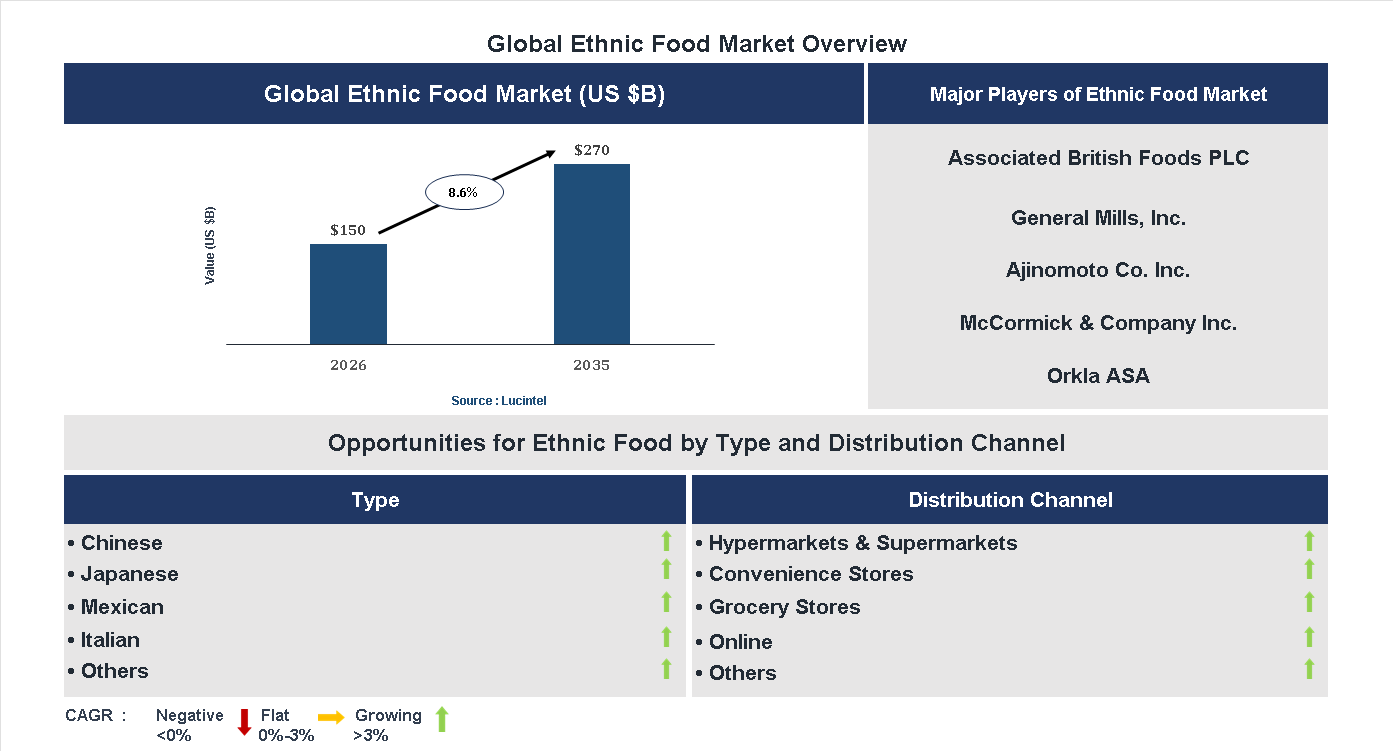
Ethnic Food Market Trends and Forecast

Emerging Trends in the Ethnic Food Market

The ethnic food market is experiencing rapid growth driven by increasing globalization, changing consumer preferences, and a rising interest in diverse culinary experiences. Consumers are seeking authentic flavors and unique food options, which are fueling innovation and expansion within this sector. Technological advancements, supply chain improvements, and a focus on health and sustainability are further shaping the landscape. As a result, the market is becoming more competitive and dynamic, with new players entering and existing brands expanding their offerings. These developments are not only transforming how ethnic foods are produced and marketed but also influencing consumer behavior and preferences worldwide.

• Growing Consumer Demand for Authenticity: Consumers are increasingly seeking genuine ethnic food experiences, prioritizing authenticity over convenience. This trend is driven by a desire for cultural exploration and healthier, natural ingredients. Brands that emphasize traditional recipes, sourcing practices, and cultural storytelling are gaining popularity. Authenticity enhances consumer trust and loyalty, encouraging companies to invest in authentic product development and marketing strategies. This shift is also prompting suppliers to focus on sourcing ingredients directly from native regions, ensuring genuine flavors and quality.
• Expansion of Plant-Based and Health-Conscious Options: The rise of plant-based diets and health awareness is significantly impacting ethnic food offerings. Consumers are demanding healthier, sustainable options that align with their dietary preferences. Ethnic cuisines are adapting by incorporating plant-based proteins, reducing sodium, and avoiding artificial additives. This trend broadens the market appeal to vegetarians, vegans, and health-conscious consumers. Food manufacturers are innovating with new recipes and ingredients to meet these needs, which enhances market diversity and encourages the development of functional foods with added health benefits.
• Technological Innovations and E-Commerce Growth: Technology is revolutionizing how ethnic foods are produced, marketed, and sold. E-commerce platforms enable brands to reach a global audience, offering convenience and access to authentic products. Digital marketing, social media, and online reviews influence consumer choices and brand visibility. Additionally, innovations like AI-driven supply chain management and food traceability improve efficiency and transparency. These technological advancements facilitate product customization, quick distribution, and consumer engagement, making ethnic foods more accessible and appealing to a broader demographic.
• Increased Focus on Sustainability and Ethical Sourcing: Sustainability concerns are shaping the ethnic food market, with consumers demanding ethically sourced ingredients and environmentally friendly packaging. Brands are adopting sustainable practices such as fair trade sourcing, reducing carbon footprints, and using biodegradable packaging. This trend enhances brand reputation and appeals to eco-conscious consumers. Ethical sourcing also supports local communities and preserves traditional farming practices. As sustainability becomes a key purchasing criterion, companies investing in eco-friendly initiatives are gaining a competitive advantage and fostering long-term customer loyalty.
• Market Diversification and New Product Development: The ethnic food market is witnessing diversification through the introduction of innovative products and fusion cuisines. Companies are blending traditional flavors with modern culinary trends to create unique offerings. This approach attracts a broader consumer base, including those unfamiliar with specific ethnic cuisines. Additionally, product diversification includes ready-to-eat meals, snacks, and beverages tailored to various dietary needs. This trend encourages experimentation and creativity within the industry, leading to increased market penetration and consumer engagement. It also helps brands differentiate themselves in a competitive landscape.

These trends are fundamentally reshaping the ethnic food market by emphasizing authenticity, health, technology, sustainability, and innovation. They are expanding consumer choices, improving supply chain efficiencies, and fostering a more inclusive and sustainable industry. As these developments continue, the market is poised for sustained growth, diversification, and global influence.
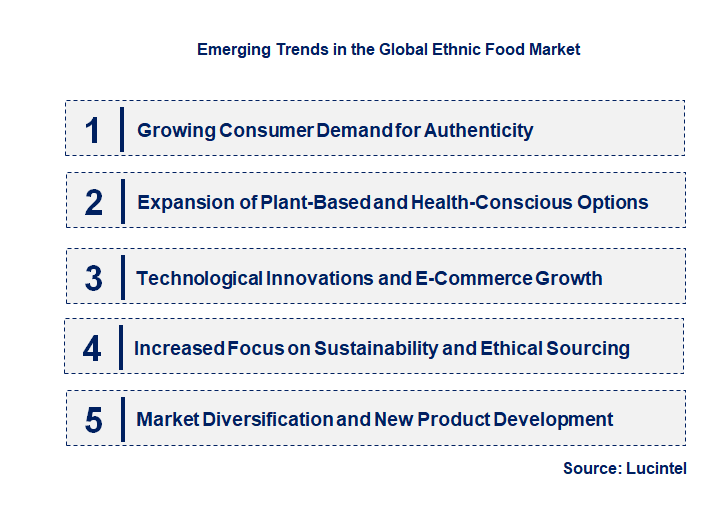
Emerging Trends in the Ethnic Food Market

Recent Development in the Ethnic Food Market

The ethnic food market has experienced significant growth driven by increasing globalization, diverse consumer preferences, and rising interest in authentic culinary experiences. Consumers are seeking new flavors and cultural foods, prompting businesses to innovate and expand their offerings. Technological advancements and e-commerce platforms have further facilitated access to ethnic cuisines worldwide. This dynamic environment presents numerous opportunities for market expansion, product diversification, and strategic partnerships, shaping the future landscape of ethnic foods globally.

• Growing Consumer Demand for Authentic Flavors: Increasing globalization and cultural curiosity have led consumers to seek authentic ethnic cuisines, boosting demand for traditional ingredients and dishes. This trend encourages restaurants and food producers to innovate with genuine recipes, expanding product lines to meet diverse tastes. As consumers prioritize unique culinary experiences, the market benefits from increased sales, brand loyalty, and the development of niche segments focused on authenticity and cultural heritage.
• Expansion of E-Commerce and Online Food Delivery: The rise of e-commerce platforms and online food delivery services has revolutionized access to ethnic foods, making them more accessible to a broader audience. Consumers can now easily purchase specialty ingredients and ready-to-eat ethnic meals from home, increasing market reach. This digital shift enables small and large players to tap into new customer bases, enhance convenience, and boost sales, ultimately accelerating market growth and diversification.
• Innovation in Product Offerings and Packaging: Companies are investing in innovative product development and packaging solutions to attract consumers and extend shelf life. This includes ready-to-cook kits, frozen ethnic meals, and eco-friendly packaging, catering to convenience and sustainability trends. Such innovations improve consumer experience, increase product appeal, and open new distribution channels, thereby strengthening market competitiveness and encouraging brand differentiation in the ethnic food sector.
• Rising Investment in Market Expansion and Strategic Partnerships: Businesses are increasingly investing in expanding their geographic presence and forming strategic alliances with local distributors and retailers. These collaborations facilitate market penetration, enhance supply chain efficiency, and enable localization of products to suit regional tastes. Such investments foster growth opportunities, increase brand visibility, and accelerate market development, positioning companies to capitalize on rising consumer interest in ethnic cuisines globally.
• Adoption of Sustainable and Ethical Sourcing Practices: The market is witnessing a shift towards sustainable sourcing of ingredients and ethical production methods. Consumers are more conscious of environmental and social impacts, prompting companies to adopt eco-friendly practices and transparent supply chains. This focus enhances brand reputation, meets regulatory standards, and appeals to ethically-minded consumers, ultimately driving market growth through increased trust and loyalty in ethnic food products.

The overall impact of these developments is a rapidly expanding, more diverse, and accessible ethnic food market. Innovation, digitalization, and sustainability are key drivers shaping future growth, creating opportunities for new entrants and established players alike. These trends are fostering a more competitive, consumer-centric landscape that is poised for sustained global expansion.

Strategic Growth Opportunities in the Ethnic Food Market

The ethnic food market is experiencing rapid expansion driven by increasing globalization, diverse consumer preferences, and rising interest in authentic culinary experiences. Consumers are seeking unique flavors and cultural dishes, prompting food producers and retailers to innovate and diversify their offerings. Technological advancements and strategic partnerships are further facilitating market growth. This dynamic environment presents numerous opportunities for brands to capture new customer segments, expand geographically, and enhance product development, ultimately shaping the future landscape of ethnic cuisine consumption worldwide.

• Expanding Ethnic Food Offerings in Supermarkets and Retail Chains: Retailers are increasingly incorporating authentic ethnic products to meet rising consumer demand for diverse flavors. By expanding their product range, supermarkets can attract a broader customer base, improve sales, and strengthen brand loyalty. This includes sourcing traditional ingredients, ready-to-eat meals, and snack options from various regions, making ethnic foods more accessible and convenient for everyday consumption.
• Leveraging Digital Platforms for Market Penetration and Consumer Engagement: E-commerce and social media are vital tools for ethnic food brands to reach global audiences. Online platforms enable direct sales, targeted marketing, and storytelling around cultural heritage, increasing brand visibility. Digital engagement also facilitates consumer feedback, fostering product innovation and loyalty. As internet penetration grows, especially in emerging markets, digital channels will become essential for expanding ethnic food markets beyond traditional retail outlets.
• Developing Innovative Fusion and Modernized Ethnic Food Products: Combining traditional ethnic flavors with contemporary culinary trends creates appealing fusion products. This approach attracts younger consumers and those seeking novel experiences, broadening market appeal. Innovation in packaging, health-conscious formulations, and convenient formats further enhances product attractiveness. Such developments help ethnic food brands differentiate themselves and adapt to evolving consumer preferences, driving growth in both established and emerging markets.
• Forming Strategic Partnerships with Local Distributors and Chefs: Collaborations with local distributors, restaurants, and celebrity chefs can boost brand credibility and market reach. These partnerships facilitate authentic product positioning and cultural storytelling, resonating with consumers seeking genuine experiences. Additionally, co-creating signature dishes or limited-edition products can generate buzz and increase sales. Strategic alliances also enable brands to navigate regional regulations and distribution channels more effectively, accelerating market penetration.
• Investing in Sustainable and Ethical Sourcing Practices: Consumers are increasingly conscious of sustainability and ethical considerations in their purchasing decisions. Ethnic food companies adopting responsible sourcing, fair trade practices, and environmentally friendly packaging can enhance brand reputation and appeal to socially conscious buyers. These initiatives also ensure long-term supply chain stability and compliance with regulations. Emphasizing sustainability can differentiate brands in a competitive market, fostering customer loyalty and supporting market growth.

The overall landscape of the ethnic food market is poised for significant expansion as these opportunities are harnessed. Innovation, digital engagement, strategic collaborations, and sustainability initiatives will shape the future, enabling brands to meet diverse consumer demands and explore new geographic and demographic segments. This dynamic growth will continue to redefine the global culinary scene, offering exciting prospects for industry stakeholders.

Ethnic Food Market Driver and Challenges

The ethnic food market is influenced by a variety of technological, economic, and regulatory factors that shape its growth and development. Advances in food processing technology and digital marketing have expanded consumer access and awareness. Economic factors such as rising disposable incomes and globalization have increased demand for diverse culinary experiences. Regulatory frameworks concerning food safety and import-export policies impact market operations. Additionally, cultural trends and consumer preferences for authentic and healthy foods further drive market expansion. However, challenges such as supply chain complexities, regulatory hurdles, and changing consumer tastes also pose significant obstacles. Understanding these drivers and challenges is essential for stakeholders aiming to capitalize on market opportunities and navigate potential risks effectively.

The factors responsible for driving the ethnic food market include:
• Increasing Consumer Demand for Authentic and Diverse Foods: The growing desire among consumers for authentic ethnic cuisines is a major driver. As globalization progresses, consumers seek new culinary experiences, leading to higher demand for ethnic foods. This trend is supported by increased travel, cultural exchange, and social media influence showcasing diverse cuisines. The demand is also driven by the rising popularity of ethnic foods in mainstream markets, prompting restaurants and retailers to expand their offerings. This consumer preference for authenticity and novelty fuels market growth, encouraging producers to innovate and diversify their product lines to meet evolving tastes.
• Technological Advancements in Food Processing and Distribution: Innovations in food technology, such as improved preservation, packaging, and transportation methods, have significantly expanded the reach of ethnic foods. These advancements enable longer shelf life, better quality, and safer products, facilitating international trade. E-commerce platforms and digital marketing tools also allow ethnic food brands to reach a broader audience directly. Additionally, the development of ready-to-eat and convenience ethnic food options caters to busy consumers seeking quick, authentic meals. These technological improvements reduce costs and barriers, making ethnic foods more accessible and appealing to a global customer base.
• Growing Influence of Social Media and Digital Marketing: Social media platforms and online marketing have revolutionized how ethnic foods are promoted and discovered. Food bloggers, influencers, and user-generated content showcase authentic dishes, creating viral trends and increasing consumer curiosity. Digital marketing enables ethnic food brands to target specific demographics and expand their reach efficiently. Online reviews and ratings influence purchasing decisions, while virtual cooking classes and recipe sharing foster engagement. This digital ecosystem accelerates market penetration, enhances brand visibility, and educates consumers about diverse cuisines, thereby boosting demand and market growth.
• Rising Disposable Incomes and Changing Lifestyles: Economic growth in emerging markets and increased disposable incomes have led consumers to spend more on premium and diverse food options. As lifestyles become busier, there is a higher preference for convenient ethnic foods such as frozen, packaged, or ready-to-eat meals. The shift towards healthier and organic ethnic options also influences purchasing decisions. Consumers are willing to pay a premium for authentic, high-quality products, which encourages producers to innovate and expand their offerings. This economic empowerment and lifestyle change significantly contribute to the expansion of the ethnic food market globally.
• Expansion of International Trade and Food Retail Chains: The globalization of food supply chains and the proliferation of international retail chains have facilitated easier access to ethnic foods worldwide. Supermarkets and specialty stores now stock a wide range of ethnic products, making them readily available to consumers. Trade agreements and import-export policies further support the cross-border movement of ethnic food ingredients and finished products. Retail chains often promote ethnic foods through dedicated sections or branding campaigns, increasing consumer exposure. This expansion enhances market penetration, encourages product innovation, and supports the growth of ethnic food brands on a global scale.

The challenges facing the ethnic food market include:
• Supply Chain Complexities and Ingredient Sourcing: Ethnic foods often require specific ingredients that may be scarce or difficult to source reliably across regions. Supply chain disruptions, such as geopolitical issues, climate change, or transportation delays, can impact the availability and cost of authentic ingredients. Maintaining quality and authenticity while managing costs is a constant challenge for producers and retailers. Additionally, sourcing ingredients ethically and sustainably adds complexity, especially as consumer awareness about food origins increases. These supply chain issues can lead to product shortages, increased prices, and reduced consumer trust, hindering market growth.
• Regulatory and Food Safety Concerns: Different countries have varying regulations regarding food safety, labeling, and import-export standards, which can complicate market entry and expansion. Ethnic foods often involve unique ingredients and preparation methods that may not align with local regulations, leading to compliance challenges. Ensuring food safety and meeting regulatory standards requires significant investment in quality control and certification processes. Non-compliance can result in product recalls, legal penalties, and damage to brand reputation. Navigating these regulatory landscapes is crucial but often complex, especially for small and medium-sized enterprises.
• Changing Consumer Preferences and Cultural Sensitivities: While there is a growing interest in ethnic foods, consumer tastes can be highly variable and influenced by cultural perceptions. Some consumers may be hesitant to try unfamiliar dishes due to taste preferences, dietary restrictions, or misconceptions. Additionally, cultural sensitivities and stereotypes can impact product acceptance and marketing strategies. Evolving health trends, such as preferences for plant-based or low-sodium options, may also require product reformulation. Adapting to these dynamic preferences while maintaining authenticity presents a significant challenge for market players seeking sustained growth.

The ethnic food market is driven by increasing consumer demand for authentic cuisines, technological innovations, digital marketing, rising disposable incomes, and expanded international trade. However, it faces challenges related to supply chain complexities, regulatory hurdles, and shifting consumer preferences. These drivers and challenges collectively shape the market landscape, influencing growth trajectories and strategic decisions. While opportunities for expansion are substantial, stakeholders must navigate operational and regulatory hurdles carefully to sustain long-term success in this vibrant and evolving market.

List of Ethnic Food Companies

Companies in the market compete on the basis of product quality offered. Major players in this market focus on expanding their manufacturing facilities, R&D investments, infrastructural development, and leverage integration opportunities across the value chain. With these strategies ethnic food companies cater increasing demand, ensure competitive effectiveness, develop innovative products & technologies, reduce production costs, and expand their customer base. Some of the ethnic food companies profiled in this report include-
• Associated British Foods PLC
• General Mills, Inc.
• Ajinomoto Co. Inc.
• McCormick & Company Inc.
• Orkla ASA
• ARYZTA AG
• Paulig Group
• The Spice Tailor
• Asli Fine Foods
• TRS Group

Ethnic Food Market by Segment

The study includes a forecast for the global ethnic food market by type, distribution channel, and region.

Ethnic Food Market by Type [Value from 2019 to 2035]:


• Chinese
• Japanese
• Mexican
• Italian
• Others

Ethnic Food Market by Distribution Channel [Value from 2019 to 2035]:


• Hypermarkets & Supermarkets
• Convenience Stores
• Grocery Stores
• Online
• Others

Ethnic Food Market by Region [Value from 2019 to 2035]:


• North America
• Europe
• Asia Pacific
• The Rest of the World

Country Wise Outlook for the Ethnic Food Market

The ethnic food market has experienced significant growth globally, driven by increasing multiculturalism, changing consumer preferences, and the desire for diverse culinary experiences. In the United States, the market has expanded rapidly with a surge in demand for authentic Asian, Middle Eastern, and Latin American cuisines, supported by a rise in immigrant populations and food delivery services. China continues to see a booming ethnic food sector, especially with the popularity of Southeast Asian and Western cuisines, fueled by urbanization and tourism. Germanys market is evolving with a growing interest in Middle Eastern and Asian foods, driven by multicultural communities and food festivals. India is witnessing a rise in international food imports and fusion cuisines, reflecting its expanding global connections. Japans ethnic food market is growing through increased availability of international ingredients and the popularity of global cuisines among younger consumers.

• United States: The ethnic food market has seen rapid growth, driven by multicultural demographics, increased demand for authentic cuisines, and the expansion of food delivery platforms. Asian, Middle Eastern, and Latin American foods are particularly popular, with many restaurants and retail outlets offering diverse options. Consumer interest in health-conscious and organic ethnic foods is also rising, contributing to market expansion.
• China: The ethnic food sector is thriving, especially with the popularity of Southeast Asian and Western cuisines among urban populations. Tourism and international trade have boosted the availability of diverse ingredients, and food festivals promote cultural exchange. The market is also influenced by the younger generations adventurous eating habits and social media trends.
• Germany: The ethnic food market is experiencing steady growth, with increased demand for Middle Eastern, Asian, and African cuisines. Multicultural communities and international food festivals have contributed to this trend. Retailers are expanding their product ranges to include more authentic ingredients, and supermarkets are offering a broader selection of international foods.
• India: The market is expanding through increased imports of international ingredients and the emergence of fusion cuisines. International fast-food chains and gourmet restaurants are gaining popularity, reflecting Indias growing global connectivity. Consumers are increasingly interested in trying new flavors and authentic ethnic dishes, fueling market growth.
• Japan: The ethnic food market is growing with greater availability of international ingredients and the rising popularity of global cuisines among young consumers. Food festivals, international restaurants, and online platforms are promoting diverse culinary experiences. The market is also influenced by Japans increasing expatriate population and tourism.

Lucintel Analytics Dashboard

Features of the Global Ethnic Food Market

Market Size Estimates: Ethnic food market size estimation in terms of value ($B).
Trend and Forecast Analysis: Market trends (2019 to 2025) and forecast (2026 to 2035) by various segments and regions.
Segmentation Analysis: Ethnic food market size by type, distribution channel, and region in terms of value ($B).
Regional Analysis: Ethnic food market breakdown by North America, Europe, Asia Pacific, and Rest of the World.
Growth Opportunities: Analysis of growth opportunities in different types, distribution channels, and regions for the ethnic food market.
Strategic Analysis: This includes M&A, new product development, and competitive landscape of the ethnic food market.
Analysis of competitive intensity of the industry based on Porter’s Five Forces model.

Lucintel Consulting Services

FAQ

Q1. What is the ethnic food market size?
Answer: The global ethnic food market is expected to reach an estimated $270 billion by 2035.
Q2. What is the growth forecast for ethnic food market?
Answer: The global ethnic food market is expected to grow with a CAGR of 8.6% from 2026 to 2035.
Q3. What are the major drivers influencing the growth of the ethnic food market?
Answer: The major drivers for this market are the increasing demand for bioethanol production, the rising use in animal feed, and the growing application in food processing.
Q4. What are the major segments for ethnic food market?
Answer: The future of the ethnic food market looks promising with opportunities in the hypermarket & supermarket, convenience store, grocery store, and online markets.
Q5. Who are the key ethnic food market companies?
Answer: Some of the key ethnic food companies are as follows:
• Associated British Foods PLC
• General Mills, Inc.
• Ajinomoto Co. Inc.
• McCormick & Company Inc.
• Orkla ASA
• ARYZTA AG
• Paulig Group
• The Spice Tailor
• Asli Fine Foods
• TRS Group
Q6. Which ethnic food market segment will be the largest in future?
Answer: Lucintel forecasts that, within the type category, Chinese is expected to witness the highest growth over the forecast period.
Q7. In ethnic food market, which region is expected to be the largest in next 5 years?
Answer: In terms of region, North America is expected to witness the highest growth over the forecast period.
Q8. Do we receive customization in this report?
Answer: Yes, Lucintel provides 10% customization without any additional cost.

This report answers following 11 key questions:

Q.1. What are some of the most promising, high-growth opportunities for the ethnic food market by type (Chinese, Japanese, Mexican, Italian, and others), distribution channel (hypermarkets & supermarkets, convenience stores, grocery stores, online, and others), and region (North America, Europe, Asia Pacific, and the Rest of the World)?
Q.2. Which segments will grow at a faster pace and why?
Q.3. Which region will grow at a faster pace and why?
Q.4. What are the key factors affecting market dynamics? What are the key challenges and business risks in this market?
Q.5. What are the business risks and competitive threats in this market?
Q.6. What are the emerging trends in this market and the reasons behind them?
Q.7. What are some of the changing demands of customers in the market?
Q.8. What are the new developments in the market? Which companies are leading these developments?
Q.9. Who are the major players in this market? What strategic initiatives are key players pursuing for business growth?
Q.10. What are some of the competing products in this market and how big of a threat do they pose for loss of market share by material or product substitution?
Q.11. What M&A activity has occurred in the last 7 years and what has its impact been on the industry?

For any questions related to Ethnic Food Market, Ethnic Food Market Size, Ethnic Food Market Growth, Ethnic Food Market Analysis, Ethnic Food Market Report, Ethnic Food Market Share, Ethnic Food Market Trends, Ethnic Food Market Forecast, Ethnic Food Companies, write Lucintel analyst at email: helpdesk@lucintel.com. We will be glad to get back to you soon.
                                           Table of Contents

            1. Executive Summary

            2. Market Overview

                        2.1 Background and Classifications
                        2.2 Supply Chain

            3. Market Trends & Forecast Analysis

                        3.1 Macroeconomic Trends and Forecasts
                        3.2 Industry Drivers and Challenges
                        3.3 PESTLE Analysis
                        3.4 Patent Analysis
                        3.5 Regulatory Environment
                        3.6 Global Ethnic Food Market Trends and Forecast

            4. Global Ethnic Food Market by Type

                        4.1 Overview
                        4.2 Attractiveness Analysis by Type
                        4.3 Chinese : Trends and Forecast 2019 to 2035
                        4.4 Japanese : Trends and Forecast 2019 to 2035
                        4.5 Mexican : Trends and Forecast 2019 to 2035
                        4.6 Italian : Trends and Forecast 2019 to 2035
                        4.7 Others : Trends and Forecast 2019 to 2035

            5. Global Ethnic Food Market by Distribution Channel

                        5.1 Overview
                        5.2 Attractiveness Analysis by Distribution Channel
                        5.3 Hypermarkets & Supermarkets : Trends and Forecast 2019 to 2035
                        5.4 Convenience Stores : Trends and Forecast 2019 to 2035
                        5.5 Grocery Stores : Trends and Forecast 2019 to 2035
                        5.6 Online : Trends and Forecast 2019 to 2035
                        5.7 Others : Trends and Forecast 2019 to 2035

            6. Regional Analysis

                        6.1 Overview
                        6.2 Global Ethnic Food Market by Region

            7. North American Ethnic Food Market

                        7.1 Overview
                        7.2 North American Ethnic Food Market by Type
                        7.3 North American Ethnic Food Market by Distribution Channel
                        7.4 The United States Ethnic Food Market
                        7.5 Canadian Ethnic Food Market
                        7.6 Mexican Ethnic Food Market

            8. European Ethnic Food Market

                        8.1 Overview
                        8.2 European Ethnic Food Market by Type
                        8.3 European Ethnic Food Market by Distribution Channel
                        8.4 German Ethnic Food Market
                        8.5 French Ethnic Food Market
                        8.6 Italian Ethnic Food Market
                        8.7 Spanish Ethnic Food Market
                        8.8 The United Kingdom Ethnic Food Market

            9. APAC Ethnic Food Market

                        9.1 Overview
                        9.2 APAC Ethnic Food Market by Type
                        9.3 APAC Ethnic Food Market by Distribution Channel
                        9.4 Chinese Ethnic Food Market
                        9.5 Indian Ethnic Food Market
                        9.6 Japanese Ethnic Food Market
                        9.7 South Korean Ethnic Food Market
                        9.8 Indonesian Ethnic Food Market

            10. ROW Ethnic Food Market

                        10.1 Overview
                        10.2 ROW Ethnic Food Market by Type
                        10.3 ROW Ethnic Food Market by Distribution Channel
                        10.4 Middle Eastern Ethnic Food Market
                        10.5 South American Ethnic Food Market
                        10.6 African Ethnic Food Market

            11. Competitor Analysis

                        11.1 Product Portfolio Analysis
                        11.2 Operational Integration
                        11.3 Porter’s Five Forces Analysis
                                    • Competitive Rivalry
                                    • Bargaining Power of Buyers
                                    • Bargaining Power of Suppliers
                                    • Threat of Substitutes
                                    • Threat of New Entrants
                        11.4 Market Share Analysis

            12. Opportunities & Strategic Analysis

                        12.1 Value Chain Analysis
                        12.2 Growth Opportunity Analysis
                                    12.2.1 Growth Opportunity by Type
                                    12.2.2 Growth Opportunity by Distribution Channel
                                    12.2.3 Growth Opportunity by Region
                        12.3 Emerging Trends in the Global Ethnic Food Market
                        12.4 Strategic Analysis
                                    12.4.1 New Product Development
                                    12.4.2 Certification and Licensing
                                    12.4.3 Mergers, Acquisitions, Agreements, Collaborations, and Joint Ventures

            13. Company Profiles of the Leading Players Across the Value Chain

                        13.1 Competitive Analysis Overview
                        13.2 Associated British Foods PLC
                                    • Company Overview
                                    • Ethnic Food Market Business Overview
                                    • New Product Development
                                    • Merger, Acquisition, and Collaboration
                                    • Certification and Licensing
                        13.3 General Mills, Inc.
                                    • Company Overview
                                    • Ethnic Food Market Business Overview
                                    • New Product Development
                                    • Merger, Acquisition, and Collaboration
                                    • Certification and Licensing
                        13.4 Ajinomoto Co. Inc.
                                    • Company Overview
                                    • Ethnic Food Market Business Overview
                                    • New Product Development
                                    • Merger, Acquisition, and Collaboration
                                    • Certification and Licensing
                        13.5 McCormick & Company Inc.
                                    • Company Overview
                                    • Ethnic Food Market Business Overview
                                    • New Product Development
                                    • Merger, Acquisition, and Collaboration
                                    • Certification and Licensing
                        13.6 Orkla ASA
                                    • Company Overview
                                    • Ethnic Food Market Business Overview
                                    • New Product Development
                                    • Merger, Acquisition, and Collaboration
                                    • Certification and Licensing
                        13.7 ARYZTA AG
                                    • Company Overview
                                    • Ethnic Food Market Business Overview
                                    • New Product Development
                                    • Merger, Acquisition, and Collaboration
                                    • Certification and Licensing
                        13.8 Paulig Group
                                    • Company Overview
                                    • Ethnic Food Market Business Overview
                                    • New Product Development
                                    • Merger, Acquisition, and Collaboration
                                    • Certification and Licensing
                        13.9 The Spice Tailor
                                    • Company Overview
                                    • Ethnic Food Market Business Overview
                                    • New Product Development
                                    • Merger, Acquisition, and Collaboration
                                    • Certification and Licensing
                        13.10 Asli Fine Foods
                                    • Company Overview
                                    • Ethnic Food Market Business Overview
                                    • New Product Development
                                    • Merger, Acquisition, and Collaboration
                                    • Certification and Licensing
                        13.11 TRS Group
                                    • Company Overview
                                    • Ethnic Food Market Business Overview
                                    • New Product Development
                                    • Merger, Acquisition, and Collaboration
                                    • Certification and Licensing

            14. Appendix

                        14.1 List of Figures
                        14.2 List of Tables
                        14.3 Research Methodology
                        14.4 Disclaimer
                        14.5 Copyright
                        14.6 Abbreviations and Technical Units
                        14.7 About Us
                        14.8 Contact Us

                                               List of Figures


            Chapter 1

                        Figure 1.1: Trends and Forecast for the Global Ethnic Food Market

            Chapter 2

                        Figure 2.1: Usage of Ethnic Food Market
                        Figure 2.2: Classification of the Global Ethnic Food Market
                        Figure 2.3: Supply Chain of the Global Ethnic Food Market

            Chapter 3

                        Figure 3.1: Trends of the Global GDP Growth Rate
                        Figure 3.2: Trends of the Global Population Growth Rate
                        Figure 3.3: Trends of the Global Inflation Rate
                        Figure 3.4: Trends of the Global Unemployment Rate
                        Figure 3.5: Trends of the Regional GDP Growth Rate
                        Figure 3.6: Trends of the Regional Population Growth Rate
                        Figure 3.7: Trends of the Regional Inflation Rate
                        Figure 3.8: Trends of the Regional Unemployment Rate
                        Figure 3.9: Trends of Regional Per Capita Income
                        Figure 3.10: Forecast for the Global GDP Growth Rate
                        Figure 3.11: Forecast for the Global Population Growth Rate
                        Figure 3.12: Forecast for the Global Inflation Rate
                        Figure 3.13: Forecast for the Global Unemployment Rate
                        Figure 3.14: Forecast for the Regional GDP Growth Rate
                        Figure 3.15: Forecast for the Regional Population Growth Rate
                        Figure 3.16: Forecast for the Regional Inflation Rate
                        Figure 3.17: Forecast for the Regional Unemployment Rate
                        Figure 3.18: Forecast for Regional Per Capita Income
                        Figure 3.19: Driver and Challenges of the Ethnic Food Market

            Chapter 4

                        Figure 4.1: Global Ethnic Food Market by Type in 2019, 2025, and 2035
                        Figure 4.2: Trends of the Global Ethnic Food Market ($B) by Type
                        Figure 4.3: Forecast for the Global Ethnic Food Market ($B) by Type
                        Figure 4.4: Trends and Forecast for Chinese in the Global Ethnic Food Market (2019-2035)
                        Figure 4.5: Trends and Forecast for Japanese in the Global Ethnic Food Market (2019-2035)
                        Figure 4.6: Trends and Forecast for Mexican in the Global Ethnic Food Market (2019-2035)
                        Figure 4.7: Trends and Forecast for Italian in the Global Ethnic Food Market (2019-2035)
                        Figure 4.8: Trends and Forecast for Others in the Global Ethnic Food Market (2019-2035)

            Chapter 5

                        Figure 5.1: Global Ethnic Food Market by Distribution Channel in 2019, 2025, and 2035
                        Figure 5.2: Trends of the Global Ethnic Food Market ($B) by Distribution Channel
                        Figure 5.3: Forecast for the Global Ethnic Food Market ($B) by Distribution Channel
                        Figure 5.4: Trends and Forecast for Hypermarkets & Supermarkets in the Global Ethnic Food Market (2019-2035)
                        Figure 5.5: Trends and Forecast for Convenience Stores in the Global Ethnic Food Market (2019-2035)
                        Figure 5.6: Trends and Forecast for Grocery Stores in the Global Ethnic Food Market (2019-2035)
                        Figure 5.7: Trends and Forecast for Online in the Global Ethnic Food Market (2019-2035)
                        Figure 5.8: Trends and Forecast for Others in the Global Ethnic Food Market (2019-2035)

            Chapter 6

                        Figure 6.1: Trends of the Global Ethnic Food Market ($B) by Region (2019-2025)
                        Figure 6.2: Forecast for the Global Ethnic Food Market ($B) by Region (2026-2035)

            Chapter 7

                        Figure 7.1: Trends and Forecast for the North American Ethnic Food Market (2019-2035)
                        Figure 7.2: North American Ethnic Food Market by Type in 2019, 2025, and 2035
                        Figure 7.3: Trends of the North American Ethnic Food Market ($B) by Type (2019-2025)
                        Figure 7.4: Forecast for the North American Ethnic Food Market ($B) by Type (2026-2035)
                        Figure 7.5: North American Ethnic Food Market by Distribution Channel in 2019, 2025, and 2035
                        Figure 7.6: Trends of the North American Ethnic Food Market ($B) by Distribution Channel (2019-2025)
                        Figure 7.7: Forecast for the North American Ethnic Food Market ($B) by Distribution Channel (2026-2035)
                        Figure 7.8: Trends and Forecast for the United States Ethnic Food Market ($B) (2019-2035)
                        Figure 7.9: Trends and Forecast for the Mexican Ethnic Food Market ($B) (2019-2035)
                        Figure 7.10: Trends and Forecast for the Canadian Ethnic Food Market ($B) (2019-2035)

            Chapter 8

                        Figure 8.1: Trends and Forecast for the European Ethnic Food Market (2019-2035)
                        Figure 8.2: European Ethnic Food Market by Type in 2019, 2025, and 2035
                        Figure 8.3: Trends of the European Ethnic Food Market ($B) by Type (2019-2025)
                        Figure 8.4: Forecast for the European Ethnic Food Market ($B) by Type (2026-2035)
                        Figure 8.5: European Ethnic Food Market by Distribution Channel in 2019, 2025, and 2035
                        Figure 8.6: Trends of the European Ethnic Food Market ($B) by Distribution Channel (2019-2025)
                        Figure 8.7: Forecast for the European Ethnic Food Market ($B) by Distribution Channel (2026-2035)
                        Figure 8.8: Trends and Forecast for the German Ethnic Food Market ($B) (2019-2035)
                        Figure 8.9: Trends and Forecast for the French Ethnic Food Market ($B) (2019-2035)
                        Figure 8.10: Trends and Forecast for the Spanish Ethnic Food Market ($B) (2019-2035)
                        Figure 8.11: Trends and Forecast for the Italian Ethnic Food Market ($B) (2019-2035)
                        Figure 8.12: Trends and Forecast for the United Kingdom Ethnic Food Market ($B) (2019-2035)

            Chapter 9

                        Figure 9.1: Trends and Forecast for the APAC Ethnic Food Market (2019-2035)
                        Figure 9.2: APAC Ethnic Food Market by Type in 2019, 2025, and 2035
                        Figure 9.3: Trends of the APAC Ethnic Food Market ($B) by Type (2019-2025)
                        Figure 9.4: Forecast for the APAC Ethnic Food Market ($B) by Type (2026-2035)
                        Figure 9.5: APAC Ethnic Food Market by Distribution Channel in 2019, 2025, and 2035
                        Figure 9.6: Trends of the APAC Ethnic Food Market ($B) by Distribution Channel (2019-2025)
                        Figure 9.7: Forecast for the APAC Ethnic Food Market ($B) by Distribution Channel (2026-2035)
                        Figure 9.8: Trends and Forecast for the Japanese Ethnic Food Market ($B) (2019-2035)
                        Figure 9.9: Trends and Forecast for the Indian Ethnic Food Market ($B) (2019-2035)
                        Figure 9.10: Trends and Forecast for the Chinese Ethnic Food Market ($B) (2019-2035)
                        Figure 9.11: Trends and Forecast for the South Korean Ethnic Food Market ($B) (2019-2035)
                        Figure 9.12: Trends and Forecast for the Indonesian Ethnic Food Market ($B) (2019-2035)

            Chapter 10

                        Figure 10.1: Trends and Forecast for the ROW Ethnic Food Market (2019-2035)
                        Figure 10.2: ROW Ethnic Food Market by Type in 2019, 2025, and 2035
                        Figure 10.3: Trends of the ROW Ethnic Food Market ($B) by Type (2019-2025)
                        Figure 10.4: Forecast for the ROW Ethnic Food Market ($B) by Type (2026-2035)
                        Figure 10.5: ROW Ethnic Food Market by Distribution Channel in 2019, 2025, and 2035
                        Figure 10.6: Trends of the ROW Ethnic Food Market ($B) by Distribution Channel (2019-2025)
                        Figure 10.7: Forecast for the ROW Ethnic Food Market ($B) by Distribution Channel (2026-2035)
                        Figure 10.8: Trends and Forecast for the Middle Eastern Ethnic Food Market ($B) (2019-2035)
                        Figure 10.9: Trends and Forecast for the South American Ethnic Food Market ($B) (2019-2035)
                        Figure 10.10: Trends and Forecast for the African Ethnic Food Market ($B) (2019-2035)

            Chapter 11

                        Figure 11.1: Porter’s Five Forces Analysis of the Global Ethnic Food Market
                        Figure 11.2: Market Share (%) of Top Players in the Global Ethnic Food Market (2025)

            Chapter 12

                        Figure 12.1: Growth Opportunities for the Global Ethnic Food Market by Type
                        Figure 12.2: Growth Opportunities for the Global Ethnic Food Market by Distribution Channel
                        Figure 12.3: Growth Opportunities for the Global Ethnic Food Market by Region
                        Figure 12.4: Emerging Trends in the Global Ethnic Food Market

                                               List of Tables


            Chapter 1

                        Table 1.1: Growth Rate (%, 2024-2025) and CAGR (%, 2026-2035) of the Ethnic Food Market by Type and Distribution Channel
                        Table 1.2: Attractiveness Analysis for the Ethnic Food Market by Region
                        Table 1.3: Global Ethnic Food Market Parameters and Attributes

            Chapter 3

                        Table 3.1: Trends of the Global Ethnic Food Market (2019-2025)
                        Table 3.2: Forecast for the Global Ethnic Food Market (2026-2035)

            Chapter 4

                        Table 4.1: Attractiveness Analysis for the Global Ethnic Food Market by Type
                        Table 4.2: Market Size and CAGR of Various Type in the Global Ethnic Food Market (2019-2025)
                        Table 4.3: Market Size and CAGR of Various Type in the Global Ethnic Food Market (2026-2035)
                        Table 4.4: Trends of Chinese in the Global Ethnic Food Market (2019-2025)
                        Table 4.5: Forecast for Chinese in the Global Ethnic Food Market (2026-2035)
                        Table 4.6: Trends of Japanese in the Global Ethnic Food Market (2019-2025)
                        Table 4.7: Forecast for Japanese in the Global Ethnic Food Market (2026-2035)
                        Table 4.8: Trends of Mexican in the Global Ethnic Food Market (2019-2025)
                        Table 4.9: Forecast for Mexican in the Global Ethnic Food Market (2026-2035)
                        Table 4.10: Trends of Italian in the Global Ethnic Food Market (2019-2025)
                        Table 4.11: Forecast for Italian in the Global Ethnic Food Market (2026-2035)
                        Table 4.12: Trends of Others in the Global Ethnic Food Market (2019-2025)
                        Table 4.13: Forecast for Others in the Global Ethnic Food Market (2026-2035)

            Chapter 5

                        Table 5.1: Attractiveness Analysis for the Global Ethnic Food Market by Distribution Channel
                        Table 5.2: Market Size and CAGR of Various Distribution Channel in the Global Ethnic Food Market (2019-2025)
                        Table 5.3: Market Size and CAGR of Various Distribution Channel in the Global Ethnic Food Market (2026-2035)
                        Table 5.4: Trends of Hypermarkets & Supermarkets in the Global Ethnic Food Market (2019-2025)
                        Table 5.5: Forecast for Hypermarkets & Supermarkets in the Global Ethnic Food Market (2026-2035)
                        Table 5.6: Trends of Convenience Stores in the Global Ethnic Food Market (2019-2025)
                        Table 5.7: Forecast for Convenience Stores in the Global Ethnic Food Market (2026-2035)
                        Table 5.8: Trends of Grocery Stores in the Global Ethnic Food Market (2019-2025)
                        Table 5.9: Forecast for Grocery Stores in the Global Ethnic Food Market (2026-2035)
                        Table 5.10: Trends of Online in the Global Ethnic Food Market (2019-2025)
                        Table 5.11: Forecast for Online in the Global Ethnic Food Market (2026-2035)
                        Table 5.12: Trends of Others in the Global Ethnic Food Market (2019-2025)
                        Table 5.13: Forecast for Others in the Global Ethnic Food Market (2026-2035)

            Chapter 6

                        Table 6.1: Market Size and CAGR of Various Regions in the Global Ethnic Food Market (2019-2025)
                        Table 6.2: Market Size and CAGR of Various Regions in the Global Ethnic Food Market (2026-2035)

            Chapter 7

                        Table 7.1: Trends of the North American Ethnic Food Market (2019-2025)
                        Table 7.2: Forecast for the North American Ethnic Food Market (2026-2035)
                        Table 7.3: Market Size and CAGR of Various Type in the North American Ethnic Food Market (2019-2025)
                        Table 7.4: Market Size and CAGR of Various Type in the North American Ethnic Food Market (2026-2035)
                        Table 7.5: Market Size and CAGR of Various Distribution Channel in the North American Ethnic Food Market (2019-2025)
                        Table 7.6: Market Size and CAGR of Various Distribution Channel in the North American Ethnic Food Market (2026-2035)
                        Table 7.7: Trends and Forecast for the United States Ethnic Food Market (2019-2035)
                        Table 7.8: Trends and Forecast for the Mexican Ethnic Food Market (2019-2035)
                        Table 7.9: Trends and Forecast for the Canadian Ethnic Food Market (2019-2035)

            Chapter 8

                        Table 8.1: Trends of the European Ethnic Food Market (2019-2025)
                        Table 8.2: Forecast for the European Ethnic Food Market (2026-2035)
                        Table 8.3: Market Size and CAGR of Various Type in the European Ethnic Food Market (2019-2025)
                        Table 8.4: Market Size and CAGR of Various Type in the European Ethnic Food Market (2026-2035)
                        Table 8.5: Market Size and CAGR of Various Distribution Channel in the European Ethnic Food Market (2019-2025)
                        Table 8.6: Market Size and CAGR of Various Distribution Channel in the European Ethnic Food Market (2026-2035)
                        Table 8.7: Trends and Forecast for the German Ethnic Food Market (2019-2035)
                        Table 8.8: Trends and Forecast for the French Ethnic Food Market (2019-2035)
                        Table 8.9: Trends and Forecast for the Spanish Ethnic Food Market (2019-2035)
                        Table 8.10: Trends and Forecast for the Italian Ethnic Food Market (2019-2035)
                        Table 8.11: Trends and Forecast for the United Kingdom Ethnic Food Market (2019-2035)

            Chapter 9

                        Table 9.1: Trends of the APAC Ethnic Food Market (2019-2025)
                        Table 9.2: Forecast for the APAC Ethnic Food Market (2026-2035)
                        Table 9.3: Market Size and CAGR of Various Type in the APAC Ethnic Food Market (2019-2025)
                        Table 9.4: Market Size and CAGR of Various Type in the APAC Ethnic Food Market (2026-2035)
                        Table 9.5: Market Size and CAGR of Various Distribution Channel in the APAC Ethnic Food Market (2019-2025)
                        Table 9.6: Market Size and CAGR of Various Distribution Channel in the APAC Ethnic Food Market (2026-2035)
                        Table 9.7: Trends and Forecast for the Japanese Ethnic Food Market (2019-2035)
                        Table 9.8: Trends and Forecast for the Indian Ethnic Food Market (2019-2035)
                        Table 9.9: Trends and Forecast for the Chinese Ethnic Food Market (2019-2035)
                        Table 9.10: Trends and Forecast for the South Korean Ethnic Food Market (2019-2035)
                        Table 9.11: Trends and Forecast for the Indonesian Ethnic Food Market (2019-2035)

            Chapter 10

                        Table 10.1: Trends of the ROW Ethnic Food Market (2019-2025)
                        Table 10.2: Forecast for the ROW Ethnic Food Market (2026-2035)
                        Table 10.3: Market Size and CAGR of Various Type in the ROW Ethnic Food Market (2019-2025)
                        Table 10.4: Market Size and CAGR of Various Type in the ROW Ethnic Food Market (2026-2035)
                        Table 10.5: Market Size and CAGR of Various Distribution Channel in the ROW Ethnic Food Market (2019-2025)
                        Table 10.6: Market Size and CAGR of Various Distribution Channel in the ROW Ethnic Food Market (2026-2035)
                        Table 10.7: Trends and Forecast for the Middle Eastern Ethnic Food Market (2019-2035)
                        Table 10.8: Trends and Forecast for the South American Ethnic Food Market (2019-2035)
                        Table 10.9: Trends and Forecast for the African Ethnic Food Market (2019-2035)

            Chapter 11

                        Table 11.1: Product Mapping of Ethnic Food Suppliers Based on Segments
                        Table 11.2: Operational Integration of Ethnic Food Manufacturers
                        Table 11.3: Rankings of Suppliers Based on Ethnic Food Revenue

            Chapter 12

                        Table 12.1: New Product Launches by Major Ethnic Food Producers (2019-2025)
                        Table 12.2: Certification Acquired by Major Competitor in the Global Ethnic Food Market

.

Buy full report or by chapter as follows

Price by License Type:
[-] Hide Chapter Details
[Chapter Number] [Chapter Name] [Chapter Number Of Pages] [Chapter Price]
Title/Chapter Name Pages Price
Full Report: Ethnic Food Market Report: Trends, Forecast and Competitive Analysis to 2035 Full Report $ 4,850
A 150 Page Report
Lucintel has been in the business of market research and management consulting since 2000 and has published over 1000 market intelligence reports in various markets / applications and served over 1,000 clients worldwide. This study is a culmination of four months of full-time effort performed by Lucintel's analyst team. The analysts used the following sources for the creation and completion of this valuable report:
  • In-depth interviews of the major players in this market
  • Detailed secondary research from competitors’ financial statements and published data 
  • Extensive searches of published works, market, and database information pertaining to industry news, company press releases, and customer intentions
  • A compilation of the experiences, judgments, and insights of Lucintel’s professionals, who have analyzed and tracked this market over the years.
Extensive research and interviews are conducted across the supply chain of this market to estimate market share, market size, trends, drivers, challenges, and forecasts. Below is a brief summary of the primary interviews that were conducted by job function for this report.
 
Thus, Lucintel compiles vast amounts of data from numerous sources, validates the integrity of that data, and performs a comprehensive analysis. Lucintel then organizes the data, its findings, and insights into a concise report designed to support the strategic decision-making process. The figure below is a graphical representation of Lucintel’s research process. 
 

Please sign in below to get report brochure - Ethnic Food Market Report.

At Lucintel, we respect your privacy and maintain the confidentiality of information / data provided by you
(Please enter your corporate email. * These fields are mandatory )

Follow us on

