
Report Feature
Tokenization Platform Market Trends and Forecast
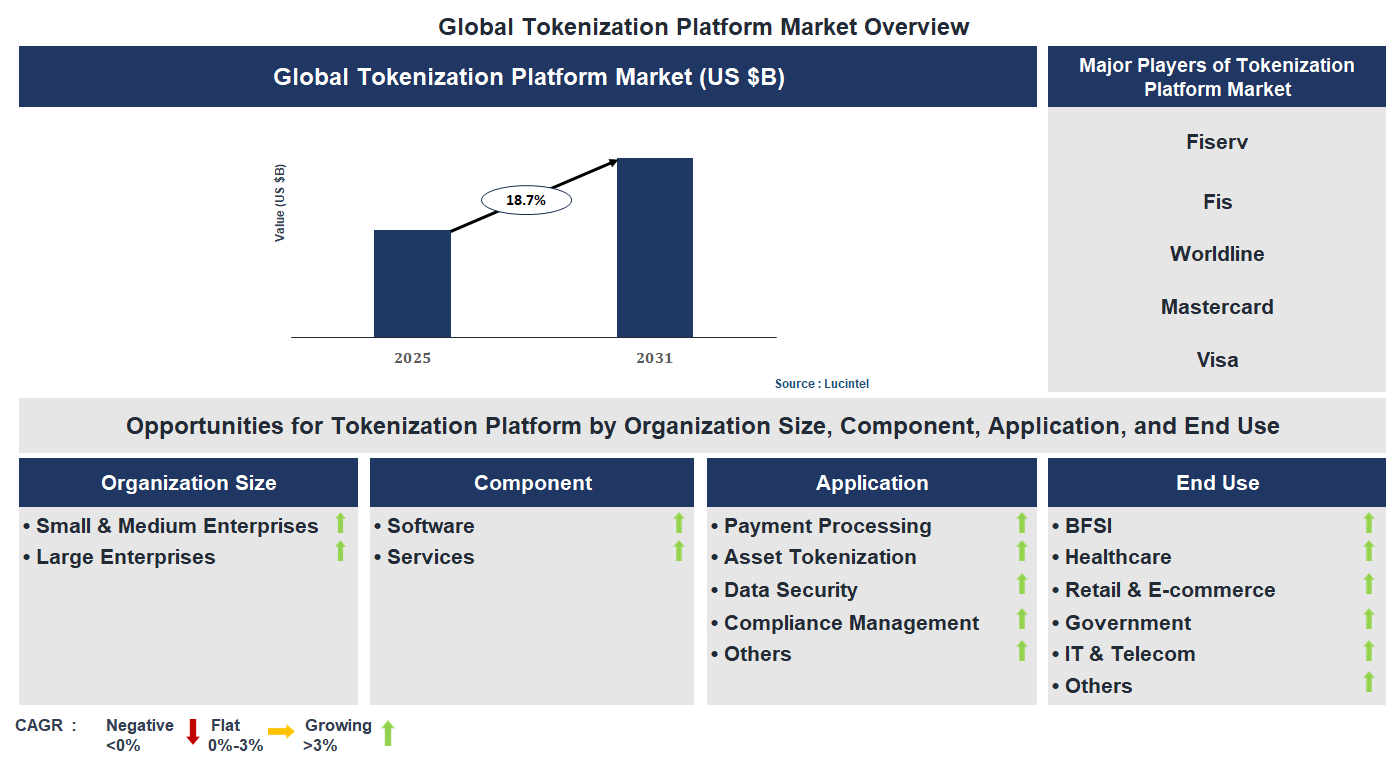
The future of the global tokenization platform market looks promising with opportunities in the payment processing, asset tokenization, data security, and compliance management markets. The global tokenization platform market is expected to grow with a CAGR of 18.7% from 2025 to 2031. The major drivers for this market are the increasing demand for asset digitalization, the rising adoption of blockchain tokenization, and the growing need for secure transactions.• Lucintel forecasts that, within the organization size category, large enterprise is expected to witness higher growth over the forecast period.
• Within the application category, payment processing is expected to witness the highest growth.
• In terms of region, North America is expected to witness the highest growth over the forecast period. Gain valuable insights for your business decisions with our comprehensive 150+ page report. Sample figures with some insights are shown below.
Emerging Trends in the Tokenization Platform Market
The tokenization platform market is experiencing rapid growth driven by technological advancements, increasing demand for digital assets, and evolving regulatory landscapes. As businesses and investors seek more secure, efficient, and flexible ways to manage assets, tokenization has emerged as a transformative solution. This market is characterized by innovation in blockchain technology, expanding use cases across industries, and a focus on compliance and security. The following key trends highlight the major developments shaping this dynamic market, reflecting its trajectory toward broader adoption and integration into mainstream financial and digital ecosystems.• Increased Adoption of Blockchain Technology: The foundation of tokenization relies on blockchain, which offers transparency, security, and decentralization. As blockchain technology matures, more platforms are integrating it to facilitate seamless token creation and management. This trend enhances trust and reduces fraud, making tokenized assets more attractive to investors and institutions. The growing ecosystem of blockchain solutions is also driving interoperability, enabling different platforms to work together efficiently. Consequently, this trend accelerates the overall growth of the tokenization market by providing robust, scalable infrastructure for digital assets.
• Expansion into New Asset Classes: Initially focused on securities and real estate, tokenization is now expanding into diverse asset classes such as art, commodities, and intellectual property. This diversification allows for fractional ownership, increased liquidity, and broader access to investment opportunities. For example, tokenized art enables investors worldwide to buy shares in high-value pieces, democratizing access to previously illiquid markets. This trend broadens the market scope, attracts new participants, and fosters innovation in asset management, ultimately transforming traditional investment paradigms.
• Regulatory Developments and Compliance Focus: As tokenization gains momentum, regulatory frameworks are evolving to address legal and security concerns. Governments and regulatory bodies are establishing guidelines to ensure investor protection, anti-money laundering (AML), and know-your-customer (KYC) compliance. Platforms are increasingly integrating compliance features to meet these standards, which boosts credibility and fosters trust among users. This trend helps mitigate legal risks, encourages institutional participation, and paves the way for mainstream adoption of tokenized assets, making the market more stable and reliable.
• Rise of Decentralized Finance Integration: DeFi platforms are leveraging tokenization to create innovative financial products such as lending, borrowing, and trading of tokenized assets. This integration enhances liquidity and provides users with more flexible, permissionless financial services. DeFi's transparent and automated nature reduces intermediaries, lowering costs and increasing efficiency. As DeFi continues to grow, its synergy with tokenization is expanding access to financial services globally, disrupting traditional finance models and fostering a more inclusive financial ecosystem.
• Focus on Security and Fraud Prevention: With the increasing value and volume of tokenized assets, security concerns are paramount. Market participants are investing in advanced cybersecurity measures, multi-signature wallets, and smart contract audits to prevent hacking and fraud. Enhanced security protocols build investor confidence and ensure asset integrity. This trend emphasizes the importance of robust security frameworks to sustain market growth, prevent losses, and comply with regulatory standards. As security becomes a priority, it will drive higher adoption rates and establish trust in tokenization platforms. In summary, these emerging trends are collectively reshaping the tokenization platform market by fostering technological innovation, expanding asset classes, strengthening regulatory compliance, integrating with DeFi, and prioritizing security. These developments are making digital assets more accessible, secure, and versatile, ultimately accelerating mainstream adoption and transforming traditional financial and investment landscapes.

Recent Development in the Tokenization Platform Market
The tokenization platform market has experienced rapid growth driven by advancements in blockchain technology, increasing demand for digital assets, and evolving regulatory landscapes. As businesses and investors seek more secure and efficient ways to manage assets, tokenization platforms are becoming essential tools for transforming traditional financial and non-financial assets into digital tokens. Recent developments reflect innovations in technology, regulatory clarity, and expanding use cases, which are shaping the future of asset management and trading. These changes are fostering greater adoption, enhancing security, and broadening the scope of tokenized assets across various industries.• Technological Advancements: Integration of AI and blockchain enhances platform efficiency and security, enabling faster transaction processing and improved asset management, which attracts more users and institutional investors.
• Regulatory Clarity: Governments and regulators are establishing clearer guidelines for tokenized assets, reducing legal uncertainties, and encouraging mainstream adoption by providing a safer environment for investors and platforms.
• Expansion of Use Cases: Tokenization is extending beyond financial assets to include real estate, art, and intellectual property, diversifying market offerings and creating new investment opportunities.
• Increased Institutional Participation: Major financial institutions are adopting tokenization platforms for asset management and trading, boosting market credibility and liquidity, and driving overall growth.
• Enhanced Security Protocols: Implementation of advanced security measures such as multi-signature wallets and decentralized custody solutions reduces fraud risks and builds investor confidence in tokenized assets. In summary, these developments are significantly transforming the tokenization platform market by increasing efficiency, ensuring regulatory compliance, expanding asset classes, attracting institutional investors, and improving security. As a result, the market is poised for sustained growth, greater innovation, and broader adoption across multiple sectors.
Strategic Growth Opportunities in the Tokenization Platform Market
The tokenization platform market is experiencing rapid expansion driven by increasing demand for secure digital transactions, regulatory compliance, and the need for innovative asset management solutions. As industries adopt blockchain technology, tokenization offers a transformative approach to asset transfer, data security, and financial inclusion. Key applications such as finance, real estate, supply chain, healthcare, and entertainment are witnessing significant growth opportunities. These developments are reshaping traditional markets, enhancing efficiency, transparency, and security. Companies that leverage tokenization are positioned to capitalize on emerging trends, creating new revenue streams and competitive advantages. The following are five key growth opportunities across major applications in this evolving market.• Digital Asset Trading and Settlement : Tokenization enables faster, more secure trading and settlement processes, reducing reliance on intermediaries and lowering costs. This enhances liquidity and broadens access to global markets, attracting institutional and retail investors alike.
• Fractional Ownership and Liquidity : Tokenization allows fractional ownership of properties, making real estate investment accessible to a broader audience. It improves liquidity, simplifies transfer processes, and reduces entry barriers, fostering a more dynamic property market.
• Provenance and Transparency : Tokenized assets improve supply chain transparency by providing immutable records of product origin and movement. This reduces fraud, enhances traceability, and builds consumer trust, especially in high-value or sensitive goods.
• Secure Data Management and Patient Records : Tokenization offers secure, interoperable management of sensitive health data. It ensures patient privacy, streamlines data sharing among providers, and facilitates compliance with regulations like HIPAA.
• Digital Rights and Content Monetization : Tokenization enables creators to tokenize intellectual property rights, ensuring transparent royalty distribution and direct consumer engagement. It opens new revenue streams and reduces piracy risks. In summary, these growth opportunities are significantly impacting the tokenization platform market by driving innovation, expanding application scope, and fostering greater adoption across diverse sectors. They are enhancing operational efficiencies, improving security, and unlocking new value propositions, positioning the market for sustained growth and transformation.
Tokenization Platform Market Driver and Challenges
The tokenization platform market is influenced by a variety of technological, economic, and regulatory factors that shape its growth trajectory. Rapid advancements in blockchain technology and increasing digital asset adoption are driving innovation and expanding market opportunities. Economic factors such as rising investor interest and the need for secure transaction methods further propel market expansion. However, regulatory uncertainties and compliance challenges pose significant hurdles. Additionally, technological complexities and the need for scalable solutions impact market development. Understanding these drivers and challenges is essential for stakeholders to navigate the evolving landscape effectively and capitalize on emerging opportunities while mitigating risks. The factors responsible for driving the tokenization platform market include:-• Technological Innovation: The rapid development of blockchain and distributed ledger technologies has enabled secure, transparent, and efficient tokenization processes. These innovations facilitate the digitization of assets, including real estate, art, and securities, making transactions faster and more accessible. As technology continues to evolve, platforms are becoming more user-friendly and scalable, attracting a broader user base and increasing market penetration. The integration of smart contracts and interoperability features further enhances platform capabilities, fostering trust and reducing operational costs, which accelerates market growth.
• Growing Adoption of Digital Assets: Increasing investor interest in digital assets such as cryptocurrencies, security tokens, and asset-backed tokens is a major driver. Institutional and retail investors are seeking diversified investment options, and tokenization offers a way to fractionalize assets, improve liquidity, and enable global access. This trend is supported by the rising popularity of decentralized finance (DeFi) platforms and the need for innovative financial instruments, which collectively boost demand for tokenization platforms and expand market reach.
• Regulatory Developments and Support: Governments and regulatory bodies worldwide are gradually establishing frameworks for digital assets and tokenization. Clearer regulations and compliance standards foster investor confidence and facilitate mainstream adoption. Initiatives such as licensing requirements, anti-money laundering (AML) policies, and security standards help legitimize the market, attract institutional players, and reduce legal uncertainties. Regulatory support acts as a catalyst for market growth by providing a safer environment for innovation and investment.
• Increasing Use Cases Across Industries: The versatility of tokenization is driving its adoption across various sectors, including real estate, art, supply chain, and healthcare. Asset tokenization enables fractional ownership, enhances liquidity, and simplifies transfer processes, making it attractive for diverse applications. For example, real estate tokenization allows investors to buy and sell fractions of properties, reducing entry barriers. This broad applicability accelerates market expansion and encourages new entrants to explore innovative use cases. The challenges in the tokenization platform market are:
• Regulatory Uncertainty and Legal Challenges: Despite progress, inconsistent regulations across regions create uncertainty for market participants. Ambiguous legal frameworks regarding asset classification, ownership rights, and compliance requirements hinder adoption and innovation. Companies face difficulties in navigating complex legal landscapes, risking non-compliance and legal disputes. This uncertainty discourages investment and slows down the development of comprehensive tokenization solutions, ultimately impacting market growth and stability.
• Security and Fraud Risks: As digital assets and tokenization platforms become more prevalent, they attract cyber threats and fraud attempts. Security breaches, hacking incidents, and smart contract vulnerabilities pose significant risks to investors and platform operators. Ensuring robust cybersecurity measures and smart contract audits is essential but can be costly and complex. Failure to address these risks can lead to loss of assets, reputational damage, and decreased trust, which hampers market expansion.
• Technological Scalability and Interoperability Issues: The current infrastructure faces challenges related to scalability and interoperability among different blockchain networks. Limited scalability can result in slow transaction speeds and high costs, restricting user experience and adoption. Interoperability issues hinder seamless asset transfer across platforms, creating fragmentation in the market. Overcoming these technical barriers requires significant investment in infrastructure development and standardization efforts, which can delay market growth and innovation. In summary, the tokenization platform market is driven by technological advancements, increasing digital asset adoption, supportive regulatory developments, and expanding use cases across industries. However, challenges such as regulatory uncertainty, security risks, and technological limitations pose significant hurdles. These factors collectively influence the pace and direction of market growth, requiring stakeholders to navigate complexities carefully. Addressing regulatory ambiguities, enhancing security measures, and improving technological infrastructure are crucial for sustainable expansion. Overall, the market holds substantial potential, but its success depends on effectively managing these drivers and challenges to foster a secure, innovative, and compliant environment for digital asset tokenization.
List of Tokenization Platform Companies
Companies in the market compete on the basis of product quality offered. Major players in this market focus on expanding their manufacturing facilities, R&D investments, infrastructural development, and leverage integration opportunities across the value chain. With these strategies tokenization platform companies cater increasing demand, ensure competitive effectiveness, develop innovative products & technologies, reduce production costs, and expand their customer base. Some of the tokenization platform companies profiled in this report include-• Fiserv
• Fis
• Worldline
• Mastercard
• Visa
• Thales Group
• Entrust
• Micro Focus
• HID Global
• CipherCloud
Tokenization Platform Market by Segment
The study includes a forecast for the global tokenization platform market by organization size, component, application, end use, and region.Tokenization Platform Market by Organization Size [Value from 2019 to 2031]:
• Small & Medium Enterprises
• Large Enterprises
Tokenization Platform Market by Component [Value from 2019 to 2031]:
• Software
• Services
Tokenization Platform Market by Application [Value from 2019 to 2031]:
• Payment Processing
• Asset Tokenization
• Data Security
• Compliance Management
• Others
Tokenization Platform Market by End Use [Value from 2019 to 2031]:
• BFSI
• Healthcare
• Retail & E-commerce
• Government
• IT & Telecom
• Others
Tokenization Platform Market by Region [Value from 2019 to 2031]:
• North America
• Europe
• Asia Pacific
• The Rest of the World
Country Wise Outlook for the Tokenization Platform Market
The tokenization platform market has experienced rapid growth driven by increasing demand for secure digital transactions, regulatory advancements, and technological innovations. As industries seek to enhance security and streamline operations, countries are adopting tokenization solutions across finance, healthcare, and supply chain sectors. The evolving landscape reflects a focus on compliance, scalability, and integration with emerging technologies like blockchain and AI. Each country’s unique regulatory environment and technological infrastructure influence their market developments, shaping the global trajectory of tokenization platforms.• United States: The US market has seen significant adoption of tokenization platforms in financial services, driven by fintech innovations and regulatory support. Major players are expanding their offerings to include real estate and healthcare tokenization, enhancing liquidity and security. The government’s focus on digital asset regulation and increasing investments in blockchain startups further propel growth. Additionally, collaborations between tech firms and financial institutions are fostering innovative tokenization solutions, making the US a leader in this space.
• China: China’s market is rapidly evolving with strong government backing for blockchain initiatives. The country emphasizes digital currency and asset tokenization to enhance financial inclusion and reduce transaction costs. Major tech giants are developing proprietary tokenization platforms, especially in supply chain and e-commerce sectors. Regulatory frameworks are tightening to ensure security and compliance, while pilot projects for digital yuan integration demonstrate China’s commitment to blockchain-based tokenization. The market is characterized by rapid innovation and government-driven initiatives.
• Germany: Germany’s tokenization market is characterized by a focus on regulatory compliance and security, aligning with its robust financial sector. The country is witnessing increased adoption of tokenization in real estate, art, and luxury assets, supported by clear legal frameworks. Financial institutions are integrating tokenization platforms to improve transparency and liquidity. Germany’s emphasis on data protection and security standards ensures a trustworthy environment for digital asset management. Collaborations between traditional banks and fintech firms are accelerating market growth, positioning Germany as a key European hub.
• India: India’s market is experiencing rapid growth driven by digital transformation and increasing acceptance of blockchain technology. The government’s initiatives to promote digital payments and financial inclusion are fostering tokenization adoption across banking and government sectors. Startups are developing innovative platforms for asset tokenization, including real estate and commodities. Regulatory clarity is gradually improving, encouraging more investments. The expanding fintech ecosystem and rising awareness about blockchain benefits are fueling market expansion, making India a promising player in the tokenization platform landscape.
• Japan: Japan’s market is characterized by a cautious yet progressive approach to tokenization, with a focus on regulatory compliance and security. The country’s financial institutions are exploring tokenization for securities and asset management, supported by clear legal guidelines. Japan’s strong technological infrastructure and innovation culture facilitate the development of advanced tokenization solutions. The government’s efforts to regulate digital assets and promote blockchain research are fostering a conducive environment. Collaborations between traditional financial firms and tech startups are driving market growth, positioning Japan as a significant player in the Asian tokenization landscape.

Features of the Global Tokenization Platform Market
Market Size Estimates: Tokenization platform market size estimation in terms of value ($B). Trend and Forecast Analysis: Market trends (2019 to 2024) and forecast (2025 to 2031) by various segments and regions. Segmentation Analysis: Tokenization platform market size by various segments, such as by organization size, component, application, end use, and region in terms of value ($B). Regional Analysis: Tokenization platform market breakdown by North America, Europe, Asia Pacific, and Rest of the World. Growth Opportunities: Analysis of growth opportunities in different organization size, component, application, end use, and regions for the tokenization platform market. Strategic Analysis: This includes M&A, new product development, and competitive landscape of the tokenization platform market. Analysis of competitive intensity of the industry based on Porter’s Five Forces model.
FAQ
Q1. What is the growth forecast for tokenization platform market? Answer: The global tokenization platform market is expected to grow with a CAGR of 18.7% from 2025 to 2031. Q2. What are the major drivers influencing the growth of the tokenization platform market? Answer: The major drivers for this market are the increasing demand for asset digitalization, the rising adoption of blockchain tokenization, and the growing need for secure transactions. Q3. What are the major segments for tokenization platform market? Answer: The future of the tokenization platform market looks promising with opportunities in the payment processing, asset tokenization, data security, and compliance management markets. Q4. Who are the key tokenization platform market companies? Answer: Some of the key tokenization platform companies are as follows:• Fiserv
• Fis
• Worldline
• Mastercard
• Visa
• Thales Group
• Entrust
• Micro Focus
• HID Global
• CipherCloud Q5. Which tokenization platform market segment will be the largest in future? Answer: Lucintel forecasts that, within the organization size category, large enterprise is expected to witness higher growth over the forecast period. Q6. In tokenization platform market, which region is expected to be the largest in next 5 years? Answer: In terms of region, North America is expected to witness the highest growth over the forecast period. Q7. Do we receive customization in this report? Answer: Yes, Lucintel provides 10% customization without any additional cost.
Table of Contents
List of Figures
List of Tables
Methodology
- In-depth interviews of the major players in this market
- Detailed secondary research from competitors’ financial statements and published data
- Extensive searches of published works, market, and database information pertaining to industry news, company press releases, and customer intentions
- A compilation of the experiences, judgments, and insights of Lucintel’s professionals, who have analyzed and tracked this market over the years.


Buy Now
Choose a license that fits your team. Instant PDF delivery.
Prices exclude taxes. Instant delivery. Custom licensing available on request.
Key Questions
- • What are some of the most promising, high-growth opportunities for the tokenization platform market by organization size (small & medium enterprises and large enterprises), component (software and services), application (payment processing, asset tokenization, data security, compliance management, and others), end use (BFSI, healthcare, retail & E-commerce, government, IT & telecom, and others), and region (North America, Europe, Asia Pacific, and the Rest of the World)?
- • Which segments will grow at a faster pace and why?
- • Which region will grow at a faster pace and why?
- • What are the key factors affecting market dynamics? What are the key challenges and business risks in this market?
- • What are the business risks and competitive threats in this market?
- • What are the emerging trends in this market and the reasons behind them?
- • What are some of the changing demands of customers in the market?
- • What are the new developments in the market? Which companies are leading these developments?
- • Who are the major players in this market? What strategic initiatives are key players pursuing for business growth?
- • What are some of the competing products in this market and how big of a threat do they pose for loss of market share by material or product substitution?
- • What M&A activity has occurred in the last 5 years and what has its impact been on the industry? For any questions related to Tokenization Platform Market, Tokenization Platform Market Size, Tokenization Platform Market Growth, Tokenization Platform Market Analysis, Tokenization Platform Market Report, Tokenization Platform Market Share, Tokenization Platform Market Trends, Tokenization Platform Market Forecast, Tokenization Platform Companies, write Lucintel analyst at email: helpdesk@lucintel.com. We will be glad to get back to you soon.


