
Report Feature
Printed Sensor Technology Trends and Forecast
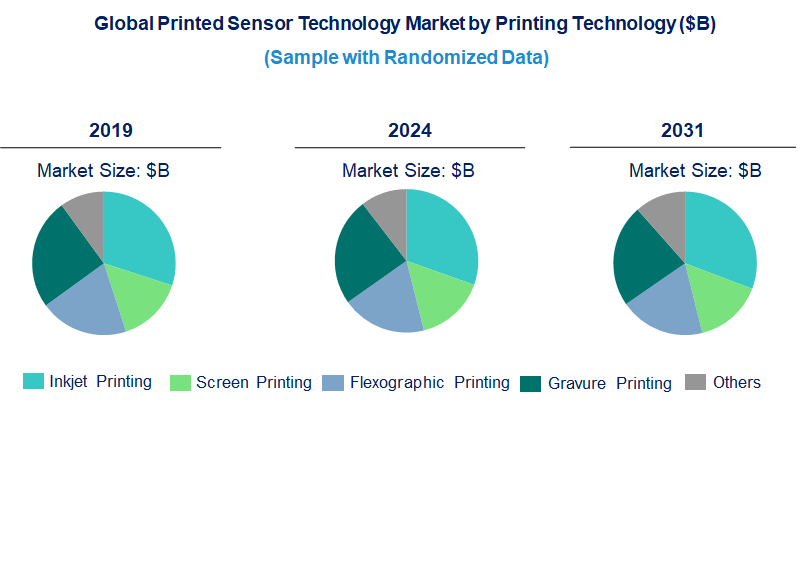
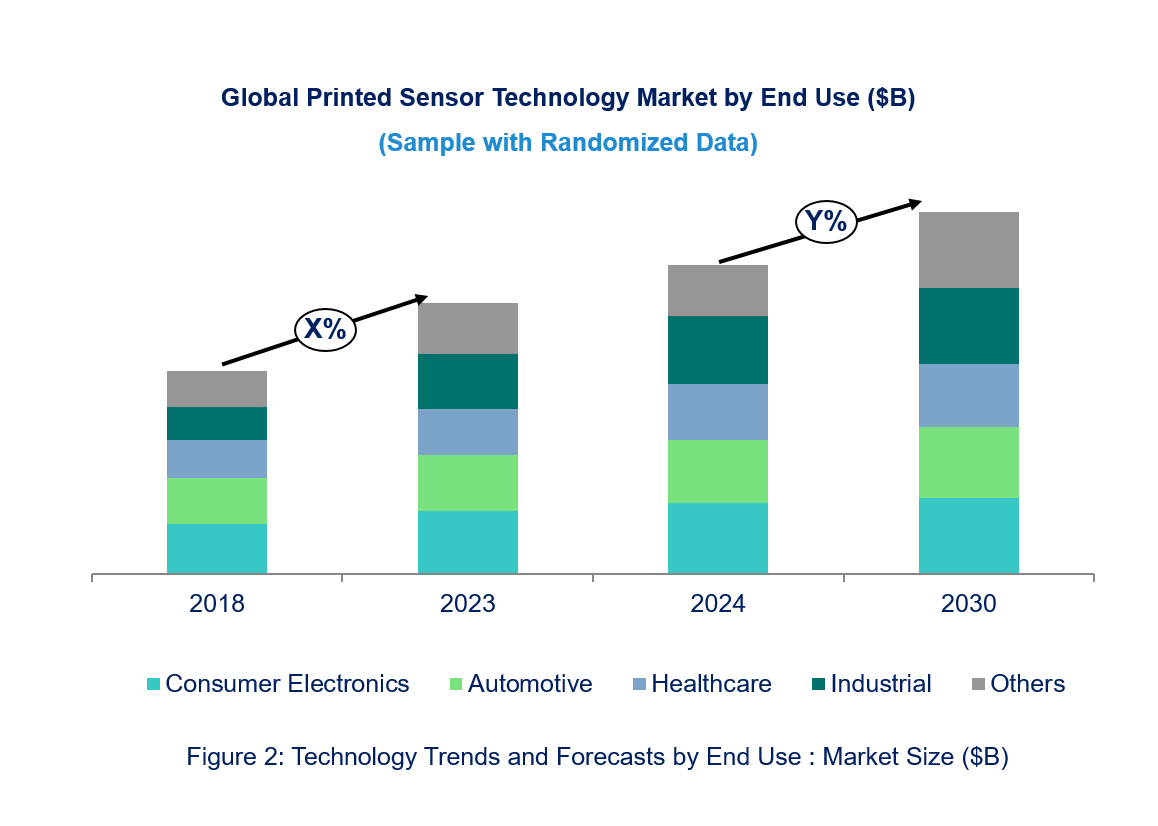
The technologies in the global printed sensor market have undergone significant changes in recent years, with a notable shift from screen printing to inkjet printing and flexographic printing. Inkjet printing offers advantages such as high resolution and the ability to produce complex designs with ease, making it ideal for applications requiring intricate sensor patterns. Flexographic printing, on the other hand, enables large-scale production at lower costs, catering to industries where cost efficiency is paramount. These advancements in printing technologies have not only enhanced the performance and functionality of printed sensors but have also opened up new possibilities for their integration into various products and systems, ranging from healthcare devices to automotive components and beyond.The global printed sensor market is expected to reach an estimated $18 billion by 2030 with a CAGR of 6% from 2024 to 2030.
As research and development continue to push the boundaries of printed sensor technology, we can expect further innovations that will revolutionize how sensors are manufactured and utilized in the future.
Emerging Trends in the Printed Sensor Technology
There have been persistent developments in the printed sensor technology market due to growing demand from healthcare, automotive, consumer electronics, and other sectors. These trends will define the future of printed sensors due to the need for lightweight and economical sensing devices. Emerging trends in the printed sensor technology market shaping its future applications and market dynamics:• Printed Sensors in Flexible and Wearable Applications: Printed sensors increasingly become the hub of wearable devices used for health monitoring. Innovations make sensors more flexible and stronger. The health and fitness industries grow further as consumers demand more advanced and comfortable wearables.
• IoT Integration: The main growth of an IoT ecosystem is built on printed sensors, which can facilitate cost-effective solutions for smart homes, industrial automation, and connected vehicles. They are suitable for large deployments in IoT because of their flexibility in various environments.
• Sustainable Manufacturing: Growing environmental concerns are pushing the market toward more environmentally friendly printing techniques, such as water-based inks and recyclable materials. This will contribute to the development of sustainable printed sensors that will not hinder global efforts to minimize electronic waste.
• Miniaturization and High Sensitivity: Advances in inkjet and gravure printing technologies make ultra-small, highly sensitive sensors possible, which are being used in medical diagnostics, automotive safety, and precision industrial monitoring systems.
• Low-Cost Production: Flexographic and screen printing will be the two most economical mass-production solutions for printed sensors. They can then be introduced to a broader spectrum of industries, such as agriculture, healthcare, and consumer electronics.
These evolving trends in the printed sensor market are bringing broader industry applicability and are also responding to the demand for sustainability and technology.
Pressure Sensor Technology: Industry Potential, Technological Development, and Compliance Considerations
Pressure sensor technology has a transformative impact across numerous industries, including automotive, healthcare, aerospace, and industrial automation. Its ability to accurately monitor and control processes by detecting and measuring pressure changes enables increased safety, efficiency, and automation. As industries increasingly move toward digitalization and precision-based operations, pressure sensors are becoming an essential component for optimizing and ensuring the reliability of critical systems.• Potential in Technology:
Pressure sensor technology has high potential in industries such as automotive, healthcare, aerospace, and industrial automation, where it occupies a critical position in monitoring and controlling processes through accurate detection and measurement of pressure changes.• Degree of Disruption:
The advancement of MEMS and IoT integration now revolutionizes pressure sensors by making them compact, accurate, and energy-efficient. Improvements in these sensors enhance automation and real-time monitoring capabilities, which are valuable across a wide range of applications.• Current Technology Maturity Level:
Pressure sensors in traditional modes are well-established and broadly adopted. Innovations for applications requiring miniaturization and enhanced sensitivity are still under development in wireless and digital pressure sensing.• Regulatory Compliance:
Regulatory compliance is crucial, primarily in industries such as healthcare and automotive, where safety and reliability are strictly needed. Conformity to ISO, FDA, and other regulations is critical because these industries define the needs for manufacturing, designing, and deploying products.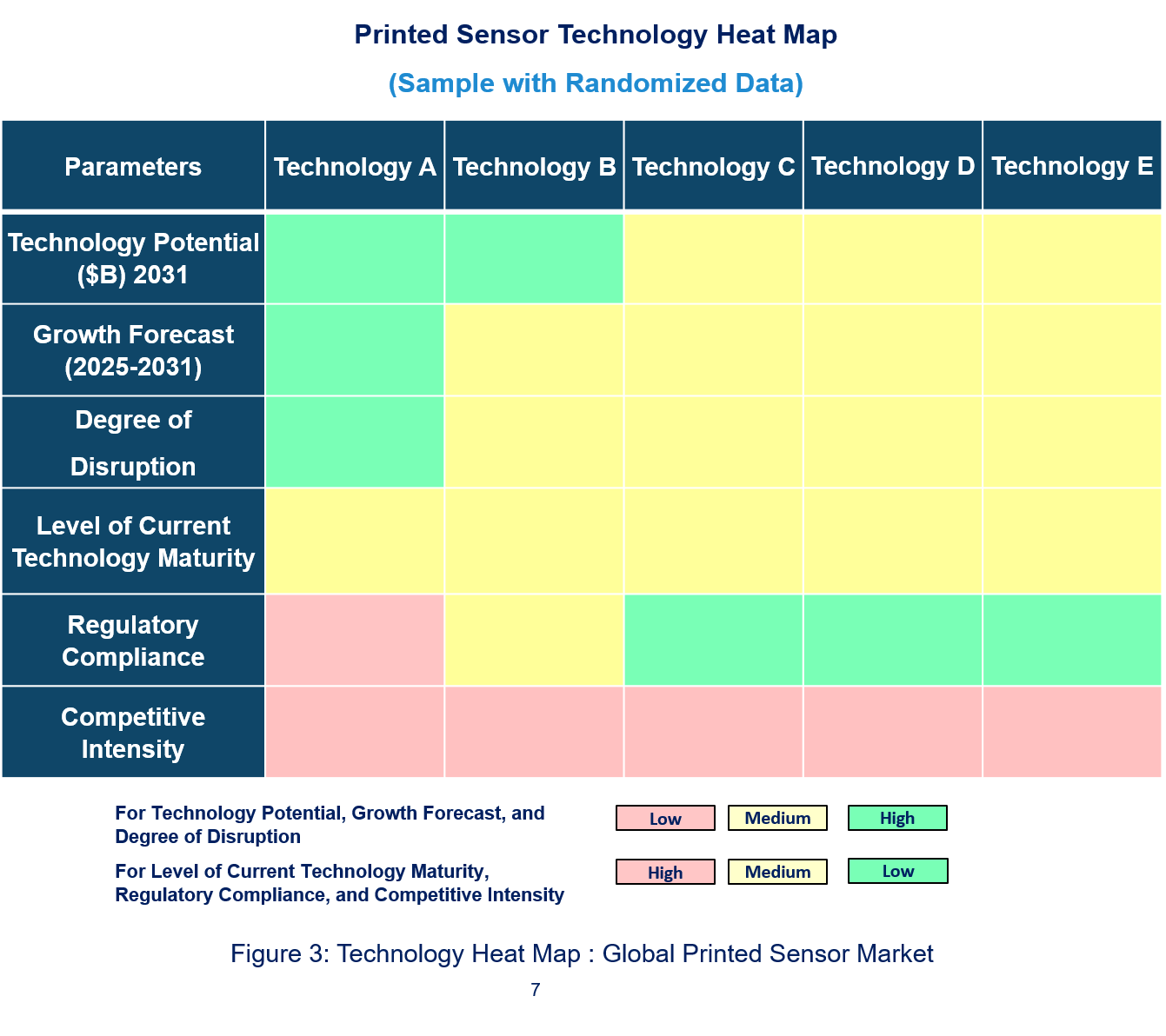
Recent Technological development in Printed Sensor Market by Key Players
Recent technological developments in printed sensor technology from leading companies like FlexEnable, Renesas, Bosch Sensortec, and Membrapor include:• FlexEnable: Innovations in organic electronics have led to flexible, lightweight printed sensors that can be integrated into various surfaces, enhancing wearability and comfort.
• Renesas: The introduction of highly sensitive printed sensors with advanced signal processing capabilities allows for precise environmental monitoring and IoT applications.
• Bosch Sensortec: The Development of low-power, high-performance printed sensors designed for smart devices improves functionality while conserving battery life.
• Membrapor: Advances in gas sensing technology enable highly accurate and compact printed sensors for air quality monitoring and industrial applications.
These developments are driving the adoption of printed sensors in sectors such as healthcare, automotive, and consumer electronics.
Printed Sensor Technology Driver and Challenges
Several factors driving the printed sensor technology market include technological, economic, and regulatory influences. While demand for smart devices and sustainability drives growth, challenges such as high production costs and regulatory barriers continue to impact the market's growth and development trajectory. The factors responsible for driving the printed sensor market include:• Industrial IoT: The vast demand for printed sensors for IoT applications is a prime driver, as they provide cost-effective, scalable solutions for connected devices in smart homes, industrial systems, and healthcare.
• Miniaturization: Advances in printing technology, such as inkjet and flexographic printing, allow the miniaturization of sensors to smaller sizes, aiding wearable devices and compact Internet of Things systems.
• Environmental Regulations: Increasing environmental concerns are driving manufacturers toward sustainable means of sensor production, using materials friendly to the environment and reducing waste. This creates demand in the market and drives innovation.
• Healthcare Demand: The use of medical wearable equipment for health monitoring promotes the use of printed sensors, as there is increased demand for dependable, real-time data for patients and their healthcare providers.
• Automotive Innovation: With a shift toward more autonomous and electric cars, the automotive industry creates increased demand for advanced printing sensors that can aid in real-time monitoring and advanced vehicle safety.
Challenges in the printed sensor market are:• High-Tech Innovations Cost: Although printing technologies are developing, the cost required to introduce the latest innovations, such as inkjet and gravure printing, is too high for most small-scale manufacturers.
• Scalability Issues: The technical intricacies of scaling up mass production for market applications in healthcare and automotive industries pose challenges due to the complexity involved in large-scale precision sensor production.
• Regulatory Hurdles: High standards for safety and performance tend to hinder the entry of printed sensors into the market, especially in healthcare and automotive applications.
The challenges and drivers shape the market for printed sensors, compelling innovation and revealing the need for cost and regulatory acceptance to fully realize the potential of the technology.
List of Printed Sensor Companies
Companies in the market compete on the basis of product quality offered. Major players in this market focus on expanding their manufacturing facilities, R&D investments, infrastructural development, and leverage integration opportunities across the value chain. Through these strategies printed sensor companies cater increasing demand, ensure competitive effectiveness, develop innovative products & technologies, reduce production costs, and expand their customer base. Some of the printed sensor companies profiled in this report includes.• FlexEnable
• Bosch Sensortec
• Renesas
• Membrapor AG
• Sensirion AG
• ISORG
Printed Sensor Market by Technology
This report analyzes technology maturity, the degree of disruption, competitive intensity, market potential, and other parameters of various technologies in the Printed Sensor Market. The study includes trends and forecasts for technology trends in the Printed Sensor Market by end-use industry, printing technology, and region as follows:•
Technology Readiness by Technology Type: The intensity and regulatory compliance of the competitive level differ among various printed sensor technologies. Inkjet printing competes at a medium level and is strictly regulated for health and food packaging applications that are safety-oriented. Screen printing is commonly applied at high volumes and is regulated based on environmental and chemical safety, which may involve hazardous inks. Flexographic printing competes in high-volume applications, and regulatory compliance regarding solvents and inks becomes a critical aspect in food-related applications. High-quality coatings characterize gravure printing, which undergoes strict requirements related to ink composition for consumer safety reasons. All the methods face competition in terms of innovation, cost efficiency, and sustainability while meeting particular regulatory demands.Printed Sensor Market Trend and Forecast by Printing Technology [Analysis by Value from 2018 to 2030]:
• Inkjet Printing
• Screen Printing
• Flexographic Printing
• Gravure Printing
• Others
Printed Sensor Market Trend and Forecast by End Use Industry [Analysis by Value from 2018 to 2030]:
• Consumer Electronics
• Automotive
• Healthcare
• Industrial
• Others
Printed Sensor Market by Region [Analysis by Value from 2018 to 2030]:
• North America
• Europe
• Asia Pacific
• The Rest of the World
•
Latest Developments and Innovations in the Printed Sensor Technologies
•
Companies / Ecosystems
•
Strategic Opportunities by Technology Type

Features of the Printed Sensor Technology
Market Size Estimates: Printed sensor market size estimation in terms of ($B).Trend and Forecast Analysis: Market trends (2018 to 2023) and forecast (2024 to 2030) by various segments and regions.
Segmentation Analysis: Technology trends in the global printed sensor market size by various segments, such as end use industry and printing technology in terms of value and volume shipments.
Regional Analysis: Technology trends in the global printed sensor market breakdown by North America, Europe, Asia Pacific, and the Rest of the World.
Growth Opportunities: Analysis of growth opportunities in different end use industries, printing technologies, and regions for technology trends in the global printed sensor market.
Strategic Analysis: This includes M&A, new product development, and competitive landscape for technology trends in the global printed sensor market.
Analysis of competitive intensity of the industry based on Porter’s Five Forces model.
If you are looking to expand your business in this or adjacent markets, then contact us. We have done hundreds of strategic consulting projects in market entry, opportunity screening, due diligence, supply chain analysis, M & A, and more.

Table of Contents
Methodology
- In-depth interviews of the major players in this market
- Detailed secondary research from competitors’ financial statements and published data
- Extensive searches of published works, market, and database information pertaining to industry news, company press releases, and customer intentions
- A compilation of the experiences, judgments, and insights of Lucintel’s professionals, who have analyzed and tracked this market over the years.


Buy Now
Choose a license that fits your team. Instant PDF delivery.
Prices exclude taxes. Instant delivery. Custom licensing available on request.
Key Questions
- • What are some of the most promising potential, high-growth opportunities for the technology trends in the global printed sensor market by end use industry (consumer electronics, automotive, healthcare, industrial, and others), printing technology (inkjet printing, screen printing, flexographic printing, gravure printing, and others), and region (North America, Europe, Asia Pacific, and the Rest of the World)?
- • Which technology segments will grow at a faster pace and why?
- • Which regions will grow at a faster pace and why?
- • What are the key factors affecting dynamics of different printing technologies? What are the drivers and challenges of these printing technologies in the global printed sensor market?
- • What are the business risks and threats to the technology trends in the global printed sensor market?
- • What are the emerging trends in these printing technologies in the global printed sensor market and the reasons behind them?
- • Which technologies have potential of disruption in this market?
- • What are the new developments in the technology trends in the global printed sensor market? Which companies are leading these developments?
- • Who are the major players in technology trends in the global printed sensor market? What strategic initiatives are being implemented by key players for business growth?
- • What are strategic growth opportunities in this printed sensor technology space?
- • What M & A activities did take place in the last five years in technology trends in the global printed sensor market? For any questions related to printed sensor market, printed sensor market Size, printed sensor market Growth, printed sensor market Analysis, printed sensor market Report, printed sensor market Share, printed sensor market Trends, printed sensor market Forecast, printed sensor companies write Lucintel analyst at email: helpdesk@lucintel.com. We will be glad to get back to you soon.


