
Report Feature
Surgical Robot Market Trends and Forecast
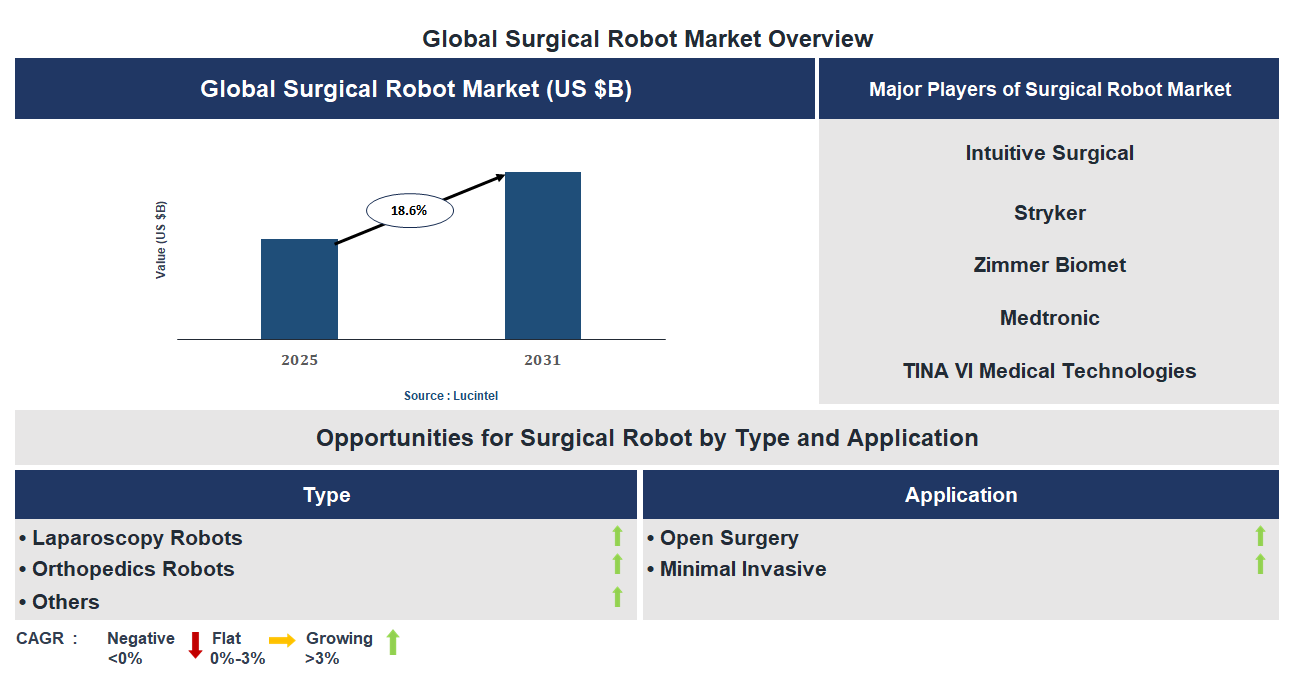
The future of the global surgical robot market looks promising with opportunities in the open surgery and minimal invasive markets. The global surgical robot market is expected to grow with a CAGR of 18.6% from 2025 to 2031. The major drivers for this market are the increasing number of surgical procedures, the rising demand for precision instruments, and the growing focus on patient safety.• Lucintel forecasts that, within the type category, laparoscopy robot is expected to witness higher growth over the forecast period.
• Within the application category, minimal invasive is expected to witness higher growth.
• In terms of region, APAC is expected to witness the highest growth over the forecast period. Gain valuable insights for your business decisions with our comprehensive 150+ page report. Sample figures with some insights are shown below.
Emerging Trends in the Surgical Robot Market
The surgical robot market is experiencing rapid growth driven by technological advancements, increasing demand for minimally invasive procedures, and a focus on improving surgical outcomes. As healthcare providers seek innovative solutions to enhance precision, reduce recovery times, and lower complication rates, the market is evolving with new players and sophisticated systems. These developments are transforming surgical practices worldwide, making procedures safer and more efficient. The following key trends highlight the major shifts shaping this dynamic industry, reflecting how technological innovation and changing healthcare needs are driving the future of surgical robotics.• Integration of Artificial Intelligence: AI is increasingly embedded in surgical robots to enhance decision-making, improve precision, and enable autonomous functions. AI algorithms analyze real-time data during procedures, assisting surgeons in complex tasks and reducing human error. This integration leads to more accurate surgeries, shorter operation times, and better patient outcomes. As AI continues to evolve, it will further personalize surgical approaches and facilitate predictive analytics, making robotic systems smarter and more adaptable to various surgical scenarios.
• Miniaturization and Enhanced Dexterity: Advances in miniaturization allow for smaller, more flexible robotic instruments that can access hard-to-reach areas within the body. These smaller tools improve the scope of minimally invasive surgeries, reducing trauma and recovery times for patients. Enhanced dexterity, with increased degrees of freedom and better articulation, enables surgeons to perform complex procedures with greater precision. This trend is expanding the range of surgeries that can be performed robotically, including intricate neurosurgical and cardiovascular interventions, thereby broadening market applications.
• Cloud-Based and Remote Surgery Capabilities: The adoption of cloud technology facilitates data sharing, remote monitoring, and collaboration among surgical teams. Cloud-based platforms enable real-time access to surgical data and support tele-mentoring, which is especially valuable in remote or underserved areas. Remote surgery, enabled by 5G connectivity, allows expert surgeons to operate or assist in procedures from distant locations, increasing access to specialized care. This trend is poised to revolutionize healthcare delivery, making advanced surgical interventions more accessible and reducing geographical disparities.
• Regulatory Approvals and Market Expansion: Increasing regulatory approvals and clearances are accelerating the adoption of surgical robots globally. Governments and health authorities are establishing standards to ensure safety and efficacy, which boosts confidence among healthcare providers. Market expansion is also driven by rising investments, strategic partnerships, and the entry of new players offering innovative solutions. As regulatory frameworks become more streamlined, the market is expected to see rapid growth, especially in emerging economies seeking to modernize their healthcare infrastructure.
• Focus on Cost Reduction and Workflow Integration: Manufacturers are developing cost-effective robotic systems to make surgical robotics more accessible to a broader range of healthcare facilities. Integration with existing hospital workflows and electronic health records (EHR) systems enhances operational efficiency. These improvements reduce overall procedure costs and training requirements, encouraging wider adoption. Additionally, modular and scalable robotic platforms allow customization based on hospital needs, further driving market penetration. This trend ensures that advanced robotic surgery becomes a standard component of surgical care rather than a specialized luxury. In summary, these emerging trends are collectively reshaping the surgical robot market by making robotic-assisted surgeries more intelligent, accessible, and efficient. The integration of AI, miniaturization, remote capabilities, regulatory support, and cost-effective solutions are expanding the scope and reach of surgical robotics. As these developments continue, they will lead to improved patient outcomes, broader adoption across healthcare settings, and a more innovative, competitive market landscape.

Recent Development in the Surgical Robot Market
The surgical robot market has experienced significant growth driven by technological advancements, increasing adoption in hospitals, and a rising preference for minimally invasive procedures. As healthcare providers seek to improve patient outcomes and reduce recovery times, the integration of robotics into surgical practices has become more prevalent. Recent developments reflect innovations in robotic systems, expanding applications, and strategic collaborations among key players. These changes are shaping the future landscape of surgical interventions, making procedures more precise, efficient, and accessible. The following are five key recent developments that are influencing the trajectory of the Surgical Robot Market.• Technological Innovations: Introduction of AI-powered surgical robots has enhanced precision and decision-making capabilities during procedures, leading to improved patient outcomes and reduced operative times. These advancements are enabling surgeons to perform complex surgeries with greater accuracy, thereby expanding the scope of robotic applications.
• Expansion of Application Areas: Robotic systems are increasingly being used in diverse surgical fields such as cardiology, urology, and gynecology. This diversification is broadening the market base, attracting new healthcare providers, and increasing overall adoption rates across various specialties.
• Strategic Collaborations and Partnerships: Major companies are forming alliances with hospitals, research institutions, and technology firms to develop next-generation surgical robots. These collaborations accelerate innovation, reduce development costs, and facilitate faster market entry, thereby boosting industry growth.
• Regulatory Approvals and Reimbursements: Recent approvals from regulatory bodies like the FDA and CMS reimbursement policies are making robotic surgeries more accessible and financially viable for healthcare providers. This regulatory support is crucial for wider adoption and market expansion.
• Cost Reduction and Miniaturization: Advances in manufacturing and design have led to more affordable and compact robotic systems. Lower costs and smaller footprints are enabling smaller hospitals and clinics to adopt robotic surgery, increasing market penetration and democratizing access to advanced surgical care. In summary, these developments are collectively driving the growth of the surgical robot market by enhancing technological capabilities, expanding application areas, fostering collaborations, improving regulatory support, and reducing costs. As a result, robotic surgery is becoming more mainstream, leading to better patient outcomes and transforming surgical practices worldwide.
Strategic Growth Opportunities in the Surgical Robot Market
The surgical robot market is experiencing rapid expansion driven by technological advancements, increasing demand for minimally invasive procedures, and rising healthcare investments worldwide. As hospitals and clinics seek to improve patient outcomes and reduce recovery times, the adoption of robotic systems is becoming more prevalent across various medical specialties. This growth is further supported by innovations in AI, machine learning, and enhanced precision capabilities. Key applications such as urology, gynecology, orthopedics, cardiology, and general surgery are witnessing significant development opportunities. These trends are transforming surgical practices, improving efficiency, and expanding access to advanced healthcare solutions globally.• Enhanced Precision and Minimally Invasive Procedures : The use of surgical robots in urology, particularly for prostatectomies and kidney surgeries, is improving surgical accuracy and reducing complications. This leads to faster patient recovery, increased surgeon confidence, and broader adoption of robotic systems in urological practices.
• Expanding Robotic Hysterectomy Procedures : Robotic technology in gynecology is enabling less invasive hysterectomies with better visualization and dexterity. This growth improves patient outcomes, shortens hospital stays, and encourages more healthcare providers to adopt robotic solutions for complex gynecological surgeries.
• Integration of Robotics for Precision and Customization : The application of robotics in orthopedic surgeries, such as joint replacements, enhances precision and customization. This results in improved implant positioning, reduced surgical time, and better long-term patient outcomes, driving market growth in orthopedic robotics.
• Development of Robotic-Assisted Cardiac Surgeries : Robotic systems are increasingly used in cardiac procedures, including minimally invasive valve repairs and bypass surgeries. These advancements offer reduced trauma, quicker recovery, and higher procedural success rates, expanding the scope of robotic applications in cardiology.
• Adoption of Multi-Functional Robotic Platforms : The deployment of versatile robotic platforms in general surgery allows for a wide range of procedures, from hernia repairs to complex abdominal surgeries. This flexibility enhances surgical efficiency, reduces operative times, and broadens the market reach for robotic systems. In summary, these key growth opportunities across applications are significantly transforming the surgical robot market by improving surgical precision, patient outcomes, and operational efficiency. The expanding adoption across diverse medical fields is driving market growth, fostering innovation, and making advanced surgical solutions more accessible worldwide.
Surgical Robot Market Driver and Challenges
The surgical robot market is influenced by a variety of technological, economic, and regulatory factors that shape its growth trajectory. Advances in robotics, artificial intelligence, and minimally invasive procedures are driving innovation and adoption. Economic considerations such as rising healthcare costs and the need for efficient surgical solutions also play a significant role. Additionally, regulatory frameworks impact the approval and deployment of surgical robots, affecting market expansion. These factors collectively create opportunities and challenges that determine the pace and direction of market development, requiring stakeholders to adapt to evolving technological standards, economic pressures, and regulatory policies. The factors responsible for driving the surgical robot market include:-• Technological Innovation: The rapid development of robotic systems with enhanced precision, flexibility, and integration of AI has revolutionized surgical procedures. These advancements enable minimally invasive surgeries, reduce patient recovery time, and improve surgical outcomes. As technology continues to evolve, hospitals and clinics are increasingly adopting robotic systems to stay competitive and improve patient care. The integration of real-time imaging and improved user interfaces further enhances surgical accuracy, making robotic systems indispensable in modern surgery.
• Rising Preference for Minimally Invasive Surgeries: Patients and healthcare providers are favoring minimally invasive procedures due to their benefits, including reduced pain, shorter hospital stays, and quicker recovery times. Surgical robots facilitate these procedures with high precision and control, expanding their application across various surgical disciplines such as urology, gynecology, and cardiology. This trend is expected to continue, driving demand for advanced robotic systems and expanding market opportunities.
• Increasing Healthcare Expenditure: Growing healthcare budgets worldwide, especially in developed countries, are enabling hospitals to invest in advanced surgical technologies. Governments and private healthcare providers recognize the long-term cost savings associated with robotic surgeries, such as reduced complication rates and shorter hospital stays. This economic support accelerates the adoption of surgical robots, fostering market growth and encouraging manufacturers to innovate and expand their product portfolios.
• Surge in Surgical Procedures: The rising prevalence of chronic diseases and an aging population are leading to an increase in surgical interventions globally. The demand for precise, efficient, and minimally invasive surgical options is fueling the adoption of robotic systems. As the volume of surgeries grows, so does the need for advanced robotic solutions, which in turn propels market expansion and encourages ongoing technological development.
• Strategic Collaborations and Investments: Major players in the healthcare and robotics sectors are forming strategic alliances, partnerships, and acquisitions to enhance their technological capabilities and market reach. Investments in research and development are focused on improving robotic systems‘ functionality, safety, and affordability. These collaborations facilitate faster product development, regulatory approvals, and market penetration, significantly impacting the growth trajectory of the Surgical Robot Market. The challenges facing the surgical robot market include:-
• High Cost of Robotic Systems: The substantial initial investment required for purchasing and maintaining surgical robots limits their adoption, especially in small and mid-sized healthcare facilities. The high costs associated with robotic systems, including training and maintenance, pose financial barriers, restricting market growth in emerging economies. This economic challenge necessitates the development of more affordable solutions and reimbursement policies to promote wider adoption.
• Regulatory and Safety Concerns: Ensuring the safety and efficacy of surgical robots is critical for regulatory approval and clinical acceptance. The complex approval process, coupled with concerns over device malfunctions and potential surgical errors, can delay market entry and limit adoption. Ongoing regulatory scrutiny requires continuous innovation and rigorous testing, which can be resource-intensive for manufacturers.
• Limited Skilled Workforce: The adoption of surgical robots demands specialized training and expertise, which is currently limited in many regions. The shortage of trained surgeons and support staff hampers the widespread implementation of robotic systems. Addressing this challenge requires investment in education and training programs, which can be time-consuming and costly, potentially slowing market growth. In summary, the surgical robot market is driven by technological advancements, increasing preference for minimally invasive procedures, rising healthcare expenditure, growing surgical volumes, and strategic industry collaborations. However, high costs, regulatory hurdles, and a shortage of skilled personnel pose significant challenges. These factors collectively influence the market‘s growth potential, requiring stakeholders to innovate, collaborate, and adapt to ensure sustainable expansion and improved patient outcomes. The overall impact suggests a promising yet complex landscape that demands strategic navigation to maximize benefits and mitigate risks.
List of Surgical Robot Companies
Companies in the market compete on the basis of product quality offered. Major players in this market focus on expanding their manufacturing facilities, R&D investments, infrastructural development, and leverage integration opportunities across the value chain. With these strategies surgical robot companies cater increasing demand, ensure competitive effectiveness, develop innovative products & technologies, reduce production costs, and expand their customer base. Some of the surgical robot companies profiled in this report include-• Intuitive Surgical
• Stryker
• Zimmer Biomet
• Medtronic
• TINA VI Medical Technologies
• Perfint Healthcare
• MedBot
• Asensus Surgical
• Avatera medical
• CMR Surgical Limited
Surgical Robot Market by Segment
The study includes a forecast for the global surgical robot market by type, application, and region.Surgical Robot Market by Type [Value from 2019 to 2031]:
• Laparoscopy Robots
• Orthopedics Robots
• Others
Surgical Robot Market by Application [Value from 2019 to 2031]:
• Open Surgery
• Minimal Invasive
Surgical Robot Market by Region [Value from 2019 to 2031]:
• North America
• Europe
• Asia Pacific
• The Rest of the World
Country Wise Outlook for the Surgical Robot Market
The surgical robot market has experienced rapid growth driven by technological advancements, increasing adoption in healthcare, and a focus on minimally invasive procedures. Countries are investing heavily in research and development to enhance robotic capabilities, improve patient outcomes, and reduce healthcare costs. Regulatory approvals and collaborations between tech firms and medical institutions are accelerating market expansion. The COVID-19 pandemic further emphasized the importance of remote and precise surgical solutions, prompting innovations worldwide. As the market evolves, each country’s unique healthcare infrastructure, regulatory environment, and technological expertise influence their development trajectory in this dynamic sector.• United States: The US leads in surgical robot adoption, with major companies like Intuitive Surgical expanding their product lines. Innovations include AI integration and enhanced imaging capabilities. Hospitals are increasingly investing in robotic systems for complex surgeries, supported by favorable reimbursement policies. Regulatory agencies are streamlining approval processes, fostering faster market entry for new technologies. The US also sees growing research collaborations between tech firms and healthcare providers, driving continuous advancements in surgical robotics.
• China: China is rapidly expanding its surgical robot market, focusing on cost-effective solutions to increase accessibility. Government initiatives promote domestic development of robotic systems, reducing reliance on imports. Chinese companies are innovating in AI-driven surgical tools and robotic-assisted procedures, especially in orthopedics and urology. The market benefits from increasing healthcare infrastructure and a large patient base. Regulatory frameworks are evolving to support faster approval and adoption, with a strong emphasis on local manufacturing and innovation.
• Germany: Germany emphasizes precision and quality in surgical robotics, leveraging its strong medical device industry. The country invests in research collaborations between universities and industry to develop advanced robotic systems. There is a focus on minimally invasive surgeries, especially in cardiology and neurology. Regulatory standards are stringent, ensuring high safety and efficacy. German hospitals are adopting robotic solutions to improve surgical outcomes, supported by government funding and European Union grants for innovation.
• India: India’s surgical robot market is emerging, driven by rising healthcare demand and increasing awareness of minimally invasive procedures. Cost-effective robotic systems are being developed to cater to a large population with diverse healthcare needs. The government’s initiatives to improve healthcare infrastructure and promote medical tourism are boosting adoption. Indian startups and established companies are investing in local manufacturing and AI integration. Regulatory pathways are being streamlined to facilitate faster deployment of robotic surgical solutions across the country.
• Japan: Japan is focusing on integrating robotics with advanced imaging and AI to enhance surgical precision. The country’s aging population drives demand for minimally invasive and robotic-assisted surgeries. Japanese firms are innovating in small, highly precise robotic systems suitable for complex procedures. Regulatory agencies are supporting innovation through accelerated approval processes. Collaborations between technology companies and healthcare providers are fostering the development of next-generation surgical robots, emphasizing safety, efficiency, and patient comfort.

Features of the Global Surgical Robot Market
Market Size Estimates: Surgical robot market size estimation in terms of value ($B). Trend and Forecast Analysis: Market trends (2019 to 2024) and forecast (2025 to 2031) by various segments and regions. Segmentation Analysis: Surgical robot market size by type, application, and region in terms of value ($B). Regional Analysis: Surgical robot market breakdown by North America, Europe, Asia Pacific, and Rest of the World. Growth Opportunities: Analysis of growth opportunities in different types, applications, and regions for the surgical robot market. Strategic Analysis: This includes M&A, new product development, and competitive landscape of the surgical robot market. Analysis of competitive intensity of the industry based on Porter’s Five Forces model.
FAQ
Q1. What is the growth forecast for surgical robot market? Answer: The global surgical robot market is expected to grow with a CAGR of 18.6% from 2025 to 2031. Q2. What are the major drivers influencing the growth of the surgical robot market? Answer: The major drivers for this market are the increasing number of surgical procedures, the rising demand for precision instruments, and the growing focus on patient safety. Q3. What are the major segments for surgical robot market? Answer: The future of the surgical robot market looks promising with opportunities in the open surgery and minimal invasive markets. Q4. Who are the key surgical robot market companies? Answer: Some of the key surgical robot companies are as follows:• Intuitive Surgical
• Stryker
• Zimmer Biomet
• Medtronic
• TINA VI Medical Technologies
• Perfint Healthcare
• MedBot
• Asensus Surgical
• Avatera medical
• CMR Surgical Limited Q5. Which surgical robot market segment will be the largest in future? Answer: Lucintel forecasts that, within the type category, laparoscopy robot is expected to witness higher growth over the forecast period. Q6. In surgical robot market, which region is expected to be the largest in next 5 years? Answer: In terms of region, APAC is expected to witness the highest growth over the forecast period. Q7. Do we receive customization in this report? Answer: Yes, Lucintel provides 10% customization without any additional cost.
Table of Contents
List of Figures
List of Tables
Methodology
- In-depth interviews of the major players in this market
- Detailed secondary research from competitors’ financial statements and published data
- Extensive searches of published works, market, and database information pertaining to industry news, company press releases, and customer intentions
- A compilation of the experiences, judgments, and insights of Lucintel’s professionals, who have analyzed and tracked this market over the years.


Buy Now
Choose a license that fits your team. Instant PDF delivery.
Prices exclude taxes. Instant delivery. Custom licensing available on request.
Key Questions
- • What are some of the most promising, high-growth opportunities for the surgical robot market by type (laparoscopy robots, orthopedics robots, and others), application (open surgery and minimal invasive), and region (North America, Europe, Asia Pacific, and the Rest of the World)?
- • Which segments will grow at a faster pace and why?
- • Which region will grow at a faster pace and why?
- • What are the key factors affecting market dynamics? What are the key challenges and business risks in this market?
- • What are the business risks and competitive threats in this market?
- • What are the emerging trends in this market and the reasons behind them?
- • What are some of the changing demands of customers in the market?
- • What are the new developments in the market? Which companies are leading these developments?
- • Who are the major players in this market? What strategic initiatives are key players pursuing for business growth?
- • What are some of the competing products in this market and how big of a threat do they pose for loss of market share by material or product substitution?
- • What M&A activity has occurred in the last 5 years and what has its impact been on the industry? For any questions related to Surgical Robot Market, Surgical Robot Market Size, Surgical Robot Market Growth, Surgical Robot Market Analysis, Surgical Robot Market Report, Surgical Robot Market Share, Surgical Robot Market Trends, Surgical Robot Market Forecast, Surgical Robot Companies, write Lucintel analyst at email: helpdesk@lucintel.com. We will be glad to get back to you soon.


