
Report Feature
SSD 3D Flash Memory Chip Market Trends and Forecast
Technologies in SSD 3D flash memory chips have changed drastically over the past couple of years. They are now transitioning from MLC technology to TLC and QLC technologies to meet the growing demands for greater storage density, lower cost per gigabyte, and performance improvements in both consumer and enterprise applications. As a result, TLC and QLC technologies have gained importance over time, becoming widespread. These technologies increase storage per dollar compared with MLC, but they entail trade-offs in terms of endurance and performance.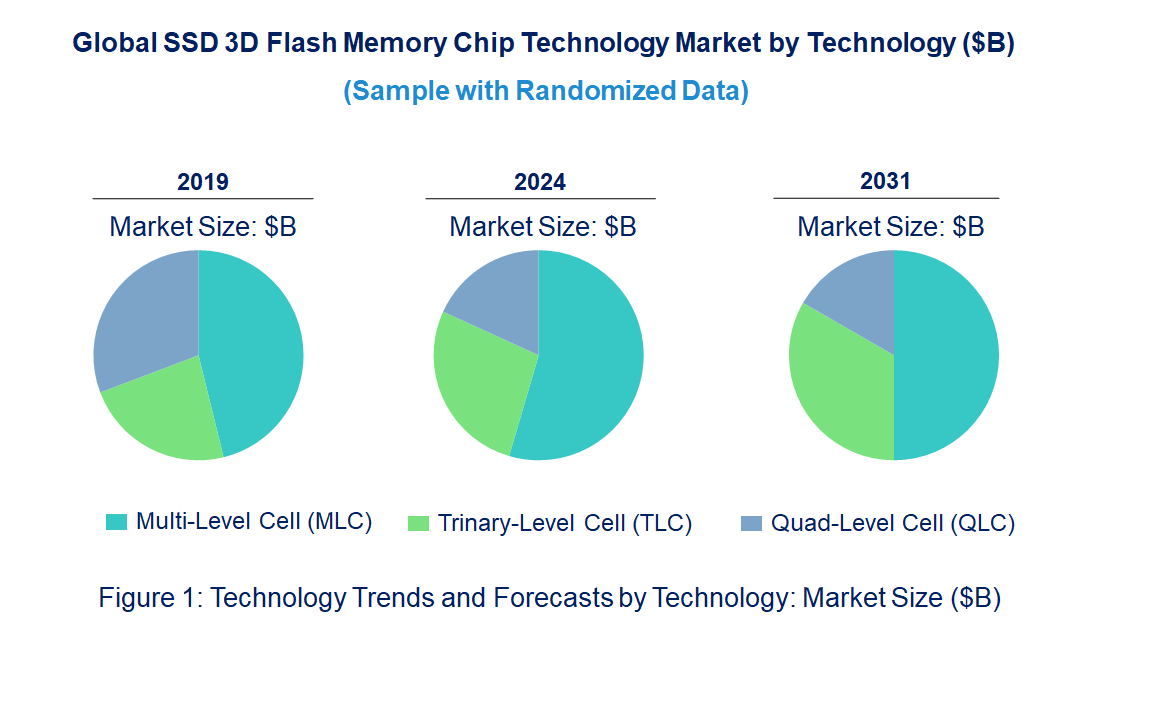
Emerging Trends in the SSD 3D Flash Memory Chip Market
The SSD 3D flash memory chip market is growing, with many emerging trends shaping the future of the market. These factors include the need for faster performance, higher storage, and advanced memory technology. Below are five key trends driving the market:• Transition to Higher Density Memory (QLC and TLC): As the demand for higher storage capacities continues to grow, manufacturers are shifting from Multi-Level Cell (MLC) technology to Trinary-Level Cell (TLC) and Quad-Level Cell (QLC) technologies. This transition allows for higher storage densities and lower costs per gigabyte, catering to the increasing storage needs of both consumer and enterprise sectors.
• Increased Adoption of 3D NAND Flash Memory: The adoption of 3D NAND flash memory technology is growing because it enables the stacking of memory cells vertically, increasing storage capacities and performance. This technology is gaining traction across various SSD applications, especially in data centers and high-performance consumer devices.
• Improving Endurance and Reliability: Though QLC memories provide greater capacity at a lower cost, their endurance levels are typically lower than those of MLC or TLC. Therefore, there has been an increasing focus on improving the endurance and reliability of these memory chips through advanced error correction algorithms and better materials.
• Integration with Emerging Technologies (AI and IoT): SSDs are increasingly being integrated into AI and IoT applications, where high-speed data processing and storage are critical. This trend is driving advancements in memory chips that offer faster read/write speeds, greater durability, and energy efficiency.
• Shift Towards PCIe Gen 4 and Gen 5 Interfaces: The industry is shifting to PCIe Gen 4 and Gen 5 interfaces, offering faster data transfer rates than older PCIe Gen 3 interfaces. This shift supports the ever-growing demand for high-performance SSDs in both consumer and enterprise markets. These trends mark a significant shift in the market for SSD 3D flash memory chips. The increased adoption of high-density memory types, growing use of 3D NAND technology, and SSD integration into new technologies are significantly altering the face of flash storage.
SSD 3D Flash Memory Chip Market : Industry Potential, Technological Development, and Compliance Considerations
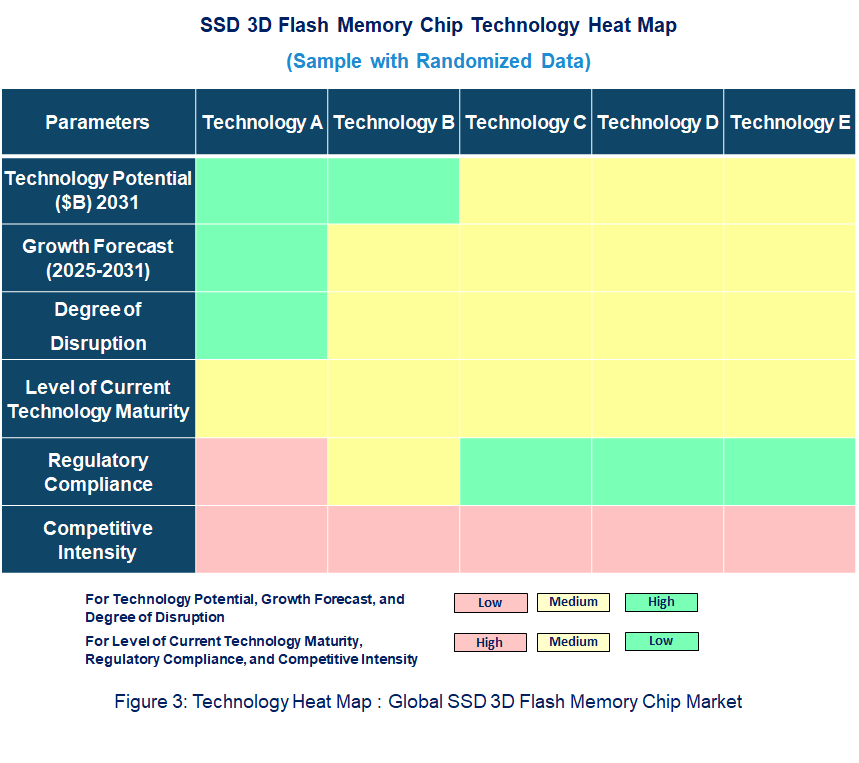
Key areas in modern data storage technologies include the SSD 3D flash memory chip markets, which are driven by speed, reliability, and the demand for capacity. Traditional 2D NAND flash led to significant milestones—the growth and advancement of SSD performance, which have acted as a catalyst for innovation in computing, data centers, and consumer electronics.• Technology Potential: The potential of 3D flash memory chips lies in their ability to stack multiple memory layers vertically, significantly increasing data density and storage capacity. This technology offers a substantial boost in read/write speeds, lower power consumption, and enhanced durability, making it ideal for enterprise, cloud storage, and consumer devices.
• Degree of Disruption: 3D flash memory is highly disruptive, replacing older storage technologies and transforming industries reliant on high-performance data storage. It has had a significant impact on high-demand applications such as artificial intelligence, big data analytics, and autonomous systems, where large amounts of fast, reliable data access are essential.
• Current Technology Maturity Level: Although 3D NAND technology is mature and widely deployed, research is still ongoing to improve manufacturing processes, scalability, and reduce costs. Leading manufacturers have improved techniques to produce more layers of chips with better endurance.
• Regulatory Compliance: While regulatory compliance is relatively straightforward, including only safety and environmental standards, manufacturers must comply with data security regulations in growing industries such as healthcare and finance.
Recent Technological development in SSD 3D Flash Memory Chip Market by Key Players
The SSD 3D flash memory chip market has witnessed significant developments from key players like Samsung, Toshiba, Microchip Technology, Texas Instruments, and SK Hynix. These companies are investing heavily in research and development to innovate and improve their products, driving market growth.• Samsung: Samsung is a leader in the SSD 3D flash memory chip market with its advancements in V-NAND technology. It launched its 6th generation V-NAND flash memory, offering better performance and energy efficiency, solidifying its position in both consumer and enterprise SSD markets.
• Toshiba: Toshiba has made remarkable progress in the 3D NAND flash memory space with its BiCS FLASH technology. The company recently launched its 200-layer 3D NAND memory chips, which provide greater storage density and improved performance, catering to both consumer and data center applications.
• Microchip Technology: Microchip Technology has expanded its product line in the SSD space by adding high-performance memory controllers for 3D NAND flash. These controllers are optimized to deliver SSD performance, increase reliability, and support higher-capacity memory configurations, making them popular among embedded systems.
• Texas Instruments: Texas Instruments focuses on developing advanced memory and storage solutions, mainly for embedded applications. The products aim to increase the reliability and durability of SSDs in industrial and automotive fields while meeting the growing demand for rugged and high-performance storage solutions.
• SK Hynix: SK Hynix has pushed the boundaries of NAND flash memory with its 128-layer 3D NAND technology. This advancement has significantly improved the company’s market share in consumer SSDs and enterprise storage markets, offering faster and more efficient data access and storage solutions. These developments from leading players demonstrate the continuous evolution of SSD 3D flash memory technology as companies push the boundaries of storage capacity, performance, and endurance to meet the demands of modern computing applications.
SSD 3D Flash Memory Chip Market Driver and Challenges
The SSD 3D flash memory chip market is influenced by several factors but faces various challenges as well. These dynamics shape the market landscape, creating opportunities for growth while presenting hurdles to overcome. The factors responsible for driving the SSD 3D flash memory chip market include:• Increasing Demand for High-Capacity Storage: Consumer and enterprise data storage needs are on the rise, creating demand for higher-capacity SSDs. 3D NAND technology innovations are helping manufacturers develop higher-density memory chips to meet this demand.
• Declining Cost of Flash Memory: The decreasing cost per gigabyte of flash memory, driven by advancements in 3D NAND and mass production, is making SSDs more affordable. This is helping push SSDs into markets traditionally dominated by hard drives, including budget consumer devices and enterprise storage solutions.
• Performance Requirements in Data Centers and AI Applications: High-performance storage solutions in data centers, cloud computing, and AI-driven applications are driving demand for advanced SSDs. The need for faster read/write speeds and high endurance in these applications is accelerating the adoption of 3D flash memory.
• Growth of Mobile and Consumer Electronics Market: The rising use of SSDs in mobile devices, laptops, gaming consoles, and other consumer electronics will further fuel the demand for high-performance storage solutions. This is expected to continue with the increasing reliance on digital content and the expansion of 5G networks. Challenges in the SSD 3D flash memory chip market include:
• Limited Endurance of High-Density Memory Types: While QLC and TLC technologies provide higher storage capacities at lower costs, they tend to have lower endurance compared to MLC. This trade-off can be a challenge in applications requiring high write cycles, such as enterprise data centers.
• Technological Complexity and Manufacturing Costs: The transition to more advanced 3D NAND technologies, such as 128-layer or 200-layer designs, comes with associated manufacturing complexities and costs. These factors may hinder production scaling and increase the price of next-generation memory chips.
• Competition from Emerging Storage Technologies: Emerging storage technologies, such as Intel’s Optane memory and 3D XPoint, present new competition to traditional NAND-based SSDs. These technologies promise better performance in specific applications, potentially disrupting the NAND flash market. Strong drivers like the increasing demand for high-capacity storage, declining costs, and performance improvements continue to propel the market for SSD 3D flash memory chips. However, challenges such as limited endurance and the emergence of new technologies keep the market in a state of flux. These factors will continue to shape the market moving forward.
List of SSD 3D Flash Memory Chip Companies
Companies in the market compete based on product quality offered. Major players in this market focus on expanding their manufacturing facilities, R&D investments, infrastructural development, and leverage integration opportunities across the value chain. With these strategies SSD 3D flash memory chip companies cater increasing demand, ensure competitive effectiveness, develop innovative products & technologies, reduce production costs, and expand their customer base. Some of the SSD 3D flash memory chip companies profiled in this report includes.• Samsung
• Toshiba
• Microchip Technology
• Texas Instruments
• SK Hynix
SSD 3D Flash Memory Chip Market by Technology
• Technology Readiness of MLC, TLC, and QLC for SSD 3D Flash Memory Chip Market: MLC is the most mature and widely adopted technology, offering the best reliability and performance for enterprise storage solutions. Although less robust than MLC, TLC has been well-optimized for consumer SSDs, balancing cost, capacity, and performance. QLC is still developing and offers the highest storage density, but its durability and write performance remain poor, making it unsuitable for high-demand environments. MLC has dominated competitive and mission-critical markets for a long time, while TLC dominates the consumer market. QLC, still under development, holds great promise for consumer and budget storage markets but is not yet ready for high-end, high-performance applications. The regulatory environment will continue to evolve to address concerns over data retention and environmental sustainability.
• Competitive Intensity and Compliance with Regulations by MLC, TLC, and QLC for SSD 3D Flash Memory Chip Market: In the SSD 3D flash memory chip market, there is high competitive intensity since MLC, TLC, and QLC target different market categories. MLC is mainly designed for high-end markets that demand reliable products, while TLC fits a market where cost and performance are balanced. QLC has the highest capacity per cell, pushing it into consumer markets but raising challenges in terms of endurance. Depending on use cases, more stringent regulatory compliance may be required in enterprise-level storage, where data security, reliability, and environmental impact are major concerns. As each technology matures, competition and regulation will influence adoption in different sectors.
• Disruption Potential of MLC, TLC, and QLC for SSD 3D Flash Memory Chip Market: The disruption potential of MLC, TLC, and QLC in the SSD 3D flash memory chip market is characterized by trade-offs between cost, performance, and endurance. MLC, which stores two bits per cell, provides a balance of cost, capacity, and endurance, making it ideal for enterprise storage. TLC, storing three bits per cell, increases storage density at a reduced cost but lowers endurance and performance, making it ideal for consumer applications. QLC, storing four bits per cell, offers the highest capacity at the lowest cost but reduces durability and write performance, making it unsuitable for high-performance applications. With advancements in these technologies, MLC, TLC, and QLC are gaining traction in the market as they suit various price points and use cases, ranging from high-end data centers to budget consumer devices.
SSD 3D Flash Memory Chip Market Trend and Forecast by Technology [Value from 2019 to 2031]:
• Multi-Level Cell (MLC)
• Trinary-Level Cell (TLC)
• Quad-Level Cell (QLC)
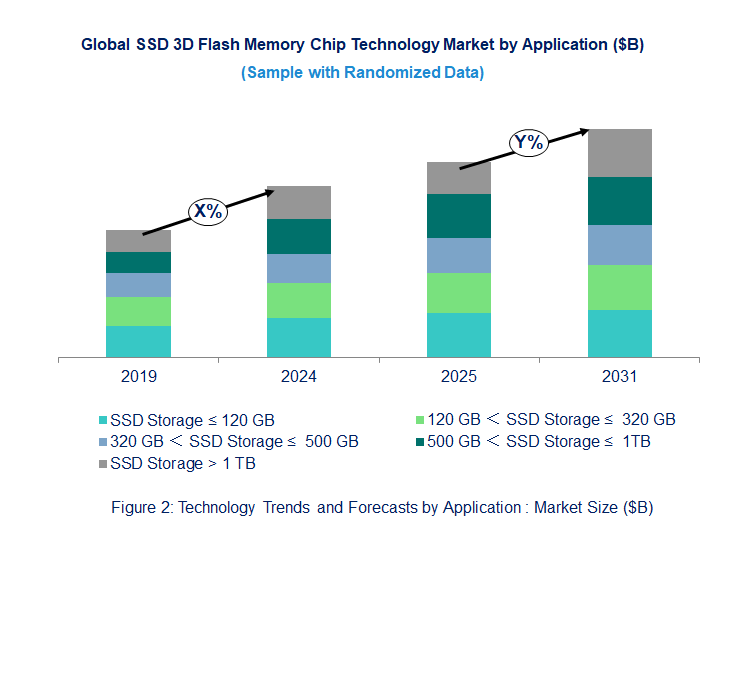
SSD 3D Flash Memory Chip Market Trend and Forecast by Application [Value from 2019 to 2031]:
• SSD Storage ≤ 120 GB
• 120 GB < SSD Storage ≤ 320 GB
• 320 GB < SSD Storage ≤ 500 GB
• 500 GB < SSD Storage ≤ 1TB
• SSD Storage > 1 TB
SSD 3D Flash Memory Chip Market by Region [Value from 2019 to 2031]:
• North America
• Europe
• Asia Pacific
• The Rest of the World
• Latest Developments and Innovations in the SSD 3D Flash Memory Chip Technologies
• Companies / Ecosystems
• Strategic Opportunities by Technology Type
Features of the Global SSD 3D Flash Memory Chip Market
Market Size Estimates: SSD 3D flash memory chip market size estimation in terms of ($B). Trend and Forecast Analysis: Market trends (2019 to 2024) and forecast (2025 to 2031) by various segments and regions. Segmentation Analysis: Technology trends in the global SSD 3D flash memory chip market size by various segments, such as application and technology in terms of value and volume shipments. Regional Analysis: Technology trends in the global SSD 3D flash memory chip market breakdown by North America, Europe, Asia Pacific, and the Rest of the World. Growth Opportunities: Analysis of growth opportunities in different applications, technologies, and regions for technology trends in the global SSD 3D flash memory chip market. Strategic Analysis: This includes M&A, new product development, and competitive landscape for technology trends in the global SSD 3D flash memory chip market. Analysis of competitive intensity of the industry based on Porter’s Five Forces model.Table of Contents
Methodology
- In-depth interviews of the major players in this market
- Detailed secondary research from competitors’ financial statements and published data
- Extensive searches of published works, market, and database information pertaining to industry news, company press releases, and customer intentions
- A compilation of the experiences, judgments, and insights of Lucintel’s professionals, who have analyzed and tracked this market over the years.


Buy Now
Choose a license that fits your team. Instant PDF delivery.
Prices exclude taxes. Instant delivery. Custom licensing available on request.
Key Questions
- • What are some of the most promising potential, high-growth opportunities for the technology trends in the global ssd 3d flash memory chip market by technology (multi-level cell (mlc), trinary-level cell (tlc), and quad-level cell (qlc)), application (ssd storage ≤ 120 gb, 120 gb < ssd storage ≤ 320 gb, 320 gb < ssd storage ≤ 500 gb, 500 gb < ssd storage ≤ 1tb, and ssd storage > 1 tb), and region (North America, Europe, Asia Pacific, and the Rest of the World)?
- • Which technology segments will grow at a faster pace and why?
- • Which regions will grow at a faster pace and why?
- • What are the key factors affecting dynamics of different technology? What are the drivers and challenges of these technologies in the global SSD 3D flash memory chip market?
- • What are the business risks and threats to the technology trends in the global SSD 3D flash memory chip market?
- • What are the emerging trends in these technologies in the global SSD 3D flash memory chip market and the reasons behind them?
- • Which technologies have potential of disruption in this market?
- • What are the new developments in the technology trends in the global SSD 3D flash memory chip market? Which companies are leading these developments?
- • Who are the major players in technology trends in the global SSD 3D flash memory chip market? What strategic initiatives are being implemented by key players for business growth?
- • What are strategic growth opportunities in this SSD 3D flash memory chip technology space?
- • What M & A activities did take place in the last five years in technology trends in the global SSD 3D flash memory chip market?


