
Retail Sporting Goods Market
The future of the global retail sporting goods market looks promising with opportunities in the athletic apparel, athletic footwear and sports equipment markets. The global retail sporting goods market is expected to reach an estimated $617 billion by 2035 with a CAGR of 5.2% from 2026 to 2035. The major drivers for this market are the increasing sports participation boosting retail demand, the rising fitness awareness driving sporting goods and the growing outdoor recreation supporting market growth.
• Lucintel forecasts that, within the application category, men will remain the largest segment over the forecast period as the growing interest in active lifestyles supporting men's demand.
• Within the type category, athletic footwear will remain the largest segment due to the the increasing fitness participation boosting athletic footwear demand.
• In terms of regions, North America will remain the largest region over the forecast period due to the the increasing participation in sports activities driving demand.
Gain valuable insights for your business decisions with our comprehensive 150+ page report.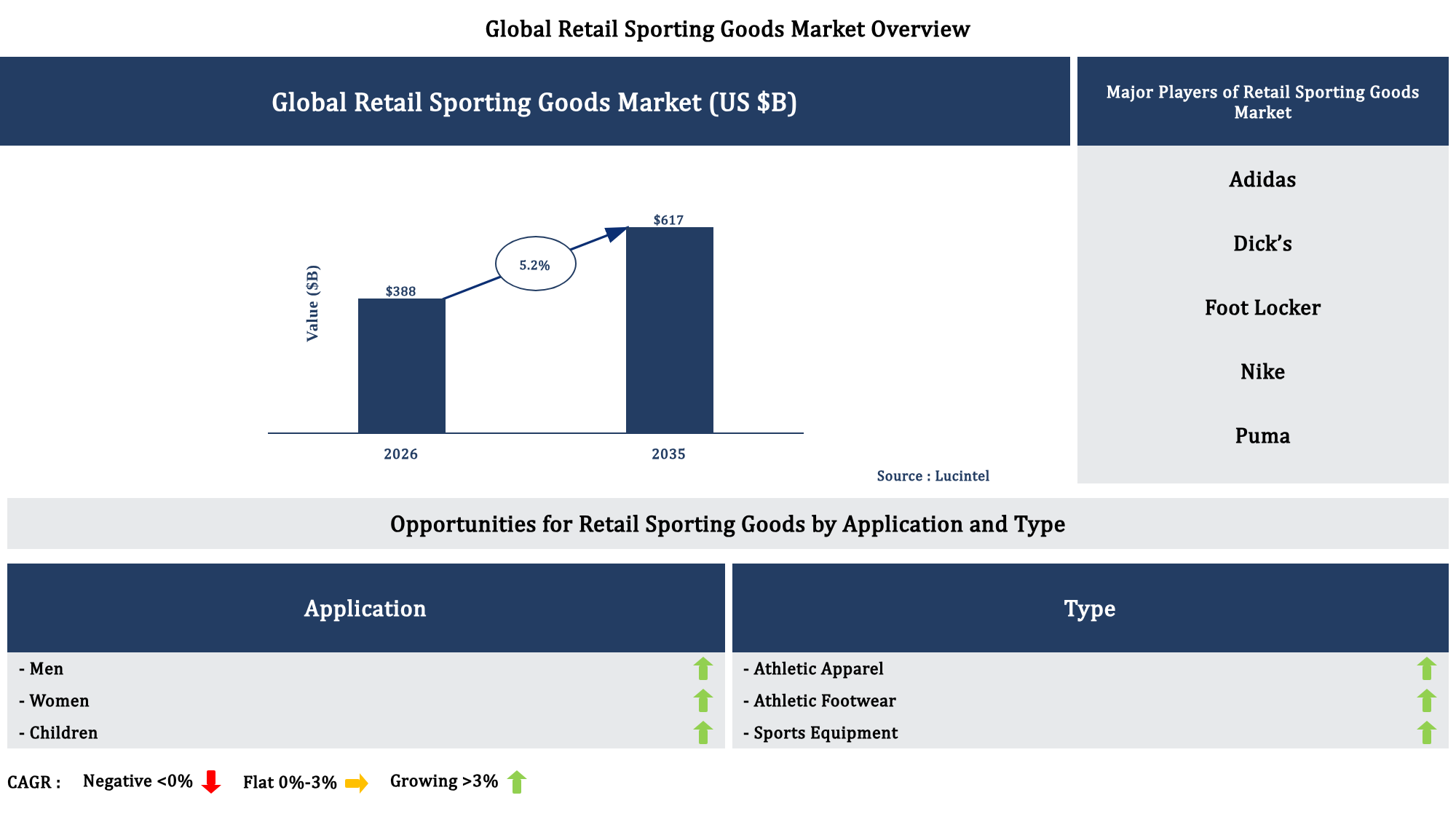
Emerging Trends in the Retail Sporting Goods Market
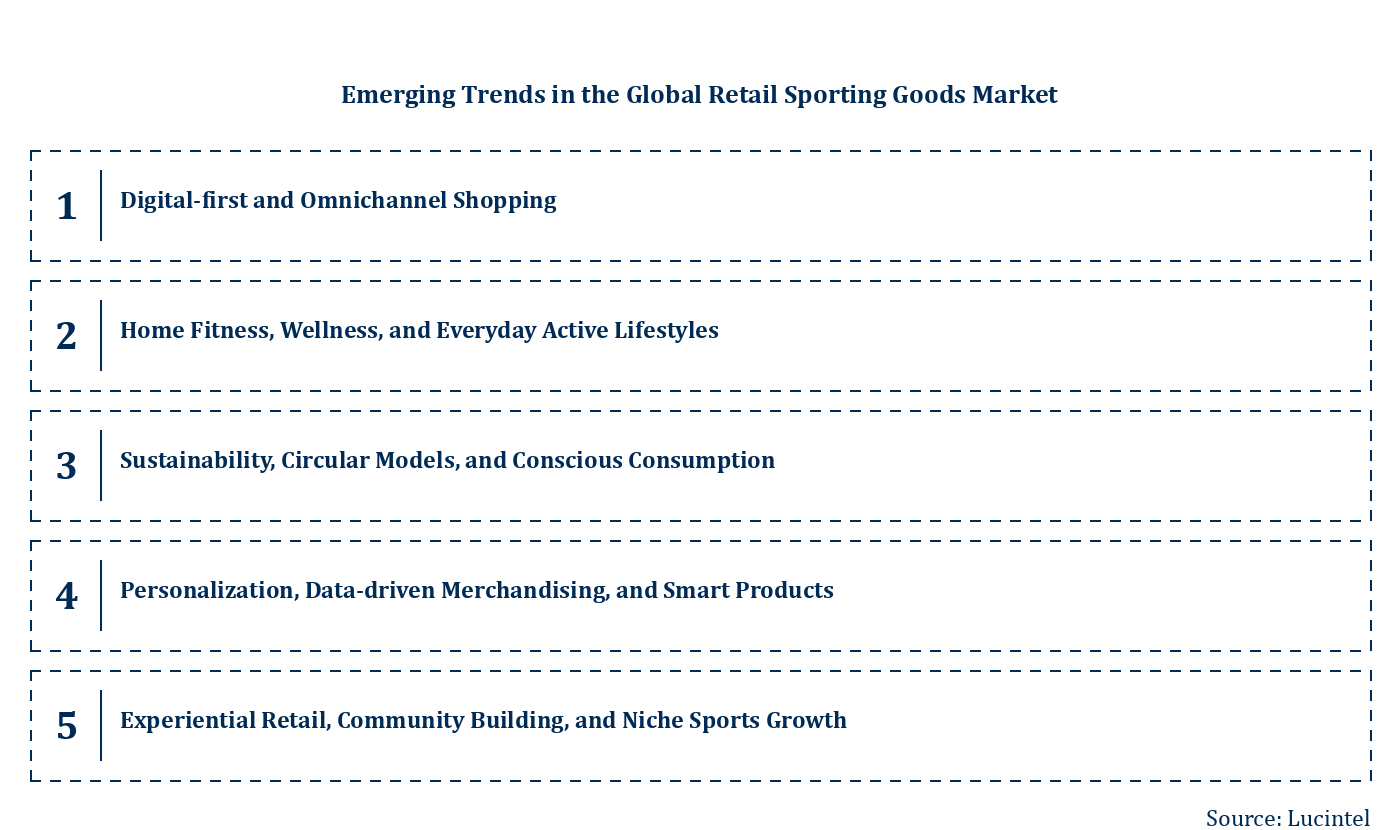
The retail sporting goods market is undergoing structural change as consumers, brands, and retailers respond to digitalization, shifting lifestyles, and sustainability expectations. Omnichannel journeys, data-driven personalization, and community-centric experiences are reshaping how shoppers discover, evaluate, and purchase equipment and apparel. At the same time, participation in home fitness, outdoor recreation, and niche sports is diversifying product demand and broadening target segments. Brands and retailers are also rethinking inventory models, circular offerings, and private label strategies to protect margins in a highly competitive environment. These emerging trends are redefining growth opportunities and competitive dynamics in the retail sporting goods market.
Recent Developments in the Retail Sporting Goods Market
The retail sporting goods market is undergoing rapid transformation as consumer expectations, sales channels, and product technologies evolve in parallel. Rising health consciousness, the proliferation of connected fitness devices, and the normalization of e-commerce are reshaping how brands design, price, and distribute sporting goods. Retailers are shifting from transactional store formats to immersive, experience-led environments that blend digital and physical touchpoints. At the same time, sustainability pressures and supply chain disruptions are forcing new approaches to sourcing, inventory, and brand partnerships. These recent developments are redefining competitive dynamics and creating new growth opportunities across the retail sporting goods market value chain.
Strategic Growth Opportunities in the Retail Sporting Goods Market
The retail sporting goods market is evolving as consumers prioritize health, performance, and experiential shopping. Demand is rising across applications from home fitness to outdoor recreation, team sports, and digitally enhanced training. Retailers and brands are rethinking assortments, integrating technology, and optimizing omnichannel journeys to capture higher value per customer. Personalization, sustainability, and community-led experiences are becoming critical differentiators. At the same time, new participation trends in women’s sports, youth engagement, and active lifestyles among older demographics are expanding the addressable base. Five key application-focused growth opportunities stand out as particularly impactful for long-term strategic expansion.
Retail Sporting Goods Market Drivers and Challenges
The retail sporting goods market is shaped by a dynamic mix of technological innovation, shifting consumer economics, and evolving regulatory expectations. Digital commerce, data analytics, and connected equipment are transforming how retailers attract, serve, and retain customers. At the same time, macroeconomic conditions influence discretionary spending on sports and fitness, while governments tighten rules on product safety, sustainability, and data protection. Understanding the interplay between these drivers and challenges is essential for brands, retailers, and investors seeking to prioritize profitable categories, optimize omnichannel strategies, and align with changing consumer values in a highly competitive and rapidly modernizing retail environment.
The factors responsible for driving the retail sporting goods market include:
The challenges in the retail sporting goods market are:
Overall, the retail sporting goods market is being reshaped by powerful growth drivers such as digital transformation, rising health awareness, product innovation, expanding sports culture, and brand‑led community engagement. These forces are expanding the customer base, increasing purchase frequency, and opening new channels for value creation. However, they coexist with serious structural challenges, including margin compression, supply chain volatility, and mounting regulatory and sustainability demands. Market participants that effectively leverage data, optimize omnichannel operations, and embed responsible practices into their business models are best positioned to capture long‑term growth while mitigating risk in this increasingly competitive environment.
List of Retail Sporting Goods Market Companies
Companies in the market compete on the basis of product quality offered. Major players in this market focus on expanding their manufacturing facilities, R&D investments, infrastructural development, and leverage integration opportunities across the value chain. Through these strategies retail sporting goods market companies cater increasing demand, ensure competitive effectiveness, develop innovative products & technologies, reduce production costs, and expand their customer base. Some of the retail sporting goods market companies profiled in this report include-
Retail Sporting Goods Market by Segment
The study includes a forecast for the global retail sporting goods market by application, type, and region.
Country Wise Outlook for the Retail Sporting Goods Market
The retail sporting goods market is undergoing notable transformation as consumers adopt healthier lifestyles, embrace outdoor recreation, and shift more spending online. Brands and retailers are responding with omnichannel strategies, data-driven personalization, and sustainability-focused product lines. Technology integration, from connected fitness devices to augmented reality fitting tools, is reshaping how shoppers discover and purchase athletic products. At the same time, local regulations, demographics, and income trends are creating distinct country-level dynamics. The following summaries highlight recent developments across the United States, China, Germany, India, and Japan, illustrating how each market is evolving within this global growth context.
Features of the Retail Sporting Goods Market
Article
Retail Sporting Goods Market: Which Strategic Shifts Are Redefining the Playing Field?
Dallas, July 17, 2026 – The retail sporting goods market is entering a decisive period of transformation as technology, shifting consumer behavior, and new business models converge. Sporting goods retailers, brands, and technology providers are rapidly rethinking how products are designed, sold, and experienced across physical and digital channels. From AI-powered personalization and connected equipment to circular commerce and immersive shopping, the industry is moving beyond transactional retail into ongoing performance ecosystems. This article analyzes the major trends reshaping the market, the segments most affected, the emerging technology use cases, and the challenges and opportunities now facing industry stakeholders.
How Is Data-Driven Personalization Changing What Consumers Expect from Sporting Goods Retail?
A powerful trend in the retail sporting goods market is the shift from product-centric merchandising to data-driven, athlete-centric personalization. Retailers and brands are harnessing purchase history, app usage, and performance data from wearables to tailor product recommendations, pricing, and content to individual consumers. This is pushing the sector toward a model where the store becomes less about inventory display and more about precision curation based on each athlete’s level, sport, and health profile.
Where Are Connected Equipment and Wearables Creating New Performance Ecosystems?
Connected hardware is moving the retail sporting goods market beyond one-time equipment purchases into ongoing, data-rich performance ecosystems. Smart treadmills, GPS watches, performance-tracking balls, sensor-enabled rackets, and connected fitness mirrors are increasingly bundled with subscriptions, coaching content, and community challenges. This hardware-plus-subscription model is redefining lifetime value and revenue predictability for brands and retailers.
Can Immersive and Hybrid Retail Models Rebuild the Role of the Physical Store?
As e-commerce penetration accelerates, physical stores in the retail sporting goods market are being reimagined as experiential, service-led destinations rather than pure points of sale. Retailers are layering augmented reality, virtual try-on, in-store diagnostics, and live-stream commerce into omnichannel strategies that blur the lines between digital and physical engagement.
How Is Sustainability and Circular Commerce Reshaping Product Lifecycles in Sporting Goods?
Sustainability is shifting from brand storytelling to operational reality across the retail sporting goods market. Consumers are increasingly questioning the environmental footprint of apparel, footwear, and equipment, as well as the waste generated by frequently replaced products in fast-evolving sports categories. In response, retailers are testing recommerce programs, rental models, repair services, and traceable material sourcing as structural elements of their strategies.
Why Are New Business Models and Athlete Communities Becoming Strategic Growth Engines?
Monetization is expanding across the retail sporting goods market from single product transactions to recurring and community-based revenue streams. Subscription boxes, training apps, digital coaching, gamified challenges, and influencer-driven micro-communities are altering how consumers discover products and stay engaged between purchases. The border between media, technology, and retail is fading as brands and retailers position themselves as ongoing performance partners rather than occasional vendors.
Which Markets and Segments Will Experience the Strongest Disruption From These Innovations?
The impact of these innovations is not evenly distributed across the retail sporting goods market. Segments with high performance sensitivity, rapid product cycles, or strong community dynamics are experiencing the most profound changes. Retailers and brands operating in these spaces face both heightened risk and outsized upside if they can execute effectively.
What Are the Key Technology Use Cases Powering Transformation in Sporting Goods Retail?
The technology industry is tightly woven into every layer of the retail sporting goods market, from product design to post-purchase engagement. Advanced analytics, AI, IoT, and immersive technologies are enabling new capabilities that would have been unattainable only a few years ago.
What Challenges Could Slow the Momentum of Innovation in the retail sporting goods market?
Despite the dynamism of the sector, several structural challenges threaten to undermine momentum and profitability. Executives must address these head-on to unlock the value of ongoing innovation.
Where Do the Biggest Opportunities Lie for Retailers, Brands, and Technology Partners?
While the challenges are material, they sit alongside significant and scalable opportunity pools for stakeholders that can move quickly and thoughtfully. Strategic collaboration between retailers, brands, and technology providers will be central to capturing this value.
How Are Recent Developments Signaling the Next Phase for the retail sporting goods market?
Recent activity across retailers, brands, and technology providers indicates that the retail sporting goods market is entering a more integrated and ecosystem-driven phase. Investments and partnerships increasingly span product, data, and experience rather than focusing on any single dimension.
The retail sporting goods market now sits at the intersection of sport, lifestyle, health, and technology. Organizations that treat data, experience, and sustainability as core strategic levers rather than side initiatives are best positioned to thrive. As innovation accelerates, the competitive field will likely polarize between ecosystem builders and legacy operators, with the former setting the pace for how athletes around the world discover, use, and re-use the products that power their performance.
Top 5 Companies
1. Adidas
Adidas is a leading global sporting goods company headquartered in Herzogenaurach, Germany, founded in 1949 by Adolf Dassler. The company employs tens of thousands of people worldwide and operates across Europe, North America, Asia-Pacific, Latin America, and emerging markets through a mix of owned retail stores, e-commerce platforms, and wholesale partners. In the retail sporting goods market, Adidas offers a broad portfolio that includes performance and lifestyle footwear, athletic and leisure apparel, and accessories such as bags, balls, socks, caps, and fitness equipment. Its brands include core Adidas, Adidas Originals, and sports performance lines addressing running, football, basketball, training, outdoor, and athleisure segments. The company has continued to expand its direct-to-consumer footprint with new flagship and concept stores in key metropolitan areas, while strengthening digital commerce channels and omnichannel services that integrate online and offline retail experiences. Adidas selectively uses shop-in-shop formats and partnerships with major retailers to deepen market penetration in the global retail sporting goods sector. Recent strategic initiatives focus on high-growth markets such as China, North America, and key cities in Europe, supported by localized assortments and collaborations that enhance brand relevance. Adidas has pursued targeted acquisitions and brand partnerships over the years to complement its core sporting goods portfolio, although recent strategy has emphasized sharpening focus on the main Adidas brand and streamlining non-core assets. The company continues to invest in sustainable materials, circular product concepts, and innovative performance technologies, positioning its retail sporting goods offering for both performance-driven athletes and fashion-conscious consumers.
2. Dick’s
Dick’s Sporting Goods, headquartered in Coraopolis, Pennsylvania, USA, is one of the largest full-line sporting goods retailers in the United States, founded in 1948 by Richard “Dick” Stack. The company employs tens of thousands of associates across its store network and distribution and support centers. Dick’s operates an extensive footprint of big-box sporting goods stores, specialty concept stores such as Golf Galaxy and Public Lands, and a rapidly growing e-commerce business that serves customers nationwide. In the retail sporting goods market, Dick’s offers a comprehensive portfolio covering team sports equipment, athletic and outdoor footwear, performance and casual apparel, fitness equipment, golf gear, hunting and outdoor products, and accessories from leading global brands as well as its own private labels. The company has been expanding its experiential retail formats, including House of Sport and expanded footwear and apparel sections, to enhance in-store engagement and services such as equipment fitting, repair, and customization. Dick’s continues to expand its geographic reach within the United States by remodeling existing locations, opening larger format stores in key metropolitan and suburban markets, and integrating curbside pickup and ship-from-store capabilities to strengthen its omnichannel model. The retailer has undertaken selective acquisitions and brand integrations in golf and outdoor categories to deepen its presence in core sporting goods segments. With a focus on combining robust digital platforms, loyalty programs, and data-driven merchandising, Dick’s positions itself as a central destination for sporting goods enthusiasts, families, and athletes ranging from youth leagues to serious competitors.
3. Foot Locker
Foot Locker, headquartered in New York City, New York, USA, is a leading global specialty retailer focused on athletic footwear and related sporting goods, established in 1974. The company employs thousands of associates across its retail banners and has a presence in North America, Europe, Asia-Pacific, and the Middle East through mall-based stores, street-front locations, and digital channels. Foot Locker’s retail sporting goods portfolio centers on athletic and lifestyle footwear, complemented by sports-inspired apparel, socks, accessories, and limited sporting goods aligned with sneaker culture and basketball, running, and training segments. The company operates multiple banners including Foot Locker, Kids Foot Locker, Champs Sports, WSS, and atmos in select regions, providing differentiated assortments and brand experiences. Foot Locker has been reshaping its geographic footprint by optimizing underperforming locations, expanding community and power stores in key cities, and enhancing its e-commerce and mobile platforms, which extend access to global sneaker releases and exclusive collaborations. The retailer has strengthened partnerships with major brands such as Nike, Adidas, and Puma while also building its own private label offerings to broaden value tiers in the sporting goods and athleisure space. Recent initiatives emphasize omnichannel capabilities, loyalty integration, and localized merchandising to better serve sneaker and sports enthusiasts in core urban and suburban markets. Foot Locker’s strategic moves have included acquisitions of regional athletic footwear chains and specialty sneaker retailers in North America and Asia to reinforce its leadership in the performance and lifestyle sporting goods categories.
4. Nike
Nike, headquartered in Beaverton, Oregon, USA, is one of the world’s largest and most influential companies in the retail sporting goods market, founded in 1964 as Blue Ribbon Sports and later rebranded as Nike. The company employs tens of thousands of people globally and operates across North America, Europe, Greater China, Asia-Pacific, Latin America, and emerging markets through a mix of owned retail stores, Nike-owned digital platforms, and a broad network of wholesale partners. Nike’s product portfolio encompasses performance footwear, sports and lifestyle apparel, and equipment such as balls, bags, accessories, and training gear serving categories including running, basketball, football, training, soccer, tennis, golf, and lifestyle segments under brands such as Nike and Jordan. In recent years Nike has accelerated its direct-to-consumer strategy by expanding Nike-branded flagship and concept stores, including House of Innovation and Nike Live formats, while investing heavily in e-commerce, mobile apps, and membership ecosystems that integrate digital and physical retail. The company has opened and upgraded stores in key global cities, strengthening its geographic expansion with localized assortments and experiential retail environments. Nike has historically undertaken targeted mergers, acquisitions, and brand investments in areas such as digital fitness, data analytics, and specialty product categories to enhance its sporting goods offering and consumer engagement capabilities. The company continues to focus on product innovation, sustainability initiatives, and personalized services, reinforcing its competitive position in the global retail sporting goods market for both elite athletes and everyday consumers.
5. Puma
Puma, headquartered in Herzogenaurach, Germany, is a major global sporting goods company founded in 1948 by Rudolf Dassler. The company employs thousands of people and has a strong geographic presence across Europe, the Americas, Asia-Pacific, the Middle East, and Africa through a combination of owned stores, outlet locations, franchise partners, and e-commerce platforms. Puma’s retail sporting goods portfolio includes performance and lifestyle footwear, athletic and casual apparel, and accessories such as bags, caps, socks, and sports equipment, serving categories like running, football, motorsport, basketball, training, and lifestyle. The brand is known for its collaborations with athletes, clubs, and cultural influencers, which support strong visibility in football, motorsport, and streetwear segments. Puma has been expanding its retail footprint by opening new flagship and concept stores in key cities worldwide and strengthening wholesale partnerships, while heavily investing in digital commerce and omnichannel services to reach consumers directly. Recent geographic expansion initiatives focus on high-growth markets in Asia and Latin America, alongside deeper penetration in major European and North American cities. Puma has engaged in selective brand and licensing deals to complement its core sporting goods business, while prioritizing organic growth and operational efficiencies. The company emphasizes product innovation, sustainable materials, and fashion-forward design to appeal to both performance-focused athletes and style-conscious consumers, solidifying its position as a significant competitor in the global retail sporting goods market.
Table of Contents
List of Figures
List of Tables
Methodology
Lucintel has been in the business of market research and management consulting since 2000 and has published over 1000 market intelligence reports in various markets / applications and served over 1,000 clients worldwide. This study is a culmination of four months of full-time effort performed by Lucintel's analyst team. The analysts used the following sources for the creation and completion of this valuable report:
- In-depth interviews of the major players in this market
- Detailed secondary research from competitors' financial statements and published data
- Extensive searches of published works, market, and database information pertaining to industry news, company press releases, and customer intentions
- A compilation of the experiences, judgments, and insights of Lucintel's professionals, who have analyzed and tracked this market over the years.
Extensive research and interviews are conducted across the supply chain of this market to estimate market share, market size, trends, drivers, challenges, and forecasts. Below is a brief summary of the primary interviews that were conducted by job function for this report.

Thus, Lucintel compiles vast amounts of data from numerous sources, validates the integrity of that data, and performs a comprehensive analysis. Lucintel then organizes the data, its findings, and insights into a concise report designed to support the strategic decision-making process. The figure below is a graphical representation of Lucintel's research process.

Buy Now
Choose a license that fits your team. Instant PDF delivery.
Prices exclude taxes. Instant delivery. Custom licensing available on request.
Frequently Asked Questions
What is the Retail Sporting Goods Market size?
What is the growth forecast for Retail Sporting Goods Market?
What are the major drivers influencing the growth of the Retail Sporting Goods Market?
What are the major segments for Retail Sporting Goods Market?
Who are the key Retail Sporting Goods Market companies?
Which Retail Sporting Goods Market segment will be the largest in future?
In Retail Sporting Goods Market, which region is expected to be the largest in next 9 years?
Do we receive customization in this report?
Key Questions
- • What are some of the most promising, high-growth opportunities for the Retail Sporting Goods Market by Application (Men, Women, and Children), Type (Athletic Apparel, Athletic Footwear, and Sports Equipment), and region (North America, Europe, Asia Pacific, and the Rest of the World)?
- • Which segments will grow at a faster pace and why?
- • Which region will grow at a faster pace and why?
- • What are the key factors affecting market dynamics? What are the key challenges and business risks in this market?
- • What are the business risks and competitive threats in this market?
- • What are the emerging trends in this market and the reasons behind them?
- • What are some of the changing demands of customers in the market?
- • What are the new developments in the market? Which companies are leading these developments?
- • Who are the major players in this market? What strategic initiatives are key players pursuing for business growth?
- • What are some of the competing products in this market and how big of a threat do they pose for loss of market share by material or product substitution?
- • What M&A activity has occurred in the last 9 years, and what has its impact been on the industry?


