
Report Feature
Pathology Workstation Market Trends and Forecast
The future of the global pathology workstation market looks promising with opportunities in the medical, biological, and research & study markets. The global pathology workstation market is expected to grow with a CAGR of 8.3% from 2025 to 2031. The major drivers for this market are rising demand for precision medicine, technological advancements and automation, and increasing healthcare investments. Lucintel forecasts that, within the type category, stainless steel 304 will remain larger segment over the forecast period due to highly resistant to rust, staining, and oxidation. Within the application category, medical will remain the larger segment due to high volume of diagnostic and clinical pathology work performed. In terms of region, North America will remain the largest region over the forecast period due to well-established healthcare system. Gain valuable insights for your business decisions with our comprehensive 150+ page report. Sample figures with some insights are shown below.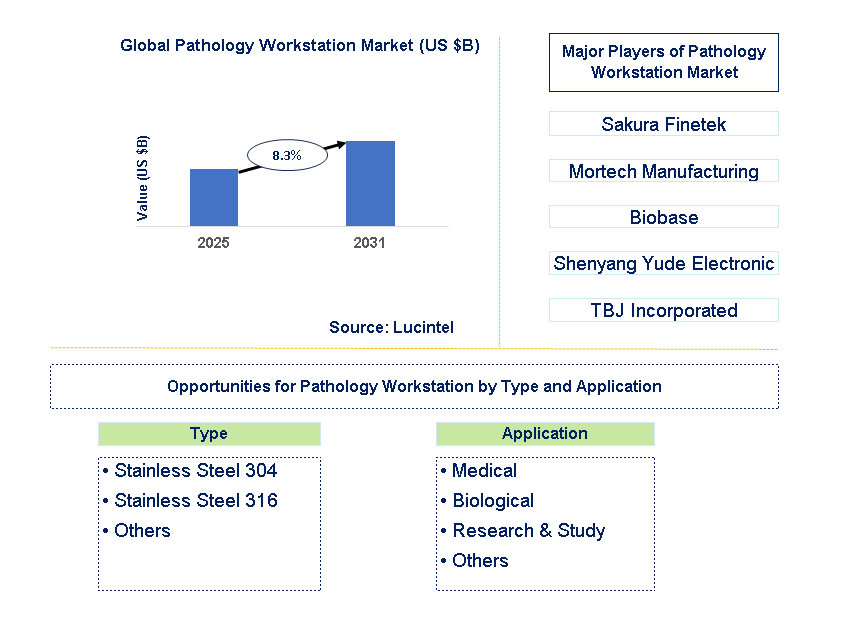
Pathology Workstation Market by Segment
• Digital Pathology and Remote Diagnostics: Digital pathology is rapidly transforming how pathologists work by replacing traditional microscope-based analysis with high-resolution imaging and digital slides. Pathology workstations now allow pathologists to digitize, store, and analyze images remotely, making telepathology and remote diagnostics more accessible. This trend is particularly important in regions with limited access to pathology expertise, as it enables pathologists to consult remotely on complex cases. As digital pathology systems become more sophisticated, the integration of telepathology with pathology workstations is expected to grow, facilitating the exchange of diagnostic information across geographies.
• Automation for High-Throughput Workflows: As diagnostic workloads increase, particularly in busy hospitals and research institutions, there is a growing demand for automated pathology workstations that streamline sample processing. These systems automate tasks such as slide preparation, labeling, and image analysis, reducing the need for manual intervention and improving efficiency. Automation also leads to greater consistency in results, reduced human error, and faster turnaround times. High-throughput pathology workstations are expected to be in high demand as healthcare providers look to optimize lab workflows, especially in settings with a high volume of specimens.
• Integration with Electronic Health Records (EHR): The integration of pathology workstations with electronic health records (EHR) and laboratory information systems (LIS) is an emerging trend that enhances workflow efficiency and ensures better patient outcomes. By linking diagnostic results directly with a patient’s EHR, pathology workstations enable a seamless flow of data between healthcare providers, improving the speed and accuracy of diagnosis. This integration reduces the potential for errors caused by manual data entry and ensures that all patient information is up-to-date and accessible for further treatment planning.
• Cloud-Based Storage and Data Sharing: Cloud-based storage and data sharing are becoming increasingly important in the pathology workstation market. As pathology workstations generate large volumes of imaging data, storing this data in the cloud enables easy access and sharing across different healthcare facilities. Cloud-based systems also support AI-powered analysis and facilitate the storage of large datasets that are used for training AI algorithms. With cloud storage, pathologists can access patient data and images from anywhere, enabling better collaboration, especially in telepathology and remote diagnostics. The integration of AI, digital pathology, automation, EHR systems, and cloud-based solutions are driving major changes in the pathology workstation market. These technologies not only enhance the accuracy and efficiency of diagnostic processes but also improve the overall quality of patient care by enabling remote consultations and faster diagnosis. The future of pathology workstations will be increasingly centered around these innovations, reshaping how pathologists perform their work and collaborate with other healthcare providers." src="Emerging Trends in the Pathology Workstation Market" style="height: auto;width: auto;" title="The pathology workstation market is undergoing significant transformation as new technologies such as artificial intelligence (AI), machine learning, and automation become increasingly integrated into diagnostic workflows. These technologies are reshaping the role of pathology workstations by enhancing diagnostic accuracy, reducing turnaround times, and improving operational efficiency. As healthcare systems across the globe seek to improve outcomes while reducing costs, the following emerging trends are shaping the future of the pathology workstation market.
• Integration of AI: These systems use deep learning and machine learning algorithms to assist pathologists in analyzing tissue samples, recognizing patterns, and making more accurate diagnoses. AI integration enhances image recognition, helping to identify anomalies that may be difficult for human eyes to detect. This not only improves diagnostic precision but also reduces human error and speeds up the process. As AI technology continues to evolve, these workstations are becoming more intuitive and capable of providing pathologists with decision-support tools, thus increasing overall efficiency.
• Digital Pathology and Remote Diagnostics: Digital pathology is rapidly transforming how pathologists work by replacing traditional microscope-based analysis with high-resolution imaging and digital slides. Pathology workstations now allow pathologists to digitize, store, and analyze images remotely, making telepathology and remote diagnostics more accessible. This trend is particularly important in regions with limited access to pathology expertise, as it enables pathologists to consult remotely on complex cases. As digital pathology systems become more sophisticated, the integration of telepathology with pathology workstations is expected to grow, facilitating the exchange of diagnostic information across geographies.
• Automation for High-Throughput Workflows: As diagnostic workloads increase, particularly in busy hospitals and research institutions, there is a growing demand for automated pathology workstations that streamline sample processing. These systems automate tasks such as slide preparation, labeling, and image analysis, reducing the need for manual intervention and improving efficiency. Automation also leads to greater consistency in results, reduced human error, and faster turnaround times. High-throughput pathology workstations are expected to be in high demand as healthcare providers look to optimize lab workflows, especially in settings with a high volume of specimens.
• Integration with Electronic Health Records (EHR): The integration of pathology workstations with electronic health records (EHR) and laboratory information systems (LIS) is an emerging trend that enhances workflow efficiency and ensures better patient outcomes. By linking diagnostic results directly with a patient’s EHR, pathology workstations enable a seamless flow of data between healthcare providers, improving the speed and accuracy of diagnosis. This integration reduces the potential for errors caused by manual data entry and ensures that all patient information is up-to-date and accessible for further treatment planning.
• Cloud-Based Storage and Data Sharing: Cloud-based storage and data sharing are becoming increasingly important in the pathology workstation market. As pathology workstations generate large volumes of imaging data, storing this data in the cloud enables easy access and sharing across different healthcare facilities. Cloud-based systems also support AI-powered analysis and facilitate the storage of large datasets that are used for training AI algorithms. With cloud storage, pathologists can access patient data and images from anywhere, enabling better collaboration, especially in telepathology and remote diagnostics. The integration of AI, digital pathology, automation, EHR systems, and cloud-based solutions are driving major changes in the pathology workstation market. These technologies not only enhance the accuracy and efficiency of diagnostic processes but also improve the overall quality of patient care by enabling remote consultations and faster diagnosis. The future of pathology workstations will be increasingly centered around these innovations, reshaping how pathologists perform their work and collaborate with other healthcare providers." />
Emerging Trends in the Pathology Workstation Market
Recent Development in the Pathology Workstation Market
Recent developments in the pathology workstation market reflect the growing demand for automation, digital integration, and AI-powered technologies. As healthcare systems worldwide face increasing pressure to provide faster and more accurate diagnoses, advancements in pathology workstation technology are helping to address these challenges. Below are five key developments that are reshaping the market.• AI-Enhanced Image Analysis and Diagnosis: One of the most significant developments in the pathology workstation market is the integration of AI and machine learning algorithms for image analysis. These systems assist pathologists by automating the process of detecting and diagnosing conditions such as cancer, enabling faster and more accurate assessments. AI-powered pathology workstations can analyze images in greater detail, helping to identify subtle patterns that may be missed by the human eye. This development is improving diagnostic precision and reducing the time pathologists need to spend on individual cases.
• Integration of Digital Pathology Systems: The shift from traditional microscopy to digital pathology is one of the most transformative changes in the pathology workstation market. Workstations are now designed to accommodate high-resolution imaging and support digital slides, allowing pathologists to store, share, and analyze tissue samples electronically. This advancement enables remote consultations, telepathology, and the integration of pathology images into broader health IT systems, improving collaboration and access to expertise. The integration of digital pathology with workstations is streamlining workflows and making diagnostic processes more efficient.
• Automation of Laboratory Processes: Automation continues to be a key development in the pathology workstation market. Automated workstations streamline various tasks such as slide preparation, labeling, and image processing, reducing the need for manual intervention. Automation improves workflow efficiency, consistency, and accuracy, enabling pathology labs to handle a higher volume of specimens with fewer resources. This development is particularly beneficial in high-throughput labs and hospitals, where speed and accuracy are crucial in managing large patient volumes.
• Cloud-Based Solutions for Data Storage and Sharing: Cloud-based pathology workstations have become increasingly popular, offering several advantages over traditional local storage systems. Cloud solutions enable easier data access and sharing, allowing pathologists and healthcare providers to collaborate on cases from different locations. Additionally, cloud platforms support AI-powered analysis, enabling the continuous improvement of diagnostic tools and algorithms. The use of cloud-based storage is improving the scalability of pathology operations and reducing the costs associated with on-premise infrastructure.
• Telepathology Integration: Telepathology has become a crucial component of modern pathology workstations, enabling pathologists to remotely review slides and collaborate with colleagues across the globe. Telepathology integration allows for faster diagnoses, particularly in areas with limited access to specialists. It also facilitates second opinions and expert consultations, improving the accuracy and quality of diagnoses. As healthcare systems embrace remote diagnostics, telepathology will continue to play a central role in the development of pathology workstation solutions. The developments in AI, digital pathology, automation, cloud-based solutions, and telepathology are revolutionizing the pathology workstation market. These innovations are improving diagnostic accuracy, streamlining workflows, and enhancing the ability to collaborate across geographic regions. As these trends continue, the pathology workstation market is expected to grow, offering more sophisticated and efficient tools for pathologists and healthcare providers.
Strategic Growth Opportunities in the Pathology Workstation Market
The pathology workstation market is poised for significant growth as advancements in digital pathology, automation, and artificial intelligence (AI) continue to reshape diagnostic workflows. These technologies are creating new opportunities across key applications, such as oncology, clinical pathology, academic research, and telepathology. With the increasing demand for precision medicine and the need for more efficient diagnostic tools, pathology workstations are becoming essential in delivering faster, more accurate diagnoses. Below are five key growth opportunities that are driving the expansion of pathology workstations across various applications.• Oncology Diagnostics: The oncology sector is one of the largest growth areas for pathology workstations, as the need for early and accurate cancer detection is rising globally. Pathology workstations integrated with AI and digital pathology systems enable more precise identification of cancerous tissues, as well as the analysis of complex biomarkers and genetic data. This results in faster diagnoses and more personalized treatment plans. Moreover, with the increasing burden of cancer, especially in aging populations, pathologists are turning to workstations with advanced imaging capabilities to handle the growing volume of cancer-related cases. This trend is likely to continue as precision oncology grows in importance.
• Clinical Pathology: In clinical pathology, pathology workstations are evolving to support a wide range of diagnostic tests, from hematology and microbiology to immunohistochemistry and genetic testing. These workstations enable pathologists to manage and analyze large volumes of test results quickly and accurately, reducing turnaround times. The integration of automated systems and AI-driven analysis into clinical pathology workstations is significantly enhancing diagnostic workflows and helping to streamline lab operations.
• Telepathology and Remote Diagnostics: Telepathology represents a significant growth opportunity for pathology workstations, driven by the increasing adoption of remote diagnostic tools and telemedicine platforms. Workstations that enable the transmission of high-resolution digital slides to remote pathologists are allowing for faster consultations, second opinions, and diagnoses, particularly in underserved or rural regions where access to specialists is limited. The expansion of telemedicine, especially accelerated by the COVID-19 pandemic, is fueling the demand for pathology workstations equipped with telepathology capabilities. As healthcare systems continue to embrace remote care, telepathology will remain a crucial growth area for pathology workstations.
• Precision Medicine and Personalized Healthcare: The rise of precision medicine is driving the demand for pathology workstations capable of integrating genetic, molecular, and clinical data for highly personalized treatment strategies. Pathology workstations in this space must handle complex datasets, including genomic and proteomic information, to deliver tailored diagnostic insights. As the healthcare industry continues to shift towards individualized treatment plans, the need for advanced pathology workstations that support precision medicine is growing. This trend is especially important in oncology and rare diseases, where personalized approaches can significantly improve patient outcomes.
• Automation and High-Throughput Testing: The push for automation in laboratory settings is driving the demand for high-throughput pathology workstations that can manage a large number of samples simultaneously. Automated workstations can perform routine tasks like slide preparation, staining, and imaging with minimal human intervention, increasing efficiency and reducing errors. This trend is particularly relevant in high-volume labs and hospitals where time is a critical factor. Automated pathology workstations are also enhancing the standardization of results, ensuring greater consistency across different laboratories. Strategic growth opportunities in the pathology workstation market are centered around critical applications like oncology diagnostics, clinical pathology, telepathology, precision medicine, and automation. These applications are driving innovation and market demand by addressing key healthcare needs, such as faster diagnoses, more personalized treatments, and greater access to specialized care. As these trends continue to evolve, pathology workstations are becoming indispensable tools in modern diagnostics, fostering market growth across diverse healthcare sectors.
Pathology Workstation Market Driver and Challenges
The pathology workstation market is experiencing substantial growth, driven by a combination of technological, economic, and regulatory factors. Advances in digital pathology, artificial intelligence (AI), and automation are transforming how pathologists diagnose diseases, with increasing demand for faster and more accurate results. However, the market also faces several challenges, including high costs of implementation, regulatory complexities, and data security concerns. These drivers and challenges are influencing the adoption and development of pathology workstations, shaping the overall trajectory of the market. Below is an analysis of the primary drivers and challenges that are impacting this sector. The factors responsible for driving the Pathology Workstation market include: 1. Technological Advancements in Digital Pathology and AI Integration: Advances in digital pathology and AI are among the most significant drivers in the pathology workstation market. Digital pathology systems allow for the digitization of tissue samples, enabling pathologists to work with high-resolution images, access remote consultation, and integrate machine learning algorithms for faster and more accurate diagnoses. AI tools, in particular, can assist pathologists in identifying subtle patterns and anomalies that may be missed by the human eye, significantly enhancing diagnostic accuracy. This growing reliance on AI-powered workstations is expected to continue, making it a core driver for the market. 2. Automation and High-Throughput Capabilities: The growing demand for automation in pathology labs is a key driver of the pathology workstation market. Automation can streamline various processes such as slide preparation, labeling, and analysis, reducing the burden on pathologists and laboratory technicians. Additionally, automated workstations can handle a higher volume of samples with greater efficiency, addressing the increasing patient load in hospitals and research settings. High-throughput capabilities are particularly crucial in large-scale laboratories, where time and resource management are critical for maintaining operational efficiency and delivering timely diagnostic results. 3. Shift Towards Precision Medicine and Personalized Healthcare: With the rise of precision medicine and personalized healthcare, there is an increasing need for pathology workstations capable of handling complex diagnostic processes. These workstations must be able to integrate multiple data points, such as genetic information, molecular markers, and imaging data, to provide comprehensive and tailored treatment plans. Pathology workstations that can support precision diagnostics are becoming a key asset in hospitals and research facilities. As healthcare systems worldwide move toward individualized treatment strategies, the demand for such workstations will likely continue to grow. 4. Demand for Remote Diagnostics and Telepathology: Telepathology and remote diagnostics are becoming increasingly important, particularly in regions with limited access to specialized medical professionals. Pathology workstations equipped with telepathology capabilities enable pathologists to review and diagnose cases remotely, improving healthcare access and efficiency. These systems allow for quicker consultations, second opinions, and collaborative diagnostics across different locations, leading to faster and more accurate diagnoses. The expansion of telemedicine and remote health services, accelerated by the COVID-19 pandemic, is expected to further drive the adoption of pathology workstations with telepathology features. 5. Healthcare Infrastructure Investments in Emerging Markets: In emerging markets such as China, India, and parts of Africa, rapid healthcare infrastructure development is driving the adoption of advanced pathology workstations. As these countries face an increasing burden of chronic diseases, cancer, and aging populations, there is a growing need for efficient diagnostic tools. Governments and private sector stakeholders are investing heavily in upgrading healthcare facilities, including pathology labs, to meet these challenges. The expansion of healthcare infrastructure in emerging markets is expected to be a significant driver for the pathology workstation market, particularly in terms of creating demand for advanced diagnostic tools. Challenges in the Pathology Workstation market are: 1. High Initial Investment and Operational Costs: The high cost of implementing pathology workstations, particularly those with advanced features such as AI and automation, remains a significant challenge. These systems require substantial upfront investment in both hardware and software. Moreover, the costs associated with training staff to operate complex workstations and maintaining these systems over time can be prohibitive, especially for smaller laboratories and healthcare centers in low-resource settings. While the efficiency gains offered by these workstations are substantial, the initial investment can act as a barrier to adoption, limiting market growth in certain regions. 2. Regulatory and Compliance Barriers: The pathology workstation market is subject to stringent regulatory requirements, including approval processes for medical devices, data privacy laws, and healthcare standards. Navigating these complex regulations can delay the introduction of new technologies and increase costs for manufacturers. In the United States, for instance, devices must meet FDA standards, while in Europe, CE marking is required for approval. Differences in regulatory frameworks across regions add complexity and may slow the pace of global adoption. Furthermore, ongoing updates to data privacy regulations, such as HIPAA in the U.S. and GDPR in Europe, also impact how pathology workstations manage patient data. 3. Data Security and Privacy Concerns: As pathology workstations increasingly rely on cloud-based storage and data sharing, concerns about data security and privacy have become more prominent. These systems store and transmit sensitive patient data, which must be protected from cyber threats, data breaches, and unauthorized access. Ensuring compliance with healthcare data protection laws, such as HIPAA in the U.S. or GDPR in Europe, can be challenging for manufacturers and healthcare providers. As the market shifts toward digital solutions and remote diagnostics, ensuring the security of patient information will remain a significant challenge. The pathology workstation market is driven by significant technological advancements such as AI integration, automation, and the growing need for digital and remote diagnostic capabilities. As the healthcare industry shifts towards precision medicine and personalized healthcare, the demand for advanced pathology workstations is expected to rise. However, challenges such as high costs, complex regulatory requirements, and data security concerns must be addressed for sustained market growth. Overcoming these challenges while leveraging emerging technological innovations will be key to shaping the future of the pathology workstation market, particularly in regions with rapidly expanding healthcare needs.List of Pathology Workstation Companies
Companies in the market compete on the basis of product quality offered. Major players in this market focus on expanding their manufacturing facilities, R&D investments, infrastructural development, and leverage integration opportunities across the value chain. With these strategies pathology workstation companies cater increasing demand, ensure competitive effectiveness, develop innovative products & technologies, reduce production costs, and expand their customer base. Some of the pathology workstation companies profiled in this report include-• Sakura Finetek
• Mortech Manufacturing
• Biobase
• Shenyang Yude Electronic Instrument
• TBJ Incorporated
Pathology Workstation Market by Segment
The study includes a forecast for the global pathology workstation market by type, application, and region.Pathology Workstation Market by Type [Value from 2019 to 2031]:
• Stainless Steel 304
• Stainless Steel 316
• Others
Pathology Workstation Market by Application [Value from 2019 to 2031]:
• Medical
• Biological
• Research & Study
• Others
Pathology Workstation Market by Region [Value from 2019 to 2031]:
• North America
• Europe
• Asia Pacific
• The Rest of the World
Country Wise Outlook for the Pathology Workstation Market
The pathology workstation market has seen rapid advancements driven by the increasing demand for automation, digitization, and high-throughput capabilities in laboratories worldwide. With the rising focus on precision medicine, AI integration, and remote diagnostics, pathology workstations are evolving to meet the needs of pathologists and healthcare providers. These developments vary by region, influenced by the specific healthcare infrastructure, regulatory environment, and technological trends in each country. Below is an overview of key developments in the pathology workstation market across the United States, China, Germany, India, and Japan.• United States: In the United States, the pathology workstation market is evolving rapidly due to advances in digital pathology, AI-assisted diagnostics, and integration with telepathology systems. The U.S. market has seen strong adoption of AI-driven pathology workstations that assist pathologists in diagnosing diseases such as cancer, improving diagnostic accuracy, and reducing workloads. Key players in the U.S. are incorporating advanced features like high-resolution imaging, 3D visualization, and machine learning algorithms to enhance efficiency. Additionally, the push towards automation in labs is driving the growth of fully integrated pathology workstations that allow for seamless sample analysis, data management, and reporting.
• China: China is witnessing significant growth in the pathology workstation market, driven by the expansion of healthcare infrastructure and increased government support for technological advancements in medical devices. Pathology workstations with integrated AI for automated image analysis and data processing are being adopted at a rapid pace in hospitals and research institutions. The Chinese market is also seeing increased investment in digital pathology technologies to support early cancer detection and improve clinical decision-making. With healthcare reforms focusing on precision medicine, there is growing demand for workstations capable of handling complex diagnostics, contributing to the market’s expansion.
• Germany: Germany’s pathology workstation market is characterized by a high level of adoption of digital solutions, with a focus on enhancing diagnostic accuracy through AI and automation. The country’s robust healthcare system and emphasis on research and development have spurred growth in the market. German companies are leading the way in developing pathology workstations with integrated digital pathology systems that facilitate remote diagnosis and telepathology. Moreover, Germany’s regulatory environment supports innovation, allowing for the rapid deployment of cutting-edge technology in pathology workstations. With increasing collaboration between medical device manufacturers and academic institutions, Germany is at the forefront of advancing pathology workstation capabilities.
• India: India’s pathology workstation market is growing steadily, driven by the demand for efficient and affordable diagnostic tools to support the country’s large population. With a rising incidence of cancer and other chronic diseases, Indian healthcare providers are increasingly adopting pathology workstations equipped with automation features to streamline operations and reduce human error. However, the adoption rate is still limited by budget constraints in smaller labs and healthcare centers. There is also a growing interest in integrating pathology workstations with telemedicine platforms, especially in rural areas, to bridge the gap in access to specialized medical expertise.
• Japan: Japan’s pathology workstation market is experiencing rapid advancements in automation and integration with digital pathology systems. The country’s aging population and the focus on improving healthcare efficiency are major factors driving the adoption of advanced pathology workstations. In Japan, pathology workstations are being used to integrate AI-driven image analysis, which helps pathologists make faster and more accurate diagnoses, particularly in oncology. Additionally, Japan’s healthcare policies encourage the adoption of precision medicine, increasing the demand for advanced pathology workstations capable of handling high-resolution imaging and complex diagnostic workflows.

Features of the Global Pathology Workstation Market
Market Size Estimates: Pathology workstation market size estimation in terms of value ($B). Trend and Forecast Analysis: Market trends (2019 to 2024) and forecast (2025 to 2031) by various segments and regions. Segmentation Analysis: Pathology workstation market size by type, application, and region in terms of value ($B). Regional Analysis: Pathology workstation market breakdown by North America, Europe, Asia Pacific, and Rest of the World. Growth Opportunities: Analysis of growth opportunities in different type, application, and regions for the pathology workstation market. Strategic Analysis: This includes M&A, new product development, and competitive landscape of the pathology workstation market. Analysis of competitive intensity of the industry based on Porter’s Five Forces model.
FAQ
Q1. What is the growth forecast for pathology workstation market? Answer: The global pathology workstation market is expected to grow with a CAGR of 8.3% from 2025 to 2031. Q2. What are the major drivers influencing the growth of the pathology workstation market? Answer: The major drivers for this market are rising demand for precision medicine, technological advancements and automation, and increasing healthcare investments. Q3. What are the major segments for pathology workstation market? Answer: The future of the pathology workstation market looks promising with opportunities in the medical, biological, and research & study markets. Q4. Who are the key pathology workstation market companies? Answer: Some of the key pathology workstation companies are as follows:• Sakura Finetek
• Mortech Manufacturing
• Biobase
• Shenyang Yude Electronic Instrument
• TBJ Incorporated Q5. Which pathology workstation market segment will be the largest in future? Answer: Lucintel forecasts that stainless steel 304 will remain larger segment over the forecast period due to highly resistant to rust, staining, and oxidation. Q6. In pathology workstation market, which region is expected to be the largest in next 5 years? Answer: North America will remain the largest region over the forecast period due to well-established healthcare system. Q7. Do we receive customization in this report? Answer: Yes, Lucintel provides 10% customization without any additional cost.
Table of Contents
Methodology
- In-depth interviews of the major players in this market
- Detailed secondary research from competitors’ financial statements and published data
- Extensive searches of published works, market, and database information pertaining to industry news, company press releases, and customer intentions
- A compilation of the experiences, judgments, and insights of Lucintel’s professionals, who have analyzed and tracked this market over the years.


Buy Now
Choose a license that fits your team. Instant PDF delivery.
Prices exclude taxes. Instant delivery. Custom licensing available on request.
Key Questions
- • What are some of the most promising, high-growth opportunities for the pathology workstation market by type (stainless steel 304, stainless steel 316, and others), application (medical, biological, research & study, and others), and region (North America, Europe, Asia Pacific, and the Rest of the World)?
- • Which segments will grow at a faster pace and why?
- • Which region will grow at a faster pace and why?
- • What are the key factors affecting market dynamics? What are the key challenges and business risks in this market?
- • What are the business risks and competitive threats in this market?
- • What are the emerging trends in this market and the reasons behind them?
- • What are some of the changing demands of customers in the market?
- • What are the new developments in the market? Which companies are leading these developments?
- • Who are the major players in this market? What strategic initiatives are key players pursuing for business growth?
- • What are some of the competing products in this market and how big of a threat do they pose for loss of market share by material or product substitution?
- • What M&A activity has occurred in the last 5 years and what has its impact been on the industry? For any questions related to Pathology Workstation Market, Pathology Workstation Market Size, Pathology Workstation Market Growth, Pathology Workstation Market Analysis, Pathology Workstation Market Report, Pathology Workstation Market Share, Pathology Workstation Market Trends, Pathology Workstation Market Forecast, Pathology Workstation Companies, write Lucintel analyst at email: helpdesk@lucintel.com. We will be glad to get back to you soon.


